

TL;DR — Four Myths That Get People Killed
- Myth: Crowd deaths are caused by panic and trampling. Reality: most are compressive asphyxia in a dense, near-static crowd — people die upright.
- Myth: A venue’s licensed maximum is a safe number. Reality: the binding limit is the lowest-capacity flow element under emergency egress, not the licence figure.
- Myth: Barriers and security guards are crowd safety. Reality: those are control hardware; safety comes from management decisions made before the doors open.
- Myth: “Crowd control” and “crowd management” mean the same thing. Reality: management is proactive prevention; control is the reactive scramble once prevention has already failed.
Crowd management is the proactive planning, design, and monitoring that keeps large groups moving safely; crowd control is the reactive response once a crowd becomes unsafe. The main hazards — overcrowding, crushing, and progressive collapse — are addressed through capacity limits, separated entry and exit routes, competent stewarding, and real-time crowd density monitoring.
On 29 October 2022, a Halloween crowd funnelled into a sloping alley about 3.2 metres wide in Seoul’s Itaewon district. 159 people died and roughly 196 were injured there, with no fire, no structural failure, and no stampede involved (Safety Science, 2024).
A peer-reviewed systems analysis later traced those deaths to an imbalance between ingress and egress and the absence of any organised crowd management at a spontaneous gathering. The crowd did not panic — the conditions that produced lethal density were never managed in the first place.
This matters because crowd disasters are predictable and preventable, yet the same failures keep recurring across decades and continents. Understanding crowd management hazards and control measures — the physics of why density kills, the specific controls that stop it, and who carries the legal duty — is the difference between an event that runs smoothly and one that ends in an inquiry.
What Is Crowd Management? (And How It Differs From Crowd Control)
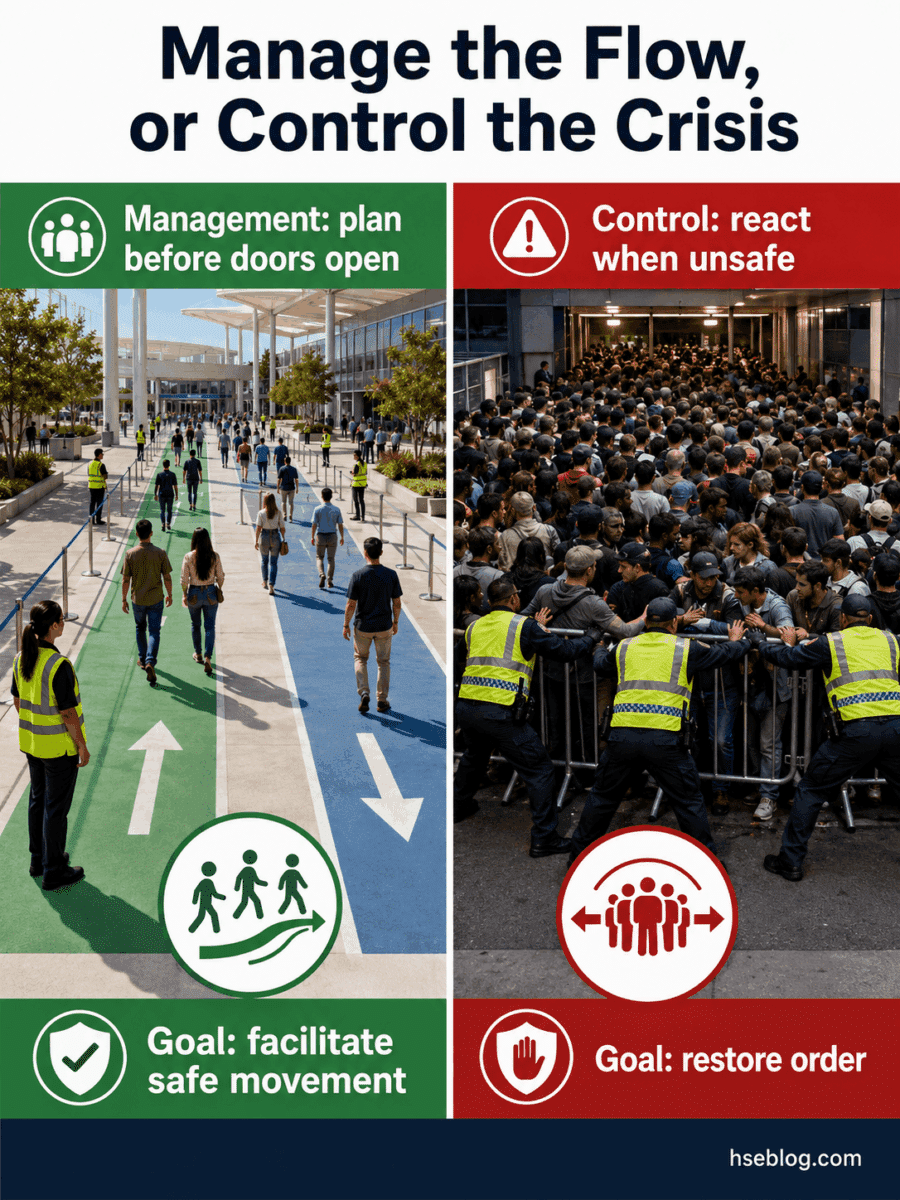
Crowd management is proactive: it is the planning, design, monitoring, and flow facilitation done before and during an event to keep dense gatherings safe. Crowd control is reactive — the interventions used to restore order once density or behaviour has already deteriorated.
The cleanest way to hold the distinction is that good crowd management aims to make crowd control unnecessary. Both sit inside wider event safety and the duty-holder’s legal obligations.
| Crowd management | Crowd control | |
|---|---|---|
| Timing | Before and throughout the event | During a developing crisis |
| Goal | Facilitate safe, free movement | Restore order and relieve pressure |
| Primary tools | Layout, capacity limits, monitoring, stewarding | Barriers, security intervention, show-stop |
A pattern worth naming sits behind most poorly run events. Organisers over-invest in control hardware — barriers, fencing, security headcount — while neglecting the management decisions that actually stop a dangerous state from forming.
Those decisions are unglamorous: how many people, admitted how fast, through what layout. Get them wrong and no amount of barrier kit will save the situation once density passes the threshold described in the next section.
How Crowd Crushes Actually Happen: The Mechanics of Density and Progressive Collapse
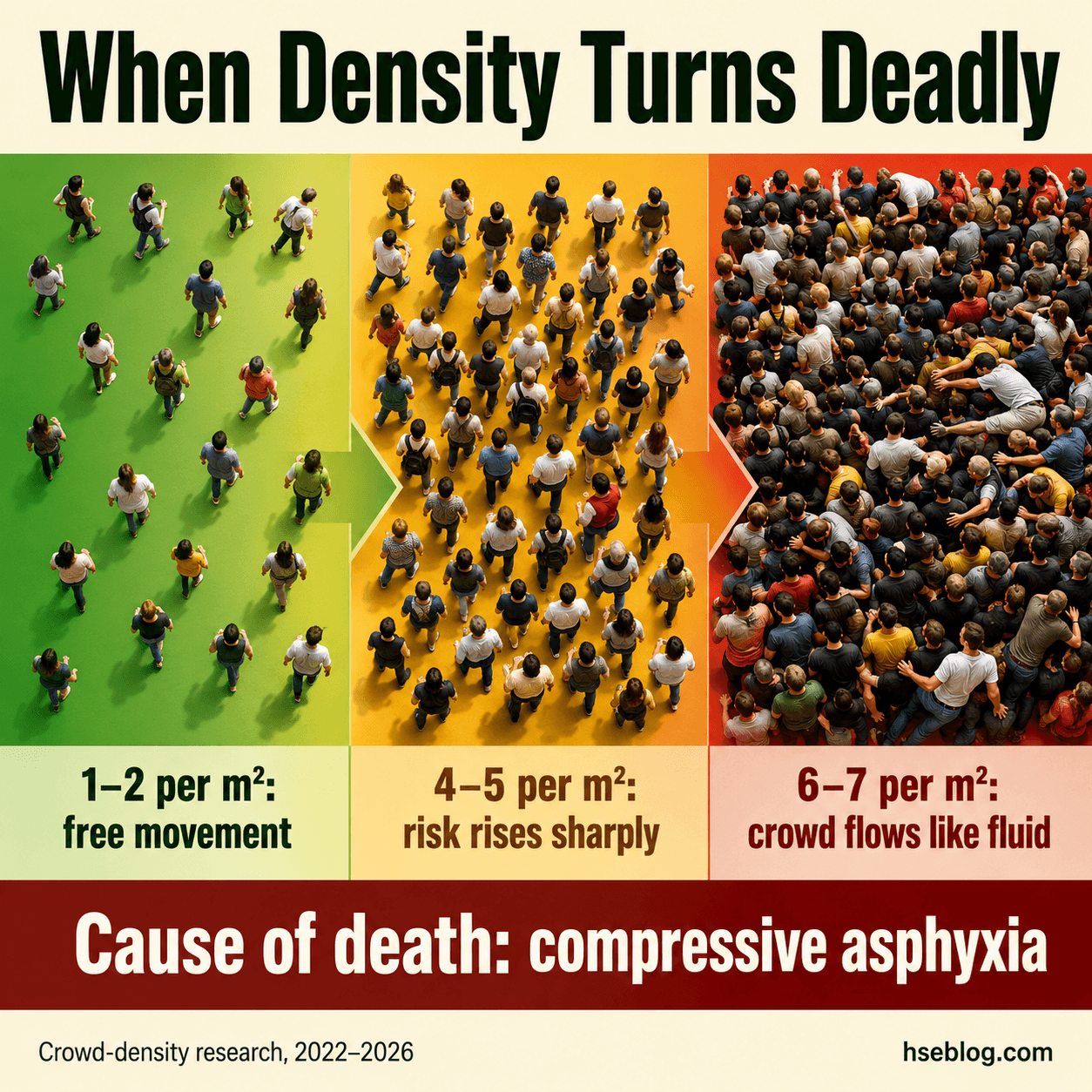
Crowd crush kills through compressive (traumatic) asphyxia, not trampling — victims are squeezed so tightly that their chest cannot expand to breathe, often while still standing upright. The trigger is density, not “panic,” and the danger climbs sharply as people per square metre rise.
Crowd-dynamics research in the Fruin and Still lineage describes a recognisable gradient. People move freely at low densities; involuntary contact and risk rise markedly around 4–5 people/m²; voluntary movement is lost and the crowd behaves like a fluid at roughly 6–7 people/m² (crowd-density analyses, restated 2022–2026).
| People per m² | Behaviour | Risk level |
|---|---|---|
| 1–2 | Free, unrestricted movement | Low |
| ~4–5 | Involuntary contact; choices constrained | Rising sharply |
| ~6–7 | Fluid-like, no voluntary movement | Critical — crush conditions |
Progressive crowd collapse is the mechanism that turns high density into mass fatality. When one person falls in a dense pack, a void opens, neighbours topple into it, and bodies stack — those at the bottom asphyxiate under the accumulated weight.
The force that drives this is a communication gap. Rear ranks cannot see that the front is blocked, so they keep pushing forward, and crushing pressure builds in the space between them.
Worse, that pressure can arrive from two directions at once — a forward surge meeting a push-back off a wall, fence, or stage barrier. The 2021 Astroworld Festival crush in Houston, where 10 people died, showed exactly this pattern: a forward surge toward a stage producing compressive asphyxia in an organised Western event (incident record, 2021).
The practitioner reframe that matters here: the crowd did not panic — the design failed. The most lethal moments cluster at ingress and at choke points, where a wide flow funnels into something narrow. (For the underlying figures, recognised references on crowd density and safe occupancy thresholds are worth reading alongside the HSE guidance on managing crowds safely.)
Types of Crowds and the Hazards Each One Presents
Crowds are not a single thing, and the right controls depend on what state a crowd is in. Categorising by behaviour — rather than listing types abstractly — lets you tie each crowd type to its dominant hazard.
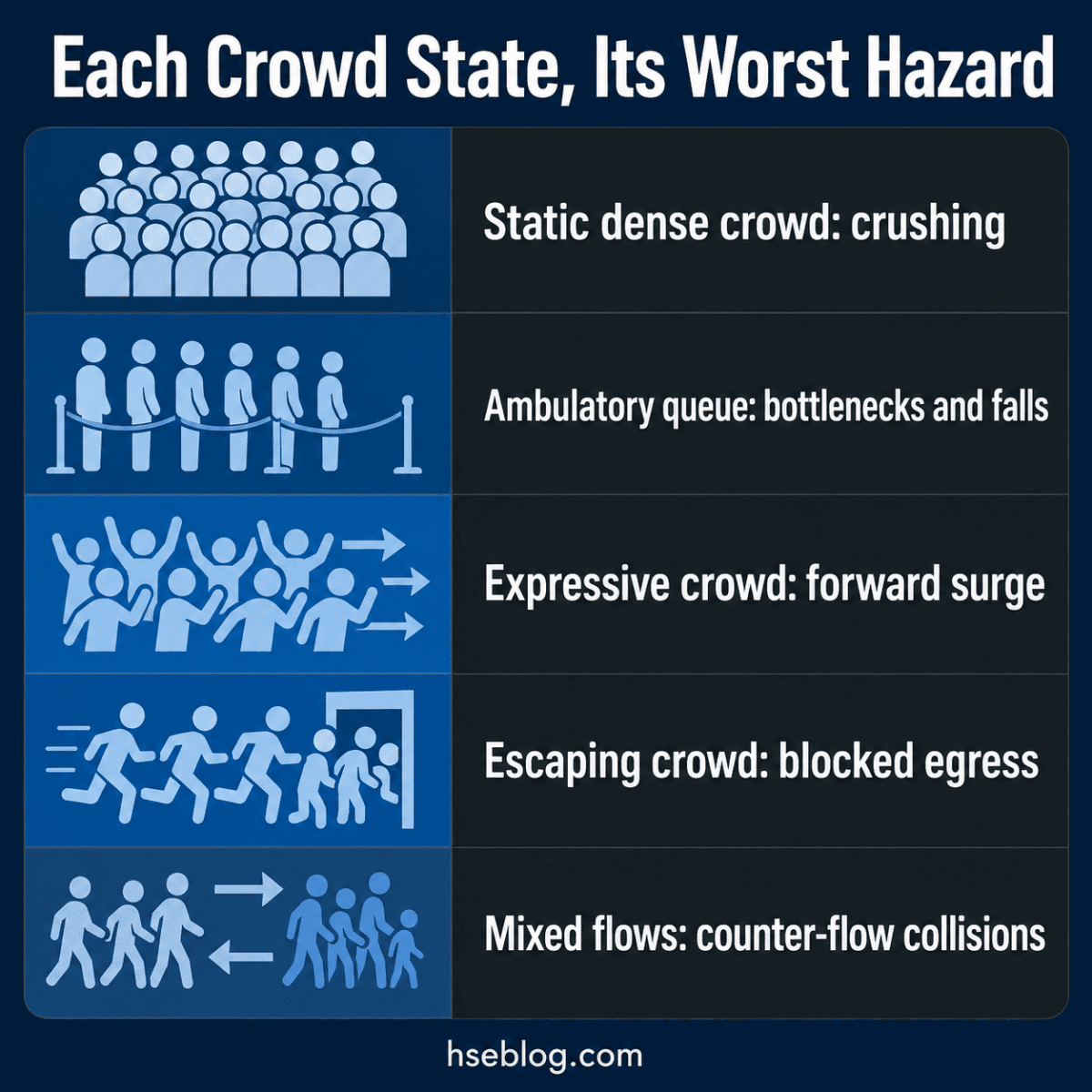
- Passive / spectator crowds — seated or standing audiences. Dominant hazards: complacency in planning and obstructed egress when the event ends.
- Dense / static crowds — packed assembly with little movement. Dominant hazards: crushing, compressive asphyxia, progressive crowd collapse.
- Ambulatory crowds — moving, queuing, circulating. Dominant hazards: bottlenecks, falls, counter-flows at choke points.
- Expressive / excited crowds — concerts, sport, surges toward a focal point. Dominant hazards: forward surges and front-of-stage crushing.
- Hostile / escaping crowds — driven by a threat. Dominant hazards: simultaneous egress, obstructed exits, secondary crushing.
Mixed flows deserve special attention. When people move in opposite directions through one space, the collision of streams raises both density and friction, and severity climbs fast.
One pattern is easy to overlook: the same crowd shifts state across an event. A passive seated audience becomes an ambulatory — and then potentially escaping — egress crowd at the close, which is frequently the least-planned-for and highest-risk phase of the whole day.
Common Causes and Contributing Factors of Crowd Incidents
Crowd disasters are almost never a single failure — they are multi-factor, and the systems view separating immediate triggers from underlying causes is exactly what blog “tips” and bare regulatory pages both miss. The trigger is what tips the event over; the underlying cause is why it was always going to.
Immediate causes:
- Imbalance between ingress and egress — entry capacity outpacing where people can go.
- Bottlenecks, choke points, sloping or stepped terrain, and dead-ends.
- Schedule pressures — gate openings, a headline act, or everyone leaving at once.
- Counter-flows and density creep that nobody intervenes against.
Underlying causes:
- Capacity that was underestimated, uncounted, or set to the licence number rather than a safety figure.
- No real-time crowd monitoring and no defined intervention trigger.
- Governance failure — unclear roles, weak inter-agency coordination, no plan for spontaneous gatherings.
- A culture that treats the crowd management plan as a document to file, not to operate.
The recurring lesson from the investigation record is that the precursor signs are usually visible long before collapse. Queue build-up, counter-flows, and density creep are observable.
The failure is rarely “no warning.” It is that no one was watching the right metric, or that the person watching had no authority to act.

Assessing Crowd Safety Risks: Capacity, Density, and Modelling
A crowd risk assessment answers one question: how many people, where, moving how, before the space stops being safe? It is crowd-specific method — not generic five-steps boilerplate — and it starts from area, egress width, and time-to-evacuate, not the venue licence.
Competent-person caveat: This article provides general HSE knowledge. Life-critical work such as crowd-safety design and capacity assessment must be planned and supervised by a competent person with relevant training, jurisdiction-specific authorisation, and a site-specific risk assessment. The information here does not replace that. Recognised pathways include NEBOSH, IOSH, and specialist crowd-safety qualifications.
UK event guidance works to practical density figures rather than a single safe line. Assessment commonly assumes around 2 people/m² for static assembly areas and up to roughly 4 people/m² for moving or queuing systems — treat the lower, static figure as the conservative default for assembly areas.
Two recognised frameworks structure the analysis:
- The DIM-ICE meta-model — examines Design, Information, and Management across the three phases of Ingress, Circulation, and Egress. It forces you to plan each phase deliberately rather than only the headline event.
- RAMP analysis — Routes, Areas, Movement, and Profile — a complementary lens for interrogating how a crowd actually flows through a site.
The single most useful idea is design capacity. The lowest-capacity element — usually the narrowest egress route under emergency conditions — governs the entire flow, no matter how generous the rest of the site is.
This is where the recurring error bites. Treating the licensed maximum occupancy as a safety number ignores the binding constraint, and the HSE guidance on managing crowds safely sets out the systematic approach that avoids it.
Documenting and Reviewing the Crowd Management Plan
A crowd management plan is a living operational document, not a one-off submission. It must record roles and responsibilities, capacity and crowd density calculations, monitoring triggers, communication arrangements, and emergency procedures.
Crucially, it is reviewed after every event and whenever conditions change — a new stage layout, different weather, a larger expected crowd. A plan that is never revisited drifts out of step with the event it is supposed to govern.

Control Measures: How to Prevent Crowd Hazards Before, During, and After an Event
The strongest control measures for overcrowding attack density first and lean on reactive measures last — the same logic as the hierarchy of control, applied to people-flow. Eliminate or reduce the conditions that create dangerous density before you ever reach for barriers and intervention.
Organise controls along the event lifecycle.
Before the event — design and capacity controls
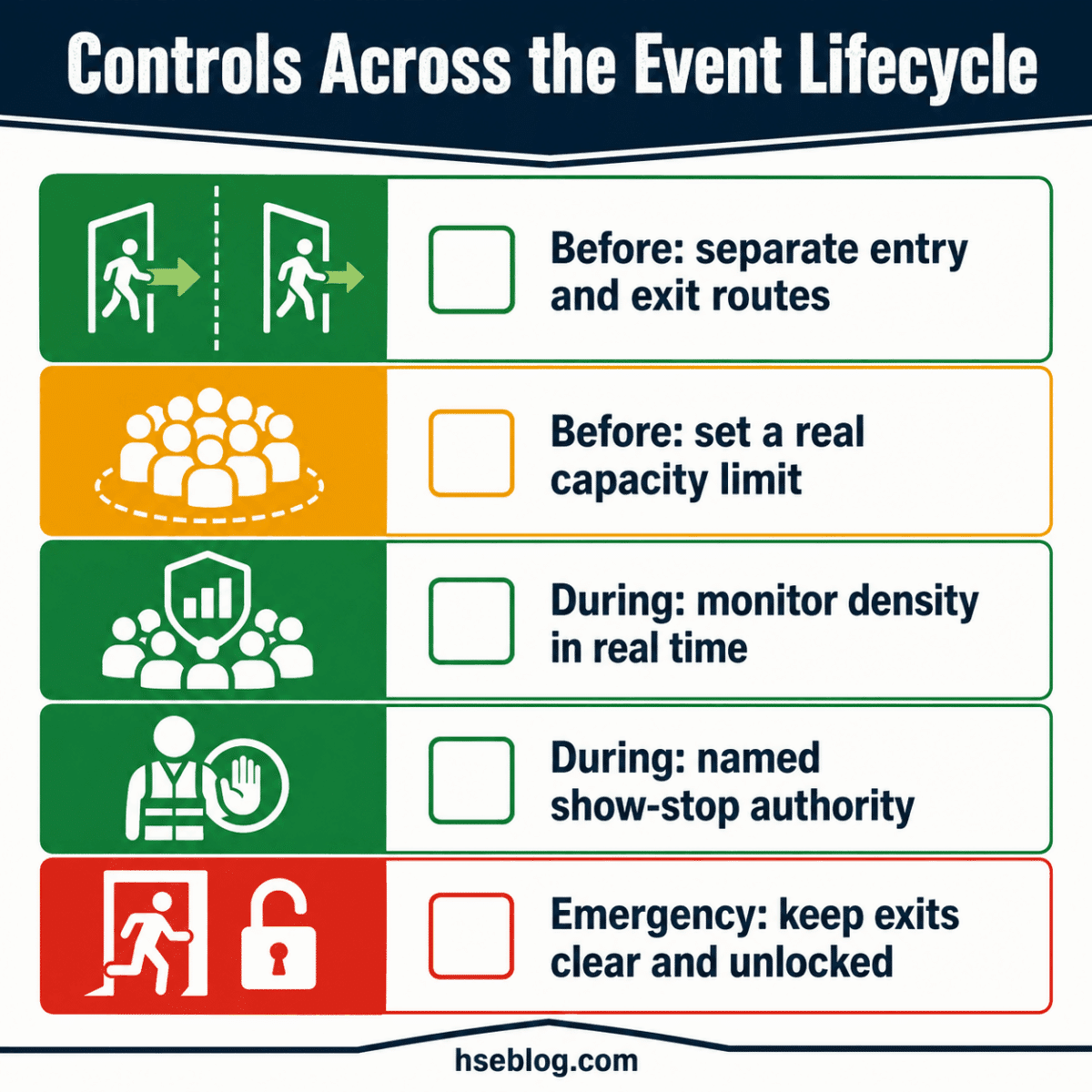
- Separate ingress and egress. Dedicated, non-crossing entry and exit routes remove the counter-flows that drive crushing.
- Design out choke points and dead-ends. One-way flow, wide unobstructed exits, and the removal of funnels where a wide stream narrows.
- Set a real capacity figure. Count and limit numbers against the binding egress constraint, not the licence — and use timed or zoned admission to flatten surges.
During the event — operational controls
- Staff to a competent stewarding ratio. Briefed stewards who know their sector, their triggers, and their escalation route.
- Monitor density in real time. CCTV, headcounts, and spotters watching the right metric, with defined intervention triggers written down in advance.
- Hold a named show-stop authority. One identified person empowered to halt ingress or pause the event the moment a density trigger is hit.
Physical and behavioural controls throughout
- Specify barriers correctly. Crush barriers and stage barriers that are load-rated for the forces involved, not decorative fencing.
- Communicate before arrival. Clear wayfinding, signage, lighting, and managed expectations reduce the surges that bunching and uncertainty create.
The most useful “controls mapped to hazards” view ties each named hazard to the measure that addresses it:
| Hazard | Indicator to watch | Primary control |
|---|---|---|
| Overcrowding | Density creep past threshold | Capacity limit + show-stop trigger |
| Crushing / asphyxia | Static dense pack, no movement | Separated flow, reduced density |
| Forward surge | Push toward stage/focal point | Crush barriers, pens, monitoring |
| Bottleneck collapse | Queue build at a narrow point | Layout redesign, route widening |
| Blocked egress | Obstructed or locked exits | Clear, unlocked, signed exit routes |
The decisive insight from the field is that controls fail when treated as set-and-forget. Barriers placed once and never re-evaluated as the crowd state changes, or a monitoring role that exists on paper but has no authority to stop anything, are controls in name only.
Emergency Planning and Crowd Incident Response
Emergency movement is itself a hazard, because evacuation multiplies density along the exit routes. Plan for both evacuation (moving people out) and invacuation (moving people to safety inside) depending on the threat.
- Keep all egress routes clear, unobstructed, and unlocked at all times.
- Provide medical cover proportionate to the crowd and the recognised risk of crush injury.
- Coordinate in advance with emergency services and other agencies — response speed depends on relationships built before the day, not on the day.
Who Is Legally Responsible for Crowd Safety?
The duty-holder for crowd safety is whoever organises the event or controls the premises — but the legal instrument, its status, and the model of responsibility differ by jurisdiction.
Legal disclaimer: Regulatory content here reflects general HSE professional understanding of UK and US requirements as of 2026. It is not legal advice. Specific compliance questions, enforcement situations, or prosecution risk should be directed to qualified legal counsel in the applicable jurisdiction. Regulatory content last reviewed: [Month YYYY — to be filled at publish].
In the UK, the general-duty framework governs. The Health and Safety at Work etc. Act 1974 requires that those in control of premises ensure, so far as is reasonably practicable, the health and safety of both employees (s.2) and non-employees such as attendees (s.3) — the legal root of crowd-safety duties at venues and events.
The practical field procedure most aligned with that duty is set out in HSG154, Managing Crowds Safely (HSE, 2000): assess the risks, set clear roles, put controls in place, monitor the crowd, and plan for emergencies. Sports grounds carry additional regimes on top.
In the US, the posture is different. OSHA’s Crowd Management Safety Guidelines for Retailers is advisory guidance rather than a binding standard — yet failure to protect workers can still attract enforcement, and liability also arises through civil and premises law. Where OSHA’s guidance and the UK’s framework diverge, treat the more developed, stricter UK methodology as the conservative reference.
| UK | US | |
|---|---|---|
| Primary instrument | HSWA 1974 + HSG154 | OSHA retailer guidance |
| Status | Statutory duty + practical guidance | Advisory (enforcement via worker-safety duties) |
| Duty-holder | Those in control of premises/event | Employer / retailer |
A newer layer now sits over UK crowd safety. The Terrorism (Protection of Premises) Act 2025 — “Martyn’s Law” — received Royal Assent on 3 April 2025 and introduces a statutory preparedness duty for qualifying premises and events, with a standard tier from 200 expected capacity and enhanced measures from 800 (Terrorism (Protection of Premises) Act 2025). Sites cited for getting this wrong will increasingly be judged against published industry guidance even where it was historically non-mandatory.
The practitioner reality is blunt: “compliant with the licence” and “actually safe” are not the same test. (Primary sources worth bookmarking are the OSHA crowd management guidelines for retailers and the text of the Terrorism (Protection of Premises) Act 2025.)

Frequently Asked Questions
The One Change That Prevents the Most Deaths
The persistent error across the crowd-disaster record is the belief that panic kills. It does not — density does, through compressive asphyxia and progressive collapse, while the people involved are doing nothing more reckless than standing in a space that was never designed for their number.
If an organisation makes only one change to its crowd management hazards and control measures, it should be this: appoint a named, competent person with genuine authority to stop ingress or pause the event the instant a density trigger is reached. Every other control — separated routes, capacity limits, monitoring, stewarding — feeds into that single decision point. A monitoring role with no power to act is the gap most inquiries eventually land on.
The duty-holder’s test is not whether the licence was honoured or the barriers looked impressive. It is whether someone was watching the right metric and was free to act on it before the crowd reached the threshold from which there is no recovery.