
TL;DR
- A fire hose is a high-pressure flexible tube designed to transport water or extinguishing agents from a supply source to a fire.
- Five main fire hose types exist: attack hose, supply hose, forestry hose, booster hose, and intake hose — each built for a specific role.
- Wrong hose selection causes delayed suppression, burst lines, and crew injuries during active firefighting operations.
- Proper rolling techniques protect hose integrity and guarantee rapid deployment when seconds determine outcomes.
- Routine inspection and maintenance prevent 60%+ of hose failures that occur during emergency operations.
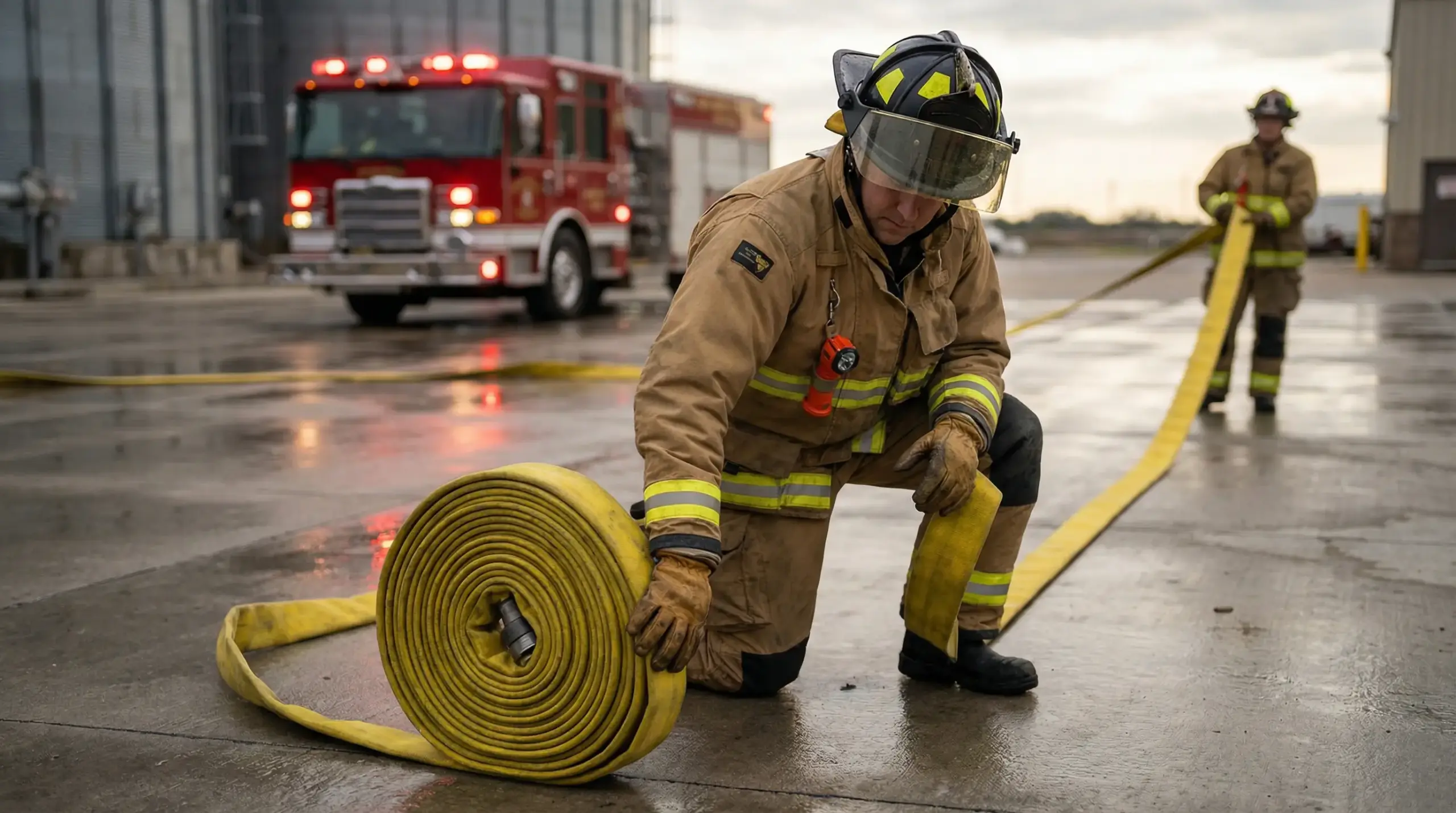
I was conducting a fire readiness audit at a large warehousing facility in the Gulf when the emergency team pulled a 65mm attack hose from its storage rack for a live drill. The coupling was seized, the jacket had visible abrasion damage near the fold point, and when they charged the line, a pinhole burst opened within thirty seconds. That hose had passed a visual check two weeks earlier. Nobody had rolled it properly after the last drill, and nobody had inspected the inner liner. A hose that should have delivered 500 liters per minute at working pressure became a liability instead of a lifeline.
A fire hose is the most fundamental piece of active firefighting equipment on any site, yet it remains one of the most misunderstood. Facility teams confuse hose types, store them incorrectly, and skip the rolling techniques that preserve structural integrity. This article covers exactly what a fire hose is, the main types and their operational uses, the correct rolling methods that every fire team should master, and the maintenance practices that keep hose lines reliable when a real fire breaks out.
What Is a Fire Hose and How Does It Work?
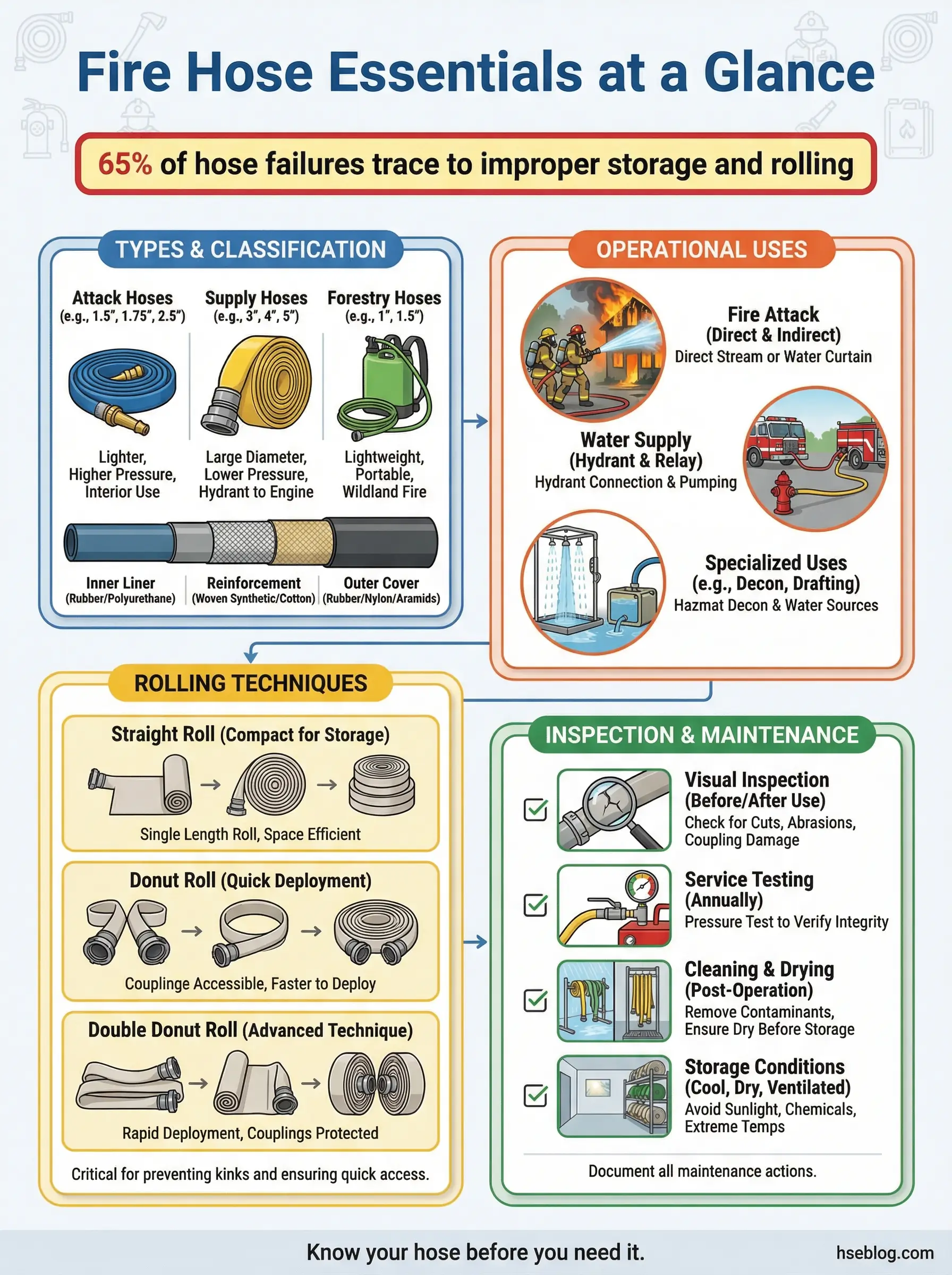
A fire hose is a flexible, high-pressure tube engineered to carry water or fire-suppressing agents from a hydrant, pump, or standpipe system to the point of fire application. Unlike a garden hose, a fire hose must withstand internal pressures ranging from 10 bar (150 psi) to over 25 bar (360 psi) depending on the type and application. The construction, materials, and coupling systems all exist for one purpose — reliable water delivery under extreme conditions.
The basic anatomy of a fire hose consists of three layers, each serving a distinct function:
- Inner liner (tube): Made from EPDM rubber, TPU, or nitrile rubber, the liner creates a watertight channel and resists chemical degradation from water additives and foam concentrates.
- Reinforcement layer (jacket): Woven from synthetic fibers such as polyester or nylon, this layer gives the hose its burst resistance and tensile strength. Double-jacket construction is standard for attack hoses used in structural firefighting.
- Outer cover (optional): Some hoses include an abrasion-resistant rubber or polyurethane exterior for protection against rough terrain, sharp edges, and heat exposure.
NFPA 1961 sets the manufacturing, testing, and performance requirements for fire hose used in fire service operations. It specifies proof test pressures, burst test minimums, and coupling attachment standards that every hose must meet before entering service.
Pro Tip: When I inspect fire hoses during facility audits, I always check the manufacturing date stamped near the coupling. A hose older than ten years in active service needs hydrostatic testing annually — not just a visual once-over. Age degrades the inner liner long before damage shows on the jacket.
Types of Fire Hoses and Their Specific Applications
Selecting the wrong fire hose for an operation is a common mistake I encounter on industrial sites. A maintenance crew once connected a booster hose to a standpipe outlet during a pump house fire, expecting structural firefighting flow rates. The hose delivered less than half the required volume, and the fire escalated before the correct attack line was deployed. Every fire hose type has a designed purpose, and confusing them creates dangerous gaps in suppression capability.
Attack Hose
Attack hoses are the primary firefighting lines used to deliver water directly onto a fire. They are designed for maneuverability, moderate weight, and the flow rates needed to suppress active flames.
- Diameter range: Typically 38mm (1.5 inches) to 65mm (2.5 inches)
- Working pressure: 10–17 bar (150–250 psi)
- Construction: Double-jacket woven polyester with rubber or TPU inner liner
- Flow rate capacity: 350–950 liters per minute depending on diameter and nozzle setting
- Primary use: Interior structural firefighting, industrial fire attack, and direct flame suppression where crews operate hose lines manually
Supply Hose (Large Diameter Hose — LDH)
Supply hoses move high volumes of water from hydrants, pumper trucks, or static water sources to the fire apparatus or distribution manifold. They are not designed for direct fire attack.
- Diameter range: 100mm (4 inches) to 150mm (6 inches)
- Working pressure: 10–12 bar (150–175 psi)
- Construction: Single-jacket lightweight design for rapid deployment and easy handling
- Flow rate capacity: 2,000–5,000+ liters per minute
- Primary use: Water relay operations, hydrant-to-pump connections, and long-distance water supply on large incident scenes
Forestry Hose
Forestry hoses are built for wildland firefighting where crews need lightweight, highly portable lines across rough terrain, steep grades, and dense vegetation.
- Diameter range: 25mm (1 inch) to 38mm (1.5 inches)
- Working pressure: 17–25 bar (250–360 psi)
- Construction: Single-jacket with a thin, flexible liner designed for minimal weight
- Primary use: Wildland fire suppression, brush fire operations, and remote area firefighting where vehicle access is limited
Booster Hose
Booster hoses are pre-connected, rubber-covered lines stored on a reel mounted on fire apparatus. They remain semi-rigid even when not charged, making them quick to deploy for small fires.
- Diameter range: 19mm (¾ inch) to 25mm (1 inch)
- Working pressure: 17–24 bar (250–350 psi)
- Construction: Rubber-covered with reinforced plies — does not collapse when empty
- Primary use: Dumpster fires, small outdoor fires, vehicle fires, overhaul and mop-up operations. Never suitable for structural fire attack due to limited flow rates
Intake (Suction) Hose
Intake hoses are hard suction lines used to draft water from open sources like ponds, rivers, tanks, or cisterns when pressurized hydrant systems are unavailable.
- Diameter range: 100mm (4 inches) to 150mm (6 inches)
- Construction: Semi-rigid with internal wire helix or corrugated walls to prevent collapse under vacuum
- Primary use: Drafting operations from static water sources, rural firefighting, and emergency water supply where municipal hydrants do not exist
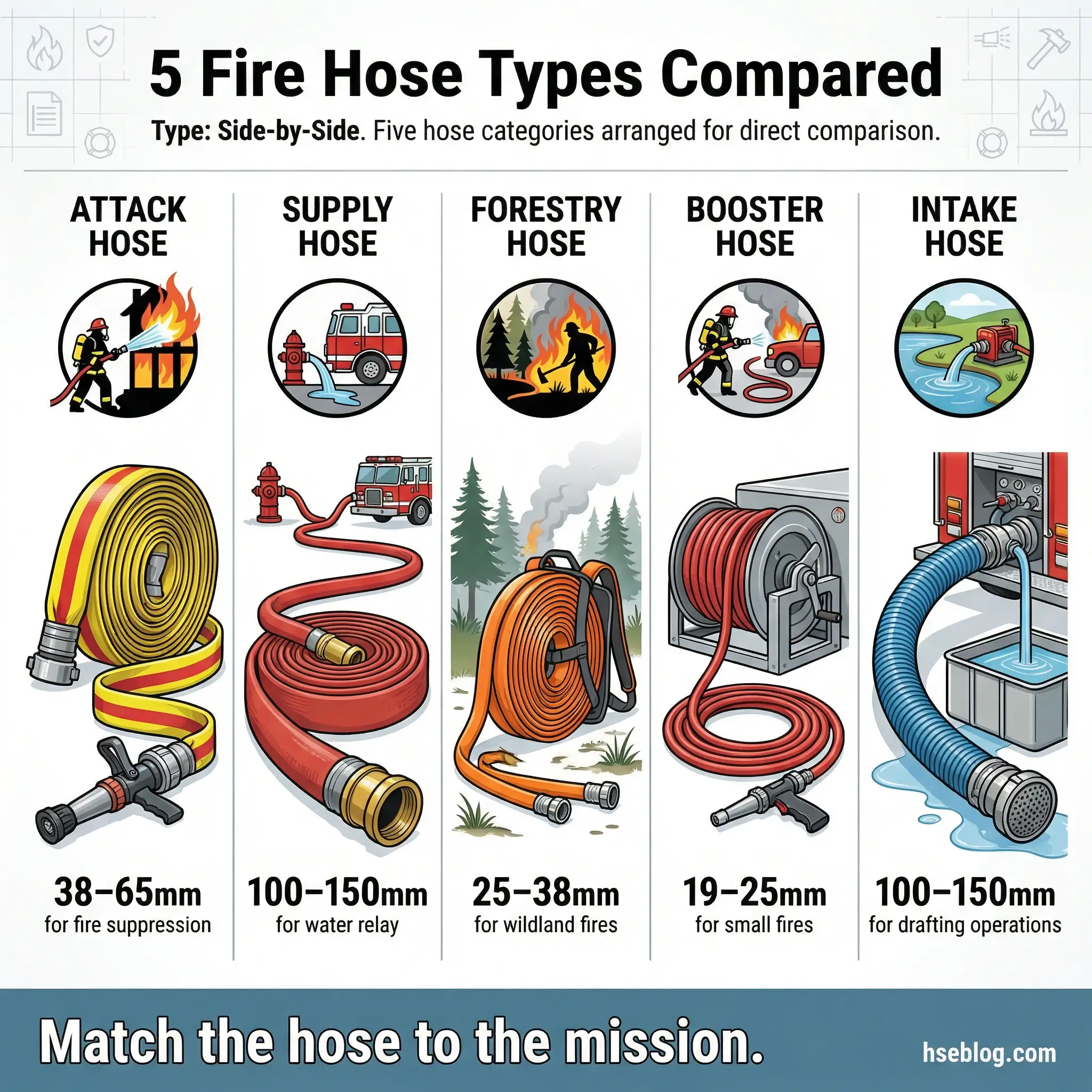
The following table provides a quick-reference comparison across the five main fire hose types for operational selection:
| Hose Type | Diameter Range | Working Pressure | Typical Flow Rate | Primary Application |
|---|---|---|---|---|
| Attack Hose | 38–65mm | 10–17 bar | 350–950 L/min | Structural firefighting |
| Supply Hose (LDH) | 100–150mm | 10–12 bar | 2,000–5,000+ L/min | Water relay / hydrant supply |
| Forestry Hose | 25–38mm | 17–25 bar | 75–350 L/min | Wildland / brush fires |
| Booster Hose | 19–25mm | 17–24 bar | 40–100 L/min | Small fires / mop-up |
| Intake Hose | 100–150mm | N/A (vacuum) | Pump-dependent | Drafting from open water |
Pro Tip: During a site emergency response planning session, I always map each hose type to its designated storage location and label connection points clearly. When a fire breaks out, responders grab what is closest — not what is correct — unless the system is designed to prevent that error.
Common Uses of Fire Hoses in Industrial and Commercial Settings
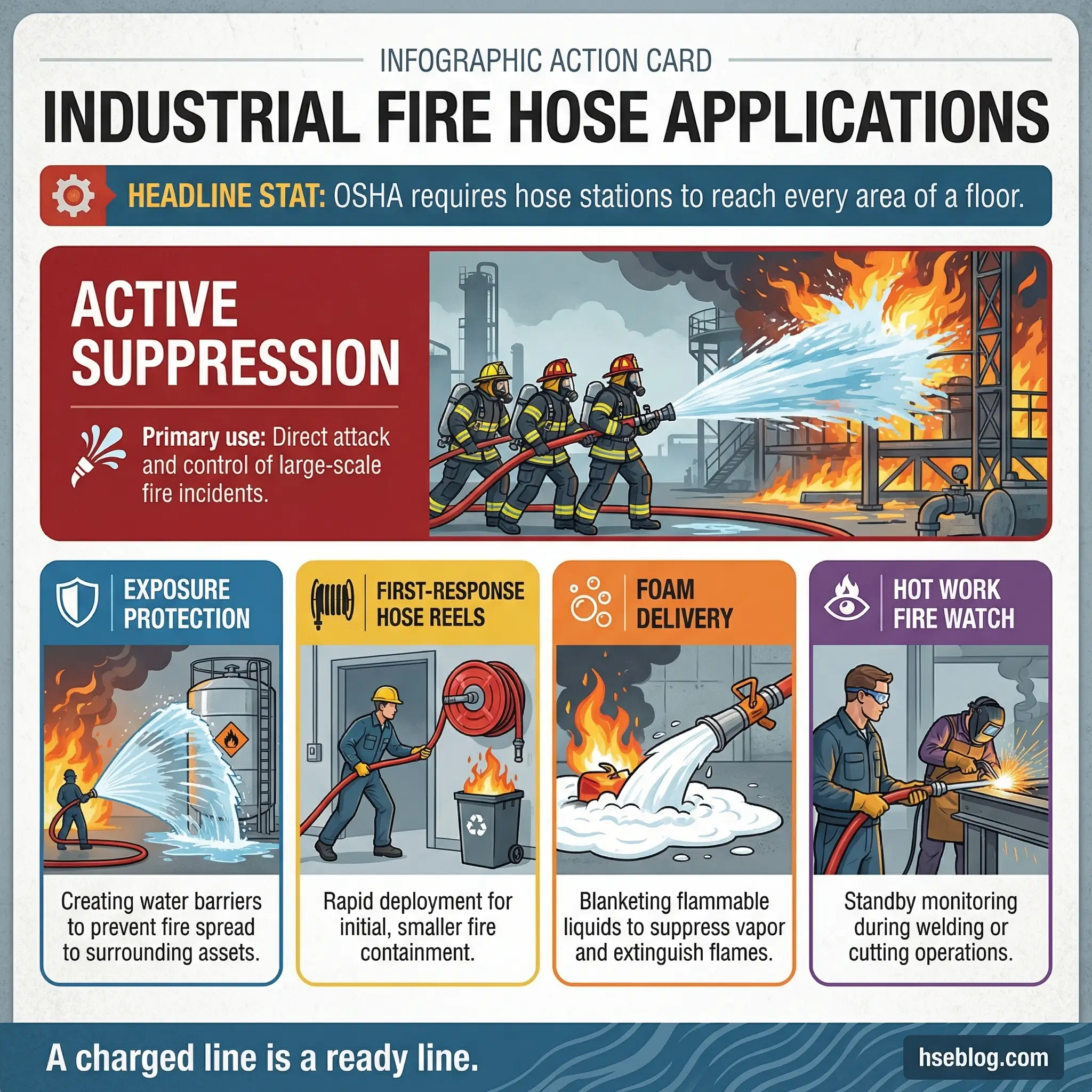
Fire hoses serve roles far beyond structural firefighting. Across industrial facilities, commercial buildings, and infrastructure projects, I have seen hose systems deployed for suppression, protection, and even hazardous material containment. Understanding these uses ensures the right hose type gets specified during fire safety planning.
The most common operational uses include:
- Active fire suppression: Attack hoses connected to standpipe systems or fire pumps deliver water directly to the seat of a fire. This is the most recognized and critical use.
- Exposure protection: During large-scale fires, supply and attack hoses create water curtains to protect adjacent structures, storage tanks, or process equipment from radiant heat. I have coordinated exposure protection lines on tank farm fires where the hose streams kept adjacent vessels below their critical temperature thresholds.
- Hose reel systems for first response: Wall-mounted hose reels with 19mm or 25mm semi-rigid tubing are installed throughout commercial and industrial buildings for occupant first-response use before the fire brigade arrives. These are not the same as structural firefighting hoses and have significant flow limitations.
- Foam application: Attack hoses fitted with inline foam inductors or connected to foam proportioning systems deliver aqueous film-forming foam (AFFF) or alcohol-resistant foam for flammable liquid fires. The hose construction must be chemically compatible with the foam concentrate.
- Hazmat decontamination and washdown: Supply hoses connected to decontamination stations provide high-volume water flow for personnel decon and area washdown after chemical releases.
- Cooling operations during hot work: Charged standby hose lines are a standard fire watch requirement during welding, cutting, and grinding operations in facilities with combustible materials nearby.
OSHA 29 CFR 1910.158 outlines requirements for standpipe and hose systems in general industry, including hose station placement, flow rate specifications, and the minimum hose lengths required to reach all portions of a floor area.
Fire Hose Rolling Techniques That Protect Readiness
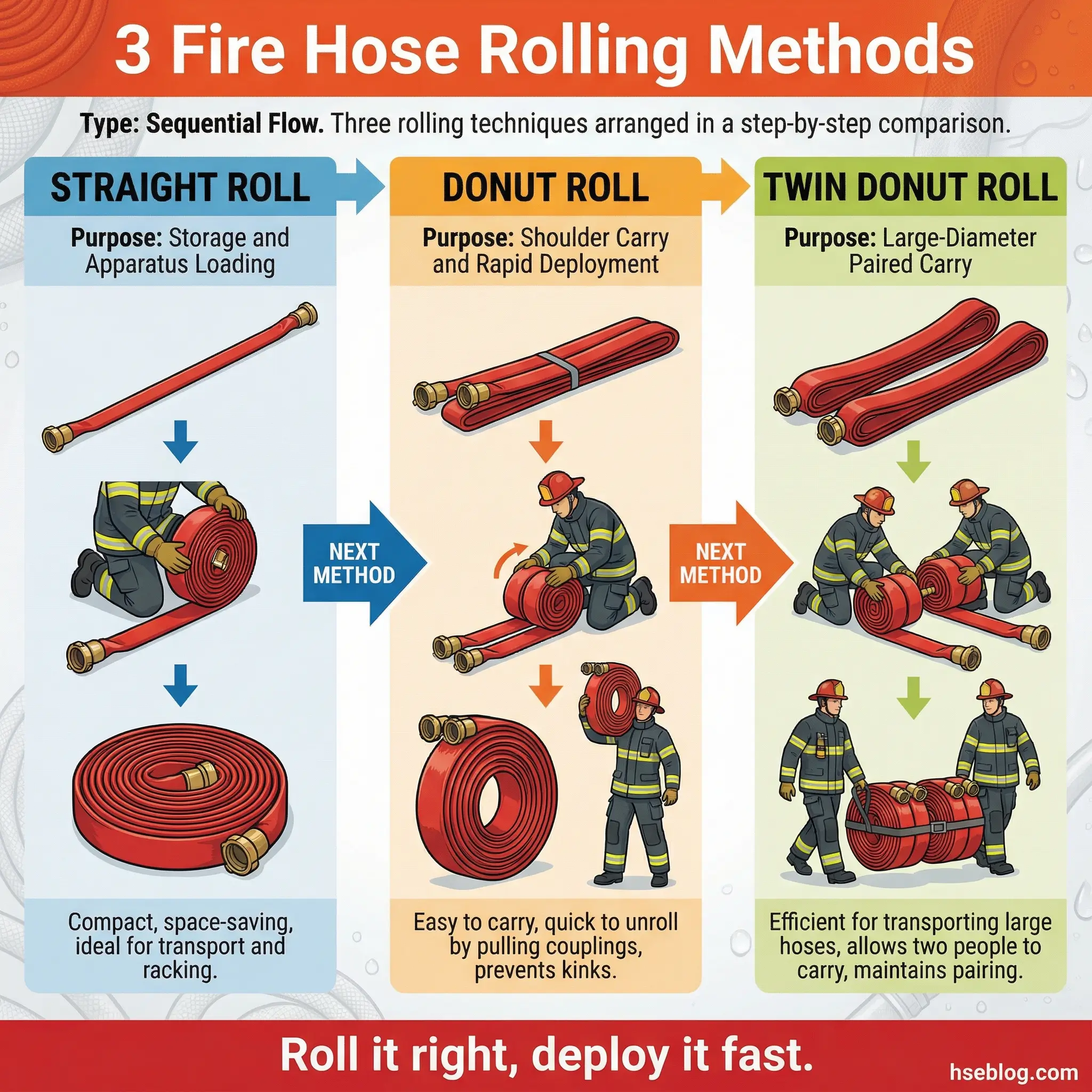
How a fire hose is rolled after use directly determines whether it deploys correctly on the next call. I have investigated emergency response delays that traced back to a single cause: a poorly rolled hose that kinked, tangled, or jammed at the coupling during deployment. Rolling is not housekeeping — it is operational readiness.
The Straight Roll (Storage Roll)
The straight roll is the most common method for storing hoses that will be loaded onto apparatus or placed in storage racks. It keeps the hose compact and protects the coupling.
- Lay the hose flat in a straight line on a clean, dry surface. Remove all twists and kinks.
- Start rolling from the male coupling end. This positions the female coupling on the outside for quick connection during deployment.
- Roll the hose tightly and evenly, keeping the edges aligned so the roll stays cylindrical rather than cone-shaped.
- Maintain consistent pressure throughout the roll to prevent air pockets that cause the hose to unravel during storage.
- Secure the finished roll with a hose strap or Velcro tie. Never use wire or cord that can damage the jacket.
The Donut Roll
The donut roll is designed for hoses that need rapid shoulder-carry deployment. The roll creates a compact shape with both couplings accessible at the center and outer edge.
- Find the exact midpoint of the hose and create a bend (bight) at that point.
- Lay both halves side by side with the male coupling at one end and the female coupling at the other.
- Begin rolling from the bend toward the couplings, keeping both layers tight and even.
- The finished roll should place one coupling at the center of the donut and the other on the outside — both immediately accessible for connection.
- Strap the roll securely. This method allows a firefighter to carry the hose over one shoulder and deploy it by dropping the outer coupling while walking toward the fire.
The Twin Donut Roll (Dual Donut Roll)
The twin donut roll is used for larger diameter hoses or when two hose sections need to be carried as a single unit. It follows the same principle as the donut roll but divides the hose into two parallel donut shapes.
- Fold the hose into quarters by finding the midpoint, then folding each half again.
- Roll each quarter section into a donut shape simultaneously, keeping couplings accessible.
- Strap both donut rolls together as a paired unit for balanced shoulder carry.
Pro Tip: After every drill or incident, I require hose teams to roll on a clean surface — never on gravel, broken concrete, or oily ground. Debris embedded in the jacket during rolling cuts into the liner over time, creating pinhole failures that only appear under pressure.
Common Mistakes That Compromise Fire Hose Performance
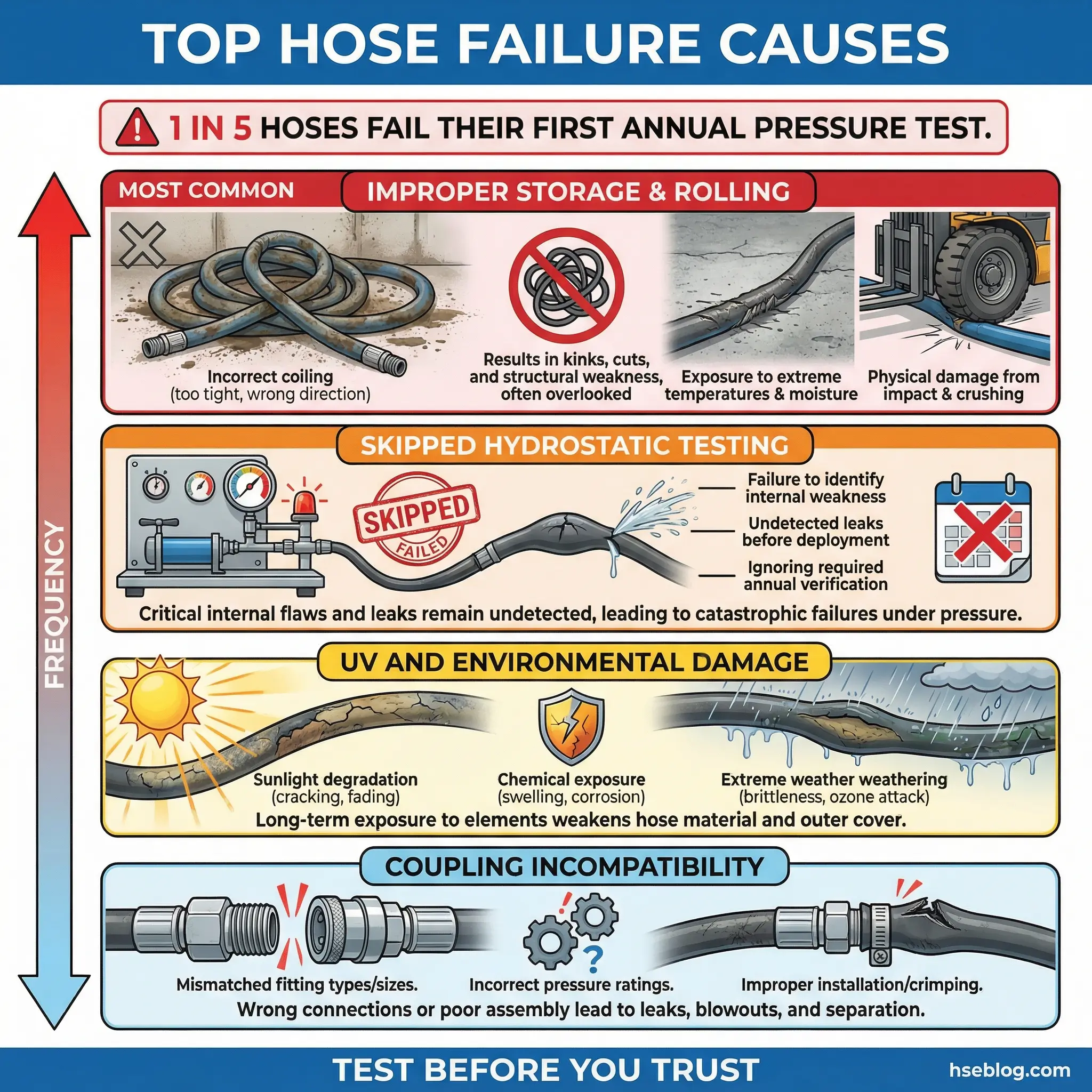
Across dozens of fire safety audits and emergency drills, I have documented the same hose-related failures repeating from site to site. These are not exotic technical problems. They are basic handling and management errors that turn reliable equipment into unreliable liabilities.
The most frequent site-level mistakes include:
- Rolling from the wrong end: Starting the straight roll from the female coupling instead of the male coupling places the connection point on the inside of the roll. During deployment, the crew wastes time flipping the roll or fishing for the buried coupling.
- Storing hoses wet: Hoses packed wet into compartments or racks develop mildew, bacterial growth, and inner liner degradation. The liner material breaks down faster in a persistently moist environment than from operational use.
- Ignoring UV exposure: Fire hoses stored in outdoor cabinets without UV protection or left draped over railings between drills suffer jacket fiber degradation. Polyester and nylon lose tensile strength with prolonged sun exposure.
- Exceeding bend radius limits: Sharp folds during storage — especially at the same point every time — create permanent stress fractures in the liner. I have pulled hoses from racks where the fold crease had worn through the inner tube completely.
- Mixing incompatible couplings: Facilities that source hoses from different manufacturers sometimes end up with mismatched coupling standards — Storz, NH (National Hose), and BS (British Standard) — that cannot connect without adapters. During an emergency, missing adapters mean disconnected lines.
- Skipping hydrostatic testing: Annual pressure testing per NFPA 1962 catches liner failures and coupling leaks before they become deployment failures. Many industrial sites treat hose testing as optional rather than mandatory.
NFPA 1962 provides the standard for the care, use, inspection, service testing, and replacement of fire hose, couplings, nozzles, and fire hose appliances. It specifies test pressures, test frequencies, and documentation requirements for all hose types in service.
Fire Hose Inspection, Testing, and Maintenance
A fire hose that has never been tested is a fire hose you cannot trust. I learned this early in my career during a refinery fire drill where three out of eight hose lines failed under pressure — one at the coupling gasket, one through a liner pinhole, and one through jacket abrasion that nobody had flagged. All three had been stored on racks and visually checked monthly. None had been pressure tested in over two years.
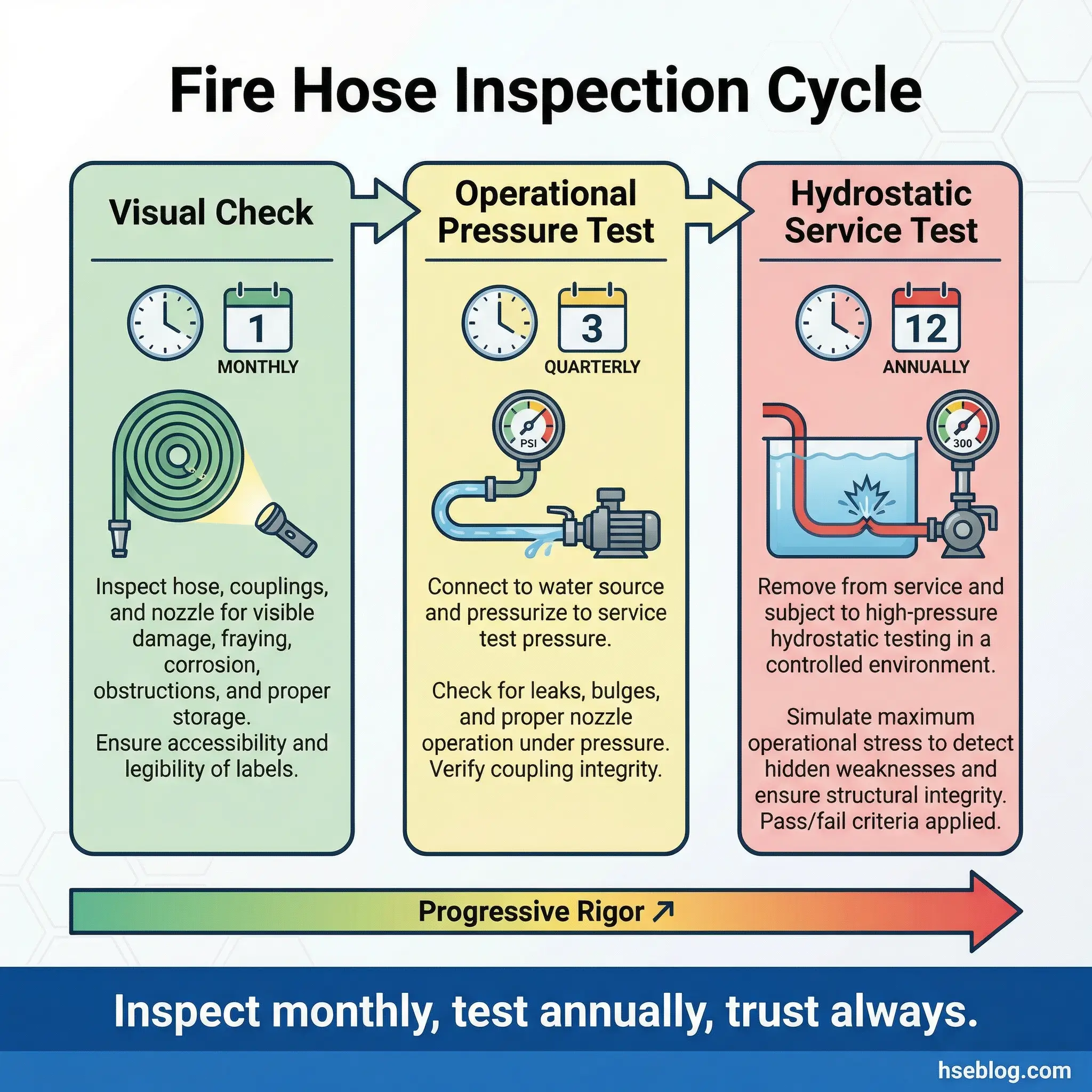
An effective inspection and maintenance program covers three levels:
- Visual inspection (monthly): Check the outer jacket for cuts, abrasion, discoloration, mildew, chemical staining, and UV damage. Inspect couplings for corrosion, thread damage, and gasket condition. Verify hose roll integrity and strap security.
- Operational check (quarterly): Charge the hose to working pressure and hold for five minutes. Walk the full length checking for weeping, pinhole leaks, coupling seepage, and abnormal swelling. Operate nozzles and appliances to confirm function.
- Hydrostatic service test (annually): Per NFPA 1962, test hoses at their rated service test pressure for three minutes minimum. Record results, tag each hose, and immediately remove any hose that fails from service. There is no “re-test and put back” — a failed hose is a condemned hose.
The following maintenance practices extend hose service life and ensure deployment reliability:
- Dry thoroughly before storage. Hang hoses vertically in a drying tower or lay flat in a ventilated area. Never roll and store a wet hose.
- Rotate fold points. Each time you re-roll a hose, shift the starting position slightly to prevent stress concentration at the same fold line.
- Clean after use. Rinse hoses exposed to chemicals, foam concentrate, or salt water immediately after the operation. Residual chemicals degrade both liner and jacket materials.
- Replace gaskets proactively. Coupling gaskets are consumable items. Replace them annually or immediately if they show compression set, cracking, or deformation.
- Maintain records. Every hose should have a unique identification number with a service log tracking inspections, tests, deployments, and repairs. Untracked hoses are unmanaged hoses.
Pro Tip: I stamp each hose with a metal tag at the coupling bearing its unique ID, manufacture date, and last test date. During an emergency, nobody opens a logbook — but a glance at the tag tells you whether that hose is current on testing.
Conclusion
A fire hose is only as reliable as the last time someone inspected it, tested it, and rolled it correctly. Every failure I have investigated — burst lines, seized couplings, deployment tangles — traced back to a gap in one of these three areas. The equipment itself is well engineered. The failures are human: wrong hose type selected, storage shortcuts taken, testing schedules ignored, rolling techniques never taught properly.
If you manage fire safety on any site, start with the basics. Confirm every fire hose matches its intended application. Train your response teams on correct rolling techniques — straight roll for storage, donut roll for deployment carry. Enforce the inspection and testing cycle without exception. A hose that has not been hydrostatically tested within the last twelve months should not be trusted to perform when a fire breaks out.
The fire hose connects your water supply to the fire. Every link in that chain — type selection, coupling compatibility, jacket condition, liner integrity, rolling discipline — must hold. When one link fails during an active fire, people get hurt. No shortcut in storage or maintenance is worth that outcome.