

TL;DR
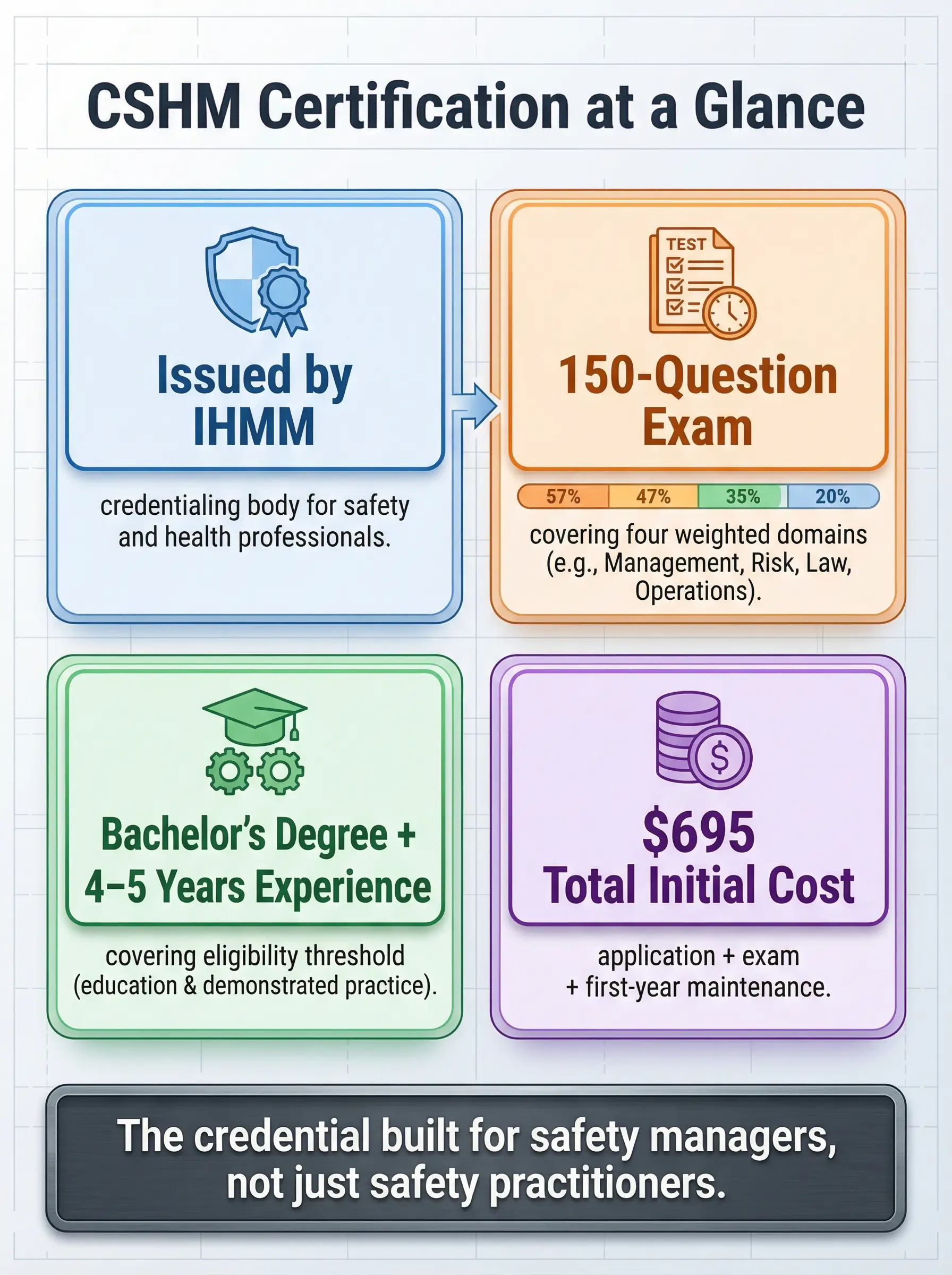
- Management-focused credential: The CSHM (Certified Safety and Health Manager) is issued by IHMM and specifically validates EHS management and business leadership competence — not just technical safety knowledge.
- Eligibility requires both education and experience: You need at minimum a bachelor’s degree plus four to five years of qualifying safety management experience, depending on your field of study.
- The exam tests business acumen alongside safety knowledge: 150 multiple-choice questions across four weighted domains, with risk identification and management accounting for the largest share at 35%.
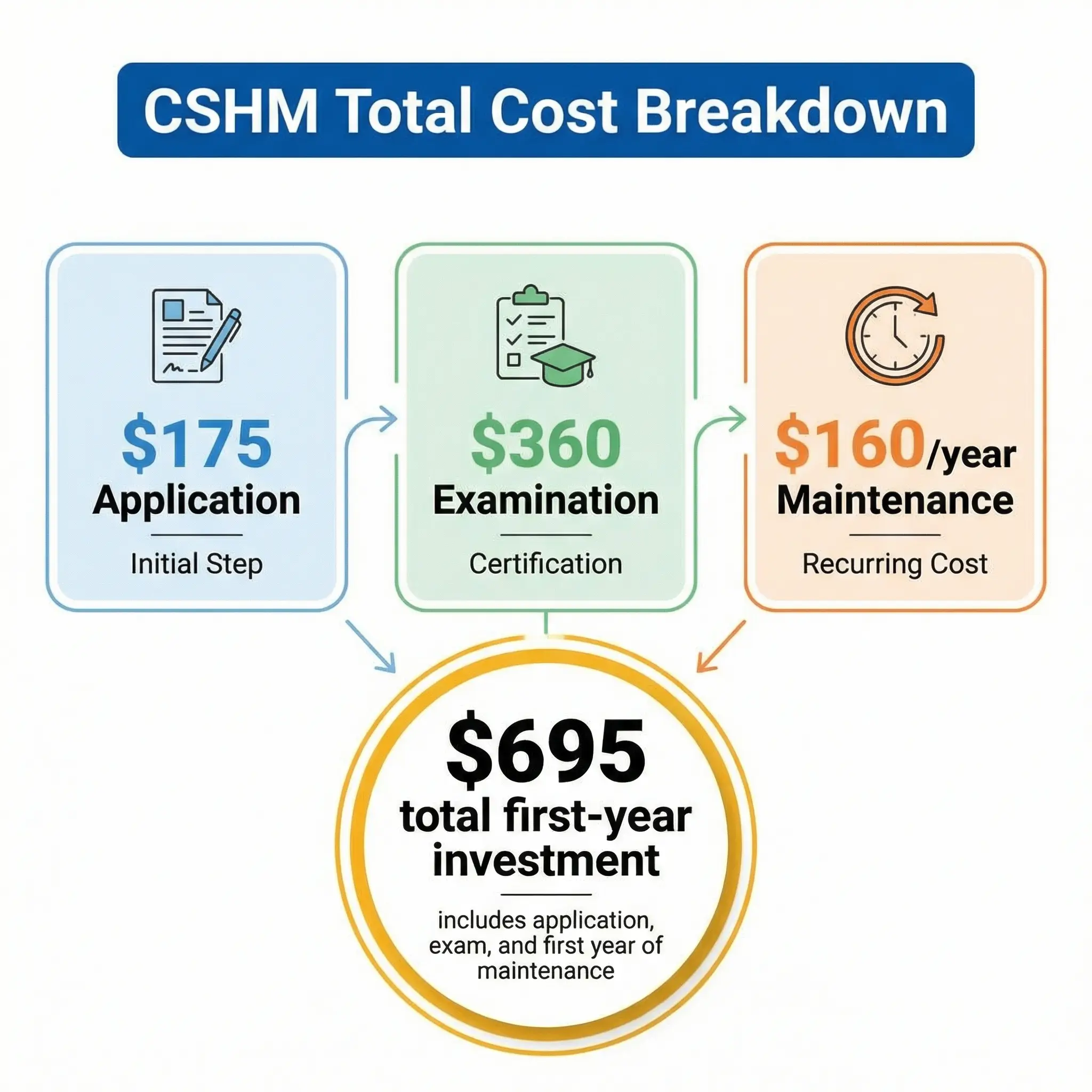
- Total investment is approximately $695 upfront: This covers the application fee, examination fee, and first-year annual maintenance — with $160 recurring annually thereafter.
- Career ROI is strong for the right candidate: 75% of credential holders report higher earnings, and the CSHM positions you for executive-level EHS roles that pure technical certifications do not directly target.
I was reviewing CVs for a senior EHS manager position on a petrochemical expansion project in the Gulf when the CSHM credential caught my attention on one particular resume. The candidate had the expected NEBOSH diploma and years of site experience, but the CSHM designation was the differentiator — it told me this person understood safety budgets, workers’ compensation risk, labor relations, and management systems at a level that went beyond knowing which regulation to cite. That distinction mattered because we were not hiring someone to write JSAs. We were hiring someone to sit in project steering meetings and defend a $2.3 million safety budget against cost-cutting pressure from procurement.
The Certified Safety and Health Manager (CSHM) certification occupies a specific and often misunderstood space in the professional credential landscape. While most EHS certifications validate technical proficiency — your ability to identify hazards, apply controls, interpret regulatory standards — the CSHM explicitly tests whether you can manage safety as a business function. That difference determines whether this credential is worth your time and money, or whether another certification serves you better. This article breaks down exactly what the CSHM is, who it suits, what the exam demands, what it costs, how it compares to alternatives like the CSP, and — honestly — where it falls short.
What Is the Certified Safety and Health Manager (CSHM) Certification?
The Certified Safety and Health Manager (CSHM) is a professional credential issued by the Institute of Hazardous Materials Management (IHMM) that recognizes EHS professionals who possess both occupational safety and health expertise and demonstrated competence in business and financial management principles. It is the only accredited safety certification that explicitly integrates general management, leadership, quality systems, and financial decision-making into its examination scope alongside traditional safety and health technical knowledge.
The CSHM was originally developed and administered by the Institute for Safety and Health Management (ISHM). In 2019, IHMM acquired ISHM and absorbed the CSHM program into its broader credentialing portfolio, which also includes the Certified Hazardous Materials Manager (CHMM), the Certified Safety Management Practitioner (CSMP), and the Associate Safety and Health Manager (ASHM). IHMM now serves as the sole credentialing body for the CSHM. The certification itself carries accreditation from the Council on Engineering and Scientific Specialty Boards (CESB), which verifies that the credential meets recognized national standards for examination fairness, psychometric rigor, and credibility.
What makes the CSHM distinct from other safety certifications is its positioning. Here is what the credential evaluates that most safety certifications do not:
- Business and financial management principles: Budgeting, cost-benefit analysis, workers’ compensation risk management, and resource allocation — the kind of knowledge that gets you a seat in executive meetings, not just a spot on the safety committee.
- Leadership and employee involvement: How to build safety culture, manage union and non-union dynamics, develop corporate safety education programs, and navigate the political realities of organizational change.
- Quality management systems integration: How safety management intersects with ISO frameworks, total quality management, and continuous improvement processes — bridging the gap between EHS and operations.
- Hazard analysis, accident investigation, and auditing: These are the technical foundations, but the CSHM tests your ability to manage these functions across an organization, not just perform them yourself.
Pro Tip: If your career goal is to lead an EHS department, defend safety budgets to a CFO, or consult at the executive level, the CSHM was designed for exactly that trajectory. If your goal is to deepen your technical mastery of hazard recognition and regulatory compliance, the CSP is likely a better fit. The two credentials are complementary, not competing — but they serve different career purposes.
Who Should Pursue the CSHM Certification?
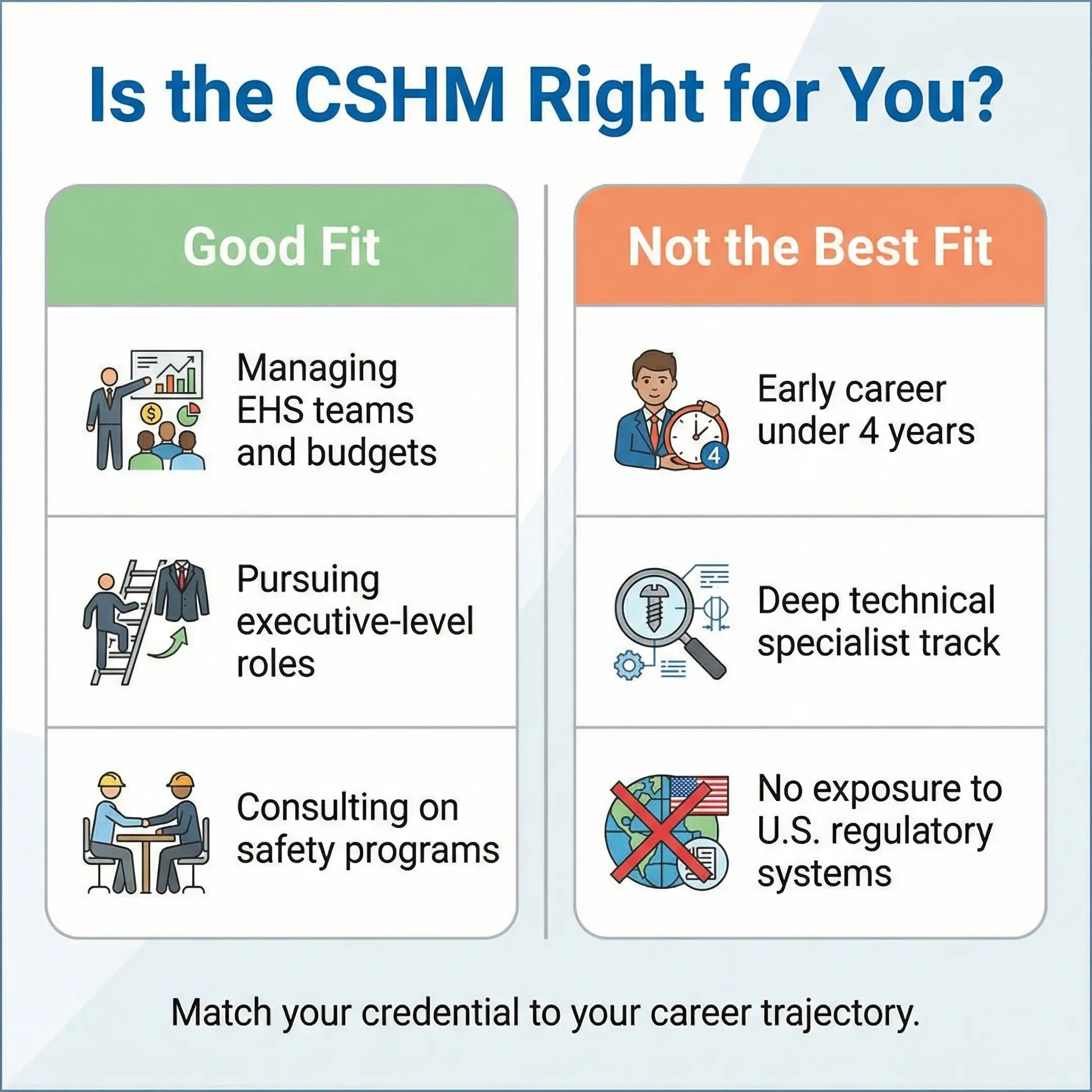
The CSHM is not an entry-level credential, and it is not designed for every safety professional. I have worked with excellent safety officers who had no need for it — their strength was in field execution, hazard identification, and regulatory enforcement. The CSHM targets a different professional profile entirely.
The credential is designed for EHS professionals who are either already in management roles or actively pursuing them. The following profiles represent the strongest candidates for the CSHM:
- Mid-career safety managers who have transitioned (or are transitioning) from field-based technical roles into leadership positions where they manage budgets, teams, and organizational safety strategy.
- EHS directors and department heads who need a credential that validates their business management competence to senior leadership, boards, or client organizations — particularly in industries where contractor prequalification requires demonstrated management-level credentials.
- Consultants and independent practitioners who advise organizations on safety program development, workers’ compensation cost reduction, or management system implementation and need a credential that signals management-level authority.
- Military-transitioning professionals whose service included safety management responsibilities — the CSHM is recognized and funded through both the U.S. Army and Navy Credentialing Opportunities Online (COOL) programs.
- Operations managers and HR professionals whose roles include partial EHS oversight (25–50% of job duties) and who want formal recognition of that competence without pursuing a full-time safety career track.
Who the CSHM Is Not For
Equally important is understanding when this credential does not fit. I have seen professionals invest time and money in the CSHM when a different certification would have served them better. The following situations suggest the CSHM may not be your best next step:
- Early-career safety professionals with less than four years of experience — you will not meet the eligibility threshold, and even if you could, the exam content assumes management-level decision-making experience that textbook study alone cannot replicate.
- Technical specialists focused on industrial hygiene, ergonomics, or environmental science — the CSHM does not go deep enough into any single technical domain to validate specialist expertise. The CIH, QEP, or CHMM would serve you better.
- Professionals working exclusively outside the United States who have no exposure to U.S. regulatory frameworks — while IHMM states that international exam versions reduce U.S.-specific content like OSHA and NIOSH references, the credential’s recognition and job-market value remain strongest in North America.
CSHM Eligibility Requirements — Education and Experience
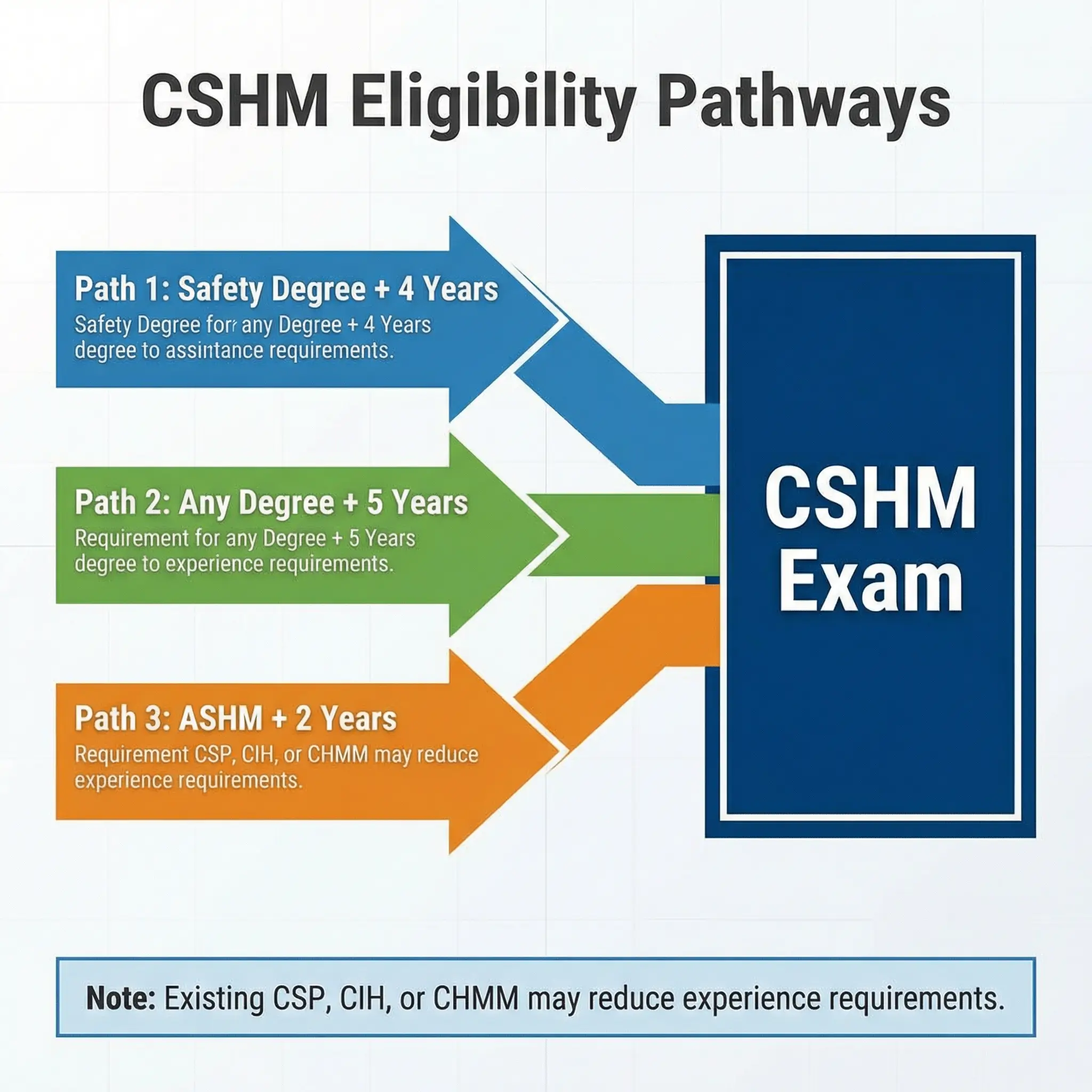
Before you invest time studying, you need to confirm you qualify. IHMM has structured the eligibility requirements around a combination of education and professional experience, with the amount of required experience varying based on your degree field.
The following breakdown covers the primary eligibility pathways:
- Bachelor’s degree (or higher) in a safety-related field from an accredited institution: Requires 4 years of relevant professional experience in safety and health management.
- Bachelor’s degree or advanced degree in any field from an accredited institution: Requires 5 years of relevant professional experience.
- ASHM (Associate Safety and Health Manager) credential from IHMM: Requires only 2 years of qualifying experience after earning the ASHM — making it the fastest pathway for recent graduates from approved programs.
There are critical details in these requirements that trip up applicants. Here is what qualifies and what does not:
- “Relevant experience” means safety management work: Conducting audits, performing hazard analyses, investigating accidents, managing safety programs, implementing management systems, overseeing workers’ compensation processes, and managing safety budgets. General field supervision without explicit safety management duties does not count.
- Degree accreditation matters: Your institution must be accredited by the Council for Higher Education Accreditation (CHEA) for U.S. degrees. International degrees must be evaluated and verified by an agency approved by the National Association of Credential Evaluation Services (NACES).
- Third-party employment verification is required: IHMM requires independent verification of your work experience. You cannot self-certify your years of experience the way some other credential programs allow.
Credential-Based Eligibility Shortcuts
Holding certain existing professional certifications can reduce or eliminate the experience requirement entirely. If you already hold a Certified Safety Professional (CSP), Certified Industrial Hygienist (CIH), Certified Hazardous Materials Manager (CHMM), or Canadian Registered Safety Professional (CRSP), these recognized credentials can streamline your path to CSHM eligibility. This is worth investigating before you assume you need additional years of documented experience.
Pro Tip: If you are a recent graduate from an IHMM-approved or ABET-approved program, apply for the ASHM within six months of graduation — the application fee is waived during that window. The ASHM puts you on a two-year fast track to CSHM eligibility instead of the standard four- or five-year pathway. Be aware that since July 2024, the ASHM can only be held for a maximum of four years before you must either sit for the CSHM exam or lose the credential.
| Eligibility Pathway | Degree Requirement | Experience Required | Notes |
|---|---|---|---|
| Safety-related bachelor’s degree | BS/BA in OHS, environmental science, or related field | 4 years | From CHEA-accredited institution |
| Non-safety bachelor’s or advanced degree | Any BS/BA/MS/MA/PhD | 5 years | Any accredited field qualifies |
| ASHM credential holder | Already earned via approved program | 2 years | Must take CSHM exam within 4 years of ASHM |
| Existing CSP, CIH, CHMM, or CRSP | Varies | Reduced or waived | Contact IHMM for specific equivalencies |
What Does the CSHM Exam Cover? — Domains, Weighting, and Format
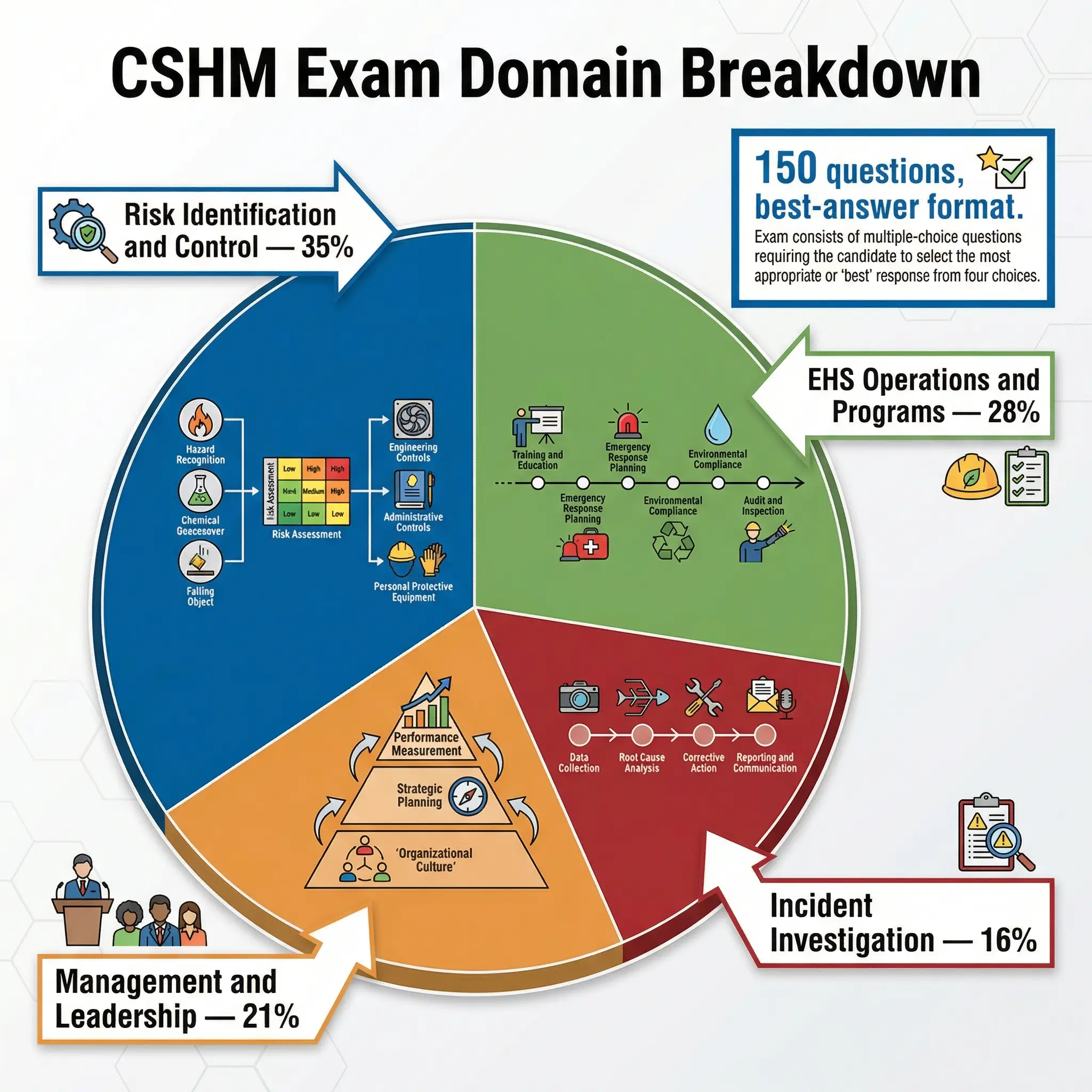
The CSHM examination is a 150-question, multiple-choice test structured around four weighted content domains. Every question requires selecting the “best” answer — not merely a correct answer, but the most appropriate response for a given management scenario. This format is deliberate. It reflects the kind of judgment-based decision-making that safety managers face daily, where multiple options might be defensible but one is clearly superior.
Understanding the domain structure and weighting is essential for effective exam preparation. The four domains, with their approximate percentage of the total exam, are as follows:
- Domain 1 — Management and Leadership Principles and Methods (21% / ~32 questions): Covers differences between policies and goals, safety budgeting and resource allocation, management systems, quality principles applied to safety, union vs. non-union dynamics, ethical practices, and corporate safety communication strategies.
- Domain 2 — Risk Identification, Management and Control (35% / ~52 questions): The largest domain. Covers risk definition, analysis, assessment, and prioritization. Includes hazard analysis techniques, control measure prioritization using the hierarchy of controls, corrective action identification, and policy development. This is where technical safety knowledge meets management-level risk decision-making.
- Domain 3 — EHS Operations, Programs and Applications (28% / ~42 questions): Covers the operational side — process safety management, blood-borne pathogen controls, excavation soil classification, data security principles, employee records confidentiality, environmental law, workers’ compensation, product safety, and labor relations.
- Domain 4 — Incident Investigation and Performance Evaluation (16% / ~24 questions): Covers accident investigation methodology, root cause analysis, safety performance measurement, trend analysis, and audit/survey techniques.
What Makes This Exam Different From the CSP
I have sat through exam prep sessions for both credentials, and the difference is immediately apparent. The CSP (Certified Safety Professional) issued by BCSP tests your ability to recognize hazards, apply standards, calculate exposure limits, and design controls. The CSHM tests whether you can manage the people, budgets, and organizational systems that make those controls actually work at scale.
A typical CSHM question does not ask you to calculate a noise exposure level. It asks you which leadership style most effectively improves subordinate satisfaction on stressful tasks, or what the best management tool is for minimizing disaster impact, or how to structure cooperation between departments on safety and health initiatives. The exam assumes you already know the technical foundations — it tests whether you can lead with them.
The CSHM exam blueprint states that the credential evaluates professionals who can “apply management systems; apply occupational health and safety, security, and environmental knowledge, principles, and standards; apply and utilize risk identification, management, and controls; and set related goals, objectives, and targets.”
| Domain | % of Exam | Approx. Questions | Focus Area |
|---|---|---|---|
| Management & Leadership | 21% | 32 | Policies, budgets, quality, ethics, communication |
| Risk Identification & Control | 35% | 52 | Hazard analysis, control hierarchy, risk prioritization |
| EHS Operations & Programs | 28% | 42 | Process safety, workers’ comp, environmental law, labor |
| Incident Investigation & Evaluation | 16% | 24 | Root cause analysis, audits, performance metrics |
How to Prepare for the CSHM Exam
Passing the CSHM exam requires a balanced preparation strategy that covers both technical safety content and business management fundamentals. IHMM does not base the exam on any single reference text and does not mandate a specific training course — which means preparation discipline falls entirely on the candidate.
Here is the preparation approach that I have seen work consistently for professionals who passed on their first attempt:
- Download and study the CSHM Blueprint first. This is non-negotiable. The blueprint published by IHMM outlines every competency area, task, and knowledge domain tested on the exam. It is the single most important study document — more valuable than any prep course. Every exam question is derived from this blueprint.
- Enroll in the IHMM Foundation’s CSHM Exam Preparation Course. The Hazmat Society (IHMM Foundation) offers a 4-hour online course that reviews all four domains. It includes over 1,000 study questions and 32 lecture videos with randomized quizzes for each domain. The course reports a 93% passing rate among participants.
- Study business and financial management independently. This is where most safety professionals underestimate the exam. If your career has been entirely field-based, you may have limited exposure to budgeting, workers’ compensation cost structures, quality management principles, and labor relations. Dedicate specific study time to these areas — they are tested heavily in Domains 1 and 3.
- Practice scenario-based questions relentlessly. The CSHM exam uses a “best answer” format where multiple options may appear correct. The only way to develop the judgment needed to consistently pick the best option is to work through practice scenarios that force management-level thinking.
- Stay current with safety regulations and industry developments. Subscribe to OSHA updates, IHMM newsletters, and relevant industry association publications. The exam reflects current regulatory reality, not historical knowledge alone.
Pro Tip: Do not study the CSHM exam the way you studied for a technical certification. The biggest failure mode I have seen is candidates who memorize OSHA clauses and hierarchy-of-controls definitions but cannot answer a question about which management approach best addresses employee resistance to safety culture change. Treat Domains 1 and 3 with the same seriousness as Domain 2.
What Does the CSHM Certification Cost?
Cost is a straightforward but important factor in any certification decision. IHMM structures the CSHM fees across three stages — application, examination, and ongoing maintenance.
The following table captures the complete fee structure based on current published IHMM rates:
| Fee Type | Amount (USD) | Refundable? | When Due |
|---|---|---|---|
| Application fee | $175 | No | At application submission |
| Examination fee | $360 | No | After application approval |
| Re-examination fee (if needed) | $160 | No | If first attempt is unsuccessful |
| Annual certification maintenance fee | $160 | No | Annually, on certification anniversary |
Your total initial investment to earn the CSHM is approximately $695 — covering the application, exam, and first-year maintenance fee. Each subsequent year, you pay $160 to maintain active certification status.
Beyond the direct fees, factor in indirect costs that most candidates overlook:
- Exam preparation materials and courses: The IHMM Foundation exam prep course is reasonably priced, but third-party bootcamps and commercial study guides can add $200–$800 depending on the provider.
- Credential evaluation for international degrees: If your degree is from an institution outside the U.S., you will need a NACES-approved evaluation, which typically costs $100–$250.
- Time investment: Realistic preparation time for a working professional is 60–120 hours spread over 2–4 months, depending on your existing management knowledge base. That time has an opportunity cost.
Compared to the CSP (which costs approximately $300 for the exam plus $80 annually for BCSP membership), the CSHM is moderately more expensive in upfront costs but comparable in ongoing maintenance burden.
CSHM vs. CSP — Which Certification Should You Pursue?
This is the question I hear most frequently from mid-career safety professionals, and the honest answer is that it depends entirely on where you want your career to go. The CSHM and CSP are not interchangeable — they test different competencies, serve different career trajectories, and carry different weight depending on the industry and organizational level you are targeting.
Here is a direct comparison across the factors that actually matter to a working professional:
| Factor | CSHM (IHMM) | CSP (BCSP) |
|---|---|---|
| Primary focus | Safety management + business leadership | Technical safety practice + hazard control |
| Issuing body | Institute of Hazardous Materials Management | Board of Certified Safety Professionals |
| Accreditation | CESB accredited | ANSI/ISO 17024 accredited |
| Exam format | 150 multiple-choice, best-answer | 200 multiple-choice, scenario-based |
| Domain emphasis | Risk management, leadership, business finance, operations | Hazard recognition, engineering controls, regulatory compliance |
| Experience required | 4–5 years (degree-dependent) | 4 years post-ASP or degree-dependent |
| Ideal candidate | EHS managers, directors, consultants | Safety engineers, specialists, technical practitioners |
| Industry recognition | Strong in management/consulting/government | Broadly recognized across all industries |
| International recognition | Growing but strongest in North America | Widely recognized globally |
The Real-World Distinction
During a management system audit at a refinery in Southeast Asia, I worked alongside a site HSE manager who held both credentials. When I asked him how he used them differently, his answer was practical: the CSP got him through prequalification screening and client technical reviews. The CSHM gave him credibility in budget defense meetings with the project director and in workers’ compensation negotiations with insurers. Two different doors, two different credentials.
If you can only pursue one certification right now, the decision framework is straightforward. Choose the CSHM if your daily responsibilities involve managing safety teams, presenting to senior leadership, controlling EHS budgets, or consulting on management systems. Choose the CSP if your work is primarily technical — conducting exposure assessments, designing engineering controls, writing safety procedures, or performing regulatory compliance audits.
If you have the time and resources, holding both credentials positions you as a well-rounded EHS leader who can operate at both the technical and strategic levels. That combination is rare, and employers notice it.
Maintaining Your CSHM — Recertification Requirements
Earning the CSHM is not a one-time achievement. Like all credible professional certifications, the CSHM requires ongoing maintenance to ensure credential holders stay current with evolving regulations, standards, and management practices.
The recertification requirements are structured as follows:
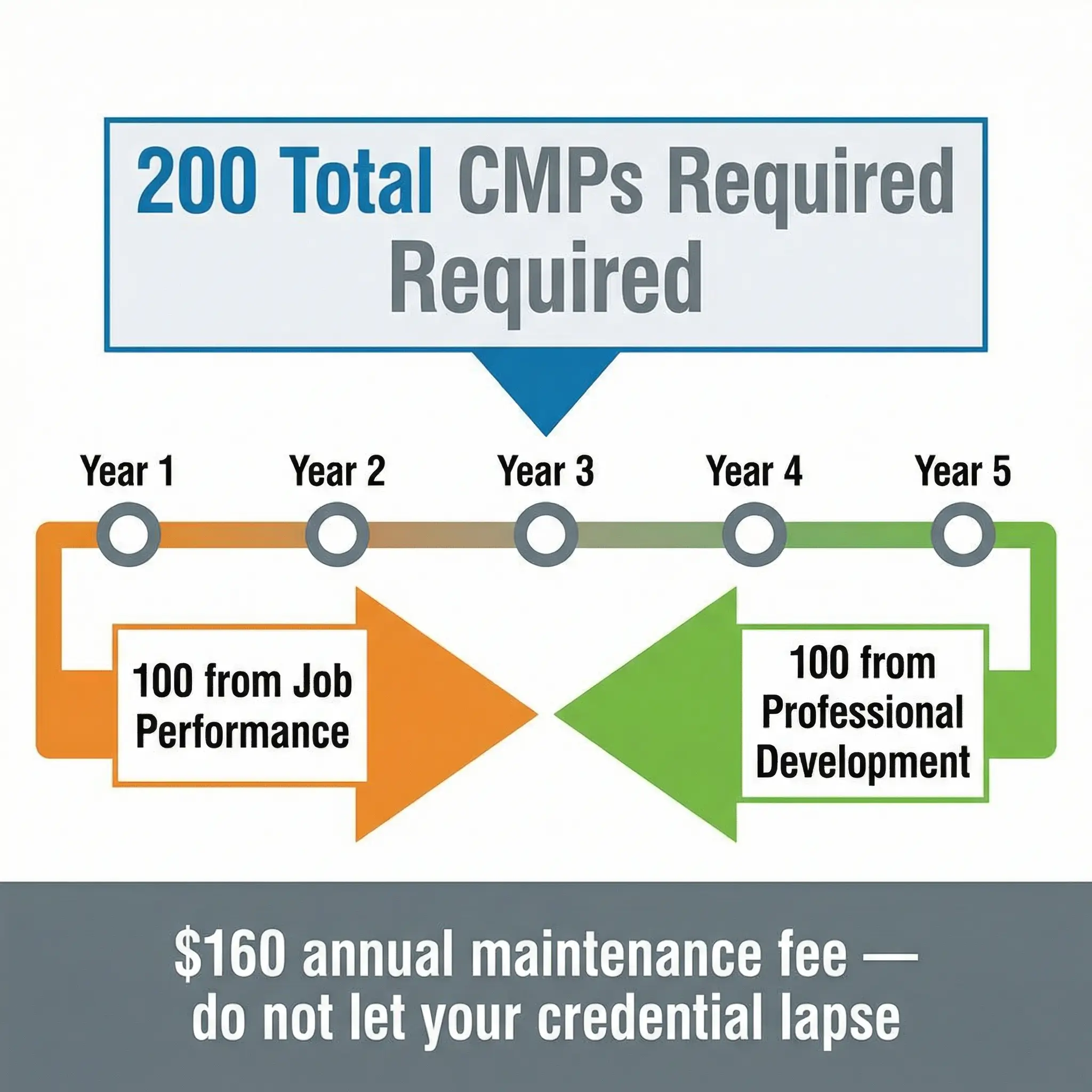
- Certification Maintenance Points (CMPs): You must earn a total of 200 CMPs over every five-year recertification cycle. Of these, 100 points are automatically credited for performing your job in an EHS management capacity. The remaining 100 points must be earned through qualifying professional development activities.
- Annual maintenance fee: $160 per year, due on the anniversary of your original certification date. Missing a payment can result in lapsed certification status.
- Qualifying activities for CMPs include: Attending conferences, completing continuing education courses, publishing articles or papers, presenting at industry events, serving on safety committees, completing additional certifications, and participating in IHMM-approved professional development programs.
The 100-point professional development requirement over five years translates to roughly 20 points per year — achievable through attending one major conference plus a few webinars or short courses annually. It is not an onerous requirement, but it does demand deliberate planning. I have seen credentials lapse not because the holder lacked professional development but because they failed to document and submit their activities before the deadline.
The IHMM Foundation offers a curated library of approved training and education programs specifically aligned with CSHM blueprint domains. Many of these programs carry pre-assigned CMP values, which eliminates the guesswork from recertification planning.
Is the CSHM Certification Recognized by Employers?
Employer recognition is the real test of any credential’s value, and this is where an honest assessment matters more than marketing claims. The CSHM enjoys solid recognition in specific sectors and contexts, but it does not carry the same universal name recognition as the CSP.
Where the CSHM carries the strongest weight:
- U.S. federal government and military: The CSHM is recognized by OSHA, the EPA, the Department of Homeland Security, and multiple branches of the U.S. military. Both the Army and Navy fund CSHM exam attempts through their COOL programs — a meaningful endorsement.
- Large corporations with mature EHS programs: Companies in construction, manufacturing, healthcare, petrochemical, and defense sectors routinely list the CSHM as a preferred or required credential for EHS management positions.
- Consulting and advisory roles: When you are advising C-suite executives on safety program strategy, workers’ compensation cost reduction, or management system implementation, the CSHM signals that you understand business language — not just safety language.
- Contractor prequalification systems: Several major operator companies in oil and gas, mining, and infrastructure include the CSHM in their contractor HSE management credential requirements.
Where the CSHM has limitations in recognition:
- Outside North America: The credential’s international recognition is growing but remains weaker than the CSP, NEBOSH International Diploma, or ISO Lead Auditor certifications in regions like Europe, the Middle East, and Asia-Pacific.
- Highly technical roles: If the position requires deep expertise in industrial hygiene, fire protection engineering, or environmental compliance, hiring managers typically look for the CIH, PE (Fire Protection), or CHMM over the CSHM.
- Organizations unfamiliar with IHMM: Smaller companies or those outside the EHS professional network may not immediately recognize the CSHM acronym. The CSP, by contrast, benefits from BCSP’s larger marketing reach and longer-established global brand presence.
IHMM’s own survey data provides context for the credential’s career impact. Among CSHM holders surveyed, 88% cited career progression as their primary motivation for earning the credential, 75% reported earning more money after certification, and 50% said the CSHM directly helped them secure a new position.
Common Mistakes to Avoid When Pursuing the CSHM
Over the years, I have mentored several professionals through the CSHM process and watched the same mistakes repeat. Most of these errors happen before the candidate even sits for the exam.
The following mistakes are the most damaging — and the most preventable:
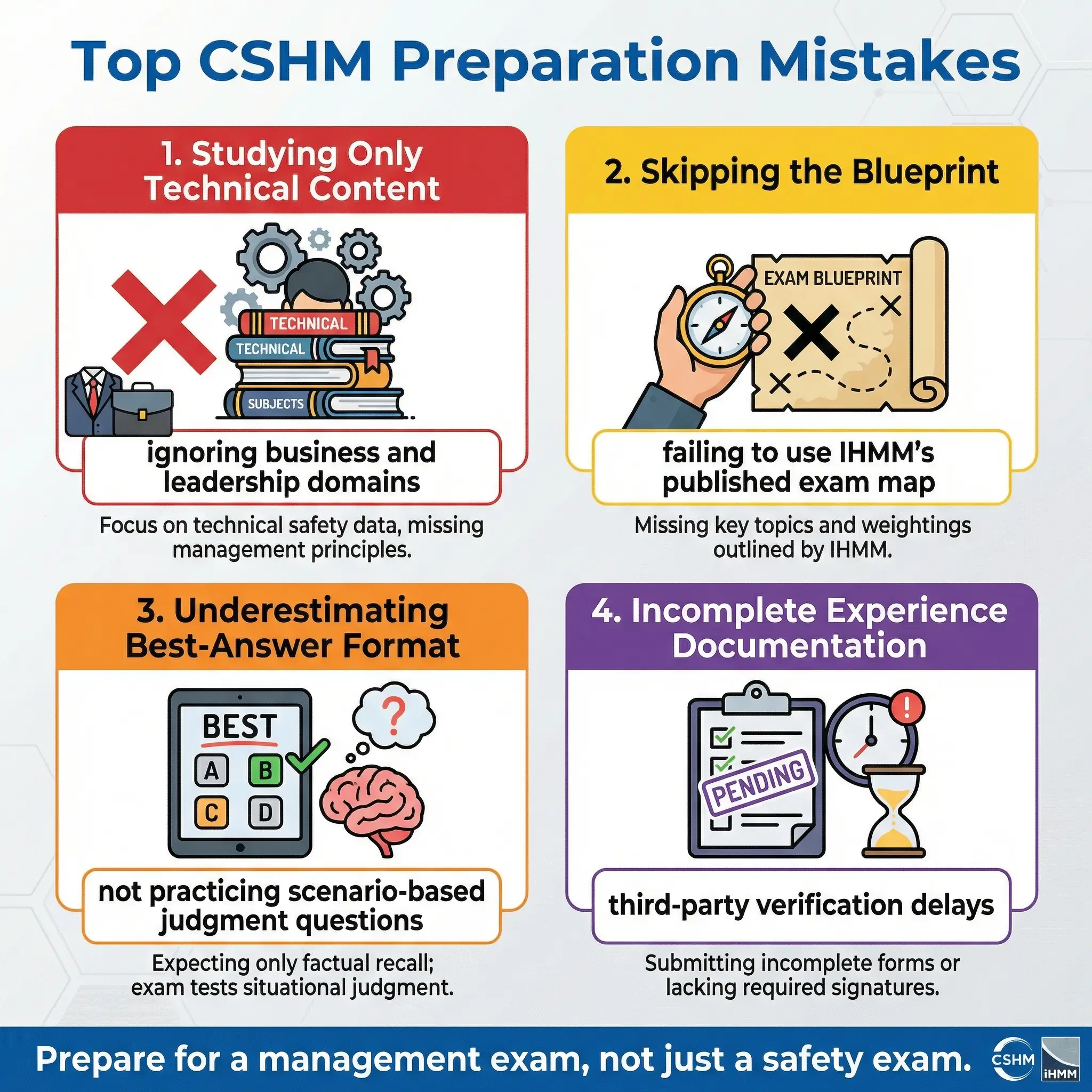
- Treating it like a technical safety exam: The single most common preparation failure. Candidates who study only OSHA standards, hazard recognition, and control hierarchies are unprepared for the 21% of the exam that tests pure management and leadership theory and the 28% that tests operational business knowledge. You need to study management principles with the same intensity as safety principles.
- Ignoring the blueprint: The CSHM blueprint is a publicly available document that tells you exactly what competencies and tasks the exam covers. Studying without it is like navigating a refinery turnaround without a scope of work — you might get somewhere, but not efficiently.
- Underestimating the “best answer” format: Multiple-choice exams where every option seems partially correct require a different skill set than exams with clearly right or wrong answers. Practice with CSHM-style scenario questions until selecting the best management response becomes instinctive.
- Applying too early without verified experience: IHMM requires third-party employment verification. If your experience documentation is incomplete or your job duties do not clearly demonstrate safety management responsibilities (not just safety task performance), your application may be delayed or rejected.
- Confusing the CSHM with the CSMP: The Certified Safety Management Practitioner (CSMP) is a separate, lower-tier IHMM credential designed for professionals with experience but limited formal education, or for operations managers with partial EHS duties. It is not the same as the CSHM, does not carry the same weight, and should not be pursued as a substitute if you qualify for the CSHM directly.
- Letting the credential lapse after earning it: Failing to track CMPs, missing annual maintenance payments, or neglecting recertification deadlines wastes the entire investment. Set calendar reminders and document every qualifying professional development activity as it happens — not at the five-year deadline.
The ASHM Fast-Track — A Strategic Entry Point
For recent graduates and early-career professionals eyeing the CSHM, the Associate Safety and Health Manager (ASHM) credential offers a structured on-ramp that significantly shortens the path to full certification.
The ASHM pathway works as follows:
- Apply within six months of graduating from an IHMM-approved or ABET-approved program with a major in a safety or health-related discipline, and the application fee is waived entirely.
- After earning the ASHM, you need only 2 years of qualifying professional experience to become eligible for the CSHM exam — compared to 4–5 years through the standard pathway.
- Effective July 2024, IHMM implemented a critical change: every ASHM granted after this date can only be held for a maximum of 4 years. After four years, you must either pass the CSHM exam or have your ASHM decertified.
This time limit is both a restriction and a motivator. It prevents the ASHM from becoming a permanent parking spot and forces credential holders onto a clear advancement timeline. If you are a student or recent graduate who knows the CSHM is your target credential, the ASHM is unambiguously the smartest first step — it saves you money, reduces your required experience, and locks you into a structured progression.
Several accredited programs — including bachelor’s and master’s programs in occupational safety and health, environmental management, and emergency services management — automatically qualify graduates for the ASHM upon completion, eliminating even the exam requirement for the associate credential.
Where the CSHM Falls Short — An Honest Assessment
No credential is perfect, and an article that only lists benefits is not giving you the full picture. After working in environments where the CSHM, CSP, NEBOSH, and various ISO lead auditor certifications all circulate, I can identify specific areas where the CSHM has limitations you should weigh before committing.
The honest shortcomings include the following:
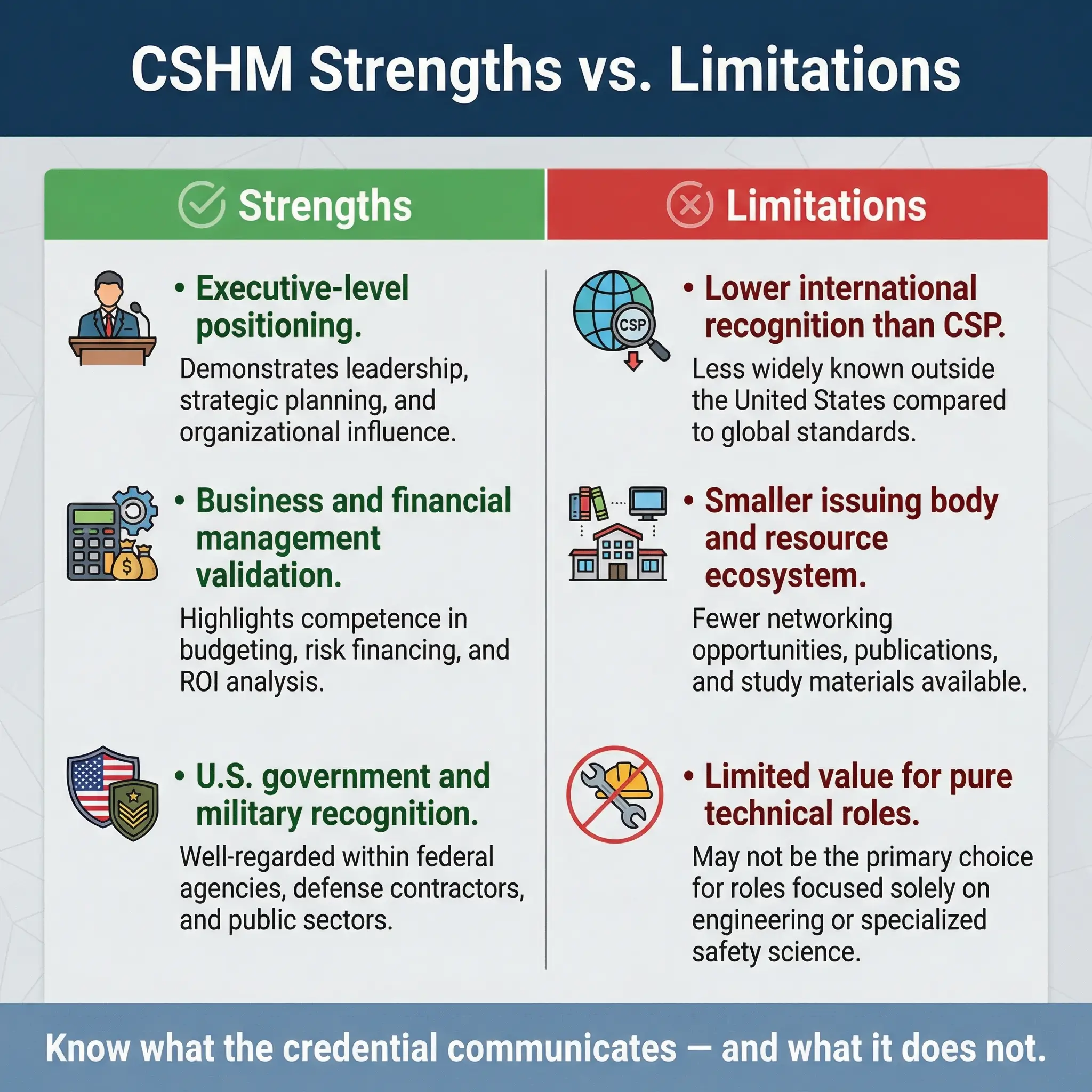
- Lower global brand recognition than the CSP: Outside North America, the CSHM is less frequently listed in job requirements, tender prequalification criteria, and regulatory recognition frameworks. If your career trajectory involves significant international mobility, the CSP and NEBOSH International Diploma carry more weight in the Middle East, Europe, and Asia-Pacific markets.
- The management focus can be a double-edged sword: In organizations where EHS credibility is primarily established through technical depth, holding the CSHM without a complementary technical certification (CSP, CIH, or CHMM) can leave gaps in how you are perceived. Some hiring managers associate the CSHM with administrative safety management rather than hands-on operational authority.
- IHMM’s smaller organizational footprint: BCSP (the CSP’s issuing body) has a larger marketing apparatus, more extensive study resources, a broader network of approved training providers, and stronger partnerships with academic institutions globally. IHMM’s ecosystem, while growing, is comparatively smaller — which affects the volume and variety of available preparation resources.
- Recertification costs add up over time: At $160 per year in maintenance fees, you will spend $800 over each five-year cycle just to keep the credential active — before factoring in the cost of earning your required 100 professional development CMPs. That ongoing investment needs to generate measurable career returns to justify itself.
- Limited value as a standalone credential for technical roles: If the job posting requires expertise in confined space rescue planning, quantitative exposure assessment, or fire protection system design, the CSHM alone does not validate that technical depth. It was never designed to.
These are not reasons to avoid the CSHM. They are reasons to pursue it strategically — understanding what it does and does not communicate about your professional capabilities, and pairing it with complementary credentials where your career demands it.
Conclusion
The Certified Safety and Health Manager credential answers a specific question that other safety certifications leave open: can this professional manage safety as a business function, not just as a technical discipline? For EHS professionals who have moved beyond writing risk assessments and conducting toolbox talks — who now manage teams, defend budgets, negotiate with insurers, and present safety strategy to boards — the CSHM provides formal, accredited validation of that transition.
Whether the CSHM is worth it depends entirely on where you sit in your career and where you are headed. If your trajectory points toward EHS director, VP of safety, corporate HSE consultant, or any role where business acumen matters as much as hazard knowledge, the CSHM is a strategic investment that pays real dividends — in salary, in credibility, and in access to leadership-level conversations that pure technical credentials do not open. Pair it with the CSP or another technical certification, and you cover both dimensions of what the modern EHS leader needs to demonstrate.
The real measure of any professional certification is not the letters after your name. It is whether the knowledge the credential validates actually changes how you operate and how others trust your judgment. The CSHM, pursued at the right career stage and for the right reasons, does both. A credential that teaches you to think like a manager and lead like a professional is never a wasted investment — as long as you were ready for it in the first place.