
TL;DR
- A trench is always an excavation — but an excavation is not always a trench. Understanding this distinction determines which OSHA protective system requirements apply to your site and whether your crew goes home safe.
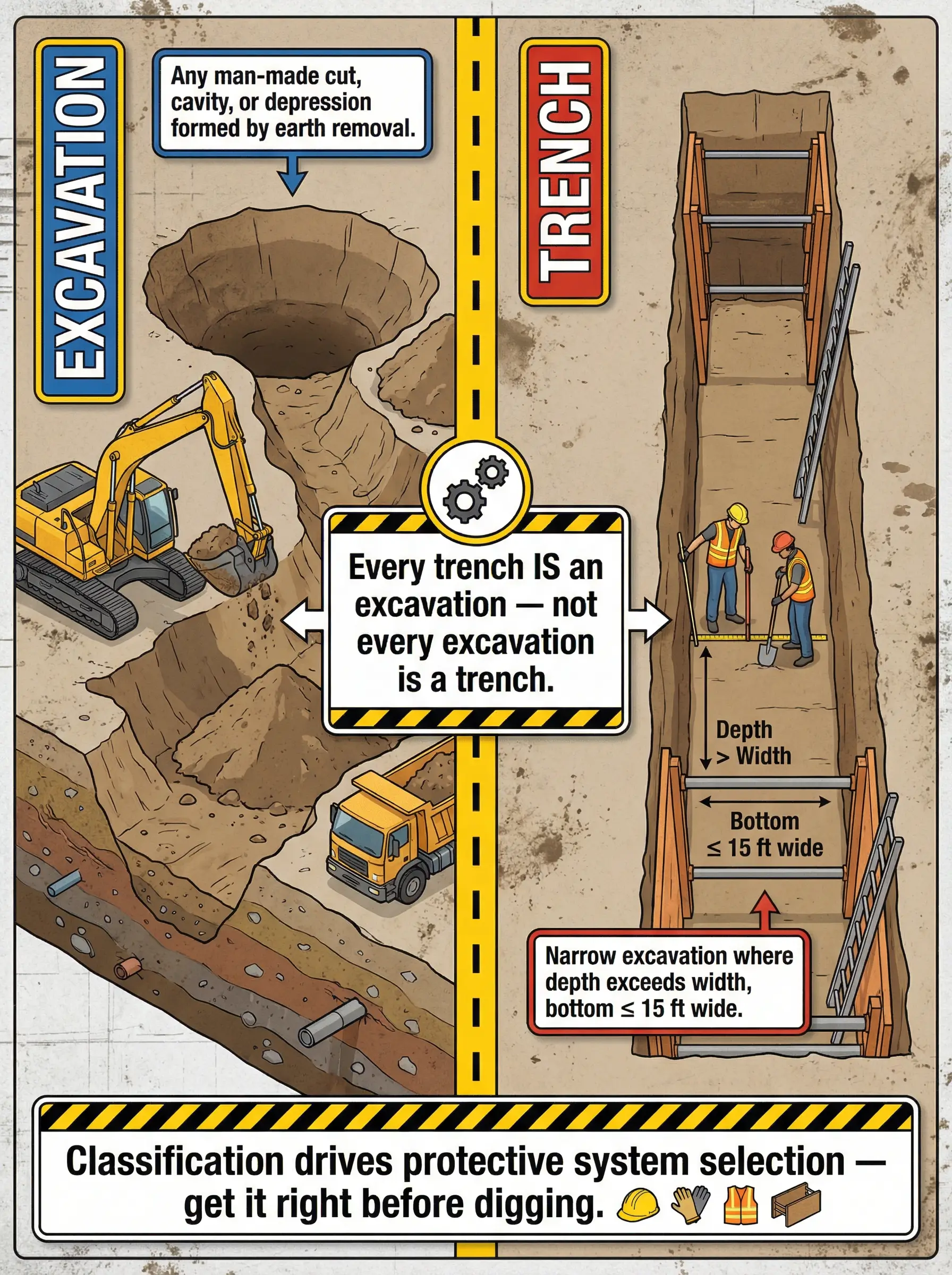
- OSHA defines the boundary clearly: A trench is a narrow excavation where depth exceeds width, and width at the bottom does not exceed 15 feet (4.6 m). Everything else is an excavation.
- Cave-in kills follow classification failures. Workers die in trenches misclassified as general excavations because the wrong protective systems were selected — or none were used at all.
- Protective system requirements differ significantly. Trenches demand shoring, shielding, or sloping once depth reaches 5 feet (1.5 m). General excavations may require benching, engineered retaining systems, or slope stability analysis depending on geometry and soil class.
- Get the classification right before the first bucket of soil moves. Every excavation permit, competent person assessment, and rescue plan flows from this single decision.
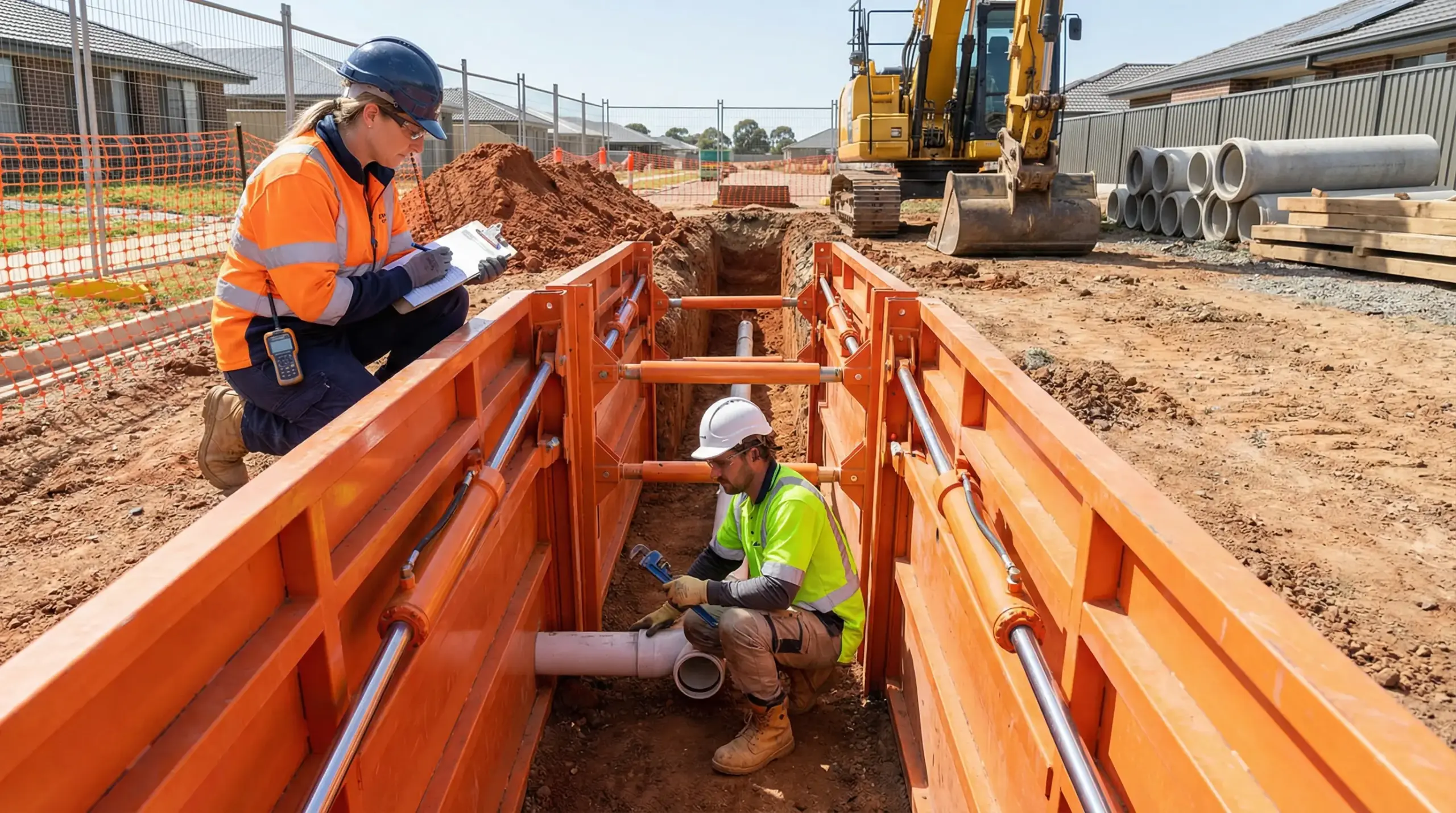
I was called to a residential infrastructure project where a utility crew had opened what they described on their permit as a “general excavation.” Standing at the edge, I looked down at a cut that was barely four feet wide at the bottom and over seven feet deep, with vertical clay walls and no protective system in sight. Three workers were inside, laying a sewer lateral. That was not a general excavation. That was an unprotected trench — and those three men were standing inside a collapse waiting to happen. I stopped the work immediately. The site supervisor argued the point for ten minutes, insisting the permit said “excavation” and that was good enough. It was not good enough. It was wrong, and wrong classifications get people buried alive.
The difference between an excavation and a trench is not academic terminology reserved for safety exams. It is an operational classification that dictates which protective systems are legally required, which hazards dominate, and how rescue plans must be structured. Every year, workers die in trench collapses that were preventable — and a disturbing number of those fatalities trace back to crews that never understood whether they were working in a trench or a general excavation in the first place. This article breaks down the technical, regulatory, and practical differences between excavation and trench work, the specific safety requirements each demands, and the field mistakes that keep turning routine earthwork into fatal incidents.
What OSHA Actually Defines as an Excavation
Before comparing the two terms, the base definition needs to be locked down — because this is where most site-level confusion begins. OSHA’s Excavation Standard, 29 CFR 1926 Subpart P, provides the regulatory framework that governs all excavation and trenching work in construction. The definitions are precise, and they exist for a reason.
Under 29 CFR 1926.650, OSHA defines an excavation as follows:
“Excavation means any man-made cut, cavity, trench, or depression in an earth surface, formed by earth removal.”
That definition is deliberately broad. It covers every scenario where the ground surface is disturbed downward by removing material. The critical elements that qualify a ground disturbance as an excavation under OSHA include:
- Man-made origin: The cut, cavity, or depression must be created by human activity — earth removal through mechanical or manual means. Natural depressions, sinkholes, or erosion channels are not excavations under this standard.
- Formed by earth removal: Material must be physically taken out, not just displaced. Pushing soil sideways to form a berm without creating a below-grade opening does not create an excavation.
- No minimum depth threshold for the definition itself: OSHA’s definition of an excavation does not require a minimum depth. A six-inch-deep utility cut is technically an excavation. However, specific protective system requirements activate at defined depths.
- Includes all geometries: Wide foundation pits, basement digs, pipeline corridors, pond excavations, road cuts, borrow pits, shaft sinkings — if earth was removed to create a below-grade opening, it is an excavation.
The practical takeaway for field supervisors is straightforward. If your crew is removing earth and creating any kind of below-grade opening — regardless of shape, size, or depth — you are working in an excavation, and OSHA Subpart P applies.
Pro Tip: I carry a laminated copy of the 1926.650 definitions in my site bag. When a foreman argues that a shallow foundation dig “isn’t really an excavation,” I hand it to them. The definition does not require depth. It requires earth removal. That ends the argument on the spot.
What Makes a Trench Different from a General Excavation
This is the classification boundary that matters most on site — and the one most frequently misunderstood or ignored. A trench is a specific subset of excavation, defined by its geometry. Getting this distinction wrong does not just create a paperwork issue. It determines whether the correct protective system is deployed, which directly controls whether a cave-in kills someone.
OSHA defines a trench under the same standard:
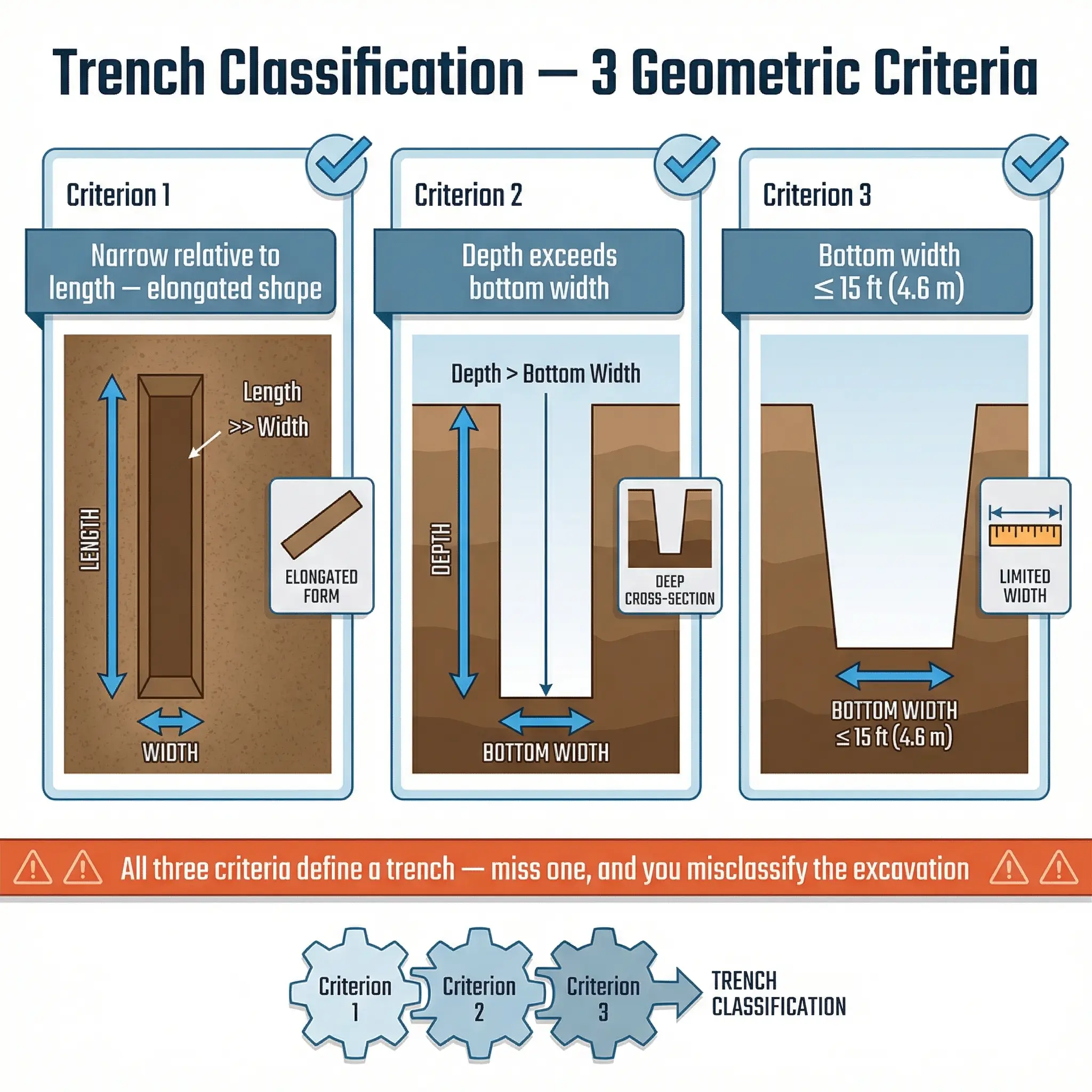
“Trench (trench excavation) means a narrow excavation (in relation to its length) made below the surface of the ground. In general, the depth is greater than the width, but the width of a trench (measured at the bottom) is not greater than 15 feet (4.6 m).”
Three geometric criteria separate a trench from a general excavation. All three must be understood together, not in isolation:
- Narrow relative to length: A trench is elongated — significantly longer than it is wide. Think pipeline corridors, utility runs, drainage channels, and cable routes. A square pit of equal length and width is not a trench, even if it is deep and narrow.
- Depth greater than width: The vertical dimension exceeds the horizontal bottom width. A cut that is 3 feet deep and 6 feet wide at the bottom is not a trench — it is a shallow, wide excavation. A cut that is 6 feet deep and 3 feet wide at the bottom is a trench.
- Bottom width does not exceed 15 feet (4.6 m): Once the bottom width exceeds 15 feet, the excavation can no longer be classified as a trench regardless of depth-to-width ratio. It becomes a general excavation with its own protective system requirements.
The following table clarifies the distinction across common site scenarios:
| Scenario | Depth | Bottom Width | Length | Classification |
|---|---|---|---|---|
| Sewer line installation | 8 ft (2.4 m) | 4 ft (1.2 m) | 200 ft (61 m) | Trench |
| Foundation pit for a building | 10 ft (3 m) | 30 ft (9 m) | 40 ft (12 m) | General Excavation |
| Water main repair | 6 ft (1.8 m) | 3 ft (0.9 m) | 15 ft (4.6 m) | Trench |
| Stormwater retention pond | 12 ft (3.7 m) | 50 ft (15 m) | 80 ft (24 m) | General Excavation |
| Electrical conduit run | 5 ft (1.5 m) | 2 ft (0.6 m) | 300 ft (91 m) | Trench |
| Basement excavation | 9 ft (2.7 m) | 25 ft (7.6 m) | 30 ft (9 m) | General Excavation |
| Gas pipeline crossing | 7 ft (2.1 m) | 5 ft (1.5 m) | 500 ft (152 m) | Trench |
| Wide drainage channel | 6 ft (1.8 m) | 18 ft (5.5 m) | 100 ft (30 m) | General Excavation |
Pro Tip: When I train site crews on this classification, I use one sentence they never forget: “If a worker standing at the bottom can touch both walls by stretching out their arms — and the hole is deeper than it is wide — you are almost certainly in a trench.” It is not a regulatory test, but it triggers the right conversation before work starts.
Why the Classification Matters for Worker Safety
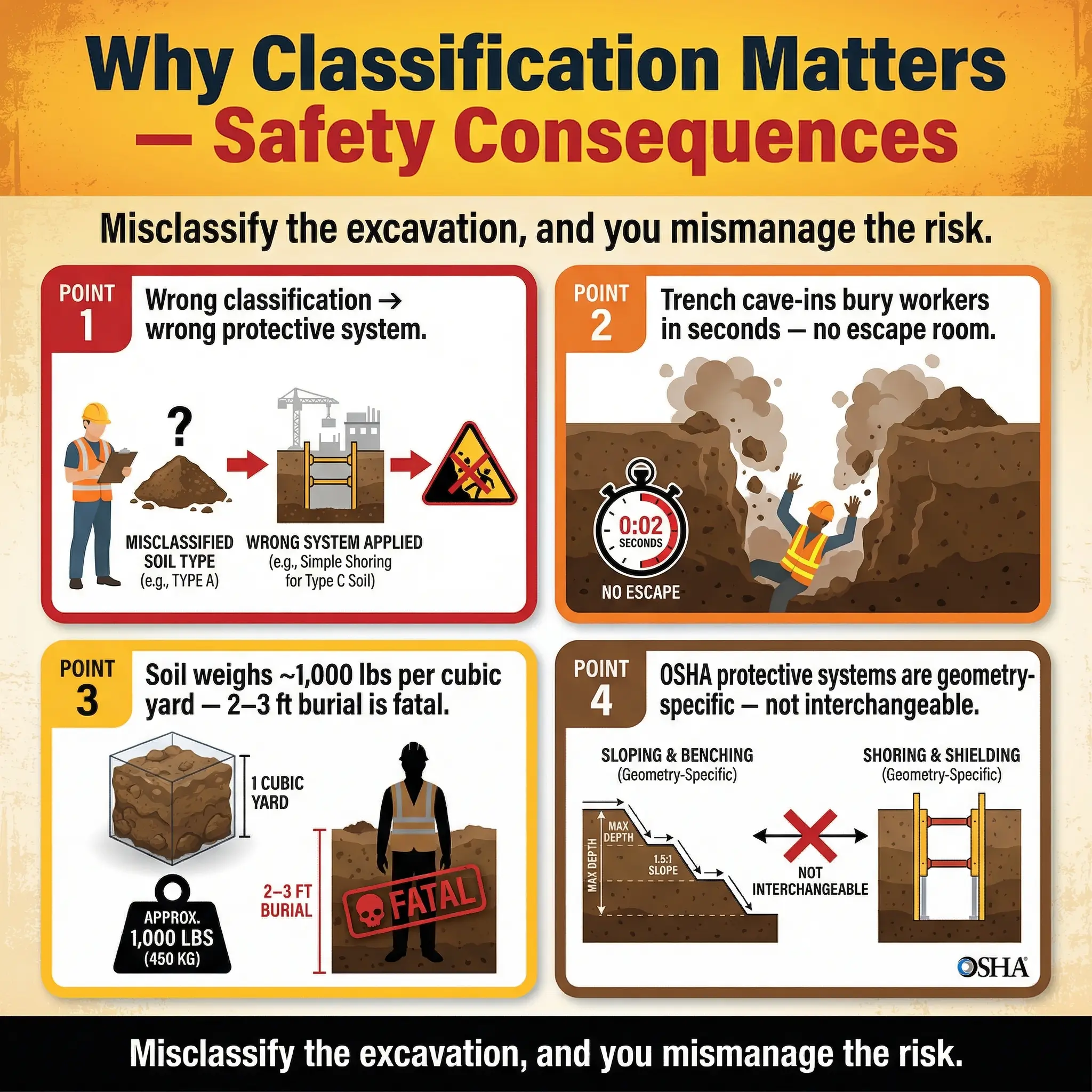
This is not a labeling exercise. The excavation-versus-trench classification drives every downstream safety decision — from protective system selection to rescue planning to competent person responsibilities. Getting it wrong creates a cascading failure that puts lives at immediate risk.
Cave-In Risk Profiles Differ Significantly
The physics of ground collapse behave differently in trenches versus wide excavations, and understanding this difference is the foundation for selecting the right protective system.
- Trench cave-ins are sudden and vertical. In a narrow trench, the dominant failure mode is wall shear — one or both vertical faces collapse inward, burying workers under a mass of soil that can weigh over 1,000 pounds per cubic yard. The narrow geometry means the falling soil fills the working space almost instantly. There is no room to run, no time to react. A worker buried under just two to three feet of soil in a trench cannot self-extricate and will suffocate within minutes.
- General excavation failures tend to be rotational or translational. In wider excavations, slope failure often follows a curved slip surface — a mass of soil rotates or slides along an arc. This can involve much larger volumes of material, but workers may have slightly more lateral space to move. The failure is still deadly, but the mechanism and the protective system response differ.
- Trench geometry concentrates the burial zone. Because the working space is narrow, there is almost no survivable zone during a collapse. In a wide excavation, workers at the center may be outside the initial failure zone of a wall collapse. In a trench, every worker is within the collapse zone at all times.
Protective System Requirements Are Not Interchangeable
OSHA Subpart P mandates specific protective systems based on the type of excavation, soil classification, and depth. The requirements for trenches are detailed and prescriptive. Applying general excavation controls to what is actually a trench — or vice versa — creates a compliance gap that can be fatal.
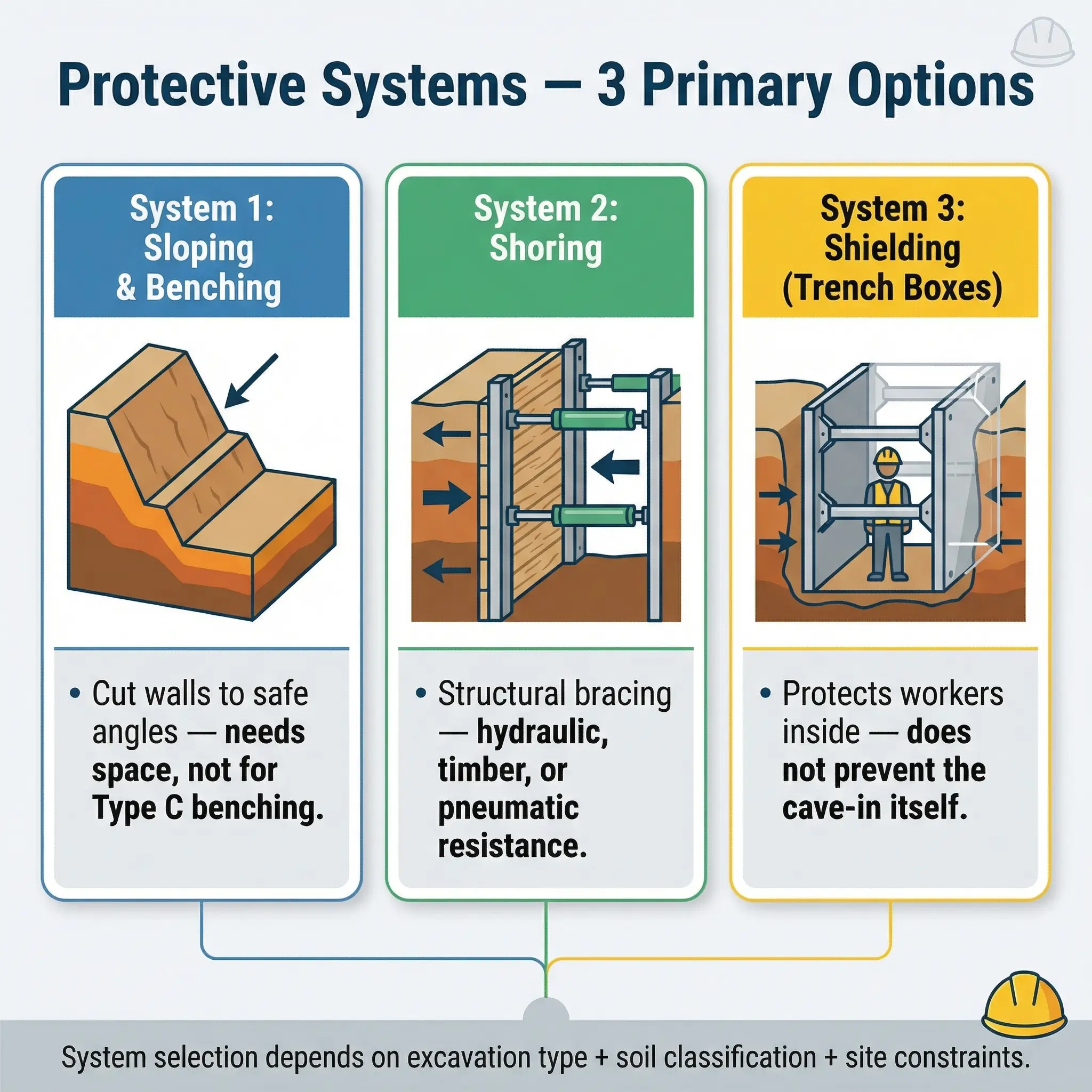
- Trenches ≥ 5 feet (1.5 m) deep require a protective system unless the excavation is made entirely in stable rock. The three acceptable options are sloping and benching the sides to acceptable angles, shoring the walls with hydraulic, pneumatic, or timber systems, or shielding workers with trench boxes (trench shields).
- General excavations ≥ 20 feet (6.1 m) deep require a system designed by a registered professional engineer. Excavations between 5 and 20 feet deep must use protective systems based on OSHA’s Appendix A (soil classification), Appendix B (sloping and benching), Appendix C (timber shoring), Appendix D (aluminum hydraulic shoring), or Appendix E (alternatives designed by a registered PE).
- Trench boxes are specifically designed for trench geometry. A standard trench shield is engineered to resist lateral soil pressure in a narrow excavation. Using one in a wide excavation where the failure mechanism is different may not provide adequate protection — and using a wide-excavation slope design in a narrow trench ignores the specific shear failure risks of narrow geometry.
OSHA 29 CFR 1926.652(a)(1): “Each employee in an excavation shall be protected from cave-ins by an adequate protective system designed in accordance with paragraph (b) or (c) of this section except when: (i) Excavations are made entirely in stable rock; or (ii) Excavations are less than 5 feet (1.52m) in depth and examination of the ground by a competent person provides no indication of a potential cave-in.”
Soil Classification — The Second Critical Variable
Classification does not stop at excavation geometry. Soil type determines which protective systems are permitted and at what angles or configurations. A competent person must classify the soil before any worker enters an excavation deeper than five feet — and I have seen this step skipped, faked, and rushed more times than I care to count.
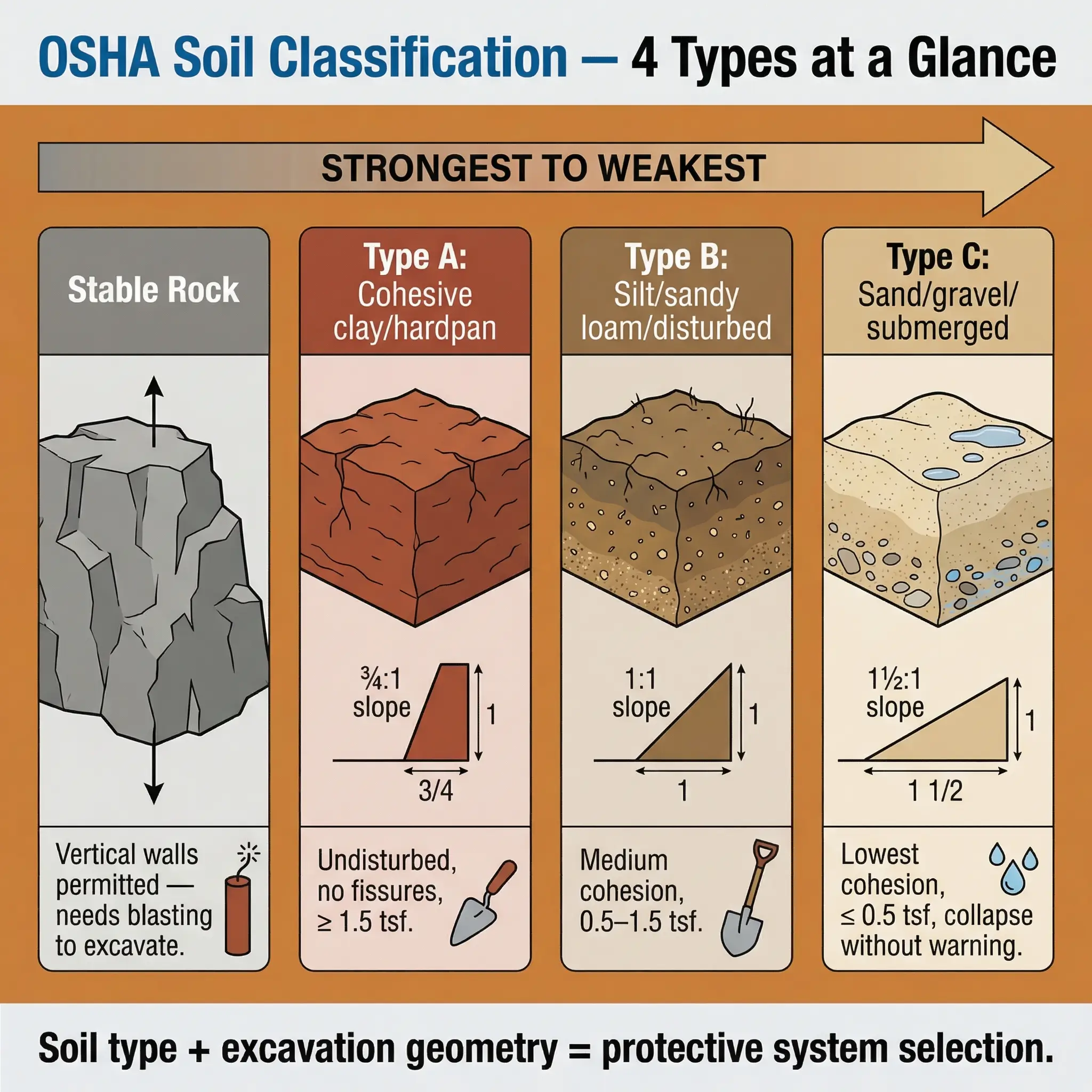
OSHA Appendix A to Subpart P establishes four soil classifications. Each classification changes the allowable slope angles, shoring requirements, and shield specifications for both trenches and general excavations:
| Soil Type | Description | Maximum Allowable Slope (H:V) | Field Characteristics |
|---|---|---|---|
| Stable Rock | Natural solid mineral matter | Vertical (90°) | Cannot be excavated without blasting or mechanical breaking |
| Type A | Cohesive soils — clay, silty clay, hardpan | ¾:1 (53°) | Unconfined compressive strength ≥ 1.5 tsf; no fissures; not previously disturbed |
| Type B | Medium cohesion — silt, sandy loam, previously disturbed Type A | 1:1 (45°) | Unconfined compressive strength 0.5–1.5 tsf; granular cohesionless soils near water |
| Type C | Low or no cohesion — gravel, sand, loamy sand, submerged soil | 1½:1 (34°) | Unconfined compressive strength ≤ 0.5 tsf; freely seeping water; submerged conditions |
The relationship between soil classification and excavation type creates a matrix of requirements that every competent person must navigate. A few field realities are worth highlighting:
- Type C soil in a trench is the highest-risk combination. Granular, non-cohesive material in a narrow excavation can collapse without warning — no visible cracking, no gradual deformation. The wall simply shears and drops. I investigated a fatality on a water main project where a trench in sandy loam collapsed while the crew was on a lunch break. When they returned, the trench walls had caved in completely. Had they been inside, at least two workers would have been buried.
- “Type A” is rarer than supervisors think. OSHA’s definition of Type A requires undisturbed, unfissured, cohesive soil with no vibration sources nearby and no water seepage. The moment heavy equipment is running adjacent to the trench, or the soil has been previously excavated, or there are fissures visible — it cannot be classified as Type A. I have reviewed excavation permits where Type A was checked despite backhoe traffic within ten feet and visible cracking on the trench face. That is not Type A. That is wishful thinking.
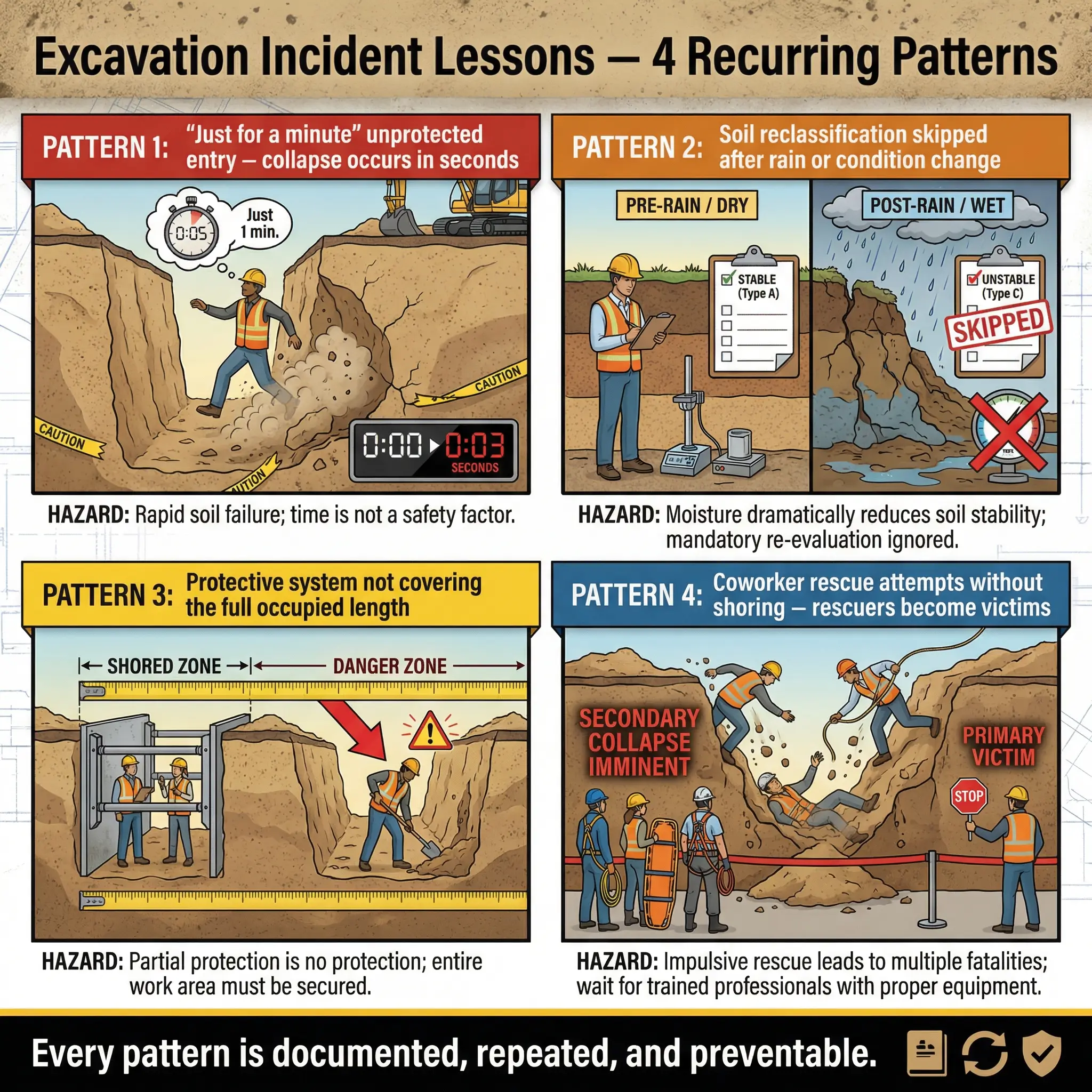
- Soil conditions can change during the work. Rain, vibration from traffic or equipment, dewatering operations, and temperature changes can degrade soil from Type B to Type C within hours. The competent person must reassess soil conditions continuously — not just once at the start of the shift.
Pro Tip: When I audit excavation sites, the first thing I ask the competent person is: “Show me how you classified this soil.” If they cannot describe the field tests they performed — thumb penetrometer, pocket vane shear, visual and manual analysis per Appendix A — the classification is unreliable. A checkbox on a permit without a field test behind it is not a classification. It is a guess.
Protective Systems — What Each Classification Demands
Once the excavation is classified as a trench or general excavation and the soil type is determined, the protective system selection follows. This is the point where the excavation-versus-trench distinction has direct, physical consequences for every worker below grade. The wrong system — or no system — is the leading cause of excavation fatalities.
Sloping and Benching
Sloping involves cutting back the excavation walls at angles determined by soil type to prevent collapse. Benching creates a series of horizontal steps in the excavation face. Both methods rely on geometry to reduce lateral soil pressure. The specific requirements differ between trenches and general excavations:
- In trenches, sloping must follow the maximum allowable slopes in OSHA Appendix B or be designed by a registered PE. Benching is not permitted in Type C soil because the granular material will not hold a vertical bench face — it simply collapses.
- In general excavations, sloping angles follow the same soil-type tables, but the wider geometry may allow for combined sloping-and-benching configurations. Engineered slope stability analysis becomes more critical as excavation width and depth increase.
- Sloping requires significant additional width. A 10-foot-deep trench in Type C soil requires a slope of 1½:1, meaning the top of the excavation must be 30 feet wider than the bottom. In congested urban sites, this space simply does not exist — which is why shoring or shielding becomes the only viable option.
Shoring Systems
Shoring uses structural members — timber, aluminum hydraulic, or pneumatic shores — to brace the excavation walls and prevent inward collapse. Shoring is the active structural resistance approach, and it is most commonly associated with trench work:
- Timber shoring follows OSHA Appendix C tables, which specify member sizes based on soil type and trench depth. Timber is labor-intensive to install and is increasingly rare on modern sites, but it remains a compliant option.
- Aluminum hydraulic shoring follows Appendix D and is the most common trench shoring system in current practice. Hydraulic cylinders are placed horizontally between vertical rails or waler plates to resist lateral pressure. Installation and removal can be done from outside the trench — a critical safety advantage.
- Pneumatic shoring uses air-pressurized struts and is less common but used in specific applications where hydraulic fluid contamination is a concern.
Shielding (Trench Boxes)
Trench shields — also called trench boxes — are the most widely used protective system in trench work across the construction industry. They do not prevent cave-ins. They protect the workers inside the shield from being crushed if a cave-in occurs. This distinction is important:
- Trench shields must be rated for the soil type and trench depth. A shield designed for Type B soil at 8 feet cannot be used in Type C soil at 12 feet. The manufacturer’s tabulated data specifies the maximum depth and soil type for each shield model.
- Shields must extend at least 18 inches above the surrounding grade or the trench must have no more than 2 feet of material between the top of the shield and the surrounding grade to prevent material from rolling over the top and onto workers.
- Workers must never be inside the trench while the shield is being moved. I have witnessed crews riding inside trench boxes as they were dragged forward by an excavator — a blatant violation that puts workers at risk of being caught between the shield and the trench wall if the box shifts or jams.
- Stacking trench boxes to achieve greater depth protection is permitted only if the manufacturer certifies the stacked configuration and the connection hardware is properly installed.
OSHA 29 CFR 1926.652(c)(4): “Shield systems shall not be subjected to loads exceeding those which the system was designed to withstand.”
Common Field Mistakes That Kill Workers
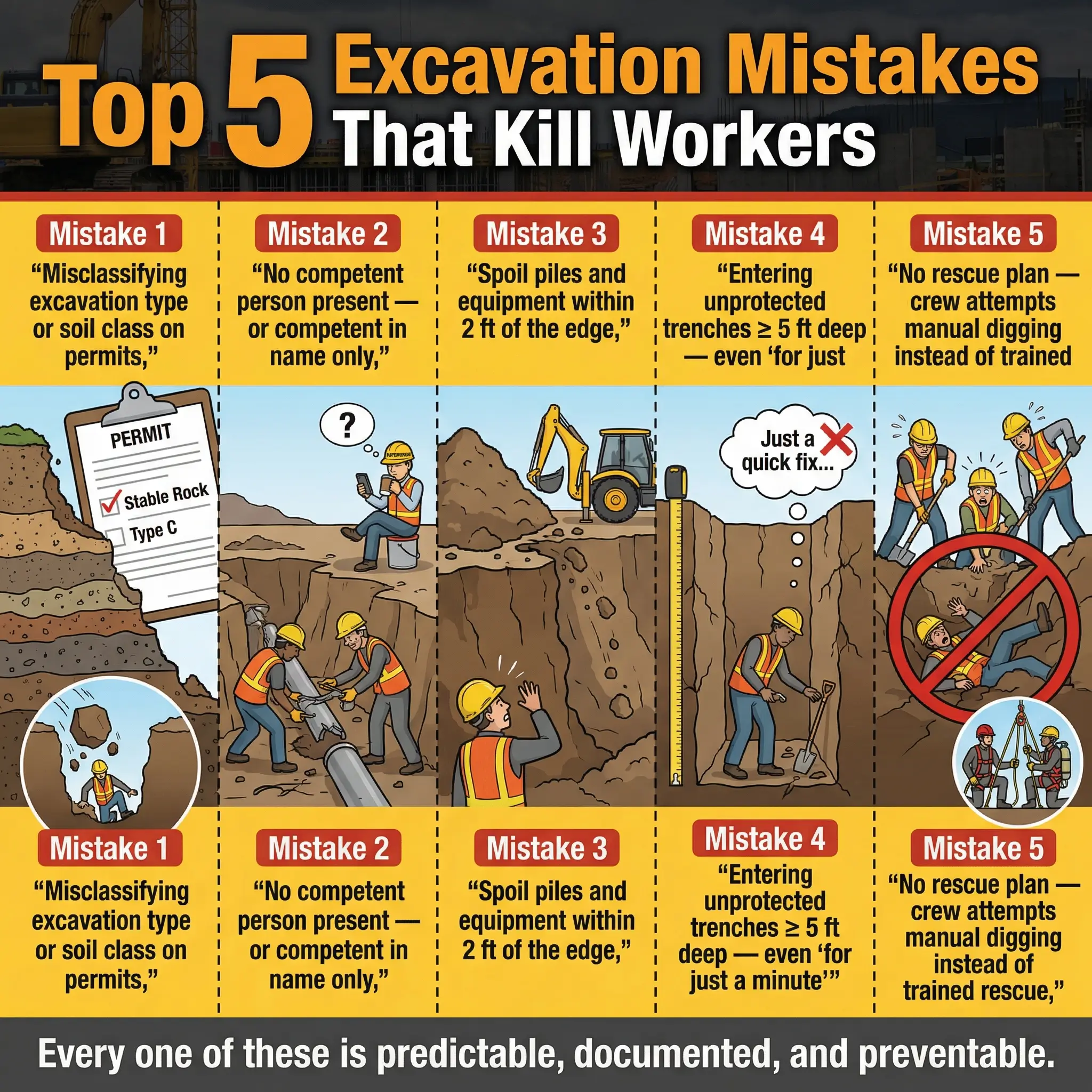
After investigating and reviewing dozens of excavation incidents across construction and utility projects, the same failures appear with disturbing regularity. These are not obscure technical oversights. They are predictable, preventable, and well-documented mistakes that continue to kill workers because they are repeated on sites every day.
Misclassification and Paperwork Substitution
The most dangerous mistake happens before any worker enters the excavation. When the excavation type or soil class is wrong on the permit, every downstream safety decision is compromised:
- Calling a trench a “general excavation” to avoid trench-specific requirements. I have seen permits where narrow, deep utility cuts were classified as general excavations because the supervisor believed trench boxes would slow production. The geometry was clearly a trench. The permit said otherwise. The protective system was absent.
- Defaulting to Type A soil without field testing. Type A is the least restrictive classification and allows the steepest slopes. It is also the hardest to justify in the field. Sites routinely mark Type A on permits for convenience, ignoring fissures, prior disturbance, adjacent vibration, or seepage that should downgrade the classification.
- Using yesterday’s permit for today’s conditions. Soil conditions change. A trench that was stable in dry Type B material at 08:00 may be saturated Type C by 14:00 after a rain event. Permits must reflect current conditions — not conditions that existed when the permit was first written.
Inadequate or Absent Competent Person
OSHA requires a competent person to inspect excavations daily, after rain events, and after any condition change. The competent person must have the authority to stop work immediately. In practice, the competent person requirement is one of the most frequently violated provisions in Subpart P:
- Assigning the title without the training. A foreman designated as the “competent person” on paper but who cannot describe soil classification methods, recognize tension cracks, or identify seepage-induced instability is not competent. The title is meaningless without the knowledge and authority behind it.
- Competent person not present during the work. The standard requires inspection and oversight — not a signature at the start of the shift followed by departure to another work area. I have audited sites where the named competent person was on a different part of the project entirely while workers were inside an unprotected trench.
- Failure to stop work when conditions change. Even when a competent person recognizes deteriorating conditions — cracking at the trench edge, water seepage, surcharge loads being placed too close — production pressure can override the stop-work decision. This is a leadership failure, not a technical one.
Spoil Pile Placement and Surcharge Loading
The soil removed from an excavation has to go somewhere — and where it goes directly affects the stability of the excavation walls. OSHA requires spoil piles to be set back at least 2 feet (0.6 m) from the edge of the excavation. This requirement is violated on virtually every poorly managed excavation site I have inspected:
- Spoil piled directly at the trench edge adds surcharge loading to the wall, dramatically increasing the lateral pressure on the soil face. In a narrow trench, this additional load can trigger a wall collapse that would not have occurred otherwise.
- Heavy equipment operating too close to the edge. Excavators, dump trucks, and pipe-laying equipment positioned near the trench lip impose dynamic and static surcharge loads that exceed what sloping or shoring systems were designed to resist.
- Materials and pipe sections stored within the 2-foot setback zone. Even relatively light materials, when concentrated at the trench edge, add cumulative load that degrades wall stability.
Rescue Planning — Where the Trench Distinction Becomes Life or Death
Rescue in a trench collapse and rescue in a general excavation collapse are fundamentally different operations. The narrow geometry of a trench creates a burial pattern that is compact, deep, and suffocating. The rescue approach must match the scenario — and having the wrong plan, or no plan at all, turns a survivable burial into a fatality.
When a trench wall collapses onto a worker, the following realities govern the rescue timeline and approach:
- Suffocation is the primary killer, not crush injury. Soil compresses the chest, preventing the lungs from expanding. A buried worker can lose consciousness within 3–5 minutes and die within 6–10 minutes if the chest is not freed. This is not a timeline that permits improvisation.
- Manual digging is almost always too slow and too dangerous. Well-intentioned coworkers who jump into a collapsed trench to dig with shovels are at extreme risk of secondary collapse — the wall that buried the first worker is likely to continue failing. Rescue attempts have killed more rescuers than original victims in multiple documented incidents.
- Trench rescue requires shoring the collapse zone before accessing the victim. Rescue teams must install emergency shoring panels around the burial site to stabilize the remaining walls before beginning to excavate the victim. This requires specialized equipment and training.
- General excavation collapses may allow approach from multiple angles. In wider excavations, rescue teams have more options for safe access routes, equipment staging, and victim approach vectors. The physics of the rescue are different because the geometry provides more working space.
A functional rescue plan for trench work must address several elements that general excavation plans may not require:
- On-site retrieval systems — including rescue tripods and mechanical winches at the trench opening — positioned before any worker enters
- Emergency contact and response time — documented evidence that a trained trench rescue team can reach the site within the survivable window, typically under 20 minutes
- Prohibition on untrained entry — an explicit standing order that no worker enters a collapsed trench without shoring and trained rescue coordination
- Pre-positioned emergency shoring panels — available at the worksite, not stored at a depot 30 minutes away
Pro Tip: During a confined space and excavation safety audit on a highway expansion project, I asked the site supervisor where their trench rescue shoring was stored. He pointed to a shipping container at the project office — a 15-minute drive from the active trench. That equipment might as well have been on the moon. If the rescue gear is not at the trench, the rescue plan is fiction. I required the shoring panels moved to within 50 meters of the active work zone before the permit was reissued.
The Competent Person — Gatekeeper for Both Classifications
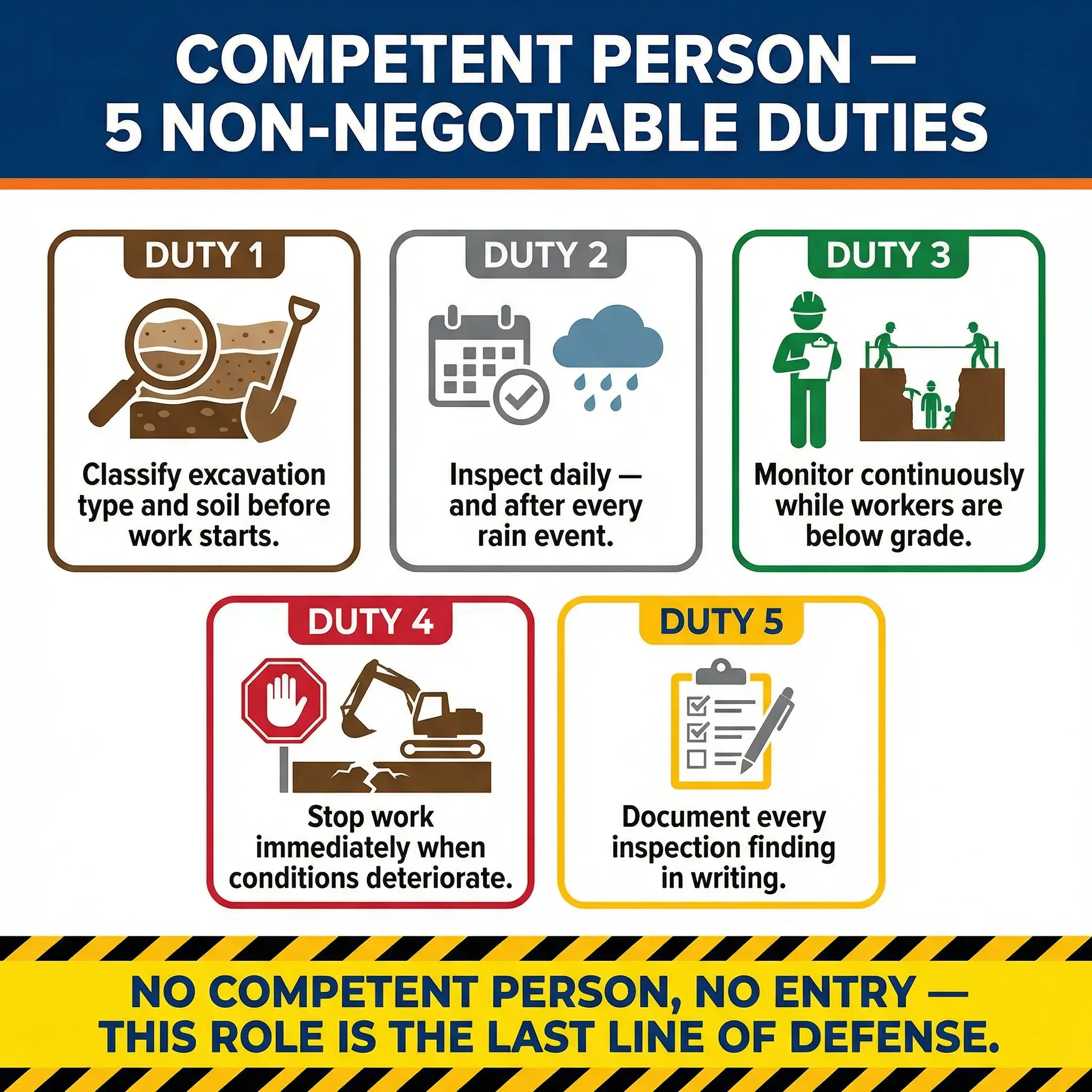
OSHA places the competent person at the center of every excavation safety decision. This role is not optional, not delegable to someone without the right knowledge, and not reducible to a signature on a form. The competent person is the single individual who must classify the excavation, classify the soil, select or verify the protective system, inspect conditions, and exercise stop-work authority. For both trenches and general excavations, this role is the last line of defense.
The specific competent person responsibilities differ slightly between trench and general excavation work, but the core duties are non-negotiable:
- Daily inspections before work begins — checking for evidence of wall movement, tension cracks at the surface, water accumulation, changes in soil conditions, and spoil pile encroachment
- Inspections after every rain event — even light rain can saturate cohesive soils and change the classification from Type B to Type C
- Continuous monitoring during the work — not a single check-in, but ongoing presence and observation while workers are below grade
- Authority to remove workers immediately — without requiring supervisor approval, project manager sign-off, or client consultation. If the competent person says “everybody out,” everybody gets out. No exceptions, no negotiation.
- Documentation of all inspections and findings — written records that can withstand regulatory scrutiny during an OSHA inspection or post-incident investigation
OSHA 29 CFR 1926.651(k)(1): “Daily inspections of excavations, the adjacent areas, and protective systems shall be made by a competent person for evidence of a situation that could result in possible cave-ins, indications of failure of protective systems, hazardous atmospheres, or other hazardous conditions.”
Side-by-Side Comparison — Excavation vs. Trench
The following table consolidates the key technical, regulatory, and safety differences between a general excavation and a trench. This is the reference most supervisors and competent persons need in the field — a single view of what applies to each classification.
| Criteria | General Excavation | Trench |
|---|---|---|
| OSHA Definition | Any man-made cut, cavity, or depression formed by earth removal | Narrow excavation; depth > width; bottom width ≤ 15 ft |
| Geometry | Any shape — wide pits, basements, ponds, borrow pits | Elongated, narrow; length significantly exceeds width |
| Protective System Trigger | ≥ 5 ft depth (same as trench) | ≥ 5 ft depth unless entirely in stable rock |
| Common Protective Systems | Sloping, benching, engineered retaining walls, soil nails | Sloping, shoring (hydraulic/timber), trench shields (boxes) |
| Trench Box Applicability | Generally not designed for wide excavation geometry | Primary shielding method — designed specifically for trench width |
| Benching in Type C Soil | Permitted with engineered design in some configurations | Not permitted — Type C soil will not hold a bench face |
| Primary Collapse Mechanism | Rotational or translational slope failure | Vertical wall shear — sudden inward collapse |
| Burial Risk | Workers may be outside initial failure zone | Every worker is within the collapse zone at all times |
| Rescue Approach | Multiple access angles possible; wider staging area | Narrow geometry — requires emergency shoring before victim access |
| Typical Applications | Foundation pits, basements, ponds, road cuts, shaft sinking | Utility trenches, pipeline corridors, sewer lines, cable runs |
| PE Design Requirement | Mandatory for depths ≥ 20 ft | Mandatory for depths ≥ 20 ft or when using alternative systems |
| Spoil Pile Setback | ≥ 2 ft from edge | ≥ 2 ft from edge — more critical due to narrow geometry |
Real Incident Patterns — Lessons from the Field
Theory and regulation only go so far. The real education happens in the aftermath of incidents — when you walk a site that went wrong and reconstruct exactly how a preventable death occurred. The patterns across trench and excavation fatalities are remarkably consistent, and they reinforce why the classification distinction matters in practice.
The “Just for a Minute” Trench Entry
On a municipal water line project I reviewed in the southern United States, a crew had been using a trench box properly for two days of pipe installation. On day three, the box was repositioned forward, leaving a 12-foot section of unshielded trench behind it. A pipe fitter entered the unshielded section “just for a minute” to tighten a joint fitting. The trench wall collapsed 90 seconds after he entered. He was buried to the chest. Coworkers managed to free him, but he spent three days in the hospital with crush injuries to his lower torso.
The lessons from this incident — and dozens like it — apply directly to the trench classification:
- The protective system must cover the entire occupied length of the trench at all times. A trench box that protects workers in one section does not protect workers who step outside it. Unshielded trench sections are unprotected trenches — full stop.
- “Just for a minute” is the most dangerous phrase in excavation safety. Soil does not wait. Wall failure can occur in seconds, with no warning signs. Duration of exposure does not reduce risk — only the protective system reduces risk.
- Coworker rescue attempts are high-risk. The workers who jumped in to dig him out were lucky the secondary collapse did not bury them as well. Without emergency shoring, they were gambling their lives on wall stability that had already failed once.
The Wide Excavation Slope Failure
On a commercial building project in Northern Europe, a foundation pit was excavated to 14 feet in mixed fill and clay. The excavation was correctly classified as a general excavation — bottom width exceeded 20 feet. Slopes were cut at 1:1, appropriate for Type B soil. However, three days of continuous rain saturated the upper fill layer, effectively converting it to Type C. The competent person noted “soft ground” in the daily log but did not reclassify the soil or adjust the slope angle. On day four, a rotational failure sent approximately 40 cubic meters of saturated fill into the pit. Two workers were struck by the sliding mass — one suffered a fractured pelvis, the other escaped with bruising.
The failure traced to a classification that was correct on day one but not updated as conditions changed:
- Soil classification is not a one-time event. Environmental changes — rain, dewatering, temperature — can degrade soil class within hours. The competent person must reassess after every significant condition change.
- “Soft ground” in a daily log is not a reclassification. Recognizing deterioration without acting on it is a documentation of negligence, not a demonstration of competence. The correct response was to reclassify the soil, recalculate the slope angle, and either re-cut the slopes or evacuate the pit until conditions improved.
- Wide excavation collapses move large volumes. The rotational failure displaced enough material to fill a dump truck. The energy and mass involved in a wide-excavation slope failure can be enormous — even when the failure looks gradual rather than sudden.
Regulatory Summary — Key OSHA Subpart P Provisions
For quick field reference, the following provisions of 29 CFR 1926 Subpart P are the most directly relevant to the excavation-versus-trench distinction and the protective system requirements that flow from it:
- 1926.650 — Scope, Application, and Definitions: Establishes the definitions of excavation and trench. This is where the classification begins.
- 1926.651 — Specific Excavation Requirements: Covers competent person duties, daily inspections, access and egress (ladders/ramps within 25 feet of lateral travel for trenches ≥ 4 feet deep), surface encumbrances, underground installations, water accumulation, and hazardous atmospheres.
- 1926.652 — Requirements for Protective Systems: The operational core of Subpart P. Specifies when protective systems are required (≥ 5 feet depth), the three options (sloping/benching, shoring, shielding), and the design requirements for each.
- Appendix A — Soil Classification: Defines soil types, field testing methods, and the classification criteria that control slope angles and shoring specifications.
- Appendix B — Sloping and Benching: Provides maximum allowable slopes by soil type and illustrates acceptable benching configurations.
- Appendix C — Timber Shoring for Trenches: Tabulated data for timber shoring member sizes by soil type and trench depth.
- Appendix D — Aluminum Hydraulic Shoring for Trenches: Tabulated data for hydraulic shoring configurations.
- Appendix E — Alternatives to Timber Shoring: Allows registered PE-designed alternative shoring systems.
- Appendix F — Selection of Protective Systems: Decision-making flowchart for protective system selection based on soil type and excavation geometry.
Conclusion
The difference between an excavation and a trench is one sentence in the OSHA standard — but it controls an entire chain of safety decisions that determine whether workers come out of the ground alive. A trench is a narrow excavation where depth exceeds width and the bottom is no wider than 15 feet. Every other man-made cut, cavity, or depression formed by earth removal is a general excavation. That geometric classification drives protective system selection, soil classification requirements, rescue planning, and competent person responsibilities. Getting it wrong — through ignorance, convenience, or production pressure — is the first link in a failure chain that has buried and killed workers on sites where the correct protective system would have taken an extra 30 minutes to install.
I have stood at the edge of collapsed trenches and reviewed the permits that were issued before the wall came down. In almost every case, the classification was either wrong, vague, or based on a soil assessment that was never actually performed in the field. These are not complicated decisions. They require a competent person who knows the definitions, performs the field tests, selects the right system, and has the authority and the backbone to stop work when conditions change. The geometry of the excavation is visible. The soil can be tested with basic instruments. The protective system tables are published and accessible. There is no mystery in excavation safety — only the decision to do it correctly or to gamble.
No production schedule, no project deadline, and no budget constraint is worth a human life buried under a wall of soil. Every excavation — whether a two-hundred-meter pipeline trench or a ten-meter foundation pit — deserves the right classification, the right protective system, and a competent person who treats the role as a responsibility, not a checkbox. The ground does not negotiate. It does not wait. It does not care about your schedule. Classify the excavation correctly, protect the workers inside it, and make the decision to do it right before the first bucket of soil moves — because there is no second chance once the wall comes down.