

TL;DR
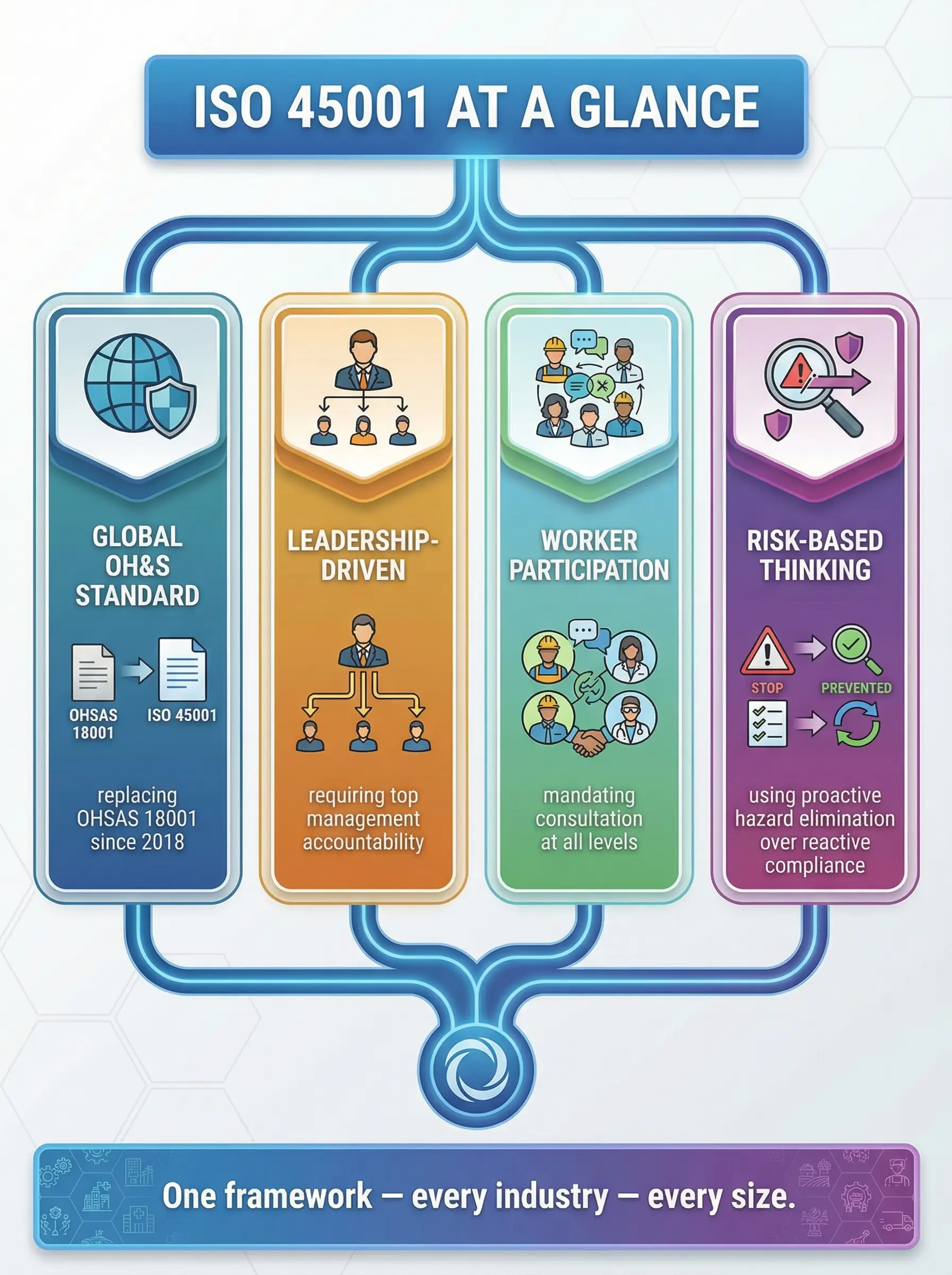
- ISO 45001 is the global benchmark for occupational health and safety management systems. It replaced OHSAS 18001 in 2018 and applies to any organization, any size, any industry — providing a structured framework to prevent work-related injury, illness, and death.
- The standard demands leadership accountability, not just safety department paperwork. Top management must own OH&S performance, allocate resources, and integrate safety into business strategy — not delegate it downward and walk away.
- Worker participation is embedded as a requirement, not a suggestion. ISO 45001 mandates consultation and involvement of workers at every level in hazard identification, risk assessment, and system planning.
- Certification delivers measurable operational and commercial benefits. Organizations consistently report reduced incident rates, lower insurance premiums, stronger regulatory standing, improved tender competitiveness, and a culture shift that moves safety from compliance to conviction.
- Transition from OHSAS 18001 ended in March 2021. Any organization still referencing OHSAS 18001 certification is holding an expired credential with zero international recognition.
I was sitting across from a plant director at a chemical manufacturing facility in the Gulf when he slid a bound document across the table — their “safety management system.” It was 400 pages of procedures nobody read, signed off by people who had never walked the production floor. Three months earlier, a contractor had suffered chemical burns during a routine transfer operation. The investigation traced the failure through missing risk assessments, untrained operators, no management of change process, and a permit system that existed on paper but collapsed in practice. The system looked impressive on a shelf. On the ground, it was hollow.
That gap — between documented safety systems and actual operational safety — is precisely what ISO 45001 was designed to close. This standard is not another binder of procedures. It is the internationally recognized framework for building an occupational health and safety management system that actually functions under real operational pressure. This article breaks down what ISO 45001 means in practice, what the standard requires clause by clause, how certification works, and whether the investment delivers real returns. If you manage safety, audit safety, or make decisions about safety resources, this is the framework you need to understand from the inside — not from a brochure.
What Is ISO 45001? Definition and Core Purpose
ISO 45001 is the international standard for occupational health and safety management systems (OH&S MS), published by the International Organization for Standardization in March 2018. It provides a structured framework that organizations use to proactively improve worker safety, reduce workplace risks, and create healthier working conditions. The standard applies to any organization regardless of size, type, or industry — from a five-person fabrication shop to a multinational energy corporation operating across 30 countries.
The core purpose can be stated plainly: ISO 45001 exists to prevent work-related death, injury, and illness by giving organizations a systematic, auditable, and continuously improving approach to managing occupational health and safety risks.
A few distinctions separate ISO 45001 from generic “safety programs” that many organizations run informally. These differences matter because they determine whether a system actually protects workers or simply generates paperwork.
- It is a management system, not a checklist. ISO 45001 requires integration of OH&S into organizational processes, business planning, and leadership decision-making — not a standalone safety department operating in isolation.
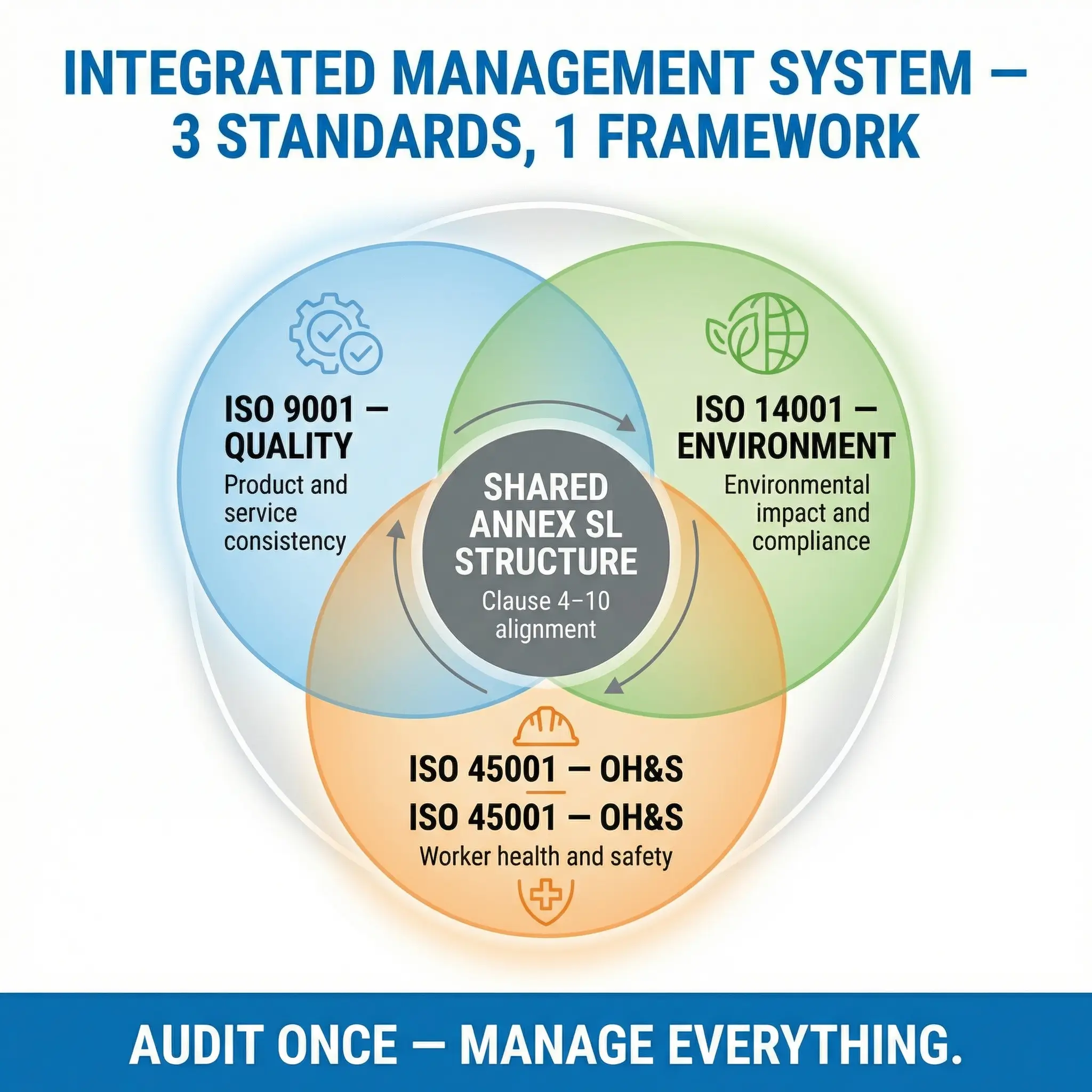
- It follows the Annex SL high-level structure. This means ISO 45001 shares the same clause structure as ISO 9001 (Quality) and ISO 14001 (Environmental), making integration into existing management systems straightforward for organizations already certified to those standards.
- It is risk-based, not prescriptive. The standard does not tell you which PPE to buy or how high your guardrails should be. It requires you to identify hazards, assess risks, determine controls, and verify their effectiveness — tailored to your specific operations.
- It replaced OHSAS 18001 permanently. The migration deadline passed in March 2021. OHSAS 18001 certificates are no longer valid, and any organization claiming current OHSAS 18001 certification is operating on an expired credential.
ISO 45001:2018, Clause 1 — Scope: “This document specifies requirements for an occupational health and safety management system… to enable an organization to proactively improve its OH&S performance in preventing injury and ill health.”
Pro Tip: When I audit organizations transitioning from informal safety programs to ISO 45001, the single biggest mental shift required is understanding that ISO 45001 is not about adding safety activities — it is about embedding safety into how the business already operates. If your safety system runs parallel to your operations rather than through them, you have not implemented ISO 45001. You have created a shadow system.
ISO 45001 vs. OHSAS 18001 — What Actually Changed
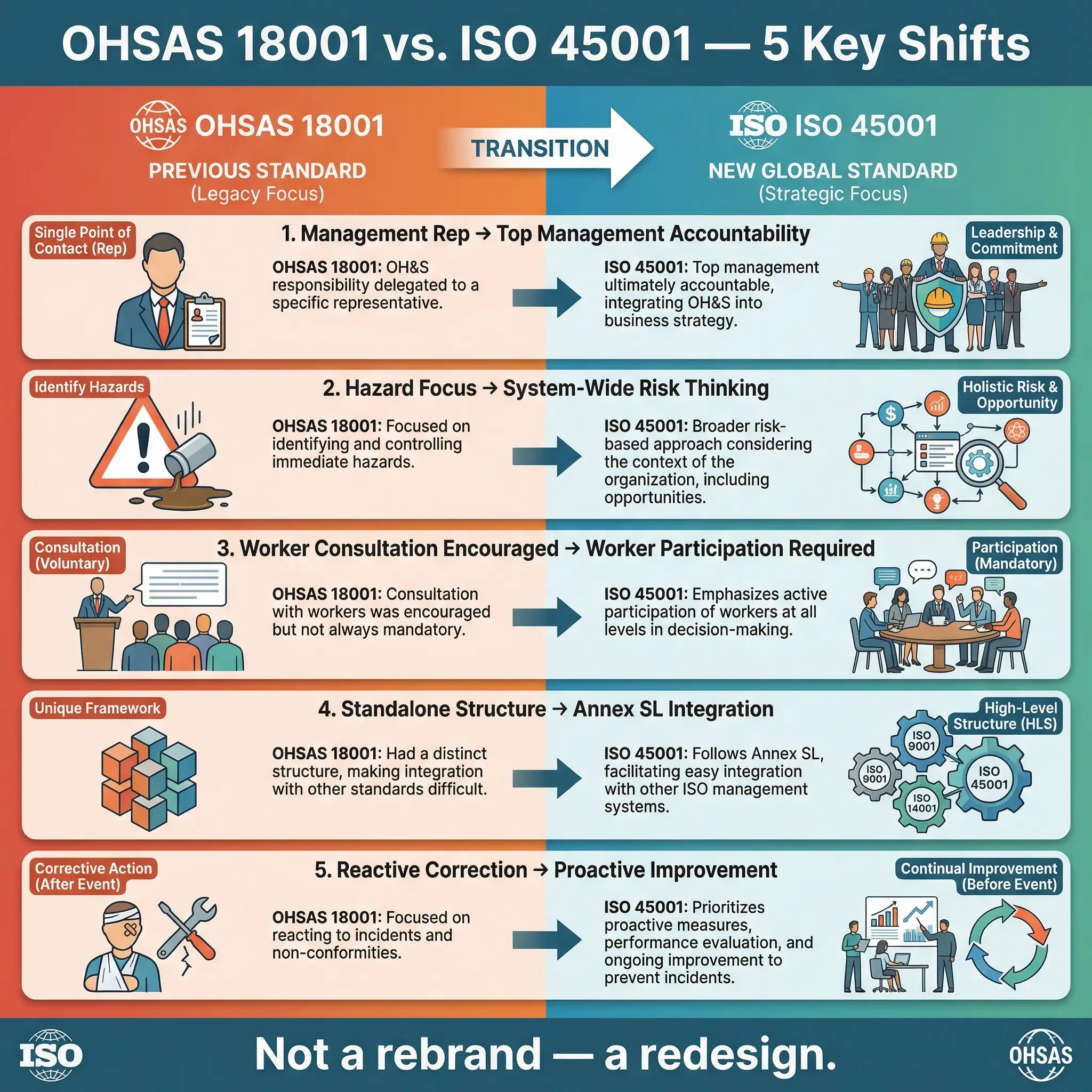
Many organizations treated the transition from OHSAS 18001 to ISO 45001 as a documentation update — swap the logos, renumber the clauses, pass the audit. I audited several organizations during the transition window, and those that took this approach failed their Stage 2 certification audits. The changes between the two standards are structural, not cosmetic.
The following table captures the most significant differences that affect real implementation on the ground.
| Aspect | OHSAS 18001 | ISO 45001 |
|---|---|---|
| Standard type | British Standard (BSI) | International Standard (ISO) |
| Structure | Unique clause structure | Annex SL high-level structure (harmonized with ISO 9001, ISO 14001) |
| Leadership role | Management representative could own the system | Top management must demonstrate direct leadership and accountability |
| Worker involvement | Encouraged as good practice | Mandated — consultation and participation are auditable requirements |
| Risk approach | Hazard-focused (identify hazards, assess risk) | Risk-based thinking across the entire system — including risks to the management system itself, plus opportunities for improvement |
| Context of the organization | Not required | Required — must identify internal/external issues and interested parties affecting OH&S |
| Outsourced processes | Limited coverage | Must be controlled or influenced — contractors and supply chain included |
| Documentation terms | “Documents” and “records” as separate concepts | “Documented information” — flexible, can be any format |
| Continuous improvement | Implied through corrective action | Explicit requirement with defined improvement objectives and measurable outcomes |
The leadership shift deserves emphasis. Under OHSAS 18001, I routinely encountered organizations where the “management representative” — typically the HSE manager — owned the entire system. The CEO signed a policy statement once a year and never engaged again. ISO 45001 closed that loophole. Clause 5.1 now requires top management to demonstrate leadership by taking accountability for the system’s effectiveness, ensuring OH&S policy and objectives are compatible with strategic direction, and integrating OH&S into business processes. During certification audits, I interview top management directly. If they cannot articulate how OH&S integrates into their business decisions, that is a major nonconformity.
Pro Tip: If your CEO or managing director treats the ISO 45001 management review as a meeting they can skip or delegate, your certification is vulnerable. Auditors are specifically trained to test top management engagement — and “I trust my safety team” is not evidence of leadership.
The Clause Structure of ISO 45001 — What Each Section Requires
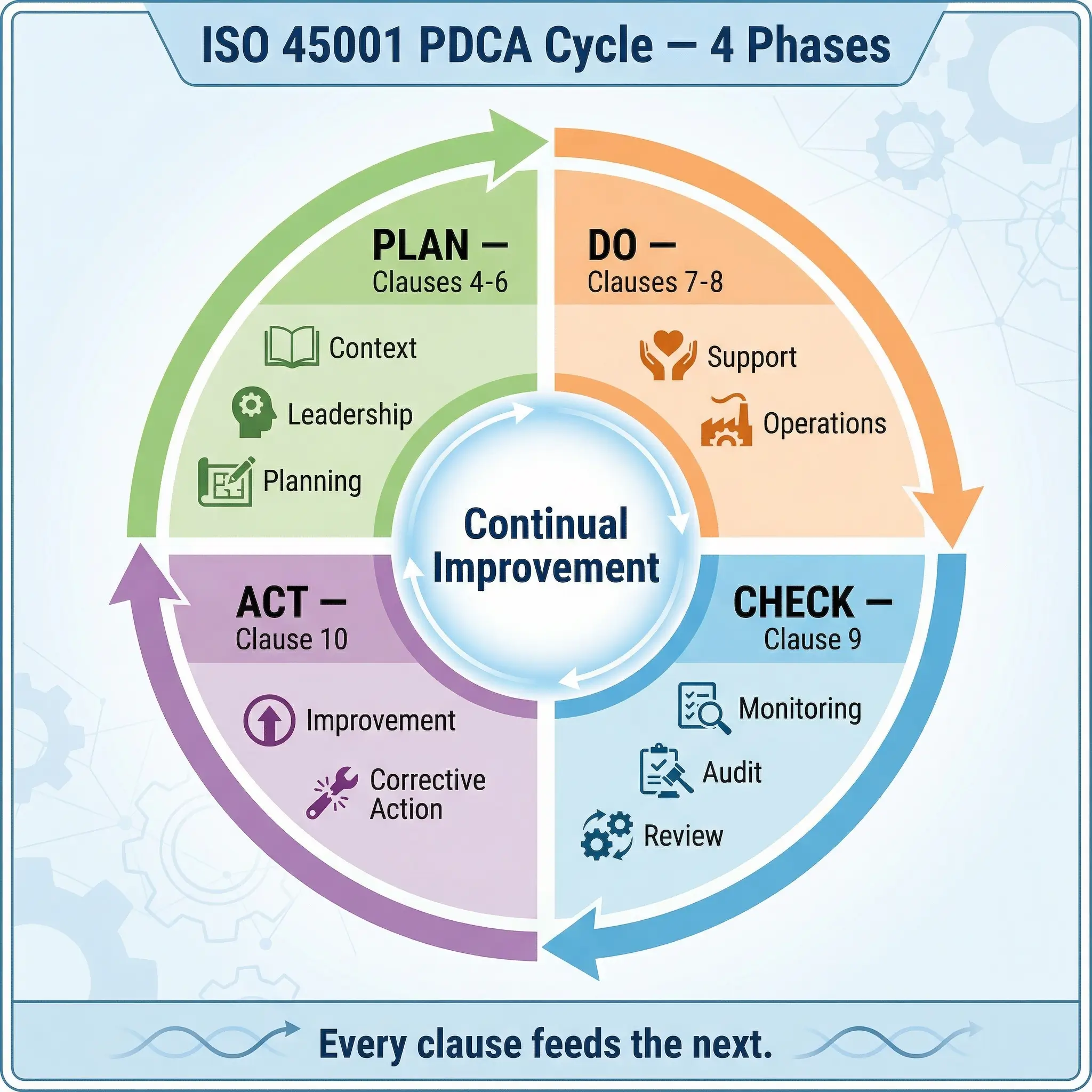
Understanding what ISO 45001 actually demands means working through its ten-clause structure. Clauses 1–3 cover scope, normative references, and terms — they set definitions but contain no auditable requirements. The auditable requirements live in Clauses 4 through 10. Each one builds on the previous, following the Plan-Do-Check-Act (PDCA) cycle that drives continual improvement.
Here is what each requirement clause demands in practical, field-applicable terms.
Clause 4 — Context of the Organization
This clause requires you to step back before building anything and understand the environment your OH&S system operates in. Most organizations skip this or treat it as a one-time exercise during certification preparation. That is a mistake — context changes, and your system must reflect those changes.
- Internal and external issues: Identify factors that affect your ability to achieve OH&S outcomes. Internal issues include organizational culture, workforce competence, shift patterns, aging infrastructure. External issues include regulatory changes, climate conditions, supply chain pressures, community expectations.
- Interested parties: Determine who has a stake in your OH&S performance — workers, contractors, regulators, insurers, neighboring communities, unions — and what their needs and expectations are.
- Scope definition: Define the boundaries of your OH&S management system. This must be realistic — you cannot exclude high-risk operations for convenience. I have raised major nonconformities against organizations that scoped out their most hazardous processes to simplify certification.
Clause 5 — Leadership and Worker Participation
This is where ISO 45001 draws its sharpest line. Leadership is not endorsement — it is ownership. And worker participation is not a suggestion box — it is structured involvement in the system.
- Top management accountability: Must take overall responsibility for prevention of injury and ill health, ensure adequate resources, promote continual improvement, and support other management roles in demonstrating leadership within their areas.
- OH&S policy: Must be appropriate to the organization’s purpose, provide a framework for setting objectives, include commitments to eliminate hazards and reduce risks, and commit to consultation and participation of workers.
- Worker consultation and participation: Workers must be consulted on policy, objectives, risk assessments, incident investigations, and changes that affect them. Non-managerial workers must participate in hazard identification, control evaluation, and competence requirements. This is not optional — auditors verify it through worker interviews on site.
Clause 6 — Planning
Planning under ISO 45001 goes beyond the traditional “identify hazards, assess risks, implement controls” model. It introduces risk-based thinking at the system level and requires organizations to identify opportunities — not just threats.
- Risks and opportunities: Assess risks to the OH&S system itself (not just workplace hazards) and identify opportunities to improve OH&S performance, eliminate hazards at source, and adapt work to workers.
- Hazard identification: Must be ongoing and proactive — covering routine and non-routine activities, emergency situations, human factors, changes in processes, and past incidents. The standard explicitly requires consideration of how work is organized, social factors, and infrastructure.
- OH&S objectives: Must be measurable, monitored, communicated, and updated. Vague objectives like “improve safety culture” without defined metrics and timelines fail audit every time.
Clause 7 — Support
The support clause addresses the resources, competence, awareness, communication, and documented information needed to make the system function. In practice, this is where under-resourced safety systems collapse.
- Competence: Workers must be competent based on education, training, or experience. Competence must be evaluated — not assumed. If a gap exists, action must be taken and its effectiveness verified.
- Awareness: Every worker must be aware of the OH&S policy, their contribution to system effectiveness, the implications of not conforming, and relevant incidents and hazards.
- Communication: Both internal and external communication processes must be defined — what is communicated, when, to whom, and how. This includes communication with contractors and visitors.
Clause 8 — Operation
Clause 8 is where system design meets site reality. Operational planning and control, management of change, procurement, and contractor management all sit here.
- Hierarchy of controls: Must be applied in order — elimination, substitution, engineering controls, administrative controls, PPE. This is not a menu to pick from based on convenience. Auditors check whether higher-order controls were considered before defaulting to PPE.
- Management of change: Any change to processes, equipment, work organization, or external conditions must be assessed for OH&S impact before implementation. The number of incidents I have investigated that trace back to unmanaged change is staggering — new chemical introduced without updated risk assessment, shift pattern changed without fatigue analysis, contractor scope expanded without revised safe work method.
- Emergency preparedness: Must identify potential emergency situations, plan responses, periodically test through drills, and review after actual events. Paper-only emergency plans that have never been tested are a common audit finding.
Clause 9 — Performance Evaluation
This clause demands that you measure what matters, audit your own system, and put findings in front of top management.
- Monitoring and measurement: Define what needs to be monitored, the methods used, when monitoring occurs, and when results are analyzed. This includes both leading indicators (inspections completed, training delivered, near-misses reported) and lagging indicators (incident rates, lost time, severity).
- Internal audit: Must be planned, conducted at defined intervals, and cover all elements of the system. Auditors must be competent and impartial — auditing your own work is not permitted. I have seen organizations run internal audits as checkbox exercises with no findings. That is not auditing — that is self-deception.
- Management review: Top management must review the system at planned intervals, considering audit results, worker feedback, incident trends, risks and opportunities, and the adequacy of resources. Outputs must include decisions on continual improvement and any needed changes.
Clause 10 — Improvement
The final clause closes the PDCA loop. It requires organizations to respond to nonconformities, take corrective action, and pursue continual improvement — not as aspirational goals, but as documented, tracked, and verified processes.
- Incident and nonconformity management: Must investigate incidents to determine root causes, take action to prevent recurrence, and review the effectiveness of actions taken. Surface-level corrective actions — “retrain the worker” without addressing system failures — are a red flag in every audit.
- Continual improvement: Must enhance OH&S performance through the outputs of all other clauses — not as a standalone initiative but as the natural result of a functioning system.
Clause 10.3: “The organization shall continually improve the suitability, adequacy and effectiveness of the OH&S management system.”
The Certification Process — What to Expect From Start to Finish
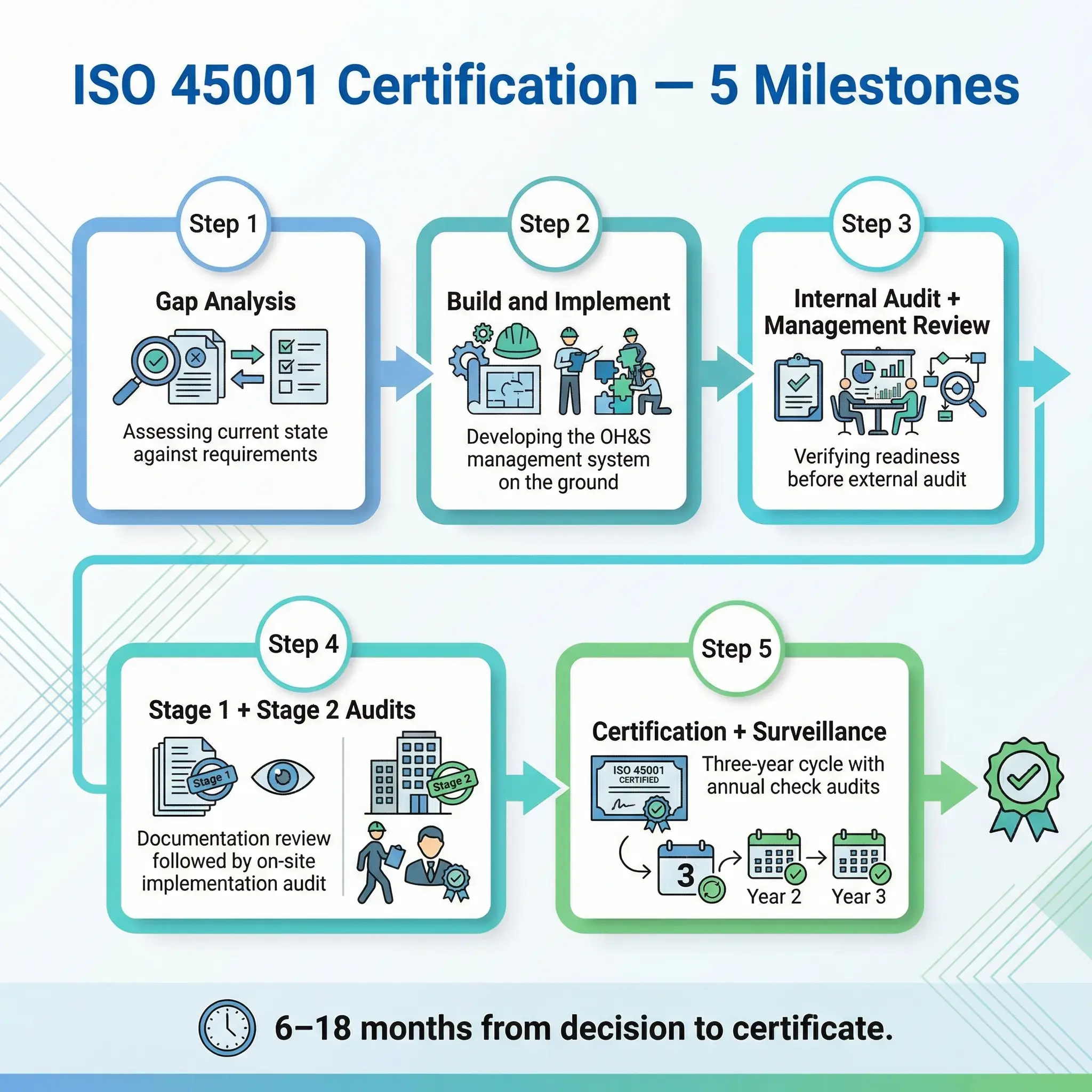
Certification to ISO 45001 is not something that happens in a week. For most organizations, the journey from decision to certificate takes 6–18 months depending on organizational size, existing system maturity, and the complexity of operations. Having guided multiple organizations through this process — and audited many more — I can break down what actually happens at each phase.
The certification process follows a defined sequence that every accredited certification body adheres to. Understanding this sequence eliminates surprises and helps you allocate resources realistically.
- Gap analysis: Assess your current OH&S practices against ISO 45001 requirements. Identify what exists, what partially exists, and what is missing entirely. This is an internal exercise — or you can engage a consultant — but it must be honest. Inflating your maturity level at this stage only delays failure to the audit stage.
- System development and implementation: Build or modify your OH&S management system to address the gaps. This includes drafting or revising policy, defining context and interested parties, conducting hazard identification and risk assessments, establishing objectives, developing operational controls, and creating documented information. The critical word here is implement — not just document. The system must be functioning on the ground with evidence of application.
- Internal audit and management review: Before approaching a certification body, conduct at least one full-cycle internal audit covering all clauses and hold a formal management review with top management. These are prerequisites — no certification body will proceed without evidence of both.
- Stage 1 audit (documentation review): The certification body reviews your documented system for adequacy against ISO 45001 requirements. They assess readiness for the Stage 2 audit. This may be conducted on-site or remotely. Common outcomes include identification of areas needing further development before Stage 2 can proceed.
- Stage 2 audit (implementation audit): Auditors come on-site and verify that your system is implemented and effective. They interview top management, supervisors, and workers. They observe operations. They review records. They sample across all clauses. Nonconformities are graded as major or minor, and you must address them within a defined timeframe.
- Certification decision: If Stage 2 is satisfactory and nonconformities are closed, the certification body issues the ISO 45001 certificate, typically valid for three years.
- Surveillance audits: Annual audits (usually at 12 and 24 months) verify continued conformity. These are smaller in scope than Stage 2 but still cover critical clauses and any areas of concern.
- Recertification audit: At the end of the three-year cycle, a full re-audit is conducted to renew the certificate.
Pro Tip: The single most common reason I see organizations fail Stage 2 is a gap between documentation and implementation. They have beautiful procedures that workers have never seen, risk assessments that supervisors did not participate in, and management reviews where no decisions were actually made. Auditors test implementation through site observation and worker interviews — not by reading your manuals. If the worker on the shop floor cannot explain the hazards of their task and the controls in place, no amount of documentation saves you.
Real Benefits of ISO 45001 Certification — Beyond the Certificate on the Wall
Certification costs money. Implementation takes time. Audits disrupt operations. So the question every operations director and finance team asks is fair: what do we actually get back?
I have worked with organizations before and after certification, and the benefits fall into two categories — measurable operational gains and strategic commercial advantages. Both are real, but only if the system is genuinely implemented. A certificate earned through a superficial system delivers superficial returns.
Operational and Safety Performance Benefits
The most direct benefits show up in incident data, operational efficiency, and workforce engagement. These are the outcomes that justify the investment to anyone who manages a site.
- Reduced incident and injury rates: Organizations with mature ISO 45001 systems consistently show lower lost-time injury frequency rates (LTIFR) and total recordable incident rates (TRIR). A structured approach to hazard identification and risk control catches exposures before they become events. On one EPC project I managed the HSE function for, TRIR dropped 40% within 18 months of full implementation — driven primarily by improved hazard reporting and operational risk assessments.
- Lower workers’ compensation and insurance costs: Insurers recognize ISO 45001 certification as evidence of systematic risk management. Several organizations I have audited reported premium reductions of 10–20% after certification, with further reductions tied to sustained performance improvement.
- Improved regulatory compliance: The systematic approach to legal and other requirements (Clause 6.1.3) means organizations identify applicable legislation, evaluate compliance, and address gaps before regulators find them. This shifts the relationship with enforcement agencies from reactive defense to proactive partnership.
- Stronger incident investigation and learning: Clause 10.2 demands root cause investigation and systemic corrective action. Organizations that genuinely follow this stop repeating the same failures. The shift from “blame the worker” to “fix the system” is one of the most valuable cultural changes ISO 45001 drives.
- Improved emergency preparedness: Tested, reviewed, and updated emergency plans reduce response times and limit consequences when incidents occur. I have seen the difference between a site with a drilled emergency plan and one with a dusty binder — the gap in response effectiveness is enormous.
Commercial and Strategic Benefits
Beyond the fence line, ISO 45001 certification carries weight in procurement, tendering, and stakeholder confidence. These benefits compound over time.
- Tender and prequalification advantage: Many major clients — particularly in oil and gas, mining, construction, and public infrastructure — require or strongly prefer ISO 45001 certification from contractors and service providers. In competitive tenders, certification can be the qualifying factor that gets you past the prequalification gate.
- International market access: ISO 45001 is recognized in over 180 countries. For organizations operating across borders or entering new markets, certification provides a universally understood benchmark that simplifies client assurance and regulatory engagement.
- Supply chain confidence: Clause 8.1.4 requires organizations to control or influence outsourced processes, including contractor OH&S performance. Certification signals to clients that your supply chain management includes safety — a growing requirement in ESG-driven procurement.
- Stakeholder and investor confidence: Environmental, social, and governance (ESG) reporting increasingly references management system certifications as evidence of social responsibility. ISO 45001 directly addresses the “S” in ESG — worker health and safety.
- Employee attraction and retention: Workers and professionals increasingly choose employers who demonstrate genuine commitment to safety. Certification provides visible evidence that safety is resourced, structured, and valued — not just spoken about in induction presentations.
ILO Global Estimates (2023): Approximately 2.93 million workers die each year from work-related accidents and diseases. Systematic occupational health and safety management — the core purpose of ISO 45001 — remains the most effective organizational tool to reverse this trajectory.

Common Implementation Mistakes — What I See Organizations Get Wrong
After auditing dozens of ISO 45001 systems across multiple industries and regions, the failure patterns repeat with depressing consistency. The standard itself is well-designed. The breakdowns happen in how organizations interpret and implement it.
Understanding these mistakes before you start implementation saves months of rework and avoids the embarrassment of audit nonconformities that should have been caught internally.
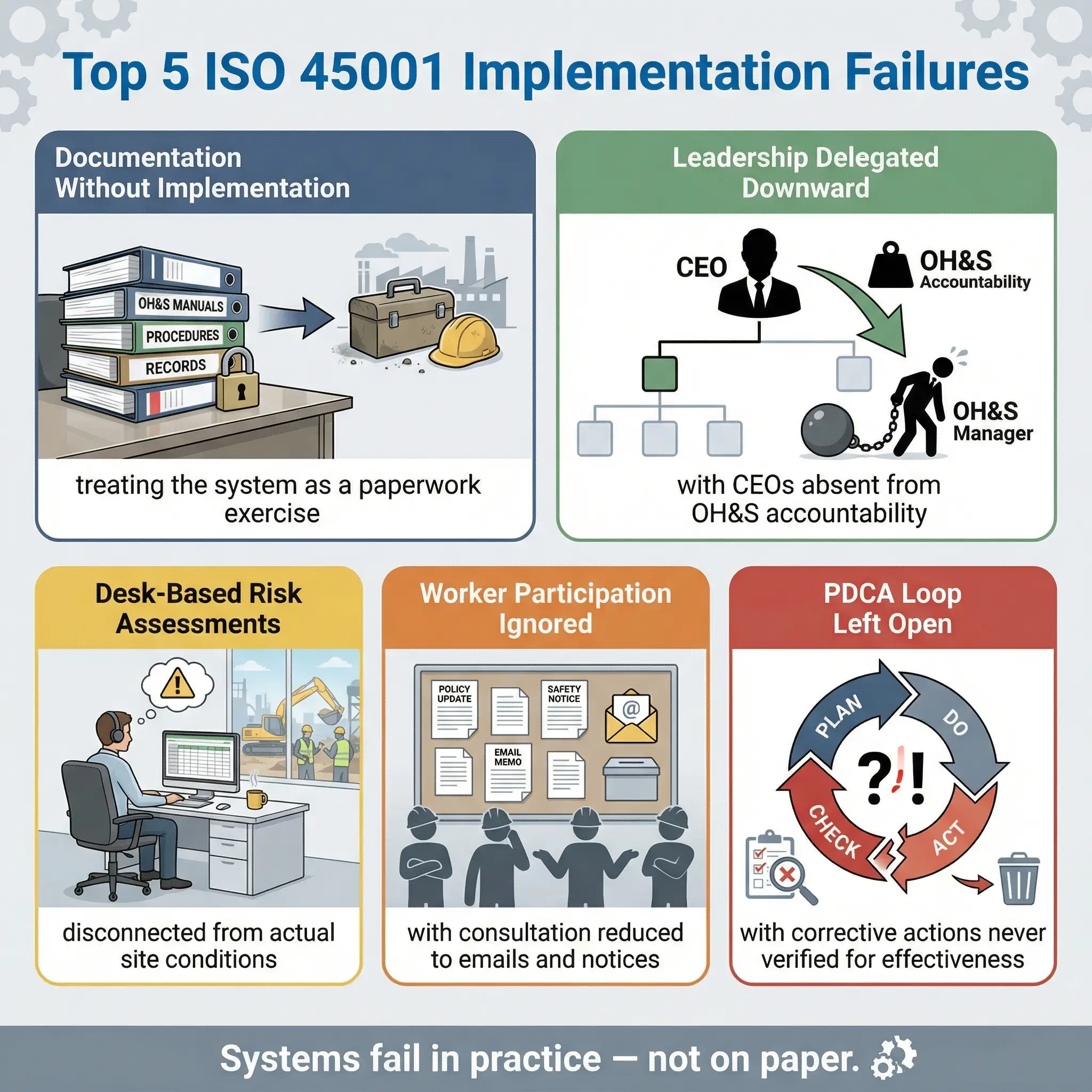
- Treating it as a documentation project. The most widespread failure. Organizations produce volumes of procedures, forms, and registers — then assume the system is “implemented.” ISO 45001 requires evidence of application, not evidence of writing. If workers cannot describe the controls for their tasks, the documentation is irrelevant.
- Delegating leadership to the HSE department. Clause 5.1 requires top management to demonstrate leadership. When the CEO delegates system ownership entirely to the safety manager, leadership accountability evaporates. During audits, I test this by interviewing the managing director or plant manager. If they cannot explain how OH&S integrates into business decisions, the nonconformity is major.
- Conducting hazard identification as a desk exercise. Risk assessments completed in a meeting room by people who have not observed the actual work are fiction. ISO 45001 requires hazard identification to consider how work is actually organized and performed — not how it is described in a procedure. Walk the site. Talk to workers. Watch the task. Then assess.
- Ignoring worker participation requirements. Some organizations interpret “consultation” as sending an email or posting a notice. Clause 5.4 is specific — non-managerial workers must participate in hazard identification, risk assessment, control determination, incident investigation, and evaluation of OH&S performance. Auditors verify this through direct worker interviews, and vague answers expose the gap immediately.
- Writing vague, unmeasurable objectives. “Improve safety culture” is not an OH&S objective under Clause 6.2. Objectives must be measurable, monitored, communicated, and have defined timeframes and responsibilities. If you cannot quantify progress, it is an aspiration — not an objective.
- Running superficial internal audits. Internal audits that report zero findings are not evidence of a perfect system — they are evidence of a broken audit process. Every system has improvement opportunities. Auditors who only verify that documents exist without testing implementation are providing false assurance.
- Failing to close the PDCA loop. Organizations implement corrective actions after incidents but never verify whether those actions were effective. Clause 10.2 explicitly requires evaluation of corrective action effectiveness. A corrective action that is implemented but not verified is incomplete.
Pro Tip: During one certification audit at a logistics warehouse, I asked a forklift operator what risks had been identified for his work area. He pointed to a framed risk assessment on the wall — printed three years earlier, never reviewed, and listing hazards for a layout the warehouse no longer used. That single observation generated a major nonconformity against Clause 6.1.2 (hazard identification) and Clause 8.1.1 (operational planning and control). Keep your risk assessments alive or they will kill your certification.
Who Needs ISO 45001? Applicability Across Industries and Organizational Size
A question I hear frequently — especially from small and medium enterprises — is whether ISO 45001 is “for them” or only for large multinationals with dedicated HSE departments. The standard itself answers this clearly in Clause 1: it is applicable to any organization, regardless of size, type, or nature of activities.
In practice, the industries and organization types that benefit most — and face the strongest market pressure to certify — share certain risk profiles and operational characteristics.
- Oil, gas, and petrochemical: High-hazard operations, process safety requirements, and client-driven prequalification make ISO 45001 virtually mandatory for contractors and operators in this sector. Most major operators require certification or equivalent as a baseline for contractor approval.
- Construction and infrastructure: High fatality rates, multi-employer worksites, and complex contractor chains make systematic OH&S management essential. International construction clients and development finance institutions (IFC, World Bank) increasingly reference ISO 45001 in project requirements.
- Mining and extractive industries: Underground and surface mining operations face geotechnical, mechanical, chemical, and environmental hazards that demand structured risk management beyond ad hoc safety programs.
- Manufacturing and heavy industry: Chemical exposure, machinery hazards, manual handling, and noise exposure across manufacturing operations benefit directly from the systematic hazard identification and control approach ISO 45001 requires.
- Energy and utilities: Power generation, transmission, and renewable energy installations involve high-voltage, working-at-height, and confined space risks that require documented, auditable safety management.
- Healthcare: Occupational exposure to biological agents, sharps injuries, manual handling of patients, and psychosocial risks make healthcare a strong candidate for ISO 45001 — though adoption has been slower than in heavy industry.
- Logistics and warehousing: Vehicle-pedestrian interaction, manual handling, racking collapses, and forklift operations represent consistent hazard profiles that benefit from systematic control.
- Small and medium enterprises (SMEs): ISO 45001 scales. A 20-person fabrication workshop does not need the same volume of documentation as a 10,000-person refinery. The requirements remain the same; the complexity of implementation scales to the organization’s risk profile and size. I have certified SMEs with lean, effective systems that outperformed bloated multinational systems in genuine risk control.
ISO Survey of Certifications (2023): Over 400,000 ISO 45001 certificates have been issued worldwide, with the strongest growth in construction, manufacturing, and services sectors across Europe, East Asia, and the Middle East.
Integrating ISO 45001 With ISO 9001 and ISO 14001 — The Integrated Management System Advantage
One of the most practical advantages of ISO 45001’s Annex SL structure is the ability to integrate it with ISO 9001 (Quality) and ISO 14001 (Environmental) into a single Integrated Management System (IMS). Organizations already certified to one or both of these standards have a significant head start.
Integration is not about merging three separate systems into one binder. It is about eliminating duplication, streamlining processes, and creating a single operational framework where quality, environment, and safety are managed together — because on a real site, they are never separate.
The shared clause structure across all three standards makes specific integration points straightforward for teams who understand the alignment.
- Context and interested parties (Clause 4): One context analysis covers quality, environmental, and OH&S issues. Interested parties often overlap — regulators, clients, workers, and communities have expectations across all three domains.
- Leadership and policy (Clause 5): A single integrated policy can address quality, environmental, and OH&S commitments. Top management accountability applies equally across all three standards.
- Risk-based planning (Clause 6): Risk assessment methodologies can be harmonized. A single risk register can capture quality risks, environmental aspects, and OH&S hazards — with domain-specific controls assigned to each.
- Document control and communication (Clause 7): One document management system, one communication procedure, one competence framework — covering all three scopes.
- Internal audit and management review (Clause 9): Integrated audits reduce audit fatigue and cost. A single management review meeting can address performance across all three domains, with domain-specific agenda items as needed.
- Corrective action and improvement (Clause 10): One nonconformity management process handles quality defects, environmental incidents, and OH&S events — with root cause analysis feeding improvement across all domains.
Pro Tip: When I set up integrated management systems, I advise organizations to start with the standard they have the weakest implementation in — not the strongest. Integration exposes gaps. If your ISO 14001 system is mature but your OH&S management is informal, integration will force you to confront that gap head-on. That confrontation is the point.
How to Choose a Certification Body — and What Accreditation Means
Not all certification bodies are equal. The ISO 45001 certificate is only as credible as the organization that issued it. Choosing the wrong certification body — or worse, an unaccredited one — can result in a certificate that clients, regulators, and international partners do not recognize.
Understanding accreditation is the first step to making a credible choice. Here is what matters and what to verify.
- Accreditation is non-negotiable. A legitimate certification body must be accredited by a national accreditation body that is a member of the International Accreditation Forum (IAF). Examples include UKAS (United Kingdom), ANAB (United States), JAS-ANZ (Australia/New Zealand), DAkkS (Germany), and RvA (Netherlands). If a certification body cannot show IAF-recognized accreditation for ISO 45001 auditing, walk away.
- Verify the accreditation scope. Accreditation is granted for specific standards and specific industry sectors (using IAF-defined EA codes). Confirm that the certification body is accredited to audit ISO 45001 in your industry sector. A body accredited for manufacturing may not be accredited for construction or oil and gas.
- Assess auditor competence. The quality of your audit depends on the auditor assigned. A competent ISO 45001 auditor should have relevant industry experience, formal lead auditor qualifications, and understanding of your operational hazards. Request auditor CVs and do not accept auditors with no exposure to your sector.
- Beware of “certification mills.” Organizations that offer guaranteed certification, unusually low fees, or minimal audit duration are red flags. Accredited certification requires defined audit time calculated based on organizational size, complexity, and risk — it cannot be compressed below IAF mandatory minimums.
- Check mutual recognition. IAF Multilateral Recognition Arrangement (MLA) ensures that certificates issued by accredited bodies in one country are recognized internationally. Verify that your chosen certification body’s accreditation body is an IAF MLA signatory.
Conclusion
ISO 45001 is not a standard you hang on a wall. It is a framework you build into the way your organization operates — into how decisions are made, how risks are assessed, how workers are consulted, and how failures are investigated and prevented from recurring. The organizations I have seen extract real value from ISO 45001 are the ones that treated it as a tool for operational improvement, not a compliance exercise to satisfy a procurement requirement.
The standard demands something that many organizations find uncomfortable: genuine leadership accountability and genuine worker participation. Not delegated. Not assumed. Demonstrated, documented, and auditable. When top management owns the system and workers trust it enough to report hazards honestly, the system works. When either element is missing, the certificate becomes paper, and paper does not prevent injuries.
If you are considering ISO 45001 certification, start with an honest gap analysis. Understand where your real risks are, how your work is actually organized, and whether your current safety management genuinely controls hazards or merely documents their existence. Build from there — systematically, practically, and with the understanding that every clause exists because somewhere, the absence of that requirement cost someone their health or their life. That is the weight this standard carries. Implement it like it matters, because it does.