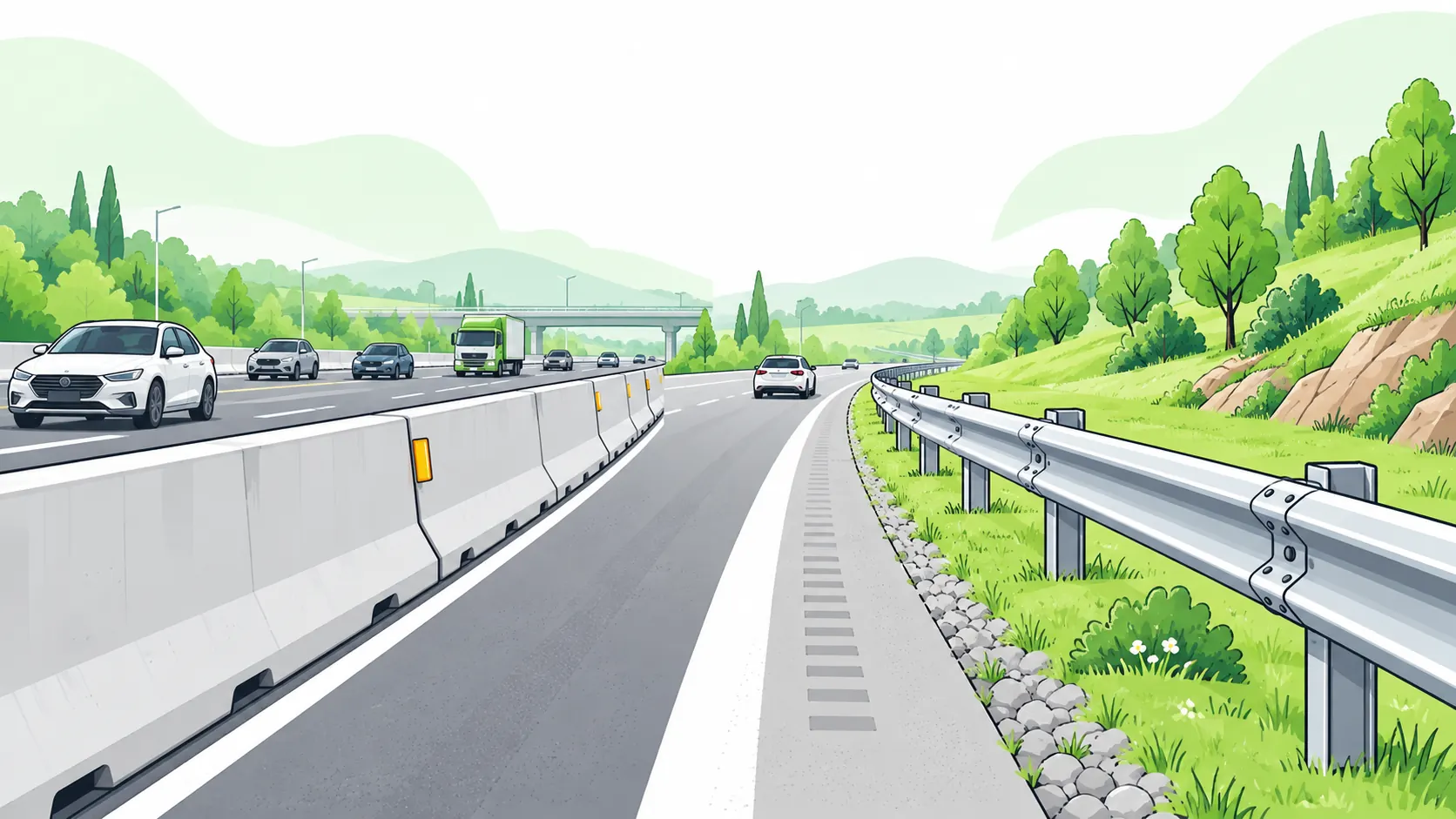
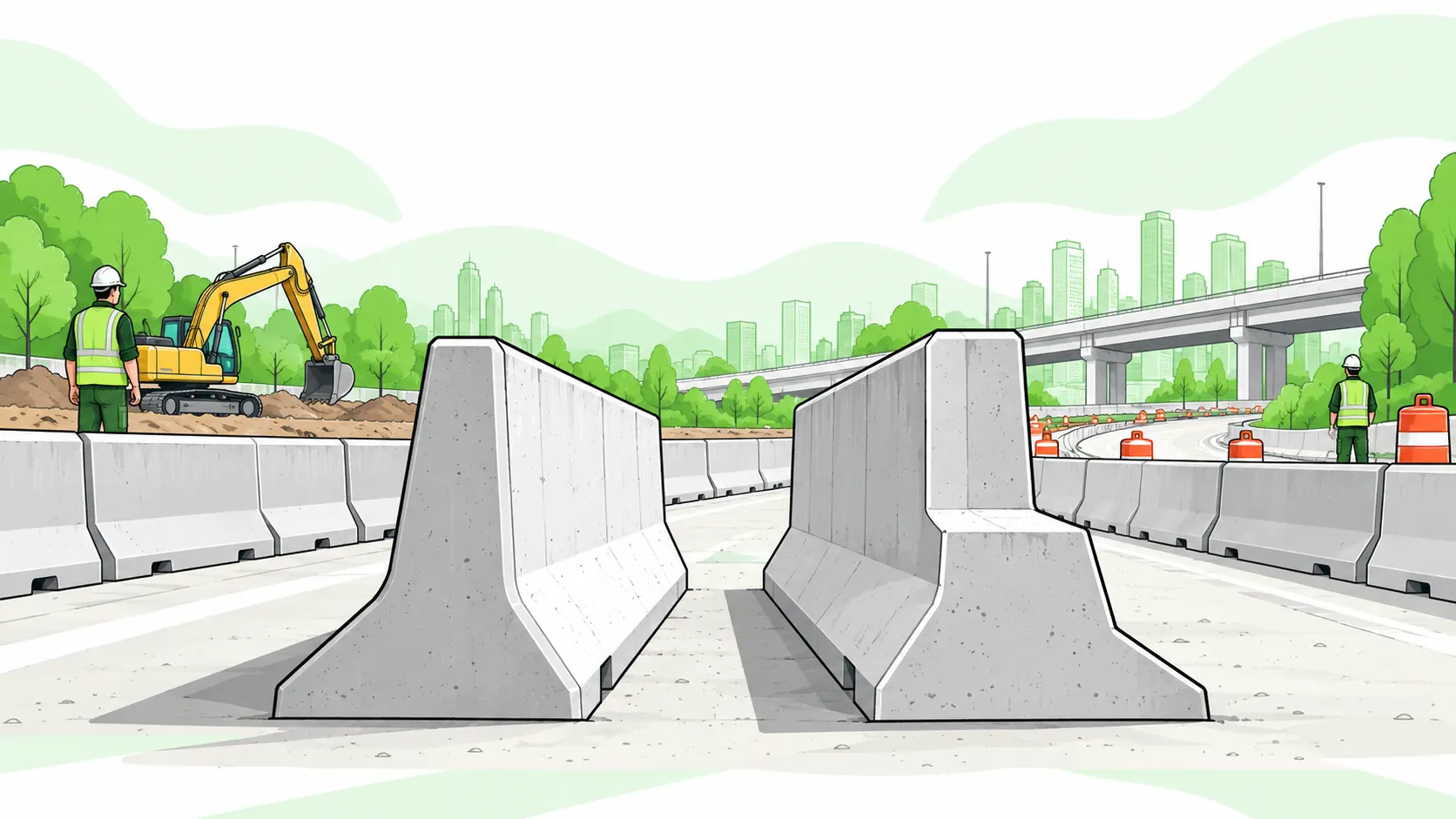
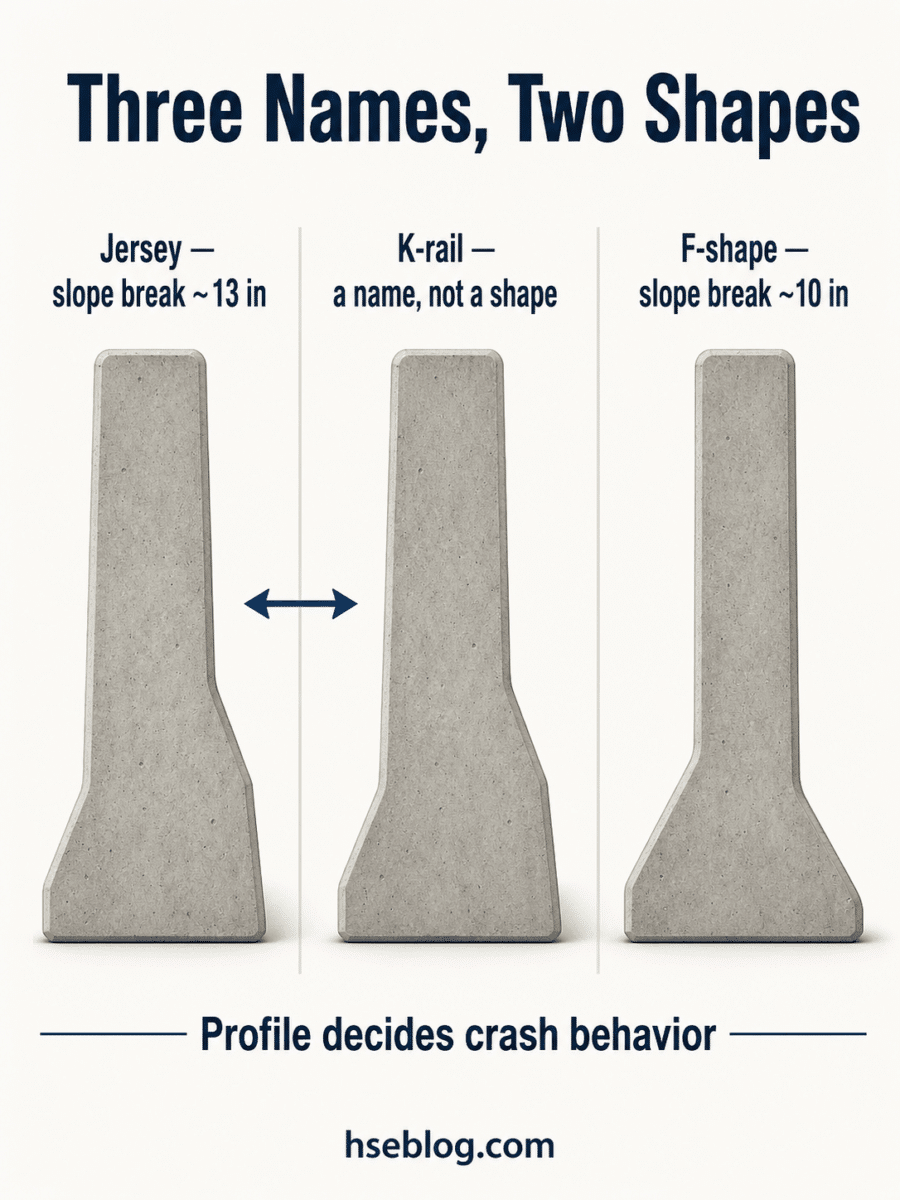
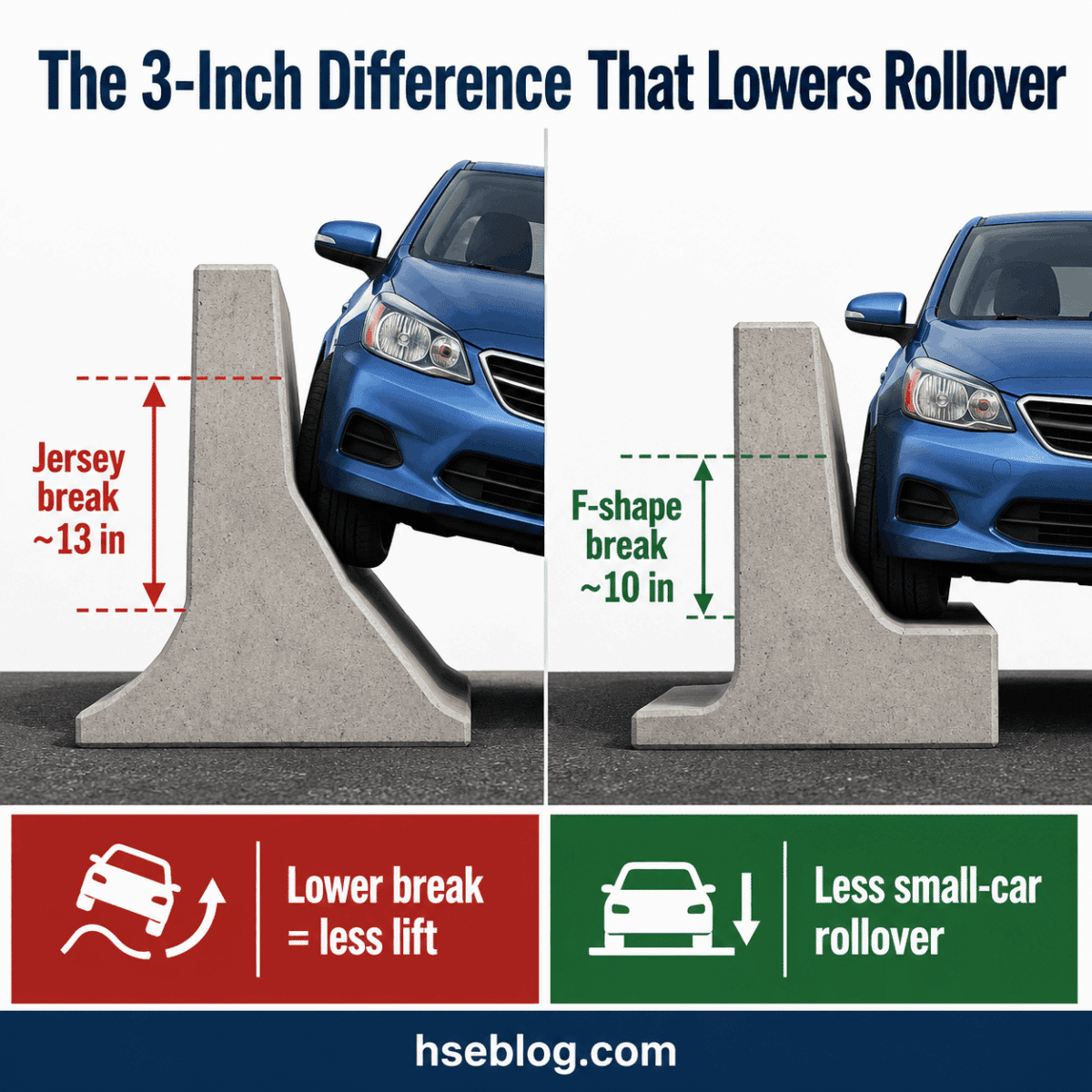
A jersey barrier and an F-shape barrier are two profiles in the same concrete safety-shape family, separated only by slope-break height — roughly 13 inches for the Jersey, 10 inches for the F-shape, which lowers small-car rollover risk. "K-rail" is not a third shape; it is California's name for a temporary concrete barrier, usually Jersey-profiled.
Plenty of purchase orders treat "jersey barrier," "K-rail," and "F-shape barrier" as three competing products on a shelf. Two of those names describe the very same profile, and one of them isn't a profile at all — which is exactly how a work zone ends up with the wrong protection installed.
That confusion has real stakes. There were 850 work-zone fatalities in the United States in 2024, down from 905 in 2023 (FHWA/NHTSA FARS via ATSSA, 2026), and barrier selection is one of the few controls standing between an errant vehicle and a crew. This article resolves the difference between a jersey barrier and K-rail and F-shape barrier across three separate layers — terminology, geometry, and crash rating — so you specify what the road actually needs.
Jersey Barrier vs K-Rail vs F-Shape: The Short Answer
These are not three parallel barrier types. Jersey and F-shape are two profiles in one safety-shape barrier family; K-rail is a regional name layered on top, usually meaning a Jersey-profile temporary unit.
| Jersey | K-rail | F-shape | |
|---|---|---|---|
| What it is | A profile | A regional name | A profile |
| Slope break point | ~13 in | Varies — usually Jersey | ~10 in |
| Typical use | Permanent + temporary | Temporary, western US | Increasingly permanent |
| Key trait | Widespread baseline | Naming convention | Lower rollover risk |
The decision that actually matters is profile + material + tested system (MASH Test Level) + deployment condition — not the nickname on the order.
Competent-person caveat: This article provides general HSE knowledge. Life-critical work such as positive-protection barrier selection, placement, and end-treatment design must be planned and supervised by a competent person — typically a qualified roadside-safety engineer — with relevant training, jurisdiction-specific authorization, and a site-specific risk assessment. The information here does not replace that. Recognized competency pathways include ATSSA work-zone certifications, agency design manuals, and broader HSE qualifications such as NEBOSH or IOSH.
A recurring field failure sits behind all this: a spec sheet says only "jersey barriers" or "K-rail," with no profile, no MASH rating, and no permanent-versus-temporary call. Teams then receive channelization devices where they needed positive protection — visually similar, functionally not the same thing.
What Actually Defines These Barriers: Profile, Not Name
Profile governs crash behavior; names govern procurement vocabulary. Every meaningful difference between a jersey barrier and an F-shape barrier comes down to one measurement — where the sloped face breaks.
The reference safety-shape barrier is roughly 32 inches tall with a base around 24 inches wide. It carries a short vertical reveal (~3 inches) at the pavement, then angled faces rising to a near-vertical upper section.
The single defining metric is the slope-break height:
- Jersey profile — slope break at roughly 13 inches above the pavement.
- F-shape profile — slope break at roughly 10 inches, which reduces how much an impacting vehicle climbs and lifts.
There's a slow-drift trap here that practitioners should track rather than assume away. Repeated asphalt overlay raises the road level relative to a fixed barrier, nudging a Jersey profile toward F-shape behavior while quietly cutting the barrier's working height for tall, heavy vehicles. After several resurfacing cycles, the barrier you installed is not the barrier you now have.
How a Safety-Shape Barrier Redirects a Vehicle
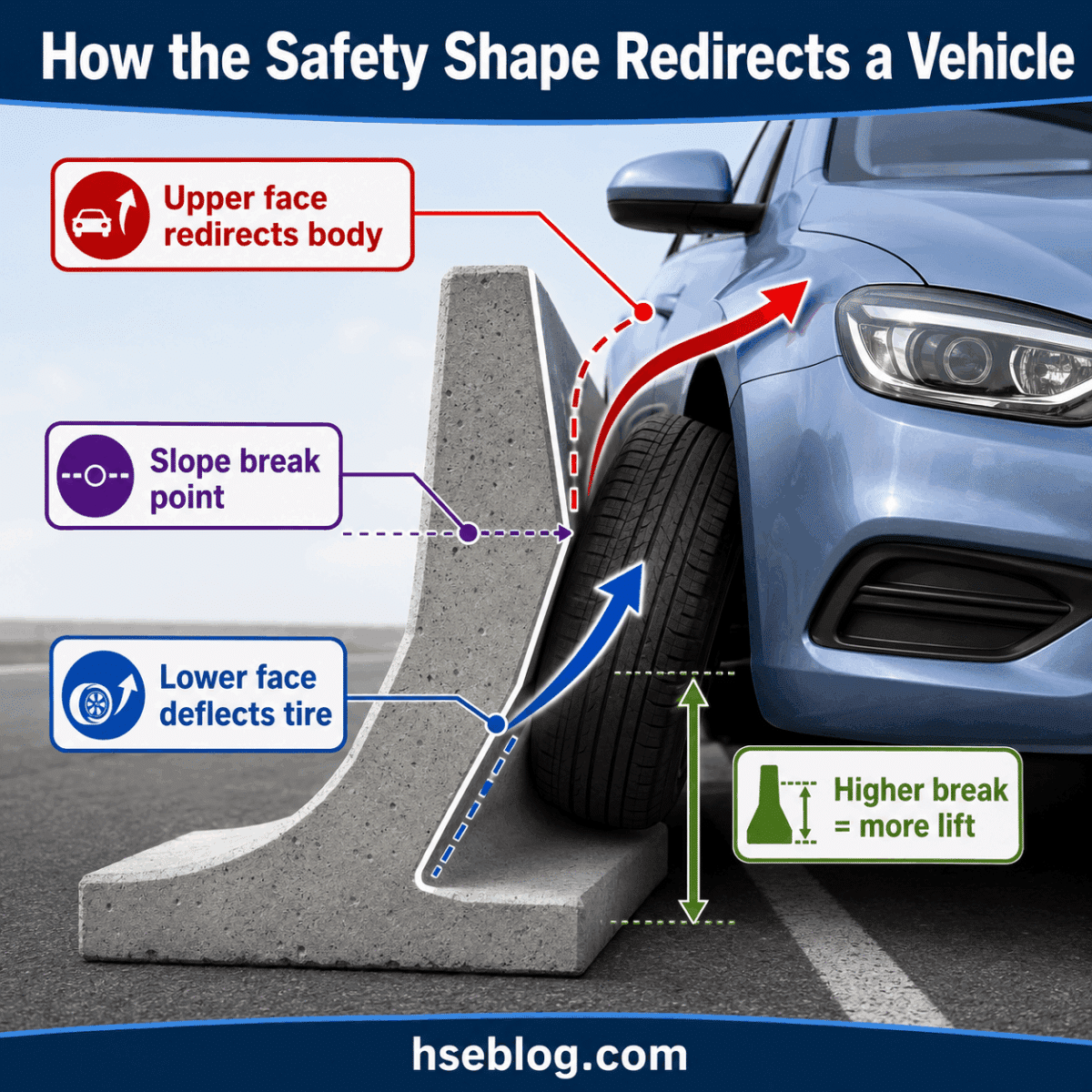
Redirection happens in two stages. The lower sloped face contacts the tire and begins lifting and steering the wheel back toward the travel lane; the upper, steeper face then meets the vehicle body and redirects its mass along the barrier line.
The Jersey Barrier Explained
The Jersey barrier is the baseline of the safety-shape family and the most over-generalized term in the field. It carries the higher 13-inch slope break, which is both its history and its known weakness.
Developed by the New Jersey State Highway Department, the profile was refined through the 1950s into the silhouette now used worldwide. It appears in two main forms: cast-in-place for permanent medians, and precast Portable Concrete Barrier (PCB) for temporary work-zone runs.
Where it dominates, and where it falls short:
- Where it's used — permanent DOT medians, widespread highway runs, and precast portable barrier for lane closures.
- Its limitation — the 13-inch break point allows more vehicle climb and lift than the F-shape, raising small-car rollover tendency in a redirecting impact.
- Its weight — a 10-foot precast unit is commonly cited around 3,000–4,000 lb, but treat that as typical vendor catalog data, not a universal design value; weight depends on length and section detail.
Because "Jersey" gets used loosely to mean any concrete barrier at all, a profile-plus-rating specification isn't pedantry — it's the only way to be sure the unit on site matches the unit you analyzed.
What Is a K-Rail? (The Terminology Trap)
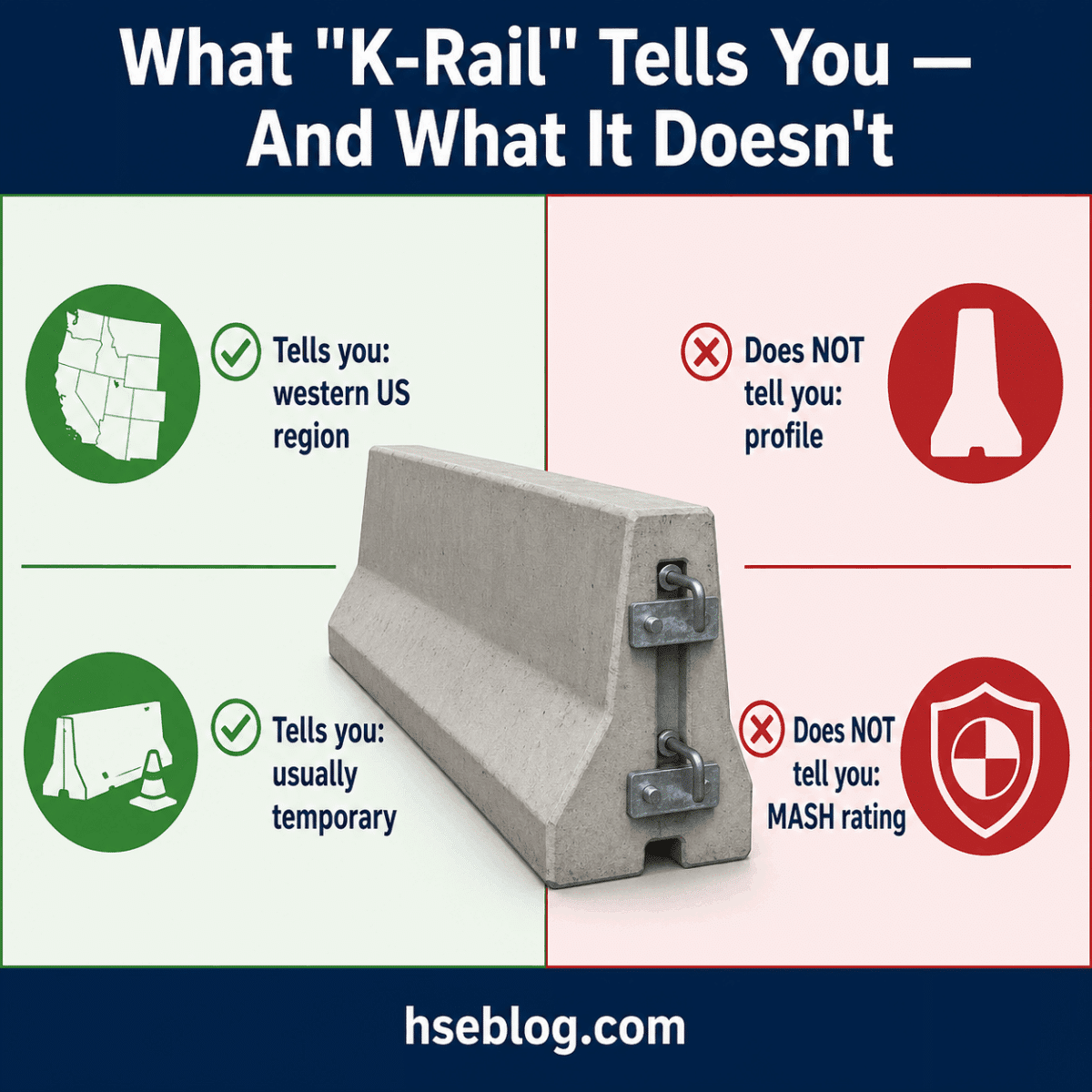
K-rail is not a separate engineered profile. It is Caltrans-derived terminology for temporary concrete traffic barrier — predominantly Jersey-shaped — used heavily in California and other western states.
If you arrived believing K-rail is its own shape, that belief is widespread and worth correcting cleanly:
- Origin — the term comes from California DOT designations for temporary concrete traffic barrier; the identical unit elsewhere is simply called a Jersey or precast barrier.
- Connections — reinforcing steel protrudes at segment ends and units link via connections such as pin-and-loop or hook-style joints. That's a feature of temporary precast barrier generally, not something unique to "K-rail."
- What the name tells you — region, and often temporary use. It does not tell you geometry or crash rating.
K-rail = a name, not a shape. A "K-rail" can be Jersey-profile or F-profile. Confirm the profile and the MASH Test Level explicitly — never infer them from the word.
The dangerous failure mode is cross-jurisdiction miscommunication. A spec written "K-rail" and read by an out-of-state or international team can be interpreted as a fixed shape, when the receiving team must instead verify profile and tested rating before anything ships.
The F-Shape Barrier: Why the Lower Break Point Matters
The F-shape exists for one reason: a lower slope break reduces vehicle lift and small-car rollover. Its name is the least intuitive part of it.
The "F" comes from a 1970s FHWA computer-simulation study that modelled six candidate profiles labelled A through F. The sixth configuration performed best against the study's criteria, so "F-shape" is the label of the winning profile — not a description of its shape. The F-shape profile and its slope-break geometry sit the break at roughly 10 inches against the Jersey's 13.
What that buys, and why it didn't take over completely:
- The safety gain — F-shape barrier height and footprint match the Jersey, but the lower break means less lift and a lower small-car rollover tendency; it's increasingly specified for permanent installations.
- A real-but-marginal edge — this is a geometry refinement within the same redirection mechanism, not a different mechanism.
- Adoption inertia — many agencies kept their existing Jersey casting forms despite the F-shape's performance edge, because re-tooling is expensive.
The procurement reality is worth naming. F-shape is frequently the better safety choice on paper, yet availability, existing forms, and the need to match an adjacent barrier run often drive the actual decision. Defaulting to "what we already cast" can quietly override the safer profile.
Crash Ratings Decide Suitability: MASH and Test Levels
Profile is necessary but not sufficient — what makes a barrier usable on a given road is its tested crash performance. A correctly shaped Jersey or F-shape barrier with no current eligibility is still the wrong choice on a federal-aid project.
Legal disclaimer: Regulatory content here reflects general HSE professional understanding of US and UK/EU requirements as of 2026. It is not legal advice. Specific compliance questions, enforcement situations, or eligibility determinations should be directed to qualified legal counsel and the governing highway authority in the applicable jurisdiction. Regulatory content last reviewed: [Month YYYY — to be filled at publish].
In the US, the AASHTO Manual for Assessing Safety Hardware (MASH), 2016 edition, defines the evaluation criteria — structural adequacy, occupant risk, and vehicle trajectory — and it superseded NCHRP Report 350 (1993) for new hardware. FHWA then issues eligibility letters confirming a system meets MASH. The MASH crash-test criteria and the NCHRP 350 transition are documented in state DOT design manuals that mirror the federal requirement.
The work-zone timing rule is the one most teams miss. Under the AASHTO/FHWA Joint Implementation Agreement (US), temporary work-zone devices — including portable concrete barriers — manufactured after December 31, 2019 must have passed MASH 2016, while older NCHRP 350 or MASH 2009 units may serve out their existing service life.
Test Levels scale with speed and vehicle size:
| Test Level | Approx. test condition | Typical use |
|---|---|---|
| TL-1 | Low speed, light vehicle | Low-speed work zones |
| TL-2 | Moderate speed | Lower-speed roads, some work zones |
| TL-3 | Highway speed, passenger vehicle | Common highway baseline |
| TL-4 | Higher speed + single-unit truck | Higher-volume/heavier mix |
| TL-5 / TL-6 | Heavy trucks / tractor-trailers | High-consequence, heavy-vehicle routes |
The recurring error is treating the shape as the safety guarantee. The rating governs, not the silhouette — and matching it to road speed matters, because speed was a factor in 34% of fatal work-zone crashes (FHWA, 2024). The broader exposure picture, roughly one work-zone fatality per 4 billion vehicle-miles of travel (FHWA, accessed 2026), is why protection scales with traffic volume — and why the FHWA work zone safety facts and statistics underpin the case for getting the Test Level right.
Choosing Between Them: A Selection Logic
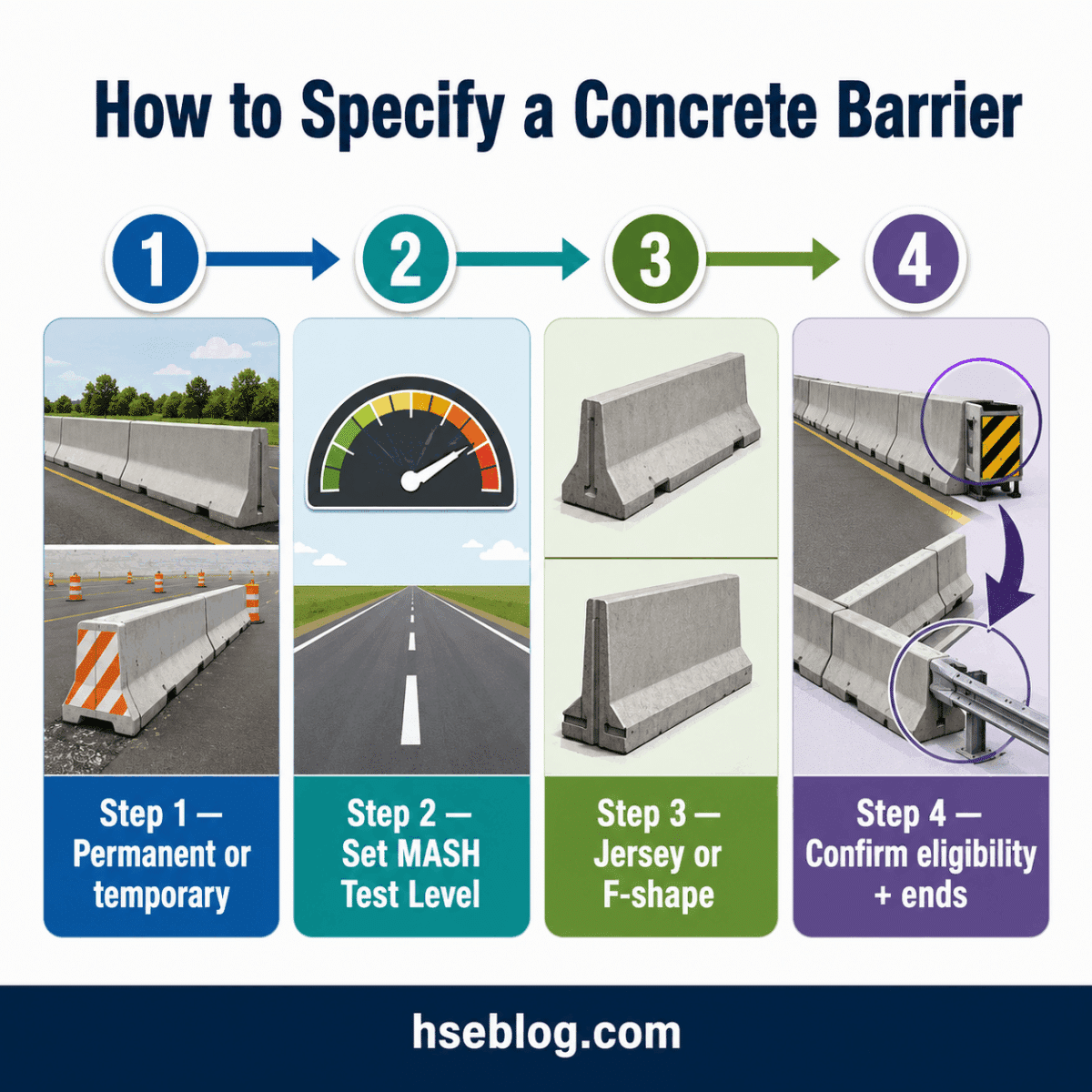
The "which do I pick" question hiding inside this comparison resolves to a sequence, not a single answer. Work it in order, and defer the final specification to a qualified engineer and the governing agency standard.
- Define the deployment. Permanent (cast-in-place median) or temporary (precast portable concrete barrier / PCB)? This narrows the candidate systems before anything else.
- Set the required MASH Test Level. Match it to road speed and traffic mix — TL-3 for typical highway passenger-vehicle conditions, higher for heavy-truck routes.
- Choose the profile. Jersey or F-shape, with the F-shape favored where small-car rollover risk is a concern and casting forms or matching runs don't force the Jersey.
- Confirm eligibility as installed. Verify the FHWA eligibility letter covers the system as it will actually be built — including end treatments and transitions, not just the barrier mid-run.
End treatments are part of crashworthiness, not an afterthought. An exposed blunt concrete end is a fixed-object hazard, and transitions to guardrail or bridge rail must be tested connections.
The pattern to guard against is "middle-run fixation" — teams obsess over the barrier profile and forget that ends and transitions are exactly where untested, non-crashworthy conditions creep into an otherwise sound installation.
How Other Jurisdictions Handle Concrete Barriers (UK, EU, Canada, Australia)
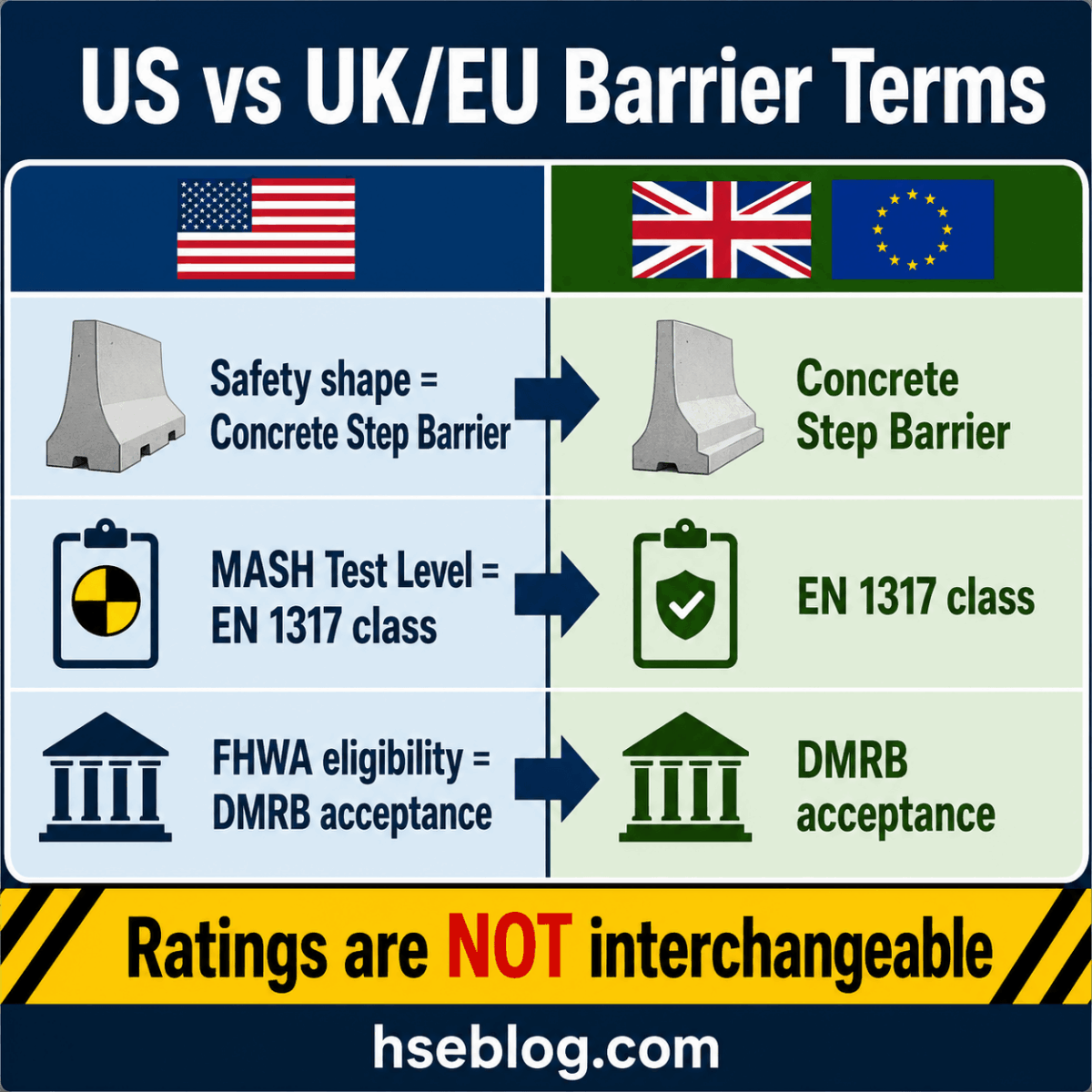
US terminology doesn't travel cleanly. The "safety shape" family maps to different names and a different testing regime abroad, and the ratings are not interchangeable.
In the UK and Europe, these are Vehicle Restraint Systems tested to BS EN 1317 (Parts 1–2), which defines containment classes (the N and H levels), impact severity, and working width rather than MASH Test Levels. The UK's rigid concrete median equivalent is the Concrete Step Barrier used on National Highways routes under the DMRB. Canada uses Jersey- and F-shape-derived profiles such as the Ontario Tall Wall variant; Australia and New Zealand test to AS/NZS 3845.
A quick terminology bridge:
| US framing | UK/EU equivalent framing |
|---|---|
| Safety-shape concrete barrier | Concrete Step Barrier / VRS |
| MASH Test Level (TL-1 to TL-6) | EN 1317 containment class (N1/N2, H-levels) |
| FHWA eligibility letter | National Highways DMRB acceptance |
The import/export trap is assuming a barrier "crash tested" in one regime is acceptable in another. A MASH TL-3 unit and an EN 1317 N2/H1 unit are not equivalencies — the rating framework, not just the shape, must match the governing jurisdiction, and where a project spans regimes the stricter applicable standard should govern.
Frequently Asked Questions
Is a K-rail the same as a Jersey barrier?
By shape, usually yes — a K-rail is most often a Jersey-profile temporary barrier. But the term denotes California and western-US regional naming, and typically temporary use, rather than a separate geometry. A K-rail can be Jersey- or F-profile, so confirm the profile and the MASH rating from the spec regardless of the name on the order.
Why is the F-shape barrier considered safer than the Jersey barrier?
The F-shape's slope break sits lower — around 10 inches versus the Jersey's 13. That earlier transition means an impacting vehicle climbs and lifts less before the upper face engages, which reduces small-car rollover tendency. It's a marginal-but-real geometry improvement within the same redirection mechanism, not a different way of containing the vehicle.
What does the "F" in F-shape barrier stand for?
It isn't a description of the shape. The label comes from a 1970s FHWA computer-simulation study that tested six profiles named A through F. The sixth configuration performed best against the study's criteria, so the winning profile carried the letter F — making "F-shape" a study designation rather than a geometric description.
What is the difference between a Jersey barrier and a single-slope barrier?
A Jersey barrier uses the two-slope safety shape, with a break point dividing a shallow lower face from a steeper upper face. A single-slope (constant-slope) barrier — often around 42 inches — uses one continuous angled face. The constant-slope design tolerates asphalt overlay better, since resurfacing doesn't shift a break point relative to the road.
Do these barriers need to be MASH-rated, and what about older barriers?
On US federal-aid projects, yes. Under the AASHTO/FHWA agreement, temporary work-zone devices manufactured after December 31, 2019 must have passed MASH 2016, while older NCHRP Report 350 units may serve out their service life. Eligibility is confirmed by an FHWA letter, and final determinations rest with the governing highway agency.
Do concrete barriers need crash-rated end treatments?
Where the system and site require it, yes. An exposed blunt concrete end is a fixed-object hazard, and the crashworthiness question covers the whole installation — including end treatments and the transitions connecting concrete barrier to guardrail or bridge rail. A correctly rated mid-run paired with an untested end is not a complete, compliant system.
Conclusion
The industry's core mistake with concrete traffic barrier types is collapsing three different questions into one. "Jersey vs K-rail" is a terminology question; "Jersey vs F-shape" is a geometry question; and "is it usable on this road" is a crash-rating question — and only the last one decides whether a barrier contains a vehicle or fails.
The single highest-impact change is to stop specifying by nickname. Write the profile, the deployment condition, and the required MASH Test Level explicitly, then confirm FHWA eligibility for the system as installed — ends and transitions included. That one discipline closes the gap that lets channelization stand in for positive protection.
Understanding the difference between a jersey barrier and K-rail and F-shape barrier is ultimately about respecting that the silhouette is the easy part. The slope-break height refines the safety margin, the rating frameworks differ by jurisdiction and don't translate, and the final call belongs to a competent engineer working to the governing standard — not to whichever word landed on the purchase order.