
I was standing on a high-rise formwork deck in Calgary when the general contractor's project manager asked me a question I've heard dozens of times since: "What exactly does your NCSO® let you do that someone without it can't?" The answer wasn't about a piece of paper. It was about the fact that I had just stopped a concrete pour because the edge protection didn't meet the fall protection standard — and I had the training, the audit experience, and the regulatory knowledge to explain exactly why, to whom, and what needed to happen before work resumed.
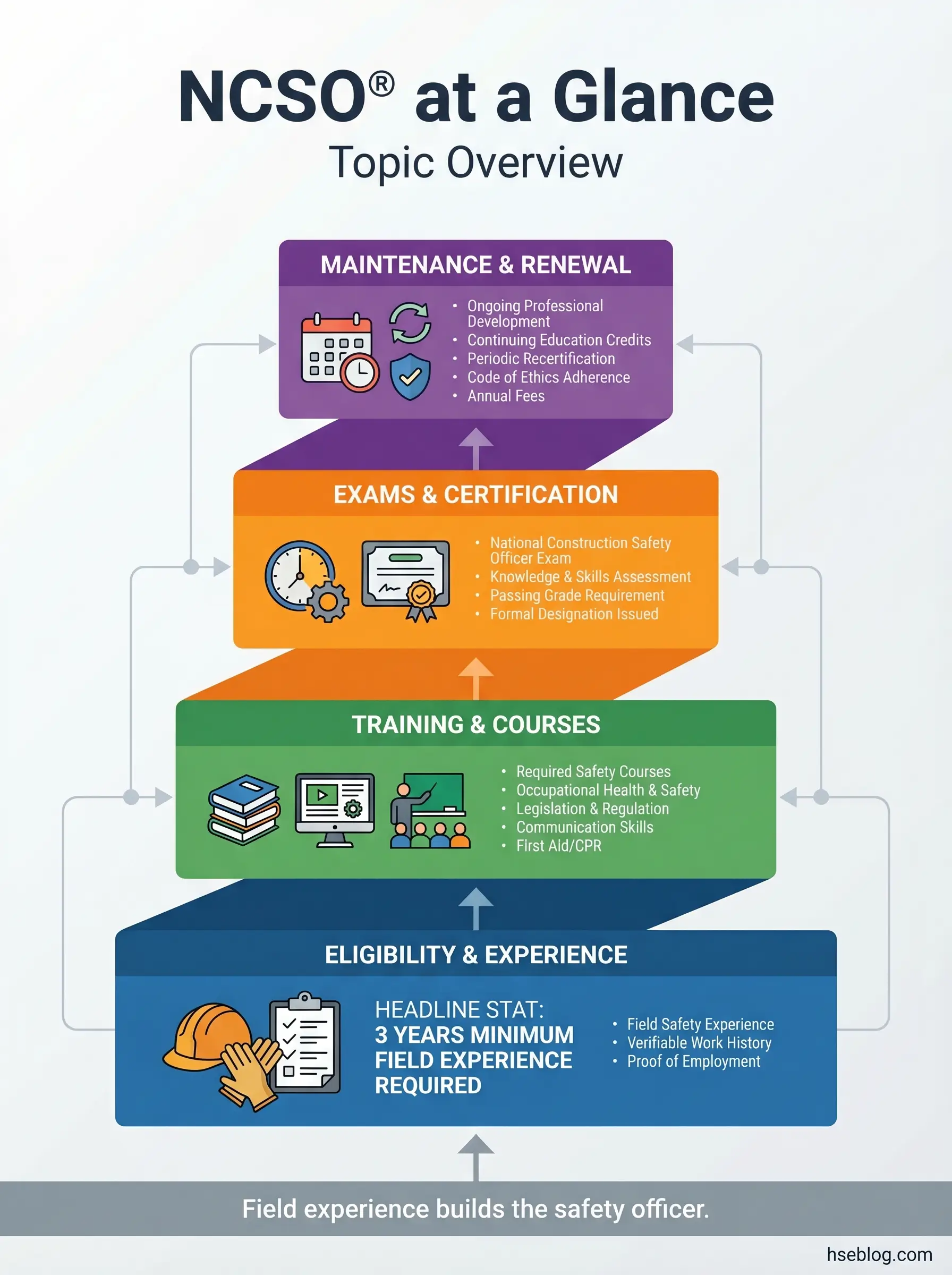
The National Construction Safety Officer (NCSO®) designation is the construction industry's entry-level field safety credential across Canada. It verifies that its holder has met a national standard combining formal safety training, practical field application, verified construction experience, and written examinations — all governed by the CFCSA. For anyone pursuing a safety career in Canadian construction, the NCSO® is not optional. It is the baseline expectation on most commercial, industrial, and infrastructure projects. This article covers what the NCSO® requires, how the certification process works, what the designation equips you to do on site, and the common mistakes candidates make along the way.
Who Governs the NCSO® and Why It Matters
The NCSO® is not a single organization's certification. It is a nationally coordinated designation managed by provincial and territorial construction safety associations — all members of the Canadian Federation of Construction Safety Associations (CFCSA). Each province administers its own program under a shared national framework, which means the core requirements are consistent across Canada, but individual jurisdictions can add requirements above the national minimum.
This structure matters for two practical reasons that every candidate should understand before starting:
- Portability across provinces: An NCSO® earned in Alberta is recognized in British Columbia, Ontario, Saskatchewan, and every other CFCSA member jurisdiction. If you transfer provinces, you typically only need to pass the receiving province's legislation exam — not repeat the entire program.
- Provincial variation in electives and practical requirements: While the compulsory training core is nationally standardized, each province may require specific elective courses, different practical submission formats, or additional legislation-specific training. Always confirm requirements with your local construction safety association before beginning.
- COR® audit requirement: NCSO® candidates — unlike NHSA™ candidates — must complete a Certificate of Recognition (COR®) health and safety audit of their company as part of the certification process. This is a hands-on assessment of your ability to evaluate a real safety management system.
- Code of Ethics: Every NCSO® applicant signs a Code of Ethics as part of the application, committing to professional conduct and continuous improvement in safety practice.
"The NCSO® designation verifies that a person has met the training, practical application, years of experience, and written performance measurement standards as set out by the members of the CFCSA." — Canadian Federation of Construction Safety Associations
Pro Tip: Before enrolling in any courses, contact your provincial construction safety association directly. Course equivalencies between provinces are recognized but must be formally approved — don't assume a course taken in one jurisdiction automatically counts in another.
NCSO® Eligibility Requirements: What You Need Before You Start
Many candidates begin taking courses before confirming they actually meet the eligibility threshold. I've seen people complete thousands of dollars in training only to discover their work experience didn't qualify. The eligibility requirements are specific and non-negotiable.
The CFCSA defines construction field experience narrowly, and your experience must fit within this definition to count:
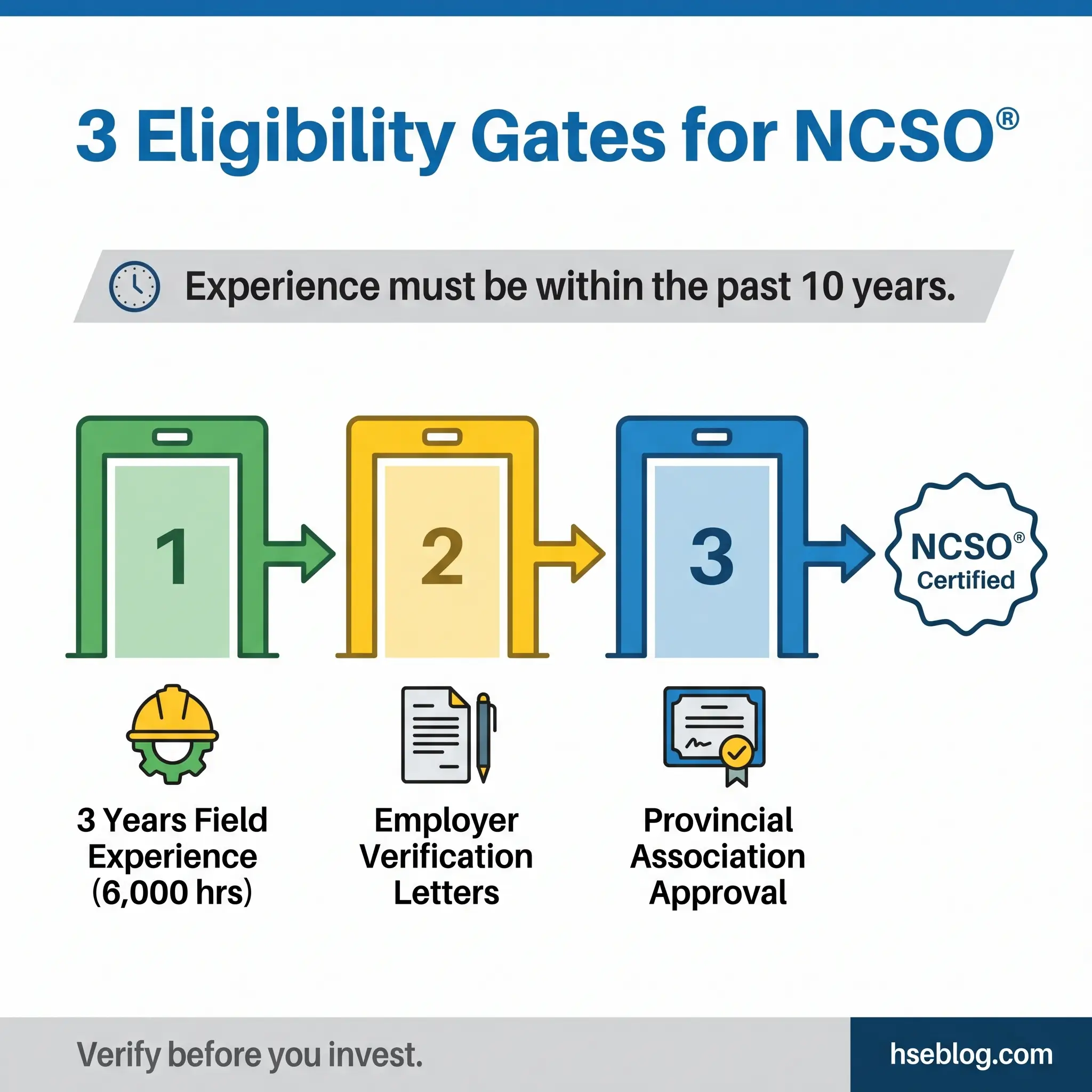
- Minimum three years (or 6,000 hours) of construction field experience within the past ten years. Experience older than ten years does not qualify, regardless of its nature or duration.
- Field experience is defined as: a construction worker (labourer or skilled tradesperson) working directly and actively in construction (residential, commercial, industrial, road building, pipeline, mobile equipment operations); or an individual directly responsible for supervision (site superintendent) or safety (site safety coordinator) who also works on site full-time.
- International experience cap: A maximum of one year of international construction experience may be accepted. At least two of the three required years must have been gained in Canada.
- Red Seal or Journeyperson Certificate in a construction-related trade is also accepted as proof of experience in some jurisdictions.
- Proof of experience format: Employer letters on company letterhead verifying your role, project types, time on site, and duration of employment. A current resume alone is not sufficient — the employer verification letter is mandatory.
Pro Tip: If you're close to the three-year threshold but unsure whether your specific role qualifies, most provincial associations offer a pre-assessment process. Submit your experience documentation early. Being told "no" before you spend money on courses is far better than being told "no" at the application stage.
Compulsory Training: The Core Courses Every NCSO® Candidate Must Complete
The NCSO® training framework combines compulsory courses, elective courses, and practical field demonstrations. The compulsory courses form the backbone — these are non-negotiable regardless of which province you're certifying in.
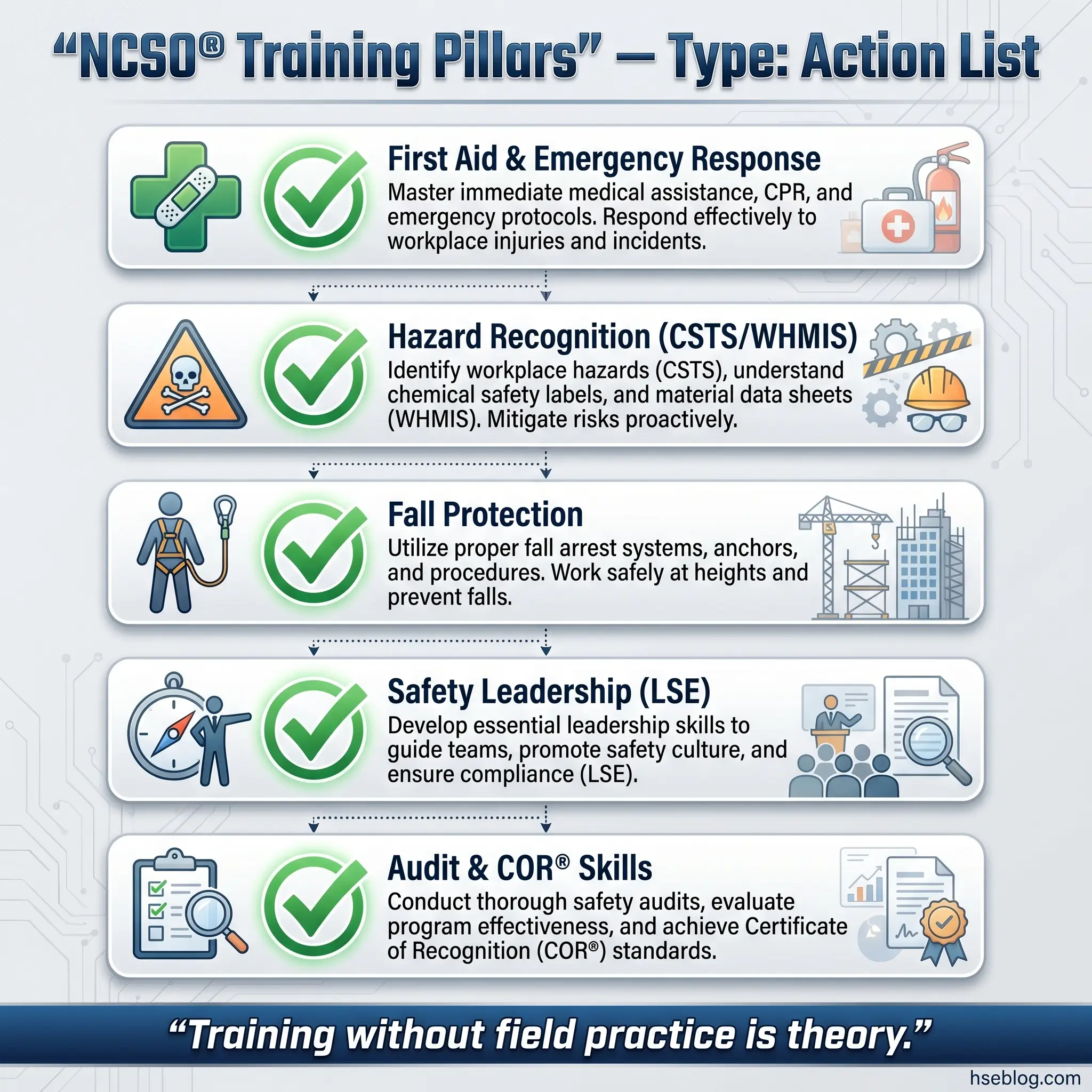
While specific course names vary slightly by province, the nationally standardized compulsory training elements cover the following subject areas:
- Standard First Aid (two-day course): Must be from a recognized provider such as Red Cross or St. John Ambulance. This is a recurring certification — it must remain valid throughout your NCSO® designation.
- Construction Safety Training System (CSTS): The foundational orientation course for construction workers across Canada, covering hazard recognition, worker rights and responsibilities, and basic safety procedures.
- WHMIS (Workplace Hazardous Materials Information System): Training on the classification, labelling, and safe handling of hazardous products — now aligned with GHS under WHMIS 2015.
- Fall Protection: Covering fall hazard identification, equipment selection, inspection, use of personal fall arrest systems, and rescue planning.
- Health and Safety Committee / Worker Safety Representative Training: Preparing candidates to serve on or support joint health and safety committees, understanding their legal functions and operational role.
- Leadership for Safety Excellence (LSE): Focused on safety leadership skills, communication, and the ability to influence safety culture on site.
- Safety Auditor Training / COR® Auditor Certification: Training candidates to plan, conduct, and report on health and safety audits — directly tied to the COR® audit requirement.
- Provincial OHS Legislation Awareness: Specific to each province's occupational health and safety act and regulations. This is the course that makes the NCSO® jurisdiction-specific.
Most provinces also require two to three elective courses, which must be at least four hours in duration and provided by the provincial safety association or a recognized training provider. Elective topics commonly include confined space entry, trenching and excavation safety, hazard assessment and control, and lockout/tagout procedures.
All courses must have been completed within the past ten years to count toward your NCSO® application.
Practical Requirements: Proving You Can Apply What You Learned
Courses alone don't earn you the NCSO®. The practical application requirements are where the designation separates itself from purely academic certifications. I remember submitting my own practical portfolio — a hazard assessment from a bridge deck project, a toolbox talk I delivered to a crew of ironworkers, and a full site inspection report. Each document had to prove that I could take classroom concepts and apply them under real site conditions.
The CFCSA requires candidates to submit documentation demonstrating practical application of their training. While the exact submissions vary by province, the nationally agreed minimum practical requirements include:
- Conduct and document a workplace inspection or hazard assessment. This must be an actual field inspection you personally conducted — not a team effort. It must be signed, dated, and clearly identify you as the assessor.
- Deliver and document a safety talk or toolbox talk presentation. You must be the presenter. The talk must be signed by attendees and clearly attribute you as the person who delivered it.
- Complete a COR® health and safety student audit. NCSO® candidates must conduct a COR® audit of their company's health and safety management system. This is typically a four-element audit covering documentation review, employee interviews, observation, and management system evaluation.
- Submit additional practical documentation as required by the specific provincial association, which may include incident investigation reports, emergency response drill documentation, or safety orientation records.
All practical requirements must be completed independently — not as part of a team or committee — and must have been completed within twelve months of submission in most jurisdictions.
Pro Tip: Start your practical submissions early. Don't wait until you've finished all courses. Many of the practical requirements can be completed alongside your training, and having them ready when you apply prevents delays in your exam scheduling.
The NCSO® Examinations: What to Expect
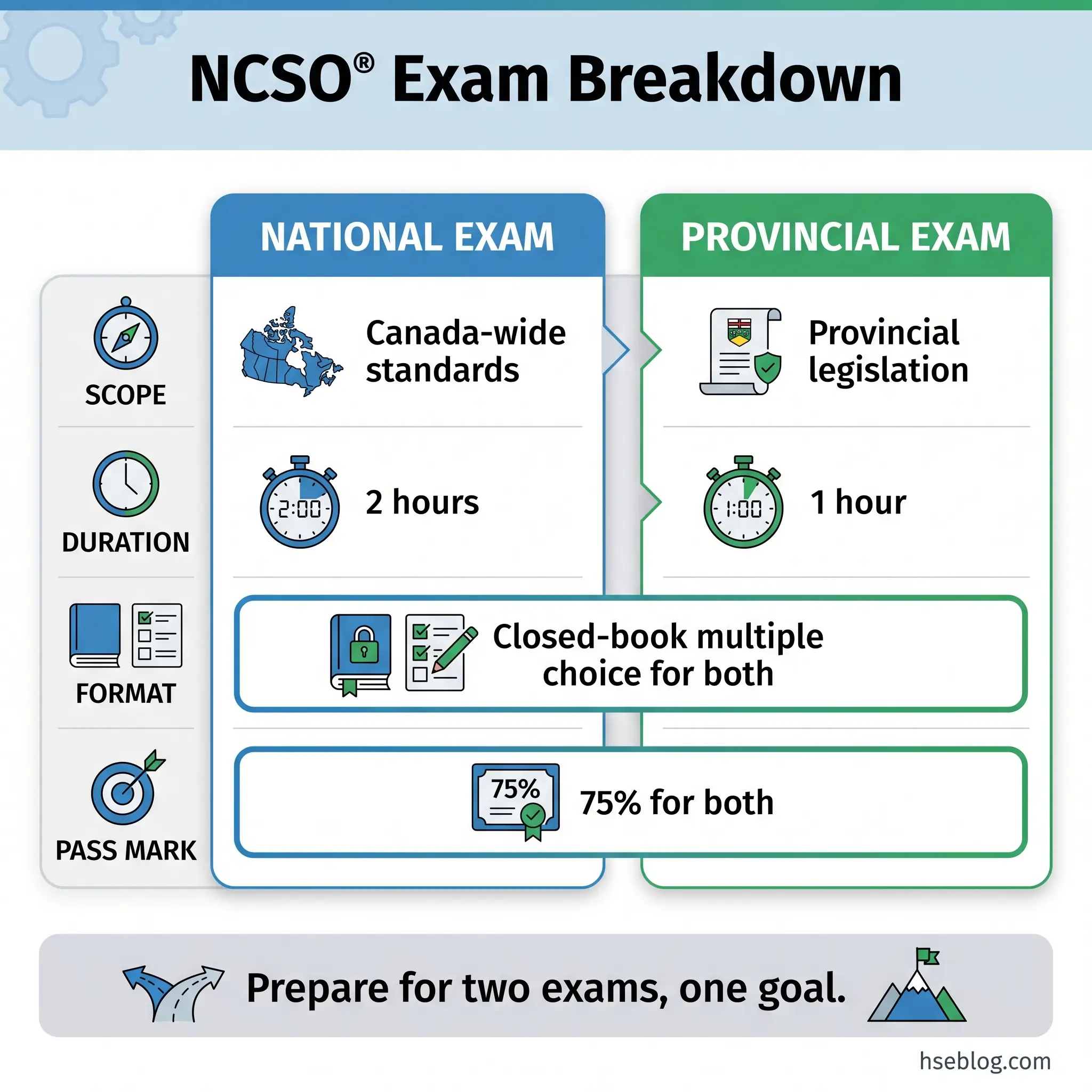
The examination process is the final gate. After completing all training, practical requirements, and experience documentation, candidates write two examinations: a national exam and a provincial exam.
Understanding the exam structure reduces anxiety and prevents the most common preparation mistakes:
- National Exam: A closed-book, multiple-choice examination covering hazard assessments and controls, training and orientations, inspections, investigations, auditing, health and safety programs, documentation, WHMIS, adopted standards, first aid, emergency preparedness, and the Canadian Criminal Code (as it relates to workplace safety obligations).
- Provincial Exam: A separate examination covering the specific occupational health and safety legislation, regulations, and standards of the province where you are certifying. This exam is jurisdiction-specific.
- Passing score: 75% on both examinations. Failing one does not require rewriting the other.
- Exam format: Both exams are typically scheduled on the same day. The national exam is written first (approximately two hours), followed by the provincial exam (approximately one hour).
- Retake policy: If unsuccessful, candidates can rewrite after a 14-day waiting period. After three consecutive failures, most provinces require the candidate to repeat all compulsory and elective courses before being eligible to rewrite.
- Exam fees: Typically $100 per exam for retakes (fees vary by province). Initial exam fees are usually included in the application fee.
The exam content draws directly from the compulsory course material. Candidates who paid attention during training and completed their practical requirements with genuine effort rarely struggle with the written examinations.
NCSO® vs. NHSA™: Understanding the Two Pathways
One of the most common questions I get from candidates just entering the safety field is whether they should pursue the NCSO® or the NHSA™. The confusion is understandable — both are administered by the same provincial associations, share much of the same training curriculum, and are nationally recognized through the CFCSA.
The following comparison clarifies the fundamental differences between the two designations:
| Criteria | NCSO® | NHSA™ |
|---|---|---|
| Target Role | Field-based safety officer on active construction sites | Administrative safety role (office-based, HR, claims) |
| Field Experience | Minimum 3 years (6,000 hours) required | Not required |
| COR® Audit | Full student audit required | COR® Internal Auditor course only (no audit assignment) |
| Recognition | Nationally recognized field designation | Nationally recognized administrative designation |
| Career Pathway | Direct entry to site safety officer roles | Stepping stone toward NCSO® once field experience is gained |
| Exam Structure | National + Provincial exams (75% pass) | National + Provincial exams (75% pass) |
The NHSA™ was created specifically for individuals who are active in safety administration but have not yet accumulated the field hours. It is not a lesser credential — it serves a different function. But if your goal is to work on construction sites as a safety officer, the NCSO® is the designation employers expect to see.
Maintaining Your NCSO®: The Three-Year Renewal Cycle
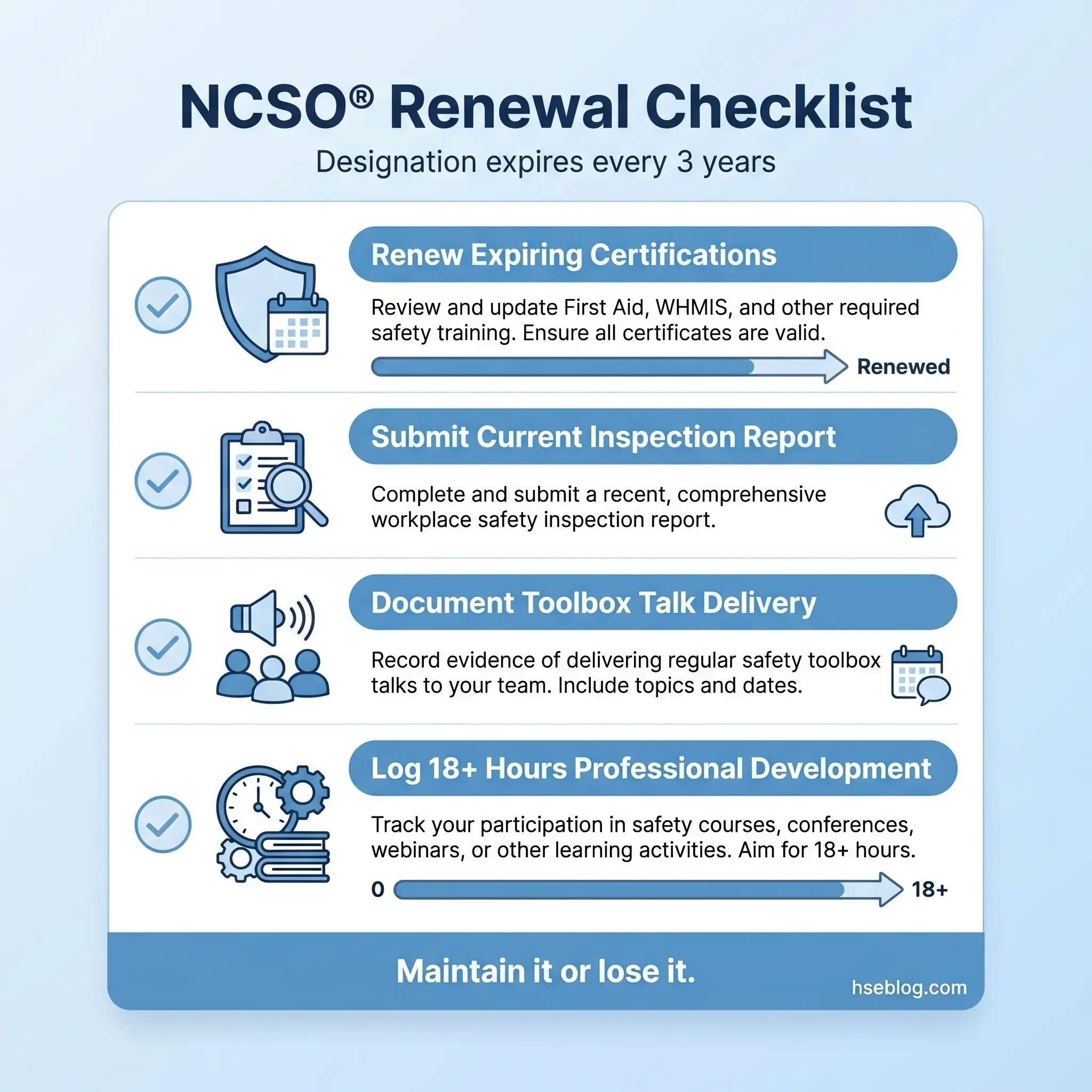
Earning the NCSO® is not a one-time achievement. The designation expires every three years, and maintaining it requires ongoing proof that you are still active, competent, and current in the field. I've watched colleagues lose their designation simply because they let a first aid certificate lapse or forgot to submit their renewal documentation on time.
The renewal requirements are consistent across most CFCSA member provinces:
- Maintain all compulsory course certifications. Any course with an expiry date (first aid, fall protection, WHMIS) must be renewed before or upon NCSO® renewal. Expired certifications will block your renewal.
- Submit a current workplace inspection or hazard assessment conducted within the past year, signed and clearly identifying you as the assessor.
- Submit a current toolbox talk or safety presentation conducted within the past year, with attendee signatures and clear attribution to you as the presenter.
- Demonstrate continued professional development. Most provinces require a minimum number of professional development hours (typically 18 hours over three years) through courses, conferences, or recognized training events.
- Provide proof of continued employment in the construction industry. An employer letter confirming your active role in construction safety is typically required.
Failure to meet any of these requirements results in loss of the NCSO® designation. Reinstatement may require repeating portions of the training and re-examination.
Pro Tip: Set calendar reminders 90 days before your three-year renewal date. Don't rely on your provincial association to chase you. The responsibility to maintain your designation is entirely yours.
Common Mistakes NCSO® Candidates Make
Over the years, I've mentored more than a dozen candidates through the NCSO® process. The ones who struggle are rarely lacking intelligence or commitment — they trip over the same avoidable mistakes.
These are the errors I see repeatedly, and each one can delay or derail your certification:
- Starting courses before confirming eligibility. Candidates invest in training without verifying that their work experience qualifies. If your experience falls outside the CFCSA definition of construction field experience, no amount of coursework will get you the designation.
- Letting courses expire during the process. The ten-year validity window for courses is generous, but candidates who take years to complete the program often find their earliest courses have expired by the time they apply. Plan your training timeline realistically.
- Submitting practical requirements completed as part of a team. Every practical submission — inspections, toolbox talks, audits — must be your individual work. Group submissions are rejected.
- Underestimating the COR® audit requirement. The student audit is not a checkbox exercise. It requires genuine engagement with a company's health and safety management system. Candidates who treat it as paperwork produce weak audits that get sent back for revision.
- Ignoring provincial legislation differences. Candidates transferring from another province sometimes assume their existing knowledge of OHS legislation transfers automatically. Each province's legislation has distinct requirements, and the provincial exam tests jurisdiction-specific content.
What the NCSO® Qualifies You to Do on Site
The NCSO® is an entry-level field designation. That phrase trips people up — they hear "entry-level" and assume it's basic. It is not. It means it is the recognized starting point for a construction safety career, not the ceiling.
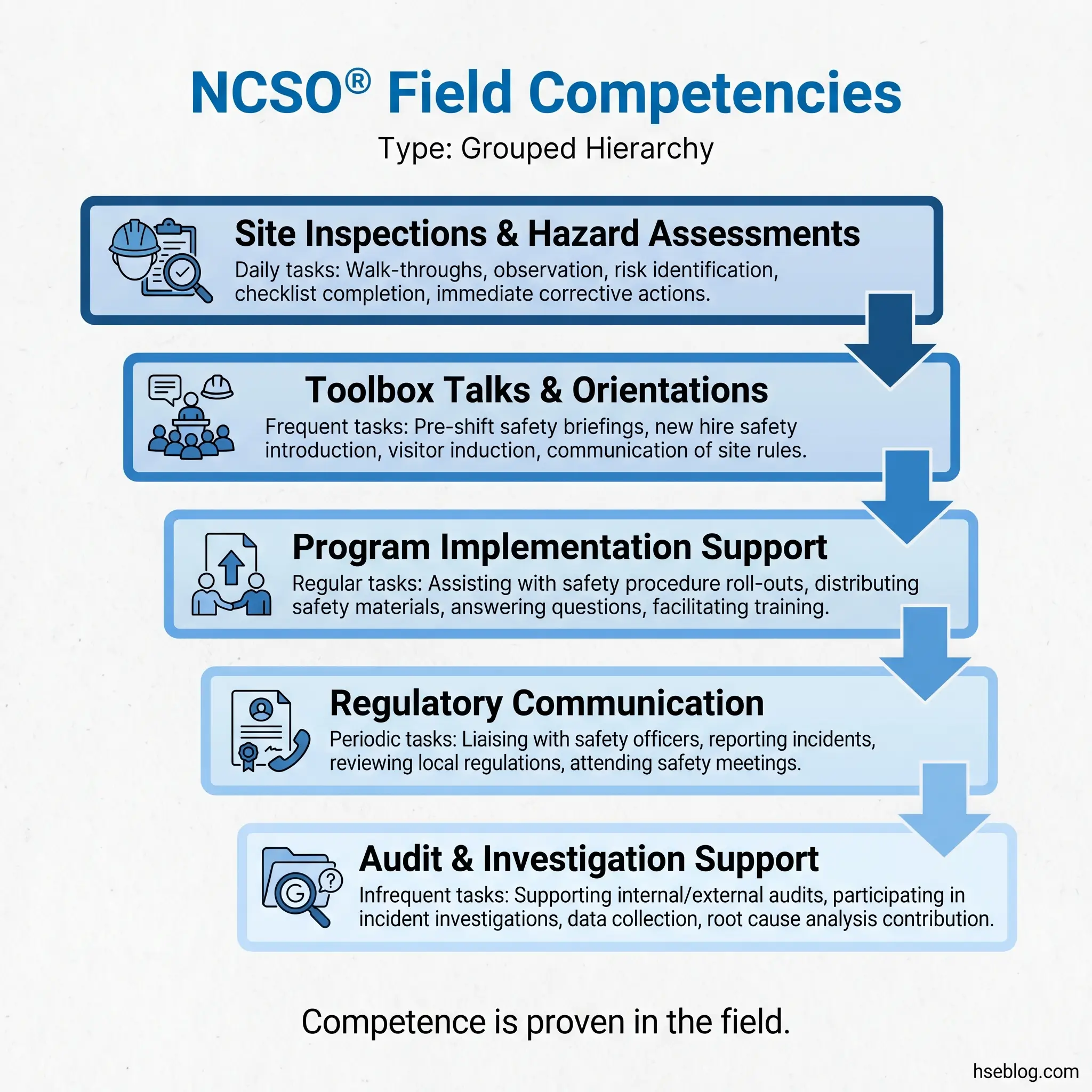
An NCSO® holder is equipped to perform core safety functions that directly impact worker safety on active construction sites:
- Conduct site inspections and hazard assessments to identify, evaluate, and recommend controls for workplace hazards before work begins and during active operations.
- Deliver toolbox talks, safety orientations, and crew briefings that communicate site-specific hazards, safe work procedures, and regulatory requirements to frontline workers.
- Assist management in implementing and maintaining the company's health and safety program, ensuring policies translate into actual field practices.
- Review and identify health and safety issues specific to the work site and company operations, including gap analysis between written programs and site conditions.
- Communicate with government OHS officers, inspectors, and regulators during site visits, inspections, and enforcement actions — representing the company's safety position with credibility.
- Conduct or support COR® internal audits, providing the company with documented evidence of its safety management system's performance.
- Support incident investigations by collecting evidence, interviewing witnesses, identifying root causes, and recommending corrective actions.
The designation does not make you a safety manager or director. Those roles require years of additional experience, often paired with higher credentials such as the CRSP (Canadian Registered Safety Professional) or CSP (Certified Safety Professional). But the NCSO® gives you the foundation to build toward those positions.
Career Value and Industry Demand for NCSO® Holders
The question candidates should ask is not whether the NCSO® is worth pursuing, but whether they can build a construction safety career in Canada without it. On most commercial and industrial construction projects across the country, the NCSO® is a minimum qualification for site safety officer roles. Project tenders frequently list it as a mandatory credential.
The career impact of holding the NCSO® extends beyond meeting a job requirement:
- COR® eligibility: In many provinces, NCSO® holders can serve as internal auditors for the Certificate of Recognition (COR®) program, which directly supports their employer's COR® certification and — in several jurisdictions — qualifies the company for workers' compensation premium rebates.
- Contractor prequalification: Many general contractors and project owners require subcontractors to have at least one NCSO® on staff as a prequalification condition. Your designation directly affects your employer's ability to win work.
- Career progression pathway: The NCSO® is a recognized stepping stone to advanced designations (CRSP, CHSC, Gold Seal) and senior safety management roles.
- Cross-provincial mobility: Because the NCSO® is nationally recognized, holders can pursue opportunities in any province without starting over — a significant advantage in an industry where workers follow projects across jurisdictions.
Conclusion
The National Construction Safety Officer designation is not a credential you hang on a wall. It is a working qualification — one that gets tested every time you walk onto a site, stop an unsafe task, deliver a toolbox talk to a crew that doesn't want to hear it, or sit across from an OHS inspector who wants to see whether your company's safety program exists beyond the binder.
Earning the NCSO® requires genuine field experience, structured training, practical demonstration of competence, and successful examination. Maintaining it demands ongoing professional development and active engagement with safety on real job sites. That is exactly what makes it valuable — it cannot be shortcut, and it cannot be faked.
If you are building a career in construction safety in Canada, the NCSO® is where that career begins. Not because the certificate opens doors by itself, but because the knowledge, discipline, and field credibility it represents are what every competent construction safety officer needs to protect workers and go home knowing they did their job.