
TL;DR
- OSHA mandates fall protection at 6 feet in construction and 4 feet in general industry — no exceptions, no shortcuts
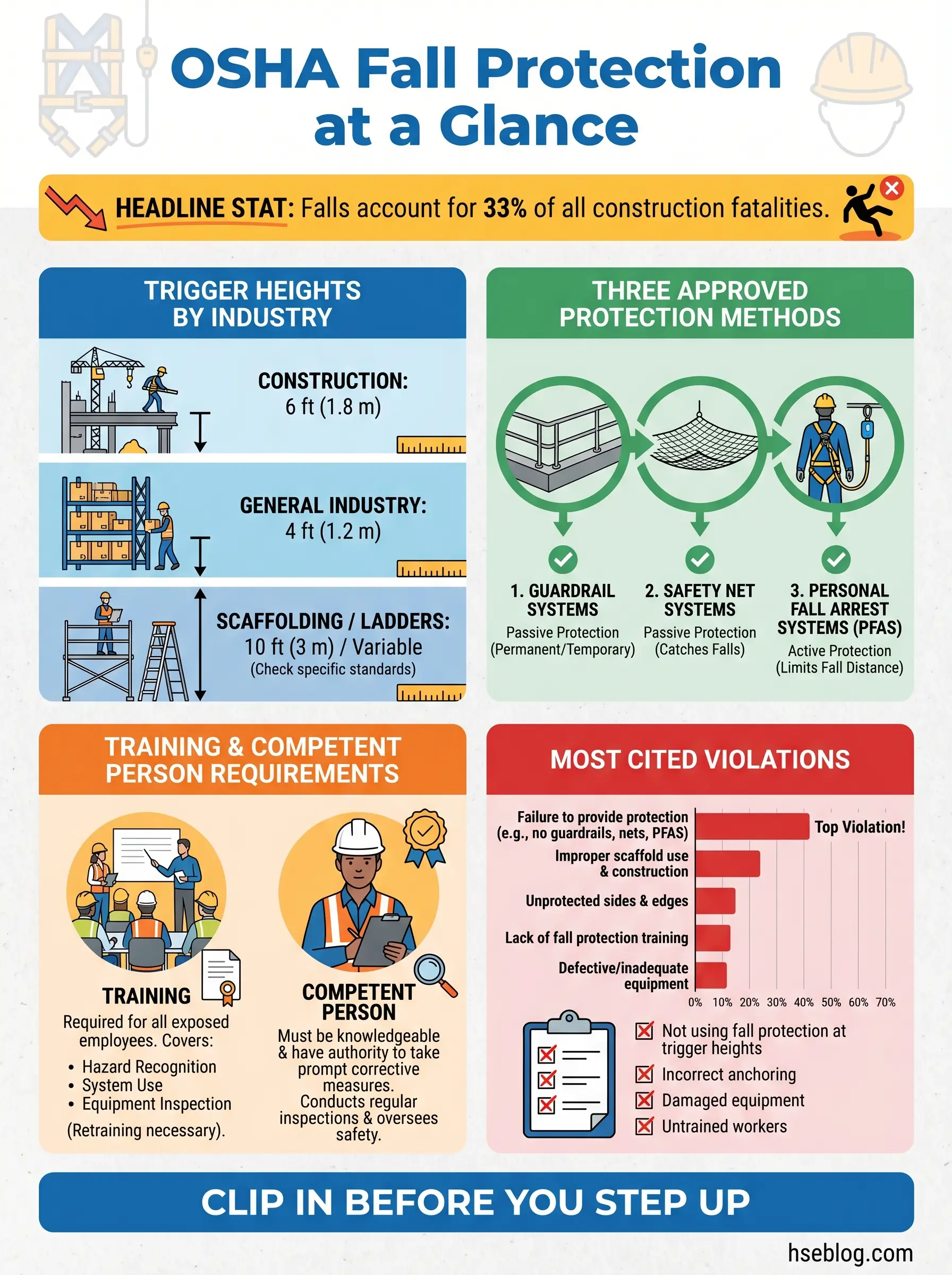
- Guardrails, safety nets, and personal fall arrest systems are the three primary protection methods under Subpart M
- A written fall protection plan is required only when conventional methods are infeasible — it is not a blanket substitute
- Every worker exposed to fall hazards must receive training from a competent person before stepping onto an elevated surface
- Fall protection violations remain OSHA’s most cited standard year after year — and most incidents trace back to the same preventable failures
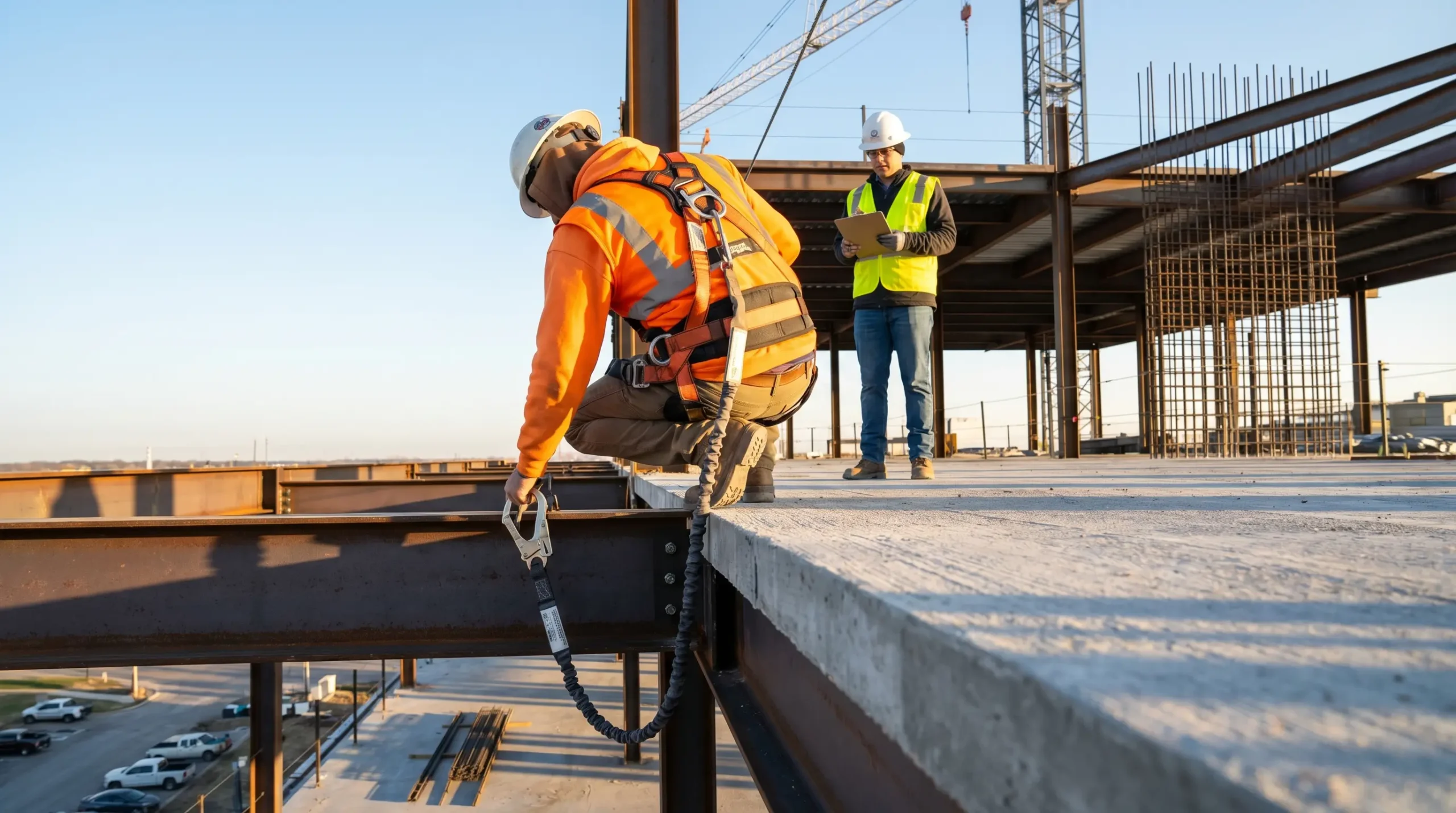
I was halfway through a steel erection walkdown on a commercial build in the Midwest when I saw a connector working two stories up with a harness on his back — unclipped. The lanyard was coiled over his shoulder like a garden hose. When I stopped the job, the foreman told me the crew “knows what they’re doing” and that clipping off slowed production. That connector was working at 28 feet with zero fall protection. One gust, one misstep, one moment of lost balance — and we’d be investigating a fatality instead of finishing a punchlist.
Falls remain the leading cause of death in construction. OSHA’s fall protection guidelines exist because gravity does not negotiate, and neither should the people responsible for keeping workers alive. This article breaks down every critical component of OSHA fall protection guidelines — the trigger heights, the approved systems, the training mandates, the common failures I see repeated on site after site, and the practical controls that actually prevent workers from hitting the ground.
What OSHA Fall Protection Guidelines Actually Require
OSHA fall protection guidelines are not suggestions. They are legally enforceable standards that define when, how, and with what methods employers must protect workers from fall hazards. The core requirements are split across two primary regulatory frameworks depending on the industry.
In construction, 29 CFR 1926 Subpart M governs all fall protection. For general industry, 29 CFR 1910 Subpart D applies. The trigger heights, approved methods, and employer obligations differ between them, and confusing the two is one of the most common compliance mistakes I encounter during audits.
The foundational requirements break down clearly:
- Construction (1926.501): Fall protection is mandatory at 6 feet above a lower level for all walking-working surfaces, including leading edges, hoist areas, holes, formwork, ramps, runways, and excavations
- General industry (1910.28): Fall protection triggers at 4 feet above a lower level for most walking-working surfaces, with specific exceptions for scaffolds, aerial lifts, and certain fixed ladders
- Steel erection (1926.760): Connectors working between 15 and 30 feet must have fall protection available; above 30 feet, it must be in use at all times
- Scaffolds (1926.451): Fall protection required at 10 feet above a lower level, with specific requirements varying by scaffold type
- Residential construction: OSHA applies the same 6-foot trigger, though enforcement and compliance methods have generated significant industry debate
29 CFR 1926.501(b)(1): “Each employee on a walking/working surface with an unprotected side or edge which is 6 feet or more above a lower level shall be protected from falling by the use of guardrail systems, safety net systems, or personal fall arrest systems.”
Pro Tip: The 6-foot trigger is not measured from the worker’s feet to the ground. It is the distance from the walking-working surface edge to the next lower level. I have seen contractors measure from a worker’s center of gravity or from the top of a parapet — both wrong, both resulting in citations.
The Three Primary OSHA Fall Protection Methods
OSHA does not leave the choice of protection to guesswork. The standard identifies three primary methods, and every employer must evaluate which system — or combination — fits the specific work activity, location, and hazard profile. I have investigated enough fall incidents to know that selecting the wrong system is almost as dangerous as using none at all.
Guardrail Systems
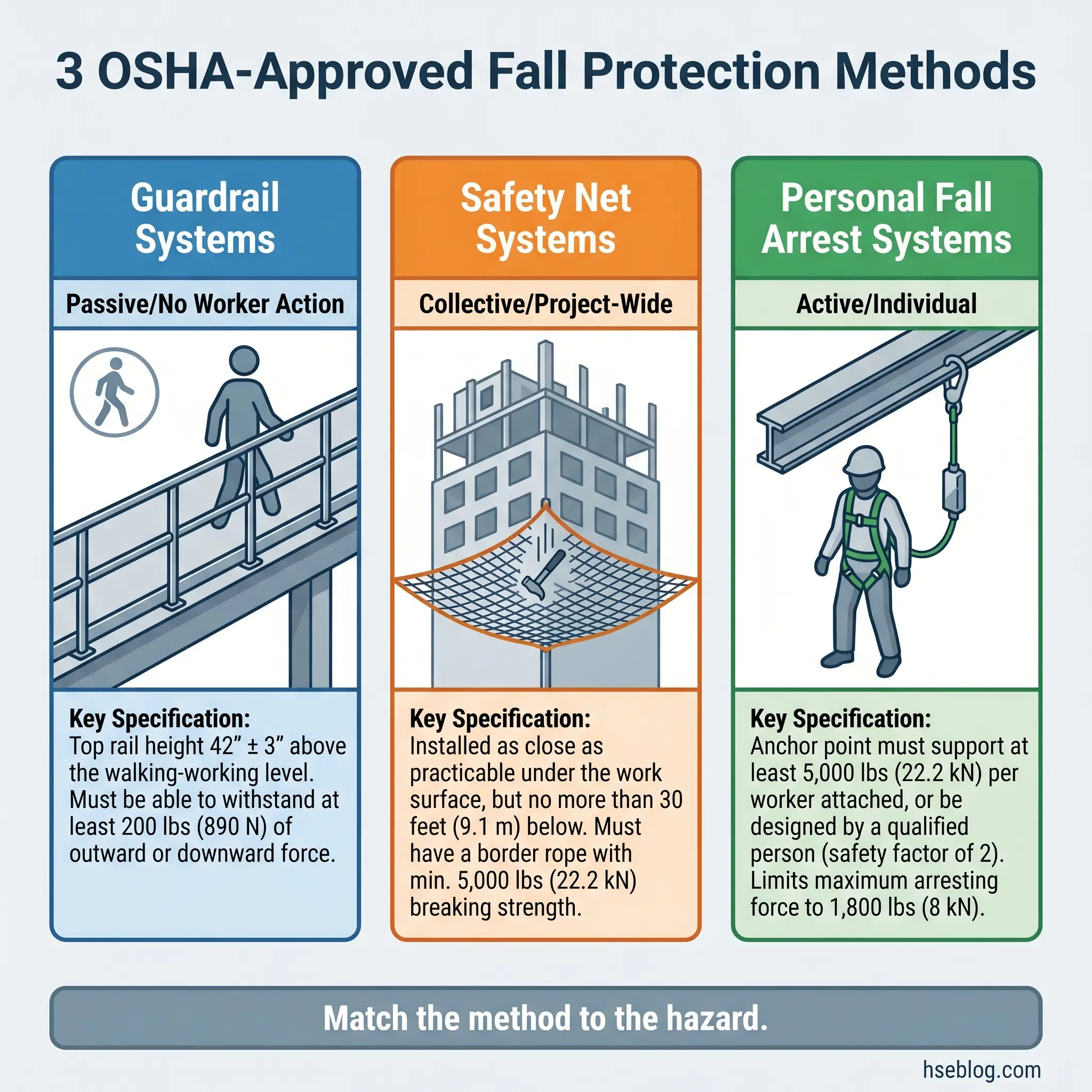
Guardrail systems are the most common passive fall protection method on construction sites, and when installed correctly, they require zero action from the worker. OSHA specifies precise engineering criteria for guardrails under 1926.502(b):
- Top rail height: 42 inches (plus or minus 3 inches) above the walking-working surface
- Mid rail: Installed at a height midway between the top rail and the walking surface
- Top rail strength: Must withstand 200 pounds of force applied in any outward or downward direction at any point along the top edge
- Mid rail strength: Must withstand 150 pounds of force in any downward or outward direction
- Toeboards: Required when there is a risk of falling objects to workers below — minimum 3.5 inches tall
Pro Tip: Wire rope used as a top rail must be flagged with high-visibility material every 6 feet to make it visible. I have seen unmarked wire rope guardrails on rooftop projects where workers walked right into them — defeating the entire purpose. If workers cannot see the barrier, it is not protecting anyone.
Safety Net Systems
Safety nets serve as collective fall protection where guardrails and personal systems are impractical — typically on bridge construction, high-rise steel erection, and large-span roofing operations. OSHA’s requirements under 1926.502(c) are demanding:
- Maximum installation distance: Nets must be installed as close as practicable under the walking-working surface, but never more than 30 feet below
- Clearance: Sufficient clearance beneath the net to prevent contact with surfaces or structures below during a fall
- Drop test: Each net must be drop-tested at the job site after initial installation and whenever relocated, repaired, or at 6-month intervals — whichever comes first
- Mesh openings: Must not exceed 36 square inches or be longer than 6 inches on any side
- Border rope: Minimum breaking strength of 5,000 pounds
Personal Fall Arrest Systems (PFAS)
Personal fall arrest systems are the most common active fall protection method, and they carry the highest margin for user error. A PFAS consists of three connected components, and every single one must be compliant and compatible:
- Full-body harness: The only acceptable body support device under OSHA construction standards — body belts are prohibited for fall arrest
- Connector: A deceleration device, lanyard, or self-retracting lifeline (SRL) that links the harness to an anchorage
- Anchorage: Must support at least 5,000 pounds per worker attached, or be designed, installed, and used under the supervision of a qualified person as part of a complete system maintaining a safety factor of at least two
One critical requirement that too many crews overlook: the system must be rigged so that a worker can neither free-fall more than 6 feet nor contact any lower level. That means calculating total fall distance — including harness deceleration distance, lanyard length, and D-ring shift — before every setup.
OSHA Fall Protection Guidelines for Specific Work Activities
The general 6-foot trigger is the baseline, but OSHA fall protection guidelines apply additional requirements to specific construction activities that carry elevated risk. Each sub-section of Subpart M addresses hazards unique to the work type, and I have found that most citation-worthy violations cluster in these specific scenarios.
Leading Edge Work
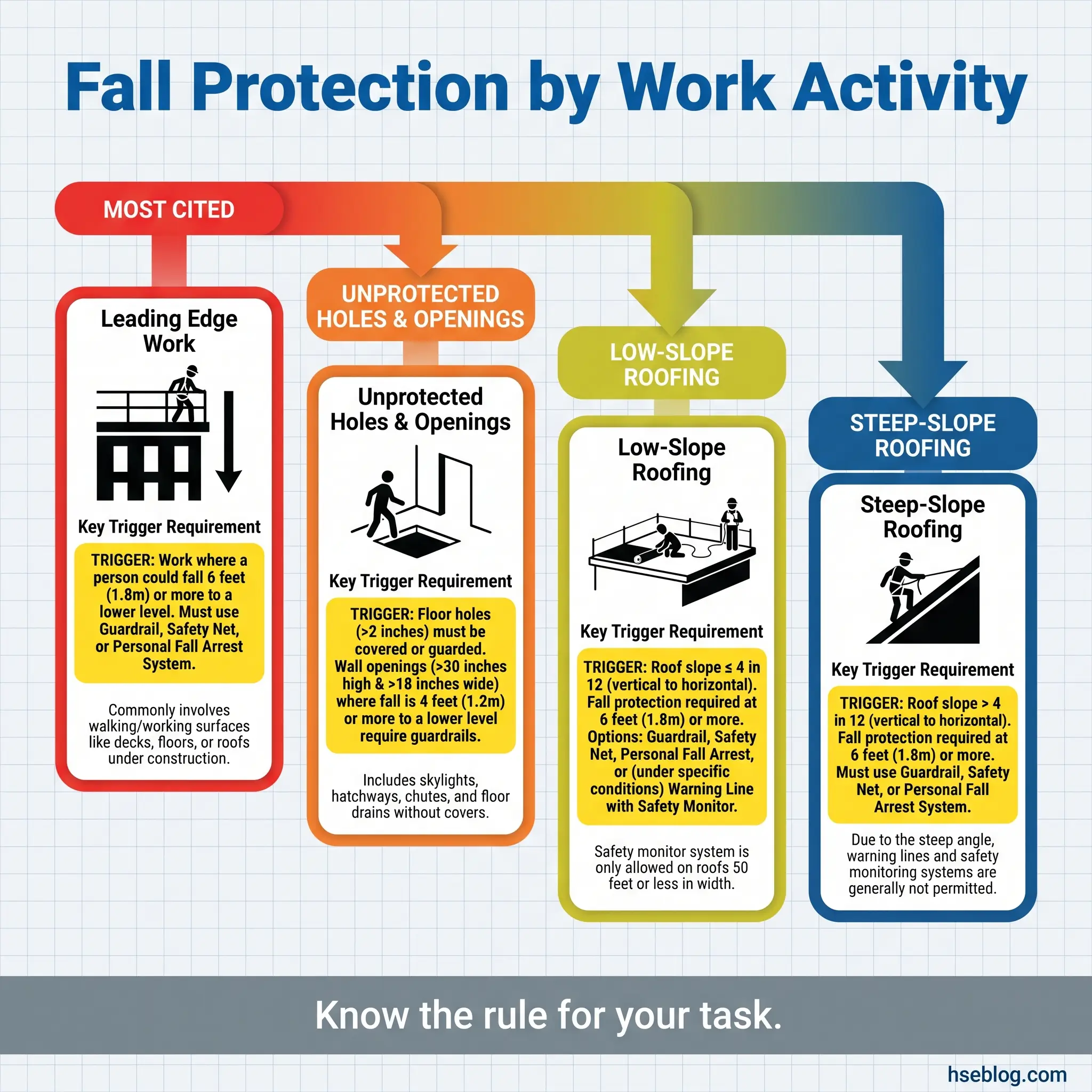
A leading edge is the unprotected side and edge of a floor, roof, or formwork that changes location as additional material is placed or erected. The standard requires conventional fall protection — guardrails, nets, or PFAS — unless the employer can demonstrate that these methods create a greater hazard or are infeasible. Only then can a fall protection plan under 1926.502(k) serve as an alternative.
Holes and Openings
OSHA distinguishes between holes (through which a person can fall) and openings (through which a person might not fall, but through which tools and materials can). Both demand specific controls:
- Floor holes: Must be guarded by covers capable of supporting at least twice the weight of workers, equipment, and materials that may cross over them, or by guardrail systems with toeboards
- Wall openings: Where the bottom edge is less than 39 inches above the walking surface and the opening is more than 18 inches wide, a guardrail system or equivalent barrier is required
- Covers must be secured against accidental displacement, marked with “HOLE” or “COVER,” and be capable of supporting the load without failure
Roofing Work
Roofing operations on low-slope roofs (4:12 pitch or less) require fall protection when work occurs within 6 feet of the roof edge and the roof edge is 6 feet or more above a lower level. On steep-slope roofs (greater than 4:12), fall protection is required regardless of distance from the edge.
- Low-slope options: Guardrails, safety nets, PFAS, or a combination of a warning line system and one of the conventional methods
- Steep-slope requirements: Guardrails with toeboards, safety nets, or PFAS — no warning line alternative
Pro Tip: Warning line systems alone are never sufficient as standalone fall protection under OSHA. They must be combined with guardrails, nets, PFAS, or a safety monitor. I have issued stop-work orders on roofing projects where contractors installed a single line of flagging tape at 6 feet from the edge and called it a “warning line system.” That is not compliant. OSHA requires the warning line to be erected at least 6 feet from the edge, supported by stanchions capable of resisting a 16-pound force, with lines flagged every 6 feet and at a height between 34 and 39 inches.
OSHA Fall Protection Training Requirements
Equipment means nothing if workers do not know how to use it, inspect it, and understand why it exists. OSHA mandates fall protection training under 1926.503, and the requirements are more specific than most employers realize. I have audited sites where the “training” was a five-minute tailgate talk with no documentation, no hands-on demonstration, and no competent person involved. That is not training — it is a liability.
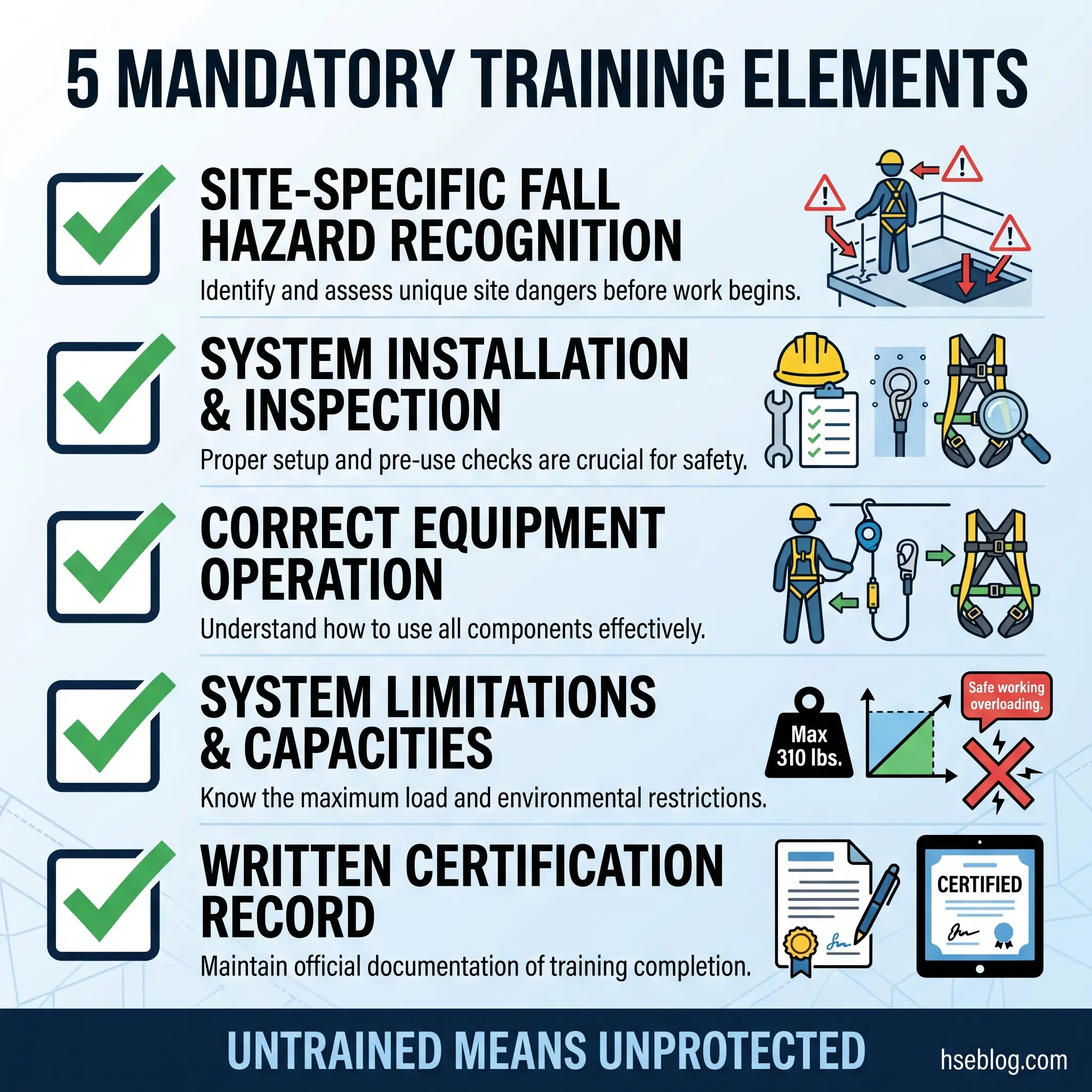
Every worker exposed to a fall hazard must be trained by a competent person who is qualified to identify fall hazards and authorized to take corrective action. The training must cover these elements at minimum:
- Nature of fall hazards in the specific work area — not generic fall awareness, but site-specific conditions
- Correct procedures for erecting, maintaining, disassembling, and inspecting each fall protection system used on the project
- Proper use and operation of guardrail systems, safety net systems, personal fall arrest systems, warning line systems, controlled access zones, safety monitoring systems, and fall protection plans
- Role and limitations of each system — workers must understand what the equipment can and cannot do
- Standards for the construction and installation of fall protection systems relevant to the work
Retraining is required whenever the employer has reason to believe an employee does not have the understanding or skill required — when changes in the workplace render previous training obsolete, or when the employee demonstrates an inability to recognize or avoid fall hazards.
The employer must maintain a written certification record for each trained employee. The certification must include the employee’s name, the date(s) of training, and the signature of the competent person who conducted it.
A competent person under OSHA means someone capable of identifying existing and predictable hazards, and who has authorization to take prompt corrective measures to eliminate them. This is not a certificate — it is a demonstrated capability backed by employer authorization.
Why Fall Protection Remains OSHA’s Most Cited Standard
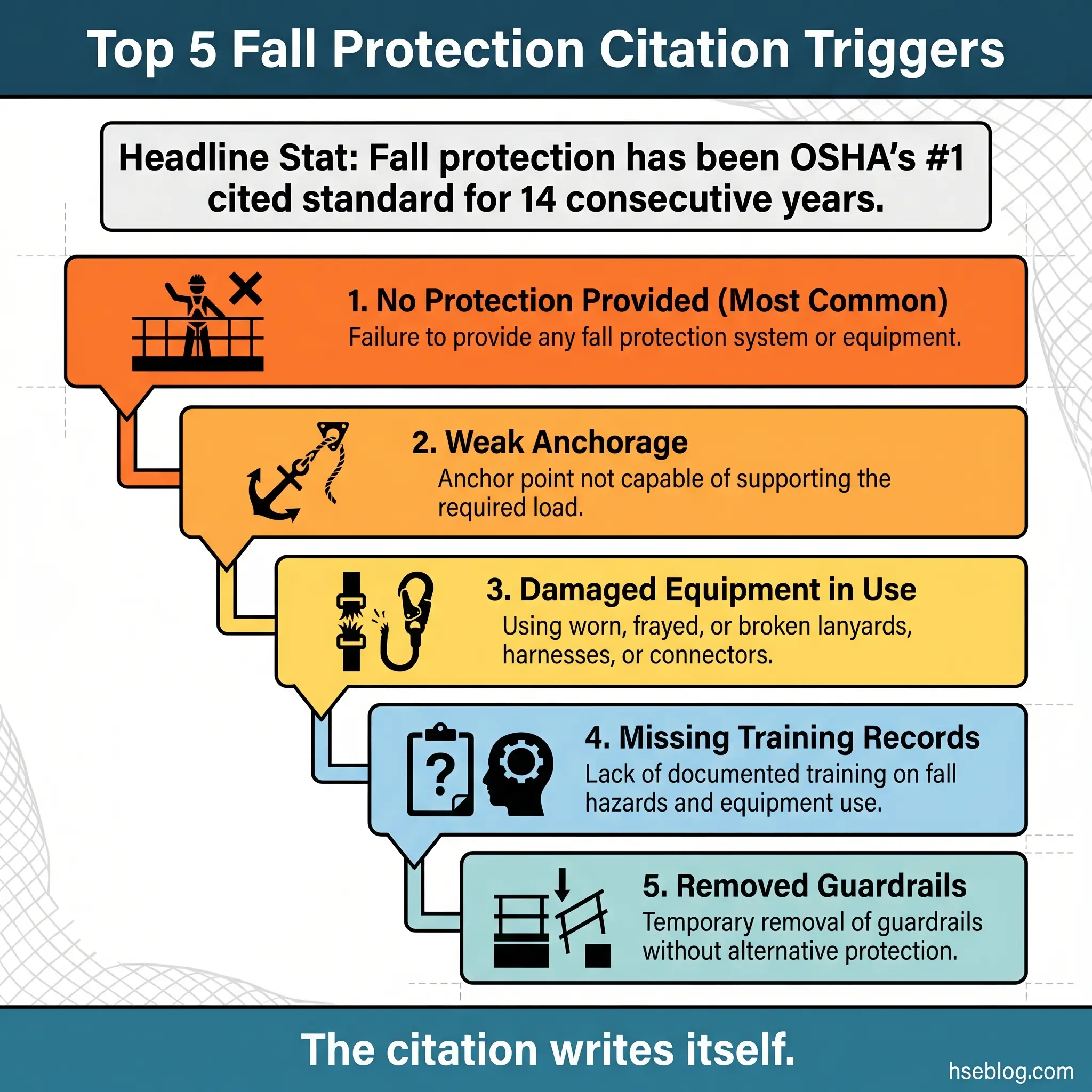
Fall protection violations have occupied the number one position on OSHA’s Top 10 most cited standards list for over a decade. The numbers are staggering, but what concerns me more is the pattern — the same violations, on the same types of projects, by the same categories of employers, year after year. The problem is not a lack of standards. The problem is a failure to implement what already exists.
The most frequent citation categories within fall protection reveal exactly where the system breaks down on site:
- No fall protection provided at all — the most basic violation. Workers at elevation with zero systems in place. This accounts for the majority of serious citations under 1926.501
- Inadequate anchorage strength — PFAS tied off to conduit, mechanical ductwork, rebar stubs, or temporary bracing incapable of supporting the 5,000-pound anchor load
- Damaged or uninspected equipment — harnesses with frayed webbing, shock absorbers with broken stitching, SRLs with corroded housings, and lanyards with cut fibers still in active use
- No training documentation — workers with harnesses who have never been trained, or training records that consist of a single sign-in sheet with no content outline or competent person signature
- Guardrails removed and not replaced — mid-rails or top rails taken down for material handling and never reinstalled, leaving unprotected edges for entire shifts
| Violation Category | Typical Penalty Range | Root Cause Pattern |
|---|---|---|
| No fall protection provided | $5,000–$16,131 per instance (serious) | Schedule pressure, cost avoidance |
| Inadequate anchorage | $5,000–$16,131 per instance | Lack of engineering review |
| No training/documentation | $1,000–$16,131 per instance | Administrative neglect |
| Guardrails removed/not replaced | $5,000–$16,131 per instance | Poor work sequencing |
| Willful violation | Up to $161,323 per instance | Deliberate non-compliance |
Pro Tip: When OSHA identifies a fall protection violation that results in a serious injury or fatality, the investigation almost always expands to inspect training records, equipment inspection logs, the written fall protection plan, and anchorage engineering documentation. A single missing harness on one worker can unravel an employer’s entire safety program during the inspection. Build the documentation before the inspector arrives — not after.
Common Field Mistakes That Defeat OSHA Fall Protection Guidelines
Compliance on paper and compliance on the ground are two different things. I have walked sites where the fall protection plan was beautifully written, the training binder was organized, and the harness inventory was cataloged — but the workers were exposed to uncontrolled fall hazards because the implementation had failed in the field. These are the mistakes I see most often.
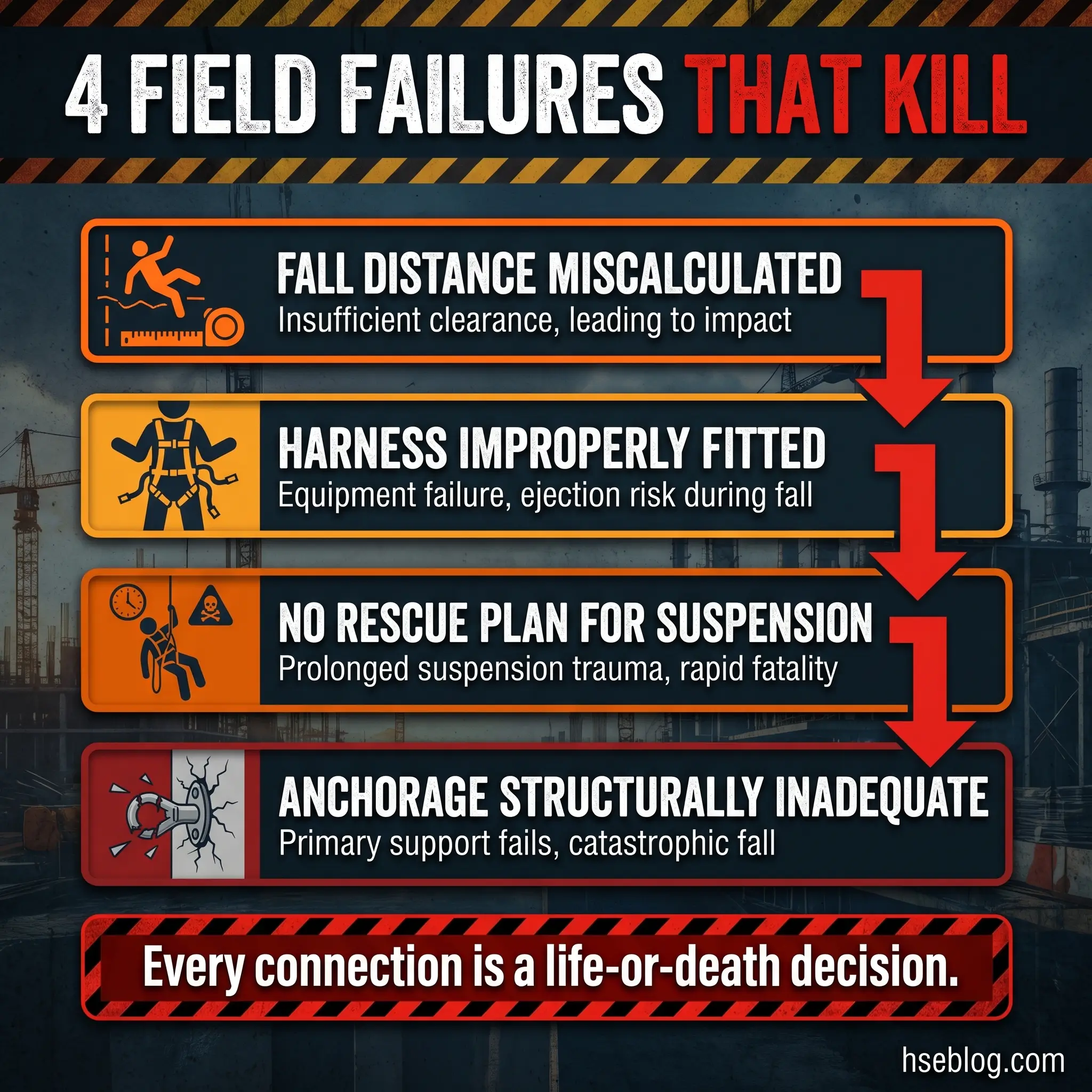
Total Fall Distance Miscalculations
This one kills people. A 6-foot lanyard does not mean the worker needs only 6 feet of clearance. Total fall distance includes free-fall distance (up to 6 feet), deceleration distance (up to 3.5 feet), harness D-ring shift (approximately 1 foot), and a safety margin. For a standard 6-foot shock-absorbing lanyard, the minimum clearance required below the worker’s feet is approximately 18.5 feet. Workers using a 6-foot lanyard while standing on a platform 12 feet above grade will strike the ground in a fall — with a harness on.
Harness Fit and Adjustment Failures
A harness that is too loose, improperly adjusted, or worn incorrectly provides a false sense of security. Common errors that compromise fall arrest performance include:
- Loose leg straps allowing the harness to ride up during a fall and potentially cause the worker to slip through
- Chest strap positioned too low shifting the arrest force away from the shoulder structure
- Dorsal D-ring not centered between the shoulder blades, altering the fall arrest geometry and increasing the risk of suspension in an inverted position
- Sub-pelvic strap skipped on harnesses that include one — removing a critical load-distribution point
Ignoring Suspension Trauma Risks
Even when a fall arrest system works perfectly and stops the fall, the worker is not safe. Suspension in a harness restricts blood flow to the legs, leading to suspension trauma — a potentially fatal condition that can develop within minutes. OSHA requires employers to have a rescue plan in place before any worker uses a PFAS. The plan must ensure rescue within six minutes of a fall arrest event.
Anchorage Abuse
I have documented workers tied off to standpipes, electrical conduit, sheet metal ductwork, plywood nailed to rafters, and in one memorable case, a plastic rainwater downpipe. None of these meet the 5,000-pound anchorage requirement. An anchorage point must be independently verified by a qualified person before any worker clips in.
Building an Effective OSHA-Compliant Fall Protection Program
Having investigated the failures, I can tell you what the sites that get it right look like. A compliant and effective fall protection program is not a document on a shelf. It is a living operational system that starts before the first worker climbs a ladder and continues through every phase of the project.
The following elements form the foundation of programs that consistently pass OSHA inspections and — more importantly — consistently prevent fall injuries:
- Conduct a site-specific fall hazard assessment before any elevated work begins. Walk the entire project area, identify every location where workers will be exposed to a fall of 6 feet or more, and document the hazard, the planned protection method, and the responsible supervisor.
- Select fall protection methods in order of the hierarchy of fall protection. Eliminate the fall hazard first (engineering the height out of the task). If elimination is not feasible, use passive protection (guardrails, covers). Use active protection (PFAS) only when passive systems cannot be installed. Administrative controls — like warning lines and safety monitors — occupy the last tier.
- Verify every anchorage point through engineering review. Structural anchorages must be evaluated by a qualified person. Temporary anchorages must be load-tested or certified. Never allow self-selected anchorages in the field.
- Implement pre-use equipment inspections at every shift. Every harness, lanyard, SRL, and connector must be visually and physically inspected by the user before each use. Any equipment that has arrested a fall must be immediately removed from service and not returned until inspected by the manufacturer or a qualified person.
- Train every exposed worker with hands-on demonstrations, not slideshow-only sessions. Workers must physically put on a harness, connect to an anchorage, and practice inspection under the guidance of a competent person.
- Establish and rehearse a rescue plan for every work location where PFAS is used. The plan must specify rescue method, rescue equipment location, trained rescue personnel, and maximum response time. A rescue plan that has never been drilled is not a plan — it is a guess.
- Audit fall protection compliance weekly through documented inspections. Assign a competent person to walk elevated work areas, verify systems are in place and properly used, and document findings with corrective actions.
The best fall protection programs I have audited share one trait: they treat every elevated task as a permit-required activity — even when OSHA does not mandate a permit. That level of discipline eliminates the casual attitude toward height that precedes most fatal falls.
Pro Tip: Build a fall protection equipment matrix for your project. Map every elevated work area to its required protection method, anchorage type, equipment specification, and rescue plan reference. Post it in the site office and review it during every pre-task briefing. This single document has eliminated more fall protection gaps on my projects than any other administrative control.
Conclusion
OSHA fall protection guidelines are not a regulatory burden to be managed — they are the engineering and procedural barrier between a worker going home and a family receiving the worst phone call of their lives. Every standard in Subpart M, every training requirement in 1926.503, every anchorage specification and guardrail dimension exists because someone fell and did not survive the lesson.
The pattern I see across every region, every industry sector, every project scale is the same: fall fatalities are rarely caused by equipment failure. They are caused by the decision to not use equipment, the failure to inspect what is being used, the inability to calculate whether the system will actually arrest the fall before the worker hits the ground, and the absence of a rescue plan for the moment after the system works. Every one of those failures is preventable with the knowledge, systems, and discipline that OSHA fall protection guidelines already require.
If you supervise workers at height, the standard is clear and the obligation is non-negotiable. Verify the anchorage. Inspect the harness. Calculate the fall distance. Train the crew. Plan the rescue. Do it every shift, every task, every worker — because the margin for error at elevation is exactly zero.