
TL;DR
- OSHA handrail standards vary by setting: General industry (29 CFR 1910) and construction (29 CFR 1926) have different height, strength, and installation requirements you must know for your specific workplace.
- Handrail height is non-negotiable: OSHA mandates 30 to 38 inches for stairway handrails and 42 inches (±3 inches) for guardrail top rails in general industry.
- Grip matters more than looks: A handrail must provide a graspable surface — circular cross-sections between 1¼ and 2 inches in outside diameter meet the standard.
- Load ratings prevent collapse: Every handrail and top rail must withstand at least 200 pounds of force applied downward or outward at any point along its length.
- Inspection gaps cause most violations: The handrail was installed correctly once — the problem is nobody checked it again after months of use, impact damage, and modification.
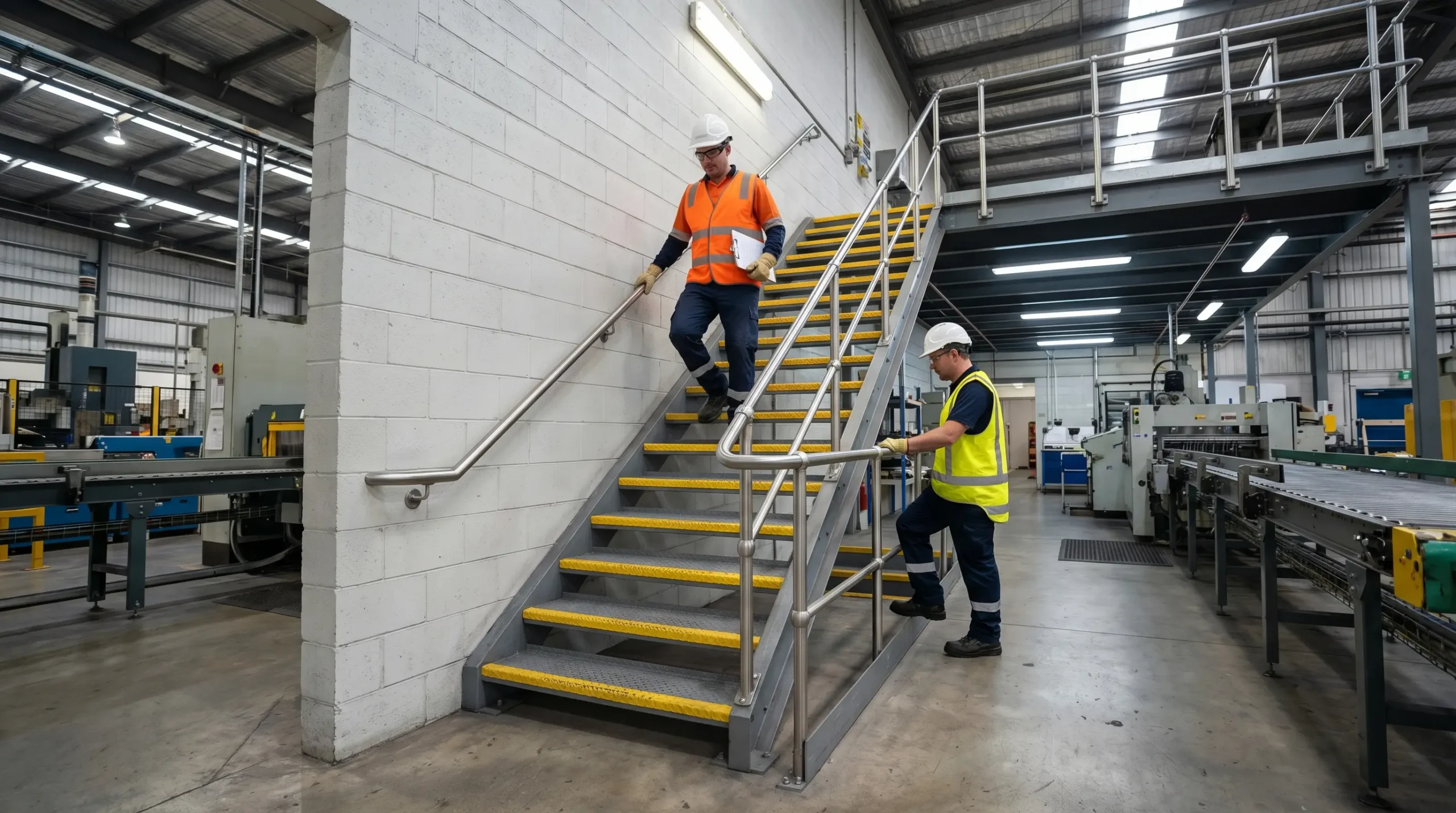
I was halfway through a routine walking-working surface inspection at a food processing plant when I grabbed a stairway handrail on a mezzanine access stair — and it moved. Not wobbled. Moved. The entire rail section shifted about two inches laterally because three of four mounting brackets had sheared from the wall. Workers had been using that stairway every shift for months. Nobody reported it. Nobody noticed. That single handrail failure sat at the intersection of everything wrong with how most workplaces treat passive fall protection: install it, forget it, and assume it works forever.
OSHA handrail requirements exist because falls remain the leading cause of fatal and serious injuries across general industry and construction. Handrails and guardrails are not decorative. They are engineered life-safety systems governed by specific dimensional, structural, and installation standards under 29 CFR 1910 (general industry) and 29 CFR 1926 (construction). This article breaks down every critical OSHA handrail requirement — height, strength, graspability, placement, inspection — and translates the regulatory language into what you actually need to verify, measure, and enforce on your site.

Handrail vs. Guardrail — Why OSHA Treats Them Differently
One of the most common compliance mistakes I encounter during audits is the assumption that handrails and guardrails are the same thing. They are not. OSHA defines and regulates each separately because they serve different safety functions, and confusing the two leads to installations that meet neither standard.
- Handrail: A rail that provides a graspable handhold for workers ascending, descending, or traversing a stairway or ramp. Its primary function is balance and support. OSHA requires handrails to be at a height that allows a natural grip while walking.
- Guardrail (guardrail system): A barrier erected along open edges of platforms, walkways, mezzanines, and floor openings to prevent workers from falling to a lower level. Its primary function is fall prevention, not balance.
- Top rail of a guardrail system: Functions as the uppermost horizontal barrier. OSHA specifies its height at 42 inches (±3 inches) in general industry — distinctly different from handrail height.
- Where they overlap: On open-sided stairways, OSHA may require both a handrail (for grip) and a stair rail system (to prevent falls off the open side). The stair rail system must meet guardrail-equivalent height and strength criteria, while the handrail must remain graspable.
Under 29 CFR 1910.28 and 1910.29, a guardrail system on an unprotected side or edge must include a top rail, mid-rail, and — where applicable — a toeboard. A handrail on a stairway must meet graspability standards under 1910.29(f).
Pro Tip: During your next walkdown, check every stairway that has an open side. If the rail on the open side is only 34 inches high and has no mid-rail, it fails both the handrail and the stair rail requirement. I’ve written this up more times than I can count — especially on older mezzanine stairs in warehouses and manufacturing plants.
OSHA Handrail Requirements for General Industry (29 CFR 1910)
The general industry walking-working surfaces standard underwent a major overhaul with the 2017 final rule. These updated requirements under 29 CFR 1910 Subpart D brought general industry closer to construction standards in several areas, but key differences remain. Here is what the standard requires for handrails specifically.
Height Requirements
OSHA is precise about handrail height — and the measurement method matters as much as the number itself.
- Stairway handrails: Must be between 30 and 38 inches in height, measured vertically from the stair tread nosing to the top surface of the handrail. Not from the floor. Not from the riser. From the nosing.
- Guardrail top rails (platforms, walkways, edges): Must be 42 inches (±3 inches) above the walking-working surface. This means the acceptable range is 39 to 45 inches.
- Stair rail systems on open sides: The top rail must be at least 42 inches above the stair tread nosing. This is higher than the handrail requirement because it serves a fall prevention function, not just balance.
Pro Tip: Carry a tape measure during every inspection and measure from the nosing — not the tread surface behind it. I’ve found installations that measured 36 inches from the tread but only 33 inches from the nosing. That 3-inch difference turns a compliant handrail into a citation.
Strength and Load Requirements
A handrail that bends, deflects, or detaches under load is worse than no handrail at all — because workers trust it. OSHA sets minimum structural performance criteria to prevent exactly the kind of bracket failure I described in the introduction.
- 200-pound concentrated load: Every handrail, top rail, and mid-rail must withstand at least 200 pounds of force applied in any downward or outward direction at any point along its top edge without failure.
- Smooth surface mandate: Handrails must be free of any features that could snag clothing, cut skin, or puncture hands — including splinters, burrs, protruding bolts, or rough welds.
- Deflection consideration: While OSHA does not specify a maximum deflection distance, the standard requires that the system must not deflect to a height below the minimum required height when the 200-pound load is applied. Practically, this means your top rail cannot sag below 39 inches under load.

Graspability Standards
This requirement trips up more employers than any other. A flat bar, a wide ledge, or a decorative railing might look like a handrail — but if a worker cannot wrap their hand around it and grip it while falling, it does not meet OSHA’s graspability criteria.
- Circular cross-section: Must have an outside diameter of at least 1¼ inches and no more than 2 inches.
- Non-circular cross-section: Must have a perimeter between 4 and 6¼ inches, with a maximum cross-section dimension of 2 inches. The shape must still permit a secure power grip.
- Continuous gripping surface: The handrail must provide an uninterrupted gripping surface along its entire length. Obstructions that break the grip — mounting brackets on top of the rail, decorative elements, or connection points — violate this requirement.
- Finger clearance: A minimum of 2¼ inches of clearance must exist between the handrail and any adjacent surface (wall, post, or object) to allow full hand encirclement.
29 CFR 1910.29(f)(4) requires that handrails have a smooth surface along the entire gripping length to prevent snagging of clothing and injury to hands.
Pro Tip: Test graspability the old-fashioned way. Wear your work gloves, grab the rail, and simulate a stumble. If your gloved hand cannot fully encircle the rail and maintain a firm grip, the railing fails the practical test regardless of what the dimension tape says.
OSHA Handrail Requirements for Construction (29 CFR 1926)
Construction sites introduce variables that do not exist in general industry — temporary structures, evolving layouts, multiple trades working simultaneously, and handrail systems that get installed, removed, and reinstalled repeatedly. OSHA addresses these realities under 29 CFR 1926 Subpart M (Fall Protection) and Subpart X (Stairways and Ladders).
Construction Stairway Handrail Specifications
The construction standards for stairway handrails align closely with general industry in some areas but diverge in others due to the temporary nature of construction access.
- Stairways with four or more risers, or rising more than 30 inches: Must have at least one handrail. If the stairway is less than 44 inches wide, one handrail is sufficient. If 44 inches or wider, handrails are required on both sides.
- Handrail height: Between 30 and 38 inches, measured from the upper surface of the handrail to the surface of the tread in line with the face of the riser at the forward edge of the tread — the same nosing-based measurement as general industry.
- Stair rail height on open sides: Must be between 36 and 42 inches from the upper surface of the stair rail to the tread nosing. Note this is different from general industry’s flat 42-inch requirement. Construction allows a lower minimum of 36 inches for stair rail systems.
- Mid-rail requirement: Stair rail systems must include a mid-rail approximately halfway between the top rail and the stair tread. This prevents workers from rolling or sliding under the top rail.

Temporary vs. Permanent Handrail Systems
This distinction causes real problems on construction projects where permanent architectural handrails are installed late in the schedule and temporary systems are removed too early.
- Temporary handrails must meet the same height and strength requirements as permanent ones. There is no reduced standard for temporary systems.
- Wooden handrails are permitted on construction sites provided they meet dimensional and strength criteria. Lumber used for top rails must be at least nominal 2×4 inches. This is a common and acceptable approach on formwork stairs and temporary access platforms.
- Wire rope may serve as a top rail or mid-rail in guardrail systems only if it meets specific criteria: flagged at 6-foot intervals with high-visibility material, and tensioned to prevent more than 3 inches of deflection under the 200-pound load test.
When and Where OSHA Requires Handrails
OSHA does not require handrails everywhere — but the locations where they are mandatory cover nearly every elevated walking surface and transition point in a workplace. The trigger thresholds and application rules catch many employers by surprise, especially those managing older facilities built to previous codes.
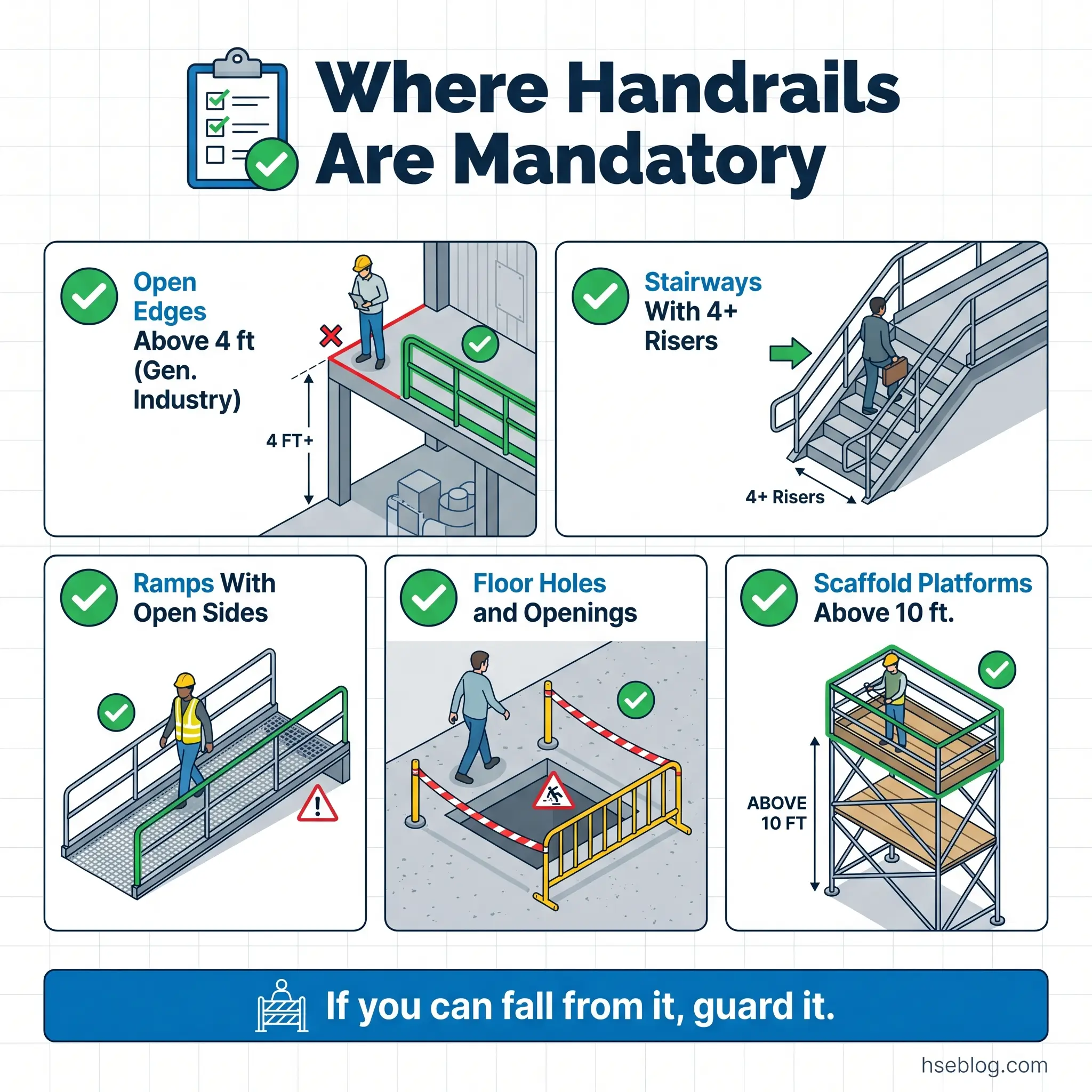
The following locations require handrail or guardrail systems under OSHA’s walking-working surfaces and fall protection standards:
- Unprotected sides and edges of walking-working surfaces 4 feet or more above a lower level in general industry (29 CFR 1910.28). Construction triggers at 6 feet (29 CFR 1926.501).
- Stairways with four or more risers or rising more than 30 inches in height — both general industry and construction.
- Ramps used as a walking surface must have guardrails on open sides if the height above the lower level exceeds 4 feet in general industry.
- Floor holes and wall openings: Holes through which a worker could fall must be guarded. Wall openings with a drop of more than 4 feet require guardrails, gates, or equivalent barriers.
- Scaffolding platforms: Each scaffold platform more than 10 feet above a lower level must have guardrail systems on all open sides and ends — this falls under Subpart L (Scaffolds), 29 CFR 1926.451.
- Loading docks and receiving areas: Open edges at dock height require either guardrails or removable barriers when not in active use.
| Location | General Industry Trigger | Construction Trigger |
|---|---|---|
| Open-sided platforms/edges | 4 feet above lower level | 6 feet above lower level |
| Stairways | 4+ risers or 30+ inches rise | 4+ risers or 30+ inches rise |
| Ramps (open sides) | 4 feet above lower level | 6 feet above lower level |
| Floor holes | Any hole a worker can fall through | Any hole a worker can fall through |
| Scaffolds | N/A (rarely in general industry) | 10 feet above lower level |
Common OSHA Handrail Violations Found on Site
After more than a decade of conducting site inspections across manufacturing, construction, and logistics operations, I can tell you that handrail violations follow predictable patterns. The same mistakes repeat across industries and geographies. Understanding these patterns is the fastest way to self-correct before OSHA arrives.
Height and Dimensional Violations
Height non-compliance accounts for a disproportionate share of handrail citations — and most of them are avoidable measurement errors.
- Measuring from the wrong reference point: Measuring handrail height from the tread surface instead of the nosing overhang. On stairs with a 1-inch nosing overhang, this creates a consistent under-measurement that puts the handrail below the 30-inch minimum.
- Post-installation floor resurfacing: I’ve inspected facilities where concrete floor overlays or anti-fatigue matting raised the walking surface by 1 to 2 inches after guardrails were installed. The guardrails that were compliant at installation now sit below the 39-inch minimum.
- Mixing up standards: Applying the 36-inch construction stair rail minimum to a permanent general industry installation that requires 42 inches. This happens frequently in facilities that transitioned from construction phase to operations without re-evaluating their handrail systems.
Structural and Mounting Failures
Strength failures often develop over time rather than existing at installation. The most dangerous ones are invisible until someone leans on the rail with their full weight.
- Corroded mounting hardware: In chemical processing, food manufacturing, and coastal environments, bracket bolts corrode from the inside out. The rail looks solid. The anchor behind the wall is dust.
- Impact damage from forklifts and equipment: Loading dock and warehouse guardrails take repeated hits from pallet jacks, forklifts, and material carts. Each impact loosens anchors incrementally. Nobody reports it. Nobody inspects it.
- Inadequate anchor depth in concrete: Rails mounted to concrete with expansion anchors that were set too shallow or into degraded concrete will pull out under load. I witnessed a guardrail section pull clean off a mezzanine edge during a load test at a distribution center — because the anchors were only 1½ inches deep in spalling concrete.
- Welded joints with hidden cracks: Tubular steel guardrails with welded connections develop fatigue cracks at weld toes, especially on stairways with heavy foot traffic and vibration.
Pro Tip: Add a physical pull test to your inspection routine. Grab the rail firmly and apply lateral force with your body weight. If you feel any movement, lateral flex beyond ½ inch, or hear creaking at the mounting points — tag it out of service immediately and initiate a structural repair.

Handrail Inspection Checklist and Field Verification
A handrail system is only as compliant as its last inspection. The most costly citations I have been part of — both in penalties and in injury outcomes — came from systems that were installed correctly but deteriorated because nobody checked them again. Inspection must be systematic, documented, and recurring.
What to Check During a Handrail Inspection
The following checklist covers every OSHA-referenced parameter and the most common field failure modes. Use it as a walk-through protocol for any facility with elevated walking-working surfaces.
- Measure height at three points minimum: Top of stair (first tread), middle of stair run, and bottom of stair (last tread). Measure vertically from the tread nosing to the top surface of the handrail at each point.
- Verify graspability: Attempt a full-hand grip while wearing standard work gloves. Confirm circular cross-section is between 1¼ and 2 inches, or non-circular profile meets perimeter and clearance requirements.
- Check finger clearance: Measure the gap between the handrail and adjacent wall or surface. Confirm at least 2¼ inches of clearance exists at every mounting bracket and along the full length.
- Apply lateral force test: Push outward and downward at multiple points with body weight. Flag any deflection, movement, creaking, or visible loosening at anchors or brackets.
- Inspect mounting hardware: Look for corrosion, missing fasteners, stripped threads, cracked welds, and anchor pullout signs (gap between baseplate and mounting surface).
- Confirm continuity: Walk the full length. Verify no obstructions break the gripping surface — no protruding brackets on top, no gaps, no sharp edges at transitions.
- Check mid-rail and toeboard presence on guardrail systems. Mid-rail should be approximately halfway between the top rail and the walking surface. Toeboards must be at least 3½ inches high with no more than ¼-inch gap at the floor.
- Document with photos and measurements. Record location, date, findings, and corrective action assigned. This documentation is your compliance defense if OSHA inspects.
OSHA does not prescribe a specific inspection frequency for handrails in general industry, but 29 CFR 1926.502(d)(7) requires fall protection systems in construction to be inspected before each use. Apply a comparable discipline to general industry: inspect at least quarterly, and after any impact event.
Selecting and Installing Compliant Handrail Systems
Choosing the right handrail system is not a procurement decision — it is a safety engineering decision. Material selection, mounting method, environmental exposure, and traffic patterns all influence whether a system will remain compliant over its service life. I have seen brand-new installations fail within months because the specifier chose the wrong material for the environment.
Material Selection by Environment
The environment dictates the material. Getting this wrong at the specification stage guarantees premature failure and non-compliance down the line.
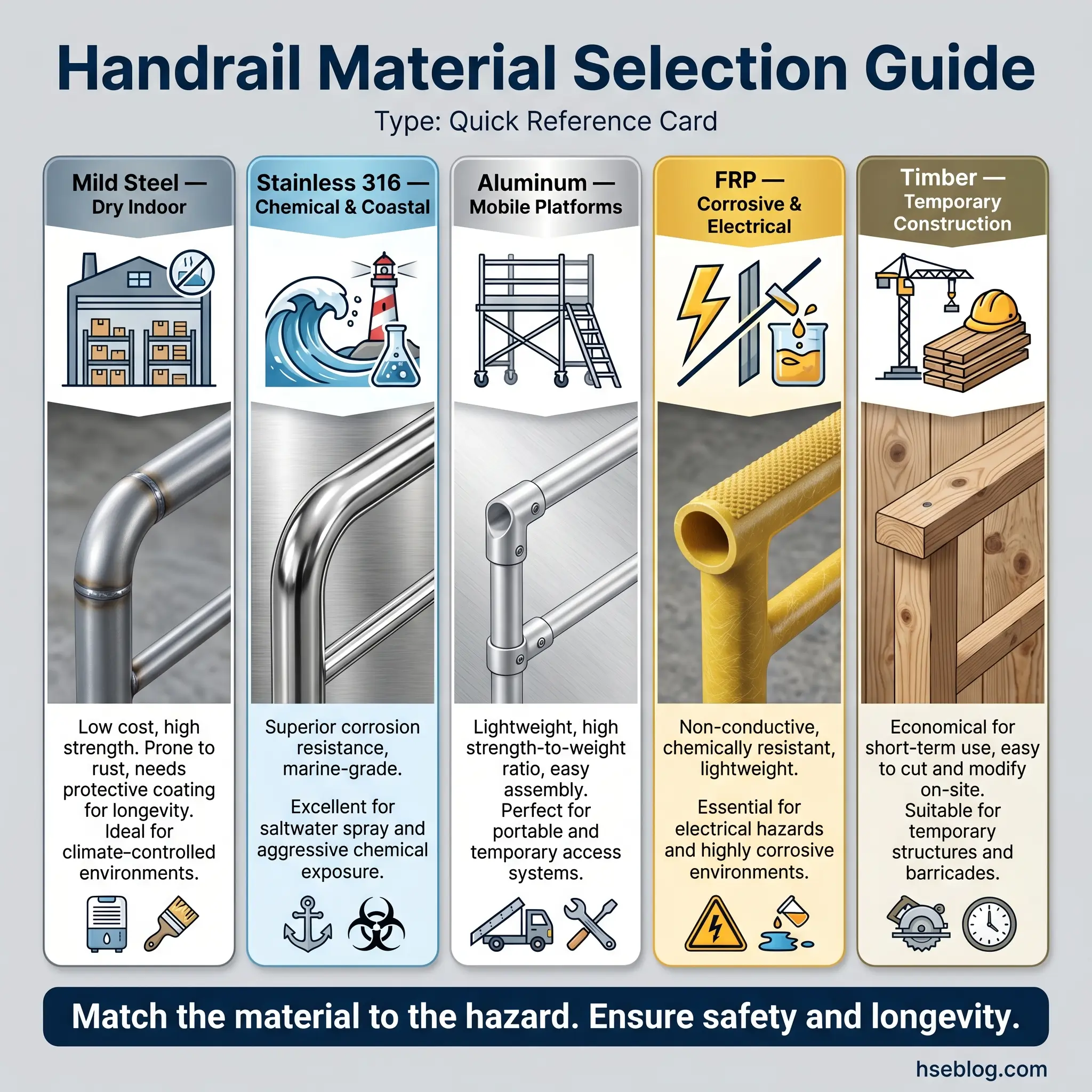
- Mild steel (powder-coated or galvanized): Suitable for interior dry environments — warehouses, manufacturing floors, office mezzanines. Not suitable for wet, chemical, or coastal environments without heavy-duty coating systems.
- Stainless steel (304 or 316 grade): Required for food processing, pharmaceutical, coastal, and chemical environments. Grade 316 is the minimum for chloride exposure (swimming pools, coastal, certain chemical plants). Higher initial cost, but dramatically lower lifecycle maintenance.
- Aluminum: Lightweight, corrosion-resistant, and common on mobile platforms and lightweight mezzanines. Must be verified for the 200-pound load requirement — some thin-wall aluminum rail profiles flex excessively under load.
- Fiberglass reinforced plastic (FRP): Used in corrosive environments where metal corrodes rapidly — acid storage areas, electroplating facilities, wastewater treatment. Non-conductive, which adds electrical safety value. Must be UV-stabilized for outdoor installations.
- Timber: Acceptable in construction under 29 CFR 1926 with specific dimensional requirements (nominal 2×4 minimum for top rails). Not typically used in permanent general industry installations.
| Material | Best Environment | Load Compliance Risk | Corrosion Resistance |
|---|---|---|---|
| Mild Steel (galvanized) | Indoor / dry industrial | Low | Moderate |
| Stainless 316 | Chemical / coastal / food | Low | High |
| Aluminum | Lightweight / mobile platforms | Moderate (verify profile) | High |
| FRP | Acid / corrosive / electrical | Low | Very High |
| Timber | Construction temporary access | Moderate (verify dimensions) | Low |
Mounting Best Practices
Installation quality determines long-term compliance more than any other factor. A perfectly specified handrail mounted with the wrong anchors into the wrong substrate will fail.
- Concrete substrates: Use mechanical or chemical expansion anchors rated for the substrate strength. Minimum embedment depth should follow the anchor manufacturer’s specification — typically 2½ to 4 inches for standard post bases. Never set anchors into cracked or spalling concrete.
- Steel substrates: Bolted connections to structural steel must use grade 5 or grade 8 bolts with lock nuts or tack welding to prevent vibration loosening. Welded connections must be performed by qualified welders and inspected visually (at minimum) for cracks, undercut, and incomplete fusion.
- Wall-mounted brackets: Brackets must anchor into structural members (studs, concrete, or steel), not drywall or hollow block alone. Use through-bolts or structural anchors — never toggle bolts or drywall anchors for life-safety rails.
- Post spacing: Maximize rigidity by keeping post spacing under 8 feet for standard handrail profiles. Closer spacing (4 to 6 feet) is recommended for high-traffic stairways and areas subject to lateral loading.
What Happens When Handrails Are Missing or Non-Compliant
OSHA citations for handrail violations fall under the walking-working surfaces and fall protection standards — both of which are among the top 10 most frequently cited standards every year. The consequences extend far beyond the fine itself.
When I investigate fall incidents where handrails were absent, broken, or non-compliant, the sequence of events follows a remarkably consistent pattern: a worker uses a stairway or elevated surface they have used hundreds of times before, encounters an unexpected condition (wet step, carrying material, fatigue, misstep), reaches for the handrail — and it either is not there or does not hold. The fall happens in under two seconds. The injury takes months to recover from. The investigation takes weeks. The legal exposure lasts years.
- OSHA penalties: Serious violations under the walking-working surfaces standards can result in penalties exceeding $16,000 per violation. Willful or repeat violations can reach over $160,000 per instance. These are per-violation amounts — a single facility with multiple non-compliant stairways can face cumulative penalties in the hundreds of thousands.
- Workers’ compensation impact: Falls from stairs and elevated surfaces consistently rank among the highest-cost workers’ compensation claims. Average medical and indemnity costs for a stairway fall exceed $40,000, with severe cases (spinal injury, traumatic brain injury) reaching seven figures.
- OSHA inspection triggers: A single employee complaint about a missing or broken handrail can trigger a full walking-working surfaces inspection. What began as one handrail issue becomes a facility-wide audit of every elevated surface, floor opening, and stair system.
- Third-party liability: In multi-employer construction settings, handrail failures create exposure for the controlling contractor, the creating employer, and potentially the site owner — regardless of whose employee was injured.
Falls to a lower level remain the leading cause of death in the construction industry and a top-three cause of workplace fatality across all industries. Many of these falls occur on stairways and from platforms where a properly installed handrail would have prevented the event entirely.

Conclusion
OSHA handrail requirements are not ambiguous. The standards specify exactly how high, how strong, how graspable, and where handrails must be installed. The gap between compliance and non-compliance almost always comes down to three things: measuring correctly, inspecting regularly, and treating handrails as life-safety systems rather than architectural finishes. Every handrail violation I have ever documented started the same way — someone assumed the rail was fine because it looked fine.
If you manage a facility, a construction project, or a maintenance program, make handrail inspection a named item on your periodic safety audit. Do not roll it into a general housekeeping walk. Give it its own checklist, its own frequency, and its own corrective action tracking. The 200-pound load test, the height measurement from the nosing, the graspability check — these take minutes per stairway. Skipping them risks lives.
The workers who use your stairways and platforms trust that every handrail they touch will hold them. That trust is earned through engineering, maintained through inspection, and destroyed in a single fall. Build your handrail program like the life-safety system it is — because that is exactly what OSHA intended it to be.