

TL;DR
- The label is the legal instrument — In the US, UK, and EU the product label and its Safety Data Sheet set binding requirements for handling, storage, and PPE.
- Control exposure before you reach for PPE — Substitution, closed transfer, and re-entry intervals cut exposure first; PPE is the last line, not the first.
- The mixing and loading station is the danger zone — Concentrate handling, not dilute application, is where most serious exposure happens.
- Store locked, segregated, and away from PPE — A ventilated, access-restricted store with hazard-class separation prevents both poisoning and cross-contamination.
- Match gloves to the label category, then watch the change-out clock — “Chemical-resistant” is time-limited, not chemical-proof.
Pesticide safety rests on three linked controls: handle concentrate over containment in label-specified PPE, store product in a locked, ventilated room segregated from food and protective equipment, and select protection the label dictates. The label is legally binding in the US, UK, and EU. Wearing more than it specifies is permitted; falling below it is unlawful.
Two notes before the guidance. This article is general HSE reference, not medical advice — anyone with exposure symptoms or a poisoning concern should contact an occupational physician or emergency services and follow the product’s first-aid statement. It is also not legal advice; it reflects general professional understanding of US, UK, and EU requirements as of 2026, and specific compliance or enforcement questions belong with qualified counsel in your jurisdiction.
A pesticide label is not packaging copy — it is an enforceable legal document. Under US FIFRA the principle is stated plainly: the label is the law, and using a product in a way the label forbids is a federal offence. UK law arrives at the same place by a different route, with the label and Safety Data Sheet driving the employer’s COSHH risk assessment. That single fact reshapes how a handler reads every instruction on the container.
Pesticide safety — handling, storage, and PPE — is best understood as one continuous exposure-control chain rather than three separate jobs. Each stage targets a specific route by which the chemical reaches the body, and a gap in any one stage undoes the others. This guide walks the full handler lifecycle across the two regimes that dominate the field, the US Worker Protection Standard and UK COSHH, with EU and international frameworks layered in for readers who operate across borders.

Why Pesticide Safety Is a Legal Duty, Not Just Best Practice
The organizing rule is simple: the product label is legally enforceable in every major jurisdiction, and your handling, storage, and PPE choices flow from it. Treat that as the floor, not the ceiling.
Pesticides reach the body by three routes, and the controls in this article each target specific ones:
- Dermal (skin) — the dominant route. Most occupational exposure is absorbed through unprotected or under-protected skin, which is why glove selection and chemical-resistant clothing carry so much weight.
- Inhalation. Volatile formulations, dusts, and fumigants enter through the lungs, the route respiratory protection exists to close.
- Ingestion. Less common at work but severe in outcome, usually from contaminated hands, food, or decanting product into unlabeled drink containers.
The human stakes behind these routes are not abstract. The World Health Organization attributes up to around 140,000 deaths a year to intentional pesticide self-poisoning, roughly 15–20% of global suicides (World Health Organization, 2024) — a figure that reflects the raw acute toxicity that storage security and handling discipline are built to contain.
A point on accuracy worth making, because it separates current guidance from a lot of what still ranks. A widely repeated figure of 385 million unintentional poisonings a year was withdrawn when the underlying study was formally retracted (BMC Public Health retraction, 2024). I leave it out entirely; an older WHO task-force estimate of roughly one million unintentional poisonings and about 20,000 deaths (World Health Organization, 1990 estimate) is the kind of historical framing that still stands, provided it is dated honestly.
Two definitions decide who carries which legal duty:
- A handler mixes, loads, applies, or cleans equipment — the people in direct contact with concentrated or diluted product.
- An early-entry worker enters a treated area before the restricted-entry interval expires, which triggers a distinct set of notification and PPE obligations under the US WPS.
A recurring failure I see across the published record and in audit findings is teams treating PPE as their primary control. The hierarchy of controls places it last for a reason. Substitution comes first — a less hazardous product or an integrated pest management (IPM) approach that reduces chemical use. Then engineering controls such as closed transfer systems and containment pads. Then administrative controls such as re-entry intervals and signage. Only after those does PPE become the final barrier, and a final barrier asked to do all the work is a barrier under strain.
A competent-person caveat applies throughout what follows: life-critical tasks such as respirator selection, fumigation, and confined handling of highly toxic concentrate must be planned and supervised by a competent person with relevant training, jurisdiction-specific authorization, and a site-specific risk assessment. Recognized training pathways include NEBOSH and IOSH certificates, OSHA outreach training in the US, and the UK Certificate of Competence for professional users.
Safe Pesticide Handling: Mixing, Loading, and Application
The highest-exposure moment is handling undiluted concentrate at the mix-load station — not spraying dilute product in the field. Build your pesticide handling safety procedures around that truth and the strictest discipline lands where it matters most.
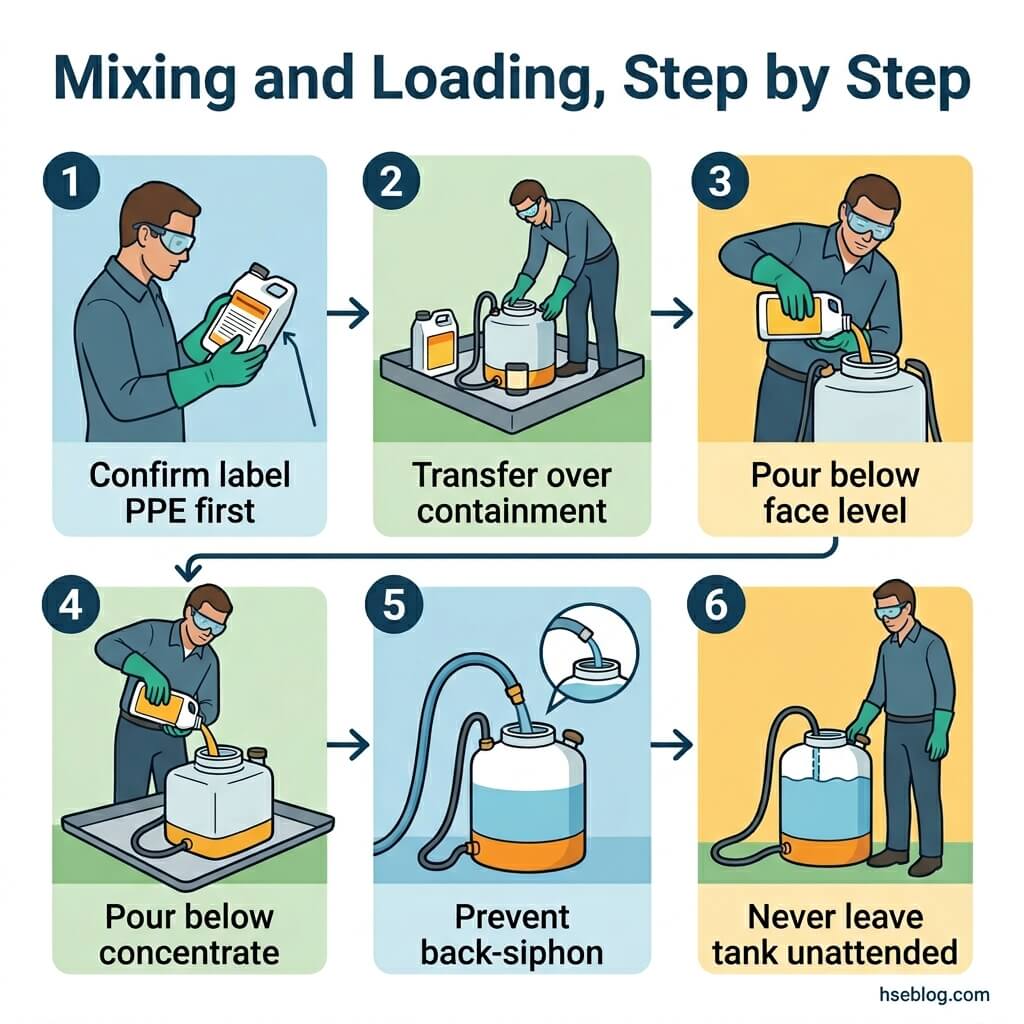
Work the sequence in order:
- Read the label and SDS before opening anything. Identify the signal word — DANGER, WARNING, or CAUTION — and confirm the required PPE is on your body before the container is breached.
- Set up over containment. Conduct every transfer over a spill-containment surface or pad so a slip or splash is captured, not spread.
- Pour low and controlled. Keep the container and product below face level when pouring to keep splashes away from eyes and airway.
- Protect the water source. Use back-siphon prevention or an air gap when drawing from a water supply so concentrate cannot be drawn back into it.
- Never leave a tank filling unattended. Overflows during filling are a classic, avoidable source of concentrate release.
- Apply with the conditions, not against them. Stand upwind, respect buffer and no-spray zones near water, and observe the restricted-entry interval before anyone returns.
If product reaches skin or clothing during the task, treat it as an immediate stop, not an end-of-shift cleanup:
- Stop work the moment contamination is noticed.
- Wash the affected skin with detergent and water; for eyes, rinse for at least 15 minutes.
- Change out of contaminated PPE and clothing into clean protection.
- Contain the spill with absorbent — never hose it down, which only widens the contaminated area and risks a watercourse.
The pattern worth internalizing is where incidents cluster. Across the published exposure record, serious contact concentrates at mixing and loading, yet most informal training over-invests in application technique. The judgment call is straightforward: give the highest-concentration moment the strictest PPE and the most deliberate procedure, even though it feels like the least glamorous part of the day. The EPA’s worker safety guidance on handler practices is a solid US reference point for the detail behind each step.
Restricted-Entry Intervals and Re-Entry Safety
A restricted-entry interval (REI) is a time-based administrative control: the period after application during which workers may not enter a treated area without specific authorization and protection. It is the clock that lets residues dissipate before skin contact resumes.
Under the US Worker Protection Standard (40 CFR Part 170), early entry during the REI is tightly limited. When it is permitted, the employer must provide the label-specified early-entry PPE, training, and hazard notification, and entry must meet the narrow conditions the rule allows. Other regimes reach the same protective goal through buffer zones, signage, and competence requirements rather than an identical REI mechanism, so check which instrument binds your site before assuming the US framework applies.
Pesticide Storage Requirements: Security, Segregation, and Containment
A compliant pesticide store is locked, ventilated, access-restricted, and segregated by hazard class — and it never doubles as a PPE cupboard. This is the pillar most PPE-focused guidance skips, and it is where stores quietly drift out of compliance.
Storage discipline runs across several fronts:
- Security and signage. Keep the store locked and ventilated with restricted access, mark it clearly as a pesticide storage area, and post an NFPA hazard placard at entrances so emergency responders know what they face.
- Container integrity. Original containers only, with labels legible and protected; shelve dry formulations above liquids; rotate stock first-in, first-out so nothing ages past its shelf life unnoticed.
- Containment and spill readiness. Provide bunding or secondary containment, keep absorbent, a shovel, and a sealed waste container on hand, and store the SDS adjacent to — not inside — the store.
Segregation is where many stores fail, because incompatible products are crowded together for convenience. The separation logic is worth setting out plainly:
| Keep apart | Reason |
|---|---|
| Pesticides from food, feed, water, seed, and fertilizer | Contamination and accidental ingestion risk |
| Pesticides from PPE (especially respirators) | Vapors and dusts contaminate protective equipment |
| Herbicides from insecticides and fungicides | Cross-contamination and misapplication risk |
| Flammable from non-flammable formulations | Fire load and ignition control |
The jurisdictional split on storage is clean enough to state directly. In the US, small and portable containers are governed by their label instructions, while EPA’s container containment rule requires secondary containment for large stationary agricultural containers of 500 gallons or more — and state or local fire codes may be stricter; EPA’s storage requirements page sets out the distinction. In the UK, HSE guidance on storing pesticides for professional users (AIS16) sets store standards alongside COSHH duties and the Defra Codes of Practice.
Temperature matters more than people assume. Many products tolerate roughly 40–100°F (4–38°C), but the label governs, and freezing or overheating can degrade a formulation or burst a container.
Two failure modes recur. The first is co-locating PPE and emergency respirators inside the store “for convenience,” which contaminates the very equipment meant to protect against the store’s contents. The second is silent inventory drift — expired, decanted, and orphaned product accumulating until the store no longer reflects what is on the shelf. Scheduled inventory checks are the unglamorous control that actually prevents both.

Storing Flammable and Highly Hazardous Pesticides
Flammable formulations raise the stakes. They belong in fire-rated cabinets with ignition sources excluded, and in the UK their storage and handling fall under DSEAR (the Dangerous Substances and Explosive Atmospheres Regulations) in addition to COSHH.
Treated seed deserves a specific mention. It is a pesticide product in a deceptive form — visually ordinary grain coated with active ingredient — so it must be stored away from food, feed, and any seed intended for consumption, and clearly identified to prevent it entering the food chain.
What PPE Is Required When Handling Pesticides?
Pesticide PPE is set by the product label, which is legally binding; the SDS often adds detail. Minimum requirements typically include chemical-resistant gloves matched to the label’s resistance category, eye protection, and a chemical-resistant suit or coveralls, with respirators required for some volatile products. Wearing more than the label specifies is permitted; wearing less is unlawful.
The categories break down as follows:
- Skin and body. Chemical-resistant suits, coveralls, and aprons in materials such as butyl, nitrile, or foil laminate. Ordinary long sleeves and trousers are not PPE under the US WPS, though the label may still require them.
- Hands. Chemical-resistant gloves matched to the label’s specified category. Waterproof does not mean chemical-resistant — a critical distinction covered below — and leather, cotton, or canvas are never appropriate unless the label specifically calls for them.
- Eyes and face. Goggles, face shields, or safety glasses meeting ANSI Z87.1 in the US.
- Respiratory. Required for some fumigants, dusts, and volatile products. In the US the respirator must be NIOSH-certified — identified by a TC number on the label — and fit testing, training, and recordkeeping all apply.
The single most common operational error involves gloves. Practitioners pick a “chemical-resistant” glove once and wear the same pair all day, when the resistance category is really a change-out clock. A glove rated only slightly resistant to a given concentrate may need replacing within minutes of contact; treating the EPA chemical-resistance category chart (categories A–H) as a material list rather than a timing tool is how skin exposure happens despite “wearing gloves.”
| Glove category guidance | Resistance to the listed chemical | Practical change-out approach |
|---|---|---|
| High resistance (e.g. category A for the relevant chemical) | Highly resistant | Longest service before change-out, but still inspect and replace if damaged |
| Moderate resistance | Resistant for limited duration | Change well within the rated window; do not stretch across tasks |
| Slight resistance | Marginal — short contact only | Change after brief concentrate contact, sometimes within minutes |
| Not resistant | Unsuitable | Do not use for that product |
Read the category against the specific active ingredient on the label, not against gloves in general — the same glove can sit in different categories for different chemicals. A useful UK reference point is nitrile of at least 0.5 mm thickness certified to EN 374. EPA’s PPE guidance for pesticide handlers is the authority for US cleaning, replacement, and respirator change-out rules.
Cleaning and disposal close the loop:
- Launder reusable PPE separately from household and other laundry to avoid spreading residue.
- Discard items drenched in concentrate that bears a DANGER or WARNING signal word rather than attempting to salvage them.
- Replace respirator cartridges on a defined change-out schedule, not when breathing becomes difficult.

How to Read PPE Requirements on a Pesticide Label
US labels place handler PPE in the Precautionary Statements, while early-entry worker requirements sit under the Agricultural Use Requirements tied to the WPS. Read both if your work spans mixing and re-entry.
Cross-check the label against the SDS before every job. The label sets the legal minimum; the SDS frequently adds glove material specifics, exposure limits, and first-aid detail that sharpen your selection. Where they appear to differ, the stricter protective requirement should govern, and the label remains the legal floor you cannot fall below.
Pesticide Safety Across Jurisdictions: US, UK, EU, and International
These regimes differ in legal architecture but converge on the same operational core — label primacy, segregated storage, route-based PPE, and demonstrated competence. Build to the stricter standard and you generally satisfy all of them.
| Jurisdiction | Governing instrument | Core handler obligation |
|---|---|---|
| US | EPA Worker Protection Standard, 40 CFR Part 170, plus FIFRA labeling; OSHA where applicable | Use label-specified PPE, observe REIs, provide decontamination and training |
| UK | COSHH 2002 (as amended), Defra Codes of Practice, Certificate of Competence; DSEAR for flammables | Assess and adequately control exposure using the hierarchy of controls, with RPE/PPE as part of adequate control |
| EU | Directive 2009/128/EC (Sustainable Use Directive) | Apply IPM, hold training/certification, inspect equipment, respect buffer zones |
| Global | FAO/WHO International Code of Conduct on Pesticide Management (voluntary) | Lifecycle standards for correct PPE, storage, and labeling where national law is weak |
A few jurisdiction-specific points are worth stating plainly:
- US scale. More than two million agricultural workers and pesticide handlers fall under the Worker Protection Standard (US EPA), which makes it one of the largest occupational protections of its kind.
- EU status in 2026. The proposed Sustainable Use Regulation, which would have set binding reduction targets and mandatory IPM, was rejected by the European Parliament and formally withdrawn, so Directive 2009/128/EC remains the governing EU instrument (European Commission, 2024).
- International fallback. The FAO/WHO International Code of Conduct on Pesticide Management is the reference framework where national legislation is absent or weak, and it is the right anchor for readers outside the US, UK, and EU.
On exposure limits, expect divergence by source. OSHA permissible exposure limits (US) are legally enforceable but often decades old; NIOSH recommended exposure limits and ACGIH threshold limit values (US) are health-based and frequently stricter; UK workplace exposure limits sit under COSHH. Where values differ for a specific active ingredient, list them and protect to the stricter reference — usually the NIOSH REL or ACGIH TLV — while noting which one is legally binding where you work.

Frequently Asked Questions
Conclusion
Strip pesticide safety down to handling, storage, and PPE as one chain, and a handful of decisions carry most of the protection. Read and obey the label as the legal floor. Give mixing and loading the strictest discipline, because that is where exposure concentrates. Store product locked, segregated, and away from your PPE.
Treat the glove resistance category as a clock, not a label, and change out before it runs down. Where you operate across borders, build to the stricter of the US WPS or UK COSHH standard and you will generally meet the EU Directive and the FAO/WHO Code as well. Keep your statistics current too — discarding the retracted 385-million figure is a small act of accuracy that quietly marks competent guidance from careless guidance.
The one habit that pays back fastest is verifying the label and SDS before each task rather than relying on yesterday’s setup. Pesticide safety in handling, storage, and PPE is rarely undone by ignorance of the rules — it is undone by routine that has stopped checking them.