

TL;DR — The Numbers That Define Substation Safety
- 74% of workplace electrical fatalities struck non-electrical occupations — meter readers, contractors, and grounds crews, not electricians (ESFI, 2025).
- 1,940 workplace deaths involved electricity from 2011 to 2023 in the US, roughly 150 per year (ESFI, 2025).
- Non-fatal electrical injuries jumped 59% in the latest biennial data, 5,180 cases with days away from work across 2023–2024 (ESFI citing BLS, 2026).
- Distance and authorization — not insulation — are the main protections. A substation’s energized bus is exposed by design.
Substation safety means controlling access and three hazard families — electrical, physical, and chemical — inside a facility full of exposed, energized equipment. Only authorized personnel may enter. Qualified persons may approach live parts within set minimum approach distances, while non-qualified workers need authorization, hazard training, an escort, and a wide clearance from live bus.
Competent-person caveat: This article provides general HSE knowledge. Life-critical work such as substation entry, switching, and energized or exposed bus work must be planned and supervised by a competent (UK) or qualified (US) person with relevant training, jurisdiction-specific authorization, and a site-specific risk assessment. The information here does not replace that.
The data behind this article comes from a clear pattern in the published record. Most people killed by electricity at work never intended to touch electrical equipment at all — they entered a yard to do something else (ESFI, 2025). That single fact reframes who needs this guidance: not the qualified electrician, but the surveyor, civil contractor, telecom installer, or grounds crew who walks into a substation and sees what looks like a fenced equipment lot.
This guide is built for that under-served reader and the supervisors who write their entry programs. It covers substation safety end to end — who may enter and under what authorization, the electrical, physical, and chemical hazards waiting inside, and the control hierarchy that contains them — with US and UK regulatory frameworks placed side by side rather than blended into one.

What Is a Substation and Why Is It So Dangerous?
A substation is a node where electricity changes voltage, gets switched between circuits, and is routed onward to distribution networks. Its danger is structural: the conductors are exposed, uninsulated, and energized at levels that kill long before a worker makes contact.
Substations step transmission voltages — often anywhere from 46kV to over 500kV — down to distribution levels. The high-side bus can sit on insulator stacks within a few strides of where a person stands on the ground, separated only by air and distance, not by any covering.
Two features make this far worse than a casual visitor expects:
- Remote operation. Modern substations are largely controlled from a distance. A breaker can close, a circuit can re-energize, and a feeder can come alive with no local warning and nobody on site touching a handle.
- No visible cue. Energized bus looks identical to de-energized bus. The protection that keeps people alive is procedural — authorization, isolation, and approach distance — not anything the eye can verify.
Reviewing the published fatality record makes the consequence plain. Contact with electricity caused 5.6% of all US workplace fatalities across 2011–2023, with 147 fatal electrical injuries recorded in 2023 alone (NFPA citing BLS, 2025).
A consistent failure pattern in investigation reports involves non-electrical workers — surveyors, telecom installers, civil crews — treating a substation as “just a fenced yard.” They underestimate it precisely because nothing looks live. In substation work, the absence of an obvious hazard cue is the hazard.
Who Is Allowed to Enter a Substation? Access and Authorization
Only authorized personnel may enter a substation, and entry authorization is not the same thing as authorization to work on equipment. Under OSHA 1926.966 and 1910.269(u) in the US, and the Electricity at Work Regulations 1989 in the UK, access is gated by role, training, and a documented sanction to enter.
The distinction that gets people hurt is between two competencies that sound similar:
- Qualified for entry means trained to recognize substation hazards and stay clear of energized parts — a meter reader, surveyor, or contractor can hold this.
- Qualified to work on or near energized equipment means a far higher standard of training, authorization, and demonstrated skill.
Being let through the gate never upgrades the first into the second.
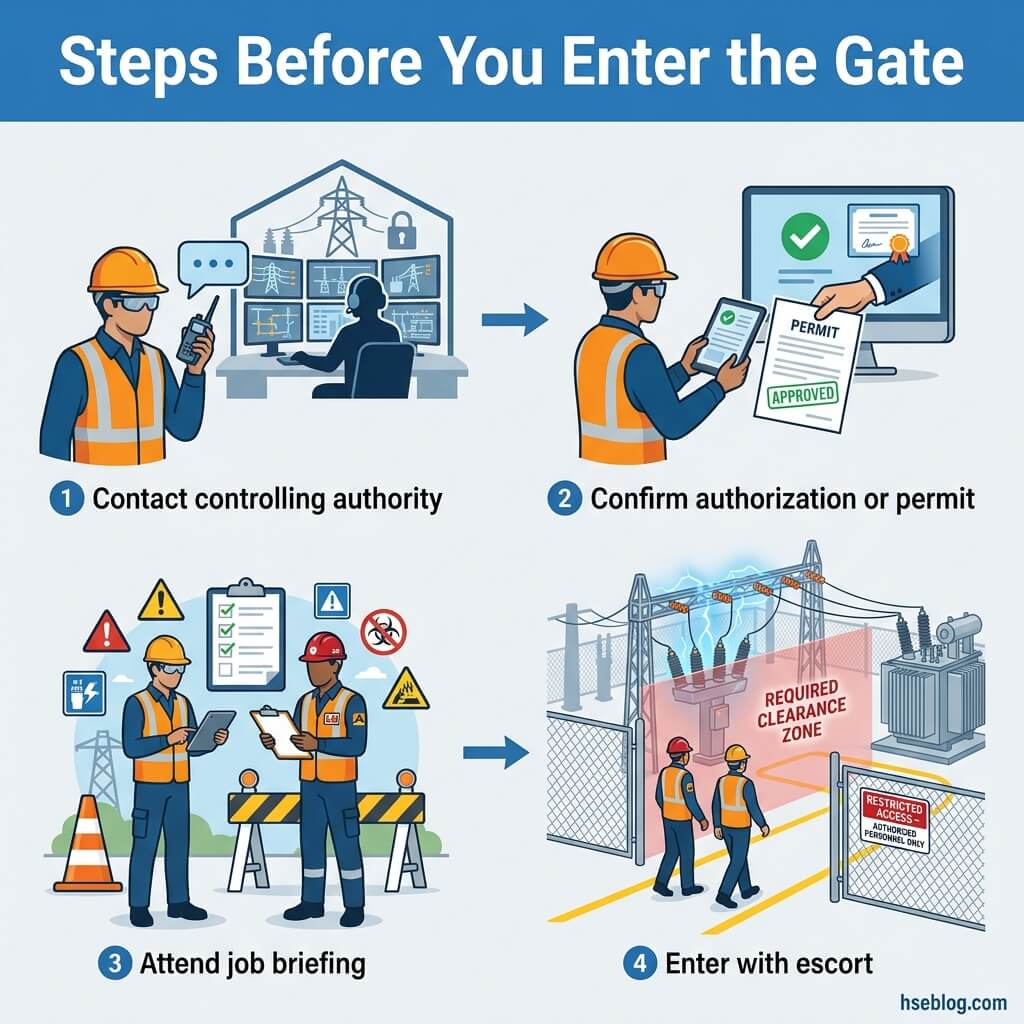
A defensible access sequence for a non-qualified entrant looks like this:
- Contact the controlling authority. Reach the operator or designated authority who controls the substation before entry. Because many sites are remotely controlled, this is the only way to know equipment will not be operated while you are inside.
- Confirm authorization and any permit. In the UK this may run through a permit-to-work or sanction-for-test system; in the US, entry is governed by the access and report-on-entry duties in 1910.269(u) and OSHA’s substation standard, 1926.966.
- Hold the pre-task job briefing. Confirm what is energized, what is de-energized, where the limits are, and what to do if conditions change. OSHA 1910.269(u) and 1926.966 make this briefing a duty, not a courtesy.
- Report on entry and arrange escort. Non-qualified entrants are typically escorted by a qualified person; the controlling party must know who is on site.
A recurring breakdown in the published record is the contractor “let in” informally — no documented briefing, the controlling party unaware of who is inside. That authorization gap turns lethal the moment remotely controlled equipment operates.
Legal disclaimer: Regulatory content here reflects general HSE professional understanding of US and UK requirements as of 2026. It is not legal advice. Specific compliance questions, enforcement situations, or prosecution risk should be directed to qualified legal counsel in the applicable jurisdiction.
Minimum Approach Distance (MAD) and Clearance Space
Minimum approach distance is the primary protection for anyone near energized parts, and it is voltage-based — there is no single safe number. MAD is established before work begins and communicated in the job briefing; for non-qualified workers, a much larger blanket clearance applies instead.
| Worker type / standard | Approach rule |
|---|---|
| Qualified employee (US) | Voltage-based MAD per OSHA 1910.269(l)(2) Table R-6; cross only with proper protection |
| Same task, NESC reference | ANSI/IEEE C2 Section 43 values — more recent and slightly greater than OSHA’s table |
| Non-qualified worker (US practice) | A wide blanket clearance, commonly cited as 20 ft from energized aerial facilities |
| UK approach | Defined exclusion zones set by a safe system of work under EAW 1989 / HSG85 |
Two cautions matter here. First, OSHA’s own Minimum Approach Distance eTool advises that the NESC values are more recent and slightly larger, and recommends incorporating them — so the larger NESC figure is the safer reference. Second, OSHA has a proposed rule to revise its MAD tables, so current values should not be treated as permanently settled.
The Three Hazard Families in a Substation
Substation hazards fall into three families — electrical, physical, and chemical — and a credible entry program treats all three, not just the obvious one. The electrical hazards kill fastest, but the physical and chemical hazards routinely catch people who navigated the energized equipment without incident.
This table compresses the spine of the section into one view:
| Hazard | Mechanism | Who it tends to catch | Primary control |
|---|---|---|---|
| Shock / electrocution | Contact with exposed energized bus | Anyone crossing approach distance | De-energization + LOTO; MAD |
| Arc flash | Fault releases thermal energy, blast, pressure | Workers near switching/racking | Arc-rated PPE inside the boundary |
| Step & touch potential | Ground potential rise during a fault | Anyone standing on or near energized earth | Ground grid / equipotential design |
| Physical / trench | Open cable ditches, vehicle, overhead | Civil and survey crews | Guarding, barriers, traffic control |
| Chemical / battery | Hydrogen, electrolyte, SF6 byproducts, PCBs | Maintenance and inspection staff | Ventilation, containment, disposal rules |
Electrical Hazards: Shock, Electrocution, and Arc Flash
The electrical family covers two distinct mechanisms that are often wrongly treated as one: shock from current passing through the body, and arc flash, which can injure without any contact at all. Conflating them leads to PPE that protects against one and not the other.
Exposed three-phase bus runs through the yard, with the high side carrying transmission-level voltage and the low side the stepped-down distribution voltage. Either can be fatal.
Arc flash is a separate hazard. When an arcing fault occurs, it releases intense thermal energy measured in calories per square centimetre, alongside a pressure wave and blast that can throw a worker and rupture hearing.
NFPA 70E — the US consensus standard OSHA references for arc flash practice — organizes protection around boundaries:
- Limited approach boundary — the outer shock-protection line for unqualified persons.
- Restricted approach boundary — closer in, where increased shock risk demands qualified-person controls.
- Arc flash boundary — the line inside which incident energy could cause a second-degree burn; crossing it changes both PPE and permit requirements.
Crossing any of these boundaries is a deliberate, controlled act — not something that happens by drifting a few steps closer.
Step and Touch Potential: The Hidden Killer
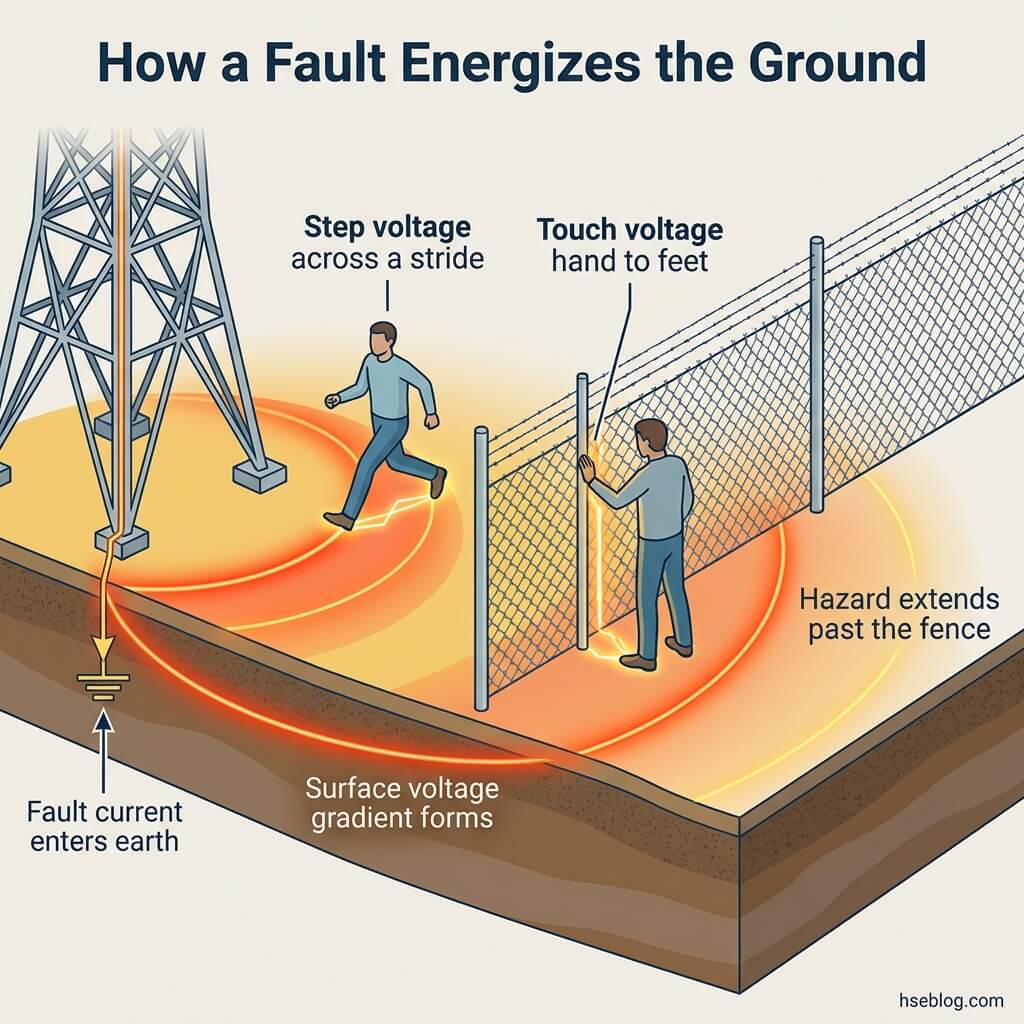
Step and touch potential is the hazard most workers have never heard of and the one that can reach them outside the fence. It is invisible until a fault occurs, then it energizes the ground itself.
The mechanism is ground potential rise. When fault current dumps into the earth through the grounding system, the soil surface develops a voltage gradient that falls off with distance from the fault point.
That gradient produces two distinct exposures:
- Step potential — the voltage difference across a single stride, foot to foot, as you stand on energized earth.
- Touch potential — the voltage difference between your hand on an energized object (a fence, a structure) and your feet on the ground.
The detail competitors miss: this gradient can extend beyond the perimeter fence, into ground where there is nothing to touch and no equipment in sight. A person standing in the wrong spot during a fault is at risk with no warning.
A persistent misconception is that grounding “to a low ohm value” equals safety. In practice, the correct measure under IEEE Std 80 is whether tolerable step and touch voltages are met for the actual fault current and clearing time — not whether an arbitrary impedance figure was hit. A grid can read a satisfying low resistance and still leave dangerous touch voltages on a structure.
Physical and Chemical Hazards
Physical and chemical hazards are the ones that catch people who survived the electrical risks, and they are routinely under-weighted in entry briefings. They demand the same authorization discipline as the energized equipment.
Physical hazards in a substation yard include:
- Open cable trenches and broken trough covers — civil and survey crews stepping into cable ditches or onto collapsed covers.
- Overhead clearance and structures — low conductors and steelwork that constrain crane and vehicle movement.
- Vehicle and crane operations — booms and loads that can encroach into energized clearances.
- Sensitive control-house equipment — vibration-sensitive relays and “pistol grip” controls that should never be casually handled.
- Wildlife and weather — nesting birds, animals bridging gaps, and ice or wind affecting clearances.
Chemical hazards are less obvious but real:
- Battery rooms — flooded battery banks release explosive hydrogen and contain corrosive electrolyte, demanding ventilation and ignition control.
- SF6 gas — switchgear insulation that, after arcing, can leave toxic decomposition byproducts in enclosed spaces.
- Transformer oil and legacy PCBs — older oil-filled equipment may contain polychlorinated biphenyls, handled and disposed of under EPA 40 CFR Part 761 in the US.
A brief note: content touching exposure to SF6 byproducts, electrolyte, or PCBs is for HSE practitioner reference and is not medical advice. Workers with specific symptoms or exposure concerns should consult an occupational physician.
Controlling Substation Hazards: The Hierarchy of Controls
Every substation control belongs somewhere on the hierarchy of controls, and the single most common mistake is jumping to PPE while skipping the levels that actually remove the energy. PPE is sized to the energy that better controls should have eliminated first — the same logic NFPA 70E and OSHA both emphasize.
The hierarchy, applied to substation hazards specifically:
- Elimination / de-energization. Establishing an electrically safe work condition — de-energization plus lockout/tagout (LOTO) — is the default goal, not the fallback. If the work can be done dead, it should be.
- Engineering controls. Ground grid and equipotential design to hold step and touch voltages within tolerable limits (IEEE Std 80); crushed-rock surfacing to raise foot resistance; fence grounding and bonding; remote racking and switching to keep people out of the arc flash zone; and guarding of live parts above 150V to ground.
- Administrative controls. Authorization, job briefings, permits, two-person rules, and the sensory pre-entry check — looking, listening, and smelling for signs of arcing before committing to entry.
- PPE — the last line. Arc-rated clothing, hard hat, safety glasses or face shield, insulating gloves, and hearing protection inside the arc flash boundary.
Two failure modes recur in the published record. Teams select PPE first and treat the top of the hierarchy as optional, which inverts the logic entirely. And teams treat the ground grid as “set and forget” rather than verifying its integrity and bonding on entry — a corroded or severed bond can leave the equipotential protection they are relying on partly absent.

A current development worth folding into any PPE program: the NFPA 70E 2024 edition tightened several rules relevant to substation entrants. Hearing protection is now required for anyone inside the arc flash boundary — the word “working” was removed, so presence inside the boundary is enough, whether or not active work is underway (NFPA, 2024). The same cycle added an emergency-response planning requirement to job safety planning and simplified the DC PPE table into a single 150–600V DC band.
Substation Safety Under OSHA vs HSE: Two Regulatory Frameworks
The US and UK regulate substation safety through fundamentally different philosophies — prescriptive tables versus goal-based duties — and a worker operating across both must not assume one regime’s rules satisfy the other. They converge on the principle of de-energizing first and using a competent person, but they diverge sharply on how compliance is demonstrated.
| Dimension | United States (OSHA + NESC) | United Kingdom (HSE + EAW) |
|---|---|---|
| Governing instrument | 29 CFR 1910.269(u) and 1926.966; ANSI/IEEE C2 (NESC) | Electricity at Work Regulations 1989; HSG85; HSG230 |
| Regulatory style | Prescriptive — specified tables and dimensions | Goal-based — duties to achieve a safe outcome |
| Access / working space | Set in 1910.269(u) and 1926.966; NESC for clearances | Safe system of work justified case by case |
| Approach distance | Voltage-based MAD, Table R-6 / NESC Section 43 | Defined exclusion zones within the safe system |
| Person standard | “Qualified person” | “Competent” / “authorized person” |
| Arc flash practice | NFPA 70E (OSHA-referenced consensus standard) | Risk assessment under EAW duties; HSG85 guidance |
In US practice, 1910.269(u) and its construction counterpart 1926.966 set out a structured set of duties — access and working space, draw-out breaker handling, fence grounding, guarding of energized parts, and report-on-entry and job-briefing obligations — with NESC supplying the clearance dimensions.
In UK practice, the HSE guidance HSG85 on safe electrical working practices operationalizes the EAW 1989 duties: justify any live working, isolate safely, and prove the system of work is safe. HSG230 extends this to the condition, rating, and operation of switchgear.
The practical reading for a cross-border operator: the US route hands you tables to comply against, while the UK route hands you an outcome to achieve and expects you to evidence how. Neither is automatically stricter across every dimension, so where MAD figures differ between OSHA Table R-6 and current NESC values, the larger NESC distance is the safer reference to govern by.
Regulatory currency note: This article’s regulatory content was reviewed in [Month YYYY]. Update on any OSHA revision to 1910.269(u)/1926.966 or its proposed MAD-table changes, each new NFPA 70E cycle (next: 2027), each new ESFI/BLS data release, or any HSE revision to HSG85.
For workers building competence here, recognized pathways include OSHA outreach training and the NEBOSH and IOSH qualifications in the UK and internationally — none of which substitute for site-specific authorization, but all of which underpin it.
Frequently Asked Questions

Conclusion
The hard truth behind every substation fatality figure is that the person who died usually walked in to do something ordinary. Three-quarters of those killed by electricity at work were not electricians (ESFI, 2025) — they were doing a survey, running cable, reading a meter, mowing inside the fence. The yard looked quiet, and that quiet is exactly what cost them.
Competence here is not heroics. It is the discipline to call the controlling authority before the gate opens, to hold the briefing that names what is live, to honour the clearance from energized bus, and to remember that the ground itself can carry voltage during a fault — beyond the fence, where there is nothing to touch. Those habits are unglamorous, and they are what keep the non-qualified entrant alive.
Substation safety, done properly, is the refusal to let an absence of visible danger lower your guard. The equipment will not warn you, the regulations differ by jurisdiction, and the protection you are relying on is mostly invisible. Treat every entry as if the bus is live and the ground is energized — because the day it is, that assumption is the only thing standing between a routine task and a name in next year’s fatality data.