
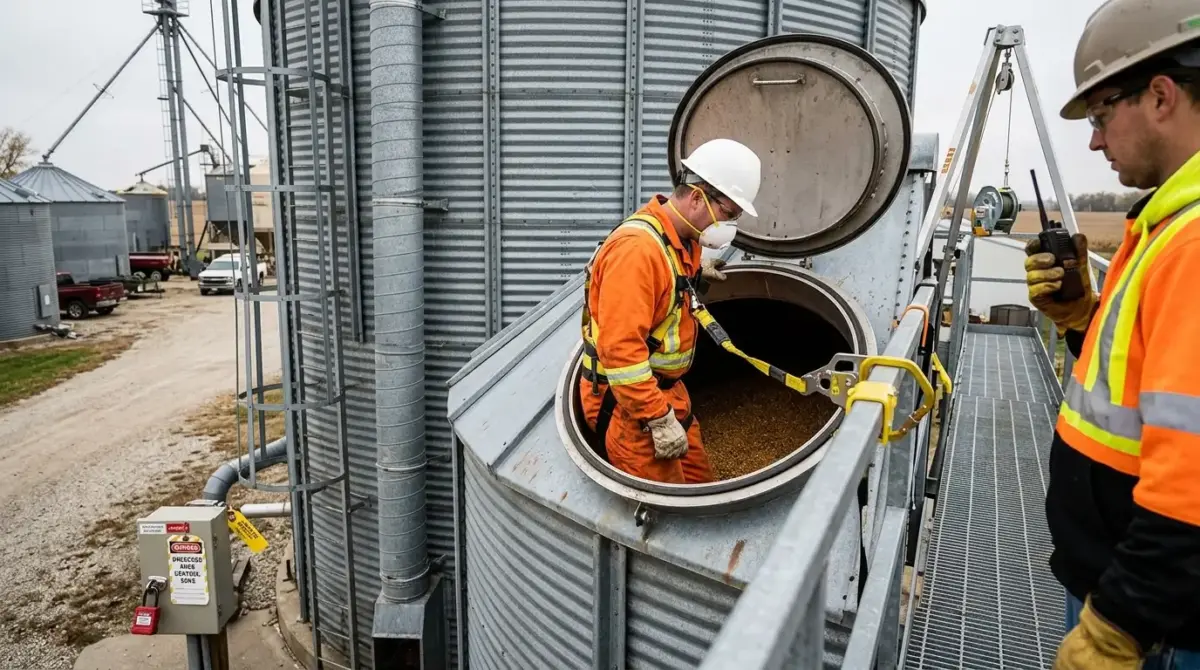
TL;DR — The Numbers That Define This Hazard
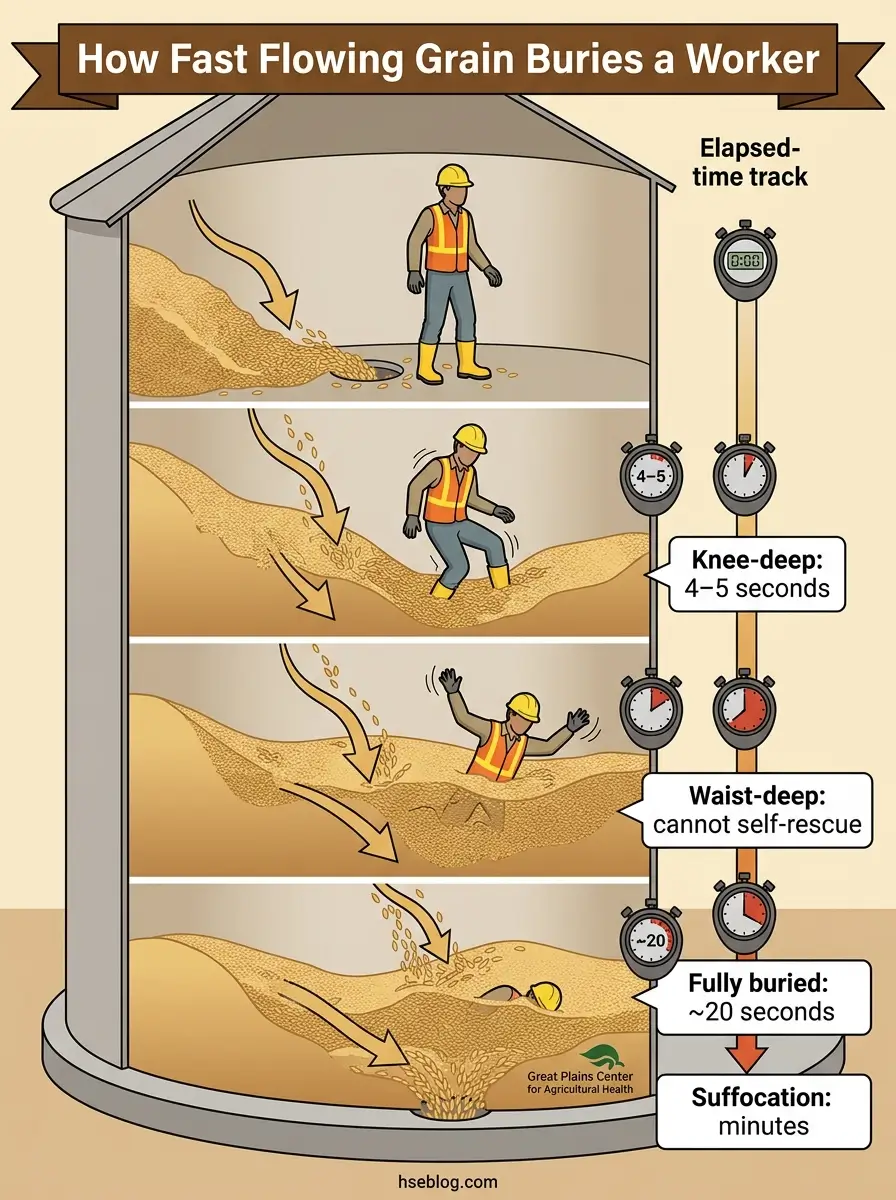
- ~20 seconds to full burial: A worker standing in flowing grain can be buried completely in about twenty seconds, and knee-deep in roughly four to five (Great Plains Center for Agricultural Health, current).
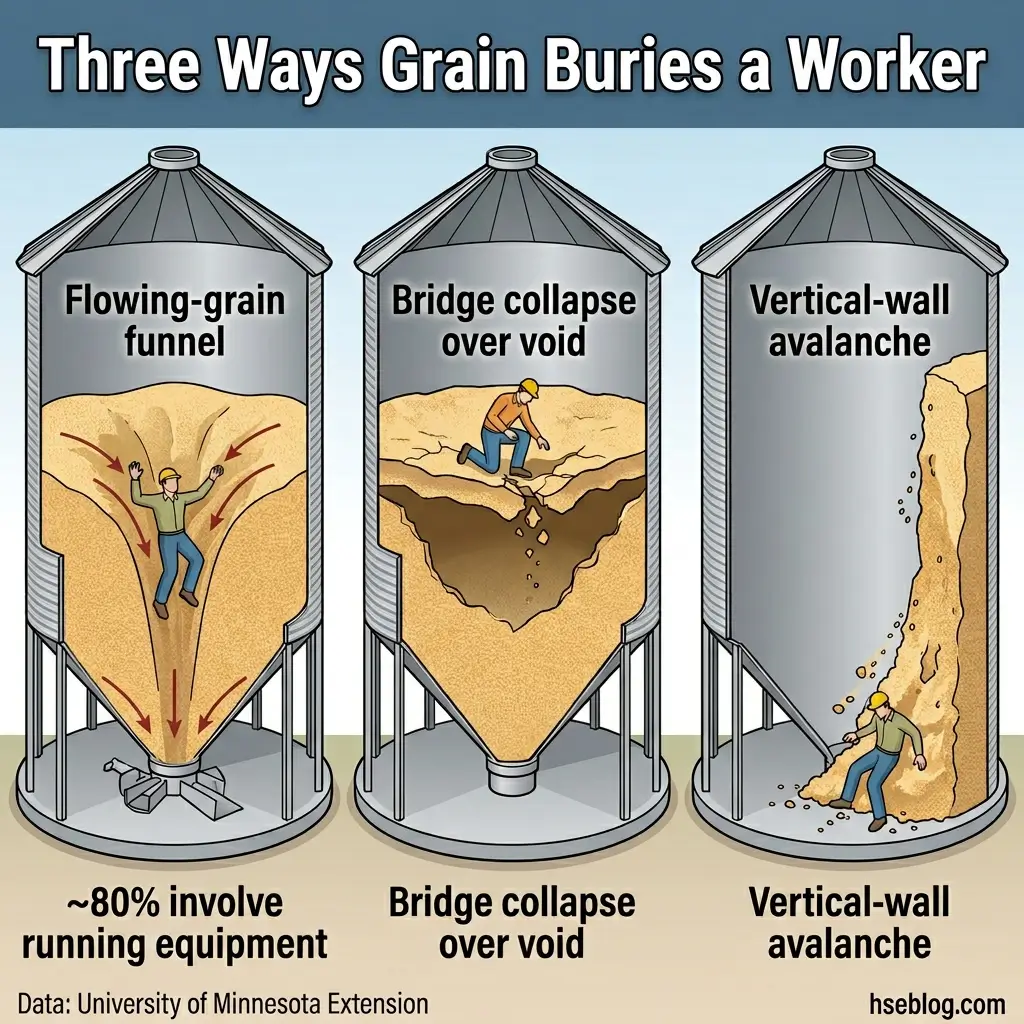
- ~80% involve running equipment: Around four in five engulfments happen while unloading equipment is operating beneath the worker (University of Minnesota Extension, current).
- 34 entrapments, ~41% fatal in 2024: Grain entrapment remained the leading category of agricultural confined-space incidents last year, with roughly two in five proving fatal (Purdue University PACSID, 2025).
- 600+ lb to free a waist-deep victim: Friction makes a buried person nearly impossible to pull out — extraction force exceeds 2,000 lb for full burial (University of Minnesota Extension, current).
Grain engulfment occurs when a worker becomes fully submerged in flowing or collapsing grain, which behaves like quicksand. A person sinks knee-deep in about four to five seconds and is completely buried in roughly twenty (Great Plains Center for Agricultural Health) — far faster than self-rescue is possible. Suffocation is the leading cause of death inside grain storage structures.
In 2024, 22 people died in U.S. agricultural confined spaces, most of them in grain (Purdue University PACSID, 2025). What makes these deaths distinct is how preventable they are and how predictably they repeat: a worker steps onto grain to break up a clump, the surface gives way, and the reaction window closes before anyone outside understands what has happened. Grain silo engulfment hazards are not a matter of bad luck — they are a matter of physics that does not negotiate.
This article treats engulfment as a standalone hazard rather than one item on a long grain-facility checklist. It separates the three distinct ways grain kills, explains why forced rescue fails, and sets out the confined space grain entry controls required under both OSHA and UK law — with every regulatory claim labelled by jurisdiction.
What Is Grain Engulfment and Why Is It So Deadly?
Engulfment and entrapment are not the same event, and the difference matters for both survival and rescue. Entrapment means a worker is partially submerged and cannot self-extract; engulfment means the body is fully covered. Entrapment is the gateway — once grain reaches the waist, the friction load makes self-rescue effectively impossible, and a shifting surface can complete the burial in seconds.
The primary mechanism of death is suffocation. The chest cannot expand against the surrounding grain pressure, so breathing stops even when the airway is technically clear. Secondary mechanisms include positional asphyxia, where the body is pinned in a posture that prevents breathing, and blunt-force injury from collapsing grain or falls into the structure.
Why does grain behave like a fluid that will not hold you up? Bulk corn sits at roughly 750–800 kg/m³, dense enough to resist movement but offering almost no buoyant support. Flowing grain hazards come down to this: you displace it as you sink, but it closes back around you, and the more you struggle the deeper you settle. That is the honest answer to why flowing grain is like quicksand — except quicksand will often let a calm person float, and grain will not.
The seconds-to-burial progression is the part most people underestimate:
- Around 4–5 seconds: knee-deep in actively flowing grain, the point at which footing is already lost (Great Plains Center for Agricultural Health, current).
- Within the same window: waist-deep, where the friction load alone defeats self-rescue.
- Roughly 20 seconds: complete burial (Great Plains Center for Agricultural Health, current).
- Minutes: the time to suffocate. Hours: the time to recover a body.
A note on the figures — time-to-burial numbers vary across sources because grain type and flow rate change the speed. The reliable, well-sourced range is the 4–5 second knee-deep / ~20 second full-burial window above; treat any single absolute number with caution.
The recurring failure pattern across the published incident record is not recklessness — it is misjudged speed. Reviewing the annual Purdue confined-space summaries, the same sentence sits behind case after case: I’ll just be in there a second to knock down a clump. The window to react is gone before a person registers that their feet are caught. Grain engulfment is best understood as a no-second-chance hazard, not a risk you can grade and manage on the fly.
The Physics of Why Self-Rescue Is Impossible
A buried worker cannot be pulled free by force, and treating this as a strength problem gets rescuers killed. The numbers from grain-entrapment research, summarised by the University of Minnesota Extension, are stark: freeing a person buried to the waist requires a pull equal to their body weight plus about 600 lb, and extracting a fully buried victim can demand more than 2,000 lb (University of Minnesota Extension, current).
That force does not just fail — it injures. Straight vertical pulling against trapped grain transfers load through the spine and soft tissue. You can cause spinal and joint damage, or separate joints, long before the grain releases its grip.
The mechanics behind those numbers come from how grain pressure builds. Lateral pressure on a buried body increases with depth, the same silo-wall behaviour engineers describe through Janssen’s principle. The deeper the burial, the harder the grain squeezes inward — which is why trained rescue removes grain from around the victim using a cofferdam or rescue tube rather than pulling. The Great Plains Center for Agricultural Health resources on engulfment set out this distinction clearly, and it is the single fact that separates a rescue from a second fatality.
The Three Ways Grain Engulfs a Worker
Most coverage collapses engulfment into one generic “grain is like quicksand” warning, and that blurring costs lives — because each mechanism has a different trigger, a different warning sign, and a different control. A worker who only fears flowing grain will walk straight onto a deadly bridge. Disaggregating the three (plus an equipment-specific fourth) is the difference between awareness and competence.
| Mechanism | Trigger | Warning sign | Primary control |
|---|---|---|---|
| Flowing-grain funnel | Unloading equipment running while a worker stands on the grain surface | Visible surface movement toward the outlet | Lock out and tag out all unloading equipment before entry |
| Bridge collapse | Crusted or spoiled grain forms a void beneath an apparently solid surface | A walkable-looking crust over recently unloaded grain | Never walk on the surface; break the bridge from outside |
| Vertical-wall avalanche | Clumped grain adhered to the bin wall breaks loose | Vertical walls or columns of grain stuck to the sidewall | Knock down accumulations remotely; never stand beside them |
| Grain-vacuum funnel | Vacuum or sweep auger creates a localised draw at the worker’s feet | Equipment running near the entrant | De-energise equipment; maintain harness and lifeline tension |
A few points deserve emphasis beyond the table.
The flowing-grain funnel is the dominant mechanism — roughly 80% of reported engulfments involve a worker inside the bin while unloading equipment runs (University of Minnesota Extension, current). The grain surface funnels toward the floor outlet like sand in an hourglass, and the worker is pulled into the centre. This is why grain bin lockout tagout of every unloading device is the highest-leverage control in the entire topic.
The bridge collapse is the most deceptive. Out-of-condition grain crusts over a void where the grain beneath has been drawn down or has spoiled and clumped. The crust looks solid. The judgment lesson here is uncomfortable: a walkable-looking surface over recently unloaded grain is a red flag, not reassurance. If the bin has been emptied or partly emptied and the top still looks intact, assume a void underneath.
The vertical-wall avalanche comes from the side, not below. Spoiled grain adheres to the wall in a column — sometimes several feet of it — held up well past its natural angle of repose. When it breaks loose, it buries a worker laterally with no warning. Standing at the base of a grain wall to dislodge it from inside is one of the most direct ways to trigger the collapse you were trying to prevent.
Why Workers Enter Bins — and How to Remove the Reason
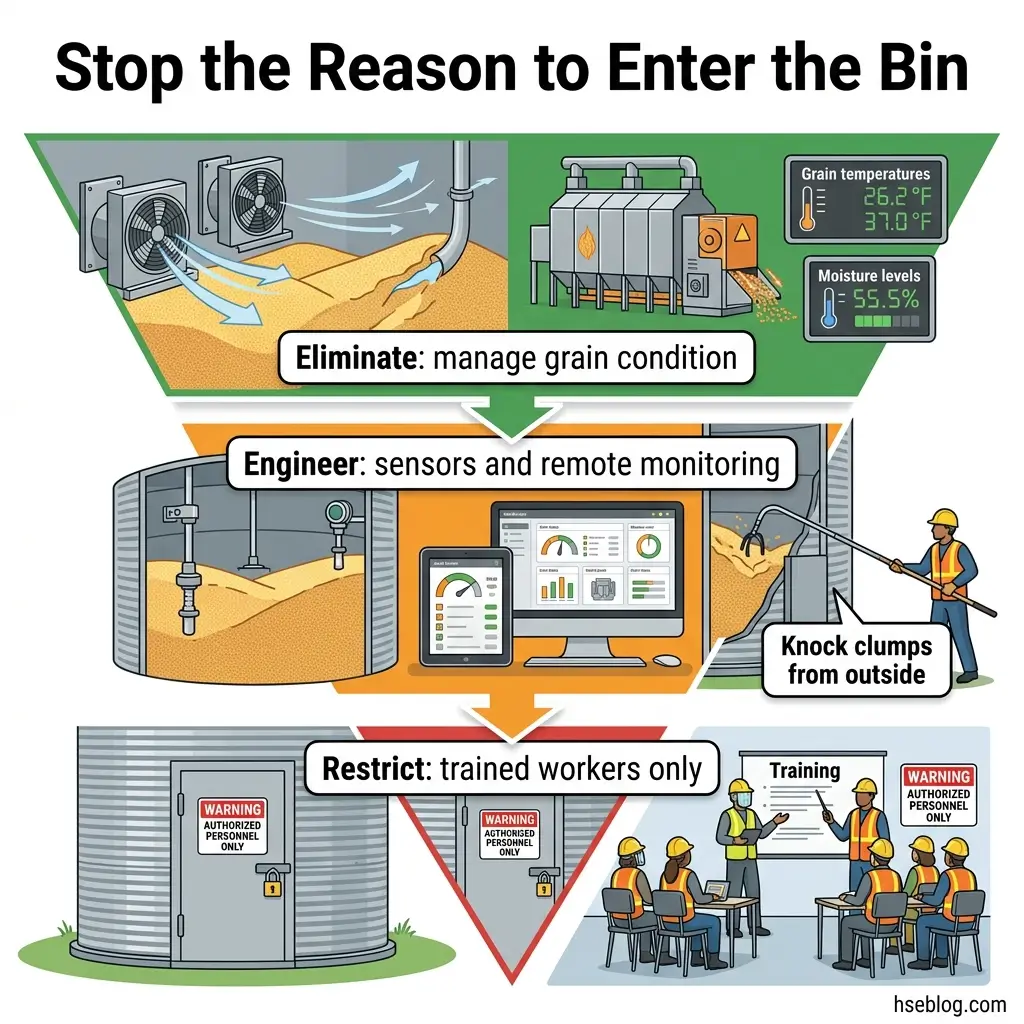
The safest grain bin entry is the one that never happens, and that reframing is where genuine grain engulfment prevention starts. Both OSHA and HSE position elimination of entry at the top of the response — not safer entry, but no entry. So the controlling question is not how do we enter this bin safely but why are we entering at all, and can we kill that reason.
Almost always, the reason is out-of-condition grain. Wet, spoiled, frozen, or crusted grain stops flowing, clumps to walls, and bridges over voids — and someone gets sent in to break it up. Remove the spoilage and you remove most of the need to enter.
That makes prevention a storage-management problem long before it becomes an entry problem:
- Manage grain condition first. Proper aeration, drying to safe moisture, and continuous temperature monitoring keep grain flowing and free of crust. Grain that never goes out of condition rarely needs a person inside.
- Engineer the reason away. Bin level sensors, temperature cables, and remote monitoring let you read the bin without entering it. External bin-whips and poking devices break up clumps and bridges from outside the structure.
- Restrict who can even approach entry. Untrained workers and youth should have no path to bin entry. The mechanical and engulfment hazards make this a competent-person task, not a chore to delegate.
The failure mode I see most often in the published record is set-and-forget. A facility installs monitoring, congratulates itself, and then treats stored grain as a static inventory. It is not. Spoilage develops across the storage season as moisture migrates and outside temperatures swing. The practitioner discipline is to treat grain condition as a variable that is continuously reassessed — because the day the monitoring is ignored is the day the crust forms that puts someone inside the bin.
Safe Entry Requirements When Entry Is Unavoidable
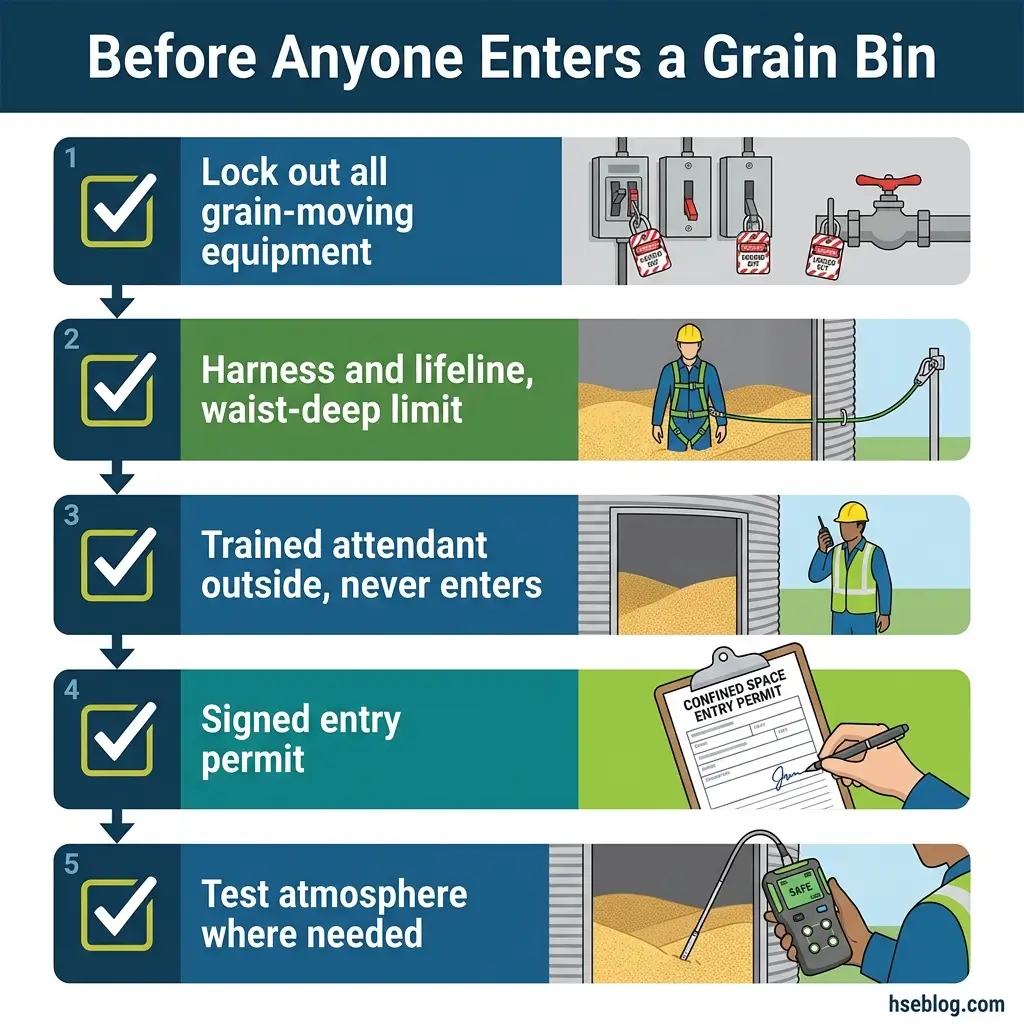
When entry cannot be eliminated, the United States control set is prescriptive and specified directly in 29 CFR 1910.272(g) — the harness, the observer, the permit, and the lockout are not best practice, they are the standard. This is the procedural core of grain silo confined space entry requirements, and it is where Elevated-YMYL caution applies in full.
Competent-person caveat: This article provides general HSE knowledge. Life-critical work such as grain bin entry must be planned and supervised by a competent person with relevant training, jurisdiction-specific authorization, and a site-specific risk assessment. The information here does not replace any of that.
Read against OSHA’s grain handling standard, 29 CFR 1910.272(g), the US entry sequence runs as follows:
- Lock out and tag out everything that moves grain. De-energise and isolate all unloading, sweep, and conveying equipment — augers, sweep augers, conveyors, grain vacuums — before anyone enters. Grain bin lockout tagout of the unloading system is the control that defeats the dominant flowing-grain mechanism.
- Prohibit walking down grain. No one stands on or under bridged or funnelling grain to dislodge it. Walking down grain is the practice that produces the largest share of these deaths.
- Fit a body harness and lifeline. The harness and lifeline must be positioned to prevent the worker sinking past waist-deep, or a boatswain’s chair must be used. The waist-deep limit is the threshold beyond which self-rescue fails.
- Station a trained observer outside. An equipped attendant stays outside the bin with continuous communication to the entrant. The observer’s role is to summon trained rescue — never to enter.
- Issue an entry permit or have an authorising representative present. The employer certifies in advance that the required precautions are in place before entry begins.
- Test the atmosphere where relevant. Where oxygen deficiency or toxic gas from spoiling or fermenting grain is foreseeable, atmospheric testing and the permit-required confined space requirements of 29 CFR 1910.146 apply alongside 1910.272. Spoiling grain also generates grain dust, a separate explosion and respiratory concern that belongs in the same risk assessment.
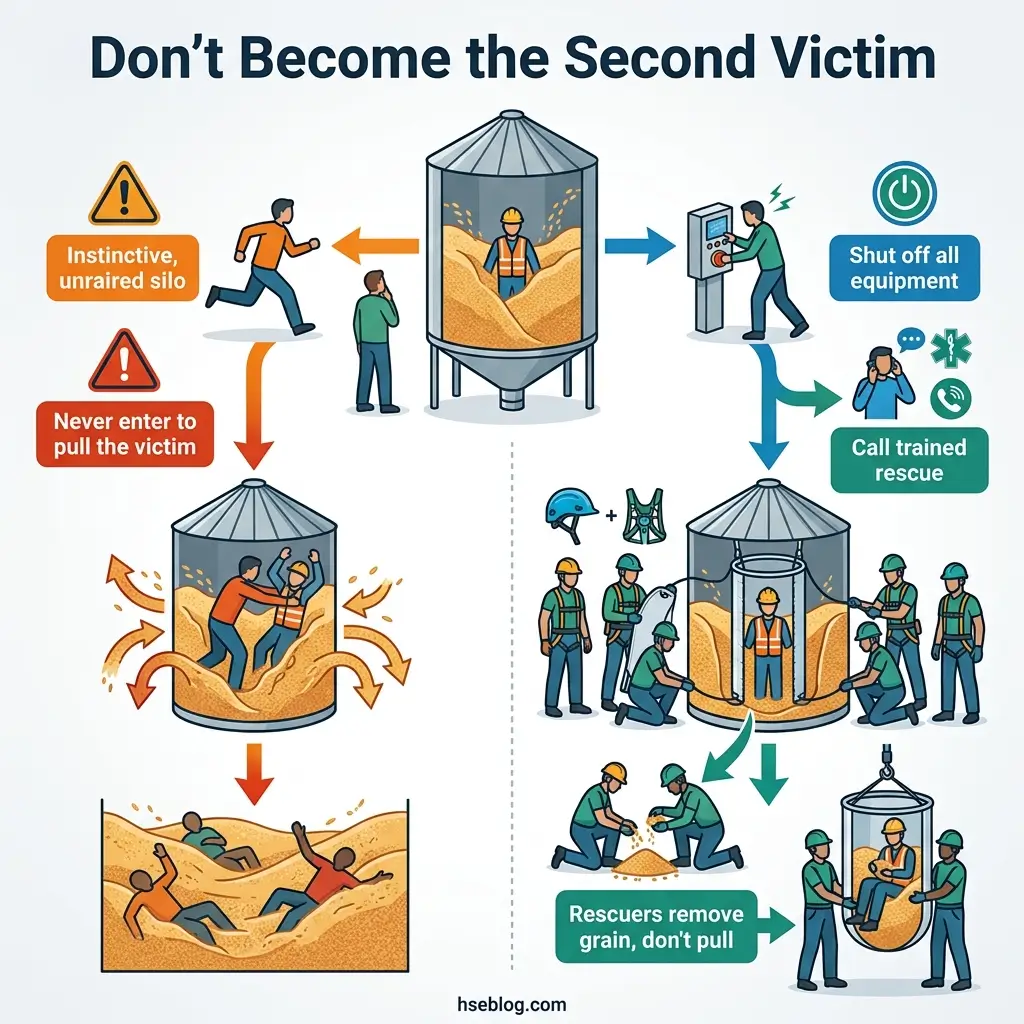
The single most lethal pattern in the record sits inside step 4. A worker goes down, a coworker rushes in to help, and the rescuer becomes the second fatality — sometimes the third. Multi-fatality silo incidents almost always follow this exact sequence. The attendant who enters to save a colleague is not a hero in the data; they are the next name on the report. The bin observer summons trained rescue and holds position. That is the whole job, and it is non-negotiable.
For competence behind these controls, point workers and supervisors toward recognised training pathways — OSHA outreach training in the US, and NEBOSH or IOSH qualifications more broadly — rather than on-the-job familiarity.
US vs UK: How the Rules Differ
The US and UK reach the same safety outcome by opposite routes, and understanding the difference matters for anyone operating across both. OSHA writes the controls into the standard; HSE makes you derive them from a risk assessment.
| United States (OSHA) | United Kingdom (HSE) | |
|---|---|---|
| Governing rule | 29 CFR 1910.272(g) for bins/silos/tanks; (h) for flat storage | Confined Spaces Regulations 1997, supported by HSE AIS26 |
| Style | Prescriptive — specifies harness, observer, permit | Goal-setting — risk-assessment-led safe system of work |
| Confined-space trigger | Permit/atmospheric duties via 1910.146 where hazards present | Engulfment risk alone qualifies the space, even with breathable air |
| Core hierarchy | LOTO → harness/lifeline → attendant → permit | Avoid entry → safe system of work → emergency/rescue arrangements |
Two clauses round out the US picture. 29 CFR 1910.272(h) extends engulfment and mechanical-hazard protection to flat storage structures — buildings that do not empty by gravity and allow unrestricted ground-level entry — closing a gap the bin-focused (g) provision left open. And where the atmosphere is in play, 1910.146’s permit-required confined space regime layers on top.
On the UK side, HSE’s guidance on managing confined spaces on farms (AIS26), read with the Confined Spaces Regulations 1997, makes a point US readers sometimes miss: a moist grain silo is a confined space on engulfment risk alone. You do not need a toxic or oxygen-deficient atmosphere to trigger the regulations — the risk of being buried is enough.
There is a coverage gap worth naming plainly. In the US, more than two-thirds of grain entrapment incidents occur on farms that fall outside federal OSHA enforcement — small operations below the employee threshold. The prescriptive standard, in other words, does not reach the population at highest risk. That is not a reason to ignore 1910.272; it is a reason for farm owner-operators to adopt it voluntarily, because the grain does not check who employs you.
Where the two frameworks diverge on a specific control, the defensible default is the stricter, more prescriptive requirement — treat OSHA’s concrete control set as the baseline and HSE’s risk-assessment duty as the governing principle.
Legal disclaimer: Regulatory content here reflects general HSE professional understanding of US and UK requirements as of 2026. It is not legal advice. Specific compliance questions, enforcement situations, or prosecution risk should be directed to qualified legal counsel in the applicable jurisdiction. The regulatory content above was reviewed against the standards current at the date shown in the byline.
Rescue and Emergency Response
The first rule of grain rescue is that you do not become the second victim, and everything else follows from it. This section describes what trained response looks like — it is not a manual for entering a bin to pull someone out, because that act is what turns one fatality into several.
When a worker is trapped, the response runs in this order:
- Shut down everything immediately. Stop and isolate all unloading and conveying equipment. As long as grain is flowing, the situation is getting worse by the second.
- Call trained emergency services. Summon rescue equipped for grain entrapment. The window for survival depends on reaching the person before suffocation, but untrained entry shortens no one’s odds and lengthens the casualty list.
- Keep the airway clear if the person is reachable. If the victim’s head and chest are accessible from a safe position, protecting the airway buys time. Do not pull against the grain to do it.
- Use grain-removal methods, not force. Trained rescuers place a cofferdam or rescue tube around the victim and remove grain from inside it. They do not haul on the body — the 600 lb to 2,000+ lb friction loads make pulling both futile and injurious (University of Minnesota Extension, current).
If someone is trapped in a grain silo and you are not trained and equipped for confined-space rescue, the most useful thing you can do is shut off the equipment, call for help, and keep anyone else from going in. That restraint is the hardest instruction in HSE and the one that saves the most lives.
Recent enforcement activity shows the hazard is being treated as live, not legacy. In 2024, OSHA expanded its Regional Emphasis Program for grain-handling facilities into Missouri — joining identical programs in Kansas and Nebraska — targeting engulfment among six priority hazards after documented fatalities, amputations, and hospitalizations (US Department of Labor / OSHA, 2024). The 2025 Stand Up 4 Grain Safety Week reinforced engulfment prevention alongside other grain hazards; OSHA’s Alliance Program credited collaboration with helping cut fatal grain entrapments by about 25.7% from 2022 to 2023 — even as roughly half of 2024 entrapments still proved fatal (OSHA, 2025). And across the Atlantic, a March 2026 HSE-reported fatality in which a farmer fell into a grain silo and was asphyxiated is a blunt reminder that the hazard is current on both sides of the ocean.
Frequently Asked Questions
The Cost of Treating This as a Gradeable Risk
The grain does not know how experienced you are, how quick you think you’ll be, or that you only meant to step in for a second. That is the hard truth running underneath every grain silo engulfment statistic — the people who die are usually competent, often the owner or a senior hand, and almost always certain they had more time than the physics allowed.
What the industry consistently gets wrong is framing engulfment as a risk to be managed during entry, when the real work is removing the reason to enter at all. Keep grain in condition, lock out what moves it, and put a trained attendant outside who knows their only job is to call for help and hold the line. The highest-impact change available to most operations is not better rescue gear — it is the decision that nobody walks on grain that could flow or collapse, and that the would-be rescuer stays out of the bin.
Audit your own site against one question: if a worker went down in your largest bin tomorrow, would the next person stop the equipment and call — or climb in? The answer to that question is the difference between one tragedy and several.