
TL;DR
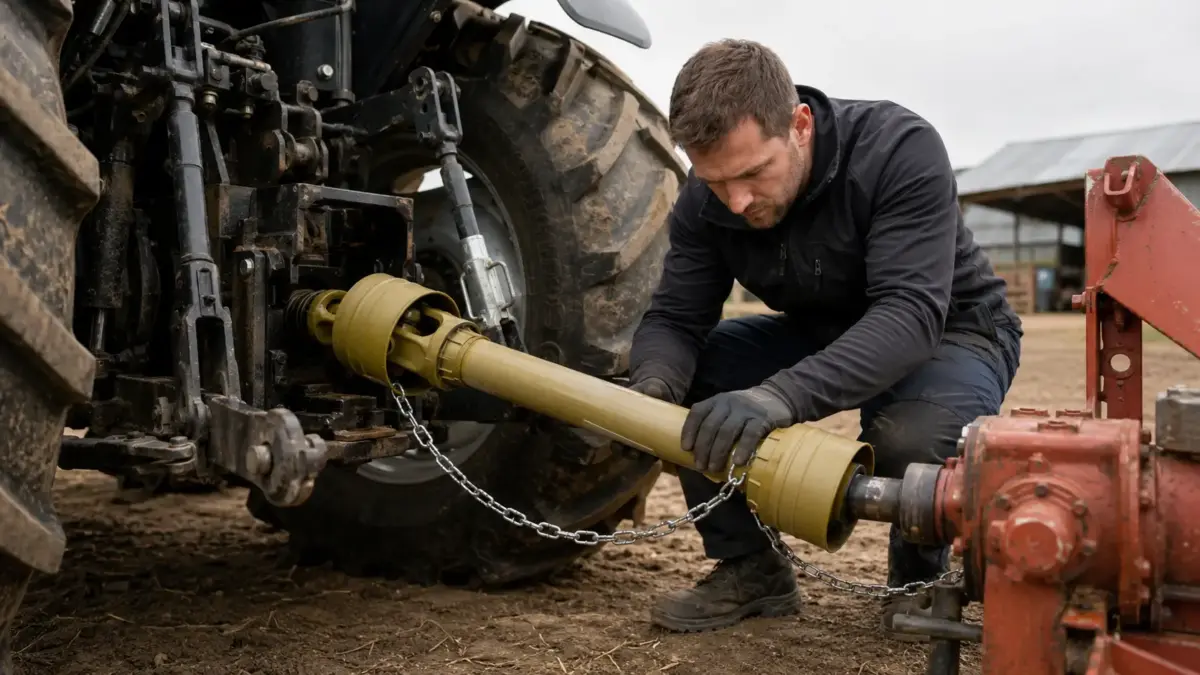
- Guard the whole driveline, not just the straight shaft. PTO safety guards must cover the stub, the universal joints, and the implement coupling — the joints are where most snags actually begin.
- A guard that spins with the shaft is not a guard. A seized guard bearing turns the cover into a wrap-point. Replace it; do not grease it and carry on.
- Never clear a blockage with the PTO turning. Run the safe stop sequence — handbrake on, controls neutral, engine off, key out — before any limb goes near the shaft.
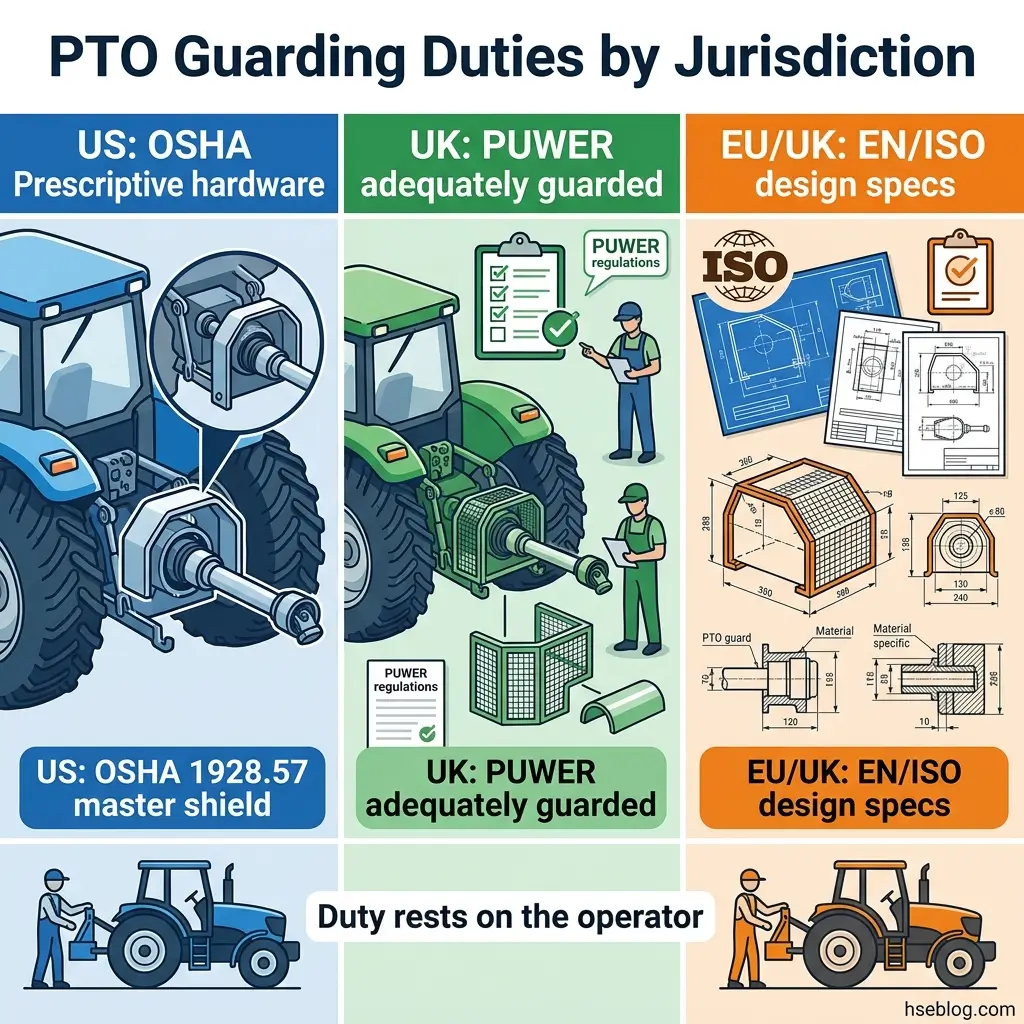
- The law differs by country; the physics does not. OSHA (US) prescribes a master shield; UK PUWER demands “adequately guarded”; EU/ISO sets the design specs.
Yes — PTO safety guards are legally required, and they must cover the driveline’s full length, including the universal joints and couplings, not just the straight section. In the US, OSHA 29 CFR 1928.57 requires a rear-PTO master shield; in the UK, PUWER 1998 requires equipment to be adequately guarded before use. The duty falls on the employer or operator at the point of use.
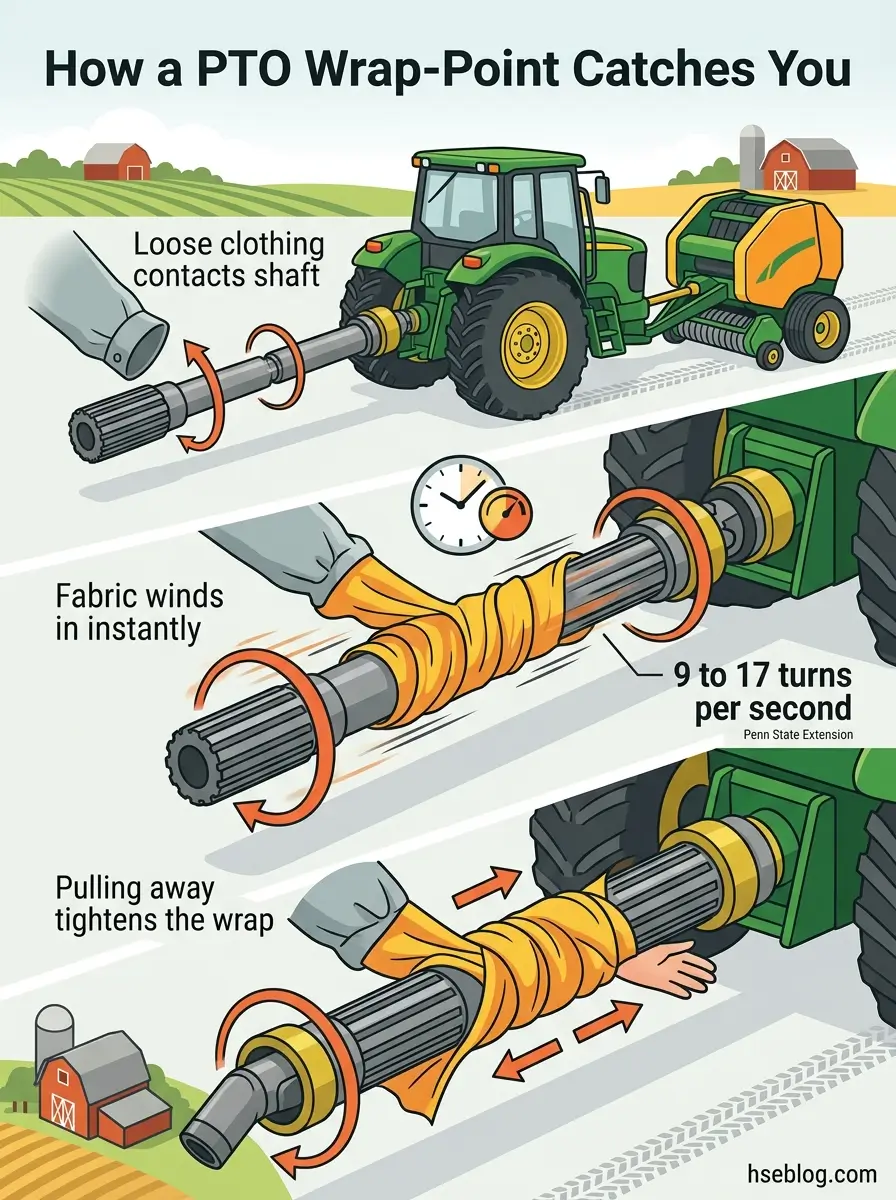
A power take-off driveline turning at 540 rpm completes about nine full rotations every second; at 1000 rpm it is closer to seventeen (Penn State Extension). A splined shaft moving at that speed does not snag a sleeve cuff and politely stop — it winds the fabric in, then the forearm, then the torso, faster than the brain registers that contact has even happened.
That speed is the whole story behind power take-off hazards, and it is why PTO safety guards are treated as a life-critical control rather than a tidy bit of bodywork. This article covers the hazard mechanism, the real-world failure modes that keep killing experienced operators, the guarding duties across US, UK and EU law, what a compliant guard actually looks like, and how to inspect one without improvising repairs on a powered shaft.
What Is a PTO and Why Is It So Dangerous?
A PTO is the splined stub that transfers engine power from a tractor or stationary power unit into an implement’s input driveline — and its danger comes from a simple mismatch between rotational speed and human reaction time.
The two standard speeds tell you most of what you need to know:
- 540 rpm — roughly nine revolutions per second, the common speed for many mounted and trailed implements (Penn State Extension).
- 1000 rpm — roughly 16.6 revolutions per second, used for higher-power equipment.
Neither speed is survivable to argue with. Once clothing, hair, a drawstring, a glove or a limb contacts an exposed shaft, the tension pulls the person inward, and the instinct to pull away only tightens the wrap.
The injury profile is what sets PTO entanglement apart from slower hazards. Amputation, degloving, scalping, multiple fractures, spinal injury and death arrive in the same second as contact — there is no developing exposure, no warning window.
Here is the pattern worth internalising before anything else. Reviewing the published incident record, the bare tractor stub gets most of the warning posters, yet field incidents frequently start somewhere else — at a universal joint, a front or rear coupling, or a protruding locking pin on a driveline that “looks guarded” because a cover is physically present.
Anatomy of a PTO Drive System: Stub, Driveline, and Coupling Points
You cannot inspect what you cannot name, so the component vocabulary matters. The Penn State Extension PTO safety guide sets out the full set that competent self-inspection depends on.
- PTO stub — the splined output shaft on the tractor; protected by the PTO master shield.
- Implement input driveline (IID) — the connecting shaft, with one or more universal joints, covered by an integral-journal (driveline) guard.
- Implement input connection (IIC) — where the driveline couples to the implement’s gearbox.
- Universal joints and splined coupling — the flex and connection points; the snag-prone zones an inadequate guard leaves exposed.
A “driveline guard” and a “master shield” are not interchangeable. The master shield covers the tractor stub; the driveline guard covers the implement shaft and its joints. Both are needed, and missing either leaves a live wrap-point.
Where PTO Injuries Actually Happen: The Real-World Failure Modes
Most fatal PTO incidents trace back not to ignorance of the hazard but to a control that was defeated at the moment of contact. A Purdue University analysis documented 674 agricultural driveline-related injuries and fatalities across 1970–2003, including secondary drivelines (Purdue University, 2006) — and the recurring scenarios cluster tightly.
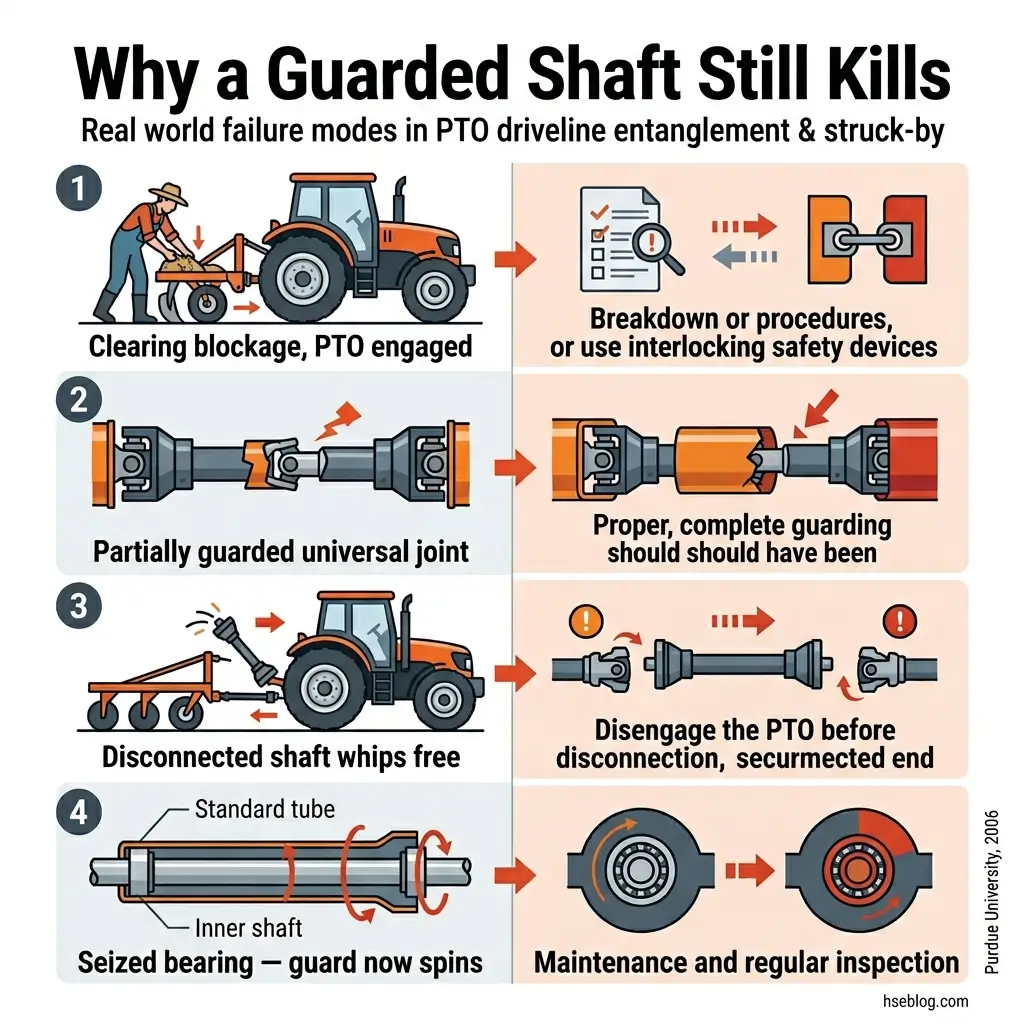
The dominant scenarios, each with its failed control named:
- Clearing a blockage or making an adjustment with the PTO still engaged. This is the leading fatal pattern. The failed control is procedural — the safe stop sequence was skipped.
- Stepping over or working alongside a rotating, partially-guarded shaft. The failed control is coverage: the straight section was guarded, the universal joint was not.
- Shaft separation and whipping. When a powered driveline disconnects at the implement end, a heavy shaft can flail. This is a struck-by hazard, distinct from entanglement, and the failed control is connection security.
- Guards present but defeated. Missing master shields on older tractors, cracked plastic guard tubes, removed restraining chains — and the one most operators miss entirely.
That last one deserves singling out. A consistent pattern across the literature is the guard treated as set-and-forget: a seized or worn guard bearing means the tube now rotates with the shaft instead of staying stationary. The “guard” has quietly become a wrap-point, and a quick visual check passes it because the cover is still physically in place.
A note on a figure you will see everywhere. A long-cited “≈40 fatalities and 150 amputations per year” estimate circulates across insurance, legal and training material attributed to a federal source, but no current primary government page substantiates it — so treat it as a legacy estimate, not live official data, and weigh it against the Purdue and CDC/NIOSH figures instead.
Are PTO Safety Guards Legally Required? Duties by Jurisdiction
Yes — guarding is a legal duty in every major jurisdiction, but the shape of that duty differs sharply, and “the tractor came compliant from the factory” is not a defence anywhere. The duty attaches to the employer or operator at the point of use.
| Jurisdiction | Governing instrument | Core guarding duty |
|---|---|---|
| US | OSHA 29 CFR 1928.57 | Rear-PTO master shield required (must withstand a 250-lb operator using it as a step); drive members guarded against contact; safety instruction at initial assignment and at least annually |
| UK | PUWER 1998, reg 11 | Dangerous moving parts effectively guarded; equipment “adequately guarded” before use — goal-based, enforced case by case |
| EU / UK (design) | BS EN 12965, BS EN ISO 4254-1, BS EN ISO 5674 | Design, strength and wear specs for the shaft guard, including the ≥50 mm overlap and collar-lock connectors on new machines |
| Australia | Model WHS Regulations | Eliminate or minimise the risk so far as is reasonably practicable |
Read the differences carefully, because they change what “good enough” means:
- The US position is prescriptive. OSHA 29 CFR 1928.57 names the hardware — a master shield, a specific 250-lb step-load test, and a defined instruction frequency. You can read the standard text directly via OSHA’s published 1928.57 guarding standard, with the General Duty Clause sitting behind it as a backstop.
- The UK position is goal-based. PUWER 1998 reg 11 does not list parts; it requires the dangerous moving part to be guarded before use and tests adequacy after the fact. The Health and Safety at Work etc. Act 1974 and the Supply of Machinery (Safety) Regulations 2008 sit alongside it.
- Enforcement is real, not theoretical. HSE UK has prosecuted under reg 11 for an unguarded in-use PTO shaft — confirming that the duty bites at the point of work, not at the point of sale.
The practical reading for anyone operating across borders: build to the stricter combined position. A full-length non-rotating guard to BS EN ISO 5674 / EN 12965 specs, plus the OSHA master-shield and annual-instruction requirements, covers you regardless of where the machine runs.
Legal disclaimer: This regulatory content reflects general HSE professional understanding of US, UK and EU requirements as of 2025. It is not legal advice. Specific compliance questions, enforcement situations, or prosecution risk should be directed to qualified legal counsel in the applicable jurisdiction. Confirm the current text of any standard before relying on it — the regulatory content here was last reviewed at the date shown in the byline.
What a Compliant PTO Guard Actually Looks Like (Standards & Specs)
A compliant guard is a maintained state, not a purchase event — the standard is met when the guard still performs, not on the day it was bolted on. Competitors stop at “use a guard to standard”; the value is knowing which standard and which feature to check first.
The features a competent person verifies, with their reference standards:
- Full-length coverage — from the tractor stub to the first bearing on the implement, including every universal joint and coupling, not just the straight run (BS EN 12965, EU/UK).
- Non-rotating guard tube — the cover stays stationary on a free-spinning bearing while the shaft turns inside it (BS EN ISO 5674, EU/UK).
- Intact restraining chain or device — anchored at both ends so the guard cannot spin up with the shaft.
- Correct size, retracted and extended — the guard must cover the driveline through its full telescoping range.
- ≥50 mm overlap — between the shaft guard and the machine’s fixed guard, front- and rear-mounted (BS EN ISO 4254-1, EU/UK).
| Guard feature | What to verify | Reference |
|---|---|---|
| Coverage | Full length, stub to first implement bearing, including U-joints | BS EN 12965 (EU/UK) |
| Overlap | ≥50 mm between shaft guard and fixed machine guard | BS EN ISO 4254-1 (EU/UK) |
| Rotation | Tube stays stationary; bearing free-spinning | BS EN ISO 5674 (EU/UK) |
| Connector | Collar lock on new machines, not exposed push-pin/spring | BS EN 12965 (EU/UK) |
| US equivalent | Driveline guard to industry spec | ANSI/ASABE S604 (US) |
Two specs degrade silently and deserve first attention: the 50 mm overlap and the non-rotating function. Both can be lost without the guard looking any different from the seat. The HSE guidance on PTO shaft guards treats these as the headline checks for the same reason.
One freshness point on connectors. The EN 12965 collar-lock requirement — retained in UK law after Brexit, with entry-into-force around 2020–2024 — restricts exposed-spring and push-pin connectors on new machines (Farm Safety Foundation). When buying new equipment or commissioning a repair, the practical step is to confirm the lock type, because a snag-prone protruding pin is exactly the underestimated coupling hazard discussed earlier.
How to Inspect, Maintain, and Replace PTO Safety Guards
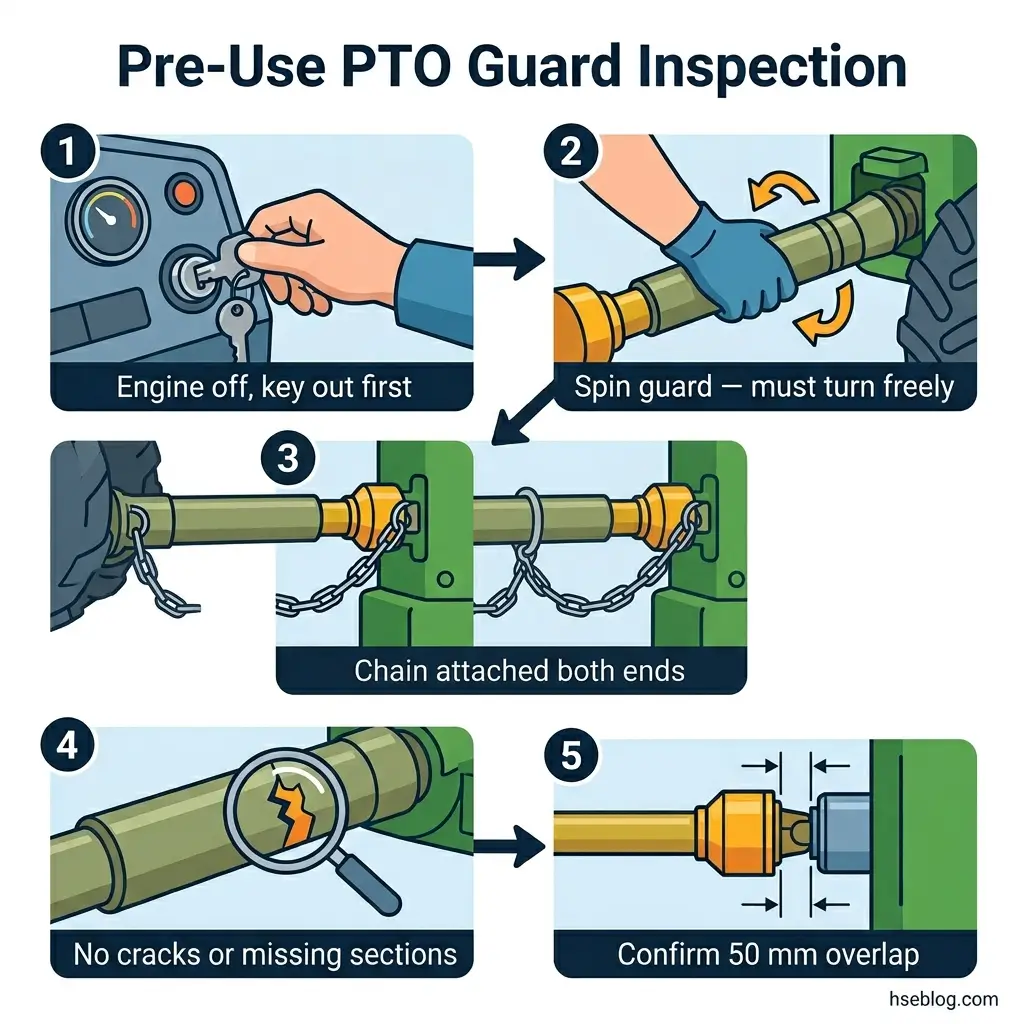
A reliable pre-use routine takes under a minute and is done with the engine off and the key out — full stop, no exceptions for “just a quick look.”
This article provides general HSE knowledge. Life-critical work such as inspecting, adjusting or replacing a PTO driveline guard must be carried out by a competent person with relevant training, jurisdiction-specific authorization, and a site-specific risk assessment. Never improvise a repair on a shaft that can be powered. The information here does not replace that.
The pre-use inspection, in order:
- Isolate first. Engine off, key removed, before a hand goes near the driveline.
- Spin-test the guard by hand. The tube should rotate freely on its bearing. If it is stiff or seized, the guard is now a wrap-point — replacement, not grease.
- Check the restraining chain. Present, attached at both ends, not wrapped around the shaft.
- Look for damage. Cracks, brittle or missing sections, split seams, caked mud holding the tube against the shaft.
- Check for protrusions. No locking pins, bolt heads or spring ends standing proud of the guard line.
- Confirm the overlap. Both guard ends still meet the fixed machine guards within spec through the telescoping range.
Handling and storage matter as much as the check:
- Support a disconnected guard — do not let it hang by its chain or take its weight on the bearing.
- Never rest the driveline on the drawbar or drop it; both deform the tube and damage the bearing.
Replacement triggers — retire the guard when you see any of these:
- Cracked or brittle plastic tube
- A bearing that no longer spins freely
- Wear-through to the shaft
- An older U-shaped tunnel guard, which should be replaced with the manufacturer’s retrofit shield rather than patched
Safe Work Practices Around PTO-Driven Equipment
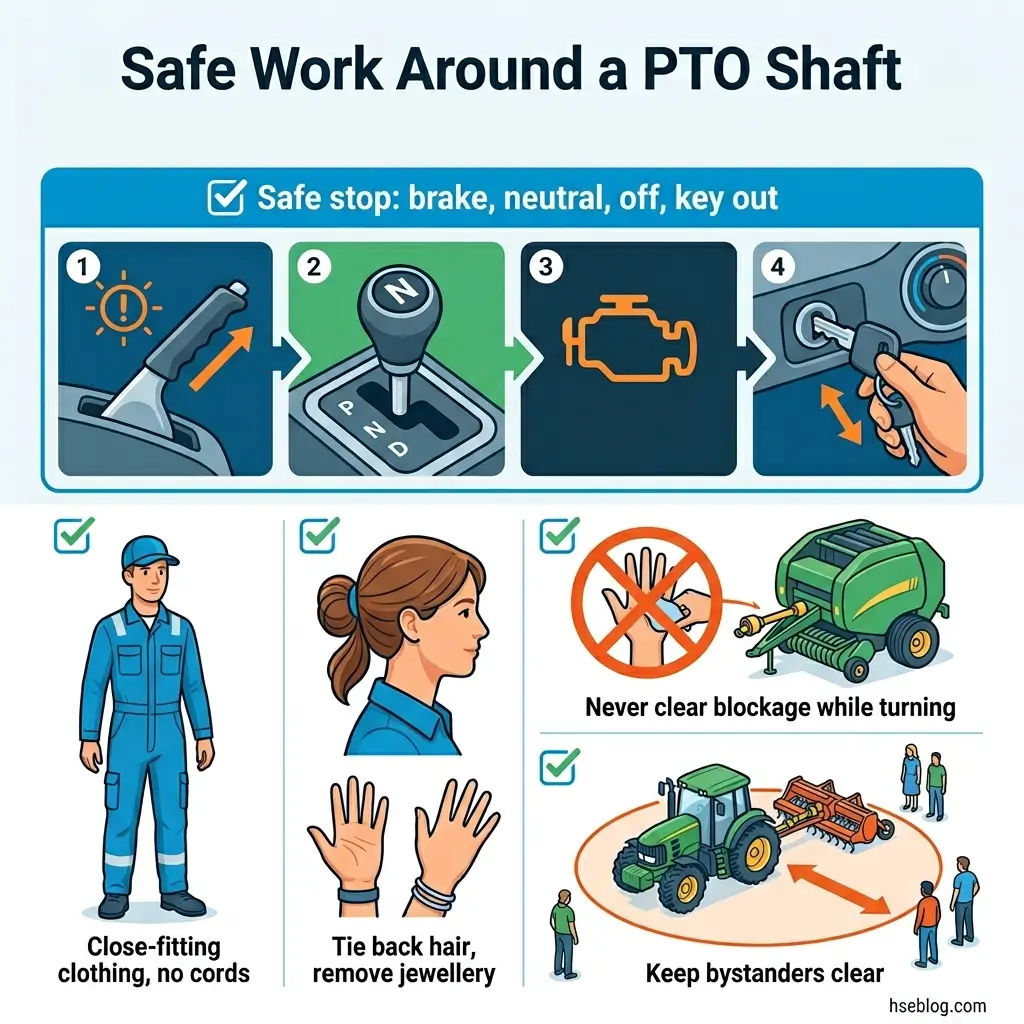
Guards are necessary but not sufficient — the behaviour around the driveline carries equal weight, because the single most protective habit is procedural, not mechanical. Agriculture, forestry, fishing and hunting recorded 18.6 fatal injuries per 100,000 full-time-equivalent workers in 2022, against 3.7 per 100,000 across all US industries (CDC/NIOSH, citing BLS CFOI, 2022), and machinery contact sits among the leading causes.
Before approaching the shaft:
- Run the “safe stop” sequence. Handbrake on, controls in neutral, engine off, key removed — every time, before any contact with the driveline.
- Never clear a blockage or adjust an implement while the PTO turns. This is the dominant fatal scenario; no task is quick enough to skip the stop.
During work and dress:
- Wear close-fitting clothing. No drawstrings, no hood cords, no flapping cuffs.
- Tie back hair and remove jewellery. Both are wrap-points at 540 or 1000 rpm.
People nearby:
- Keep a bystander and child exclusion zone around any running driveline.
- Train new and seasonal workers explicitly before they operate or work near PTO-driven equipment.
For formal competence, point people toward recognised pathways — NEBOSH and IOSH for HSE practitioners, OSHA outreach training in the US, and agricultural machinery training through bodies such as LANTRA or City & Guilds in the UK.
There is also a policy signal worth flagging: Ireland’s National Farm Safety Measure 2025 reopened grant aid covering 60% of PTO shaft-cover cost — up to €100 per cover for four covers — after farm vehicles and machinery accounted for nearly half of farm fatalities across 2015–2024 (CAP Network Ireland, 2025). When a regulator starts subsidising the guard itself, the field judgement that “the old shield can wait” gets harder to defend.
Frequently Asked Questions
Conclusion
The industry’s blind spot is not the bare shaft — that hazard is well advertised. It is the guard that is physically present but no longer doing its job: the seized bearing turning the cover into a wrap-point, the lost 50 mm overlap, the missing restraining chain, the cracked tube nobody hand-spun before the shift.
If there is one change with outsized impact, it is treating PTO safety guards as a maintained state rather than a fitted part — a ten-second hand-spin and overlap check before every use, backed by the safe stop sequence whenever a limb has to go near the driveline. That single habit closes the gap between “looks guarded” and “is guarding.”
The physics never negotiates: nine to seventeen turns a second leaves no room for a second attempt. Guard the whole driveline, verify it still spins free, and never trust a cover you haven’t checked since the last blockage.