
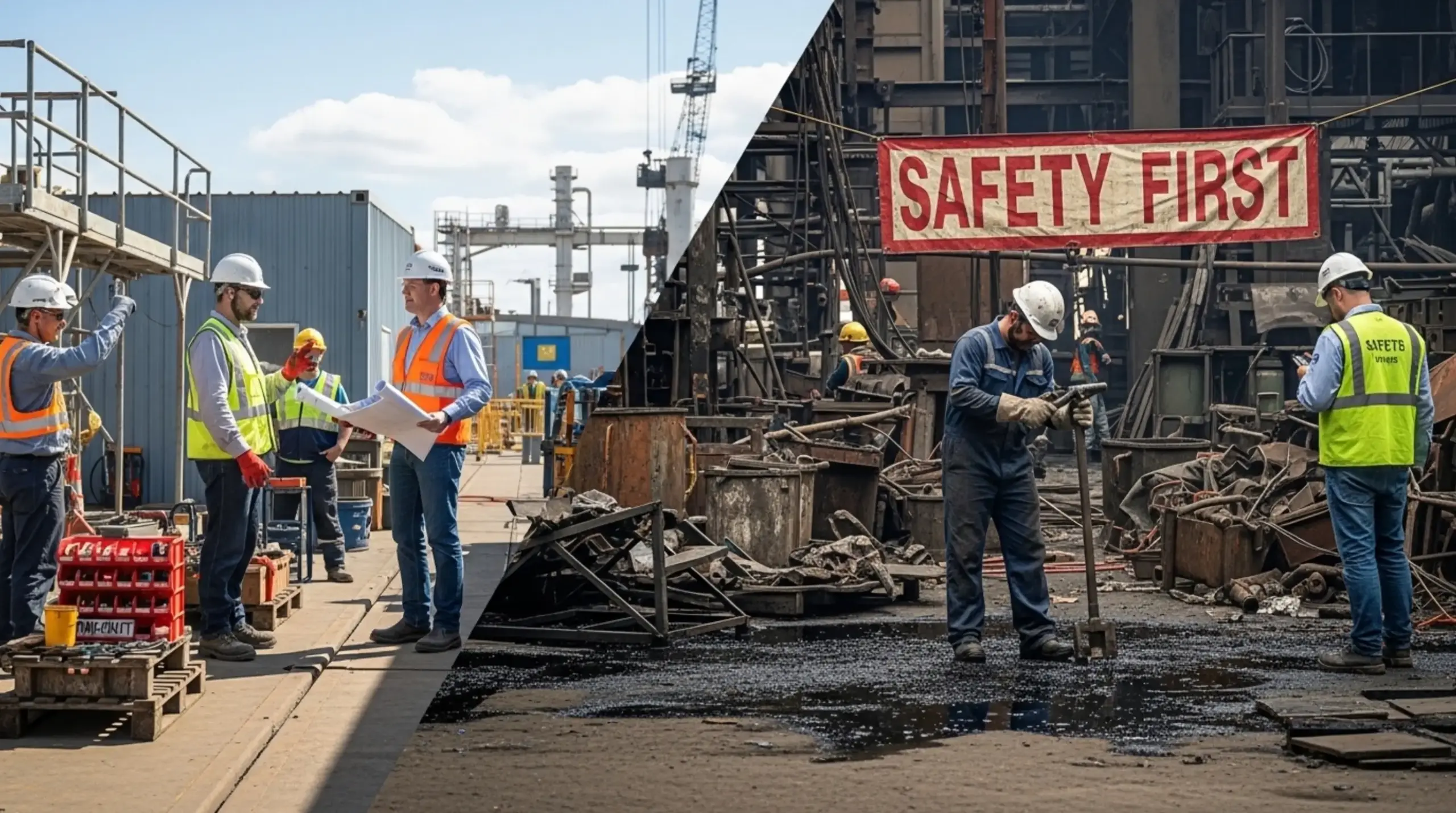
I recall an audit I conducted at a large petrochemical complex that boasted “Zero LTIs” for three years running. On paper, they were perfect; in the field, the tension was palpable. During a walkthrough, I watched a rigger struggle with a damaged sling while his supervisor stood ten feet away, checking his watch, clearly prioritizing the schedule over the critical lift. When I intervened, the rigger flinched, expecting a reprimand, not a correction. That reaction told me everything I needed to know. The “safety culture” was purely a façade of fear and compliance, designed to protect statistics rather than people.
This distinction is why understanding the elements and indicators of health and safety culture is the most critical skill for senior leadership and HSE professionals. Culture is the invisible force that dictates whether a procedure is followed or ignored. It is the product of individual and group values, attitudes, perceptions, and competencies. In this article, I will break down the core elements of a robust safety culture and provide a concrete checklist of positive and negative indicators I have gathered over a decade of auditing high-risk industries.
TL;DR
- Culture is behavior, not paperwork: It is defined by what happens when management isn’t watching, not what is written in the HSE manual.
- Leadership visibility is key: If leaders only appear for accidents or audits, the culture is reactive and likely toxic.
- Negative indicators are often silent: Unreported near-misses, silent safety meetings, and “clean” accident books are often signs of a suppression culture, not safety.
- Positive culture requires psychological safety: Workers must feel empowered to stop unsafe work without fear of retaliation or ridicule.
- Auditing culture requires eyes, not checklists: You assess culture by observing interactions and housekeeping, not just reviewing KPIs.
Core Elements of a Positive Safety Culture
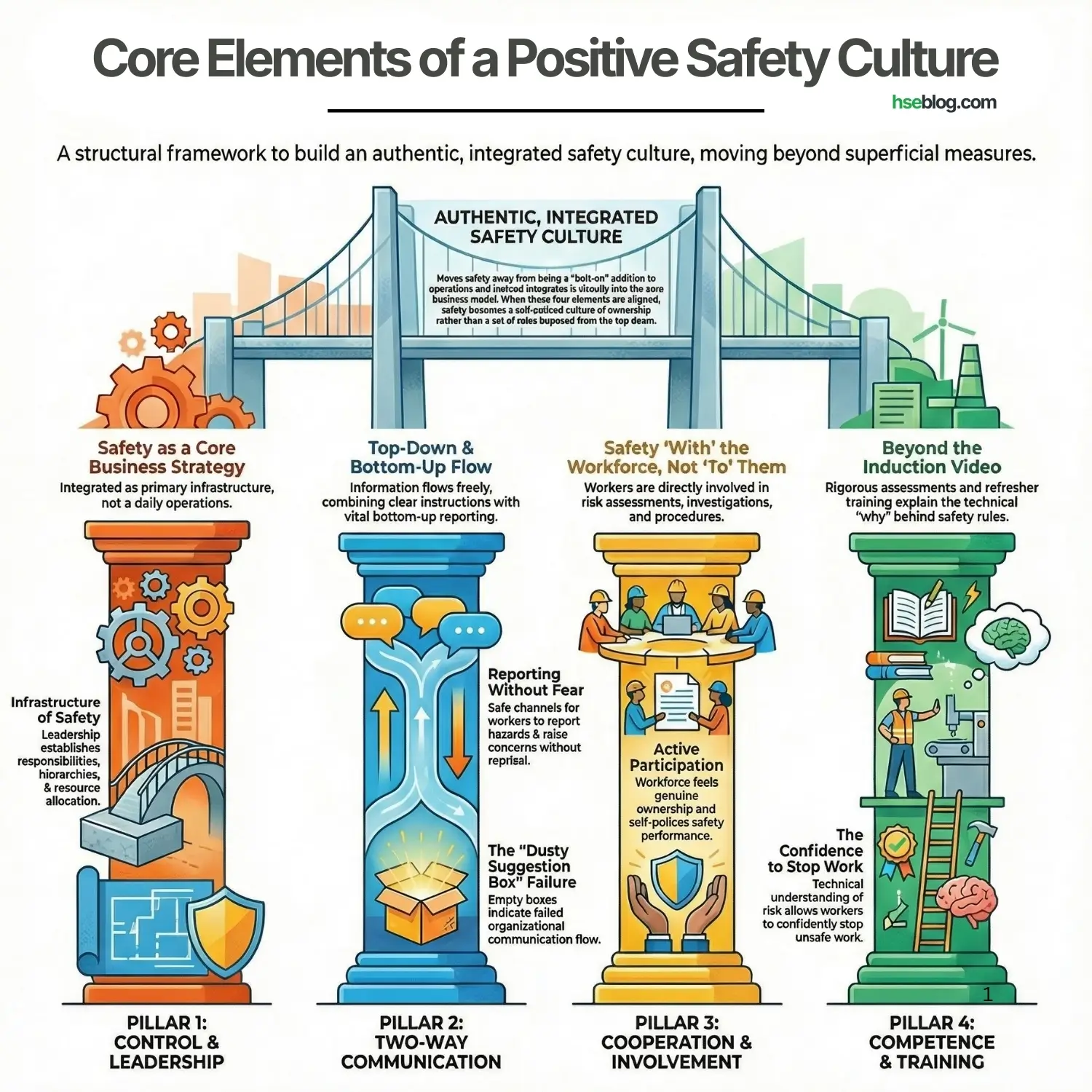
A positive safety culture isn’t created by posters or slogans; it is built on structural pillars that support safe decision-making. Based on the “4 Cs” model and my field experience, these are the non-negotiable elements.
1. Control and Leadership
This refers to the infrastructure of safety. It includes clear responsibilities, valid hierarchies, and the allocation of resources. In a positive culture, safety is not a “bolt-on” to operations; it is integrated into the business model. Leaders must demonstrate commitment through action—funding safety improvements, attending training, and holding themselves accountable to the same rules as the shop floor.
2. Communication (Two-Way)
Information must flow freely in both directions. Top-down communication involves clear instructions and visible commitment. Bottom-up communication is even more vital: workers must have channels to report hazards, suggest improvements, and raise concerns without fear. If the safety suggestion box is empty or dusty, communication has failed.
3. Cooperation and Involvement
Safety is done with the workforce, not to them. A positive culture involves workers in risk assessments, incident investigations, and procedure writing. When workers own the safety process, they police it themselves. We need “active participation,” where the workforce feels a genuine sense of ownership over the site’s safety performance.
4. Competence and Training
You cannot have a safety culture if people don’t know how to work safely. This goes beyond induction videos. It involves rigorous competency assessments, refresher training, and an understanding of why rules exist. Competence gives workers the confidence to stop unsafe work because they understand the technical risk.
Positive Indicators of Health and Safety Culture
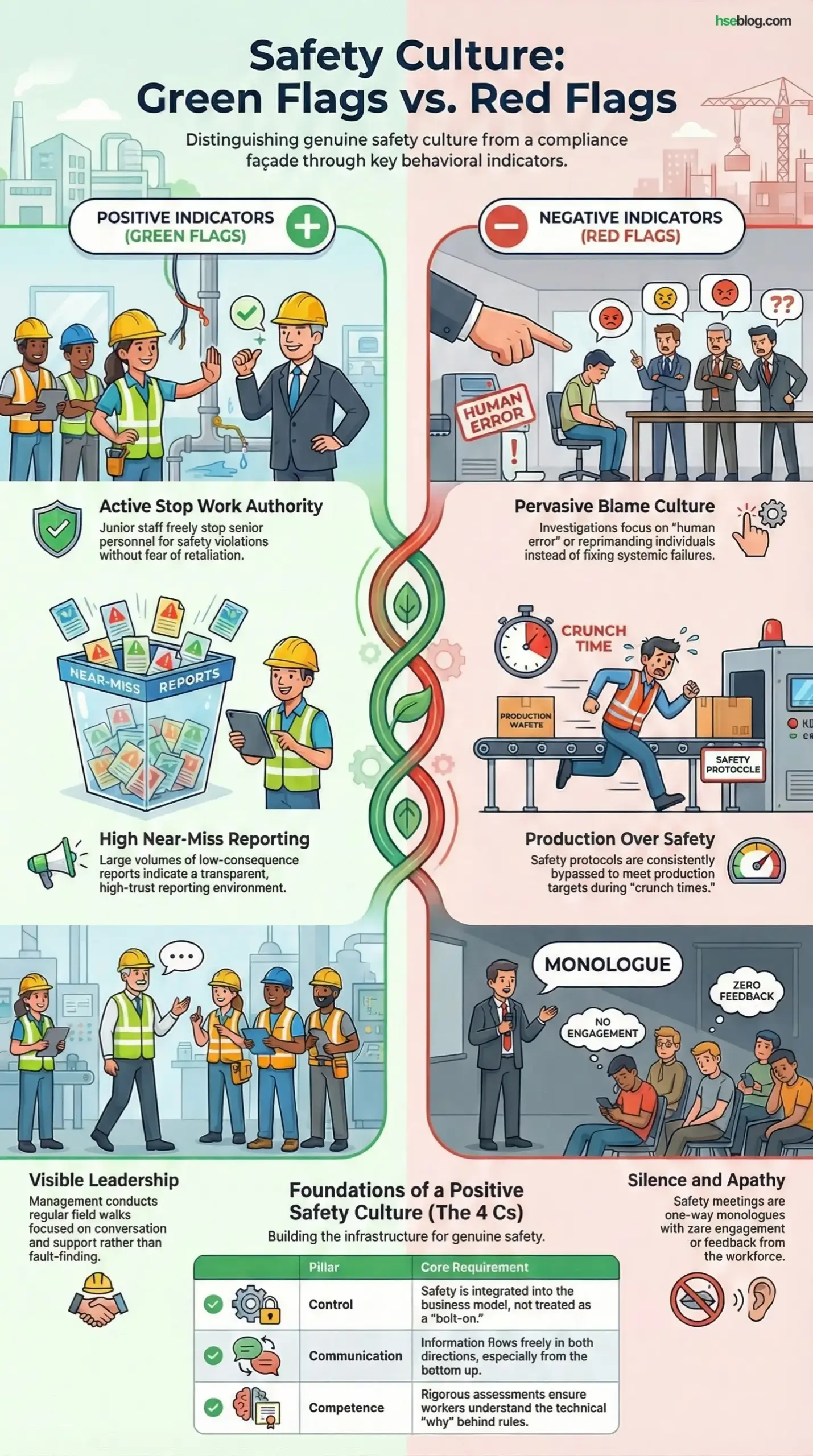
These are the “green flags” I look for when I first walk onto a site. These behaviors indicate that safety is internalized, not just enforced.
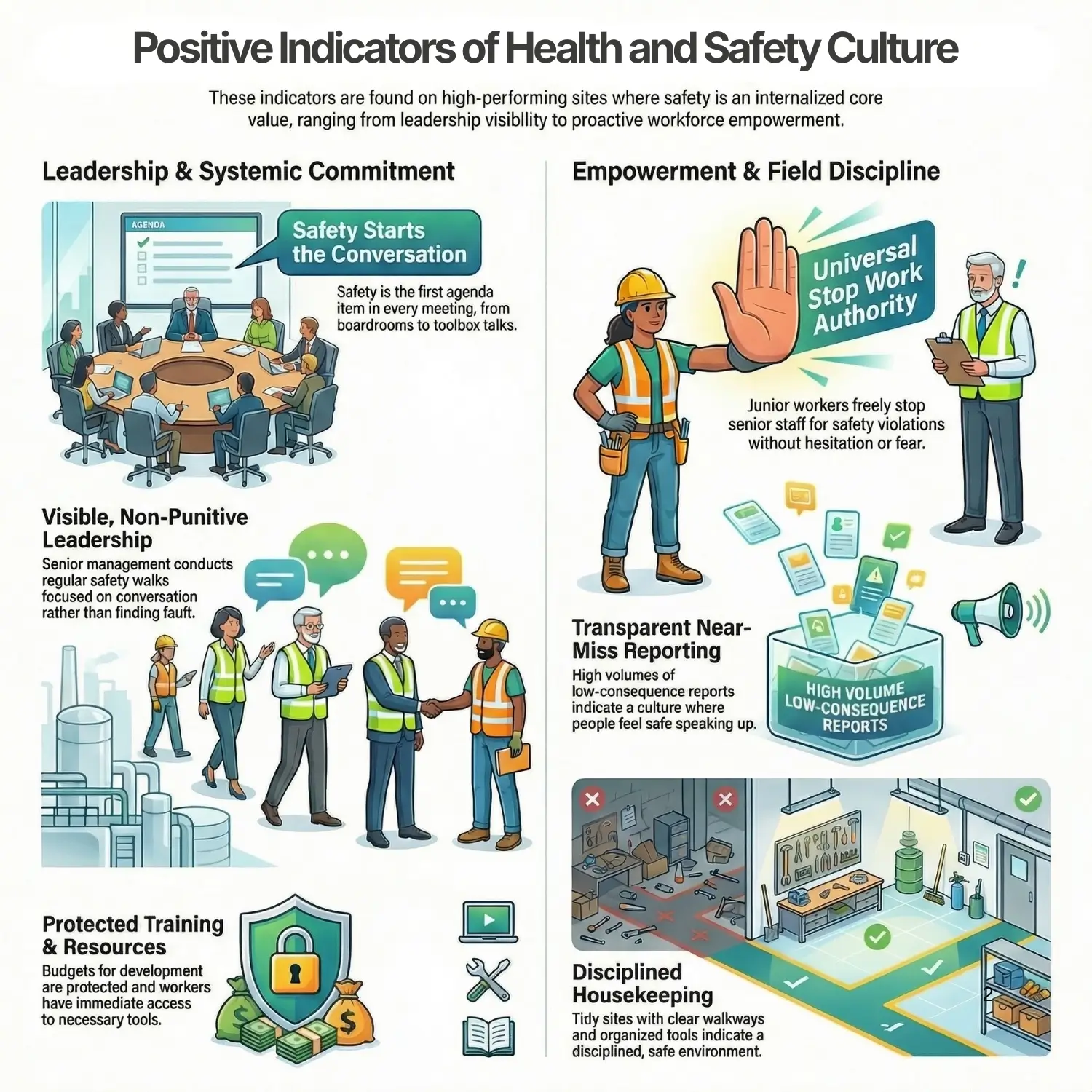
- Stop Work Authority is exercised freely: I see junior workers stopping senior staff or contractors for safety violations without hesitation.
- High volume of near-miss reporting: A large number of low-consequence reports indicates a transparent culture where people aren’t afraid to speak up.
- Leaders are visible in the field: Senior management conducts regular, non-punitive safety walks, focusing on conversation rather than fault-finding.
- Safety is the first agenda item: In every meeting—from boardrooms to toolbox talks—safety is discussed first, and not just as a formality.
- Active Safety Committee: The safety committee meets regularly, has high attendance, and actually closes out action items.
- Good housekeeping standards: Tools are returned to shadow boards, walkways are clear, and waste is segregated. A tidy site is a disciplined site.
- Low staff turnover: High retention often correlates with a supportive environment where workers feel valued and safe.
- Resources are available: Workers have access to the right tools and PPE without having to beg or improvise.
- Investment in training: The budget for training is protected, and records show continuous development beyond statutory minimums.
- Open incident investigations: Investigations focus on root causes (systems/processes) rather than blaming individuals (“human error”).
- Contractors are treated as employees: Subcontractors are held to the same standards and given the same support as direct staff.
- Safety achievements are celebrated: Milestones are recognized, but the focus is on proactive efforts (e.g., “Best Hazard Spotter”) rather than just “Zero Accident” days.
- Supervisors lead by example: Frontline supervisors wear full PPE and follow all procedures, setting the standard for their crews.
- Prompt maintenance: Safety-critical equipment and general infrastructure defects are repaired quickly.
- Clear emergency response: Drills are taken seriously, and everyone knows their specific role during an alarm.
Negative Indicators of Health and Safety Culture
These are the “red flags.” When I see these, I know that an accident is not a matter of if, but when. I have categorized them for clarity.
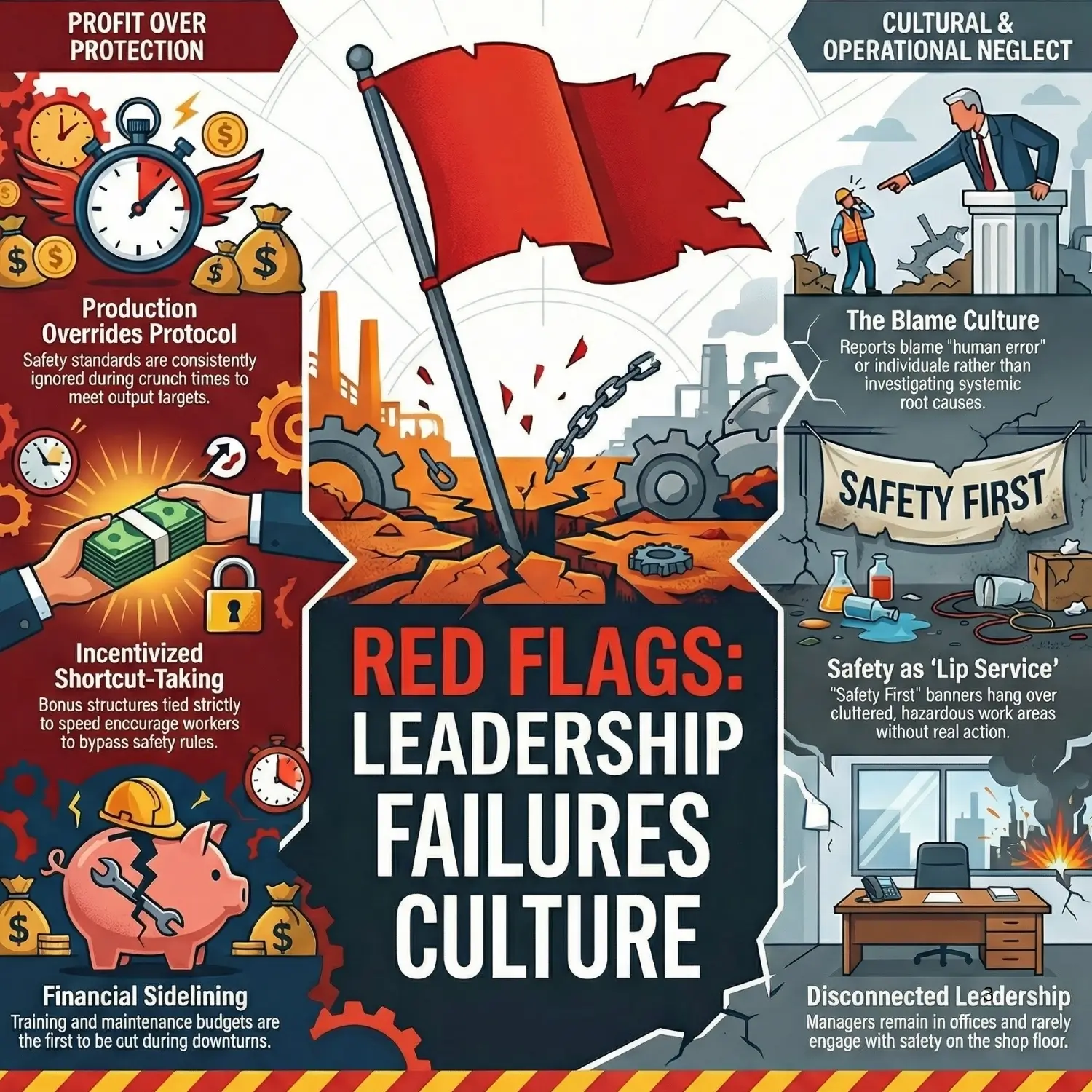
Leadership and Management Failures
- Safety is a priority only when convenient: Production targets consistently override safety protocols during crunch times.
- Blame culture: Accident reports conclude with “worker reprimanded” or “human error” without digging deeper.
- Absentee leadership: The HSE Manager or Site Manager is rarely seen outside the office.
- Budget cuts hit safety first: Training and maintenance budgets are the first to be slashed during downturns.
- Knee-jerk reactions: New rules are invented immediately after an accident without consulting the workforce.
- Lip service: “Safety First” banners hang over dangerous, cluttered work areas.
- Unrealistic targets: Bonus structures are tied strictly to production speed, incentivizing shortcut-taking.
- Ignoring expert advice: HSE professionals are sidelined or excluded from operational planning meetings.
- Lack of follow-through: Action items from audits or meetings remain open for months or years.
- Inconsistent enforcement: The “star performer” is allowed to break safety rules, while others are punished.
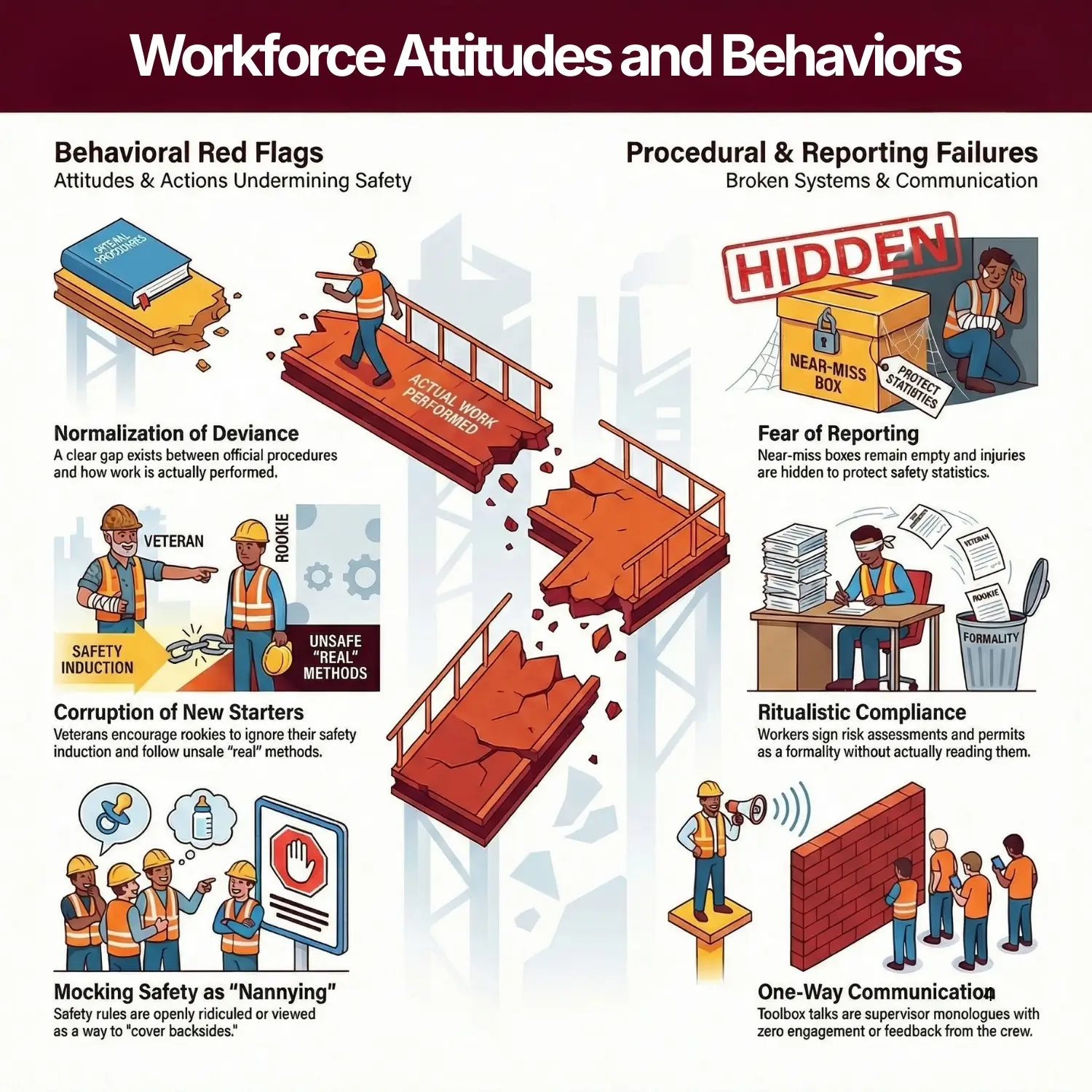
Workforce Attitudes and Behaviors
- “Ideally vs. Actually”: Workers have a clear distinction between how the procedure says to do it and how they actually do it.
- Silence during meetings: Toolbox talks are monologues by the supervisor with no engagement from the crew.
- Mocking safety: Safety rules are referred to as “nannying” or “covering their backsides.”
- Hiding injuries: Workers treat minor cuts or burns themselves to avoid “ruining the stats.”
- Us vs. Them: A palpable hostility exists between the workforce and the HSE department.
- Normalization of deviance: Unsafe practices (e.g., removing guards) become the accepted standard over time.
- New starters are corrupted: Veterans tell rookies, “Forget what you learned in induction; this is how we really do it.”
- PPE policing: The HSE officer spends all their time reminding people to put on glasses/helmets (indicating a lack of personal discipline).
- Fear of reporting: The near-miss box is empty because workers fear being labeled as troublemakers.
- Ritualistic signatures: Workers sign risk assessments or permits without reading them.
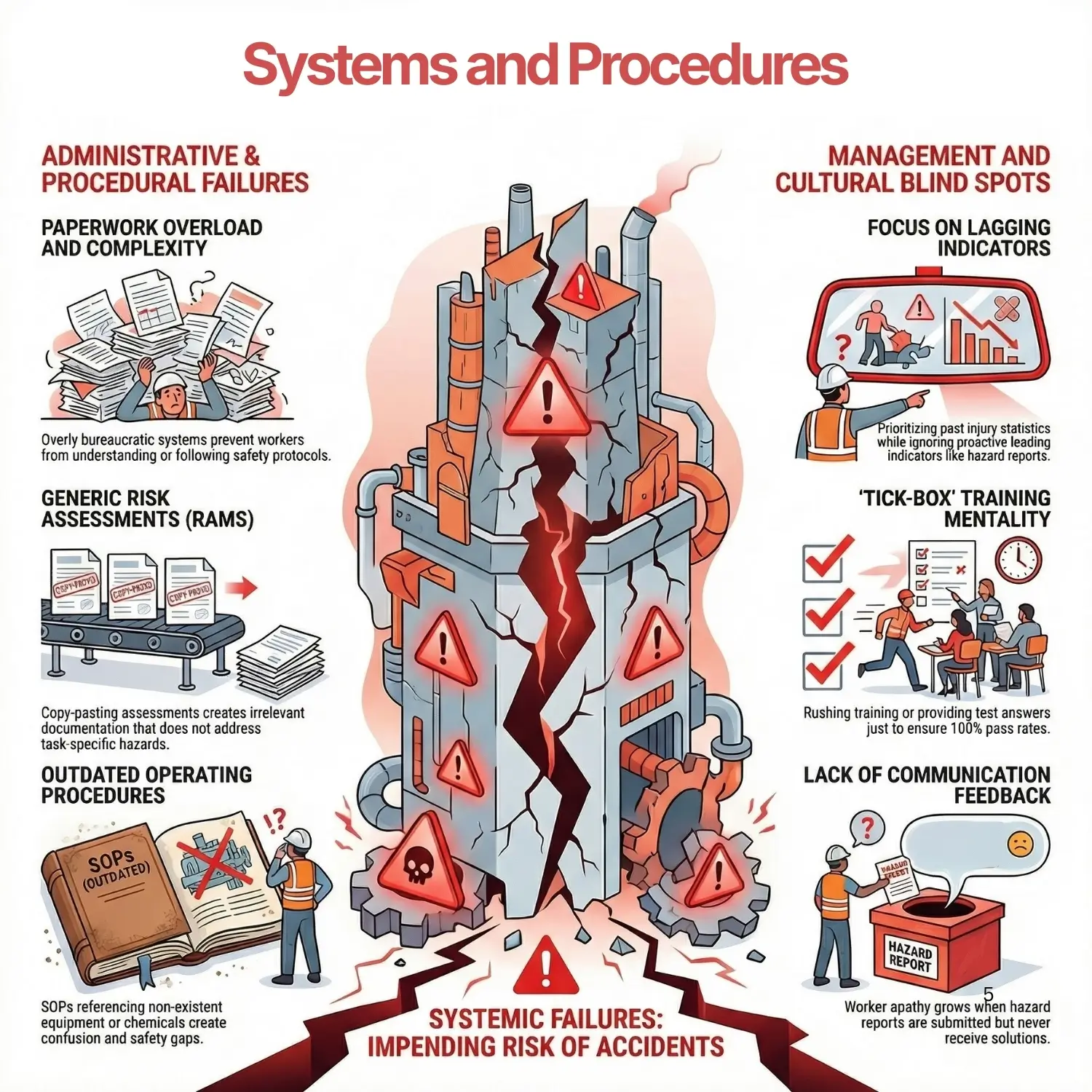
Systems and Procedures
- Paperwork overload: The safety management system is so complex and bureaucratic that no one understands it.
- Generic risk assessments: RAMS (Risk Assessment Method Statements) are copy-pasted and irrelevant to the specific task.
- Outdated procedures: SOPs refer to equipment or chemicals that haven’t been on site for years.
- Lagging indicators focus: Management only cares about LTIs (Lost Time Injuries) and ignores leading indicators like hazard reports.
- Training is a tick-box: Training sessions are rushed, or answers to tests are given out to ensure 100% pass rates.
- Permit-to-Work violations: Permits are issued remotely without a site visit or verification of controls.
- Lack of feedback: Workers report hazards but never hear back about the solution, leading to apathy.
- External compliance only: The site only gets tidied up when a regulator or client auditor is due to visit.
- Poor change management: New equipment or chemicals are introduced without a Management of Change (MoC) process.
- Legacy issues: Hazards identified years ago are still present and have been “risk accepted” indefinitely.
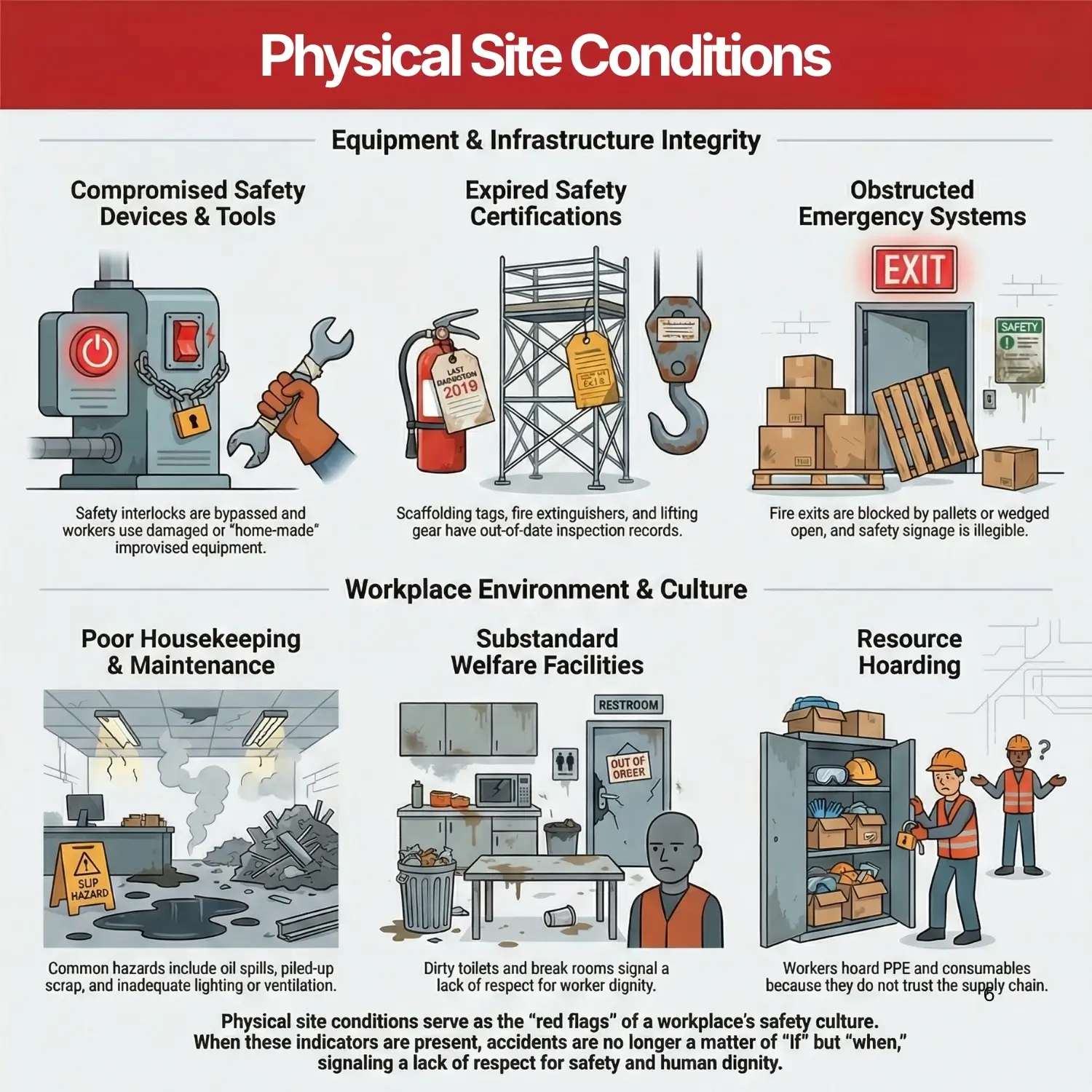
Physical Site Conditions
- Poor housekeeping: Trip hazards, oil spills, and piled-up scrap are common.
- Illegible signage: Safety signs are faded, dirty, or missing.
- Bypassed safety devices: Interlocks on machines are taped over or bridged out.
- Damaged tools: Hammers with loose heads, frayed electrical cords, or mushroomed chisels are in use.
- Blocked emergency exits: Fire doors are wedged open or blocked by pallets.
- Inadequate welfare facilities: Toilets and break rooms are dirty, signaling a lack of respect for human dignity.
- Improvised equipment: Workers are using “home-made” tools because the correct ones aren’t provided.
- Expired inspections: Scaffolding tags, fire extinguisher checks, or lifting gear certifications are out of date.
- Poor lighting/ventilation: Working environments are unnecessarily uncomfortable or hazardous.
- Hoarding: Workers hoard consumables (gloves, masks) because they don’t trust the supply chain.
Conclusion
A negative safety culture is a ticking time bomb. It is not a question of luck; it is a systemic failure waiting for a trigger. As an HSE professional or a leader, you cannot fix a culture from behind a desk. You must be in the field, observing these indicators.
If you recognize more than a few of the negative indicators listed above in your own organization, you need to stop worrying about your LTI rate and start worrying about your leadership credibility. The transition to a positive culture requires honesty, the removal of blame, and a genuine partnership with the workforce. It is hard work, but the alternative—explaining a fatality to a family—is infinitely harder.