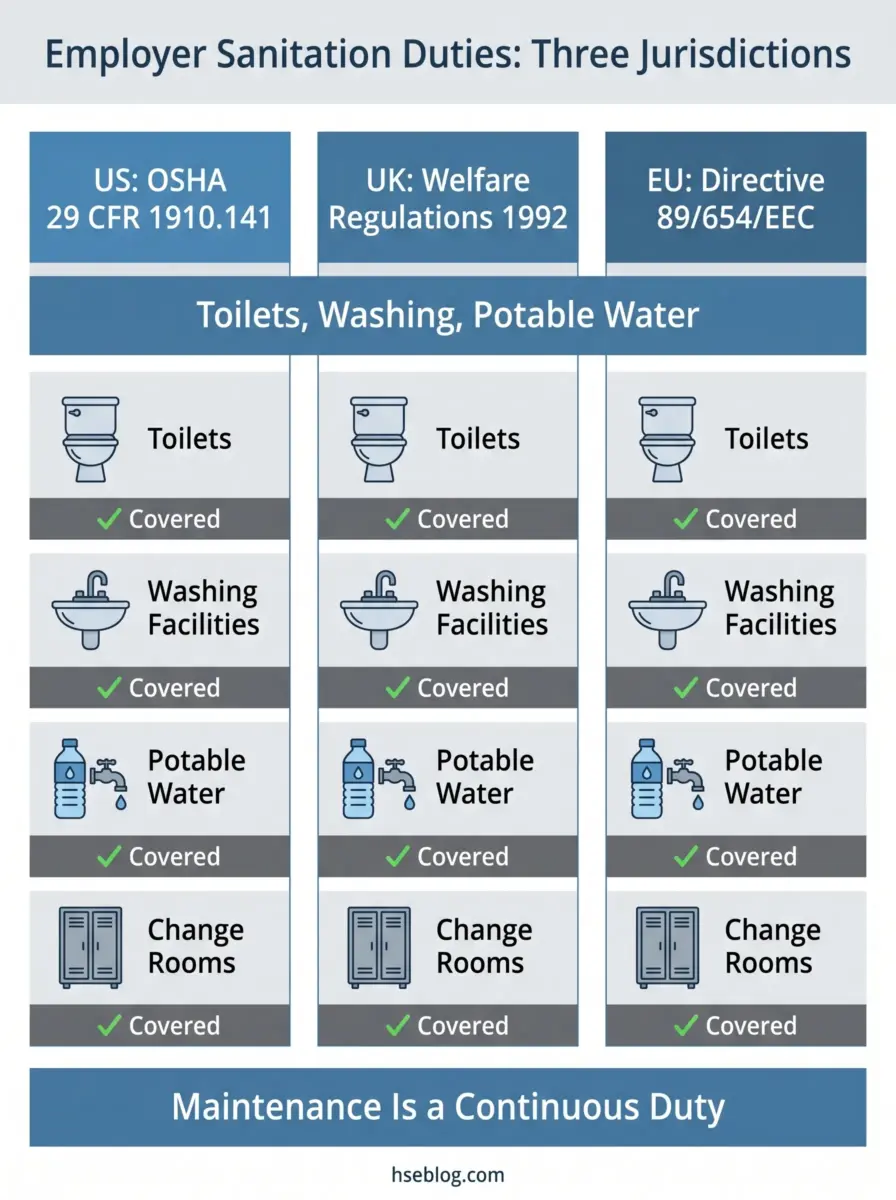
Employers in every jurisdiction share one non-negotiable duty: provide adequate, clean, and accessible toilet and washing facilities for all workers, maintained in sanitary condition and stocked with soap, running water, and drying materials at all times. In the US, OSHA mandates minimum toilet-to-employee ratios under 29 CFR 1910.141 for general industry and 29 CFR 1926.51 for construction. UK employers must comply with Regulations 20–21 of the Workplace (Health, Safety and Welfare) Regulations 1992, and EU member states implement the minimum requirements of Council Directive 89/654/EEC.
A toilet facility that exists on a site plan but has no soap in the dispenser, no paper on the roll, and no running water at the tap is not a compliant facility. Under OSHA enforcement interpretation, that facility is treated as unavailable — functionally identical to having provided nothing at all. This distinction between provision and maintenance is where a significant proportion of workplace sanitation citations originate. The obligation is not to install a restroom and forget about it. The obligation is to keep it operational, stocked, and accessible every hour of every shift.
Workplace sanitation and washing facility requirements sit at the intersection of occupational health law, worker dignity, and disease prevention. Globally, the ILO estimates that nearly 230,000 work-related deaths in 2017 were attributed to communicable diseases, many linked to inadequate drinking water, sanitation, and hygiene in workplace settings (ILO / UN DESA, 2016). The legal frameworks governing these employer duties — OSHA in the US, the 1992 Welfare Regulations in the UK, and Directive 89/654/EEC across the EU — each prescribe specific minimum standards. This article synthesises all three jurisdictions into a single practitioner-oriented reference, explains how enforcement actually evaluates compliance, and incorporates the July 2025 OSHA penalty guideline revisions that no competitor resource has yet addressed.
What Are Employer Duties for Workplace Sanitation and Washing Facilities?
The core duty is straightforward in principle: every employer must provide adequate, clean, and freely accessible toilet and washing facilities for the entire workforce, maintained continuously in sanitary condition, and supplied at all times with soap, running water, and hand-drying materials. That duty extends beyond initial provision to ongoing maintenance, cleaning, and supply replenishment throughout every working shift.
Where the duty gets operationally complex is in scope. The requirements differ depending on the type of workplace — permanent facilities in general industry, temporary and portable provisions on construction sites, and field sanitation for agricultural crews each carry distinct regulatory expectations. A permanent office subject to 29 CFR 1910.141 (US) faces different fixture ratios and maintenance obligations than a highway construction project governed by 29 CFR 1926.51 (US) or a factory floor in Manchester operating under UK Regulation 21.
The most common compliance gap across all three jurisdictions is not the absence of facilities but their degradation. Facilities that technically exist but lack soap, towels, or functioning water — or that are locked, excessively distant from the work area, or practically inaccessible due to supervisory culture — are treated as non-compliant under enforcement interpretation. Provision without maintenance is not provision.
| Jurisdiction | Primary Standard | Scope |
|---|---|---|
| US — General Industry | 29 CFR 1910.141 | Toilet ratios, lavatories, potable water, food areas, vermin |
| US — Construction | 29 CFR 1926.51 | Toilets, washing for hazardous substances, change rooms |
| UK | Workplace Regulations 1992, Reg. 20–21 | Toilets, washing, showers (if needed), drying, ventilation |
| EU | Directive 89/654/EEC | Lavatories, washbasins near workstations, rest/change areas |
Toilet Facility Requirements: Minimum Numbers and Standards
Determining whether a workplace has enough toilets is not a matter of rough estimation. Each jurisdiction prescribes specific ratios tied to workforce size, and the calculation method matters more than most employers realise.
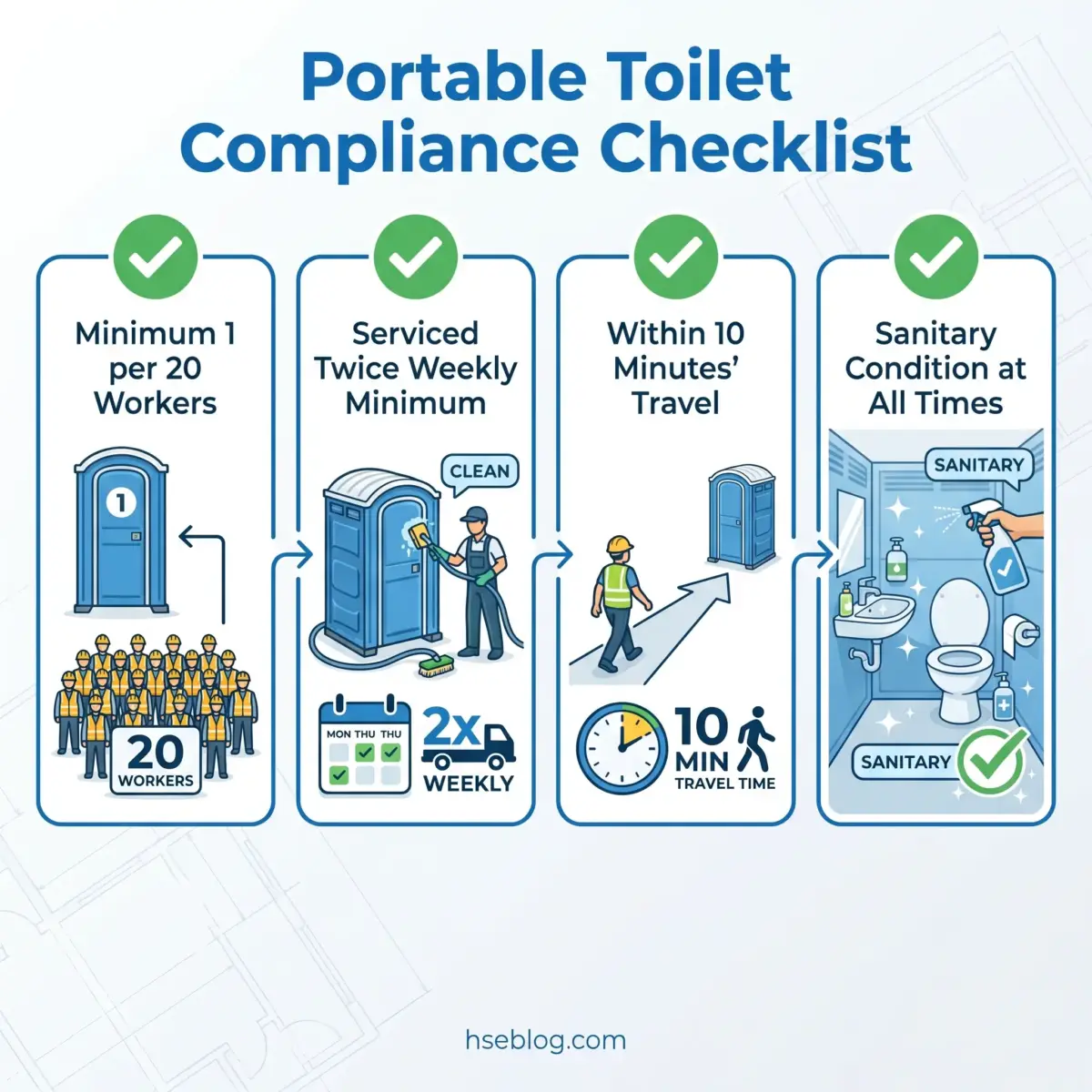
Under OSHA's general industry sanitation standard (29 CFR 1910.141), Table J-1 sets the minimum toilet-to-employee ratios: one toilet for 1–15 employees, two for 16–35, three for 36–55, four for 56–80, five for 81–110, and one additional unit per 40 employees beyond 110. For construction sites under 29 CFR 1926.51, the minimum is one toilet per 20 workers, with at least one facility available under temporary field conditions regardless of crew size.
The UK's HSE Approved Code of Practice L24 publishes separate tables for mixed-use facilities, women-only, and men-only — generally requiring one toilet and one washbasin for every five workers in smaller workplaces, scaling proportionally.
A critical privacy requirement applies across jurisdictions: toilet compartments must have doors and partitions high enough to assure privacy. Urinals may supplement toilet provision but cannot substitute for the minimum toilet count. Both OSHA and UK standards accept single-occupancy lockable rooms as an alternative to sex-segregated facilities.
Watch For: The friction point is how "number of employees" gets calculated. Employers frequently use average headcount rather than peak-shift headcount. During shift overlaps and break rushes, this miscalculation creates under-provision. The correct baseline is the maximum number of workers present at any one time — not the payroll average.
| Requirement | US General Industry (OSHA) | US Construction (OSHA) | UK (L24 Guidance) |
|---|---|---|---|
| Base ratio | 1 per 15 employees | 1 per 20 workers | ~1 per 5 (mixed-use, small sites) |
| Privacy | Separate compartments, doors | Separate compartments | Separate compartments, lockable |
| Urinals | Supplement only | Supplement only | Supplement only |
| Single-occupancy option | Satisfies requirements | Satisfies requirements | Satisfies requirements |
Portable Toilets and Temporary Facilities
On construction sites and temporary worksites, portable and chemical toilets fill the gap where permanent plumbing does not exist. OSHA 29 CFR 1926.51 accepts chemical toilets, flush toilets, combustion toilets, and sanitary privies — the key is that the unit must be "maintained in a sanitary condition."
That phrase — "maintained in a sanitary condition" — is a performance standard, not a prescribed cleaning schedule. ANSI Z4.3-1995 suggests a minimum servicing frequency of twice weekly for units serving up to 20 workers, but site conditions dictate the real requirement. High-heat environments, heavy use during overtime periods, and multi-trade projects often demand daily servicing.
Placement also matters. Industry guidance positions portable toilets within 10 minutes' travel from the work area. On multi-storey construction, the consensus expectation — reinforced by ANSI/ASSP A10.25-2023 (US) — is availability on every third floor and within 200 feet horizontally.
The Fix That Works: Servicing contracts that specify a fixed weekly schedule frequently fail the performance standard during summer months or high-occupancy phases. The more reliable approach is contracting for outcome-based servicing — the vendor is responsible for maintaining sanitary condition, with the frequency adjusted to actual demand rather than a calendar date.
Washing Facility Requirements: What Employers Must Provide
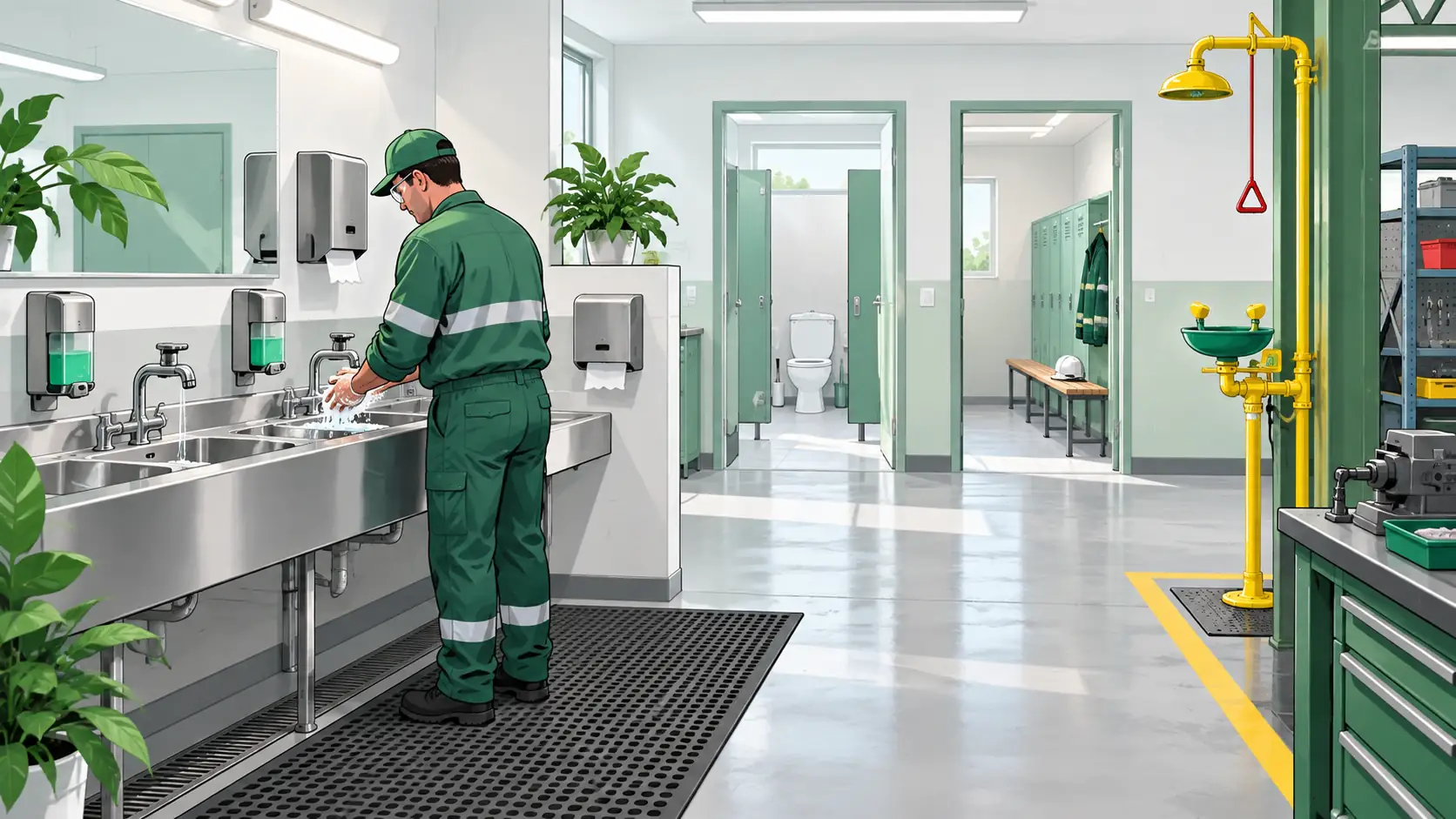
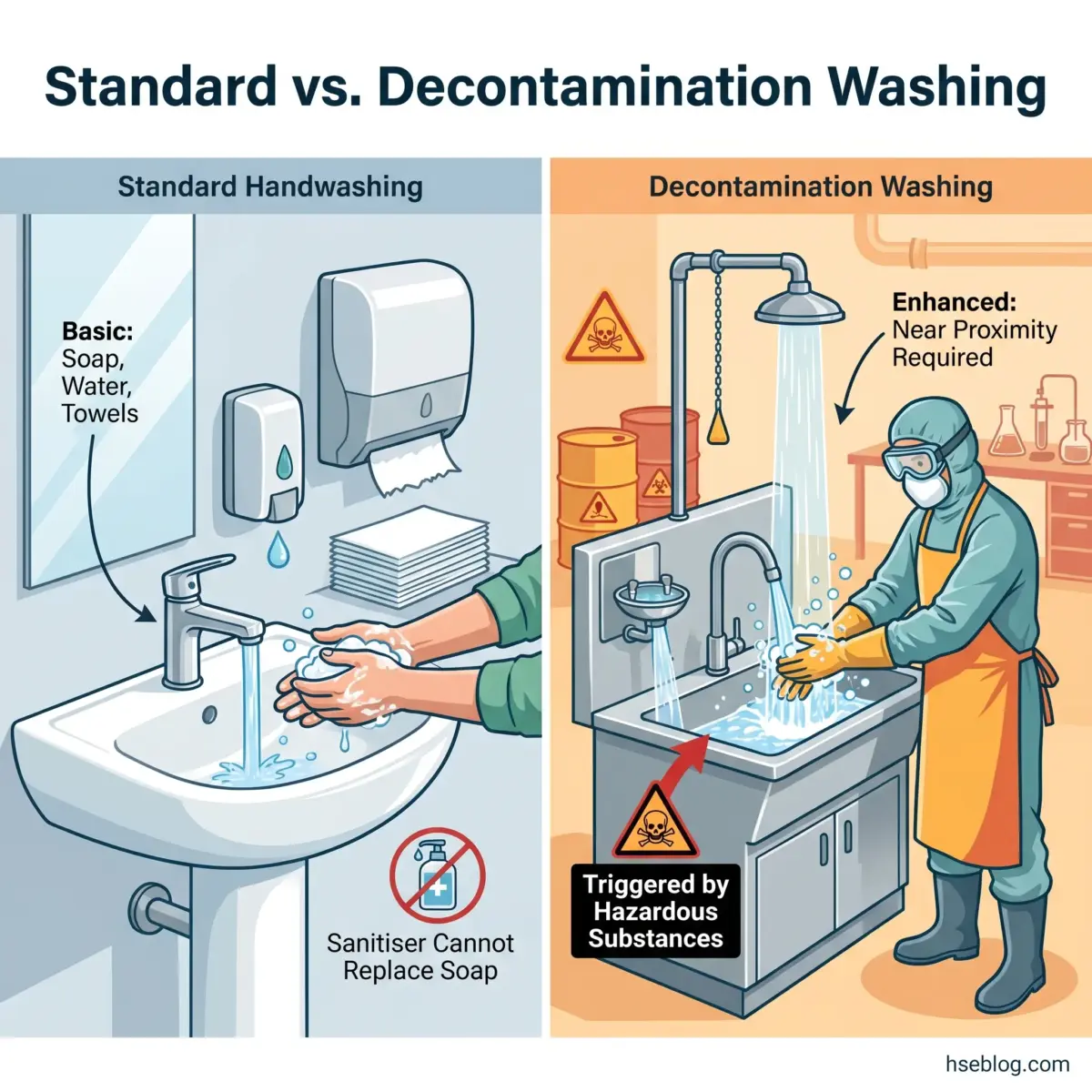
Every workplace lavatory must include running water — hot and cold, or at minimum tepid — hand soap or an equivalent cleansing agent, and individual hand-drying materials such as paper towels, cloth towels, or air blowers. This is the baseline. Waterless hand cleaners and sanitiser gels are not acceptable substitutes for soap and running water under OSHA standards. They may supplement, but they cannot replace the primary washing provision.
The UK's Regulation 21 of the 1992 Welfare Regulations mirrors this requirement: washing facilities must include a supply of clean hot and cold (or warm) water, soap or other suitable means of cleaning, and towels or other means of drying. Facilities must be in readily accessible locations and kept clean, well-ventilated, and well-lit.
The distinction that creates the most enforcement exposure is between standard handwashing and decontamination washing. Under 29 CFR 1926.51(f)(1) (US — construction), workers exposed to paints, coatings, herbicides, insecticides, or other potentially harmful contaminants require enhanced washing facilities in "near proximity" to the work area. A break-room sink 300 metres from the spray-painting operation does not satisfy this requirement. The washing station must be close enough that workers can decontaminate promptly — before the substance has time to cause dermal absorption or skin sensitisation.
Audit Point: When reviewing washing facility compliance, the question is not "does a sink exist?" but "can the worker who just handled the contaminant reach soap and running water within a reasonable timeframe without removing PPE in a contaminated environment?" If the answer requires qualification, the facility placement likely needs adjustment.
Shower and Change Room Obligations
Showers are not required under the general sanitation standard. They become mandatory only when triggered by a specific OSHA substance standard — lead (29 CFR 1910.1025), asbestos, cadmium, and similar regulated substances each carry their own shower provisions. When showers are required, the ratio is one shower per 10 workers of each sex per shift who are required to shower.
The UK standard under Regulation 21 takes a broader approach: showers must be provided when "required by the nature of the work or for health reasons" — a judgment call that the employer and their HSE adviser must make based on the specific exposures present.
Change rooms with dual storage are required whenever workers must change into protective clothing. The critical design feature is separation: street clothes must be stored apart from contaminated PPE. A recurring enforcement issue is the single-locker failure — employers provide a change room but assign one locker per worker for both street clothes and contaminated gear, which undermines the cross-contamination control that the standard exists to achieve.
Where employer-provided work clothes become wet during the course of work, the UK standard requires provision of clothes-drying facilities.
Potable Water and Drinking Facilities
Every employer must supply potable water that meets the EPA's National Primary Drinking Water Regulations (40 CFR 141) in the US, or the equivalent national drinking water standards in the UK and EU. This is a non-delegable duty — the employer cannot assume the building's plumbing delivers safe water without verification, particularly on older industrial sites.
Non-potable water outlets — used for industrial processes, dust suppression, or fire systems — must be clearly marked with signage stating "not safe for drinking, washing of person, or cooking." Cross-connections between potable and non-potable systems are prohibited. The practical challenge here is that older industrial facilities often have plumbing systems modified over decades, where cross-connection risks are not visible without a physical survey.
On construction sites, potable water must be provided via drinking fountains, covered containers with single-use cups, or single-use sealed bottles. Common-use cups and dipping arrangements are prohibited.
The UK requires an "adequate supply of wholesome drinking water" readily accessible at suitable locations, along with cups or drinking vessels unless the supply is from a drinking fountain.
How Does Restroom Access Work for Mobile and Remote Workers?
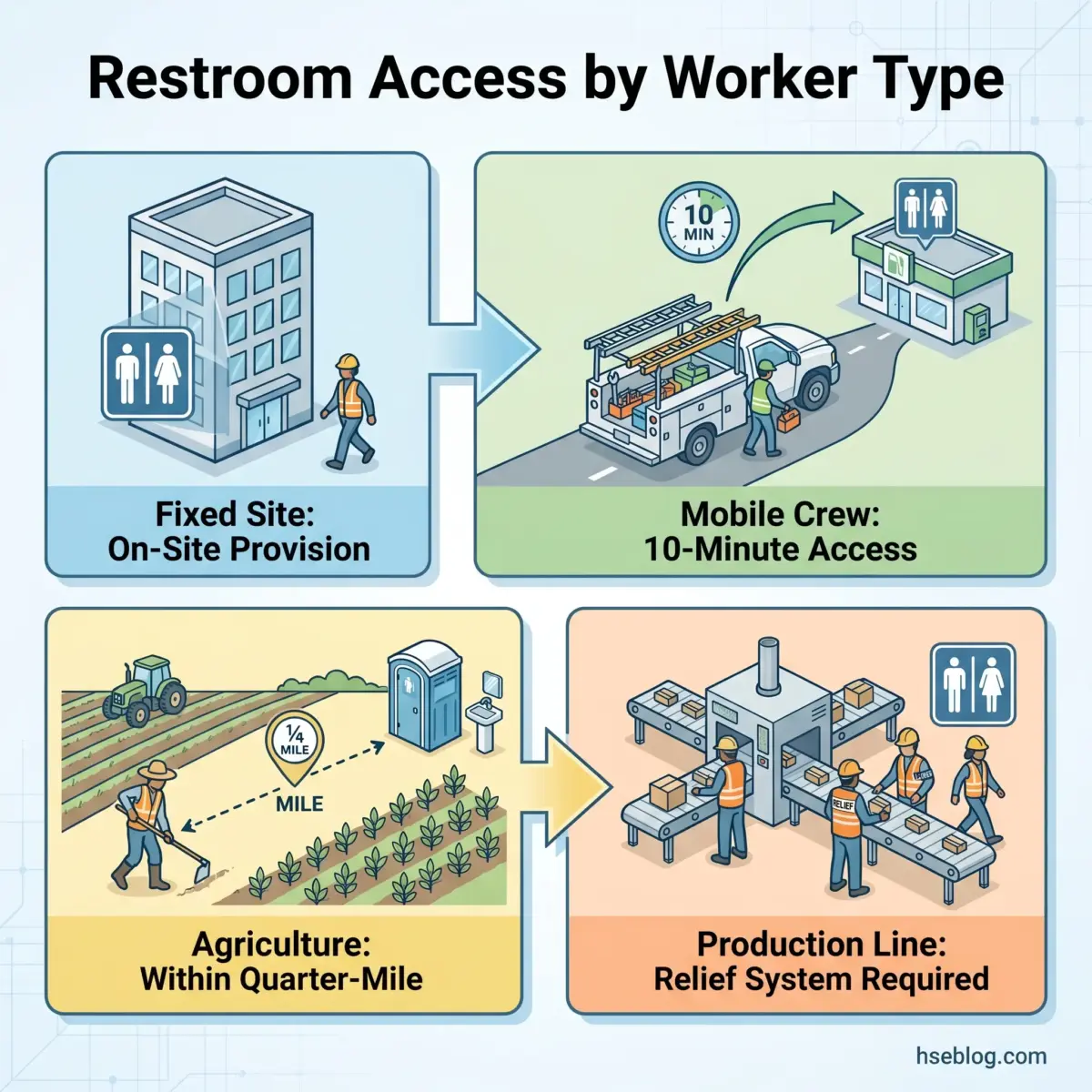
The employer's duty to provide toilet facilities does not evaporate when workers leave the fixed site. For mobile crews and normally unattended work locations, OSHA permits an exemption from on-site provision — but only when workers have "readily available transportation" to "nearby" facilities. OSHA's 1998 interpretation on prompt restroom access establishes the benchmark: access within approximately 10 minutes.
Agricultural workers receive more prescriptive protection. Under 29 CFR 1928.110 (US), employers must provide toilet and handwashing facilities within a quarter-mile of the work location — a landmark standard specifically designed for field sanitation where commercial restrooms are not available.
For production-line and continuous-coverage roles, the employer must implement a relief-worker system or similar arrangement that allows workers to leave the line without unreasonable delay. Supervisory culture that informally discourages bathroom breaks — even when facilities are physically present — creates enforcement risk. The question during an OSHA inspection is not whether a restroom exists on the premises. The question is whether the worker's actual workflow allows access without unreasonable delay.
Field Test: Ask three frontline workers — independently — how long it takes them to reach a restroom and return during a normal shift. If any answer exceeds 10 minutes or includes "I usually just wait," the prompt-access standard may not be met regardless of what the site plan shows.
Maintaining Sanitary Conditions: Cleaning, Supplies, and Upkeep
Provision and maintenance are separate obligations. An employer who installs adequate facilities but allows them to deteriorate faces the same enforcement outcome as an employer who never installed them.
OSHA's sanitation standard is performance-based — it requires the outcome ("sanitary condition") without prescribing the exact cleaning method or frequency. This means the employer owns the burden of demonstrating that whatever system they use actually delivers a clean, stocked, functional facility at any point during the working day. ANSI Z4.3-1995 provides voluntary guidance: toilets serving up to 20 people should be serviced at minimum twice per week. But on high-traffic or multi-shift sites, that frequency is a floor, not a ceiling.
Continuous supply is a recurring citation trigger. Toilet paper, hand soap, and towels must always be available — not restocked once per day and depleted by mid-morning. Waste receptacles must be emptied at least once per working day. Vermin control requires a continuing and effective programme, not a reactive call when an infestation becomes visible.
Eating and drinking are prohibited in toilet rooms and in any area exposed to toxic materials — a requirement that intersects with chemical hygiene programmes in laboratory and industrial settings.
The UK standard adds specificity on the physical environment: toilet and washing rooms must be clean, well-lit, and adequately ventilated, with walls and floors preferably tiled or finished with a waterproof surface to facilitate cleaning.
The gap between "we have a cleaning schedule" and "the facilities are actually clean when workers need them" is where the majority of real-world failures occur. Employers who treat sanitation as a procurement task — buy the facility, check the box — rather than an operational task — maintain it continuously, verify it routinely — encounter repeated citations.
Penalties for Non-Compliance with Workplace Sanitation Standards
Enforcement consequences for sanitation failures are concrete and escalating.
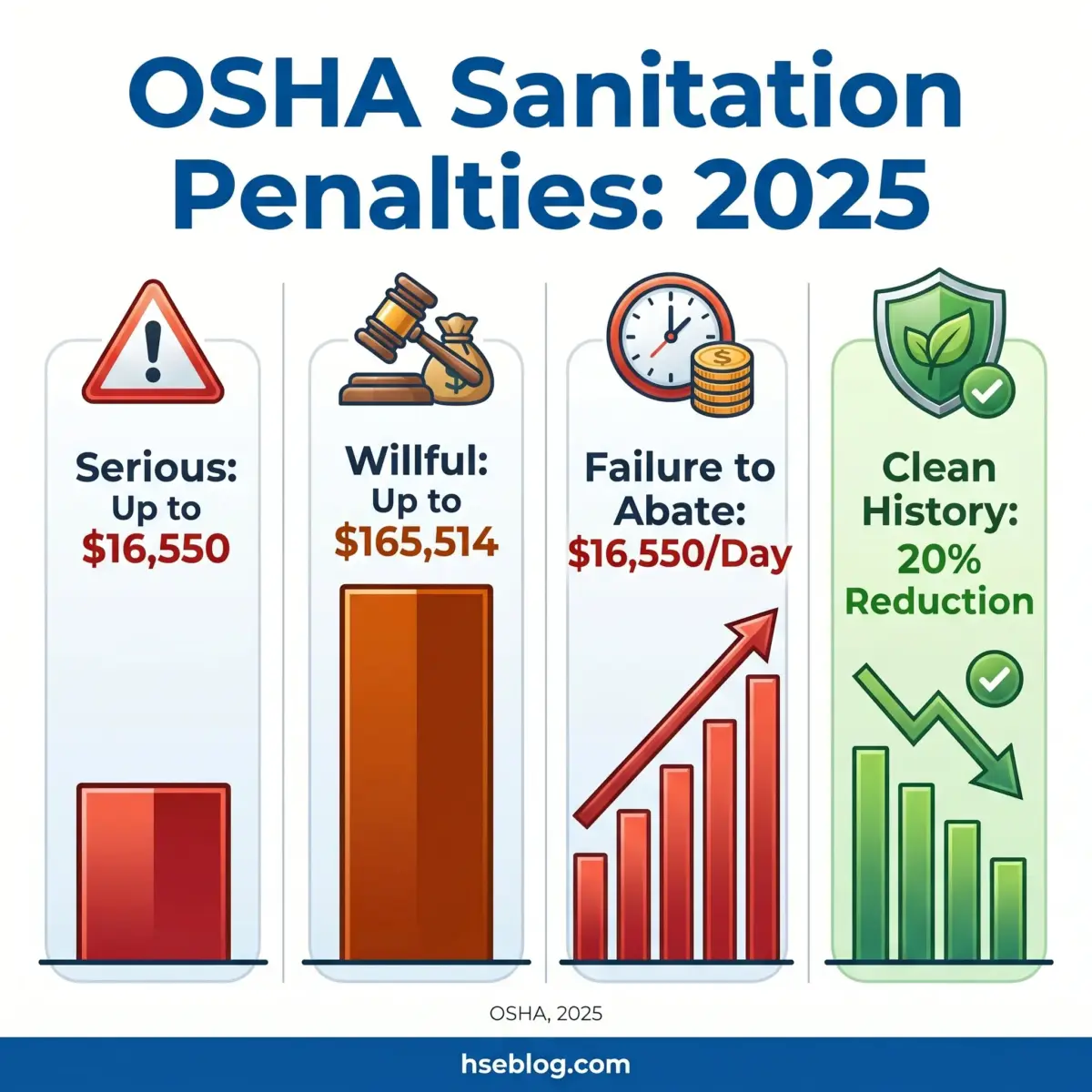
In the US, the maximum OSHA penalty for a serious or other-than-serious violation — including sanitation deficiencies — is $16,550 per violation (OSHA, 2025). Willful or repeated violations carry a maximum of $165,514 per violation (OSHA, 2025). Failure to correct a cited condition within the abatement deadline adds up to $16,550 per day.
OSHA revised its penalty guidelines in July 2025, introducing a 20% penalty reduction for employers with clean 5-year inspection histories — specifically, no prior serious, willful, or failure-to-abate violations (OSHA, 2025). This offers a meaningful incentive for employers who have maintained baseline compliance, including sanitation standards.
The enforcement landscape itself is shifting. Data from a Senate investigation reported that OSHA performed 20% fewer inspections and issued 42% fewer fines for severe violations in the first nine months of 2025 (US Senator Elizabeth Warren's office, 2026). Fewer inspections do not mean lower risk — penalty amounts per individual citation have increased, meaning that when an inspection does occur, the financial consequences are steeper.
In the UK, breach of the 1992 Welfare Regulations is a criminal offence. On summary conviction, fines are unlimited. On indictment, the court has discretion on the penalty amount, and imprisonment is available for the most serious offences.
| Penalty Type | US (OSHA, 2025) | UK |
|---|---|---|
| Serious / other-than-serious | Up to $16,550 per violation | Unlimited fine (criminal offence) |
| Willful / repeated | Up to $165,514 per violation | Unlimited fine; imprisonment possible |
| Failure to abate | Up to $16,550 per day | Enforcement notice; prosecution |
| Clean-history reduction | 20% reduction (July 2025 revision) | N/A |
Sanitation citations frequently appear as secondary findings during inspections triggered by unrelated complaints. An inspection prompted by a fall hazard or chemical exposure concern often results in sanitation citations as well — the inspector walks through the facility and observes what they observe. Baseline sanitation compliance is therefore a risk-reduction measure across all OSHA standards, not an isolated welfare issue.
Special Considerations: Inclusivity, Accessibility, and Dignity
Complying with the toilet-ratio tables addresses the legal minimum. It does not automatically address the actual needs of the workforce.
Disability access creates overlapping obligations. Under the ADA (US), at least one restroom must be ADA-compliant — wider stalls, grab bars, accessible fixtures, and adequate turning space. Workers with medical conditions such as pregnancy, bladder conditions, or prostate issues may require more frequent or extended access under ADA reasonable accommodation provisions.
OSHA's guidance on transgender employees advises that workers should be allowed to use restroom facilities consistent with their gender identity. Single-occupancy lockable rooms satisfy both OSHA and UK requirements regardless of gender composition and are the most straightforward path to inclusive compliance.
Menstrual hygiene provision is explicitly addressed in UK regulations, which require disposal facilities for sanitary items. Globally, this is increasingly recognised as a baseline obligation rather than an optional amenity.
Religious washing requirements — such as wudu stations for Muslim employees — are not mandated by occupational safety standards but represent a practical consideration in diverse workforces. Employers who proactively address these needs through facility design tend to see higher utilisation and fewer informal complaints about facility adequacy.
The judgment call here is between minimum-compliance provision and needs-based provision. Employers who actively solicit feedback on facility adequacy from the workforce consistently outperform those who rely on complaint-driven compliance. The ratio table tells you the legal floor. The workforce tells you whether the floor is enough.
Frequently Asked Questions
Can an employer restrict bathroom breaks at work?
OSHA's 1998 interpretation memorandum requires employers to provide "prompt access" to toilet facilities. Restrictions must be reasonable and cannot cause extended delays. Case-by-case evaluation applies, but patterns of denial — such as requiring supervisor permission and imposing waiting periods — have drawn enforcement action. Prolonged voluntary urinary retention carries health risks including urinary tract infections and kidney complications, making access restrictions both a compliance and an occupational health issue.
Are waterless hand sanitisers acceptable instead of soap and water?
No. Under OSHA's general industry and construction sanitation standards, waterless hand cleaners and disposable towelettes are not adequate substitutes for soap and running water. Sanitiser may be provided as a supplement — for example, at points distant from a fixed lavatory — but the employer must still provide accessible lavatories with soap, water, and drying materials as the primary washing provision.
How many portable toilets are required on a construction site?
OSHA 29 CFR 1926.51 requires a minimum of one toilet per 20 workers. Under temporary field conditions, at least one must be available regardless of crew size. ANSI/ASSP A10.25-2023 (US) specifies ratios that are generally stricter than OSHA's enforceable minimum. Employers should consult both: OSHA's ratio sets the legal floor, while the ANSI standard represents current industry best practice.
Do employers have to provide showers at work?
Not under the general sanitation standard. Showers become mandatory only when triggered by a specific OSHA substance standard — lead (29 CFR 1910.1025), asbestos, cadmium, and similar regulated materials each carry their own shower provisions. UK Regulation 21 takes a broader approach, requiring showers when "the nature of the work or health reasons" demand it. The ratio, when showers are required, is one per 10 workers of each sex per shift.
Is it illegal to not have a bathroom at work?
Yes. OSHA considers toilet facilities a fundamental workplace safety and health requirement. Failure to provide them violates federal law in the US. In the UK, it constitutes a criminal offence under the Workplace (Health, Safety and Welfare) Regulations 1992. Enforcement agencies in both jurisdictions treat complete absence of facilities as a serious violation warranting immediate action.
What sanitation facilities must employers provide for farmworkers?
Under 29 CFR 1928.110 (US), agricultural employers must provide toilet and handwashing facilities within a quarter-mile of the work location. This field sanitation standard — a landmark regulation for agricultural worker welfare — requires clean water, soap, and single-use towels at each handwashing station. The quarter-mile requirement is measured from where workers are actually performing field tasks, not from a central staging area.
Conclusion
The pattern across published enforcement actions and inspection reports is consistent: employers rarely get cited for never having installed a toilet. They get cited for facilities that exist on paper but fail in practice — no soap in the dispenser, no paper on the roll, a locked door during the night shift, a portable unit that hasn't been serviced in two weeks, or a supervisor who treats bathroom access as a productivity leak rather than a legal obligation. The single highest-impact change most workplaces can make is shifting sanitation from a procurement line item to an operational process with the same audit frequency as any other safety-critical system.
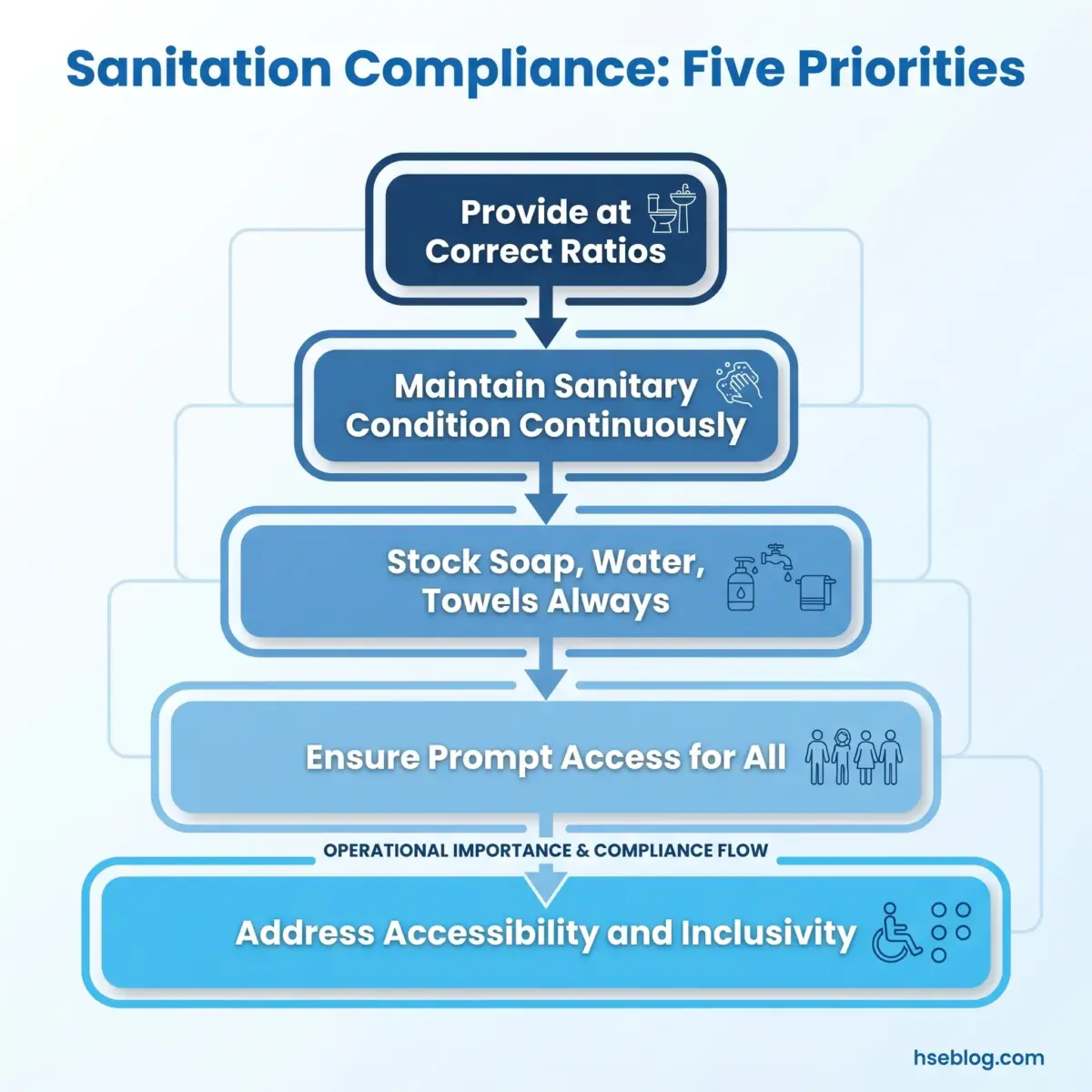
Across US, UK, and EU jurisdictions, the employer's duty follows the same architecture: provide adequate facilities at prescribed ratios, maintain them continuously in sanitary condition, supply soap, water, and drying materials without interruption, and ensure every worker — regardless of role, location, or shift pattern — can access them without unreasonable delay. With OSHA's 2025 penalty structure increasing the financial cost per citation even as overall inspection volume has declined, the calculus is clear. Baseline sanitation compliance is not discretionary welfare — it is a legal obligation with escalating consequences, and it intersects with every other standard an inspector evaluates when they walk through the door.
The facilities themselves are simple. Keeping them functional, stocked, and genuinely accessible is the work that separates compliant employers from those who accumulate citations they did not expect.