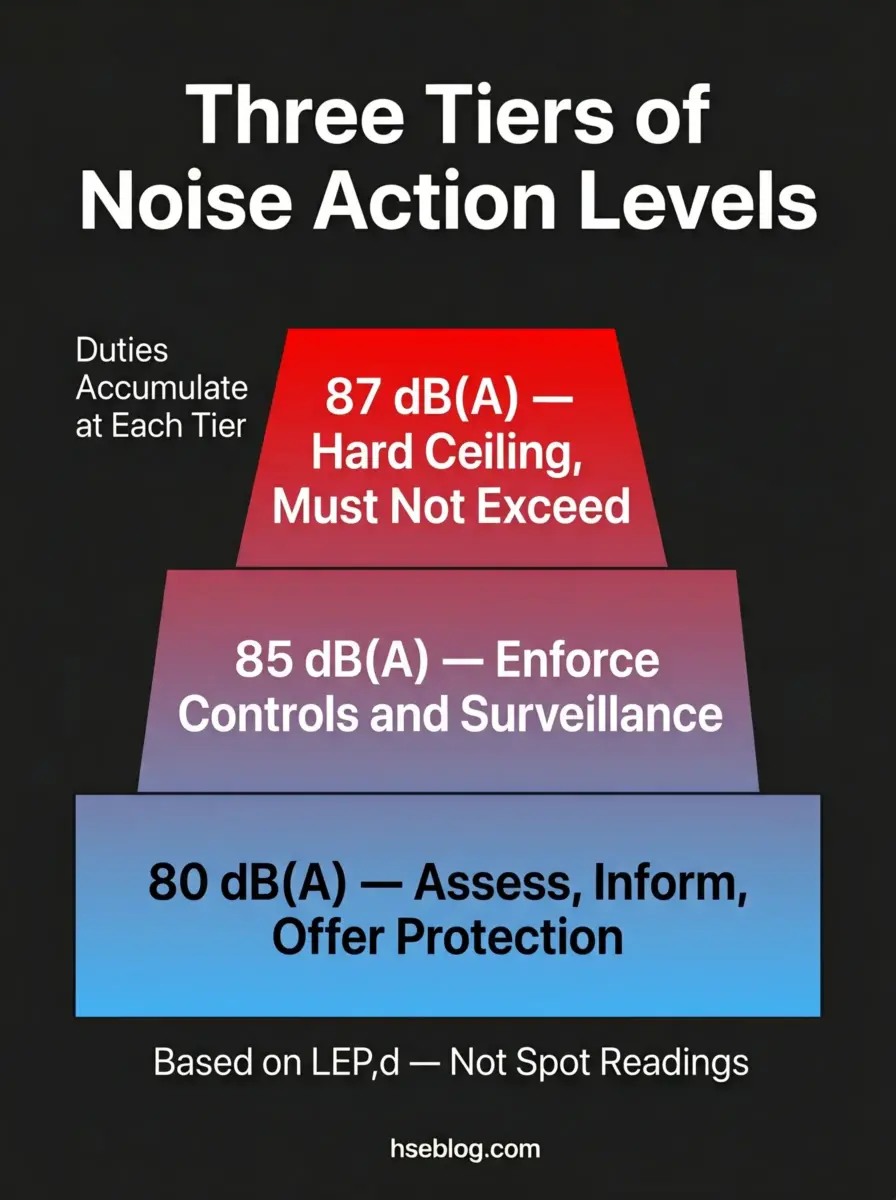
Noise action levels are regulatory thresholds defined in the Control of Noise at Work Regulations 2005 (UK) that trigger escalating employer duties based on workers' daily noise exposure, measured as LEP,d. The three levels are the lower exposure action value at 80 dB(A), the upper exposure action value at 85 dB(A), and the exposure limit value at 87 dB(A) — a hard ceiling that must not be exceeded. These values derive from EU Directive 2003/10/EC and are not interchangeable with the OSHA framework used in the United States.
This article provides general HSE knowledge. Noise risk assessment, LEP,d measurement, and hearing protection selection must be carried out or supervised by a competent person with appropriate training, calibrated instrumentation, and site-specific risk assessment. The information here does not replace that professional assessment.
What Are Noise Action Levels and Why Do They Matter?
Noise action levels are not limits on the noise a machine produces. They are thresholds on the worker's personal daily exposure that trigger specific, escalating employer duties under the Control of Noise at Work Regulations 2005.
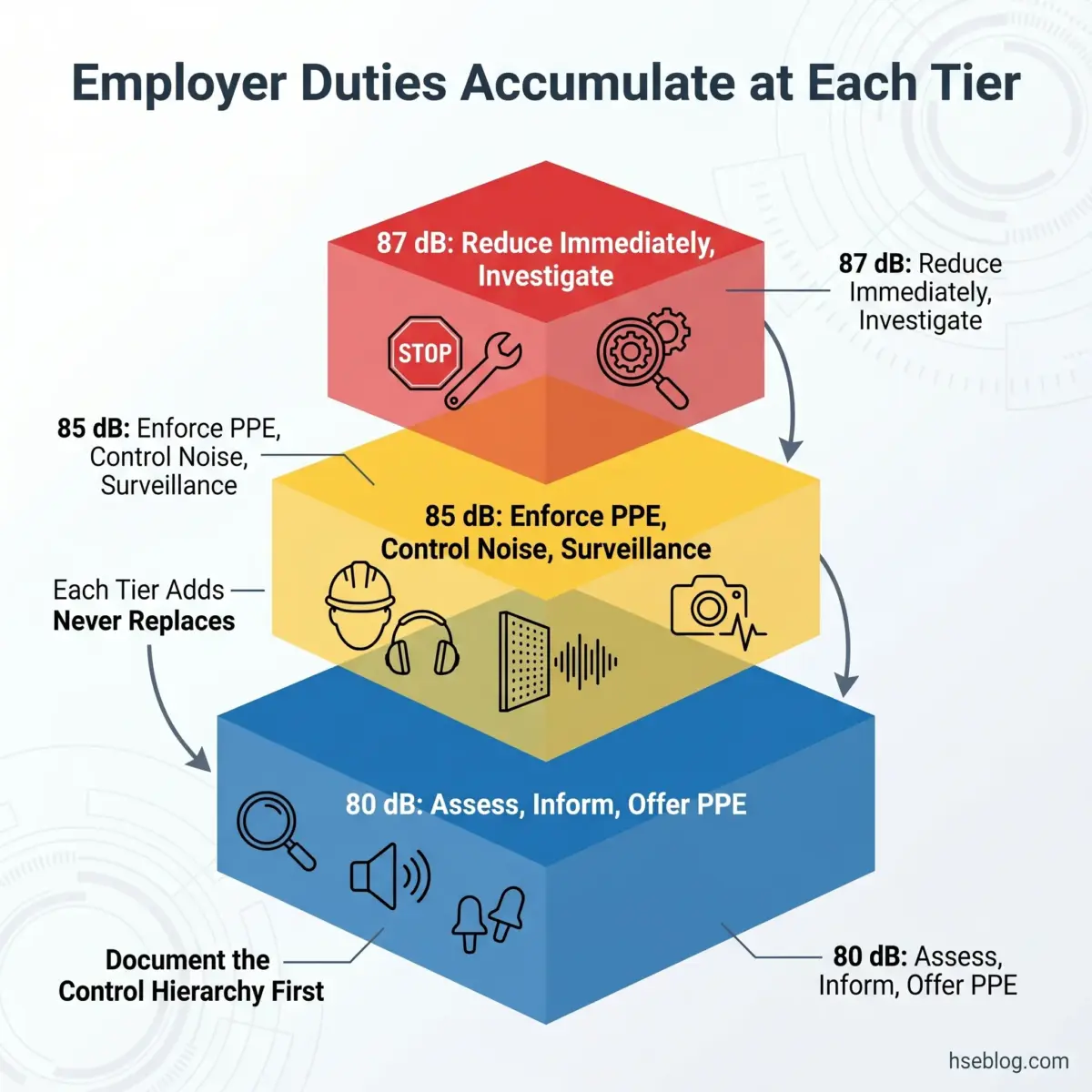
The three-tier system — lower exposure action value, upper exposure action value, and exposure limit value — creates a graduated response framework. Each threshold adds obligations; none removes the duties from the tier below.
A persistent misconception confuses these thresholds with instantaneous readings. Pointing a sound level meter at a machine, reading 83 dB(A), and concluding "we're between the lower and upper action values" misapplies the regulation entirely. The action values are assessed against LEP,d — the worker's time-weighted daily noise exposure normalised to an 8-hour reference period — not against a spot reading at a single location.
| Tier | dB(A) Daily (LEP,d) | dB(C) Peak | Core Duty Trigger |
|---|---|---|---|
| Lower Exposure Action Value | 80 | 135 | Assess, inform, make protection available |
| Upper Exposure Action Value | 85 | 137 | Mandatory controls, enforce protection, health surveillance |
| Exposure Limit Value | 87 | 140 | Must not be exceeded (assessed with hearing protection) |
The 80/85/87 dB(A) structure originates from EU Directive 2003/10/EC, which UK regulations transposed. It is not the same as OSHA's US framework — a distinction the jurisdictional comparison section below addresses in detail.
What Does LEP,d Mean and How Is It Calculated?
LEP,d (daily personal noise exposure level) is the single metric against which every action level is assessed. It represents the worker's total A-weighted noise dose across a working day, normalised to an 8-hour reference period — regardless of the actual shift length.
The formula is:
LEP,d = LAeq + 10 × log₁₀(T/8)
Where LAeq is the equivalent continuous sound level the worker is exposed to, and T is the actual duration of exposure in hours.
This normalisation matters because it means shift length directly affects the result. A worker exposed to an LAeq of 85 dB(A) for 12 hours does not record an LEP,d of 85 — the extra four hours adds approximately 1.8 dB, pushing LEP,d to 86.8 dB(A). That small numerical difference crosses the threshold from upper action value into territory where the exposure limit value becomes a genuine concern once hearing protection attenuation is assessed.
Worked Example
Consider a manufacturing operator who spends 3 hours at a press (LAeq 92 dB(A)), 4 hours at an assembly bench (LAeq 78 dB(A)), and 1 hour in a quiet office (LAeq 55 dB(A)).
- Calculate the partial noise exposure for each task using the points system from HSE L108 or the formula.
- The 3 hours at 92 dB(A) dominates — this single task contributes far more energy than the other seven hours combined.
- The resulting LEP,d falls at approximately 88 dB(A), which exceeds the exposure limit value.
The HSE's points system offers a simplified calculation path: look up the "noise exposure points per hour" for each dB(A) level, multiply by hours, sum, and convert back to dB(A). This avoids logarithmic maths on site and is fully accepted for compliance purposes.
Two Measurement Approaches
- Task-based analysis uses a calibrated sound level meter to measure the LAeq at each work position. The assessor records time spent at each task and calculates LEP,d from the combined exposures. This works well in structured, predictable work environments.
- Full-shift dosimetry mounts a personal noise dosimeter on the worker's shoulder near the ear for the entire shift. The instrument integrates all noise exposure continuously and outputs LEP,d directly.
Competent assessors cross-check between both methods. Over-reliance on dosimetry alone can mask errors — a dosimeter worn incorrectly, shielded by clothing, or disturbed during the shift produces unreliable data. Task-based analysis without validation can miss mobile or variable exposures.
The 3 dB Doubling Rule and Why Small Numbers Matter
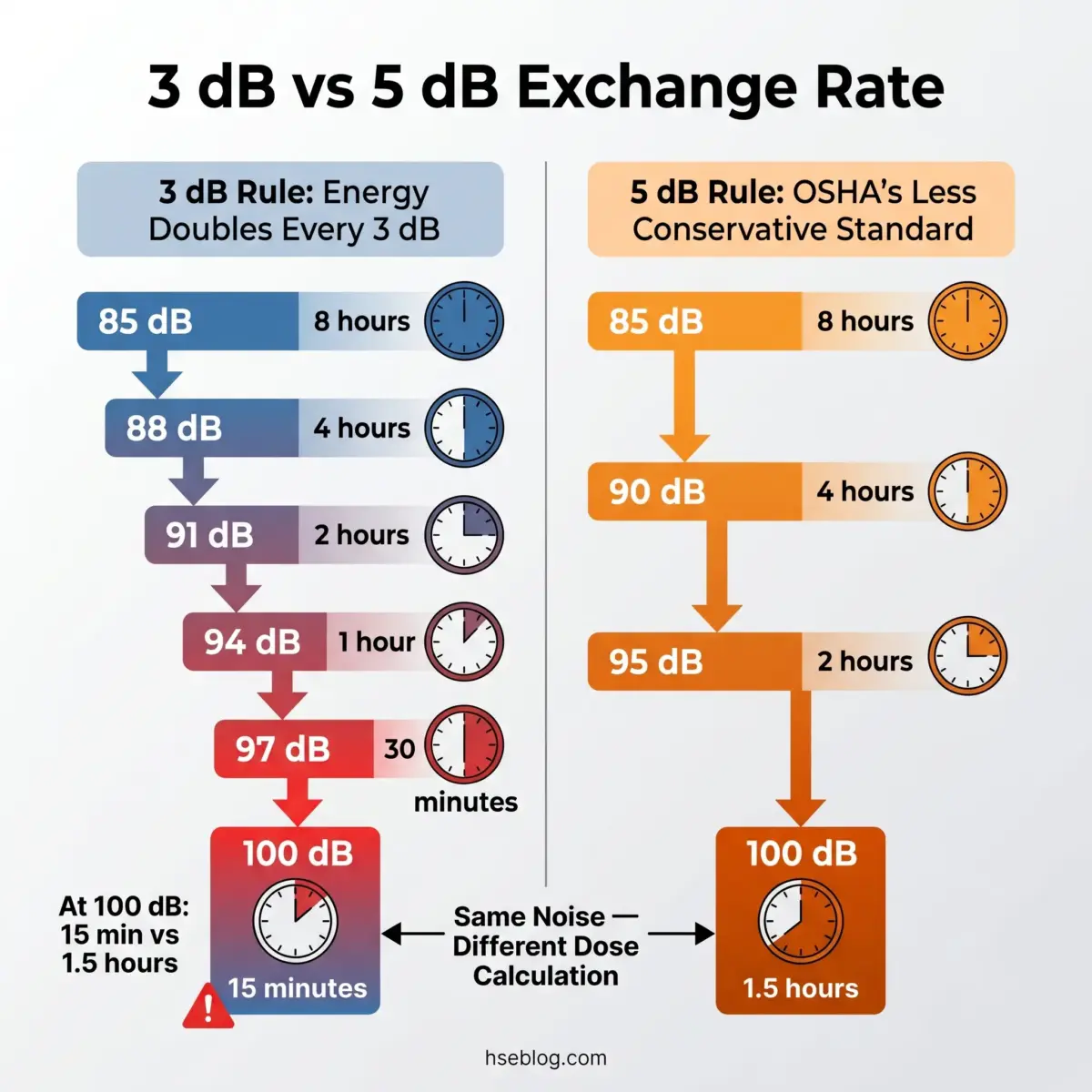
The UK/EU framework operates on the 3 dB exchange rate, also called the equal energy principle. Every 3 dB increase doubles the sound energy reaching the ear and halves the permissible exposure duration.
This means the gap between 80 and 85 dB(A) is not a modest increase — it represents more than a threefold increase in sound energy.
| Noise Level dB(A) | Max Exposure Duration (3 dB rule) | Max Exposure Duration (OSHA 5 dB rule) |
|---|---|---|
| 85 | 8 hours | 8 hours |
| 88 | 4 hours | 6 hours |
| 91 | 2 hours | 4 hours |
| 94 | 1 hour | 3 hours |
| 97 | 30 minutes | 2 hours |
| 100 | 15 minutes | 1.5 hours |
OSHA uses a 5 dB exchange rate — a historical regulatory choice, not a reflection of current scientific consensus. NIOSH and virtually all other international bodies use the 3 dB rule. The practical consequence: for the same worker doing the same job, OSHA calculates a lower noise dose than the UK/EU method. This makes OSHA's standard less conservative, and it is exactly why the two frameworks must never be treated as interchangeable.
The Lower Exposure Action Value: 80 dB(A)
The lower exposure action value is the threshold most frequently ignored — not through deliberate non-compliance, but because employers never assess whether it is reached in the first place.
At 80 dB(A) LEP,d, or a single peak above 135 dB(C), the following duties activate:
- Carry out a noise risk assessment identifying all noise sources, exposed workers, and the controls needed.
- Provide information and training on the risks of noise exposure, the control measures in place, and the employee's own duties under the regulations.
- Make hearing protection available to any employee who requests it — but the employer cannot mandate its use at this level.
The HSE's rule of thumb is practical: if noise is intrusive but normal conversation is still possible at 2 metres, you are probably at or around 80 dB(A). That is the sound level of a busy urban street or a domestic vacuum cleaner.
Many light manufacturing, food processing, and logistics environments sit just above this level without anyone recognising it. The noise is not dramatic — no one is shouting, no one is complaining — but the daily exposure accumulates past 80 dB(A) and the employer has no assessment, no training programme, and no hearing protection available. The 2025 HSE noise inspection campaign confirmed this pattern: 75% of employees in noisy workplaces lacked knowledge about storing, checking, or reporting faults with hearing protection (UK Health and Safety Executive, 2025) — a finding that reflects upstream failure at the 80 dB information duty.
The Upper Exposure Action Value: 85 dB(A)
At 85 dB(A) LEP,d, or a peak above 137 dB(C), the regulation shifts from "inform and offer" to "control and enforce." This is the compliance step change.
The employer must:
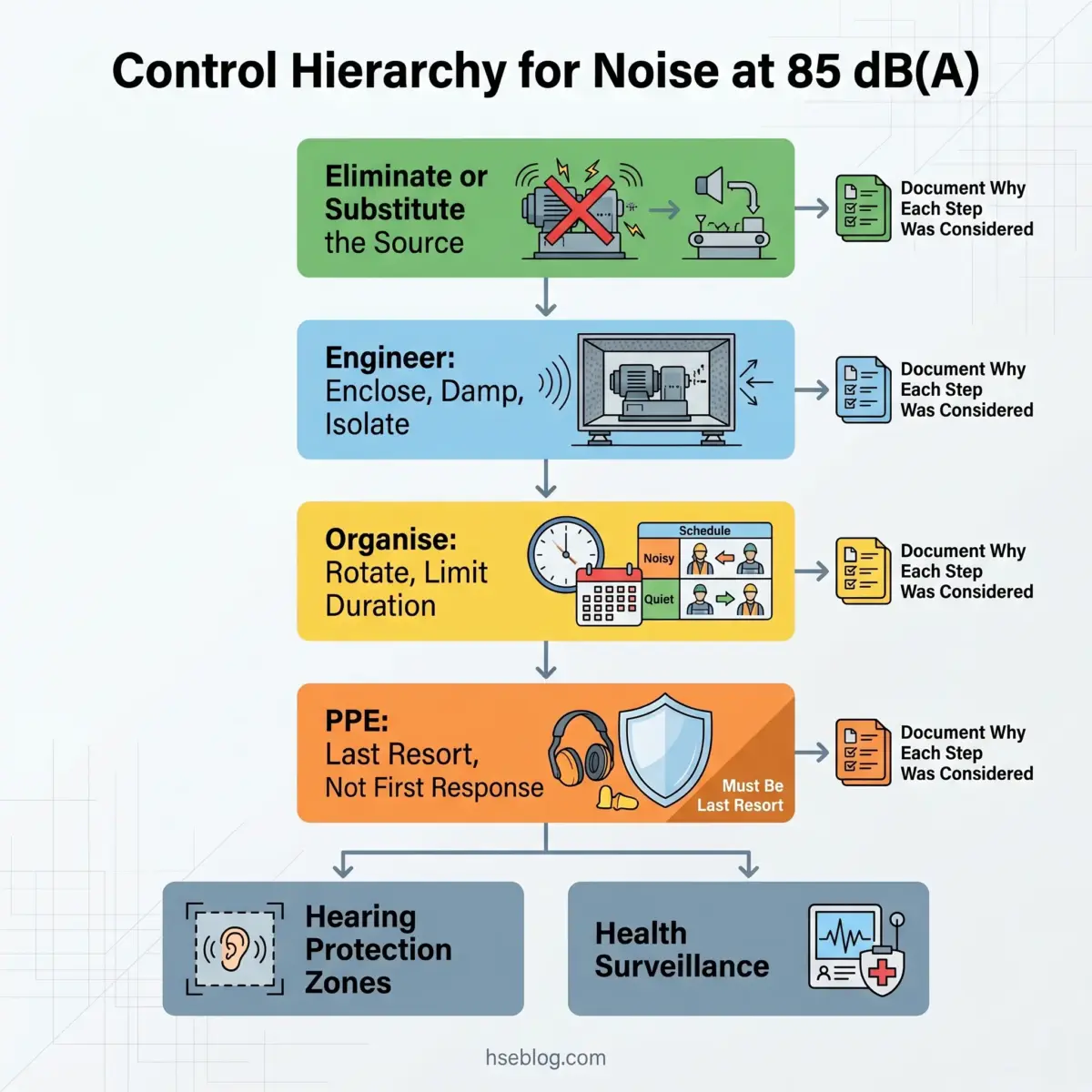
- Reduce noise exposure to as low as reasonably practicable — starting with the control hierarchy. Engineering controls come first: enclosure, damping, vibration isolation, substitution of quieter equipment, maintenance of worn components that generate excess noise.
- Provide hearing protection and ensure it is worn. At this tier, use is no longer voluntary.
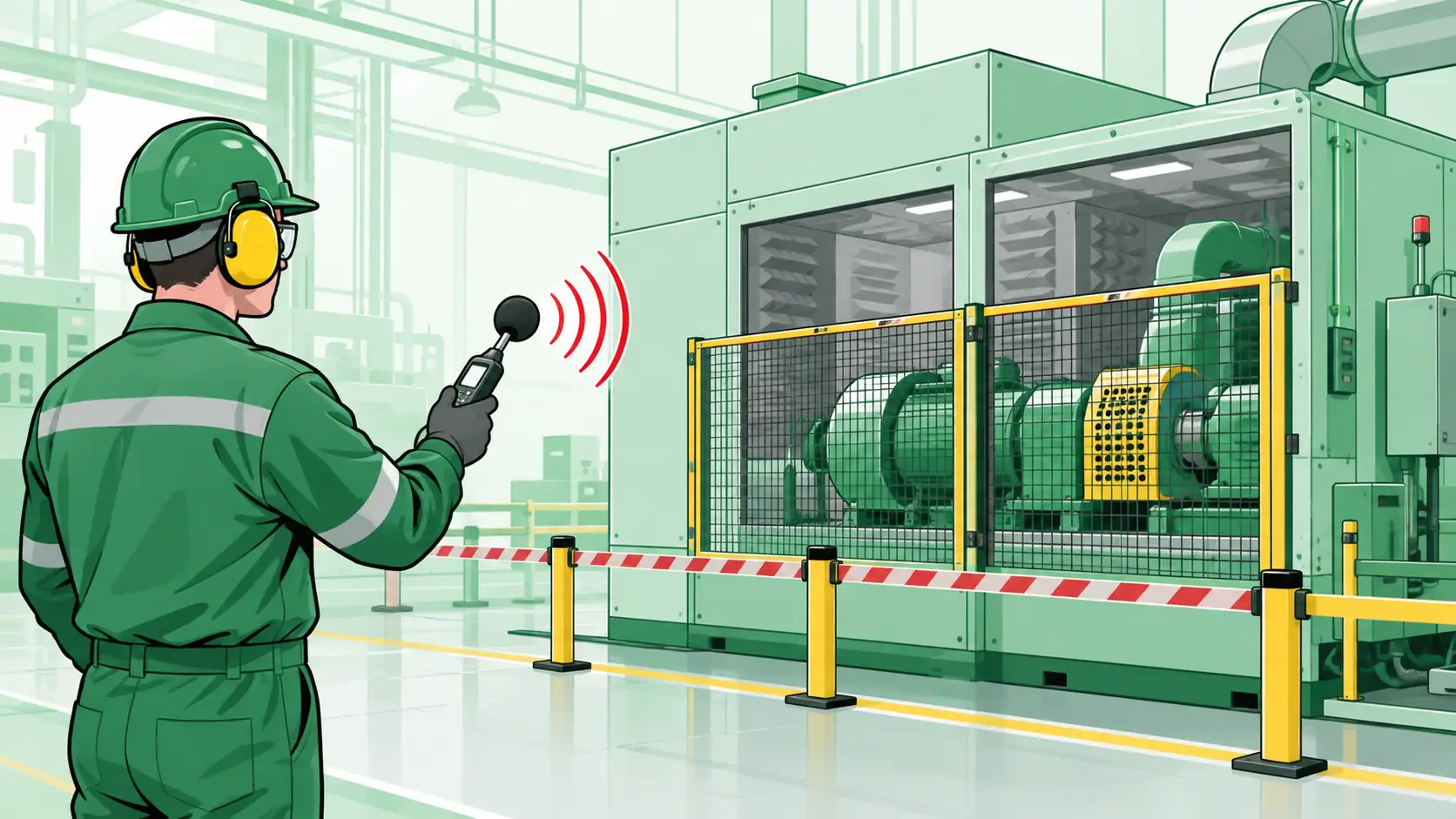
- Designate and mark hearing protection zones where exposure reaches or exceeds 85 dB(A), with signage and access control.
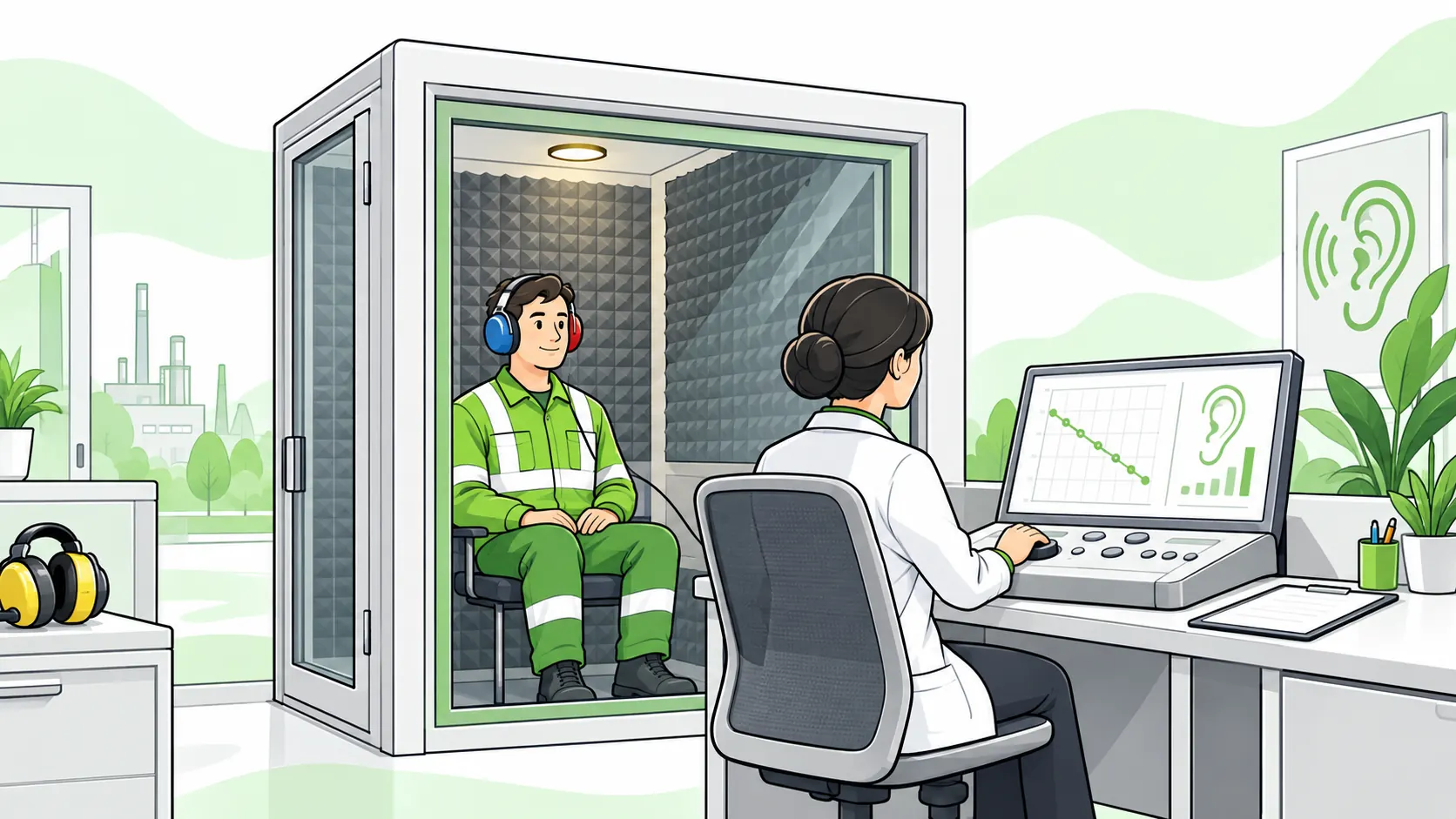
- Implement health surveillance — audiometric testing for all workers regularly exposed at or above this level.
The HSE's conversational rule of thumb for this level: if you have to shout to be heard by someone 2 metres away for more than about two hours per day, exposure is likely at or above 85 dB(A).
The most common compliance failure at this tier is treating hearing protection as the primary control rather than the residual one. The regulations explicitly require employers to demonstrate why engineering and organisational controls are not reasonably practicable before defaulting to PPE. The HSE's 2025 enforcement findings confirm this pattern persists: 60% of noise control reports produced by employers and noise consultants were rated unsatisfactory (UK Health and Safety Executive, 2025). The most frequent deficiency was the jump from measurement directly to PPE issuance, with no documented consideration of the control hierarchy — which is a regulation breach under the Control of Noise at Work Regulations 2005, Regulation 7, not merely poor practice.
The Exposure Limit Value: 87 dB(A) — The Hard Ceiling
The 87 dB(A) exposure limit value is structurally different from the two action values, and misunderstanding this difference is the highest-stakes compliance failure in the entire noise regulation framework.
The action values at 80 and 85 dB(A) are assessed on the ambient noise exposure — the noise level the worker encounters before hearing protection is considered. The employer is expected to exceed these action values in many workplaces and respond with the appropriate duties.
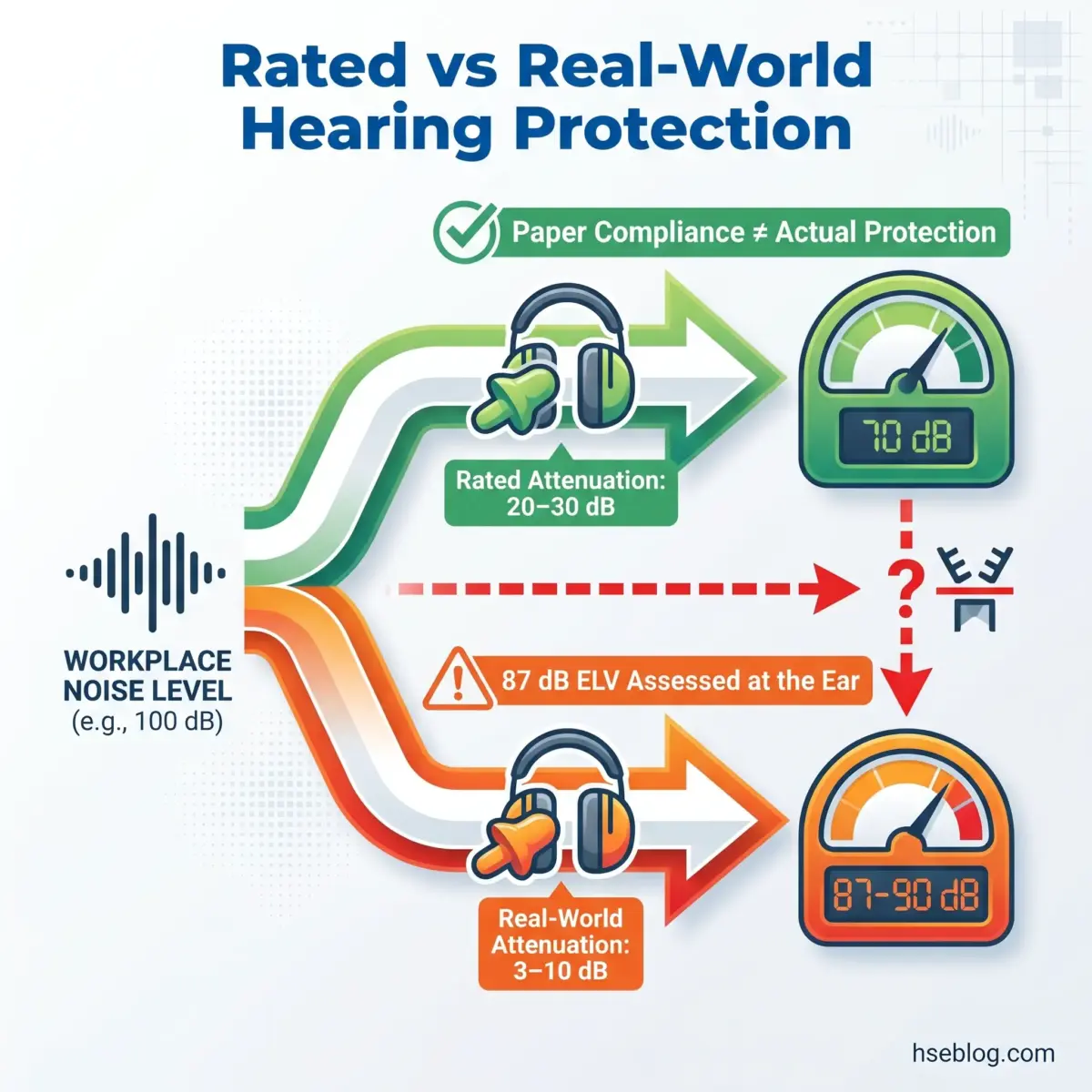
The 87 dB(A) ELV, by contrast, is assessed after accounting for the attenuation provided by hearing protection. It is the noise level at the worker's ear, behind the protector. And it must not be exceeded under any circumstances.
This distinction creates an important operational consequence. A workplace running at 95 dB(A) ambient can be fully compliant with the ELV — provided hearing protection reduces the effective exposure at the ear to below 87 dB(A). But that same workplace still triggers every duty under the upper exposure action value, because the action values are assessed without protection factored in.
The Real-World Attenuation Trap
Here is where employers are most exposed to enforcement action. Hearing protection manufacturers publish attenuation ratings — SNR (Single Number Rating) in Europe, NRR (Noise Reduction Rating) in the US — that suggest substantial protection. An earplug rated SNR 30 dB appears to offer generous margin.
Real-world attenuation is far lower. HSE data consistently shows that typical real-world protection delivers 3–10 dB of effective attenuation, not the 20–30 dB on the packaging. Poor fit, incorrect insertion, degraded foam, facial hair under earmuff seals, and inconsistent wear all erode performance dramatically.
The practical consequence: an employer issuing ear defenders rated at SNR 30 dB to workers exposed to 100 dB(A) may calculate effective exposure at 70 dB(A) and assume comfortable compliance. In reality, real-world attenuation of 10–15 dB leaves those workers at 85–90 dB(A) at the ear — potentially above the ELV.
HSE L108 provides three methods for estimating real-world attenuation:
- SNR method — apply the SNR rating with a derating factor
- HML method — uses High, Medium, and Low frequency attenuation values
- Octave band method — the most accurate, using attenuation data across eight frequency bands matched to the actual noise spectrum
All three require derating from manufacturer-published figures. The field procedure most aligned with Regulation 7 is to select the method that best matches the noise source characteristics and always apply the most conservative reasonable estimate.
The peak equivalent for the ELV is 140 dB(C). Above this, no worker may be exposed regardless of hearing protection worn. Impulsive noise sources — cartridge-operated tools, explosive charges, pneumatic nail guns — require specific peak-level measurement using instruments capable of capturing the impulse waveform.
How Do UK/EU Noise Action Levels Compare with OSHA Standards?
Multinational HSE professionals encounter both the UK/EU and OSHA frameworks — and the most damaging error in practice is treating them as variations of the same system. They are structurally different regulatory architectures that produce different compliance outcomes for identical exposures.
| Parameter | UK/EU (Regulations 2005 / Directive 2003/10/EC) | US OSHA (29 CFR 1910.95) | NIOSH REL (1998 Criteria) |
|---|---|---|---|
| Lowest duty trigger | 80 dB(A) — Lower EAV | 85 dBA — Action level | 85 dBA — REL |
| Mandatory controls trigger | 85 dB(A) — Upper EAV | 90 dBA — PEL | N/A (recommends at REL) |
| Absolute ceiling | 87 dB(A) ELV (with HPE) | None equivalent | None equivalent |
| Exchange rate | 3 dB | 5 dB | 3 dB |
| ELV includes HPE attenuation? | Yes | N/A | N/A |
| Peak limits | 135 / 137 / 140 dB(C) | 140 dB SPL | 140 dB SPL |
Several distinctions demand attention:
- OSHA has no equivalent to the UK's 80 dB lower exposure action value. OSHA's 80 dB threshold level is a measurement parameter — it tells the dosimeter when to start accumulating dose — not a trigger for employer duties. The information, training, and protection-availability duties that UK law creates at 80 dB(A) simply do not exist in US regulation.
- The exchange rate difference is the largest practical divergence. At 100 dB(A), the 3 dB rule permits 15 minutes of exposure; OSHA's 5 dB rule permits 1.5 hours. For the same worker doing the same job, OSHA calculates a substantially lower noise dose.
- The 87 dB ELV has no OSHA counterpart. OSHA's PEL at 90 dBA is assessed on ambient exposure without hearing protection. The UK's 87 dB ELV is assessed at the ear with protection factored in — a fundamentally different concept.
- NIOSH's recommended exposure limit — 85 dBA with a 3 dB exchange rate — aligns far more closely with the UK/EU framework than with OSHA's own enforceable standard. NIOSH recommendations are not legally enforceable in the US; OSHA's PEL is.
The practical risk: applying OSHA's less conservative thresholds in a UK or EU jurisdiction produces under-compliance. Applying the UK/EU framework where only OSHA applies creates unnecessary cost — and potentially distracts from the controls OSHA actually requires. In compliance audits for multinational operations, the most revealing check is confirming that the site's noise assessment uses the correct jurisdictional framework, the correct exchange rate, and the correct action thresholds.
Employer Duties at Each Noise Action Level: A Practical Summary
The duty matrix below consolidates employer and employee obligations at each tier. In practice, this is the reference document site managers request most frequently — and the one most often incomplete.
| Threshold | Employer Duties | Employee Duties |
|---|---|---|
| 80 dB(A) / 135 dB(C) peak | Conduct noise risk assessment; provide information and training; make hearing protection available on request | Cooperate with assessment; attend training |
| 85 dB(A) / 137 dB(C) peak | All 80 dB duties, plus: reduce exposure so far as reasonably practicable; provide hearing protection and enforce use; designate hearing protection zones; implement health surveillance | All 80 dB duties, plus: wear hearing protection in designated zones; use equipment and controls correctly; report defects in protection or controls |
| 87 dB(A) / 140 dB(C) peak | All 85 dB duties, plus: immediately reduce exposure below the ELV; investigate the cause; modify controls to prevent recurrence | Report immediately if ELV may have been exceeded; cooperate with investigation |
Two points frequently missed in compliance audits:
- Duties accumulate. Reaching the 85 dB(A) upper action value does not replace the duties triggered at 80 dB(A) — it adds to them. An employer enforcing hearing protection at 85 dB but providing no training (an 80 dB duty) is still non-compliant.
- The telling audit question is not "do you have hearing protection?" but "show me how you calculated the LEP,d for your highest-exposed worker and what controls you considered before defaulting to PPE." The duty matrix only functions when each tier's requirements are demonstrably met in the correct order.
How to Conduct a Noise Risk Assessment Against the Action Levels
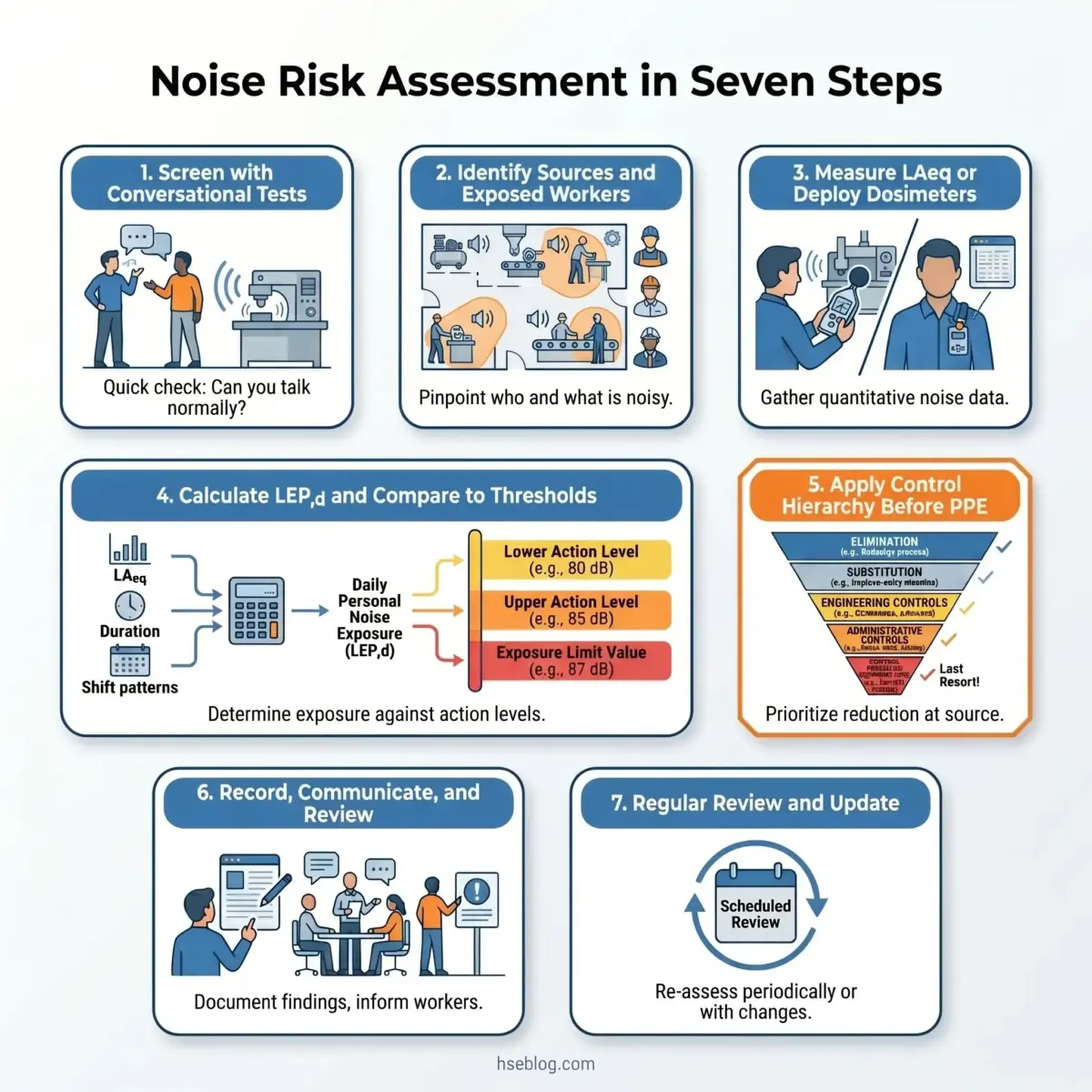
A noise risk assessment under the Control of Noise at Work Regulations 2005, Regulation 5, is not a measurement exercise — it is a structured determination of which duties apply to which workers and what controls are needed. HSE L108 sets out the approved methodology.
Step 1: Screen
HSE's rule-of-thumb tests provide an effective first filter:
- At 80 dB(A): Noise is intrusive but normal conversation is possible at 2 metres.
- At 85 dB(A): You have to shout to be heard at 2 metres.
- At 90 dB(A): You have to shout to be heard at 1 metre.
If either threshold is plausible, formal assessment is required.
Step 2: Identify Sources and Exposed Workers
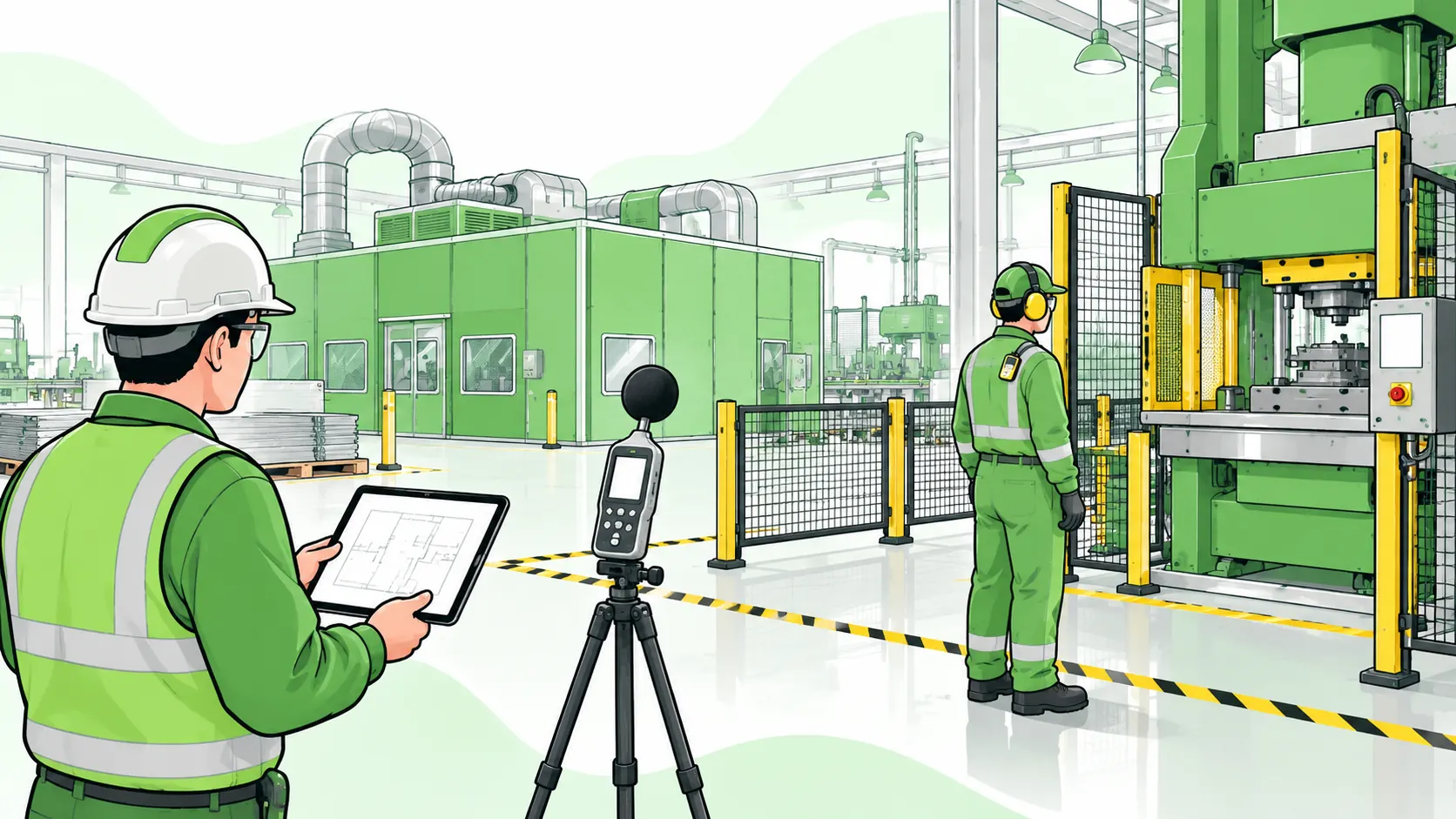
Map every noise source and determine which workers are exposed, for how long, and at what tasks. Mobile workers, maintenance staff, and supervisors who enter noisy areas intermittently are frequently excluded from assessments but may still reach the lower action value.
Step 3: Measure
Use calibrated instrumentation. Two approaches:
- Task-based analysis: Measure LAeq at each work position with a sound level meter. Record time spent at each task.
- Full-shift dosimetry: Deploy personal noise dosimeters for the entire shift.
Both methods are valid. Cross-checking between them — particularly in dynamic or unpredictable environments — is the mark of a competent assessment.
Step 4: Calculate LEP,d
Apply the formula (LEP,d = LAeq + 10 × log₁₀(T/8)) or the HSE points system for each worker or homogeneous exposure group.
Where daily exposure varies significantly across the working week, LEP,w (weekly average) may be used instead — but only when one or two days are substantially different (typically 5+ dB) from the others, or the working week is three or fewer exposure days.
Step 5: Compare Against Action Levels
Determine which tier of duties applies. Record this finding explicitly.
Step 6: Apply the Control Hierarchy
Eliminate → substitute → engineer → organise → PPE. Document what was considered at each stage and why it was or was not reasonably practicable.
Step 7: Record, Communicate, Review
Record findings, produce a timetable for control implementation, and communicate results to affected workers. The assessment must be reviewed whenever there is reason to suspect it is no longer valid — new equipment, process changes, complaints, or changes in shift patterns.
Approximately 27 million US workers are exposed to hazardous noise at work each year (CDC/NIOSH, 2026), and over 430 million people worldwide require rehabilitation for disabling hearing loss (World Health Organization, 2024). These are not abstract numbers. Noise-induced hearing loss is permanent and irreversible — the damaged sensory hair cells in the cochlea do not regenerate. The entire action level framework exists because once damage is detected through health surveillance, the opportunity for prevention has already passed.
Frequently Asked Questions
What is the difference between an exposure action value and an exposure limit value?
Exposure action values (80 and 85 dB(A)) are thresholds that trigger specific employer duties — assessment, training, hearing protection provision, engineering controls, health surveillance — but ambient workplace noise can legitimately exceed them provided the required duties are met. The exposure limit value (87 dB(A)) is an absolute ceiling on the worker's actual noise dose at the ear, assessed after accounting for hearing protection attenuation. Exceeding an action value activates duties; exceeding the ELV is a regulatory breach requiring immediate corrective action.
Can an employer use weekly noise exposure (LEP,w) instead of daily (LEP,d)?
Yes, but only when daily exposure varies markedly across the working week — typically when one or two days are 5+ dB higher than others, or the working week is three or fewer exposure days. The weekly average must still comply with the ELV. Using LEP,w to obscure consistently high daily exposures is not compliant with the intent of Regulation 4 of the Control of Noise at Work Regulations 2005.
Do noise action levels apply to the music and entertainment industry?
Yes. The Control of Noise at Work Regulations 2005 extended to music and entertainment from April 2008. The same 80/85/87 dB(A) thresholds apply. Practical compliance in this sector requires sector-specific measures — musician's earplugs with flat attenuation profiles, acoustic filters, set-length management, venue acoustic design, and monitoring of cumulative exposure across rehearsals and performances.
What is the difference between dB(A) and dB(C) in noise action levels?
dB(A) is A-weighted to approximate human hearing sensitivity and is used for measuring average exposure across the day (LEP,d). dB(C) is C-weighted and captures the full energy of impulsive or explosive noise, used specifically for peak sound pressure measurement. The regulations set separate action and limit values in both weightings: 80/85/87 dB(A) for daily exposure, and 135/137/140 dB(C) for peak events. A single peak above 135 dB(C) triggers lower action value duties regardless of the daily average.
How often must noise risk assessments be reviewed?
No fixed statutory interval is prescribed. However, assessments must be reviewed when there is reason to suspect they are no longer valid — introduction of new equipment, process changes, worker complaints, changes in working patterns, or evidence that existing controls are not effective. HSE L108 recommends regular review as a matter of good practice. Given that HSE has made noise a 2025–2026 enforcement priority, employers with assessments more than two years old should treat review as urgent.
Is noise-induced hearing loss from workplace exposure reversible?
No. Noise-induced hearing loss is permanent and irreversible. The sensory hair cells in the cochlea, once damaged by excessive noise exposure, do not regenerate. This biological reality is exactly why the action level framework is preventive — by the time health surveillance audiometry detects a threshold shift, the damage is already done. Self-reported non-use of hearing protection among noise-exposed US workers stands at 53% (CDC/NIOSH, 2026), which underscores the scale of the prevention gap.
Conclusion
The single most consequential misunderstanding in the noise action level framework is treating the 87 dB(A) exposure limit value the same way as the action values at 80 and 85. The ELV operates on a fundamentally different logic — assessed at the ear, behind the protector, with real-world attenuation that rarely matches the numbers on the packaging. Employers who rely on manufacturer ratings without applying derating methods are not just under-protecting workers; they are potentially in breach of a hard legal ceiling they believe they are meeting.
The 2025 HSE inspection campaign findings — 60% of noise assessment reports rated unsatisfactory, 75% of workers uninformed about maintaining their own hearing protection — reveal a systemic pattern. The problem is not that the noise action levels are unclear. The problem is that most compliance efforts jump from measurement to PPE issuance, bypassing the control hierarchy documentation that the regulations explicitly require. That gap between what the law demands and what most employers actually do is where enforcement action lives.
Noise-induced hearing loss does not announce itself. It accumulates silently, shift by shift, until the audiogram confirms what cannot be undone. The 80/85/87 framework exists to interrupt that accumulation at three distinct points — each with duties designed to prevent the next threshold from being reached. When those duties are met in order, the framework works. When they are skipped, the only thing that accumulates is irreversible damage.