
TL;DR
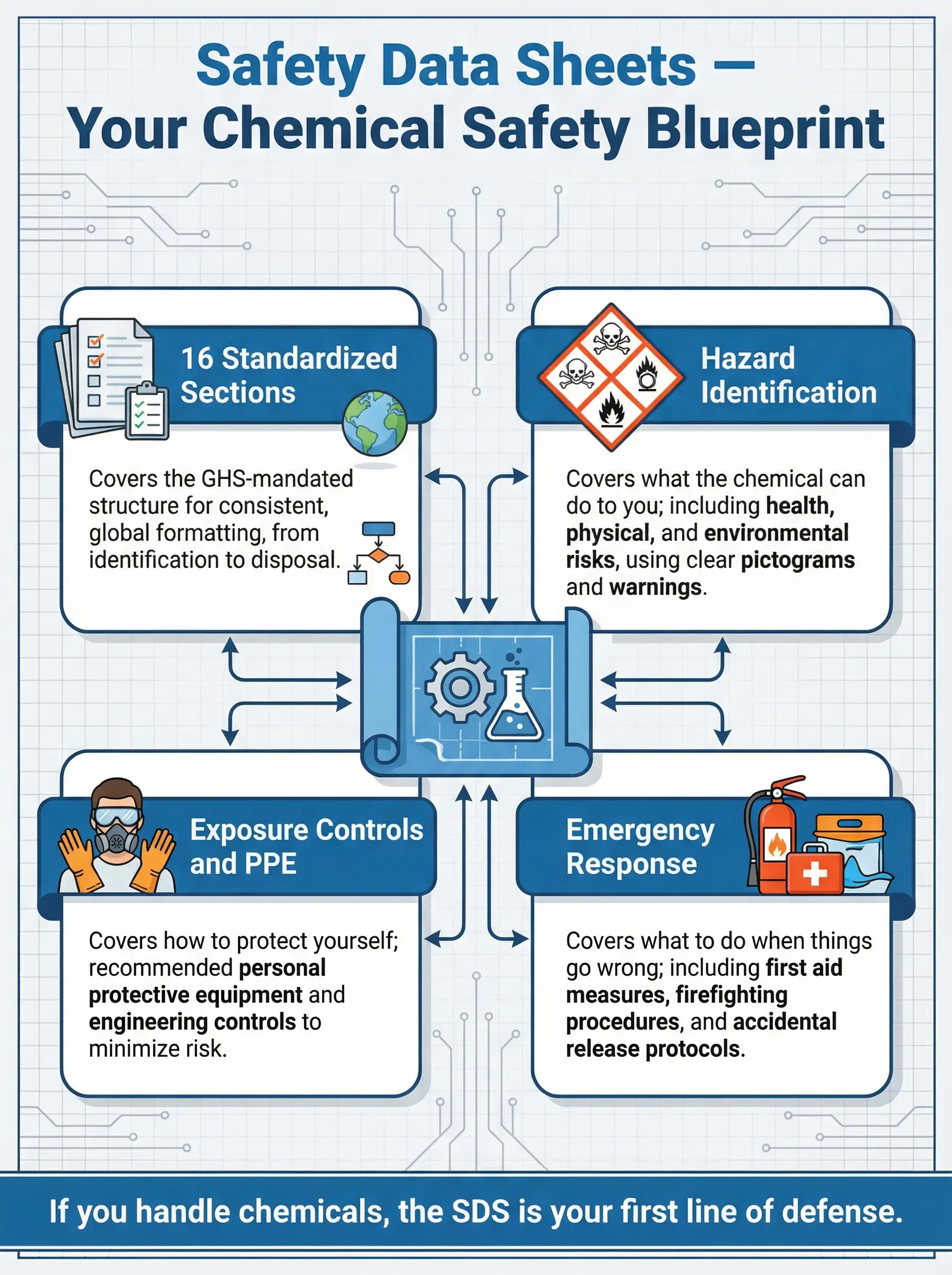
- An SDS is your chemical’s biography: It tells you what a substance can do to your body, how to handle it safely, what PPE to wear, and what to do if things go wrong — all in a standardized 16-section format mandated by GHS.
- Section 2 (Hazard Identification) and Section 8 (Exposure Controls/PPE) are your survival sections: If you read nothing else, these two sections tell you what the chemical can do to you and how to protect yourself.
- An SDS is only useful if people can find it and understand it: Binders collecting dust in a locked office protect nobody. Accessibility, training, and practical interpretation save lives.
- “I didn’t know” is never an acceptable incident finding: Every workplace chemical must have a current SDS available to every worker who may be exposed — no exceptions, no delays.
- Reading an SDS is a skill, not a chore: Once you understand the structure, you can extract critical safety information from any SDS in under five minutes.
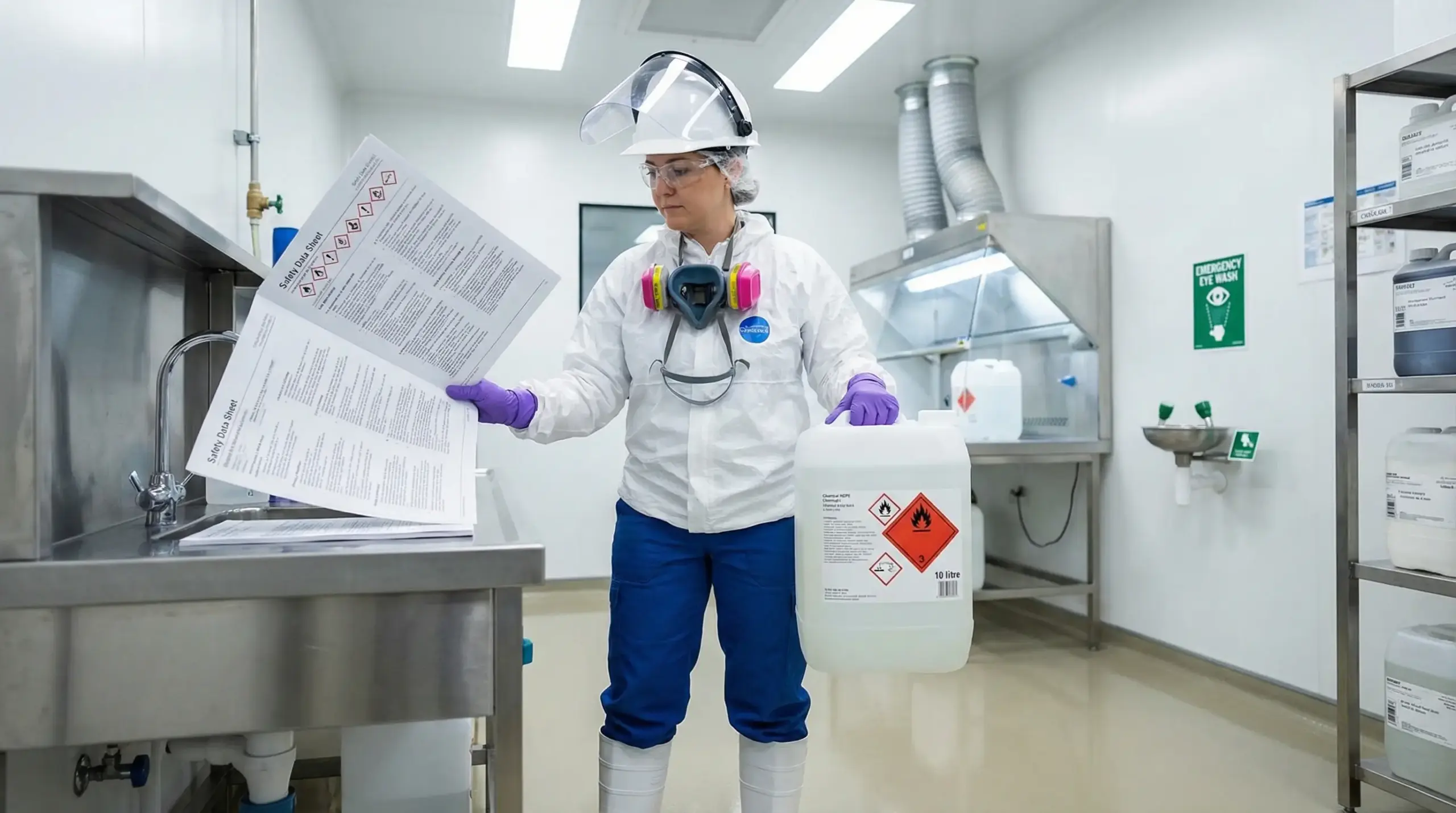
I was halfway through a routine chemical storage audit at a coatings manufacturing facility in Southeast Asia when I pulled a 20-litre drum of methyl ethyl ketone off the rack and asked the nearest operator a simple question: “Where’s the SDS for this?” He pointed vaguely toward a filing cabinet two buildings away, behind a locked supervisor’s office. The cabinet held over 300 sheets — unsorted, some dating back eight years, several for products no longer on site. The SDS for the solvent he was pouring by hand, without gloves, did not exist in that cabinet. He had never seen it. He did not know the vapor could damage his central nervous system.
That moment captures exactly why Safety Data Sheets matter — and why simply having them is not the same as using them. An SDS is the single most important document connecting a chemical product to the people who handle it. Across every industry where hazardous substances are stored, used, transported, or disposed of, the SDS is the frontline reference for protecting human health. This article breaks down what an SDS actually is, walks through all 16 sections with field-relevant interpretation, and shows you how to extract life-saving information quickly and confidently. Whether you are a safety officer building a chemical management program or a worker who just wants to know what you are breathing, this is the practical guide you need.
What Is a Safety Data Sheet (SDS) and Why Does It Exist?
A Safety Data Sheet is a standardized document that provides detailed information about a chemical product’s hazards, safe handling procedures, exposure limits, PPE requirements, storage conditions, and emergency response measures. Under the Globally Harmonized System of Classification and Labelling of Chemicals (GHS), every manufacturer or supplier of a hazardous chemical must produce an SDS and make it available to downstream users. The format follows a strict 16-section structure — the same worldwide — so that a worker in a refinery in the Gulf reads the same organized information as a lab technician in Northern Europe.
The SDS replaced the older Material Safety Data Sheet (MSDS) format, which varied wildly between countries and manufacturers. Some MSDSs were four pages; others were forty. Some buried critical toxicity data in dense paragraphs; others omitted PPE recommendations entirely. The GHS standardization — adopted into OSHA’s Hazard Communication Standard (HazCom 2012, 29 CFR 1910.1200) and the EU’s REACH Regulation (EC 1907/2006) — solved that problem by mandating a universal structure.
The core regulatory requirements are consistent across major jurisdictions, and understanding them removes any excuse for non-compliance:
- OSHA HazCom Standard (29 CFR 1910.1200): Requires employers to maintain an SDS for every hazardous chemical in the workplace, ensure they are readily accessible to workers during each shift, and provide training on how to read and use them.
- EU REACH Regulation (EC 1907/2006, Title IV): Mandates that suppliers provide an SDS to downstream users for substances classified as hazardous, PBT (persistent, bioaccumulative, toxic), or subject to community workplace exposure limits.
- GHS (UN Globally Harmonized System, Rev. 10): Establishes the universal 16-section SDS format, hazard classification criteria, and labelling requirements adopted by most national regulations worldwide.
- ISO 11014: Provides the international standard for the content and format of safety data sheets, aligning with GHS requirements.
“Every employee who may be exposed to a hazardous chemical must have access to its Safety Data Sheet. Access means immediate availability — not locked cabinets, not supervisor-only computers, not ‘we’ll get it for you later.'” — Principle derived from OSHA 29 CFR 1910.1200(g)(8)
Pro Tip: During audits, I never just ask “Do you have SDSs?” I ask a random worker on the floor to show me the SDS for the chemical they are currently using. If they cannot find it within two minutes, the system is failing — regardless of what the filing cabinet looks like.
The 16 Sections of a Safety Data Sheet — What Each One Tells You
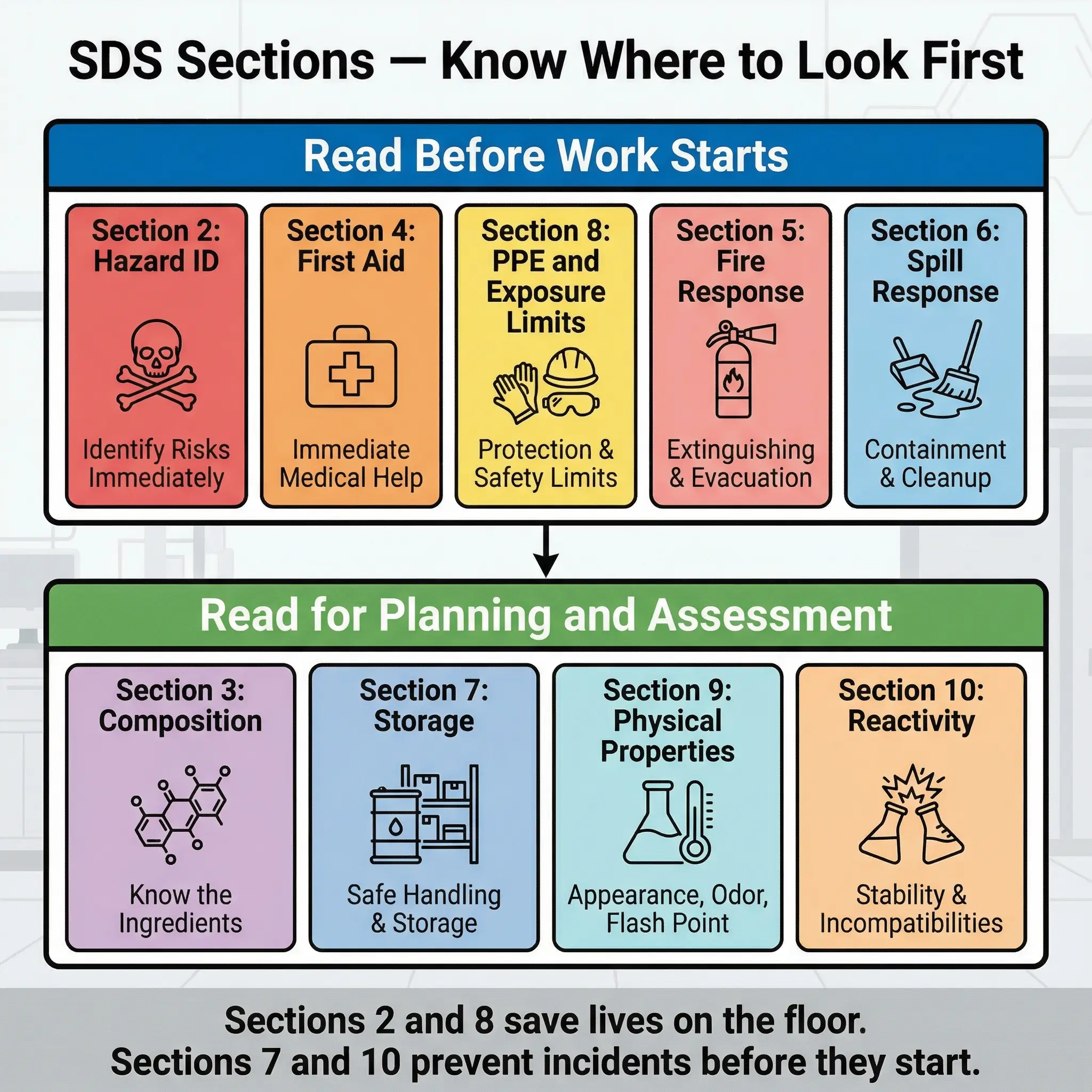
The GHS-mandated SDS format contains exactly 16 sections, always in the same order. But not all sections carry equal weight for the person on the shop floor. Understanding the structure means knowing where to look first, what to focus on, and what you can reference later when needed. Below is a field-focused walkthrough of each section — organized by how urgently a worker or safety professional needs the information.
Sections You Must Read Before Anyone Touches the Chemical
These are the sections I brief crews on before any chemical task begins. They answer the three questions every worker deserves answered: What can this do to me? How do I protect myself? What do I do if something goes wrong?
- Section 2 — Hazard Identification: This is the most critical section for frontline safety. It contains the GHS hazard classification (e.g., Flammable Liquid Category 2, Acute Toxicity Category 3), signal word (Danger or Warning), hazard pictograms, hazard statements (H-codes describing the nature of the hazard), and precautionary statements (P-codes describing protective measures). Read this section first, every time.
- Section 4 — First Aid Measures: Describes immediate actions for each exposure route — inhalation, skin contact, eye contact, and ingestion. Also includes symptoms of exposure (both acute and delayed) and notes for medical professionals. This section must be part of every task-specific briefing where chemical contact is possible.
- Section 5 — Firefighting Measures: Identifies suitable and unsuitable extinguishing media, specific hazards from the chemical during fire (toxic decomposition products, explosive vapor-air mixtures), and special protective equipment for firefighters. Critical for emergency response planning and hot work near chemical storage.
- Section 8 — Exposure Controls / Personal Protective Equipment: The second most important section for daily operations. Lists Occupational Exposure Limits (OELs) — including OSHA PELs, ACGIH TLVs, and national WELs — engineering controls required, and specific PPE: respiratory protection type, glove material and breakthrough time, eye/face protection, and body protection. This section directly dictates your risk controls.
- Section 6 — Accidental Release Measures: Tells you what to do during a spill or leak — personal precautions, protective equipment for cleanup, containment methods, and environmental precautions. This is your spill response playbook.
Sections You Need for Risk Assessment and Planning
These sections inform your COSHH assessments, job hazard analyses, permit-to-work conditions, and storage design. They are essential for the safety professional and supervisor, even if workers don’t reference them daily.
- Section 1 — Identification: Product identifier, manufacturer/supplier details, emergency phone number, and recommended uses. Seems basic, but I have seen incidents where the wrong SDS was filed under a product name because Section 1 was never checked against the actual container label.
- Section 3 — Composition / Information on Ingredients: Lists chemical identity, CAS numbers, and concentration ranges for hazardous components. Essential for industrial hygiene assessments — you cannot set monitoring priorities without knowing what is in the mixture and at what concentration.
- Section 7 — Handling and Storage: Precautions for safe handling (avoiding ignition sources, minimizing vapor release) and conditions for safe storage (temperature limits, incompatible materials, ventilation requirements). Directly affects your storage layout and standard operating procedures.
- Section 9 — Physical and Chemical Properties: Appearance, odor, pH, flash point, boiling point, vapor pressure, vapor density, solubility, and auto-ignition temperature. These are the numbers that determine whether a chemical will pool or disperse, whether vapors will rise or settle, and whether a hot work permit can be issued within a certain radius.
- Section 10 — Stability and Reactivity: Conditions to avoid (heat, sunlight, moisture), incompatible materials, and hazardous decomposition products. I have investigated storage incidents where two compatible-sounding chemicals were stored adjacent — but Section 10 of each clearly listed the other as incompatible. Nobody had checked.
- Section 11 — Toxicological Information: Routes of exposure, acute and chronic health effects, LD50/LC50 data, carcinogenicity classification (IARC, NTP), and target organ toxicity. This is where the long-term health picture lives — essential for occupational health surveillance programs and exposure monitoring decisions.
Sections for Regulatory, Transport, and Disposal Compliance
These sections are primarily referenced by HSE managers, environmental specialists, logistics teams, and compliance officers. They are essential for legal compliance — but a worker handling the chemical on site rarely needs them in real time.
- Section 12 — Ecological Information: Aquatic toxicity, persistence, bioaccumulation potential, and mobility in soil. Required for environmental risk assessments and spill impact evaluation, but explicitly noted by GHS as not required for regulatory classification of the substance itself.
- Section 13 — Disposal Considerations: Waste treatment methods, contaminated packaging disposal, and relevant local/national regulations. Directly informs your waste management plan and determines whether a used container is hazardous waste.
- Section 14 — Transport Information: UN number, proper shipping name, transport hazard class, packing group, and environmental hazard classification (marine pollutant status). Mandatory information for any movement of the chemical by road, rail, sea, or air under IMDG, ADR, IATA, or DOT regulations.
- Section 15 — Regulatory Information: Lists substance-specific safety, health, and environmental regulations beyond the main classification — such as SARA 313 reporting, EU Seveso III thresholds, or other national notification requirements.
- Section 16 — Other Information: Revision dates, version history, changes from previous SDS versions, abbreviations, and references. The revision date is more important than most people realize — an SDS older than three years should trigger a check with the supplier for an updated version.
Pro Tip: When auditing chemical management systems, I always check Section 16 first. If the revision date is more than five years old, the entire SDS is suspect — formulations change, exposure limits get updated, and classification criteria evolve. An outdated SDS can be worse than no SDS because it creates false confidence.
How to Read an SDS Quickly and Effectively in the Field
Knowing the 16-section structure is one thing. Knowing how to extract what you need in three minutes flat — while standing next to a drum on a loading dock — is the real skill. Over years of doing chemical safety briefings and task risk assessments, I have developed a reading sequence that prioritizes worker protection above all else.
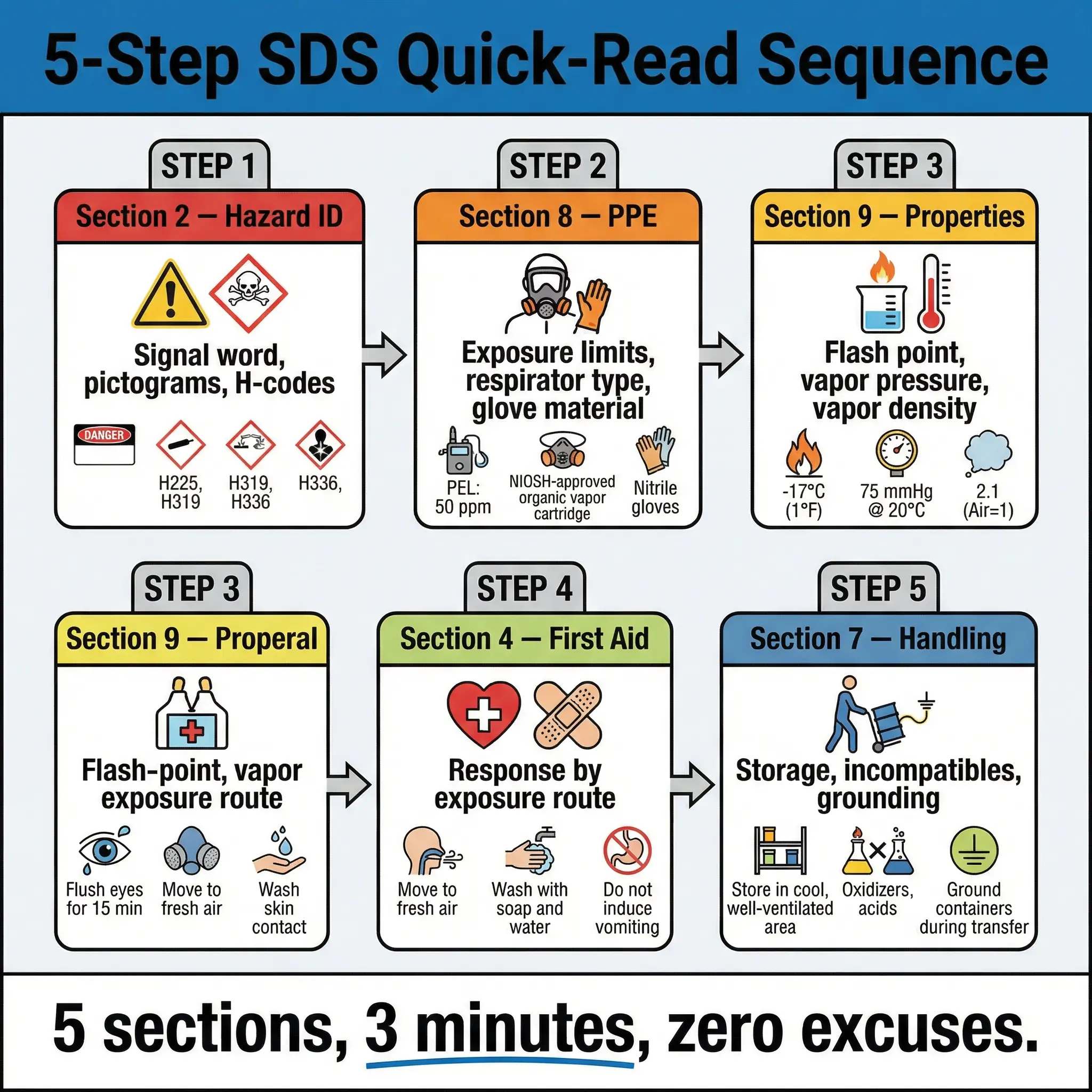
The following five-step reading sequence has been field-tested across petrochemical shutdowns, construction sites, and laboratory environments. It works for any SDS, any chemical, any industry:
- Start with Section 2 — Hazard Identification. Read the signal word first. “Danger” means you are dealing with a higher-severity hazard; “Warning” means lower severity but still hazardous. Look at the pictograms — the skull-and-crossbones, flame, corrosion, exclamation mark, health hazard, or environment symbols tell you the hazard category instantly. Then read the H-statements. These are standardized codes: H301 means “Toxic if swallowed,” H314 means “Causes severe skin burns and eye damage,” H350 means “May cause cancer.” Each H-code maps to a specific, non-negotiable hazard.
- Move to Section 8 — Exposure Controls / PPE. Identify the Occupational Exposure Limit. Is it a TWA (time-weighted average over 8 hours) or a STEL (short-term exposure limit over 15 minutes)? Then read the PPE requirements line by line: what type of respirator (APF 10 half-face vs. APF 50 full-face), what glove material (nitrile, butyl rubber, PVA — not just “chemical-resistant gloves”), what minimum breakthrough time, and what eye protection.
- Check Section 9 — Physical and Chemical Properties. Focus on flash point (can it ignite at ambient temperature?), vapor pressure (how fast does it evaporate?), and vapor density (do vapors rise or sink and pool at floor level?). A vapor density greater than 1 means the vapors are heavier than air — they will settle in pits, trenches, and low-lying areas. This single data point has saved lives in confined space planning.
- Read Section 4 — First Aid Measures. Know the immediate response for each route: inhalation (fresh air, oxygen, CPR?), skin (water flushing, specific neutralizer?), eyes (15-minute irrigation?), ingestion (do NOT induce vomiting?). Brief your crew on these before work starts — not after an exposure.
- Review Section 7 — Handling and Storage. Confirm whether the chemical requires grounding and bonding (flammable liquids), inert atmosphere storage, temperature control, or segregation from specific incompatibles. This feeds directly into your job hazard analysis and permit conditions.
Understanding GHS Pictograms and Signal Words
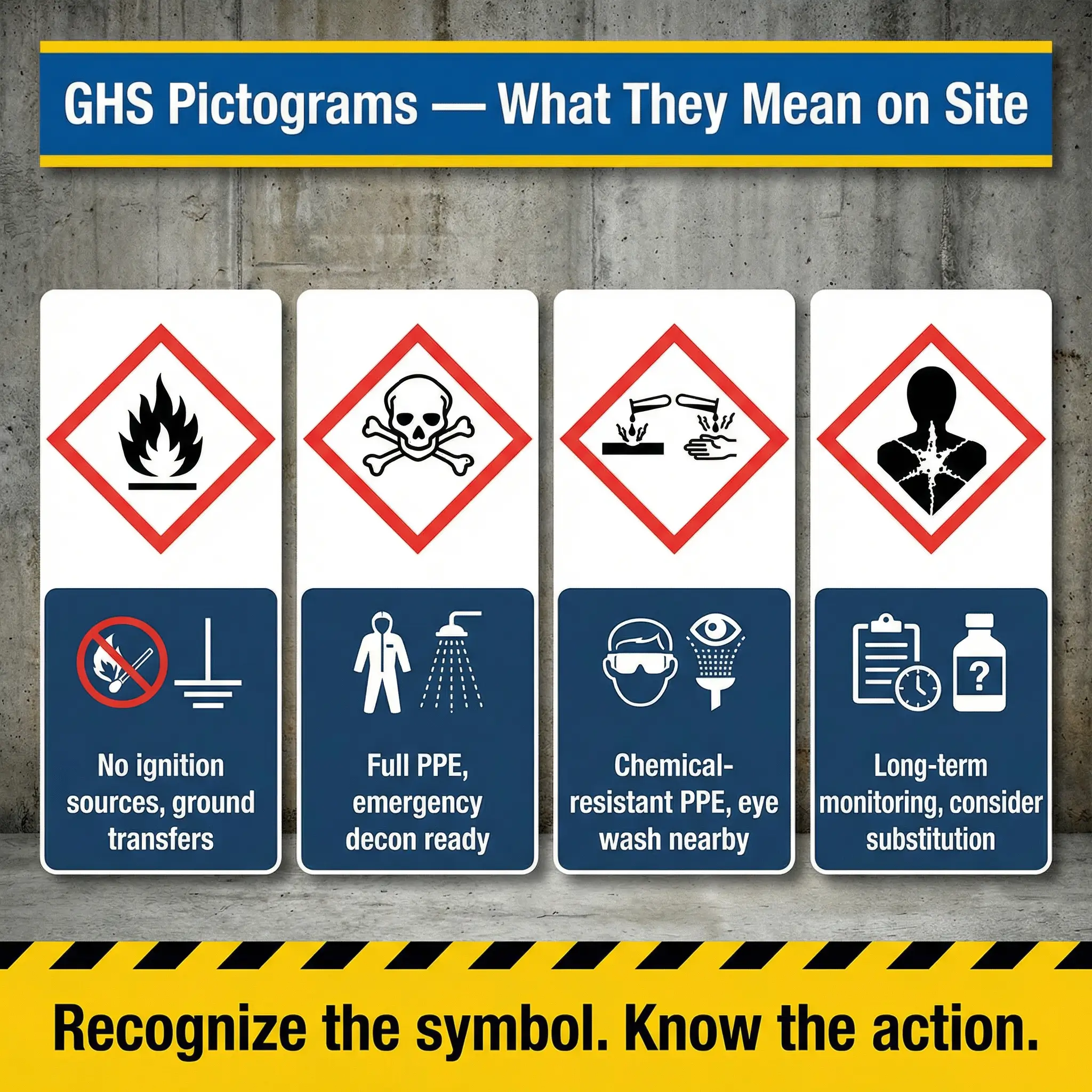
The GHS pictogram system is designed to be universally understood regardless of language. But I have found that most workers recognize the symbols without understanding what they actually mean for their specific task. A flame pictogram on a degreaser, for example, does not just mean “flammable” — it means no hot work within the vapor travel distance, mandatory grounding during transfer, and explosion-proof electrical equipment in the use area.
The nine GHS pictograms and their practical field meanings are critical knowledge for anyone handling chemicals:
| GHS Pictogram | Hazard Category | What It Means on Site |
|---|---|---|
| Flame | Flammable liquids, gases, aerosols, solids | No ignition sources. Ground and bond during transfer. Explosion-proof ventilation. |
| Flame over Circle | Oxidizers | Segregate from flammables and combustibles. Can intensify fire dramatically. |
| Exploding Bomb | Explosives, self-reactives, organic peroxides | Shock-sensitive. Specialized storage, handling, and transport required. |
| Skull and Crossbones | Acute toxicity (severe — fatal/toxic) | Strict exposure controls. Full PPE ensemble. Emergency decontamination ready. |
| Corrosion | Corrosive to skin, serious eye damage, corrosive to metals | Chemical-resistant PPE mandatory. Eye wash and safety shower within 10 seconds. |
| Exclamation Mark | Irritant, skin sensitizer, acute toxicity (less severe), narcotic effects | PPE required. Ventilation needed. May cause allergic reactions on repeated exposure. |
| Health Hazard | Carcinogen, mutagen, reproductive toxin, respiratory sensitizer, target organ toxicity | Long-term health surveillance. Biological monitoring. Substitute if possible. |
| Gas Cylinder | Gases under pressure | Secure cylinders upright. Pressure relief hazard. Temperature-sensitive storage. |
| Environment | Aquatic toxicity | Spill containment mandatory. No drain disposal. Environmental incident reporting. |
“The pictogram is the first warning. The H-statement is the specific threat. The P-statement is the prescribed defense. Together, they are the minimum information any worker needs before opening a container.”
Pro Tip: I print the GHS pictogram table as a laminated A3 poster and mount it at every chemical storage area and mixing station. Workers glance at it constantly — far more than they will ever open a binder. Visual recognition at the point of use beats document literacy every time.
Common Mistakes That Make Safety Data Sheets Useless
Having SDSs on file means nothing if the system around them fails. Across dozens of chemical safety audits in manufacturing, construction, and petrochemical operations, the same failures appear repeatedly. These are not obscure compliance gaps — they are the reasons workers get exposed, and they are entirely preventable.
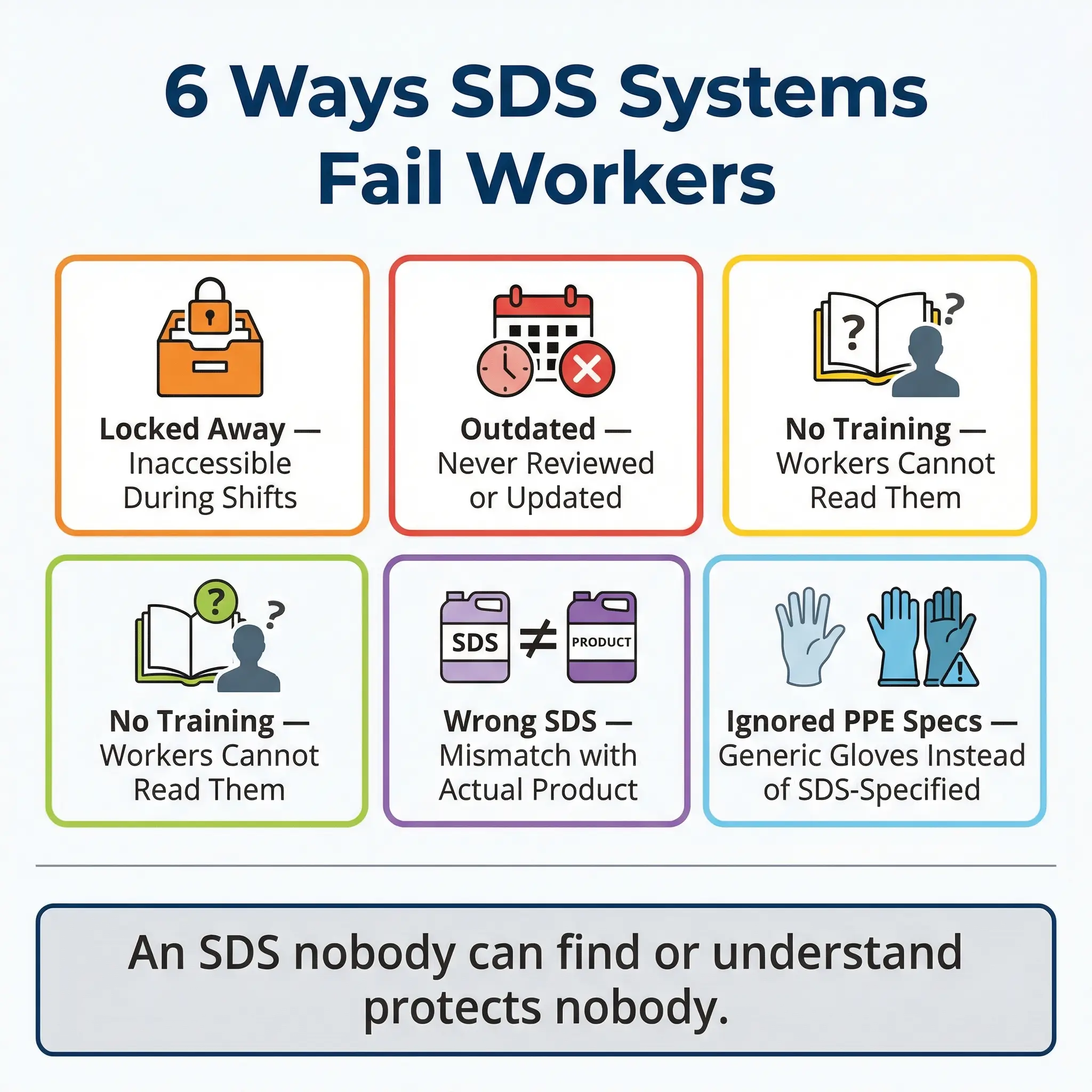
The following mistakes represent the most frequent and dangerous SDS management failures I have documented across multiple industries and jurisdictions:
- SDSs exist but are inaccessible during work hours. The binder is in the supervisor’s locked office. The digital system requires a password and computer access that floor workers do not have. The warehouse has SDSs, but the mixing area where chemicals are actually used does not. OSHA 29 CFR 1910.1200(g)(8) is explicit: SDSs must be readily accessible during each work shift. Readily means without barriers, without delays, without asking permission.
- SDSs are outdated and never reviewed. Chemical formulations change. Exposure limits are revised. Classification criteria are updated. An SDS from 2014 for a product reformulated in 2020 may list incorrect PPE, wrong first aid procedures, or obsolete exposure limits. I have found sites running on SDSs that were ten years old for products that had been reclassified twice in that period.
- Workers are never trained on how to read an SDS. The document is available, but nobody has been shown what Section 2 means, how to find the PPE requirements in Section 8, or what an H-statement tells them. Training must go beyond “here is where the binder is” to “here is how you find what protects you.”
- SDSs are filed for the wrong products. Container labels do not match SDS product identifiers. Decanted chemicals lose their identity entirely — transferred into unmarked containers with no SDS trail. Section 1 exists specifically to verify product identity, but it only works if someone checks it against the actual label.
- The SDS is treated as a compliance document, not an operational tool. It gets filed for the auditor, not used for the job. Risk assessments reference “chemical hazards” generically without extracting specific OELs, PPE types, or incompatibility data from the actual SDS. The document that should drive every chemical task decision sits unused while workers rely on experience, habit, or guesswork.
- PPE selection ignores SDS Section 8 specifics. The SDS specifies butyl rubber gloves with a minimum 480-minute breakthrough time for the solvent in use. The site issues generic nitrile gloves rated for 30 minutes. The SDS specifies a full-face respirator with organic vapor cartridges. The site provides a dust mask. This disconnect between the SDS recommendation and the PPE actually provided is one of the most dangerous gaps I encounter.
How to Build an Effective SDS Management System
Compliance is the baseline. Effectiveness is the goal. An SDS management system that merely satisfies an auditor’s checklist but fails to put actionable information into the hands of workers at the point of chemical use is a system that will eventually contribute to an incident. I have helped build and rebuild chemical management programs across multiple industries, and the systems that work share a set of common characteristics.
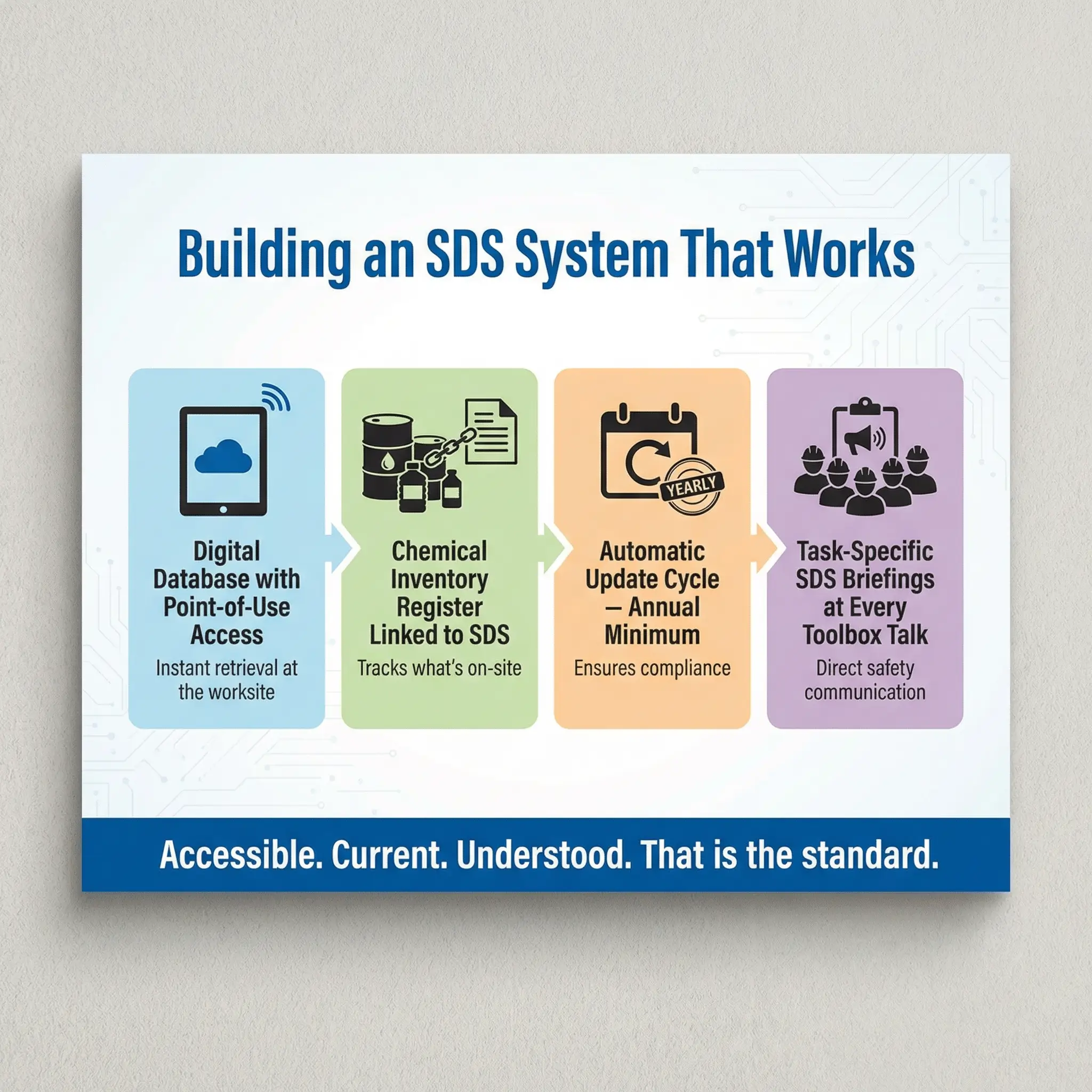
The following elements form the foundation of every effective SDS management system I have implemented or assessed:
- Centralized digital SDS database with point-of-use access. Use a cloud-based or networked SDS management platform (multiple commercial options exist) that allows any worker to search by product name, CAS number, or supplier and retrieve the current SDS instantly. Supplement with tablets or terminals at chemical storage areas, mixing stations, and loading docks. The digital system is the master — printed copies are backups, not the primary access method.
- Chemical inventory register linked to the SDS database. Every chemical on site — from bulk process chemicals to cleaning agents to aerosol lubricants — must be listed in a register that maps each product to its current SDS. When a product is added, its SDS is obtained before it arrives on site. When a product is removed, its SDS is archived. No orphan SDSs. No unregistered chemicals.
- Automatic update and review cycle. Configure the SDS system (or assign a responsible person) to check for updated versions from manufacturers at least annually. Flag any SDS older than three years for mandatory supplier verification. When an SDS is updated, compare the new version against the old — changes to Section 2 (hazard classification), Section 8 (OELs or PPE), or Section 10 (reactivity) require immediate re-briefing of affected workers.
- Task-specific SDS briefings integrated into toolbox talks. Do not train workers on “how to read an SDS” as a one-time classroom exercise and expect retention. Instead, incorporate SDS content into every pre-task briefing where chemicals are involved. “Today we are using Product X. Section 2 says it is a Category 2 flammable liquid and an aspiration hazard. Section 8 says nitrile gloves with minimum 60-minute breakthrough and organic vapor half-face respirator. Section 4 says if it gets on your skin, flush with water for 20 minutes. Questions?”
- Annual SDS audit as part of the HSE management system. Conduct a formal audit at least once per year covering: completeness of the chemical register, accuracy of SDS versions, accessibility at all use points, worker comprehension (practical test — ask five random workers to find and interpret an SDS), and alignment between SDS-specified PPE and PPE actually issued.
Pro Tip: The simplest and most effective SDS accessibility test I use during audits is the “two-minute drill.” I pick a random chemical container from the work area, then ask the nearest worker to show me the SDS for that product. If they cannot locate it within two minutes — the system needs work, regardless of how well-organized the master database looks.
SDS in Practice — Translating Paper Into Protection
The real value of an SDS is not in the document itself — it is in the decisions that flow from it. Every control measure on a chemical task, every PPE selection, every storage arrangement, every emergency response procedure should trace back to specific information extracted from the relevant SDS. When I investigate chemical exposure incidents, the root cause is almost never “no SDS existed.” The root cause is almost always “the SDS was not used to make the decisions that would have prevented this.”
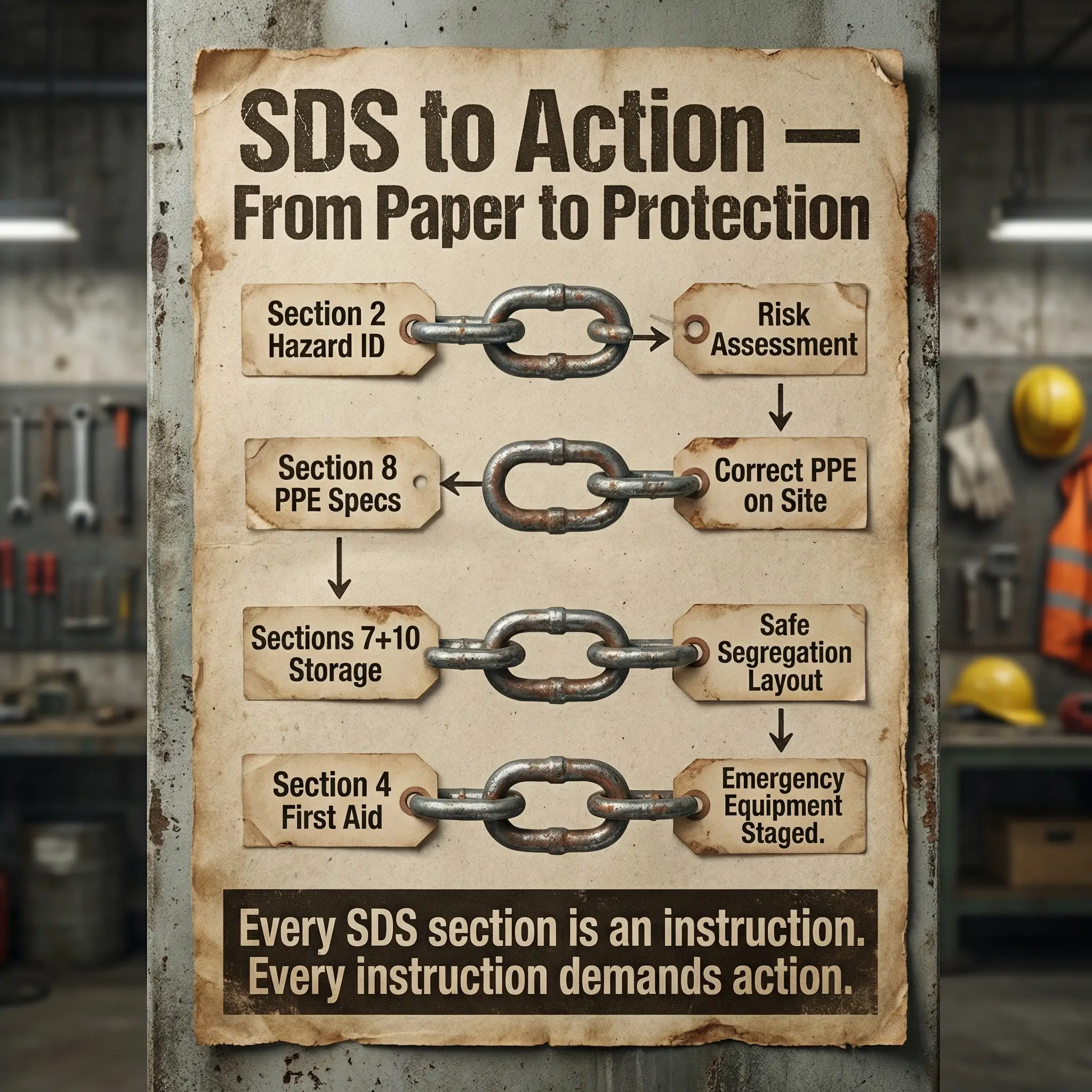
The connection between SDS content and operational decisions follows a clear chain, and every link matters:
- SDS Section 2 → Risk Assessment Hazard Identification. The hazard classification and H-statements from Section 2 feed directly into your COSHH assessment, JHA, or task risk assessment. A chemical classified as H340 (may cause genetic defects) and H350 (may cause cancer) demands a fundamentally different risk posture than one classified as H315 (causes skin irritation). The SDS tells you the severity — your risk assessment must reflect it.
- SDS Section 8 → PPE Selection and Procurement. Generic PPE is not acceptable when the SDS specifies requirements. If Section 8 states “Wear butyl rubber gloves (EN 374, breakthrough time > 480 minutes)” — then the procurement department must buy butyl rubber gloves meeting that standard. Issuing latex gloves because “they are chemical-resistant” is a failure traceable to not reading Section 8.
- SDS Section 7 + Section 10 → Storage Design and Segregation. These two sections together determine where and how chemicals are stored. Section 7 provides handling precautions and storage conditions (temperature, ventilation). Section 10 identifies incompatible materials. A chemical that Section 10 lists as incompatible with oxidizers must never share a bunded area with oxidizing agents — regardless of how convenient it might be for logistics.
- SDS Section 4 + Section 2 → Emergency Response Planning. The first aid measures in Section 4, combined with the hazard information in Section 2, define what emergency equipment must be staged at the work location — eye wash stations, safety showers, specific antidotes, oxygen delivery systems. They also determine what information must be communicated to emergency medical responders.
- SDS Section 9 → Atmospheric Monitoring and Ventilation Design. Vapor pressure tells you how quickly the substance will become airborne. Vapor density tells you whether it will rise and disperse or sink and accumulate. Flash point determines the LEL monitoring threshold. These physical properties, pulled from Section 9, are the engineering inputs for ventilation design and gas detection alarm set points.
| SDS Section | Operational Decision It Drives | Consequence of Ignoring It |
|---|---|---|
| Section 2 — Hazard ID | Risk assessment severity rating | Underestimation of hazard → inadequate controls |
| Section 8 — Exposure / PPE | PPE type, glove material, respirator selection | Wrong PPE → chemical exposure despite “wearing protection” |
| Section 7 + 10 — Storage / Reactivity | Chemical segregation and storage layout | Incompatible storage → exothermic reaction, fire, or toxic gas release |
| Section 4 — First Aid | Emergency equipment staging | Delayed or incorrect first aid → worsened injury outcome |
| Section 9 — Physical Properties | Ventilation design, gas detection alarm points | Undetected vapor accumulation → acute exposure or explosion |
Training Workers to Use Safety Data Sheets — What Actually Works
Classroom SDS training where workers sit through a PowerPoint explaining all 16 sections does not work. I have delivered that training myself early in my career and watched the retention disappear within a week. What works is practical, repetitive, task-specific exposure to the document in the context where it matters — at the chemical storage area, at the mixing station, at the point of use.
Effective SDS training programs share these characteristics, and every one has been validated by measurable improvement in chemical safety performance on sites where I have implemented them:
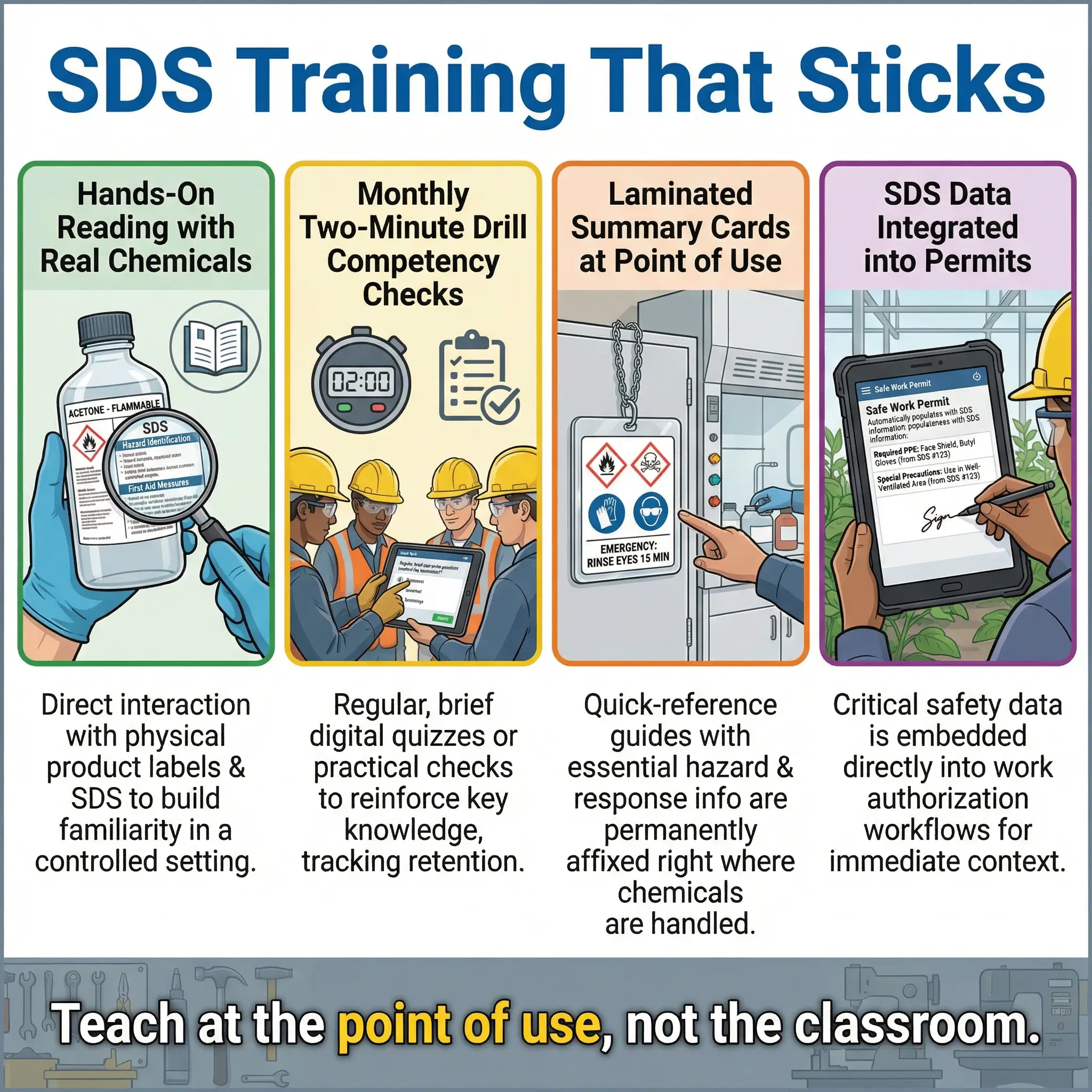
- Hands-on reading exercises using the actual chemicals on site. Give each worker the SDS for a chemical they use daily. Walk them through Sections 2, 8, and 4 with the actual container in front of them. Ask them to match the label pictograms to the Section 2 pictograms. Ask them to identify the correct glove material from Section 8 and compare it to the gloves they are currently wearing.
- Two-minute drill as a recurring competency check. Monthly or quarterly, the supervisor picks a random chemical and asks a random worker to locate the SDS and answer three questions: What are the main hazards? What PPE does it require? What is the first aid for skin contact? This takes five minutes and builds lasting competency.
- Simplified SDS summary cards at the point of use. For the 10–15 most frequently used chemicals, create a one-page laminated summary card that extracts Section 2 (hazards), Section 8 (PPE), Section 4 (first aid), and Section 6 (spill response) into a quick-reference format. These are not replacements for the full SDS — they are field aids that get looked at a hundred times more often than the full document.
- Multilingual access for diverse workforces. On multinational projects, I have worked with crews speaking four or five languages. SDSs in English alone are useless for half the workforce. Obtain SDSs in the workers’ primary languages where available, and ensure summary cards are translated and pictogram-based for universal comprehension.
- Integrate SDS content into permit-to-work systems. When a hot work permit is issued near chemical storage, the permit should reference the SDS flash point data. When a confined space entry permit involves chemical residues, the permit should reference the SDS exposure limits and PPE requirements. This embeds SDS usage into the operational workflow rather than treating it as a separate training topic.
“Training is not an event — it is a system. A worker who reads Section 8 of an SDS once in a classroom will forget. A worker who checks Section 8 every morning before their chemical task will internalize it.”
Conclusion
Safety Data Sheets are not paperwork. They are not compliance checkboxes. They are not documents that exist to satisfy auditors and gather dust between inspections. An SDS is a direct, standardized, legally mandated communication from the manufacturer to the worker that says: this is what this chemical can do to you, this is how to protect yourself, and this is what to do if protection fails. Every section exists because someone, somewhere, was harmed by the hazard it describes.
The gap between having SDSs and using them is where chemical injuries happen. I have investigated skin burns from solvents where the SDS specified butyl rubber gloves and the worker wore latex. I have reviewed inhalation exposures where the SDS listed a vapor pressure that made atmospheric monitoring essential — and no monitoring was in place. I have audited facilities where hundreds of current SDSs sat in a database that no worker had ever been trained to access. In every case, the information existed. The failure was in translating that information into action.
If you manage chemical safety in any capacity — whether you oversee a petrochemical complex or a small workshop with a dozen cleaning agents — the standard is simple. Every chemical has a current SDS. Every worker can find it. Every worker can read the sections that protect them. Every risk assessment, PPE decision, storage layout, and emergency plan traces back to specific SDS data. Anything less is not a chemical safety program. It is a filing system waiting for an incident.