
TL;DR
- Site safety inductions are mandatory in most jurisdictions — CDM 2015 (UK), OSHA 29 CFR 1926.21(b)(2) (US), and the WHS Act (Australia) all require workers be informed of site hazards before exposure.
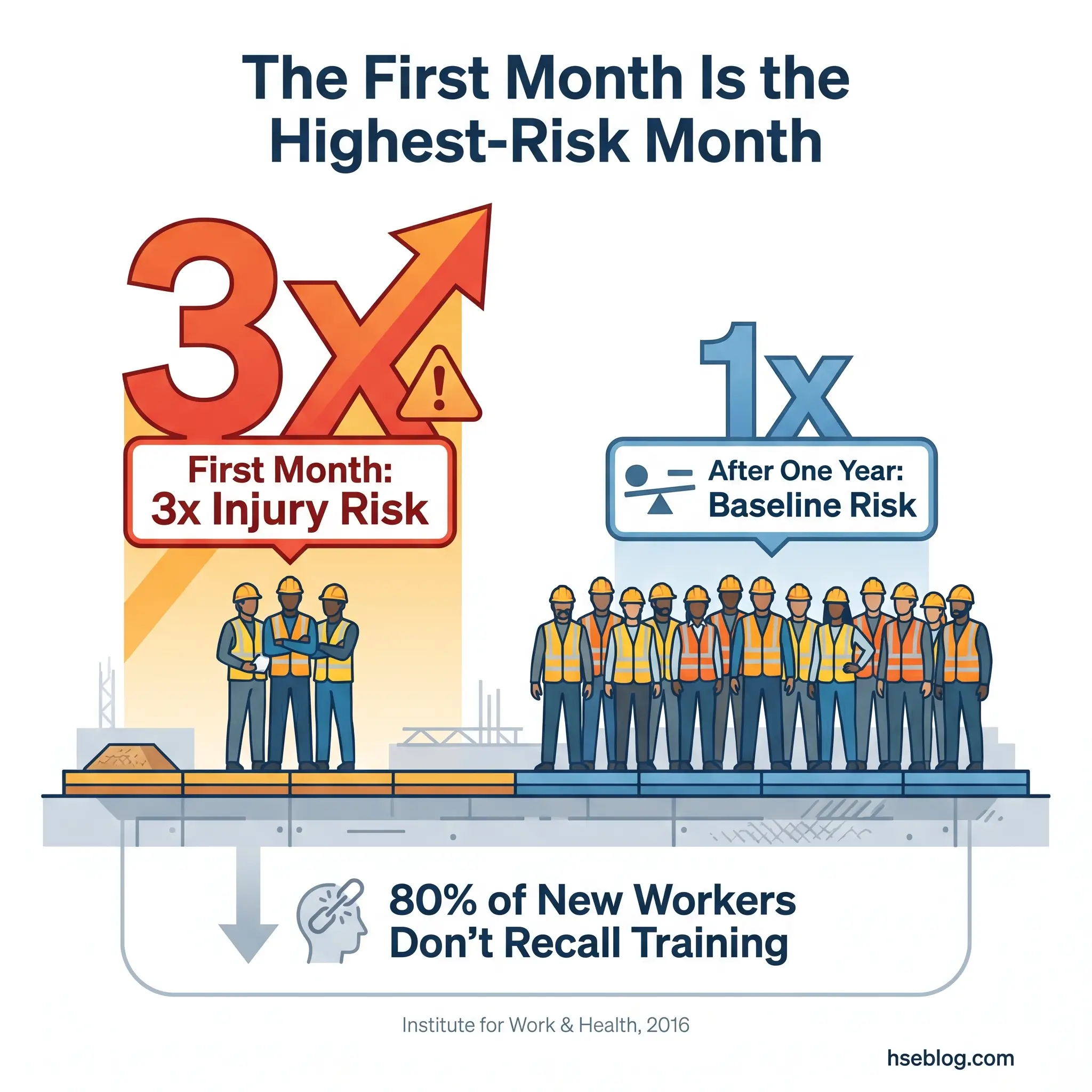
- First-month workers face triple the injury risk — over three times the lost-time injury rate of those with one year of tenure (Institute for Work & Health, cited in Safety+Health Magazine, 2016).
- Site-specific content is the legal threshold — generic company onboarding does not satisfy CDM 2015 Regulation 13(4) or its equivalents.
- Sign-off is not the same as understanding — verifying comprehension separates a defensible induction from a tick-box exercise.
- Inductions must evolve with the site — hazard profiles change as projects move through phases, and the induction must change with them.
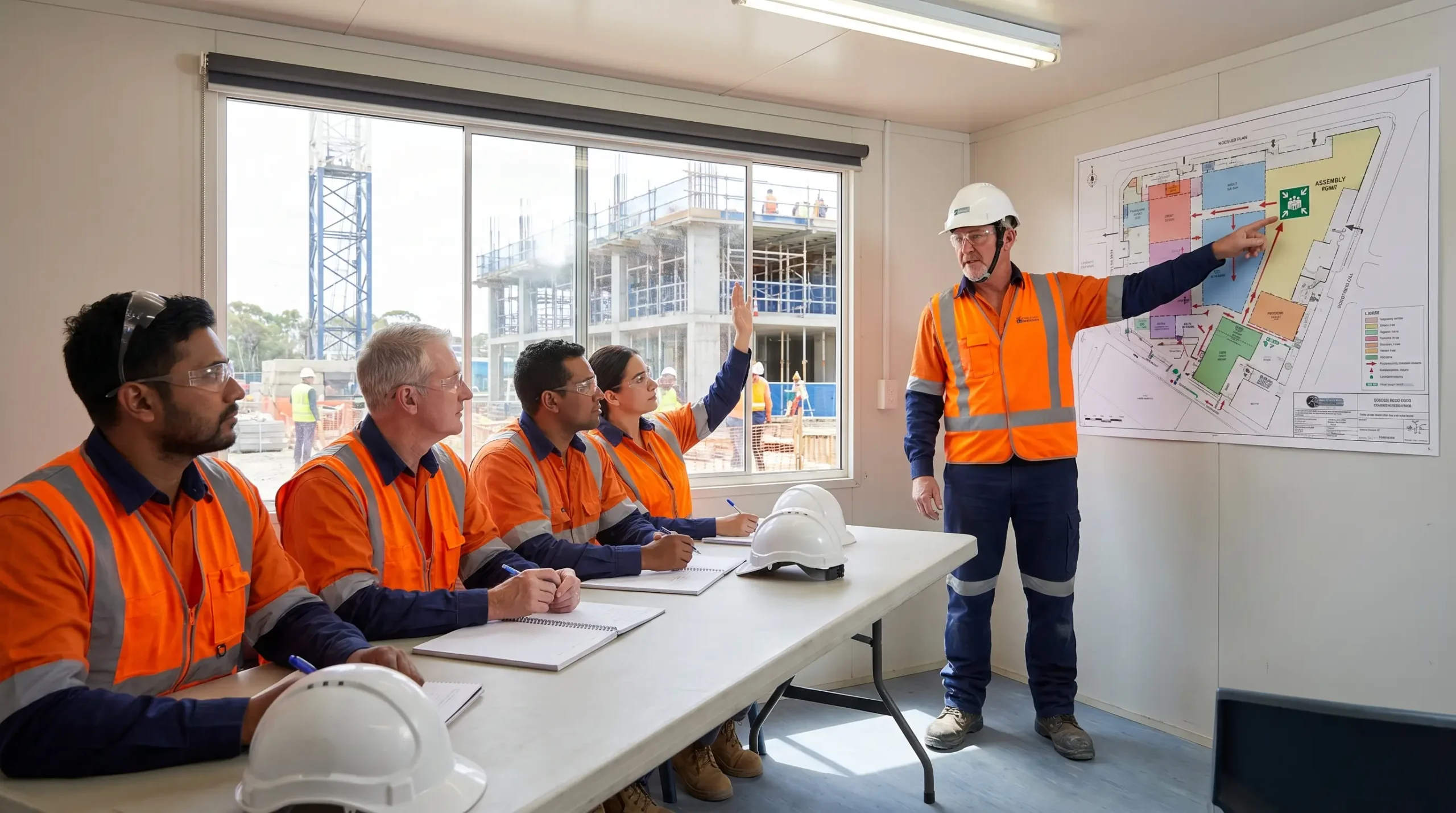
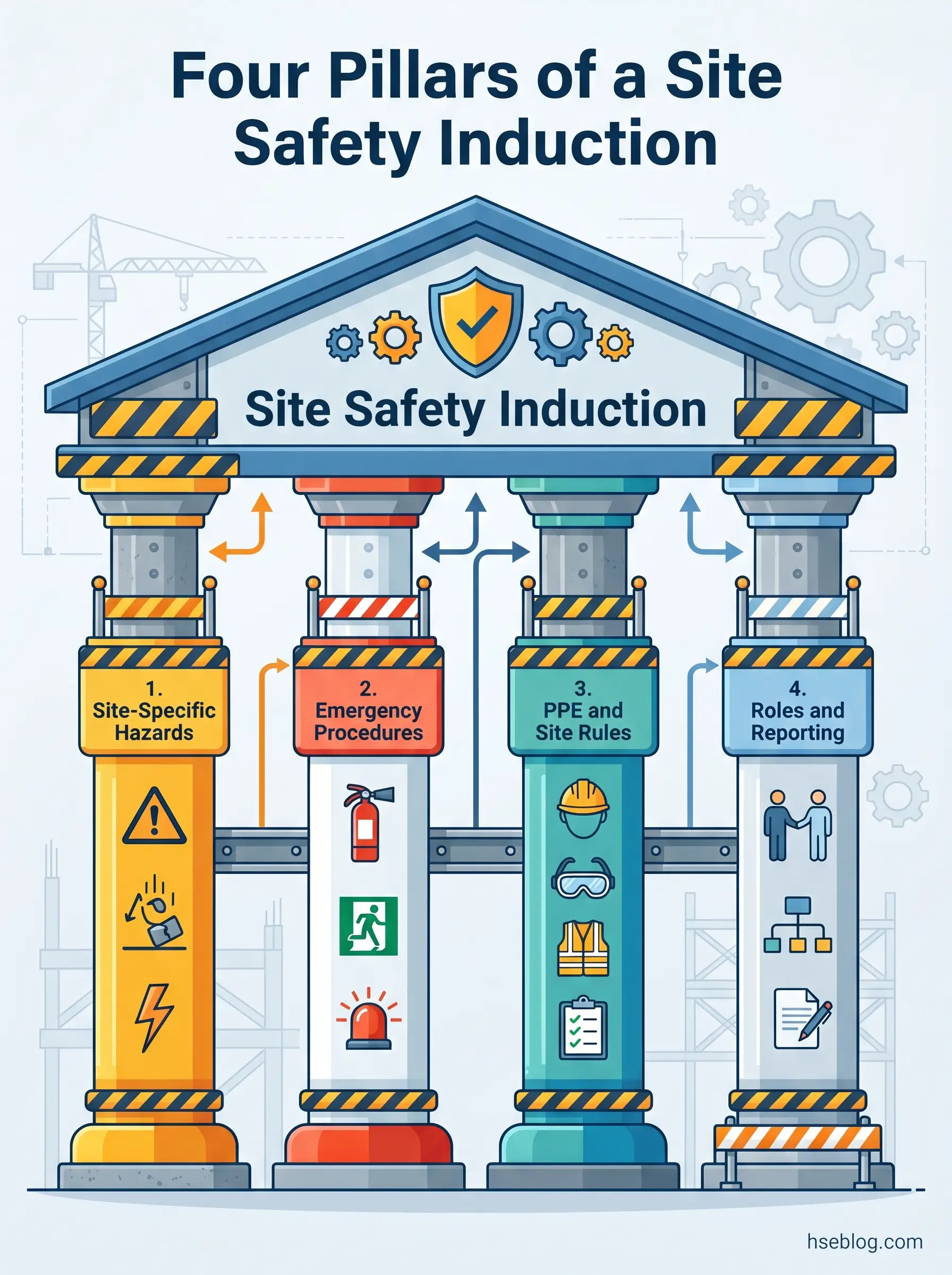
A site safety induction is a structured briefing given to every worker, contractor, and visitor before they begin work on a site. It covers site-specific hazards, emergency procedures, PPE requirements, site rules, and individual responsibilities. Required by law in most jurisdictions, its purpose is to ensure everyone entering the site can recognise hazards and work safely from day one.
Workers in their first month on a job carry more than three times the lost-time injury risk of colleagues with over a year of tenure (Institute for Work & Health, cited in Safety+Health Magazine, 2016). That gap is not explained by inexperience alone. It reflects how little a new arrival knows about the specific hazards in front of them — the pinch points on this site’s plant, the location of this site’s assembly point, the particular substance stored in that bay. A site safety induction exists to close that gap on the first day, not the fifth.
Site inductions sit at the intersection of legal duty and operational reality. Done well, they shape how every worker reads risk on site for the duration of the project. Done badly — generic slides, monotone delivery, sign-off treated as the goal — and you have a paper record that protects no one. This article covers what a site safety induction is, why regulators require it, the topics it must cover under different jurisdictions, how to deliver it so the content actually lands, and the failure modes that turn induction into compliance theatre.
What Is a Site Safety Induction?
A site safety induction is a structured pre-work briefing covering the hazards, controls, rules, and emergency arrangements of a specific site, delivered to every individual who will work on or enter that site before they do so. The defining word is specific. A site induction is not the same as a company induction, which covers organisational policies, employment terms, and general health and safety culture. It is also not task-specific training — the detailed competency development needed to operate a piece of plant, work at height, or enter a confined space. Site induction sits between the two: it tells the worker what this site will throw at them.
The audience is broader than many sites assume. Direct employees are the obvious group, but the duty extends to subcontractors, agency workers, delivery drivers, escorted visitors, and anyone else who will set foot in operational areas. Under CDM 2015 in the UK, the principal contractor’s duty to brief workers on particular risks does not stop at the gate when a delivery driver arrives. Under OSHA’s framework in the US, the controlling employer cannot let a contractor’s staff begin work in a hazardous area without ensuring they understand the relevant risks.
A pattern I see repeatedly across projects: the same induction deck recycled site after site, with the title slide changed and nothing else. If the briefing does not reference the actual hazards a worker will encounter that day — the live overhead crane in Bay 3, the asbestos register status of this building, the diesel tank position relative to the welding zone — it is not a site induction. It is a generic safety lecture wearing the wrong name.
Why Site Safety Inductions Matter
The case for inductions rests on three legs: the data on new-worker harm, the cultural signal an induction sends, and the legal evidentiary weight it carries.
The data is uncomfortable. New workers face disproportionate injury exposure in their early weeks — a pattern that holds across construction, manufacturing, and process industries. The Institute for Work & Health found that workers in their first month had more than three times the lost-time injury risk of those with over a year of tenure (cited in Safety+Health Magazine, 2016). The same body of research found roughly 80% of new workers in their first year could not recall receiving any workplace safety or orientation training (Institute for Work & Health, 2007 study, cited in Safety+Health Magazine, 2016). That second figure is the more damning one — it points to the gap between induction delivery and induction retention.
The cultural signal matters because workers form judgments about a site’s safety standards within hours of arriving. If the induction is a tired hour of read-aloud slides, the message is that safety paperwork matters more than safety practice. If the induction includes a walkthrough where the manager points out the actual edge of the floor opening, the actual nearest first aider, and the actual radio channel for emergencies, the message is the opposite. The induction is rarely the first encounter with the site’s safety culture, but it is usually the most concentrated one.
The compliance function is the third leg. A documented induction creates the record that demonstrates due diligence in the event of an incident, an inspection, or a prosecution. Recent US data underscores why that matters: the Bureau of Labor Statistics reported 5,005 fatal work injuries in 2024, of which construction and extraction workers accounted for 1,032 (US Bureau of Labor Statistics, 2026 release). Behind every fatality investigation comes a question about training records, and the induction record is usually the first document requested.
Field Test: Twenty-four hours after induction, ask a new worker to name the assembly point and the on-shift first aider. If they can’t, the induction was a transmission, not a transfer.
Legal Requirements for Site Safety Inductions by Jurisdiction
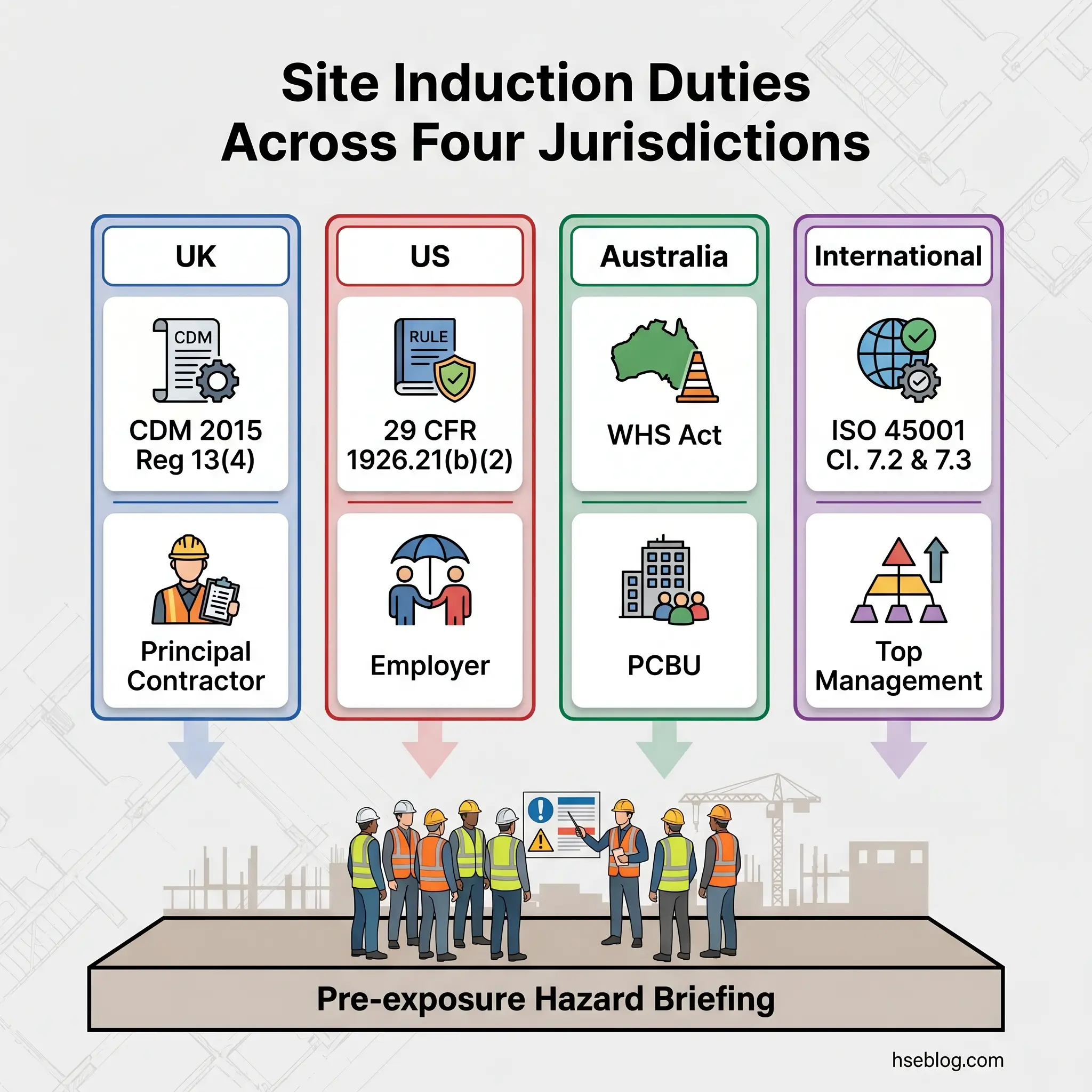
The duty to induct exists in every major regulatory regime, but the specificity differs. Below is how the obligation maps across four jurisdictions.
| Jurisdiction | Key Regulation | Duty-Holder | Core Requirement |
|---|---|---|---|
| United Kingdom | CDM 2015 Reg 13(4); HSWA 1974 s.2; MHSWR 1999 Reg 13 | Principal Contractor (CDM); Employer (HSWA, MHSWR) | Site-specific induction covering particular risks and control measures before work begins |
| United States | OSH Act §5(a)(1); 29 CFR 1926.21(b)(2) | Employer (controlling and exposing) | Instruction in recognition and avoidance of unsafe conditions and applicable regulations before exposure |
| Australia | WHS Act / Model WHS Regulations | PCBU (Person Conducting a Business or Undertaking) | Information, training, instruction, and supervision necessary to protect workers from risk |
| International | ISO 45001:2018, Cl. 7.2 & 7.3 | Top management (within OHSMS) | Determine and ensure worker competence; ensure awareness of hazards, OH&S policy, and consequences of non-conformance |
In the UK, the HSE’s published guidance on site rules and inductions sets out CDM 2015 Regulation 13(4) as the principal anchor. Read in practice, it places the duty firmly on the principal contractor to ensure every worker on a construction site receives a suitable site-specific induction covering particular risks and the controls in place — referenced against the project’s construction phase plan. This is supported by the broader Section 2 duty in the Health and Safety at Work etc. Act 1974, which requires employers to provide information, instruction, training, and supervision so far as is reasonably practicable, and by Regulation 13 of the Management of Health and Safety at Work Regulations 1999, which specifies training on recruitment and on exposure to new or changed risks.
US obligations work differently. There is no single OSHA standard that mandates a “site induction” by that name. Instead, the General Duty Clause (OSH Act Section 5(a)(1)) sits over a stack of standards that each require specific training before exposure: 29 CFR 1926.21(b)(2) for general construction safety instruction, 29 CFR 1926.503 for fall protection training, 29 CFR 1910.1200 for hazard communication, and so on. OSHA’s training guidelines for employees provide the practical framework most US sites build their orientation programs against. Sites cited under 1926.21(b)(2) typically show one of two failure patterns — either no documented instruction at all, or documented instruction that does not match the actual hazards present.
Australia’s WHS Act framework places the duty on the Person Conducting a Business or Undertaking (the PCBU) and is interpreted through Model WHS Regulations and regulator guidance such as WorkSafe’s published material on effective inductions. The duty language (“information, training, instruction, and supervision”) deliberately covers more than the induction event itself, which is why mature WHS systems treat induction as one component of a competency framework, not a standalone deliverable.
ISO 45001:2018 sits over all of this as a management-system reference. Clause 7.2 (Competence) requires the organisation to determine the necessary competence of workers whose work affects OH&S performance, and to ensure they are competent — including the ability to identify hazards. Clause 7.3 (Awareness) requires that all workers be aware of the OH&S policy, the hazards relevant to their work, and the implications of not conforming. For multi-site organisations operating across borders, ISO 45001 is often the unifying framework that makes induction content consistent in principle while allowing site-specific adaptation in execution.
A misconception worth addressing directly: many smaller contractors believe induction obligations only bite on “big” projects. Under CDM 2015, the duty applies to all construction work regardless of project size or contractor count. Under OSHA, the training duties under 1926.21(b)(2) apply to all covered construction work — there is no minimum-project threshold.
Who Is Responsible for Delivering the Induction?
The legal duty and the practical delivery are two different things. In UK construction, CDM 2015 places the duty on the principal contractor to ensure the induction happens — but the principal contractor may delegate delivery to a competent site manager, HSE advisor, or qualified subcontractor representative for portions covering specialist work. The duty does not transfer with the delegation; the principal contractor remains accountable.
In the US, the duty sits on the employer of the worker being inducted, with controlling-employer responsibilities adding a further layer on multi-employer worksites. An exposing employer must train its own employees; a controlling employer must ensure that contractors on its site meet the training standards required for the hazards present.
In Australia, the PCBU duty cannot be delegated, though the act of delivering the induction can be. In practice, the senior site supervisor or HSE manager carries the accountability whether or not they personally deliver the briefing.
Essential Topics Every Site Safety Induction Should Cover
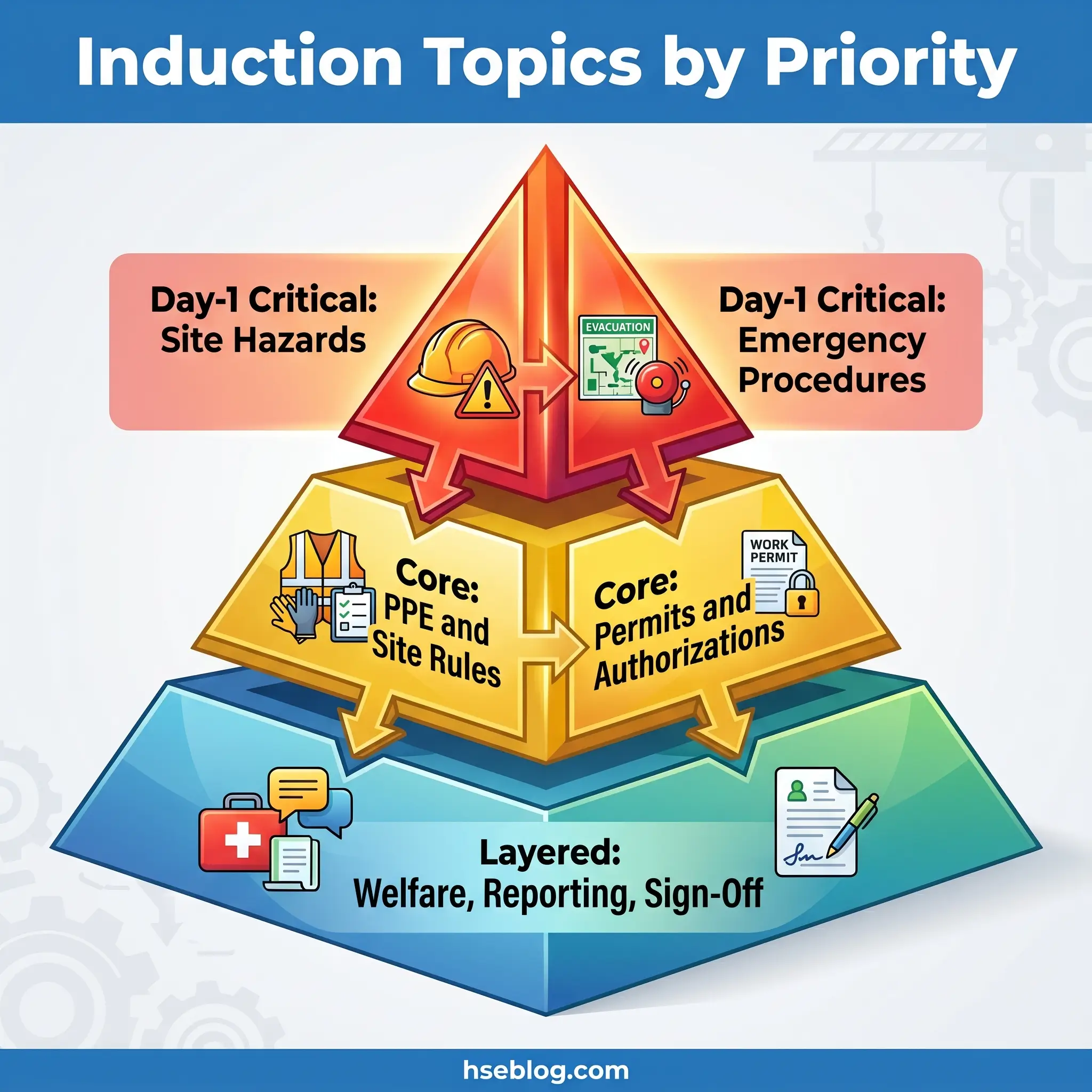
Most published induction checklists list topics flat — twenty-five bullets in a column with no priority. That is the wrong shape. The induction needs to be ordered around what could kill a worker on Day 1, with secondary content layered through follow-up communication. The clusters below are what should appear in every site induction, organised in the order most likely to support retention.
Site Orientation and Layout
Cover the physical map of the site: boundaries, access and egress routes, vehicle and pedestrian segregation, operational zones, exclusion zones, welfare facilities, and parking. A walkthrough beats a floor plan on a screen every time — workers retain spatial information far better when they have walked the route. The orientation must specify where the welfare facilities are (toilets, drinking water, rest areas, drying rooms), because workers who do not know where the basics are will bypass site rules to find them.
Site-Specific Hazards and Controls
This is where generic templates collapse. Cover the actual hazards present on this site at this phase: physical hazards (working at height, moving plant, excavations, lifting operations, electrical risks), chemical hazards (substances under COSHH in the UK or HazCom in the US, with reference to the safety data sheet locations), and environmental hazards (noise, dust, vibration, weather exposure). Each hazard should be linked to its control measure — engineering control, administrative control, or PPE — so workers understand not just what the hazard is but how it is being managed.
The induction must reference the project’s current construction phase plan (UK) or site-specific safety plan (US), because the hazard profile changes as the project moves through phases. A demolition-phase induction does not protect a worker who arrives in the structural phase six months later.
Emergency Procedures and First Aid
Cover evacuation routes, assembly points, fire alarm recognition, first aid post locations, the names of first aiders on shift, incident reporting procedures, and near-miss reporting expectations. Include environmental emergencies appropriate to the site — chemical spill, gas leak, structural collapse warnings.
The judgment call here is between describing procedures and practising them. Description satisfies the legal duty on paper. Practice — including a physical walk to the assembly point during induction — is what produces workers who actually evacuate correctly when an alarm sounds. Where the induction must be classroom-based, schedule a drill within the worker’s first week to close the gap.
PPE Requirements
State the mandatory PPE for this site (and for specific zones within it), the inspection requirements before each shift, the maintenance and storage expectations, and the procedure for replacing damaged or worn equipment. Cover the principle that PPE is the last line of defence after engineering and administrative controls, not the first — workers who understand the hierarchy of controls treat PPE differently from those who think a hard hat is the entire safety system.
Reporting, Communication, and Sign-Off
Cover incident, near-miss, and hazard reporting procedures, including the reporting channels, expected timeframes, and the worker’s right to stop unsafe work without retaliation. On multilingual sites, address translation provisions, visual signage standards, and interpreter availability. Close with the documented sign-off process — including any competency check for higher-risk work — and explain that signing the form is acknowledging receipt and understanding, not just attendance.
Watch For: A signed induction record is a compliance document, not a safety control. Treat it as evidence of attendance, then verify understanding separately.
The most common failure I see in this section is information overload. Sites pack everything into a single hour-long briefing because there is one window to do it. Workers retain perhaps the first ten minutes and the last five. The fix is to triage: prioritise the handful of items that could kill someone today (the critical site-specific risks), use the induction to establish those, and use toolbox talks, buddy systems, and supervisor follow-ups to layer in the rest over the first two weeks.
How to Deliver an Effective Site Safety Induction
Content alone does not make an induction work. Delivery does.

The gold standard for site-specific content is face-to-face delivery with a physical walkthrough of the site. Pre-boarding via a digital platform can carry the organisational-level content (company policies, general awareness modules, document acknowledgments), which frees the on-site briefing to focus on what only the site can show. WorkSafe’s published guidance on effective inductions reinforces this layered approach, and the same logic applies internationally.
Delivery quality moves on a few practical points:
- Tailor the depth to the role. A scaffolder beginning a six-month appointment needs more depth than a one-day delivery driver entering a defined corridor. Both need an induction; the content set differs.
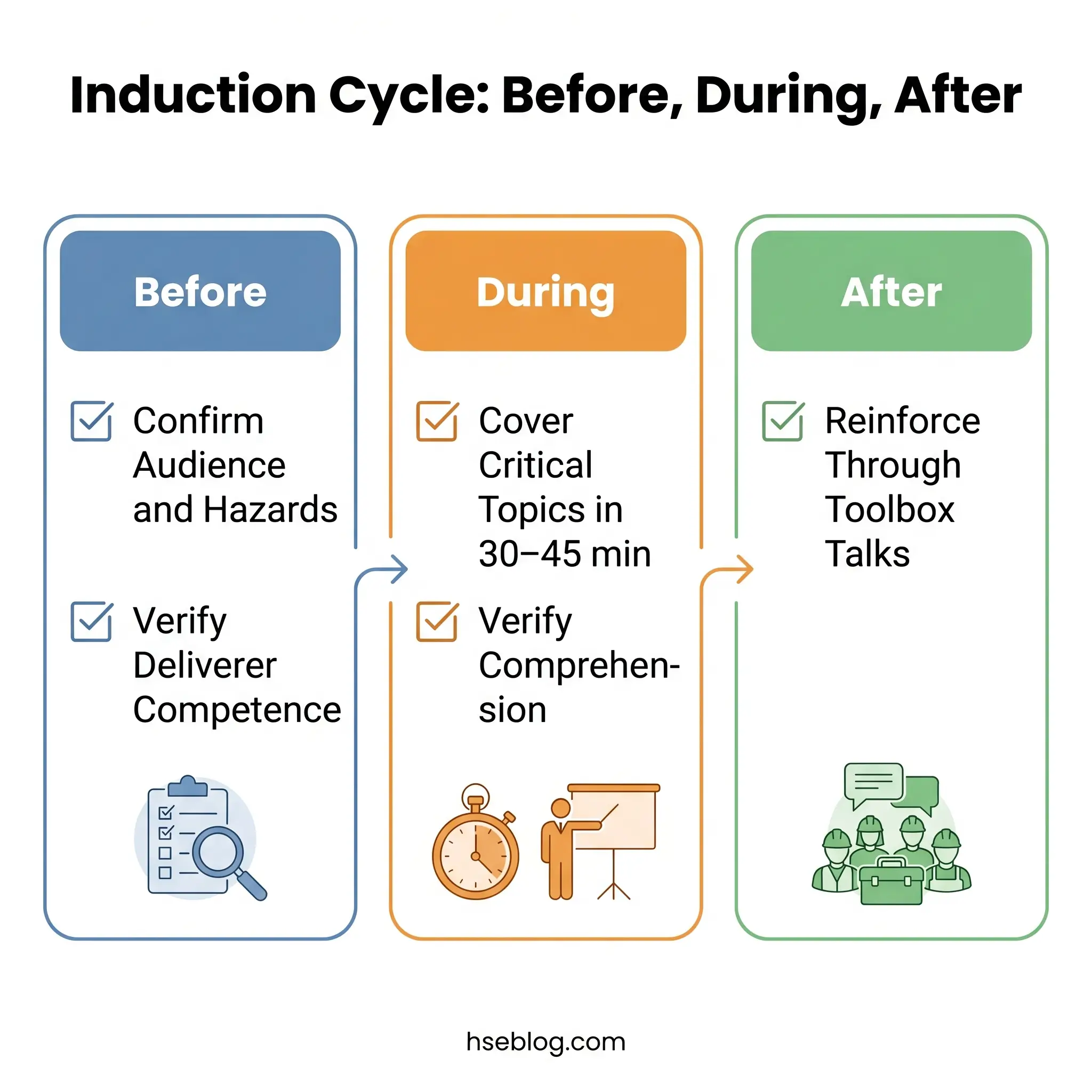
- Cap critical safety content at 30–45 minutes. Beyond that, retention falls off sharply. Long inductions feel thorough but produce thin recall.
- Use scenario-based discussion, not passive lecture. Ask the worker how they would respond to an alarm, what they would do if they saw a near miss, where they would go in an evacuation. Two-way exchange embeds content; one-way lecture does not.
- Address language and literacy directly. Translated materials, bilingual delivery, visual aids, and interpreter support are not optional courtesies — they are the difference between an induction that informs every worker and one that informs only the fluent ones.
- Verify comprehension before sign-off. A short verbal check, a question-and-answer exchange, or a structured comprehension test is the difference between a defensible record and a fragile one.
Digital induction platforms have a legitimate role and a clear limit. The American Society of Safety Professionals’ 2025 Construction Industry Safety Challenges Report notes increased reliance on standardised digital systems as workforce shortages and subcontractor turnover stretch traditional in-person delivery (American Society of Safety Professionals, 2025). Digital systems excel at consistency and tracking — they ensure every contractor across multiple sites receives the same baseline content, and they produce auditable records automatically. They struggle with site-specific content that demands the physical context of a walkthrough, which is why the strongest current practice is hybrid: digital pre-boarding for the standardisable, in-person delivery for the situational.
Common Mistakes That Undermine Site Safety Inductions
Many inductions are compliant on paper and ineffective in practice. The gap between the two is where most of the harm happens. The patterns below are the ones I encounter most often when reviewing induction systems.
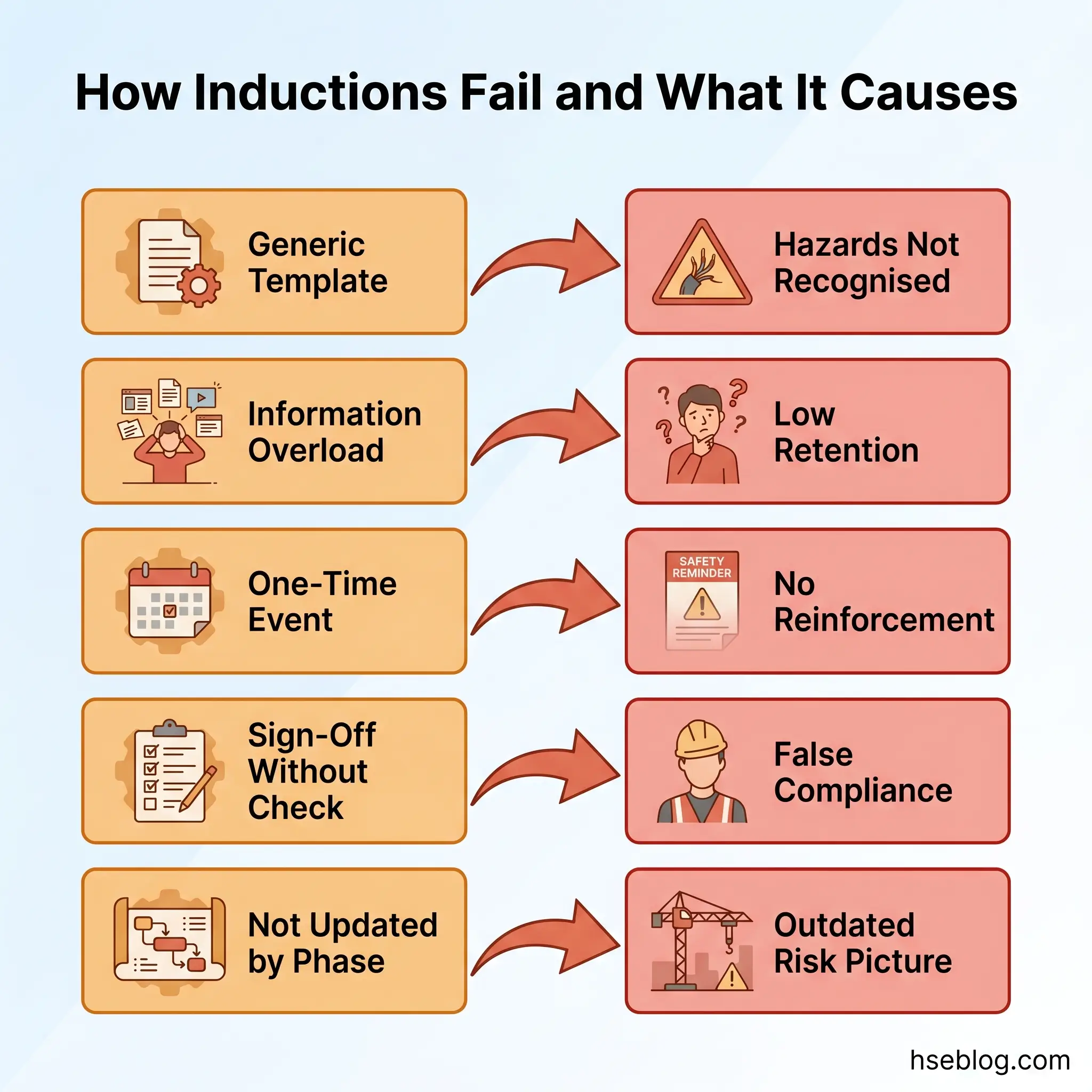
Generic templates without site-specific adaptation. A deck written for the head office and reused unchanged across every project. Legally inadequate under CDM 2015 Regulation 13(4), which requires the induction to reference particular risks. Operationally inadequate because workers cannot transfer generic warnings to specific hazards.
Information overload in a single session. Trying to cover everything from policy through to detailed procedures in one sitting. Recall collapses, and workers leave with a vague impression rather than usable knowledge.
Treating induction as a one-time event. No follow-up, no toolbox talks reinforcing critical content, no checks at one-week or one-month points. Induction is the start of a competency-building process, not the entire process.
Treating sign-off as proof of understanding. A signed form proves attendance, not comprehension. Verification — verbal questioning, scenario walk-throughs, written checks for high-risk work — is what closes the loop.
Failing to update the induction as the project evolves. A pattern I see frequently on long projects: the induction is built for the early phase, never refreshed when the project moves to structural, finishing, or commissioning works. The hazard profile fundamentally changes; the induction does not. Workers arriving in month nine receive a briefing about hazards that no longer exist while the current ones go unaddressed.
Excluding visitors, delivery drivers, and short-term workers. They enter the site, they are exposed to its hazards, and they fall under the same duty of care. A short, focused visitor induction covering essentials — boundaries, no-go zones, what to do on hearing an alarm, how to summon help — is the proportionate response.
Site Safety Induction Checklist: A Practical Reference
A checklist is a memory aid, not the induction itself. Used correctly, it stops the deliverer from missing a critical topic. Used incorrectly — read aloud, ticked, signed, filed — it becomes the induction in name only. The checklist below covers preparation, delivery, and follow-up across a typical induction cycle.
Before the induction:
- Confirm the audience and role mix — direct employees, subcontractors, escorted visitors, and delivery drivers all fall in scope at differing depth
- Review the current site hazard register — ensure the induction reflects the current phase, not last quarter’s
- Prepare site-specific materials — current site map, construction phase plan summary, PPE requirements, emergency contact list
- Verify the deliverer’s competence — the person delivering must understand the hazards being communicated
- Schedule a walkthrough route — assembly points, welfare facilities, first aid posts, restricted zones
During the induction:
- Site orientation — boundaries, access, zones, welfare, parking
- Site-specific hazards and controls — physical, chemical, environmental, with control measures
- Emergency procedures — evacuation, fire, medical, environmental; assembly point physically identified
- PPE requirements — mandatory items, inspection, replacement procedure
- Site rules and permits — working hours, restrictions, permit-to-work overview
- Roles and responsibilities — site management, HSE contacts, right to stop work
- Reporting procedures — incidents, near misses, hazards
- Communication protocols — radios, signage, language provisions
- Health and welfare — manual handling, occupational health, fatigue, mental health signposting
- Comprehension check — verbal Q&A or written check before sign-off
After the induction:
- Sign-off captured and stored — name, date, deliverer, topics covered, comprehension check result
- Records retained for audit and litigation purposes — minimum periods vary by jurisdiction; longer is safer
- Buddy or supervisor pairing arranged for the first week — particularly for higher-risk roles
- Toolbox talk schedule confirmed — reinforcing critical content over the first weeks
- Re-induction trigger identified — phase change, incident, extended absence
Frequently Asked Questions
Conclusion
The thing the industry consistently gets wrong about site safety inductions is treating them as a compliance event rather than a behaviour-shaping intervention. A signed register satisfies the auditor for an afternoon. A worker who can name the assembly point, point to the nearest first aider, and articulate the three highest-risk hazards on site protects themselves and the people around them for the duration of the project. Those are not the same outcome.
If there is one change worth making to most induction systems, it is reducing the content packed into the first session and investing the saved time in verification and reinforcement. Cap the critical content at 30–45 minutes, verify comprehension before sign-off, schedule reinforcement through toolbox talks across the first two weeks, and refresh the site safety induction as the project’s hazard profile changes. None of this is novel; all of it is unevenly applied. The induction works when it is treated as the first hour of an ongoing competency-building process — not the only hour.
The uncomfortable question to take back to your own site: if a worker inducted last Tuesday were stopped today and asked where the assembly point is, what would they say?