
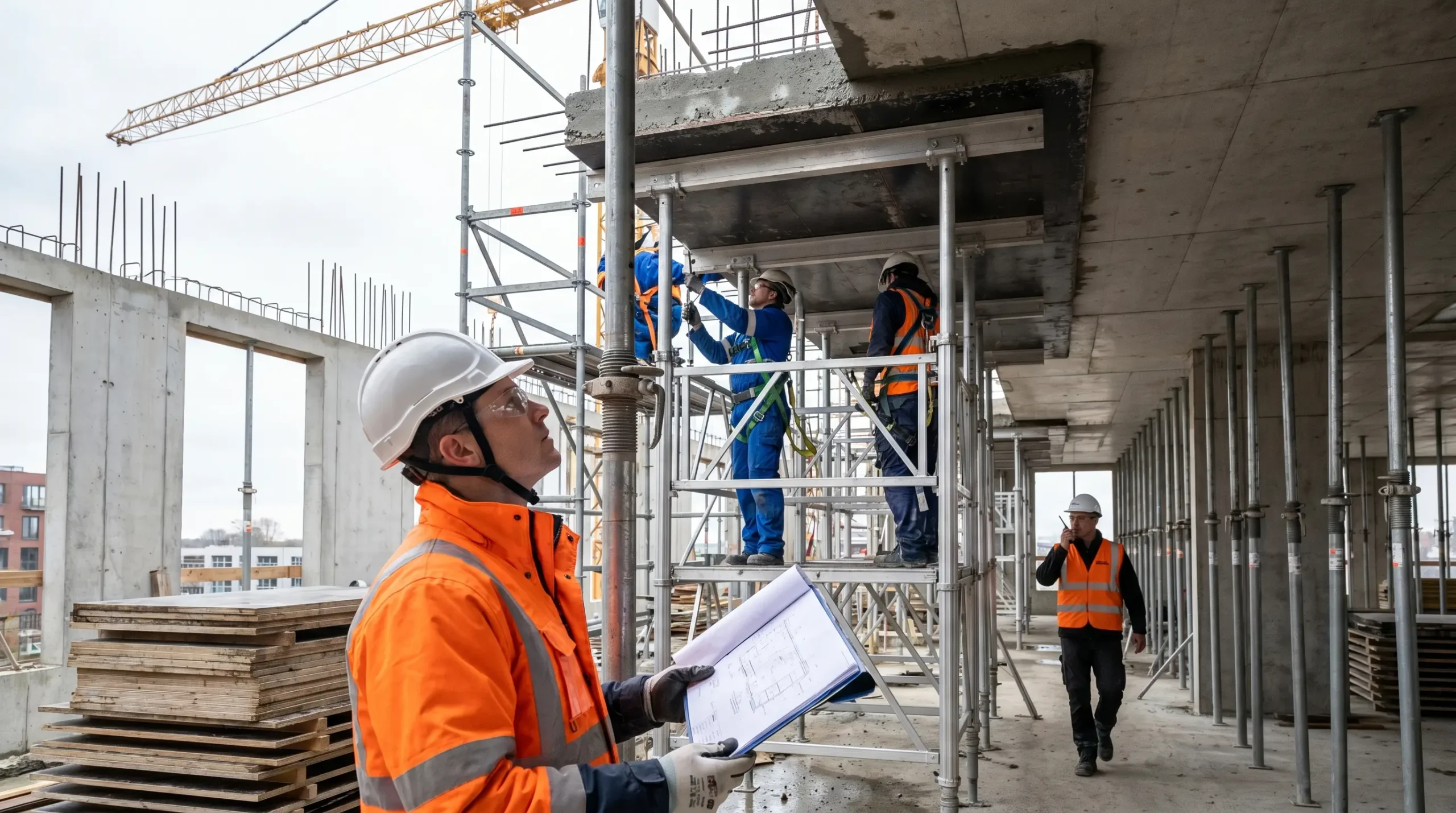
- What are they? Engineered structures used during construction to support, protect or access the permanent works — scaffolding, falsework, formwork, shoring, propping, cofferdams, crane bases.
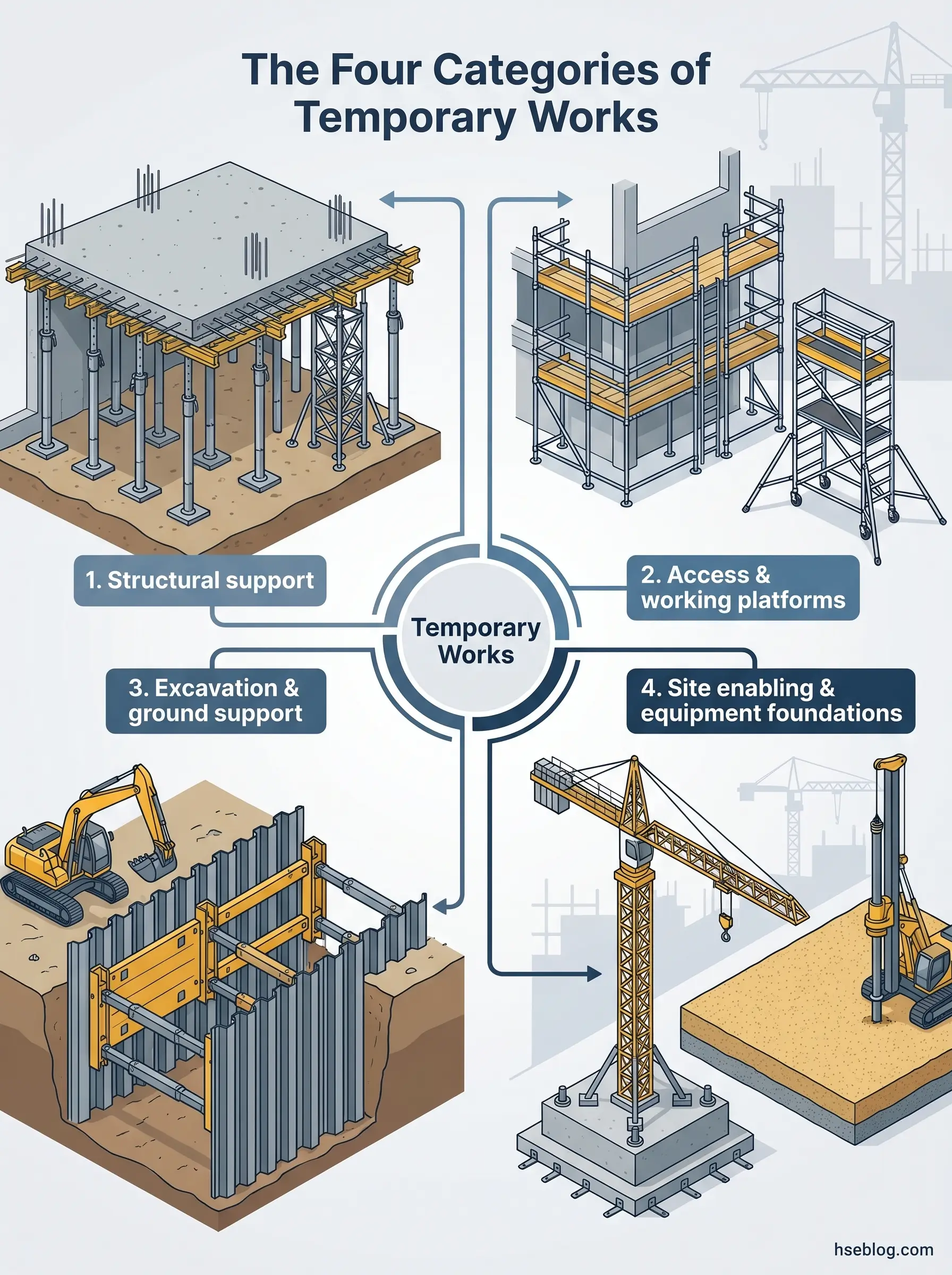
- What types exist? Four functional groups — structural support, access and working platforms, excavation and ground support, and site enabling works including equipment foundations.
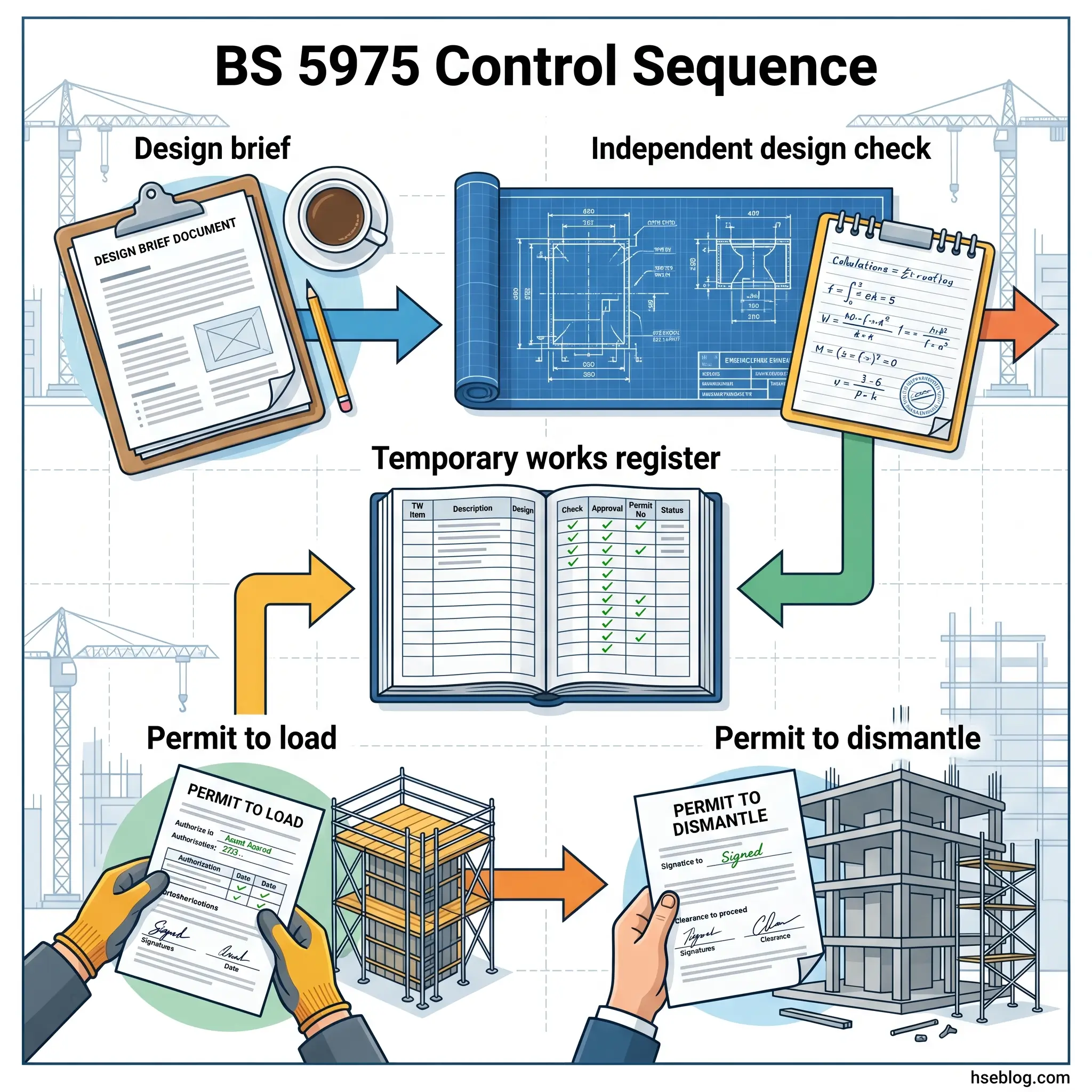
- How are they controlled? Under BS 5975-1:2024, through a named Temporary Works Coordinator, a written design brief, a temporary works register, an independent design check sized to the risk, and formal permits to load and dismantle.
Temporary works are the engineered structures used during construction to support or protect a permanent structure, an item of plant, the sides of an excavation, or to provide access. They include scaffolding, falsework, formwork, shoring, propping and cofferdams, and are removed once the permanent works are self-supporting.
Great Britain recorded 35 construction worker fatalities in the year ending 31 March 2025, an injury rate roughly 4.8 times the all-industry average (HSE, Construction statistics in Great Britain 2025). Falls from height remained the single largest cause of fatal injury that year, and on construction sites most of those falls happened from, or in connection with, temporary structures — scaffolds, working platforms, edge protection, falsework (HSE, 2025). The temporary works on a site are not background scenery. They are the structures people work from, under and alongside, sometimes for months.
This article explains what temporary works are, the types encountered on a construction site, the hazards they present, and the procedural controls the industry has developed in response. The framework is primarily a UK discipline — BS 5975 paired with CDM 2015 — with parallel references to the US OSHA subparts that regulate the same physical structures under a different model. It is an orientation piece for site managers, junior engineers, HSE practitioners and candidates preparing for TWC or TWS training. It is not a substitute for that training.
Competent-person caveat: This article provides general HSE knowledge on temporary works. Life-critical construction activity — appointment of a Temporary Works Coordinator, approval of temporary works designs, issuing of permits to load or dismantle — must be planned and supervised by a competent person with relevant training, jurisdiction-specific authorisation, and site-specific risk assessment. The information here does not replace that.
What are Temporary Works in Construction?
BS 5975-1:2024 defines temporary works as an engineered solution used to support or protect a structure during construction, an item of plant, the sides of an excavation, or to provide access (BSI, 2024). The key word in that definition is engineered. Temporary works are not incidental site fittings. They are structures that carry real loads — sometimes the weight of wet concrete, sometimes the lateral pressure of soil against an excavation, sometimes a crane — and the discipline exists so those loads are carried by design rather than by luck.
The misconception that causes most damage on sites is reading temporary as informal. Teams hear the word and assume the rules soften — fewer drawings, less checking, a more flexible attitude toward modifications. The whole point of BS 5975 is the opposite. Temporary describes duration. It says nothing about the engineering rigour required.
The UK discipline has a specific origin. After a series of falsework collapses in the early 1970s, the Bragg Report (1975) recommended a formal management regime, and the first edition of BS 5975 followed in 1982. The 2024 revision — published on 31 December 2024 — is the current benchmark, strengthening the guidance on documentation, independent design checks, and environmental risks such as flooding and soil erosion (BSI, 2025).
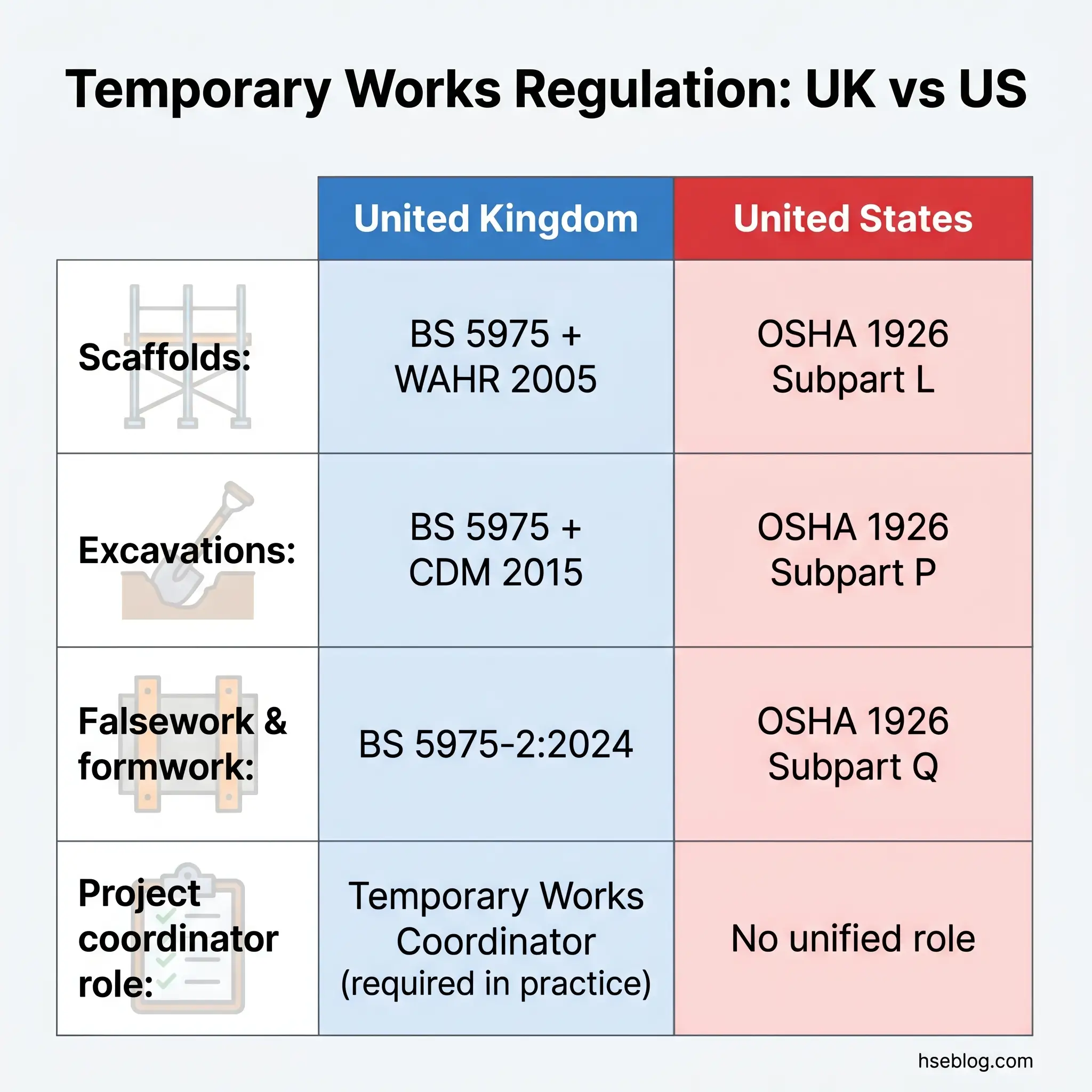
In the United States, there is no single temporary works regime. The same physical structures are regulated piece by piece — scaffolds under OSHA 29 CFR 1926 Subpart L, excavations under Subpart P, formwork and shoring under Subpart Q. The outcome sought is similar; the management architecture is different.
Types of Temporary Works
Flat lists tend to teach site teams a vocabulary without giving them a mental model. A more useful approach is to group items into four functional categories, because that is how an experienced TWC reads an unfamiliar site. Each category answers the first judgement call for every item on a register — what is this temporary structure here to do?
Structural support: falsework, formwork, propping and retention
Structural-support temporary works hold up either the permanent works during construction or an existing structure while it is altered. Falsework supports wet concrete and the formwork around it until the concrete is self-supporting. Formwork is the mould itself — the surface the concrete cures against. Propping takes load off floors, beams or lintels during structural alterations. Façade retention holds the front of a listed building upright while everything behind it is demolished and rebuilt.
The falsework/formwork distinction is the single most confused pair of terms in the field. Formwork is the mould; falsework is the load-bearing structure that supports the formwork and the weight of concrete on top of it until curing is complete. US practice often uses shoring as a synonym for falsework, which creates predictable confusion on international projects.
Access and working platforms: scaffolding and beyond
Scaffolding is the most common form of temporary works on earth. In UK practice, a scaffold built strictly within the configurations published in NASC TG20 is a standard-configuration scaffold and does not require a bespoke design. Anything outside that envelope — unusual loading, cantilevered sections, return-free elevations, heavy sheeting — requires a designed scaffold prepared by a competent temporary works designer. OSHA 29 CFR 1926 Subpart L imposes the equivalent design-by-qualified-person requirement in the US, plus competent-person inspection before each work shift.
Alongside scaffolds, this category covers mobile access towers, temporary stairs and ramps, crash decks, and loading platforms hung off the building frame.
Excavation and ground support
Trench shoring, soldier piles and lagging, sheet piling, cofferdams and caissons exist to stop the sides of an excavation collapsing onto the people working in them. Under CDM 2015 and BS 5975 these are temporary works and sit on the project’s temporary works register. Under OSHA, the same structures fall under Subpart P — protective systems required at five feet of depth, daily competent-person inspection, engineer design above twenty feet.
Site enabling works and equipment foundations
This is the category most often missed from site temporary works registers. Tower crane bases, hoist ties, mast climbing work platform anchors, piling platforms, haul roads, site hoardings, temporary bridges and welfare cabin foundations are all engineered structures carrying real loads. Because they sit on the ground and look permanent, they are frequently treated as contractor housekeeping rather than as designed temporary works — a recurring root cause identifiable in published tower-crane incident investigations, and the reason dedicated guidance such as CIRIA C703 exists for crane bases and working platforms.
Key Hazards Associated with Temporary Works
The hazards worth understanding are failure modes, not accident types. On a live site, what can go wrong is a more useful question than what accident might happen — because it pushes the thinking back one step, to the chain of decisions and conditions that produce the accident.
The dominant hazard is collapse of the temporary structure itself. Falsework collapses most often during or shortly after concrete placement, when the system is carrying peak load and the concrete has not yet gained the strength to support itself. Scaffolds fail under eccentric loading, weather, or loss of ties. Excavations cave in when the ground behaves differently from the ground the protective system was sized for.
Falls from height during erection, use and dismantling sit alongside collapse as the highest-consequence hazard class, and they dominate the construction fatality record numerically (HSE, 2025). Being struck by falling components, tools and materials is the next tier — particularly during erection and dismantling, when items are in motion rather than statically in place.
Further hazards come from the interfaces. Temporary works often sit against existing buildings, next to live excavations, close to overhead power lines, or on ground that is wetter, softer or more loaded than originally assumed. Environmental effects — wind, rain, flood, thermal movement, plant impact — can destabilise a structure that was perfectly adequate under design conditions.
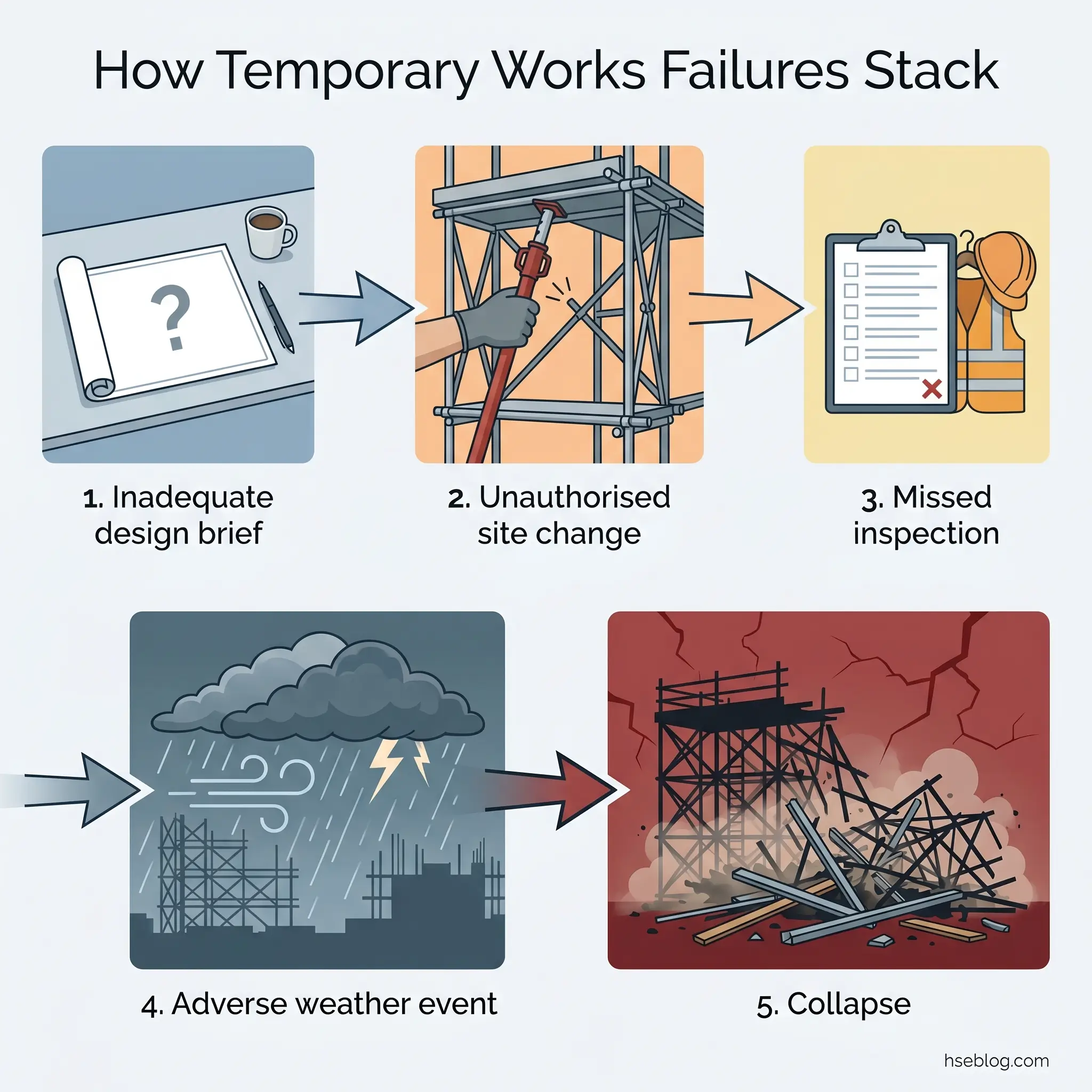
Watch for — hazards that stack: Catastrophic temporary works failures are almost never single-cause events. They stack. An inadequate design brief, plus an unauthorised site modification, plus a missed inspection, plus an adverse weather event — each link in that chain is individually preventable, and collectively they are the pattern the HSE enforcement record returns to again and again.
What Causes Temporary Works to Fail?
The Health and Safety Executive’s own enforcement guidance (SIM 2/10/04) sets out the common causes of temporary works failure in a form that has barely changed in twenty years — because the causes have barely changed. Reframed for the reader, the list runs as follows.
First, the absence of a temporary works procedure, or a procedure on paper that nobody on site actually follows. No named TWC, no register, no independent checks, no permits. Second, inadequate site investigation — the geotechnical assumptions, the condition of adjacent structures, the location of buried services all treated as the designer’s problem rather than as site-supplied information. Third, poor construction and missed inspection of erection — the gap between what the drawing specifies and what is actually built, unseen because nobody checked.
Fourth, and in published casework the single most persistent cause, unauthorised changes to the approved design. Props removed “just for a few hours” to get materials through an opening. Scaffold ties cut to fit cladding. Bracing temporarily unbolted. Each of these modifications, taken alone, looks harmless and rarely produces an immediate collapse — which is exactly why the practice spreads, and exactly why the TWC’s authority to stop work, and the permit-to-load system, exist.
Fifth, overloading — either loading the structure before it has reached design capacity (concrete too green, shoring incomplete) or loading it beyond design limits (materials stacked on a platform rated for people only). Sixth, inadequate communication between designer, erector and users — the design brief changes mid-project and the updates never reach the people on the ground. Seventh, dismantling before the permanent works can carry themselves — removing falsework from a slab that has not yet cured, removing propping from a beam that still depends on it.
How are Temporary Works Controlled?
The procedural controls exist because the failure causes above are known and repeat. BS 5975-1:2024 sequences them into a lifecycle that starts before design and ends after dismantling, and it is worth walking through that sequence in order.
- Formal TWC appointment. A named individual, in writing, with authority to stop work. On larger sites the TWC is supported by one or more Temporary Works Supervisors (TWS) who deputise for specific zones or work packages.
- Design brief. A written statement capturing what the temporary works must do — loads, interfaces, site conditions, durations, sequence. The brief is owned by the TWC and signed off before design work begins.
- Temporary works register. A live document listing every item of temporary works on the project — designer, checker, category, inspection status, permit status. If it is not on the register, it does not exist as far as the TWC’s control is concerned.
- Design by a competent temporary works designer (TWD).
- Independent design check, sized to the risk. BS 5975 sets out four check categories (0–3), explained below.
- Pre-erection inspection of materials and components against the design.
- Supervised erection in accordance with the approved drawings and specification.
- Permit to load, issued by the TWC before the temporary works are put into service. This is the decision point — the moment at which design, check and erection are confirmed complete.
- In-service inspection. Under the UK Work at Height Regulations 2005, scaffolds must be inspected by a competent person before first use and at intervals of not more than seven days, and after any event likely to affect stability. Other temporary works follow intervals set in the design brief.
- Permit to dismantle, issued only once the permanent works have reached the strength to stand on their own.
Audit point — register and permit-to-load: These two documents together form the single most important control in the whole system. They force a conscious decision before loading, at which the TWC must confirm design, check and erection are all complete. Sites that skip this step — loading on an implicit “looks finished to me” judgement — are precisely where the HSE prosecution record shows the failure chain repeatedly begins.
TWC and TWS: what’s the difference?
The Temporary Works Coordinator holds overall authority for temporary works on the project — appointment is formal and in writing, typically by the principal contractor. The Temporary Works Supervisor is a site-based delegate who assists the TWC, usually on larger or multi-subcontractor sites where a single coordinator cannot be present in every zone. The TWS reports to the TWC, and does not replace the TWC’s decision-making role or issue permits independently unless specifically delegated in writing.
Design check categories under BS 5975-1:2024
The independent design check is sized to risk. Four categories exist, and the TWC is responsible for confirming that the category assigned to each item is appropriate.
| Category | Description | Who performs the check | Typical example |
|---|---|---|---|
| Cat 0 | Standard solutions used within their tested envelope | Verification by the TWC; no separate calculation check required | Proprietary props to manufacturer’s load tables; TG20-compliant scaffold |
| Cat 1 | Simple designs with clear standard methods | Another competent person in the same design team | Simple formwork to a slab soffit |
| Cat 2 | More complex, less standard | Competent independent checker within the same organisation | Complex shoring, larger façade retention |
| Cat 3 | Complex, novel, or high-consequence | Competent checker from a separate organisation, working from the design brief without sight of the designer’s calculations | Bridge falsework, deep cofferdams, heavy-lift temporary works |
Temporary Works Regulations and Standards by Jurisdiction
The regulatory picture differs sharply between the UK and US, and multinational readers need the map more than any single clause reference.
United Kingdom
CDM 2015 is the legal spine. It places duties on clients, principal designers, principal contractors, designers, contractors and workers to plan, manage and monitor construction health and safety — and temporary works are firmly inside that scope (HSE, 2015). The procedural standard is BS 5975-1:2024 for management, paired with BS 5975-2:2024 for falsework design. HSE’s temporary works guidance treats BS 5975 as the benchmark against which temporary works management is judged in enforcement.
The 2024 revision matters. Published on 31 December 2024 and publicly announced in February 2025, it expands definitions of the TWC and TWS roles, strengthens alignment with CDM 2015 Principal Designer duties, enhances guidance on independent design checks, introduces tougher documentation and traceability requirements, adds guidance on environmental risks including flooding, soil erosion and contamination, and — in BS 5975-2 — introduces limit state design methods for falsework alongside the traditional permissible stress approach (BSI, 2025). Articles still citing BS 5975:2019 are out of date.
Alongside these, the Work at Height Regulations 2005 set the scaffold inspection duties, and the Management of Health and Safety at Work Regulations 1999 supply the general risk assessment and competent-person framework.
United States
No single standard uses the phrase temporary works as a regulated category. Instead, scaffolds fall under OSHA 29 CFR 1926 Subpart L — design by a qualified person, competent-person inspection before each shift, specific load and access criteria. Excavations fall under Subpart P — protective systems required at five feet of depth, daily competent-person inspection, engineer design above twenty feet. Formwork and shoring fall under Subpart Q — designed, fabricated, erected and braced to support all reasonably anticipated vertical and lateral loads.
Jurisdiction note: The UK system centres on project-level coordination through the TWC. The US system centres on subpart-specific physical requirements without a unified coordinator role. Neither is stricter in the abstract — they allocate the same risks differently. Multinational contractors working across both increasingly apply BS 5975 procedures as an internal standard on US projects, because OSHA’s subpart approach does not mandate the project-level coordination that reliably prevents multi-element failures. The BS 5975 framework satisfies most OSHA competent-person and inspection duties, but does not replace the specific subpart requirements themselves.
Temporary Works Inspection, Maintenance and Dismantling
The highest-risk moments in a temporary works lifecycle are often at the end, not the start. Erection is supervised, use is inspected, then dismantling happens under time pressure with the permanent works now physically in the way. BS 5975 treats dismantling as an engineered activity in its own right — with a planned sequence, a competent supervisor, and a permit to dismantle issued only once the permanent structure can support itself.
Inspection frequency during service depends on the item. Scaffolds follow the seven-day Work at Height Regulations cycle in the UK, with additional inspections after any event likely to affect stability — high winds, vehicle impact, alteration, extended disuse. Excavations in the US require daily competent-person inspection under Subpart P. Other temporary works items follow intervals set by the temporary works designer and TWC in the design brief, typically keyed to loading stages, weather events and modification triggers.
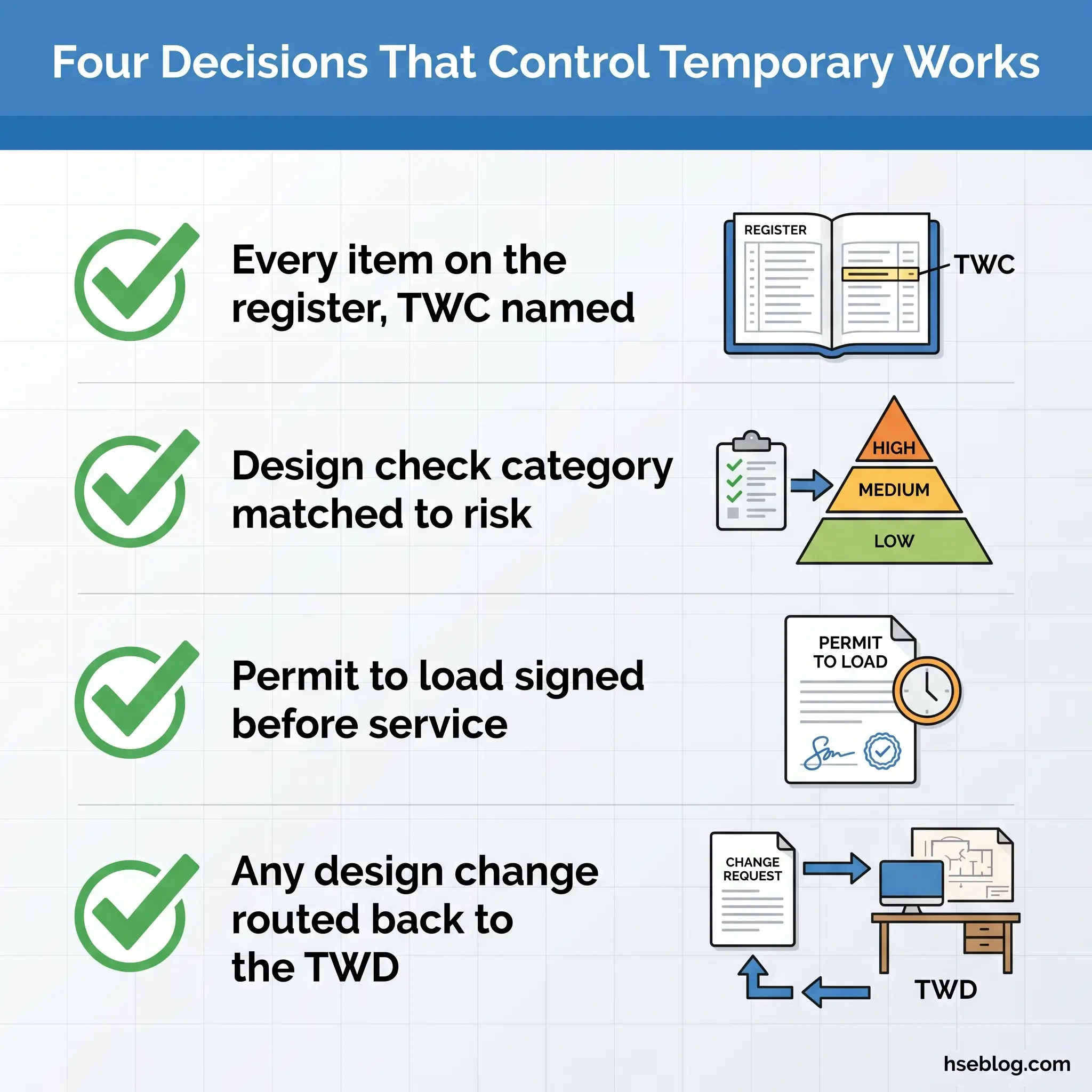
Any change to an approved design must route back to the TWD for reassessment. Any change means any change — bracing pattern, tie spacing, base condition, sequence, loads. The unauthorised-change pattern in the HSE casework is consistent enough that the procedural answer is unambiguous: if a design is to change, it is re-authorised in writing before the change happens on site.
Frequently Asked Questions
Key Takeaways
The practical discipline of temporary works comes down to four decisions, made in the right order. Confirm every temporary item exists on a register owned by a named TWC. Match the independent design check category to the consequence of failure — Cat 0 for standard solutions inside the tested envelope, Cat 3 for novel or high-consequence structures. Treat the permit to load and the permit to dismantle as real authorisations, not paperwork — they are the points where the chain of control either holds or breaks. And treat any proposed modification to an approved design as a new design question routed back to the temporary works designer, not a site-level judgement call.
Regulatory currency matters here. The UK temporary works framework moved to BS 5975-1:2024 and BS 5975-2:2024 on 31 December 2024, and content still citing the 2019 edition is out of date (BSI, 2025). US readers should note that OSHA regulates the same physical structures through Subparts L, P and Q without a unified coordinator role, and that BS 5975 procedures are increasingly applied as an internal baseline on US and international projects for precisely that reason.
This article is a reader-level orientation. It is not a replacement for CITB-accredited Temporary Works Coordinator or Temporary Works Supervisor training, and it is not legal advice — specific CDM 2015 compliance questions or enforcement situations should go to qualified construction legal counsel in the applicable jurisdiction.