

TL;DR
- 7 deaths, 58 injuries when the temporary roof structure over the Indiana State Fair grandstand stage collapsed in a single wind gust (Thornton Tomasetti, 2011).
- Failure began at ~33 mph gusts against an industry-standard capacity near 68 mph — collapse occurred far below the rated wind speed (Thornton Tomasetti investigation, 2012).
- A 0.85 load-reduction factor is applied to reused systems under ANSI E1.21, putting a number on the cumulative damage that repeated erection and transit cause (ANSI E1.21).
- No universal evacuation wind speed exists — the governing limit is each structure’s own engineered maximum wind load capacity, verified against how it was actually built.
Temporary structures at events — stages, grandstands, marquees, towers, screens and barriers — must be designed, erected, inspected and managed to the same safety expectation the public holds for permanent buildings. The event organiser usually carries primary legal responsibility. A competent person checks each structure against its engineered design and signs it off before the public is admitted, and requirements vary by jurisdiction.
On 13 August 2011, a wind gust struck the temporary roof and rigging structure over the main stage at the Indiana State Fair, and it collapsed onto the crowd waiting below. The forensic investigation commissioned by the State of Indiana recorded 7 deaths and 58 injuries (Thornton Tomasetti, 2011), and it became the reference case for how these structures fail.
What makes that collapse instructive is not that wind is dangerous — every organiser knows that. It is that the structure gave way well below the wind speed it was assumed to withstand, because the lateral load resisting system was never adequate. This article maps the full picture of temporary structures at events safety: what counts as a temporary structure, why they fail, who is legally responsible, the safety lifecycle, and how inspection actually works across the UK and US regimes.

What Counts as a Temporary Structure at an Event?
The category is far broader than the main stage, and underestimating its scope is where many scoping failures begin. A temporary structure is any engineered assembly erected for the event, used by the public or crew with a real expectation of safety, then dismantled — yet often falling outside routine building control.
In the UK and international events world, the term of art is temporary demountable structures (TDS). The US codified concept, set out in the 2024 International Building Code, instead distinguishes a “temporary structure,” a “public-occupancy temporary structure,” and a “temporary event” lasting under one year.
The structures that fall under this umbrella include:
- Stages and stage roofs — including suspended sound, lighting and video rigging.
- Grandstands and tiered seating — high-occupancy structures with crowd-dynamic loads.
- Marquees, tents and fabric structures — where the dominant hazard shifts toward fire and egress.
- Lighting and speaker towers, masts and screens — slender, wind-exposed and ballast-dependent.
- Fencing, front-of-stage barriers and hospitality units — load-bearing under crowd surge.
- Gazebos, signage and market stalls — small, numerous, and routinely treated as trivial.
That last group matters more than its size suggests. A consistent scoping failure is the team that diligently engineers the main stage while leaving gazebos, signage and stalls without an assigned owner — and these light structures are disproportionately involved in wind-displacement incidents precisely because nobody was made responsible for them.
The word “temporary” is the misconception that does the most damage. Temporary does not mean low-risk; reuse, repeated erection and dismantling introduce cumulative component damage and assembly error that a permanent building never accumulates.

Why Temporary Event Structures Fail: The Core Hazards
The dominant failure mode is wind and environmental loading acting on a structure whose lateral load resisting system — the guy lines, bracing and ballast that hold it upright against sideways force — is the weakest link. The primary frame is rarely what gives way first.
A pattern runs through the documented collapse record that every organiser should internalise: catastrophic failures rarely happen at the wind speed the structure was rated for. They happen well below it, because the as-built structure never matched the as-designed structure — a missing brace here, under-spec ballast there, a guy arrangement modified on site to clear an obstruction.
The Indiana State Fair investigation is the clearest illustration. The structure began to give way at gusts around 33 mph and could no longer support itself by around 43 mph, against an industry-standard expectation of withstanding roughly 68 mph, with a recorded gust near 59 mph (Thornton Tomasetti investigation, 2012).
The hazard families that drive these outcomes:
- Wind and lateral loading — the governing failure path on almost every outdoor structure.
- Inadequate or shifted ballast and anchorage — including poor ground bearing capacity beneath kentledge or ground anchors.
- Snow, rain pooling and combined loads — dynamic effects from crowd surge against barriers or swinging suspended rigging.
- Assembly error and component damage — accumulated through repeated transit, erection and reuse.
- Fire and egress hazards — specific to tents and membrane structures, and entirely distinct from structural collapse.
Wind: The Single Biggest Variable
Wind earns its own treatment because it is both the leading cause of collapse and the hardest hazard to manage in real time. The single most important engineering output for any outdoor structure is a defined maximum wind load capacity — the stated wind speed beyond which the structure must not be occupied.
That figure has to exist before the structure is ever erected, not be discovered during a storm. Without a stated operating limit, an on-site crew has no defensible basis for deciding when to reduce loading, clear the area, or evacuate — and the decision defaults to guesswork at the worst possible moment.

Who Is Legally Responsible for Event Structure Safety?
At most events the organiser holds primary legal responsibility for the safety of temporary structures, even when a contractor builds them. A competent person must design, check and inspect each structure and provide a signed certificate confirming it was built to the design before the public is admitted — though the legal mechanism differs sharply by jurisdiction.
This is not legal advice. The regulatory content here reflects general HSE professional understanding of UK and US requirements as of 2024. Specific compliance questions, enforcement situations, or prosecution risk should be directed to qualified legal counsel in the applicable jurisdiction. Regulatory currency was reviewed at the last-reviewed date shown in the byline.
Competent-person caveat. This article provides general HSE knowledge. Life-critical work such as the design, erection and structural sign-off of public-occupancy temporary structures must be planned and supervised by a competent person — for significant structures, a chartered or registered structural engineer — with relevant training, jurisdiction-specific authorization, and site-specific risk assessment. The information here does not replace that.
In the UK, the duty sits within general health-and-safety law rather than a bespoke structures code. Organiser obligations flow from the Health and Safety at Work etc. Act 1974 and the Management of Health and Safety at Work Regulations 1999, with design and contractor duties allocated under the Construction (Design and Management) Regulations 2015. The competent-person concept is central, and the IStructE guidance on temporary demountable structures is the recognised reference for design, independent design check and handover.
A point that catches many UK organisers out: building control legislation frequently does not apply to TDS, so people assume scrutiny is light. It is not. Safety Advisory Groups and local authorities still require demonstrated due diligence, and the HSE event-safety guidance on temporary demountable structures sets the regulator’s expectation.
The US route is codified. When a structure qualifies as a public-occupancy temporary structure, the 2024 International Building Code Chapter 3103 brings it under code, the International Fire Code Chapter 31 governs tents and membrane structures, and the owner must employ a qualified, independent approved agency to inspect the installation and furnish an inspection report to the fire code official.
How the two regimes compare:
| Dimension | UK guidance route | US codified route |
|---|---|---|
| Governing reference | IStructE TDS guidance + Purple Guide, under HSWA 1974 / CDM 2015 | ANSI E1.21-2024 + 2024 IBC Ch. 3103 + IFC Ch. 31 |
| Who inspects | Competent person; independent check for significant structures | Owner’s qualified, independent approved agency |
| Building-control status | Building control often does not apply; SAG/local-authority due diligence does | Permit and code-compliance route applies |
| Wind-management mechanism | Structure-specific max wind load capacity with staged 60% / 80% action thresholds | ANSI E1.21 with ASCE 7-derived loads and service-life reductions in the IBC |
| Legal posture | Voluntary guidance, legally enforced through general duties | Codified, enforced through permit and inspection |
Across both regimes, the registered or chartered structural engineer and the independent design check are the technical backbone — the people whose judgment underwrites the wind rating everything else depends on.
The most persistent organisational failure here is diffuse accountability — an ambiguity of authority where no single named person held the power to halt the build or order an evacuation. The fix is one named, briefed decision-maker with explicit stop authority, identified in writing before the event opens.

The Safety Lifecycle: Design, Procurement, Erection, Use, Dismantling
Safety here is a lifecycle, not a single inspection, because the inspection only validates decisions made much earlier. Each phase has its own evidence gate, and a gap at any gate carries forward into everything after it.
The field procedure most aligned with the IStructE approach and the Purple Guide chapter on temporary demountable structures runs through six phases:
- Design. A documented basis of design with loadings, calculations and drawings, plus a stated maximum wind speed and operating limits. Significant structures get an independent design check.
- Procurement. Selecting competent, adequately resourced contractors and requesting their documentation early — UK practice is roughly 28 days before the event, not the week of build.
- Erection. Safety-critical checkpoints with hold-points, where a competent person confirms each stage before the next proceeds rather than signing off at the end.
- Handover. A signed sign-off or completion certificate confirming the structure was built to the design and is fit for use.
- In-use management. An operations management plan, ongoing checks, and execution of the wind management plan as conditions change.
- Dismantling. A discrete hazard phase in its own right — tired crews, removed bracing and partial loads — not an afterthought once the public has gone.
The judgment call worth flagging sits between phases four and five. Many teams treat the handover certificate as the end of structural safety, when the highest-risk window is actually in-use, under weather that shifts after sign-off. The certificate is a starting line, not a finish line — it confirms the structure was right at handover, not that it stays right through a storm three days later.

Inspection in Practice: Who, When, and What Gets Checked
Inspection is not one event but a set of distinct checks tied to distinct triggers, and conflating them is a common gap. Each type confirms a different thing, and each is performed by a competent person — for significant structures, an independent or qualified one.
The four inspection types and what sets them off:
| Inspection type | Trigger | Primary purpose |
|---|---|---|
| Independent design check | Before fabrication/erection | Confirm the design is sound before anything is built |
| Erection / handover check | Before the public is admitted | Confirm built-to-design; basis for the sign-off certificate |
| Periodic in-use inspection | Regular intervals during use | Confirm continued integrity under live loading |
| Re-inspection (triggered) | After high winds, impact, or any stability-affecting event | Confirm the structure survived the event intact |
What gets physically checked spans the load path end to end:
- Anchorage and ballast — quantity, placement and condition of kentledge or ground anchors.
- Bracing and guy lines — present, correctly arranged and tensioned to the design.
- Connections and structural members — bolts, pins and frames sound and complete.
- Foundations and bearing — ground capacity adequate under point loads.
- Egress — exits unobstructed and adequate for occupancy.
- Electrical installations within the structure.
- Flame-resistance certification for fabrics and membranes.
In the US, the standards put numbers on this. NFPA 102 governs anchoring against wind load, flame resistance and egress minimums for tents; ANSI E1.21 sets inspection criteria and applies a 0.85 load-reduction factor to the strength of reused systems (ANSI E1.21), a quantified acknowledgement that a structure on its tenth outing is not the structure it was when new.
The most-missed inspection item is the one that matters most. Inspectors reliably confirm that bolts are tight — far fewer verify the structure as-built against the as-designed calculations, checking that the actual guy and ballast arrangement matches the engineered design the wind rating depends on. Tight bolts on the wrong configuration is still the wrong configuration.
The Wind Management Plan
The wind management plan is the operational mechanism that connects a structure’s engineered limit to real-time action. It translates a number on a drawing into a sequence of pre-decided steps that someone is named and authorised to take.
UK practice uses a staged-threshold approach built on the structure’s maximum wind load capacity:
- At 60% of capacity — begin pre-defined precautionary actions: reduce loading, secure or lower banners and screens, brief the team.
- At 80% of capacity — escalate toward clearing the area and preparing to evacuate.
- A named monitor with authority — one person tracking conditions against the thresholds, empowered to act without seeking permission.
The plan only works if the actions are decided in advance and the monitor’s authority is real. A threshold with no pre-agreed action, or a monitor who has to find a manager before clearing a structure, fails at exactly the moment it is needed.

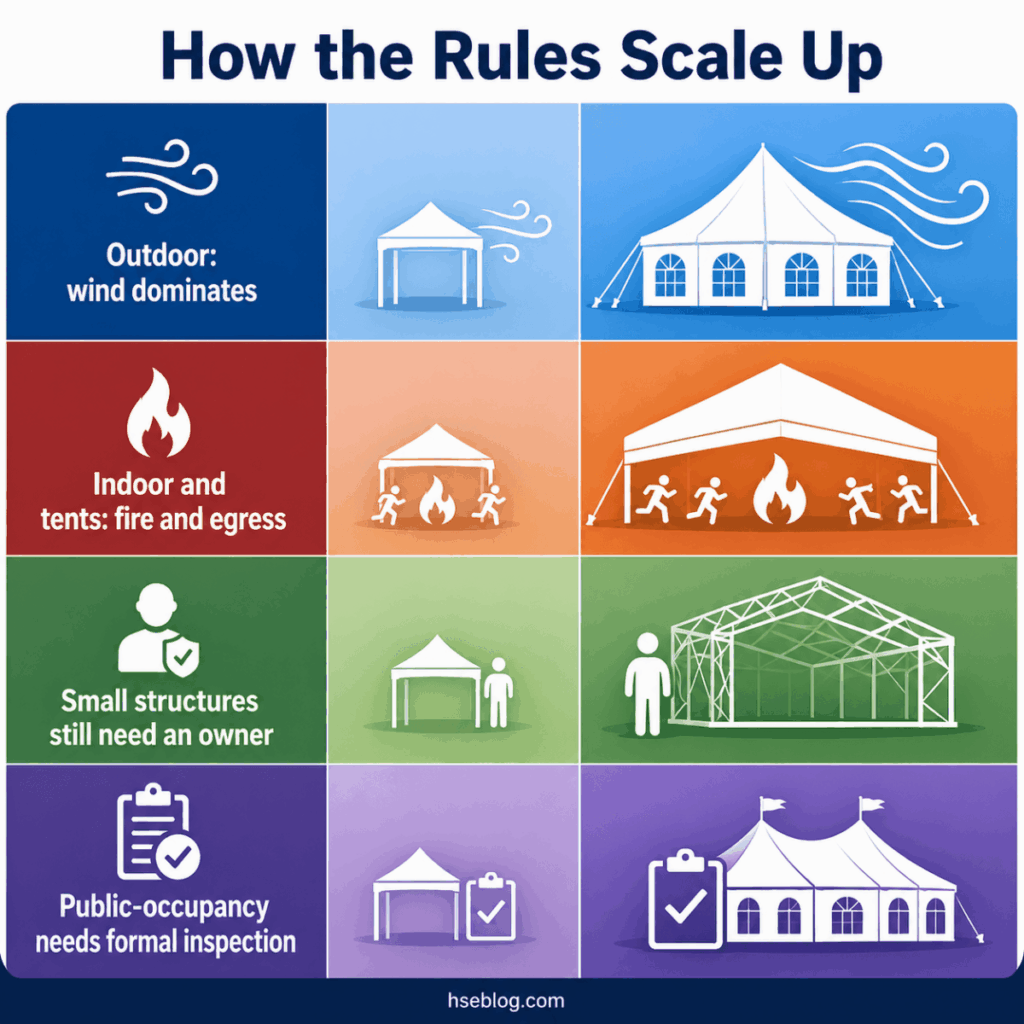
Indoor vs. Outdoor and Big vs. Small: How the Rules Scale
Applying stage-roof rigour to a market gazebo wastes effort; applying gazebo-level attention to a grandstand kills people. Requirements scale with size, occupancy and exposure — and moving a structure indoors changes which hazard dominates.
The dominant hazard flips with the environment:
- Outdoor structures — wind and environmental loading governs. The lateral load resisting system and the wind management plan are the centre of gravity.
- Indoor and tent structures — fire safety, flame resistance and egress dominate, governed in the US by NFPA 102 and IFC Chapter 31. Wind recedes; ignition sources and exit capacity move to the front.
Size and occupancy then set the depth of the regime:
| Structure scale | Engineered design | Independent check | Formal inspection report |
|---|---|---|---|
| Small (gazebo, stall, signage) | Risk assessment + correct ballast/anchorage | Competent-person check | Site records |
| Medium (small stage, hospitality unit) | Documented basis of design | Competent person; independent where significant | Records on and off site |
| Large / public-occupancy | Full engineered design | Independent design check required | US: inspection report to fire code official |
The trap at the small end is the assumption that little structures are exempt. They are not — a gazebo still needs a risk assessment, proper ballast, and a named owner, and the wind-incident record shows these are the structures most often displaced precisely because that ownership was never assigned.

Frequently Asked Questions
Conclusion
The industry’s recurring mistake is treating a temporary structure’s wind rating as a guarantee rather than a condition. The Indiana State Fair collapse killed people at gusts far below the capacity everyone assumed the structure had, because the as-built configuration never matched the engineered design (Thornton Tomasetti, 2012) — and that gap, not the weather, is the failure most worth fixing.
The single highest-impact change is also the cheapest: verify as-built against as-designed, and put one named person with explicit stop authority in charge of the wind management plan. The 2024 IBC Chapter 3103 finally pulled many of these structures under code, more than a decade after the lessons were available — proof that codification lags reality and that organisers cannot wait for the rulebook to catch up.
Temporary structures at events safety comes down to refusing the convenience of the word “temporary.” Build, inspect and monitor every stage, grandstand, marquee and gazebo as the engineered, public-occupied structure it actually is — because the crowd standing under it has no way of knowing it was only meant to last a weekend.