
TL;DR
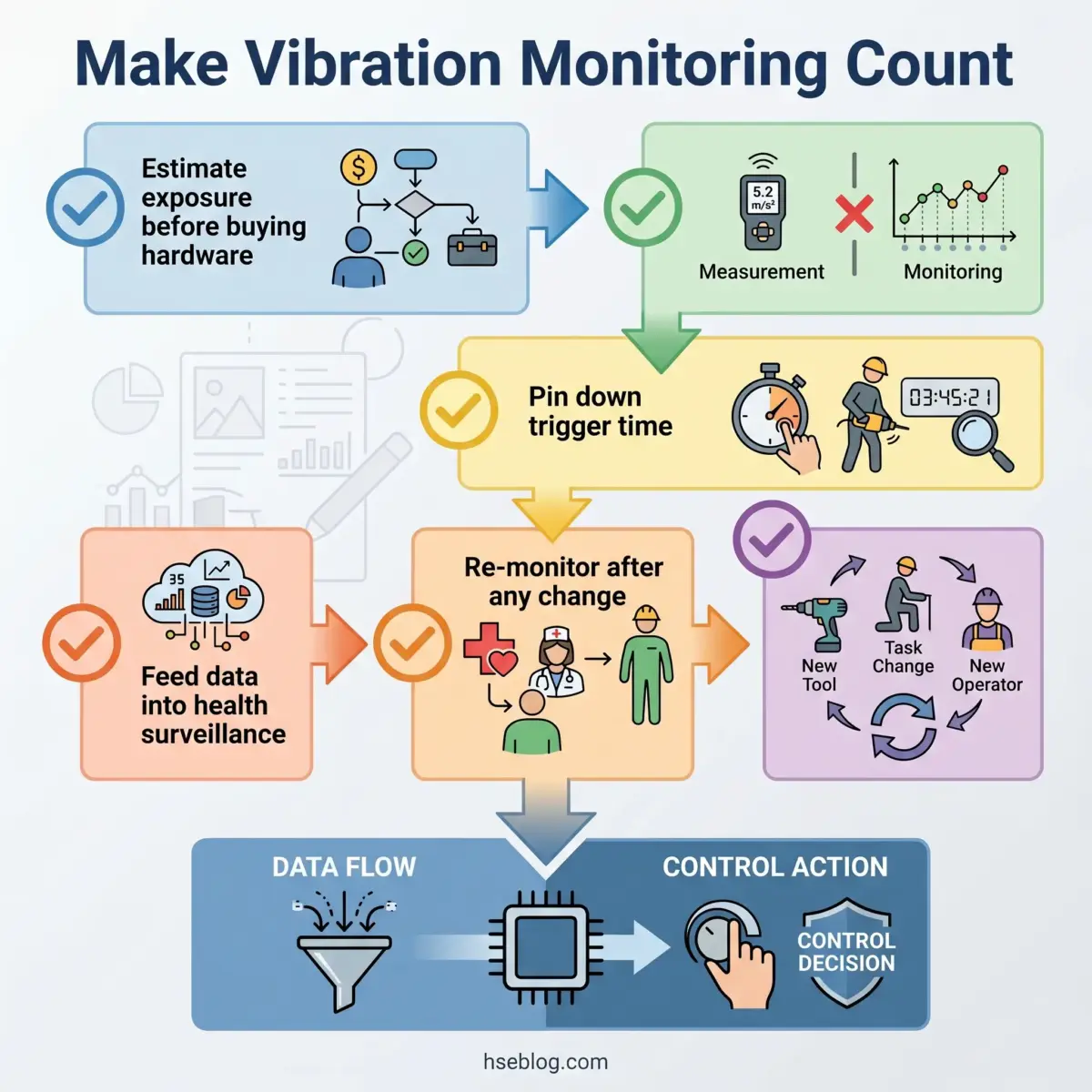
- Estimate before you buy hardware. For most workplaces, manufacturer and HSE magnitude values are enough to start a vibration risk assessment.
- Measurement and monitoring are not the same thing. Measurement quantifies tool magnitude in m/s²; monitoring tracks how long workers are exposed.
- Trigger time is the weakest link. Guessed exposure durations, not magnitude error, cause most underestimated A(8) figures.
- Thresholds differ by jurisdiction. The UK/EU set enforceable HAV limits; the US has none — only an advisory ACGIH reference.
- Data is worthless until it drives a control. Monitoring that isn’t tied to a control decision is a compliance liability, not an asset.
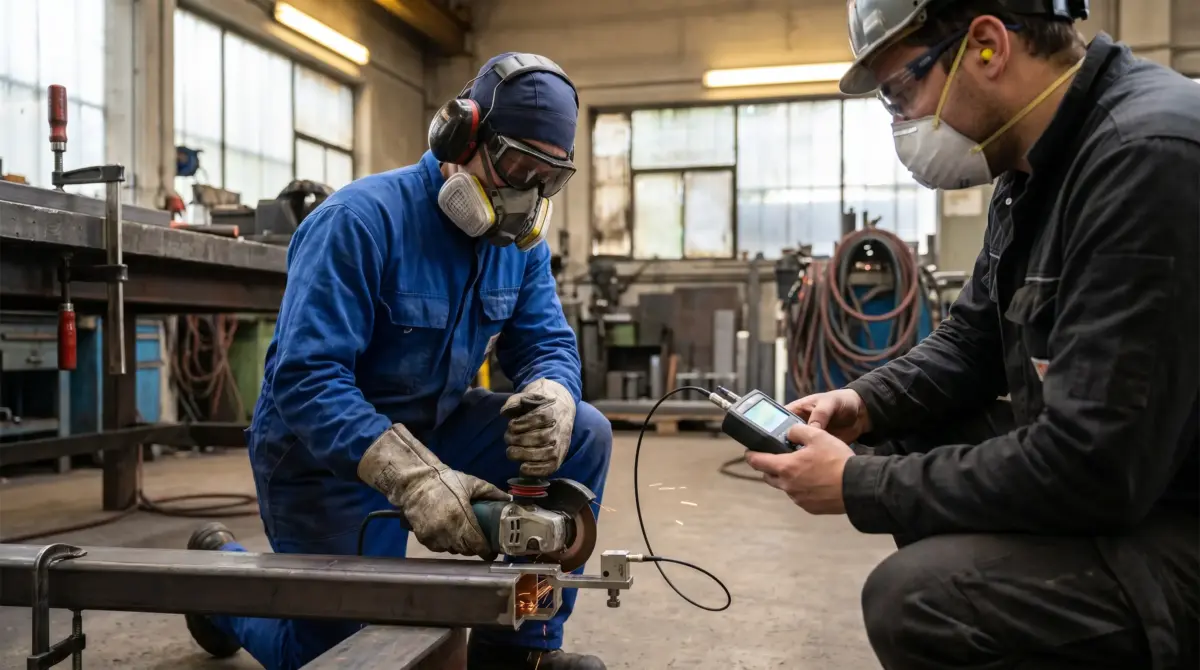
Vibration monitoring is the process of quantifying and tracking workers’ exposure to hand-arm and whole-body vibration so that risk can be controlled, not merely recorded. It combines measurement of vibration magnitude (m/s²), tracking of trigger time, and calculation of the A(8) daily exposure value against legal action and limit values.
What Vibration Monitoring Actually Means in an HSE Context
The first thing to settle is what is being monitored, because two unrelated disciplines rank for this query and conflating them wrecks the work. This article covers occupational human-exposure monitoring — protecting people. It does not cover machine condition monitoring, where accelerometers watch bearings and gearboxes to predict mechanical failure. Same sensors, entirely different purpose.
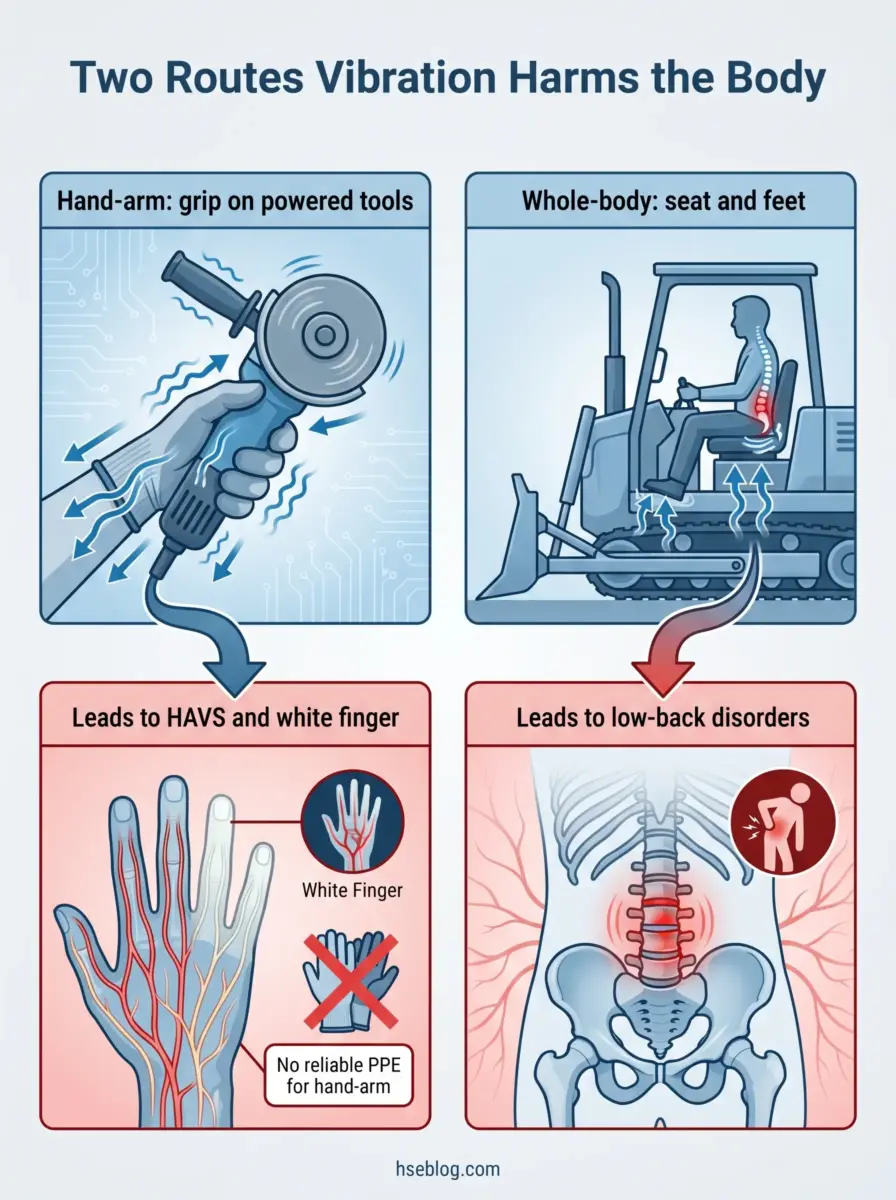
Human exposure splits into two routes, and the monitoring approach differs for each.
| Exposure route | How it transmits | Typical sources |
|---|---|---|
| Hand-arm vibration (HAV) | Through the grip, into hands and arms | Grinders, breakers, chainsaws, impact wrenches, needle scalers |
| Whole-body vibration (WBV) | Through the seat or feet | Off-road vehicles, forklifts, mobile plant, vibrating platforms |
Monitoring exists to prevent specific, diagnosable harm — not to satisfy a folder. The health endpoints it targets include:
- HAVS (Hand-Arm Vibration Syndrome) — vascular damage (vibration white finger), sensorineural loss, and musculoskeletal effects.
- Carpal tunnel syndrome — a recognised hand-arm vibration outcome alongside HAVS.
- Low-back disorders — the principal whole-body vibration concern, often compounded by poor posture and shock loading.
Content here covering HAVS symptoms, health surveillance and biological monitoring is for HSE practitioner reference. It is not medical advice. Workers with symptoms such as finger blanching, numbness or tingling should consult an occupational physician or qualified medical professional.
One framing matters more than any other on this topic. HAV has no effective PPE solution. Unlike noise or dust, you cannot engineer the hazard away at the hand with protective equipment — anti-vibration gloves help only narrowly and at specific frequencies. That single fact pushes measurement and administrative control to the front of the defence, which is precisely why monitoring carries so much weight here.
A pattern worth naming early: organisations routinely buy monitoring hardware first and define their risk-assessment purpose second. They generate dashboards of exposure points that nobody converts into a decision. Monitoring data that isn’t wired to a control choice doesn’t reduce risk — it just documents it.
What’s the Difference Between Vibration Measurement and Exposure Monitoring?
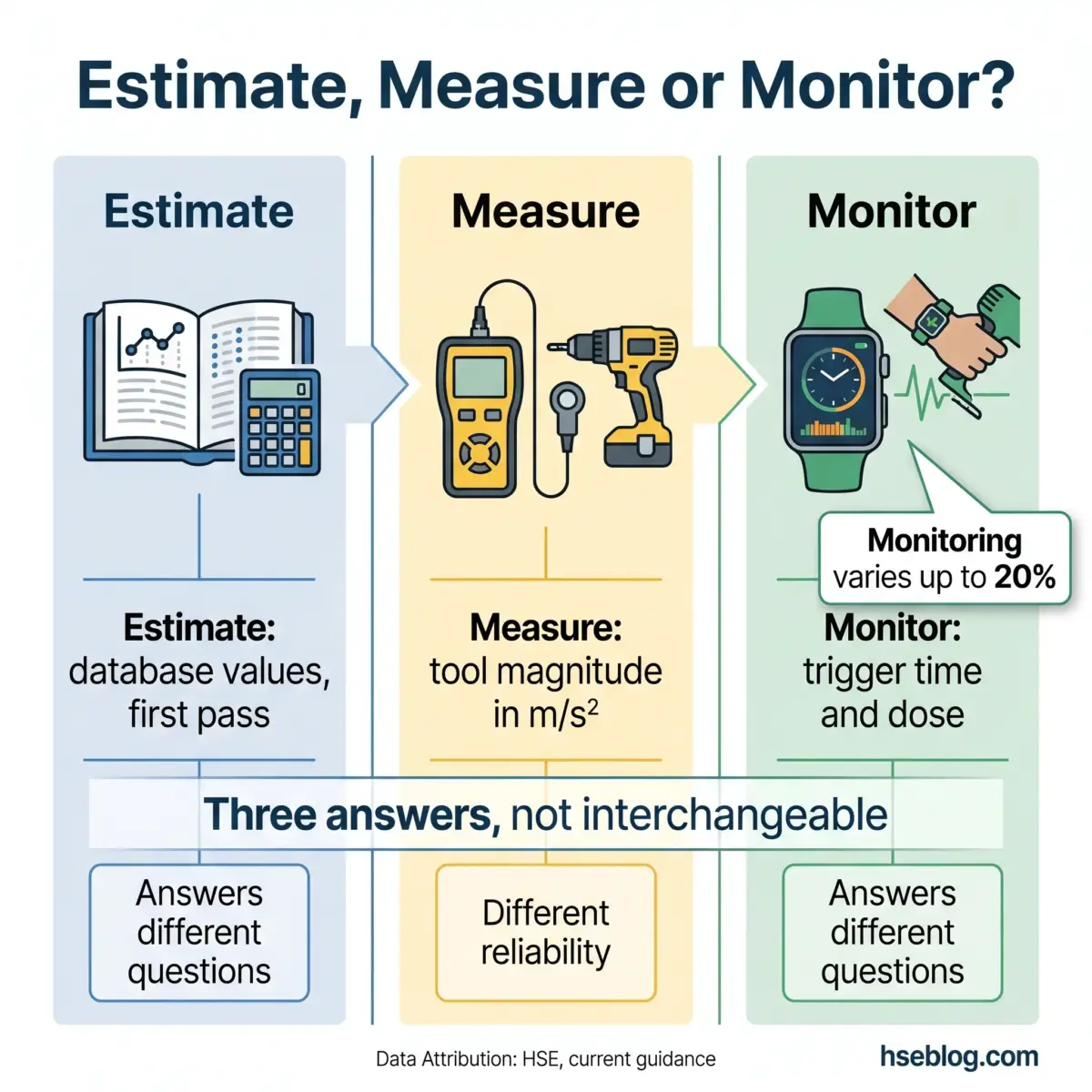
These are three different activities answering three different questions, and most blog content collapses them into one. Measurement quantifies magnitude. Monitoring tracks duration and dose. Estimation pulls a value off a database. Treating them as interchangeable is the single most common technical error on this subject.
| Method | What it answers | Accuracy | When to use | Standard / caveat |
|---|---|---|---|---|
| Estimation | Roughly how much vibration does this tool emit? | Indicative; depends on data quality | First-pass risk assessment | HSE / manufacturer magnitude values |
| Measurement | What is this tool’s actual magnitude in m/s²? | High, if done competently | Validating controls; defending a claim; no reliable data exists | ISO 5349 / ISO 2631; needs ISO 8041 instruments |
| Monitoring | How long, and how much dose accumulated? | Variable — see caveat | Tracking trigger time across a shift | Timers/loggers/wearables; not a magnitude measurement |
A few practical distinctions decide which you reach for.
- Estimation is the recommended starting point. It is the fastest, cheapest route and is genuinely sufficient for most initial assessments where reliable magnitude data already exists. The HSE guidance on vibration measurement and monitoring is explicit that you do not need bespoke measurement for every tool.
- Measurement is the exception, not the default. You measure when reliable data isn’t available, when you’re proving a control actually worked, or when a claim needs defending — and it must be done by a competent person with ISO 8041-compliant kit.
- Monitoring tracks the clock, not the tool. Timers, loggers and wearables tell you exposure duration and accumulated dose. They do not tell you the tool’s true magnitude.
Here the published guidance carries a warning practitioners should quote back to anyone selling certainty: electronic monitoring systems can vary by up to around 20% when measuring the same task (HSE, current guidance). That spread is the line between an exposure indicator and an accredited measurement — and the two should never be filed under the same heading.
The recurring audit finding is sharper than the hardware debate. Exposure data used to claim compliance often grossly underestimates real exposure because the trigger times were guessed, not measured. Magnitude tends to be reasonably known; duration is where the assessment quietly falls apart.
The Tools: Instruments and Devices for Vibration Monitoring
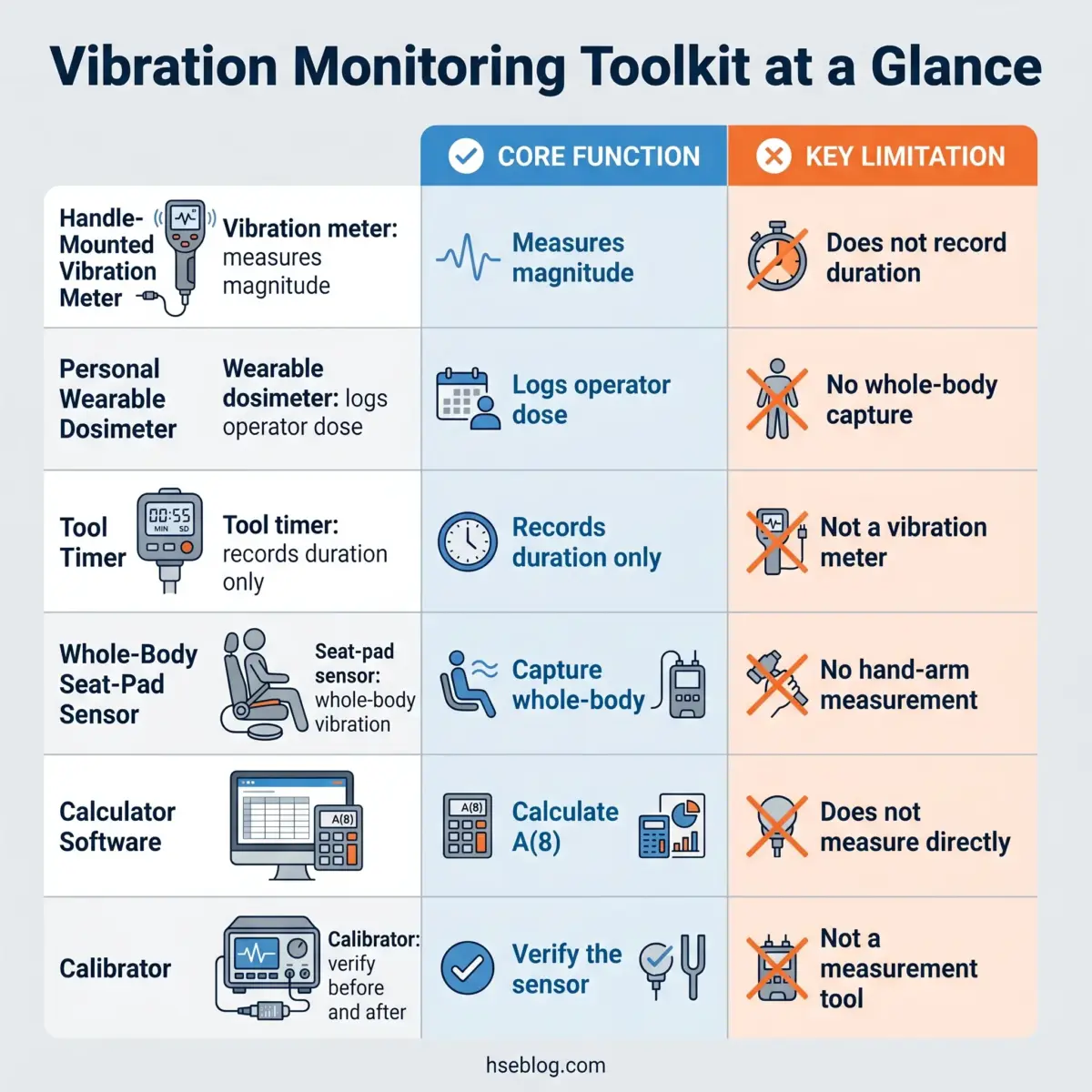
The hardware falls into six functional classes, and the title’s promise is met by knowing what each does — and, more usefully, what each does not. None of these is endorsed by brand here; what matters is the function and the governing standard.
- Human vibration meters / HAVS meters. Tool-handle-mounted instruments with a triaxial accelerometer that quantify magnitude in m/s². Does: measures real vibration emission. Doesn’t: track how long the worker actually used the tool. Governed by ISO 8041-1:2017.
- Personal vibration exposure meters / dosimeters. Palm-, finger- or wrist-mounted devices worn by the operator. Does: logs per-person exposure and accumulated dose. Doesn’t: replicate accredited tool-handle measurement. Governed by ISO 8041-2:2021.
- Tool timers and data loggers. Attach to or pair with a tool. Does: records duration — trigger time. Doesn’t: measure magnitude at all.
- Seat-pad triaxial sensors (WBV). A weighted pad placed on the operator’s seat. Does: captures whole-body vibration with the vertical z-axis weighted distinctly. Doesn’t: apply to hand-arm work.
- Software and calculators. A(8) and exposure-points calculators that turn magnitude plus duration into a compliance figure. The official HSE hand-arm vibration exposure calculator is the reference tool here rather than a spreadsheet of your own.
- Calibrators. Field calibration sources used to verify accelerometers before and after measurement — a non-negotiable step, not an accessory.
The procurement mistake I see repeatedly sits between the third item and the first: a tool timer logs duration, a vibration meter measures magnitude, and the two are bought interchangeably. An organisation buys timers, assumes it now “measures vibration,” and discovers at audit that it has half the A(8) equation and no magnitude data at all. The ISO 8041-1 instrumentation standard is worth citing in any procurement spec precisely to force that distinction into the purchase order.
Wearable and Real-Time Dosimeters: Promise and Limitations
This is the fastest-growing class and deserves a balanced read rather than either hype or dismissal. The maturing of real-time wearable and finger-mounted HAV dosimeters with on-device A(8) and points alarms (2025) has genuinely advanced routine exposure visibility — but it has also raised open questions about accuracy against tool-mounted measurement.
What they do well:
- Live exposure-point alarms that warn an operator approaching the action value during the shift, not after it.
- Per-operator and per-tool records that make planning and task rotation evidence-based.
- Planning data that surfaces which tasks dominate a worker’s dose.
Where the caution lies:
- Coupling and placement differ from ISO 5349. A finger- or glove-mounted sensor sees vibration through a different transmission path than a handle-mounted accelerometer, so the numbers can diverge.
- Practical constraints. Battery life, charging discipline and correct fitting all affect reliability across a real shift.
- They are not accredited measurement. A wearable A(8) is an exposure indicator, not a legal measurement of the tool’s magnitude.
The judgement call is straightforward once stated: use wearables to manage and alert in real time, but don’t present a wearable reading as the tool’s certified magnitude. Those are two jobs, and only one of them is the wearable’s.
The Techniques: How to Monitor and Measure Correctly
Getting a defensible number depends less on the instrument and more on the method around it. The workflow below is what a competent person follows; the arithmetic that turns it into A(8) comes in the next part.
This article provides general HSE knowledge. Life-critical and compliance-defining work — such as accredited ISO 5349 vibration measurement and the controls that depend on it — must be planned and supervised by a competent person with relevant training, jurisdiction-specific authorisation, and a site-specific risk assessment. The information here does not replace that. Recognised training pathways include NEBOSH, IOSH and equivalent regional qualifications.
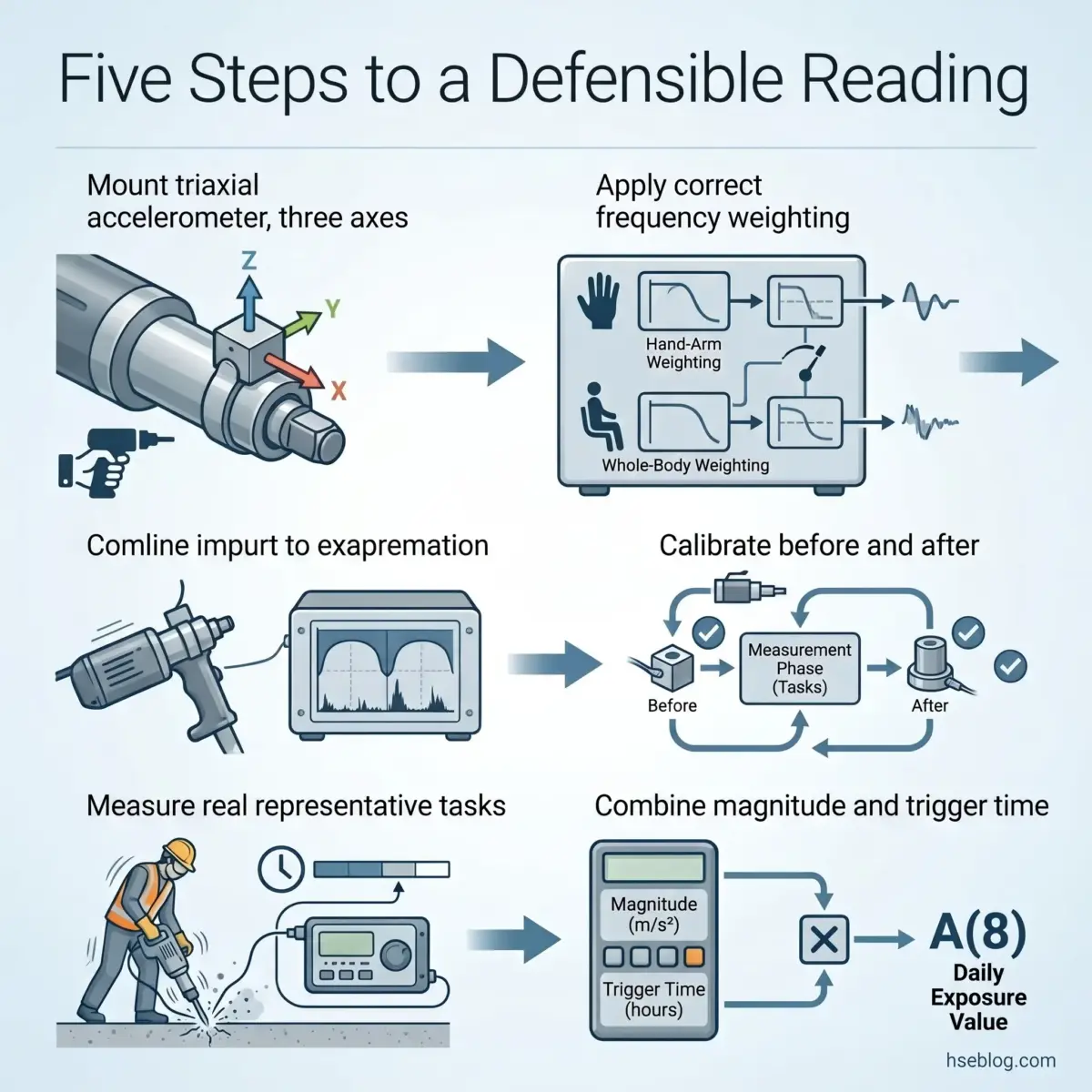
Worked correctly, the measurement sequence runs like this:
- Mount and orient the accelerometer. Capture all three orthogonal axes (X, Y, Z). For whole-body work the vertical z-axis is the dominant, distinctly weighted axis on the seat pad.
- Apply the correct frequency weighting. Hand-arm uses the Wh weighting under ISO 5349, with peak sensitivity around 8–16 Hz; whole-body uses the Wk and Wd weightings under ISO 2631.
- Field-calibrate before and after. Verify the accelerometer against a calibrator at the start and again at the end, so any drift is caught.
- Segment the work by task. Measure representative real-shift tasks, not idealised showroom runs. A tool cutting hard stock behaves differently from the same tool idling.
- Record duration alongside magnitude. A magnitude reading without a trustworthy trigger time is half an answer. CCOHS’s overview of vibration measurement and frequency weighting is a useful neutral reference for the weighting logic if you’re building competence here.
The variability is not noise to be wished away — it is the finding. Two operators using the same tool for the same time routinely produce different magnitudes. Grip force, posture, tool wear and the workpiece material all change what reaches the hand.
Sources of error to plan for:
- Operator grip and technique — tighter grip generally transmits more.
- Tool condition — a worn or blunt tool runs harder and longer.
- Workpiece material — hard or inconsistent stock spikes magnitude.
- Measurement method itself — placement and coupling differences shift the reading.
A single “spot” reading treated as a tool’s permanent value is a classic over-confidence trap. One measurement is a snapshot, not a constant.
Calculating Daily Exposure: A(8), Trigger Time and the Points System
A(8) is where magnitude and duration finally combine into something the regulations recognise. It normalises a day’s exposure to an eight-hour reference, so different tools and durations can be compared and summed on one scale.
| Tool magnitude (m/s²) | Trigger time to reach EAV | Trigger time to reach ELV |
|---|---|---|
| Lower-vibration tool (~3) | Longer working window | Rarely reached in a shift |
| Mid-range tool (~5) | Reached within a couple of hours | Reached over a full shift |
| High-magnitude breaker (~10+) | Roughly 15 minutes to the EAV | Reached well within the shift |
(Illustrative relationships only — use the official HSE calculator for actual figures.)
The exposure-points system makes day-to-day management easier than juggling decimals:
- The Exposure Action Value (EAV) equals 100 points, which is an A(8) of 2.5 m/s² for hand-arm vibration.
- The Exposure Limit Value (ELV) equals 400 points, an A(8) of 5 m/s² for hand-arm vibration.
- Partial exposures sum across the shift. Use three tools, and you add their points — a worker rarely reaches the limit on one tool alone, but easily does across several.
A high-magnitude breaker can drive a worker to the EAV in roughly 15 minutes of trigger time. That single figure reframes how managers think about “just a quick job.”
Exposure Thresholds Across Jurisdictions
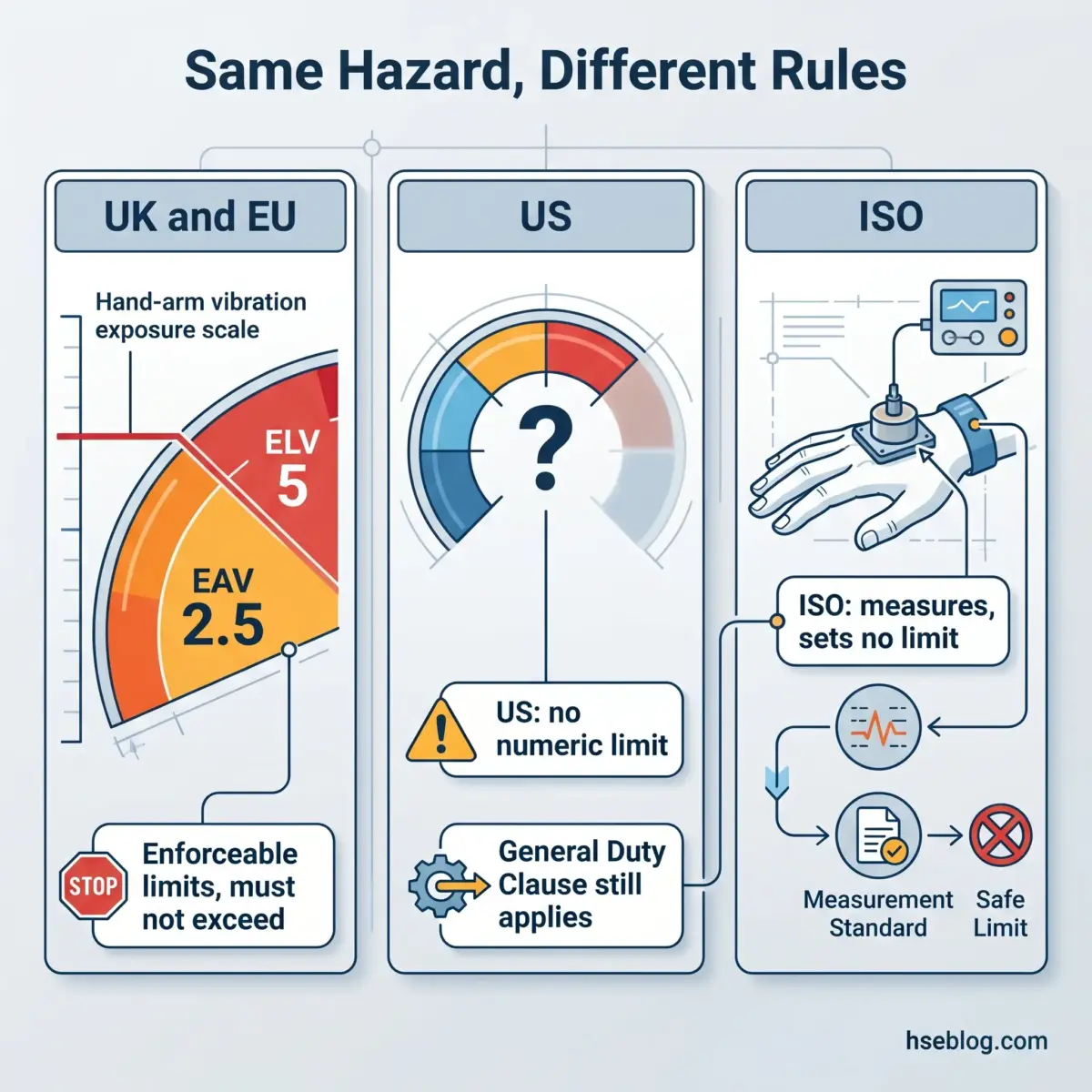
The same hazard carries different legal weight depending on where you operate, and the apparent contradictions resolve once you separate “how to measure” from “how much is allowed.” The UK and EU set enforceable numbers; ISO refuses to set any; the US sets none but still imposes a duty.
| Framework | Hand-arm A(8) | Whole-body A(8) | Status |
|---|---|---|---|
| UK — Control of Vibration at Work Regulations 2005, Reg. 4 | EAV 2.5 / ELV 5 m/s² | EAV 0.5 / ELV 1.15 m/s² | Enforceable |
| EU — Directive 2002/44/EC | EAV 2.5 / ELV 5 m/s² | EAV 0.5 / ELV 1.15 m/s² | Enforceable (via member-state law) |
| US — OSHA General Duty Clause §5(a)(1) + ACGIH TLV | ACGIH TLV (advisory, ~2.5/5) | No specific value | No numeric PEL; advisory reference |
| ISO 5349-1 / ISO 2631-1 | Defines measurement only | Defines measurement only | Explicitly sets no safe limit |
A few points make the table usable:
- The UK regulations require employers to assess exposure, control above the EAV, and never exceed the ELV. This is the most prescriptive of the frameworks and the safe conservative reference.
- The EU directive is the parent. Member-state laws — the UK regulations among them — implement its minimum action and limit values plus duties for assessment, control and health surveillance.
- ISO 5349-1 defines triaxial measurement, Wh weighting and A(8) evaluation, but explicitly does not define safe limits. It tells you how to measure, not what is acceptable.
Regulatory content here reflects a general HSE professional understanding of the cited jurisdictions’ requirements as at 2025. It is not legal advice. Specific compliance questions, enforcement situations or prosecution risk should be directed to qualified legal counsel in the applicable jurisdiction. Regulatory content was last reviewed at the publish date shown in the byline.
The misread to correct is the US position. “No US limit” is widely heard as “no US obligation,” and that is wrong. The General Duty Clause requires employers to furnish a workplace free of recognised hazards, and NIOSH directs employers to the ACGIH TLV as the recognised standard of care. A US employer carries a real exposure-control duty despite the absence of a numeric PEL.
From Data to Action: Using Monitoring to Drive Controls
Monitoring earns its budget only at the moment a number changes a decision. The hierarchy of controls applies to vibration as it does to any hazard, but with one twist already noted — PPE sits at the bottom and barely moves the needle for hand-arm exposure.
Applied to vibration, the hierarchy reads:
- Eliminate or substitute. Choose a lower-vibration tool or a method that removes the vibrating step entirely — the single highest-impact control.
- Limit trigger time. Cap how long any worker holds the tool; rotate tasks so dose is shared, not concentrated.
- Maintain equipment. Worn, blunt or poorly serviced tools raise both magnitude and the time needed to finish the job.
- PPE last. Anti-vibration gloves tested to ISO 10819:2013 offer limited, frequency-dependent benefit and never substitute for the controls above.
Monitoring data should also trigger and feed health surveillance, not replace it. Where workers are exposed above the EAV or are otherwise at risk, health surveillance is required, and the exposure record is what tells you who falls into that group. Surveillance picks up early HAVS signs; monitoring tells you where to look.
The enforcement record shows what failure costs. In April 2025, Stonewater Limited was fined £140,000 after two grounds-maintenance workers developed HAVS — one using vibrating equipment around 90% of his working day (HSE, 2025). In November 2025, Nottingham City Homes Ltd was fined £32,000 following more than ten reported vibration ill-health cases among bricklayers, joiners, electricians and others (HSE, 2025). An NHS Trust was fined £40,000 in January 2026 (HSE Media Centre, 2026). The direction is one way: inadequate monitoring and health surveillance is being actively prosecuted.
The scale of harm sits behind those fines. There were 220 new HAVS cases assessed for Industrial Injuries Disablement Benefit in Great Britain in 2024 (HSE, 2025), part of 2,860 new HAVS IIDB cases across 2015–2024 — only five of them among women, reflecting historic exposure patterns (HSE, 2025). Older HSE-linked material citing up to 300,000 working days lost per year to hand-arm disability is sometimes quoted; treat it as a dated estimate and lean on the current IIDB figures for prevalence.
The quiet failure to watch for is “set-and-forget.” A low-vibration tool purchased two years ago is not still a control today if it is worn, if the task changed, or if new operators with heavier grip joined the crew. Controls decay silently between audits, and only re-monitoring after tool wear, task change or new operators catches it.
Frequently Asked Questions
The Lesson the Enforcement Record Keeps Teaching
If there is one thing the industry consistently gets wrong about vibration monitoring, it is mistaking the act of collecting numbers for the act of controlling risk. Dashboards fill, points accumulate, and exposure quietly stays the same because nobody converted the data into a decision about tools, time or task rotation.
The highest-impact change is also the least glamorous: pin down trigger time and treat measurement and monitoring as separate jobs. Magnitude is usually known well enough to start; it is guessed durations that collapse an assessment, and it is the gap between an indicator and an accredited measurement that gets organisations caught. The six-figure fines through 2025 and into 2026 were not for bad luck — they followed exposure that was never properly controlled.
Vibration monitoring works when every number ends in an action. Estimate first, measure when it counts, monitor to catch drift, and re-check the moment a tool wears, a task changes or a new operator picks up the grinder. The worker whose fingers blanch in the cold years from now is the one your monitoring was supposed to be for — that is the test of whether yours is doing its job.