
TL;DR
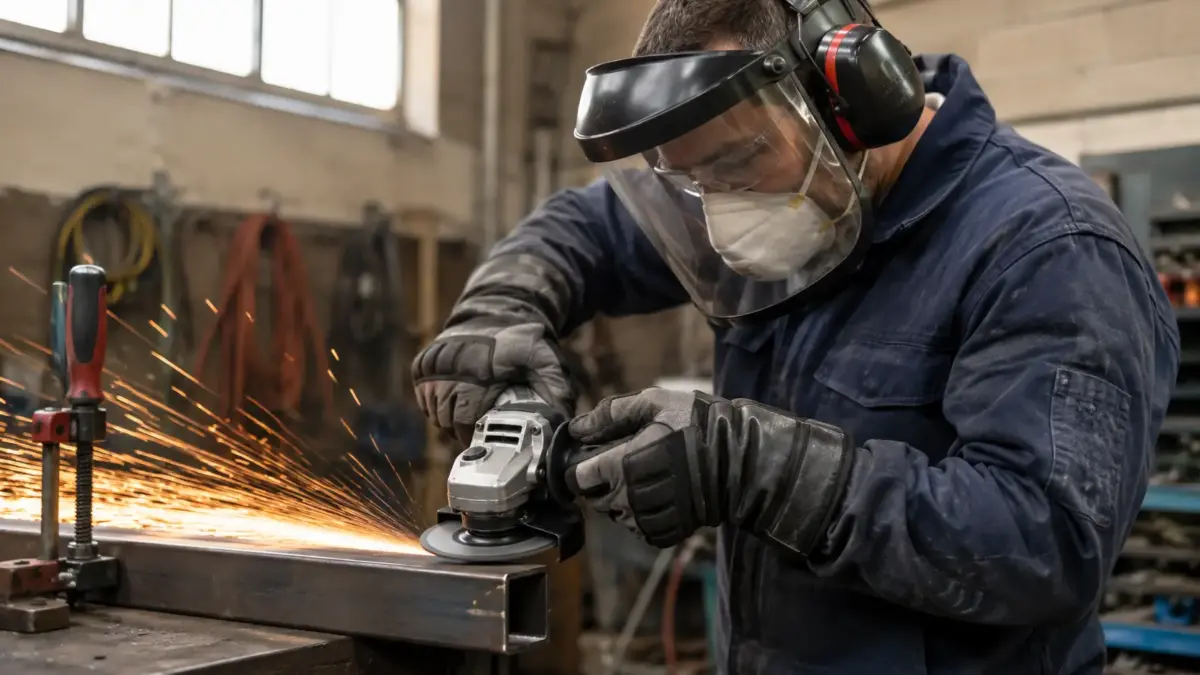
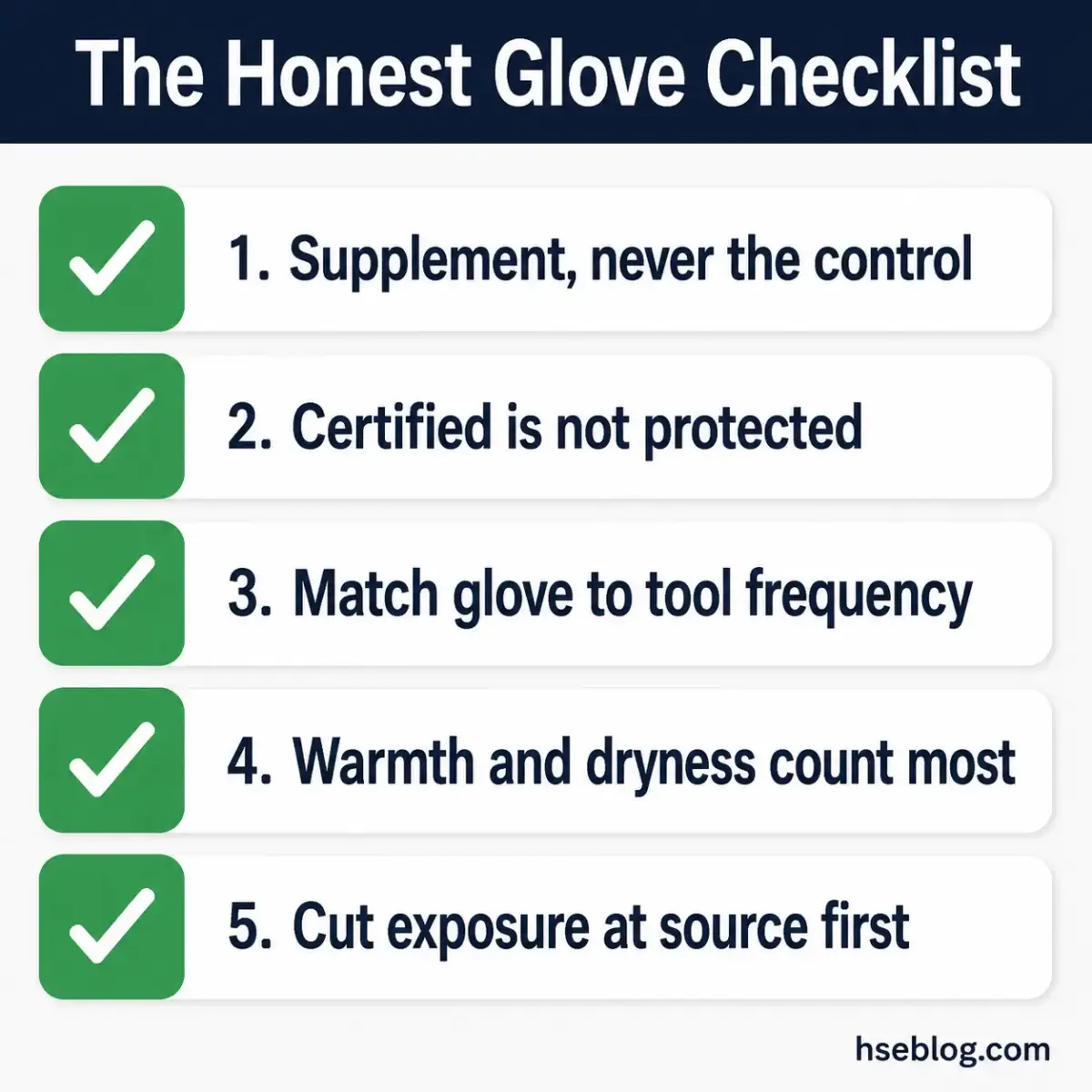
- Myth: Anti-vibration gloves are a first line of defence against HAVS. Reality: The HSE states no PPE can be shown to reduce hand-arm vibration risk.
- Myth: A certified glove protects against your tool. Reality: ISO 10819 is a laboratory benchmark, not a guarantee for any specific tool.
- Myth: More padding means more protection. Reality: Some gloves amplify certain frequencies and cut grip strength by over a third (NIOSH).
- Myth: Buying the gloves closes out the risk assessment. Reality: The legal duty is to reduce exposure at source — gloves do not discharge it.
Anti-vibration gloves work only partially. They can modestly reduce high-frequency vibration but do little against the low and mid-frequency vibration that actually causes hand-arm vibration syndrome (HAVS). Regulators including the UK’s HSE hold that no glove reliably reduces HAV risk, so gloves should supplement — never replace — lower-vibration tools and limited exposure time.
This article covers HAVS, exposure, and health surveillance for HSE practitioner reference. It is not medical advice. Workers with finger blanching, numbness, tingling, or grip loss should consult an occupational physician or qualified medical professional.
The belief that pulling on a pair of “anti-vibration” gloves protects the hands against HAVS is one of the most persistent — and most expensive — misconceptions in hand protection. The published evidence and the lead regulators point firmly the other way.
HAVS is irreversible and progressive, and it sits behind a large body of preventable occupational disease. This piece sets out what anti-vibration gloves are, the frequency physics that decides whether they help, what the research actually measures, what ISO 10819 certification really proves, where the gloves do earn their place, and the controls that genuinely reduce exposure.
Do Anti-Vibration Gloves Really Work? The Short Answer
It depends entirely on what you expect them to do — and against HAVS, the honest answer is they cannot be relied on to protect you. They can shave off some high-frequency vibration, but they do little against the frequencies that drive the disease.
The regulator position is unambiguous. The HSE’s view, reviewing the available evidence, is that no PPE can be shown to reduce the risks from hand-arm vibration.
- High frequencies only. Where gloves help, they help above roughly 150–200 Hz — not where most HAVS-causing energy sits.
- A last resort, not a control. They belong at the bottom of the hierarchy, supplementing real controls, never standing in for them.
- A label, not a guarantee. A CE/UKCA “anti-vibration” mark permits the claim; it does not certify HAVS prevention.
A recurring field failure follows from this. Teams procure CE/UKCA-marked vibration-reducing gloves, treat the purchase itself as the control, and close out the risk assessment — without ever demonstrating exposure reduction for their actual tool.
What Anti-Vibration Gloves Are — and What HAVS Actually Is
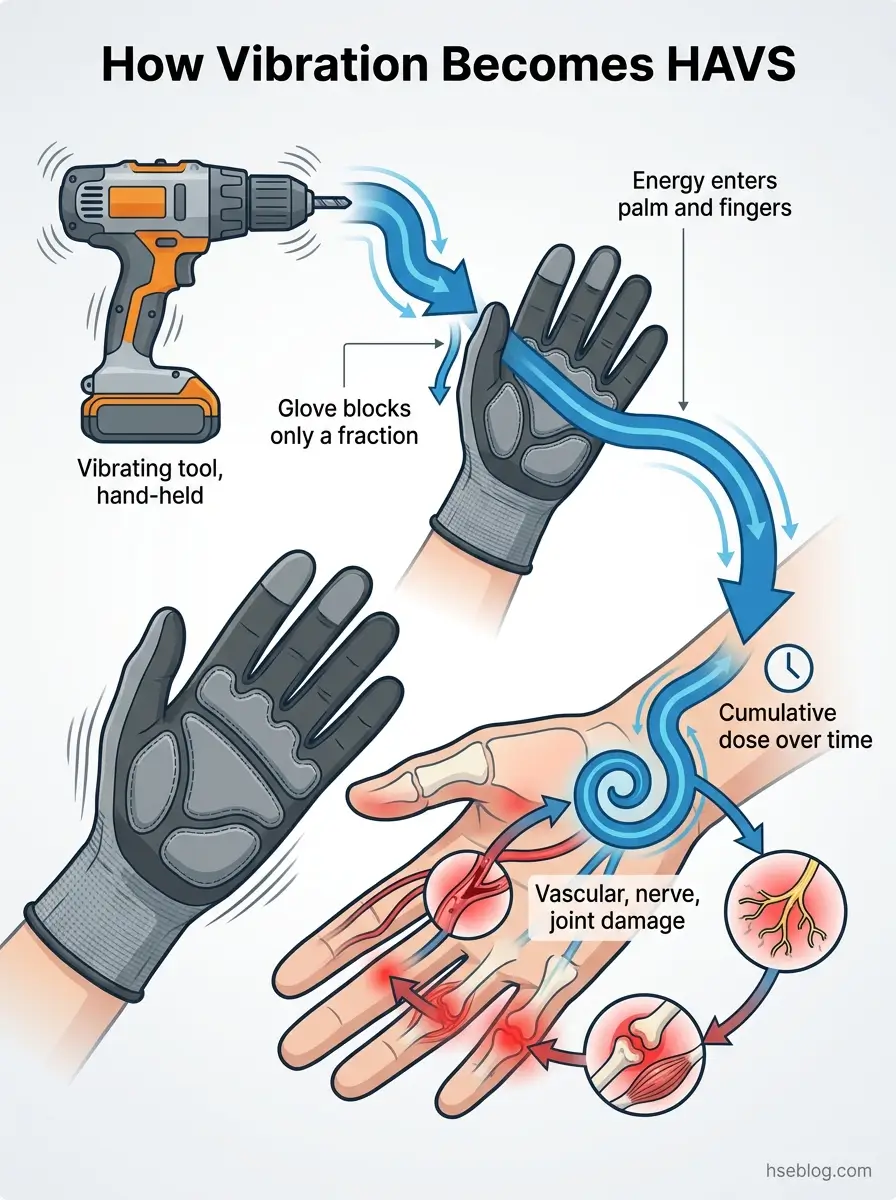
Anti-vibration gloves are gloves with damping material built into the palm and fingers; HAVS is the irreversible disease they claim to guard against. Confusing the two is where most of the trouble starts.
The construction is straightforward enough — the disease is not.
The Glove
- Padding material. Gel, foam, viscoelastic polymer, or air-bladder inserts across the palm and fingers.
- Purpose claimed. To absorb a portion of the vibration energy before it reaches the hand.
The Disease
HAVS in plain terms: a progressive, irreversible condition with three strands — vascular (vibration white finger), sensorineural (numbness, tingling, lost dexterity), and musculoskeletal — with links to carpal tunnel syndrome and secondary Raynaud’s phenomenon.
The cause is dose, not a single bad day. HAVS develops from cumulative frequency-weighted vibration — magnitude multiplied by trigger time — building up over months and years.
A consistent pattern in risk assessments is that exposure time is underestimated. Operators report “an hour” of grinding, when the trigger time that matters — motor running, tool in the hand and working — is far shorter, which distorts whether a glove is even relevant to the job.
Anti-Vibration Gloves vs Impact Gloves: Not the Same Thing
The most common conflation in the stores is treating impact gloves and anti-vibration gloves as one product. They solve different hazards under different standards.
| Feature | Anti-vibration gloves | Impact gloves |
|---|---|---|
| Hazard targeted | Hand-transmitted vibration | Blunt-force / back-of-hand impact |
| Governing standard | ISO 10819 (transmissibility) | EN 388 (mechanical) |
| Protective material | Palm/finger damping (gel, foam, polymer) | Knuckle/back-of-hand TPR padding |
| Helps with HAVS? | Only partially, conditionally | No |
A glove can carry strong EN 388 impact ratings and offer nothing measurable against vibration. The two marks answer two different questions.
The Physics: Why Frequency Decides Whether Gloves Help
The frequency of the tool’s vibration, not the thickness of the padding, decides whether a glove does anything useful — and that single fact is the one vendor pages omit. Gloves attenuate high frequencies reasonably well and low-to-mid frequencies poorly.
Here is the crux. What the regulations and the human hand respond to is frequency-weighted acceleration — the Wh weighting — which deliberately emphasises the lower and middle frequencies most strongly linked to HAVS.
That weighting works against the glove:
- Below ~25–31.5 Hz: gloves do little to nothing. Road and pneumatic breakers live here.
- 25–200 Hz mid-range: where most HAVS-causing hand-tool energy concentrates — and where gloves struggle most.
- Above ~400 Hz: appreciable reduction generally only appears here, well above the danger band.
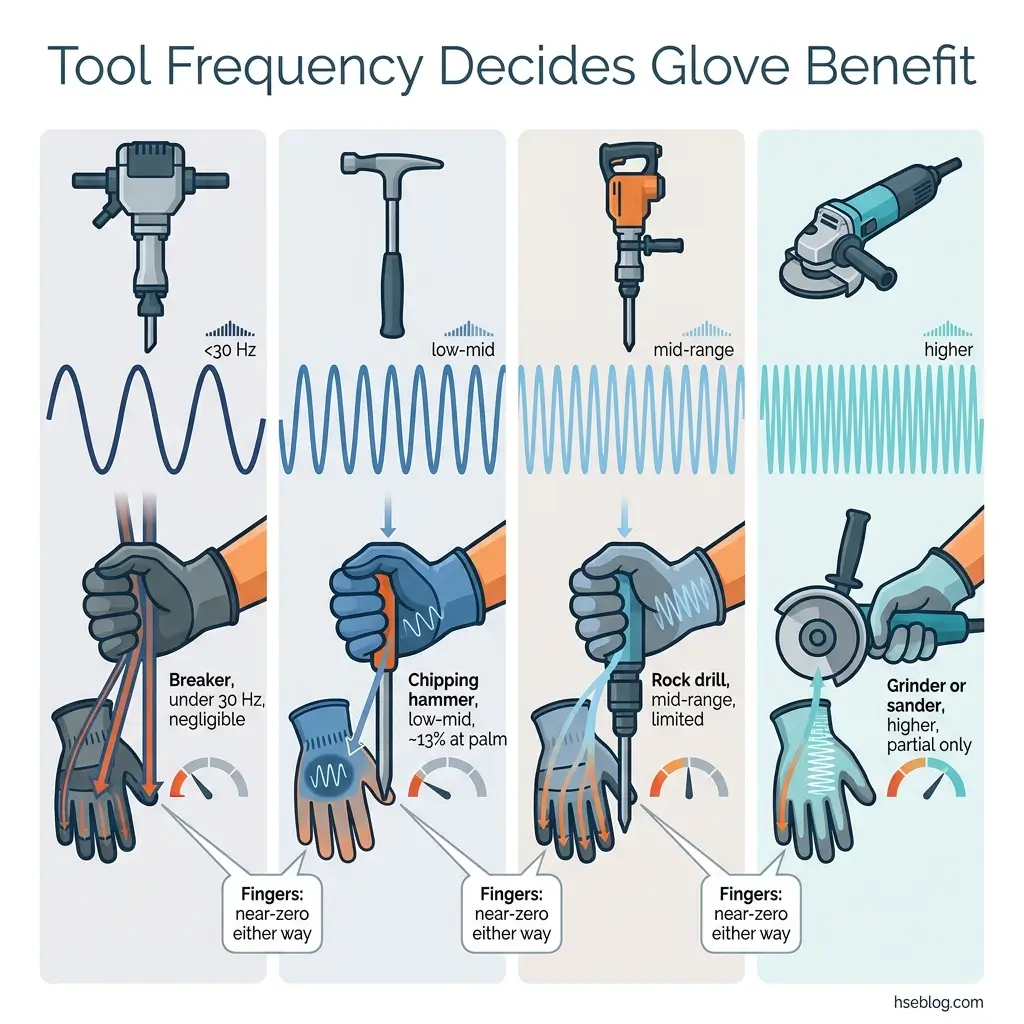
| Tool type | Dominant frequency | Realistic glove benefit |
|---|---|---|
| Pneumatic / road breaker | Below ~30 Hz | Negligible; possible increase |
| Chipping hammer | ~25–60 Hz | ~13% avg at palm (range 2–26%) |
| Rock drill / needle scaler | Low-to-mid | Limited |
| Angle grinder / sander | Higher (hundreds of Hz) | Greater but still partial |
The interpretation gap is plain once the table is in front of you. Vendors quote “high-frequency reduction” as if it settles the HAVS question, when the frequencies that matter most for HAVS are precisely the ones gloves handle worst — so a glove good for a sander can be useless on a breaker.
What the Evidence Actually Shows About Effectiveness
Quantified, the best-case numbers are far smaller than marketing implies — single-digit to low-double-digit percentage reductions, not “protection.” This is where the topic earns trust by counting rather than asserting.
Reviewing the published transmissibility work, several figures recur:
- ~10–15% at best. The most effective vibration-reducing gloves reduce frequency-weighted mid-frequency vibration at the palm by only about 10–15% (NIOSH research on glove transmissibility, 2013).
- ~13% on chipping hammers, ~1% on breakers. Independent analysis found around 13% average palm reduction with chipping hammers (range 2–26%) and roughly 1% with pneumatic breakers (peer-reviewed analysis of ISO 10819 certification, Annals of Work Exposures and Health, 2017).
- Fingers fare worse. At finger level the reduction is near-zero or negative — meaning no benefit, or harm.
- Some gloves amplify. Certain gloves, neoprene notably, increased frequency-weighted vibration by more than 10% in testing (NIOSH, 2017).
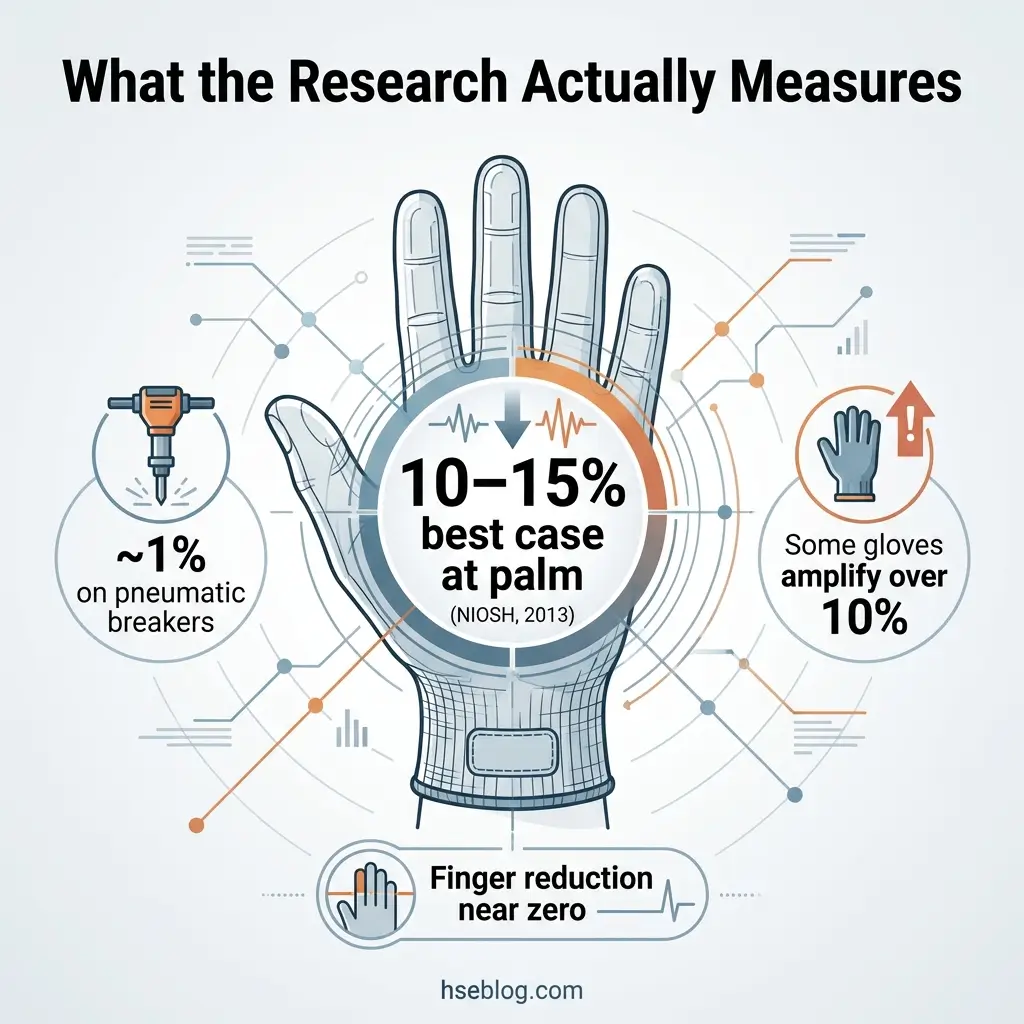
The pattern worth naming is variance. Effectiveness is so glove- and tool-specific that a generic spec-sheet number tells a duty holder almost nothing about their actual job.
The Grip-Strength Trade-Off Nobody Markets
There is a cost on the other side of the ledger that no product page advertises. NIOSH testing found gloves reduced grip strength by more than 33% compared with the bare hand.
That loss is not harmless. To keep control of the tool, the operator grips harder — and higher grip force is itself a recognised driver of carpal tunnel syndrome and musculoskeletal strain. A glove sold to protect the hand can quietly raise a different injury risk.
What ISO 10819 Certification Does and Doesn’t Guarantee
A glove can be legitimately ISO 10819 certified and still fail to protect against your specific tool — certification is a minimum laboratory benchmark, not a real-world guarantee. The standard is precise about what it tests, and silent on much of what buyers assume.
The requirements are concrete. To be labelled “anti-vibration,” a glove must achieve corrected mean transmissibility of TRM ≤ 0.90 across the M-spectrum (~25–200 Hz) and TRH ≤ 0.60 across the H-spectrum (~200–1250 Hz), with palm damping no thicker than 8 mm covering palm, fingers, and thumb (ISO 10819:2013 + Amendment 1:2019).
One representation point matters here. Some secondary sources still quote the legacy “TRM < 1.0” from the 1996 method; the current, stricter value is TRM ≤ 0.90 over 25–200 Hz, and that is the figure to apply.
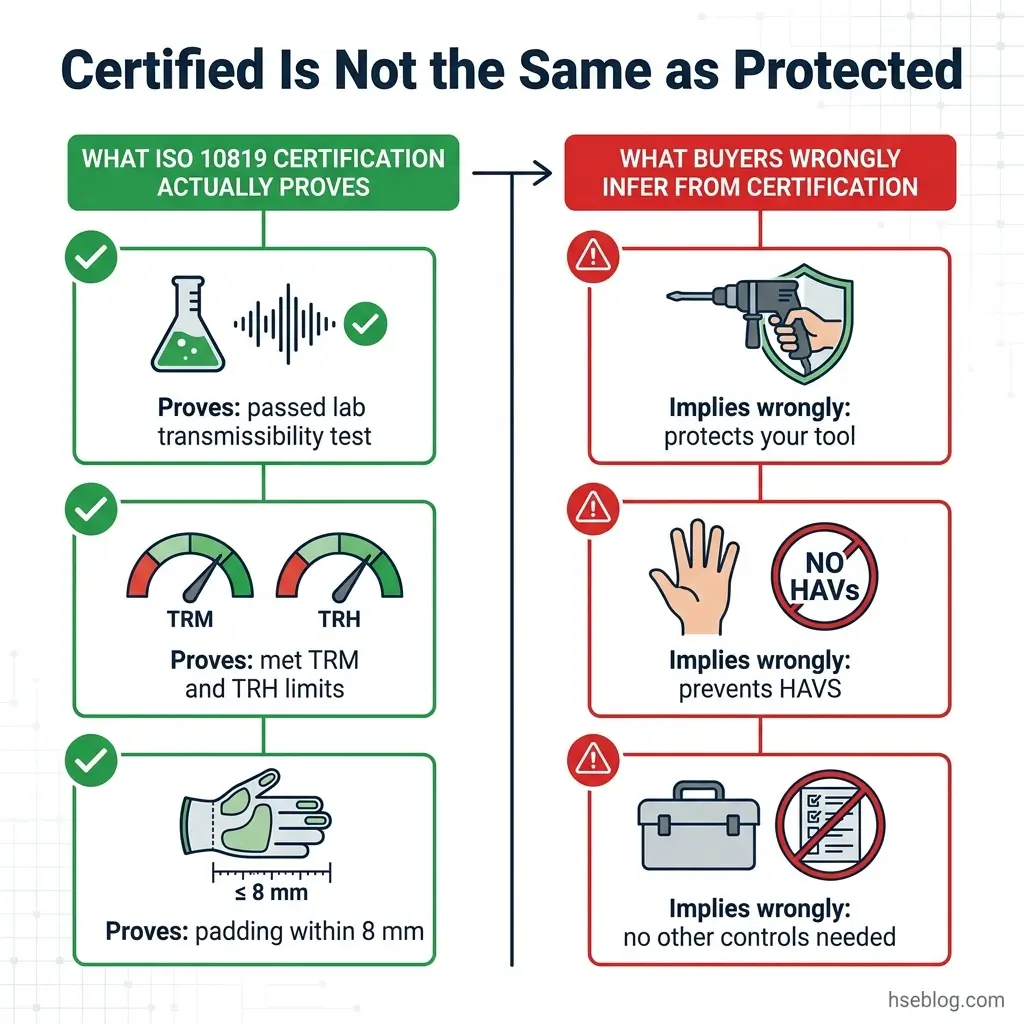
| What ISO 10819 proves | What buyers wrongly infer |
|---|---|
| The glove passed a defined lab transmissibility test | It will protect against my specific tool |
| It met TRM ≤ 0.90 and TRH ≤ 0.60 under set spectra | It prevents HAVS |
| Palm damping is within the 8 mm limit | More padding equals more protection |
| It carries a permissible “anti-vibration” label | It satisfies the legal duty to control exposure |
The research warns explicitly about the false sense of security here. Certification is read as a protection guarantee when it is only a minimum benchmark under laboratory spectra — and the freshness of that critique matters: ISO 10819:2013 was reviewed and confirmed as current in 2024, so the much-debated 2013 method, including the 2019 finger-transmissibility amendment, remains the governing standard.
Where Anti-Vibration Gloves Genuinely Help
Gloves are not useless, and the strongest, best-evidenced benefit is the one vendors mention least — keeping the hands warm and dry. This matters because cold drives the vascular component of HAVS.
- Warmth and dryness. Warm, dry hands maintain circulation, which genuinely reduces finger-blanching risk — a benefit the HSE’s own guidance on anti-vibration gloves supports.
- Abrasion, cut and comfort. Real mechanical and comfort gains that improve PPE compliance — workers wear gloves they like.
- Marginal high-frequency benefit. A possible small reduction on specific higher-frequency tools, but only when the glove is matched to the tool and exposure reduction is actually demonstrated.
The judgment to apply is to value the warmth-and-dryness benefit honestly while refusing to let it stand in for vibration control. That is the one glove benefit that holds up across the evidence — and the one least likely to appear in a sales pitch.
Regulatory content here reflects general HSE professional understanding of UK, EU, and US requirements as of 2025. It is not legal advice; specific compliance or enforcement questions should go to qualified legal counsel in the applicable jurisdiction. Regulatory content last reviewed: [Month YYYY — at publish].
What Actually Controls HAVS: The Hierarchy of Controls
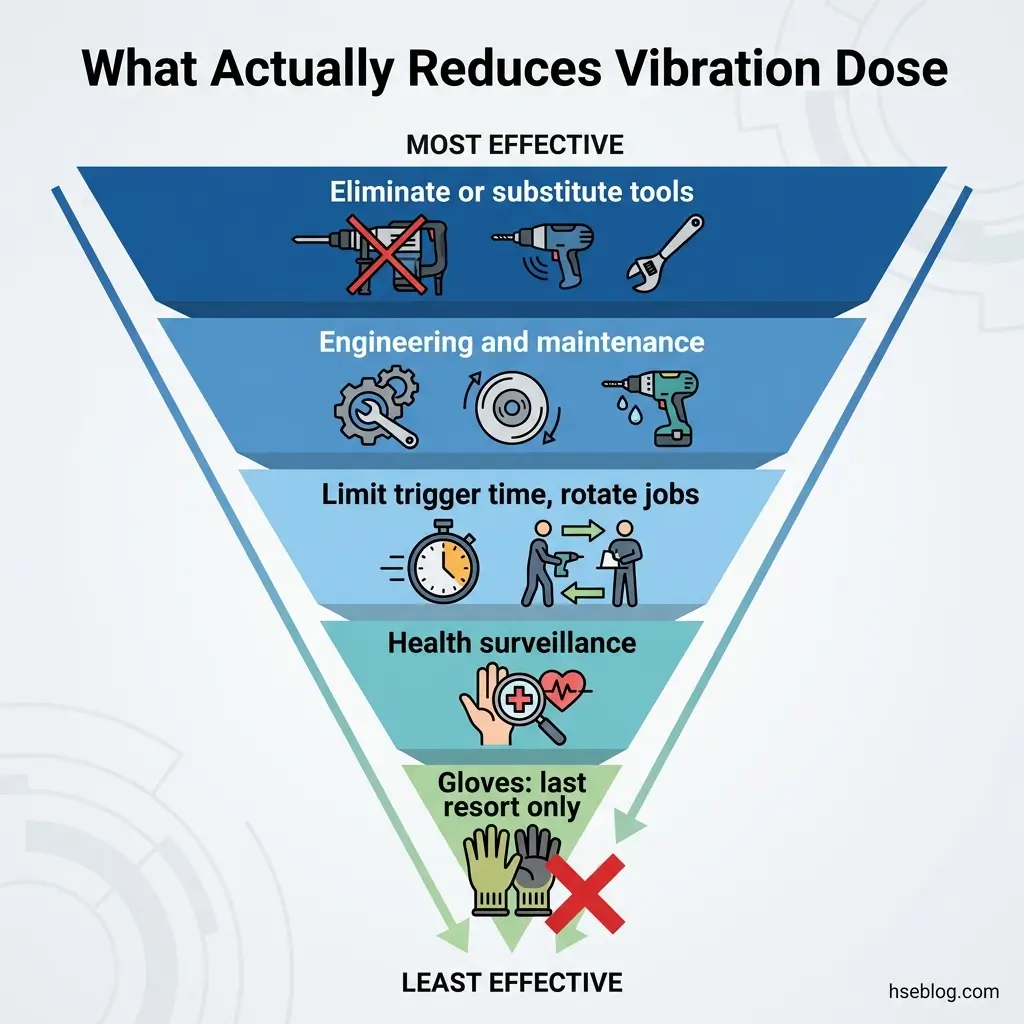
When the dominant frequency favours the tool over the glove, the only reliable lever is reducing the dose at source — which is exactly where the control hierarchy puts the effort, and where gloves sit at the very bottom. The HSE’s expectation under the Control of Vibration at Work Regulations 2005 is that gloves are not provided as the means of reducing risk unless exposure reduction is demonstrated.
- Eliminate or substitute. Choose genuinely low-vibration tools, mechanise the task, and maintain consumables — sharp bits and blades cut faster and shake less. This is the highest-impact move.
- Engineering and maintenance. Service tools on schedule; a worn tool transmits more vibration than its spec sheet promises.
- Administrative controls. Limit trigger time, rotate jobs, and monitor exposure against the action and limit values.
- Health surveillance. Arrange surveillance with a competent occupational-health provider to catch early HAVS before it becomes disabling.
- PPE (gloves). Last, as a supplement only — never the control that closes the assessment.
The exposure thresholds anchor all of this, and they differ by jurisdiction:
- UK / EU (stricter, recommended benchmark): Exposure Action Value 2.5 m/s² A(8) and Exposure Limit Value 5.0 m/s² A(8) (Control of Vibration at Work Regulations 2005; EU Directive 2002/44/EC).
- US (the gap): OSHA sets no specific HAV exposure standard — exposure falls under the General Duty Clause, with ACGIH TLVs and NIOSH guidance as the de facto references. No glove satisfies a numeric compliance test in any of these systems.
A common failure is treating these controls as set-and-forget. A tool that measured “low vibration” two years ago may now exceed the limits through wear, yet exposure estimates are rarely refreshed — which is why 2025 occupational-health commentary is steering duty holders toward real-time vibration monitoring rather than glove reliance.
Frequently Asked Questions
Conclusion
The industry gets one thing badly wrong with anti-vibration gloves: it treats a comfort and warmth product as a vibration control, then files the risk assessment as complete. The frequency physics simply doesn’t allow that — gloves shave the high frequencies while HAVS is built in the low and mid-range, which is why HSE’s own data still records thousands of new HAVS cases (3,245 across 2014–2023, HSE) for a disease that is entirely preventable and entirely irreversible.
The single highest-impact change is to stop buying protection and start removing exposure. Choose lower-vibration tools, keep them sharp and serviced, cap trigger time, and put workers into proper health surveillance — then let gloves do the honest job they’re good at: keeping hands warm, dry, and willing to wear PPE at all.
If you take one decision from this, make it this: before your team relies on any anti-vibration glove, ask the supplier for transmissibility data against your actual tool, and treat anything less as a label, not a control.