
TL;DR — The Numbers That Govern the Assessment
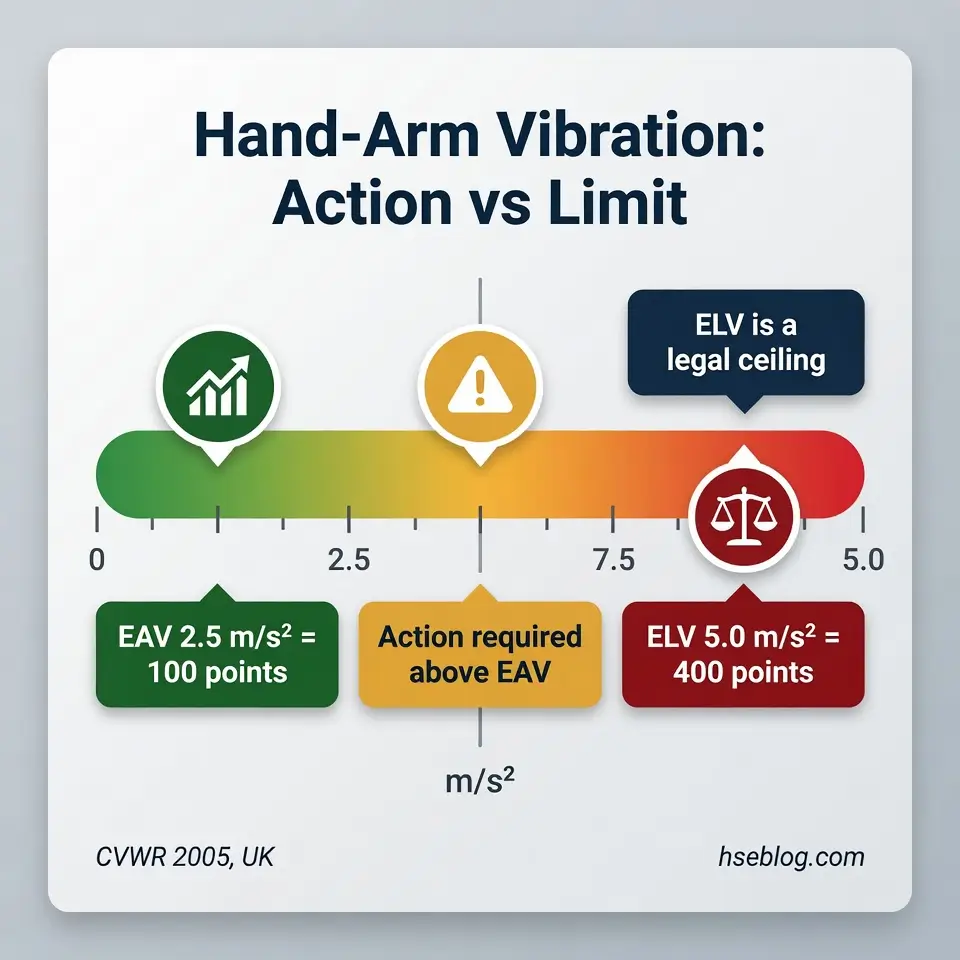
- HAV action and limit values: 2.5 and 5.0 m/s² A(8). Above the exposure action value you must act; the exposure limit value is a hard legal ceiling (Control of Vibration at Work Regulations 2005, UK).
- WBV action and limit values: 0.5 and 1.15 m/s² A(8). The whole-body track carries its own measurement standard and its own numbers — they are not interchangeable with hand-arm values (Directive 2002/44/EC, EU).
- 220 new HAVS cases were assessed for benefit in Great Britain in 2024. Down from 1,210 in 2010, but still a live, permanent, preventable disease (UK Health and Safety Executive, 2025).
- Electronic monitoring systems varied by up to 20% on the same task. A central reason wearable “vibration dosimeters” do not replace a proper assessment (UK Health and Safety Executive, current guidance).
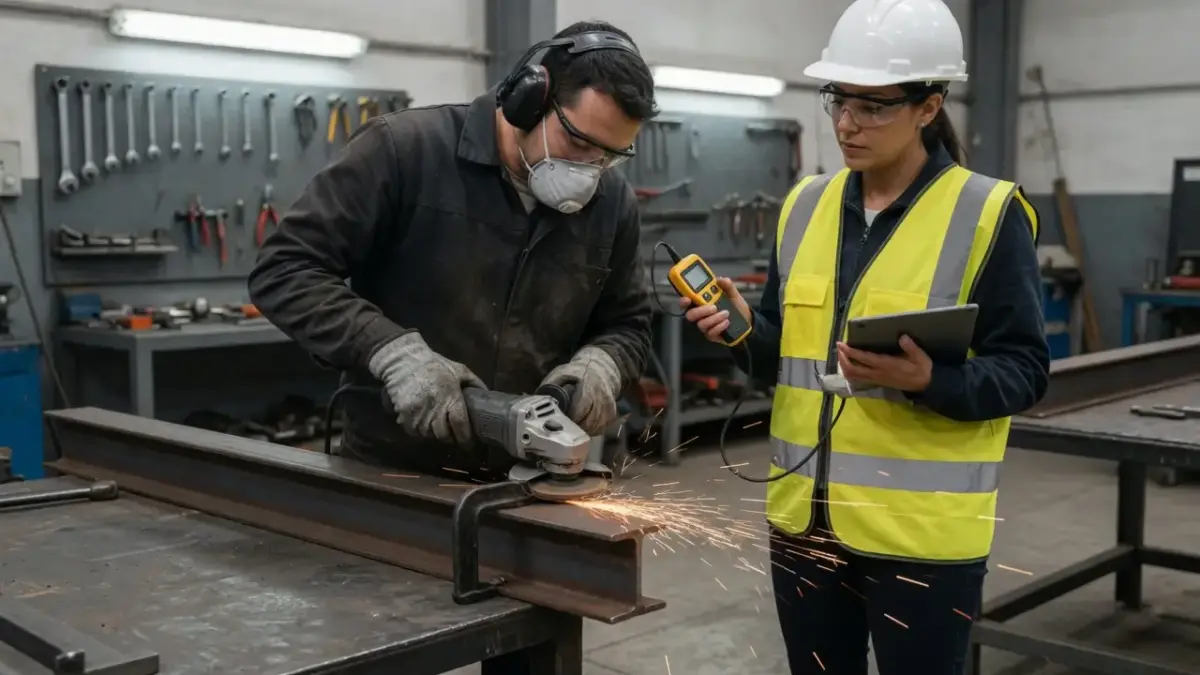
A vibration risk assessment evaluates whether workers’ daily exposure to hand-arm or whole-body vibration could harm their health and what controls are needed. In the UK and EU it is a legal duty once exposure is likely to reach the exposure action value. In the US there is no dedicated standard, but the General Duty Clause still applies.
Regulation 5 of the Control of Vibration at Work Regulations 2005 (UK) does something many employers underestimate: it makes the assessment itself the legal duty, not merely the controls that follow it. The moment a worker is likely to be exposed at or above the exposure action value, the employer must have assessed that exposure — in writing, with significant findings recorded.
That single requirement sits behind a disease that does not heal. Hand-Arm Vibration Syndrome (HAVS) is permanent once it develops, which is why the assessment exists to catch exposure before the damage, not after. This guide walks the full vibration risk assessment process step by step — both hand-arm and whole-body — sets the UK, EU and US legal positions side by side, demonstrates a real A(8) calculation, and corrects the wearable-monitor narrative competitors get wrong.
What Is a Vibration Risk Assessment, and Why Does It Matter?
A vibration risk assessment is a structured evaluation of whether a worker’s daily exposure to hand-transmitted or whole-body vibration is likely to cause harm, and what controls that exposure demands. It is one assessment in name but two assessments in practice.
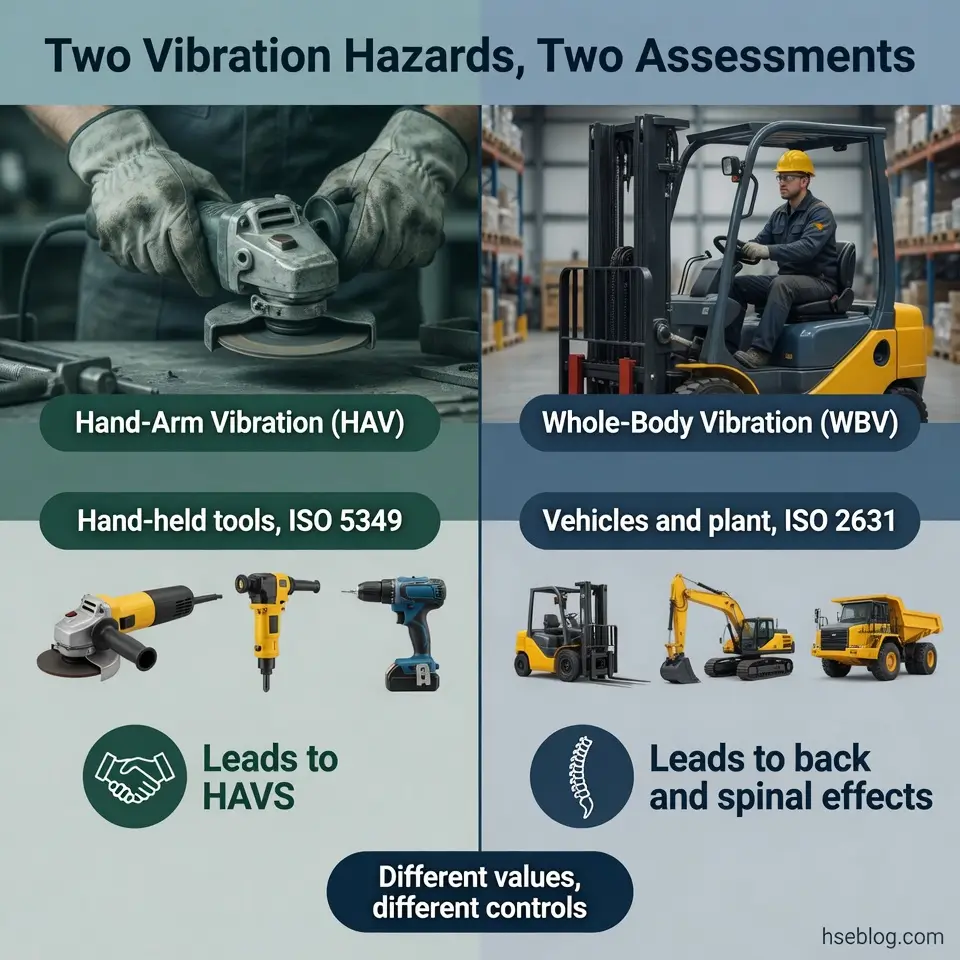
The fork matters because the two streams behave differently from the first measurement onward:
- Hand-arm vibration (HAV) — transmitted from hand-held or hand-guided tools into the hand and arm. It drives HAVS, including vibration white finger and an increased risk of carpal tunnel syndrome. Measurement follows ISO 5349.
- Whole-body vibration (WBV) — transmitted through a seat or standing surface into the body of a vehicle or plant operator. It is linked to lower-back and spinal effects. Measurement follows ISO 2631.
The reason this is non-optional is biological, not bureaucratic. HAVS damage is permanent once established; nerves and blood vessels in the fingers do not recover, so the assessment is the only chance to intervene before harm becomes irreversible.
The numbers show a hazard that has declined but not disappeared. New HAVS cases assessed for Industrial Injuries Disablement Benefit in Great Britain fell from 1,210 in 2010 to 220 in 2024 (UK Health and Safety Executive, 2025). On the carpal tunnel side, a Swedish national registry case–control study found hand-arm vibration exposure associated with raised carpal tunnel syndrome risk (odds ratio 1.61; 95% CI 1.46–1.77) (Swedish National Registry Case–Control Study, 2022).
A pattern I see repeatedly across published assessments and audit findings: organisations treat “vibration” as one hazard with one form, then apply hand-arm logic to a forklift driver or whole-body thinking to a grinder operator. That conflation is a frequent root cause of an assessment that is technically completed but practically wrong.
Is a Vibration Risk Assessment a Legal Requirement?
Yes — and the answer depends sharply on where the work happens. In the UK and EU it is a specific statutory duty triggered above a defined exposure value; in the US there is no dedicated standard, but a duty still arises through the General Duty Clause and consensus standards.
| Jurisdiction | Governing instrument | Is the assessment legally required? | Reference exposure values |
|---|---|---|---|
| UK | Control of Vibration at Work Regulations 2005 (Reg 5) | Yes — required where exposure is likely to reach the EAV | HAV: EAV 2.5 / ELV 5.0 m/s² A(8) |
| EU | Directive 2002/44/EC | Yes — same duty across member states | WBV: EAV 0.5 / ELV 1.15 m/s² A(8) |
| US | OSH Act §5(a)(1) General Duty Clause + ACGIH TLVs | No dedicated standard, but employers can be cited for an uncontrolled known hazard | ACGIH TLVs (different formulation); no enforceable OSHA limit |
The cleanest legal anchor sits in the EU framework. Directive 2002/44/EC (consolidated text) sets the same exposure action and limit values that the UK regulations enforce domestically.
The US position is where a dangerous misreading takes hold. The absence of an OSHA vibration permissible exposure limit is read as “no obligation,” yet OSHA’s Technical Manual on vibration defers to ACGIH TLVs and ISO 5349, and General Duty Clause citations and civil settlements for HAVS do occur. No numeric limit is not the same as no liability.
Legal disclaimer: Regulatory content here reflects general HSE professional understanding of UK, EU and US requirements as of the review date above. It is not legal advice. Specific compliance questions, enforcement situations, or prosecution risk should be directed to qualified legal counsel in the applicable jurisdiction.
Vibration Exposure Action and Limit Values Explained
You cannot complete Steps 3 and 4 of the process without four terms locked down. Here they are, once, cleanly — for both hand-arm and whole-body work.
- A(8) — daily exposure averaged, or “normalised,” over an 8-hour reference day. It combines vibration magnitude (m/s²) with how long the worker is actually in contact with the vibration.
- Exposure Action Value (EAV) — the level at which the law requires you to act: reduce exposure as low as reasonably practicable and put health surveillance in place.
- Exposure Limit Value (ELV) — a legal ceiling, never a target. Exposure must not exceed it on any day.
- Exposure points system — HSE’s practical alternative to the A(8) arithmetic, where the EAV equals 100 points and the ELV equals 400 points. Points add up across every tool in the shift.
The actual figures sit in the table below. In day-to-day work I rely on the points version, because it lets you add several tools together without re-running square-root maths each time.
| Vibration type | EAV | ELV | Points equivalent | Governing source |
|---|---|---|---|---|
| Hand-arm (HAV) | 2.5 m/s² A(8) | 5.0 m/s² A(8) | 100 / 400 points | CVWR 2005 (UK); Dir. 2002/44/EC (EU) |
| Whole-body (WBV) | 0.5 m/s² A(8) (or VDV 9.1 m/s¹·⁷⁵) | 1.15 m/s² A(8) (or VDV 21 m/s¹·⁷⁵) | n/a | Dir. 2002/44/EC (EU) |
One misconception is worth killing here: staying below the EAV does not mean “safe.” HSE is explicit that below-action-value exposure is not risk-free, and some individuals develop HAVS below the action value. The EAV is where the law forces action, not where harm begins.
How to Carry Out a Vibration Risk Assessment Step by Step
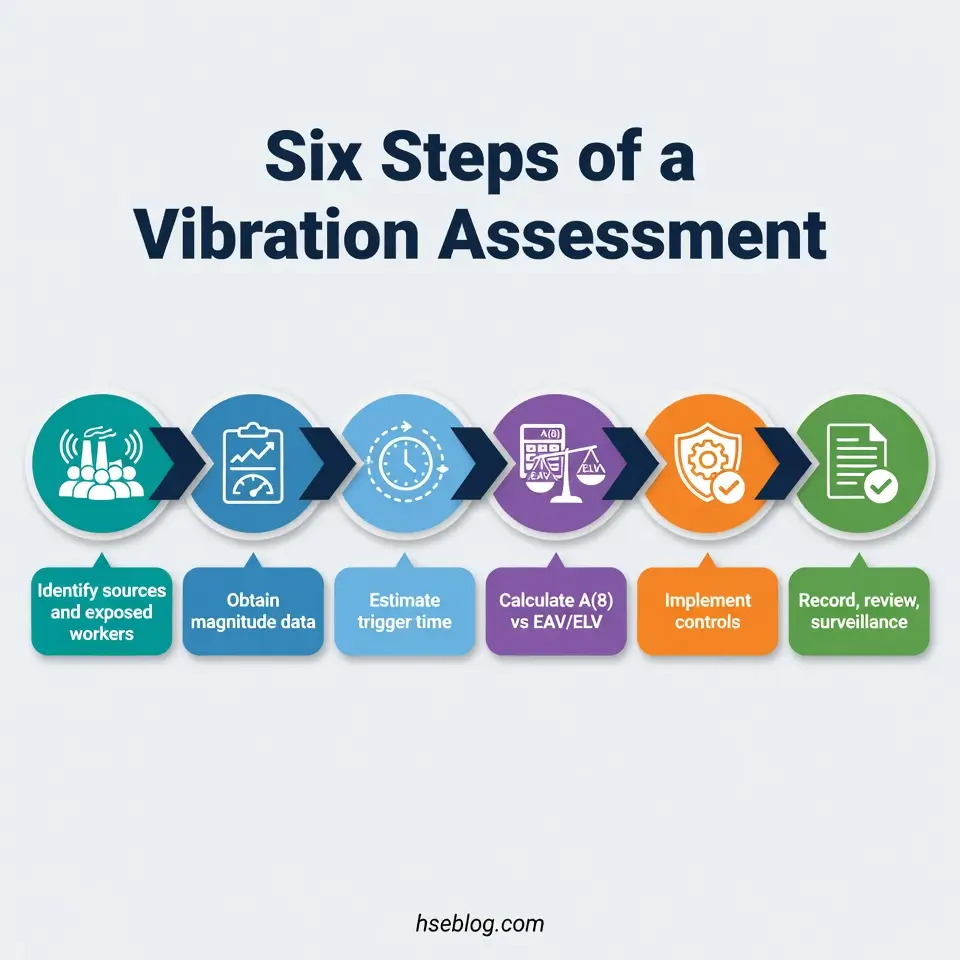
The assessment runs as six executable steps, in order: find the sources, get the magnitudes, estimate the exposure time, calculate against the EAV/ELV, assign controls, then record and review. Each step below is action-first; the deeper control and surveillance detail lives in the two sections that follow, so nothing is repeated.
Step 1 — Identify Vibration Sources and Who Is Exposed
Catalogue every tool and process that transmits vibration, and every worker who uses them. Pull this from supervisors, operators and equipment handbooks, then cross-check against what people actually do.
- Capture every tool a worker touches across a shift, not just the obvious one — the breaker plus the cut-off saw plus the impact wrench.
- Record who is exposed and roughly for how long, including occasional and cover workers.
- HSE’s own guidance on assessing hand-arm vibration risk is the reference point for this cataloguing stage.
Step 2 — Obtain Vibration Magnitude Data
You need a magnitude in m/s² for each tool, from one of three sources. They are not equally reliable, and the judgment call sits here.
- Manufacturer-declared values — fast and free, but commonly lower than real, in-use vibration because they come from controlled test conditions.
- Published databases (HSE and others) — useful for tool types and for sense-checking a declared figure.
- Direct measurement to ISO 5349 — the most accurate, used when tools are worn, modified, or used in ways the declared value never reflects.
The practical reasoning: start with declared values, but treat a worn 15-year-old breaker as a measurement case, not a brochure case.
Step 3 — Estimate Daily Exposure (Trigger Time)
Trigger time is contact time, not task time — the minutes the vibrating part is actually against the work, not the length of the job. This distinction is where most exposure estimates go wrong.
- A worker “on the grinder for two hours” may have 25 minutes of actual trigger time once you strip out setup, marking, and standing.
- Over-estimating trigger time inflates the result and wastes control effort; under-recording a second tool hides real exposure.
- Combine each tool’s magnitude with its trigger time to build a daily total.
Step 4 — Calculate A(8) and Compare to the EAV/ELV
Now run the numbers. The points system is the cleanest route, where points per hour equal two times the magnitude squared, the EAV is 100 points and the ELV is 400 points.
Take a worker who uses two tools in a shift:
| Tool | Magnitude (m/s²) | Trigger time (hours) | Exposure points |
|---|---|---|---|
| Angle grinder | 6.0 | 1.5 | 108 |
| Needle scaler | 9.0 | 1.0 | 162 |
| Daily total | — | — | 270 points |
At 270 points the worker is above the EAV (100) but below the ELV (400) — equivalent to an A(8) of roughly 4.1 m/s². That result is legally meaningful: it triggers exposure reduction, information and training, and health surveillance, but it has not breached the limit. Readers can reproduce this with HSE’s hand-arm vibration exposure calculator.
Step 5 — Decide and Implement Control Measures
This step only assigns the trigger; the menu of controls follows in the next section. What matters here is matching the result to its legal obligation.
- Below the EAV — manage and review; no mandatory action band, but not “safe.”
- At or above the EAV — reduce exposure as low as reasonably practicable, inform and train workers, and start health surveillance.
- At or above the ELV — take immediate action to bring exposure below the limit; continuing at this level is a breach.
Step 6 — Record Findings, Review, and Trigger Health Surveillance
Document the significant findings, set the conditions that will force a review, and identify where surveillance becomes a legal duty. Surveillance mechanics are covered in their own section below.
- Record the assessment in writing — the significant findings, the figures, and the controls assigned.
- Set review triggers: new tools, changed processes, new working methods, or surveillance results.
- Note that health surveillance is legally required at or above the EAV and feed its findings back into the assessment.
Selecting Control Measures That Actually Reduce Exposure
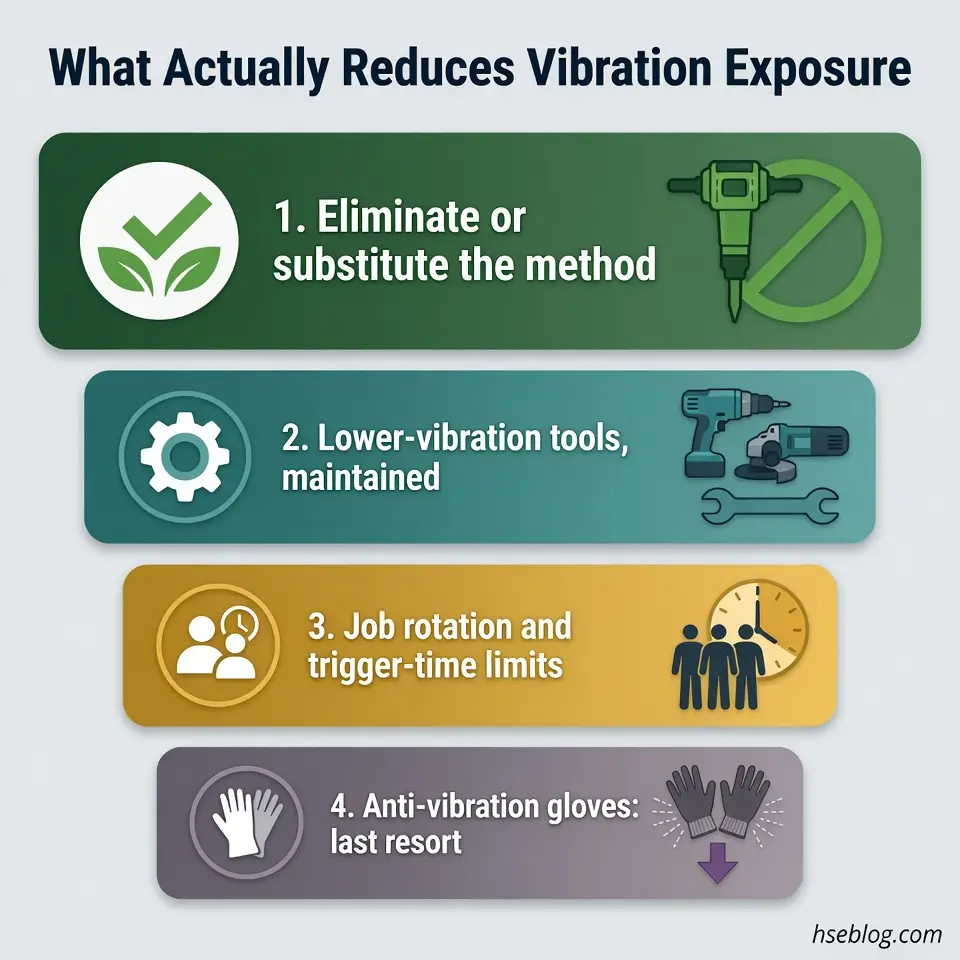
The strongest control is the one that removes the vibration at source, and the weakest is the one most often sold as the answer. The hierarchy of control, applied to vibration specifically, runs in this order:
- Eliminate or substitute — replace the high-vibration method entirely. A mechanised or remote-operated alternative, or a genuinely lower-emission tool, beats every downstream control.
- Engineering and tool selection/maintenance — choose lower-vibration plant and keep it serviced; a blunt blade or worn anti-vibration mount lets emissions climb back up.
- Administrative controls — job rotation, trigger-time limits, and maintenance schedules that cap how long any one person stays exposed.
- PPE (anti-vibration gloves) — last, and supplementary only.
Anti-vibration gloves deserve a direct verdict, because they are routinely over-trusted. Even ISO 10819-certified gloves do not reliably reduce the lower frequencies most associated with HAVS, and they must never be the primary control — at best they keep hands warm and add marginal high-frequency attenuation.
Two failure modes show up again and again in the field record:
- Rotation logged but not enforced — the rota exists on paper; on a busy shift the same skilled operator runs the breaker all day anyway.
- Low-vibration purchases undermined by maintenance — a quiet new tool drifts back toward its old emissions because nobody resharpens, rebalances, or replaces consumables.
Comparing the options on operational and compliance grounds, substitution wins because it survives human behaviour; administrative controls and PPE both depend on discipline that erodes under production pressure.
Health Surveillance: The Tiered HAVS Programme
Health surveillance becomes a legal requirement once workers are exposed at or above the EAV, or wherever the assessment identifies a risk — it is a duty under Regulation 7 of the Control of Vibration at Work Regulations 2005 (UK), not a goodwill gesture. The UK runs it as a five-tier system that escalates from a questionnaire to a specialist referral.
Medical advice disclaimer: Content covering health surveillance and HAVS diagnosis is for HSE practitioner reference. It is not medical advice. Workers with symptoms such as finger blanching, numbness or tingling should consult an occupational physician or qualified medical professional.
| Tier | Who conducts it | What it involves |
|---|---|---|
| Tier 1 | Responsible person / on entry | Baseline questionnaire at the start of exposure |
| Tier 2 | Responsible person / annually | Annual screening questionnaire |
| Tier 3 | Qualified person (e.g. occupational health nurse) | Clinical assessment where screening flags concern |
| Tier 4 | Occupational health doctor | Formal clinical diagnosis and staging |
| Tier 5 | Specialist | Referral for complex or contested cases |
The point that is most often missed: surveillance is a feedback loop, not a filing exercise. A Tier 2 or Tier 3 finding means controls may have failed, and the assessment should be reopened — rising or progressing cases are evidence, not paperwork.
Clinical practice in this area is also moving. A 2024 Delphi study from the Society of Occupational Medicine refined HAVS assessment guidance — including carpal tunnel exclusion and the investigation of late-onset cases — and noted that some official occupational-physician advice had not been fully updated (Society of Occupational Medicine, 2024). If you run a programme, that is a reason to check your clinical provider is working to current consensus, not a decade-old protocol.
Recognised training pathways — NEBOSH, IOSH, or equivalent regional qualifications — are where the competence to set up and interpret this programme is built.
Common Vibration Risk Assessment Mistakes to Avoid
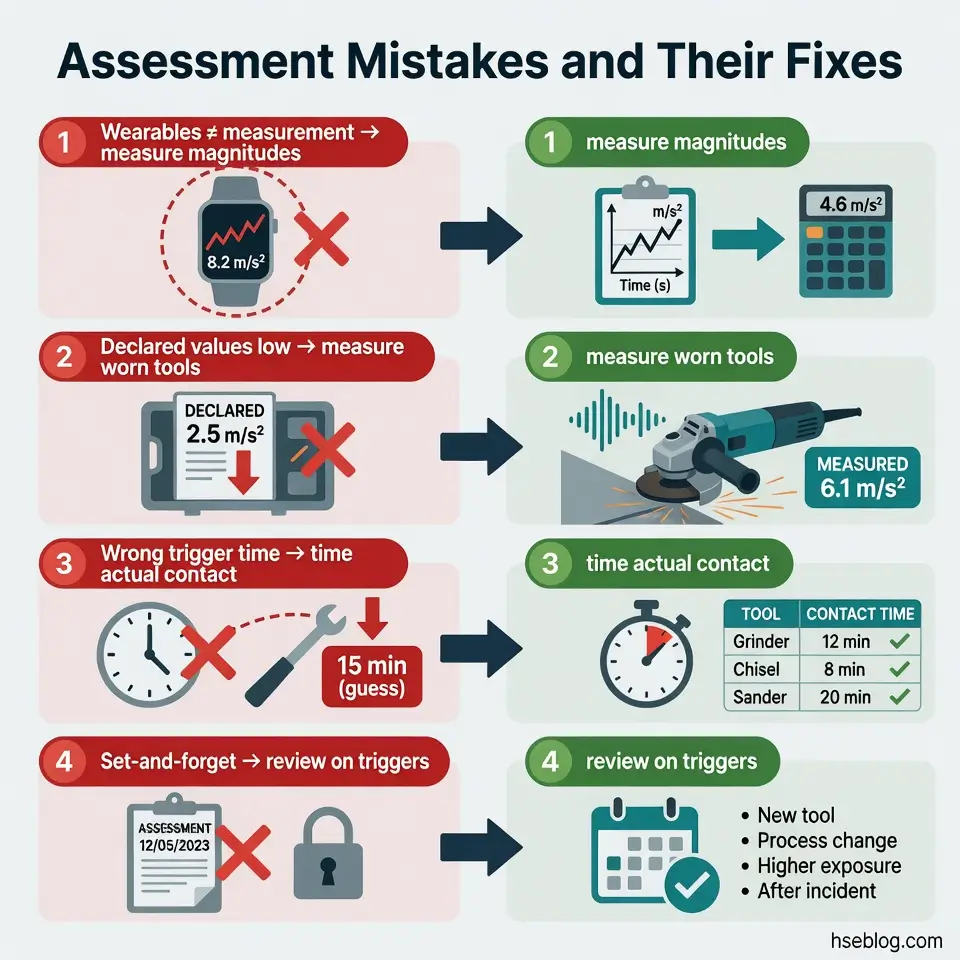
The most damaging error in this whole field is buying hardware and calling it an assessment. HSE is explicit that monitoring alone does not control risk, and you still have to demonstrate exposure reduced as low as reasonably practicable. Here are the recurring failures and the fix for each:
- Over-relying on wearable, wrist or glove “vibration dosimeters.” Why it’s wrong: in 2024 HSE clarified its measurement and monitoring guidance to deprecate these devices, stressing they are not measurement to BS EN ISO 5349, and electronic systems have varied by up to 20% on the same task (UK Health and Safety Executive, current guidance). What to do instead: derive exposure from properly measured magnitudes plus trigger time.
- Treating manufacturer-declared values as in-use reality. Why it’s wrong: declared figures come from controlled tests and usually sit below real exposure. What to do instead: use them as a starting estimate and measure worn or modified tools.
- Mis-handling trigger time. Why it’s wrong: over-estimating inflates risk and burns control budget; under-recording a second tool hides genuine exposure. What to do instead: time actual contact, and log every tool in the shift.
- Set-and-forget assessments. Why it’s wrong: an assessment that is never revisited after a process or tool change is a stale assessment — a common enforcement finding. What to do instead: bind reviews to defined triggers, not the calendar alone.
The trap underneath all of these is the false sense of compliance: a wearable on every wrist can feel like control while the duty — demonstrable exposure reduction — goes unmet.
Frequently Asked Questions
Conclusion
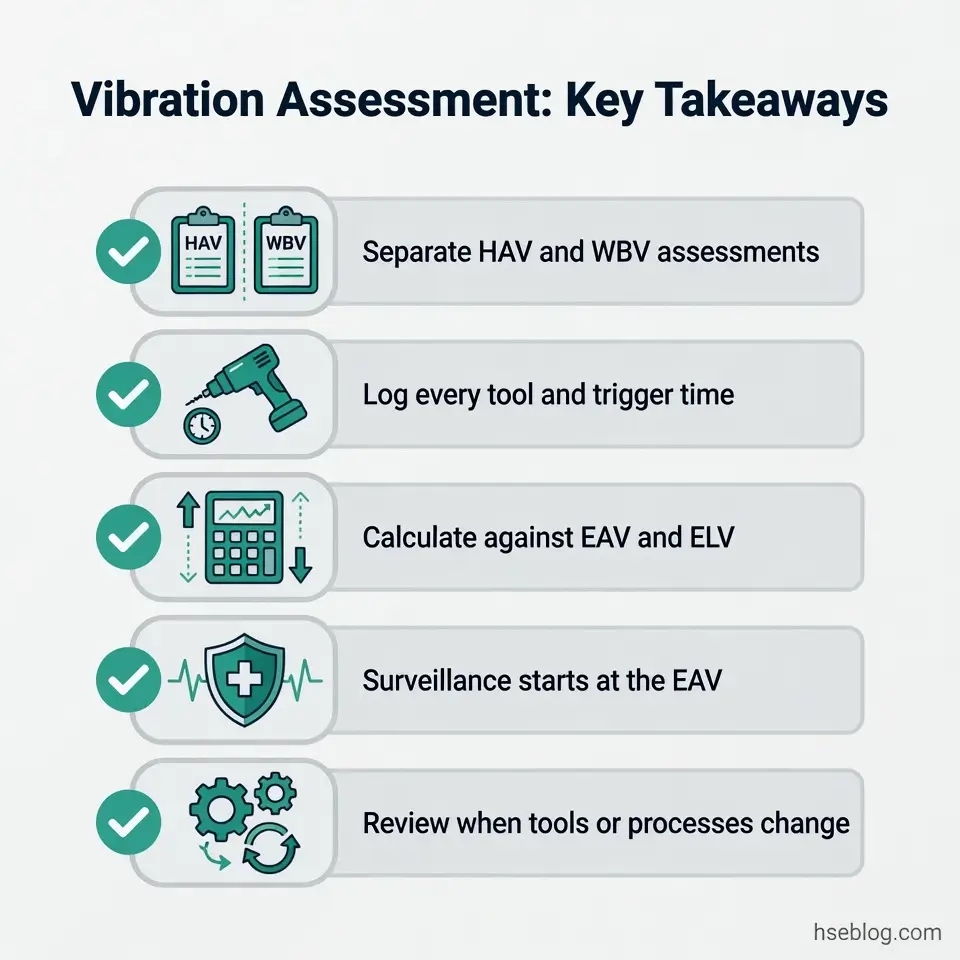
Three decisions carry most of the weight in a vibration risk assessment. First, split the work into hand-arm and whole-body streams before you measure anything, because the standards, values and controls diverge from that point on. Second, build exposure from real trigger time and credible magnitudes — not brochure figures and not a wearable’s readout.
Third, treat the EAV as the line where the law forces action: reduce exposure as low as reasonably practicable, start health surveillance, and reopen the assessment when surveillance or process changes tell you to. The worked example above lands at 270 points for a reason — most real workers sit in that band between the action and limit values, where the duty is live but the harm is still preventable.
The cross-jurisdiction picture closes the loop. UK and EU law gives you enforceable numbers; the US gives you a duty without a ceiling — but in every jurisdiction the outcome that matters is the same. A vibration risk assessment exists to stop a permanent disease while it can still be stopped, and that only happens when the assessment changes what the tools, the timings and the people actually do.
Regulatory content reviewed as of the last-reviewed date shown in the byline.