
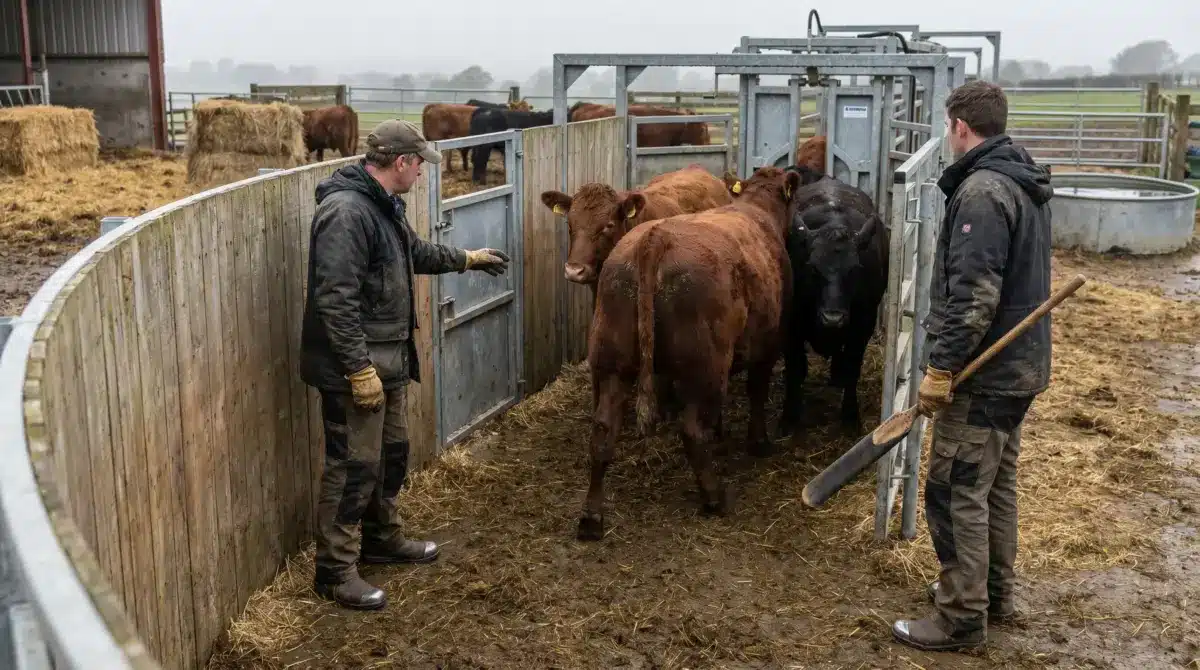
TL;DR — The Numbers That Frame This Risk
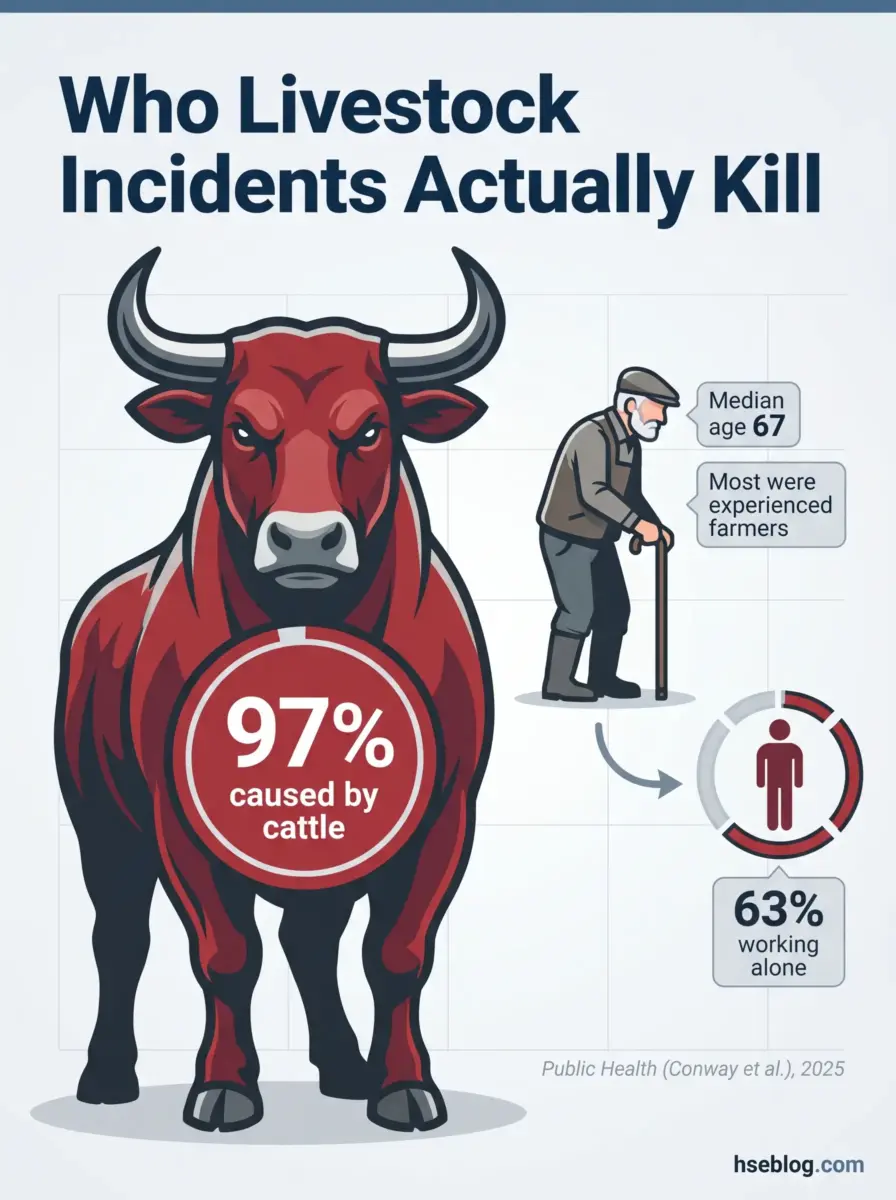
- Cattle cause almost every death. 78 livestock-related fatalities were recorded in Great Britain between 2010 and 2023, and 97% were caused by domestic cattle (Public Health, Conway et al., 2025).
- It targets the experienced, working alone. The median victim was 67 years old and 63.4% were alone at the point of injury (Public Health, Conway et al., 2025).
- The sector is the deadliest in Britain. Agriculture, forestry and fishing again recorded the highest fatal-injury rate of any main industry, with “injured by an animal” the leading cause within agriculture (HSE, 2025).
- US agricultural work runs about five times the average risk. Roughly 18.6 fatal injuries per 100,000 full-time workers in 2022, against 3.7 across all US industries (CDC/NIOSH, 2025).
Livestock handling safety is the system of behavioural awareness, facility design, and safe working practices that prevents injury when moving, restraining, or treating large animals. Cattle cause most farm-animal deaths in both the UK and US. Effective control depends on reading animal behaviour, using engineered handling facilities, and never working dangerous animals alone.
The first peer-reviewed demographic study of livestock deaths in Great Britain found 78 fatalities across 2010 to 2023, and 97% were caused by domestic cattle (Public Health, Conway et al., 2025). The detail that should unsettle every farm employer: the median victim was 67, and almost two-thirds were working alone when they were injured (Public Health, Conway et al., 2025).
These were not novices caught out by the unfamiliar — they were experienced stockpeople, often handling animals they had handled hundreds of times. This guide maps the real hazards of livestock handling safety, from physical trauma to zoonotic disease, and the controls that actually work across two very different regulatory systems.
Why Livestock Handling Is One of Agriculture’s Deadliest Tasks
Agriculture carries the highest fatal-injury rate of any main industry sector in Great Britain, and being injured by an animal is the leading cause of death within it (HSE, 2025). That is the blunt answer to why this task earns its own risk category.
The contradiction at the heart of livestock injury prevention is that these deaths are predictable, yet they keep happening to the people you would expect to be safest.
- Cattle dominate the toll. 78 livestock deaths in Great Britain over 2010–2023, with 97% from domestic cattle (Public Health, Conway et al., 2025).
- The victims are seasoned. 74.3% were farmers and the median age was 67 (Public Health, Conway et al., 2025).
- Lone work is the multiplier. 63.4% were working alone when injured, with no one to summon help (Public Health, Conway et al., 2025).
- The US picture is just as stark. Agricultural work ran about 18.6 fatal injuries per 100,000 full-time workers in 2022, versus 3.7 across all industries (CDC/NIOSH, 2025).
Reviewing the GB demographic data alongside HSE’s annual figures, one pattern recurs: familiarity erodes caution. The “I’ve handled this cow a hundred times” instinct is exactly what removes the margin of safety, which is why competent-person systems and engineered controls matter more than any individual’s confidence.
Most incidents trace back to a broken safe system of work or makeshift equipment, not freak misfortune. That distinction is what makes the rest of this guide useful — if the cause is systemic, the fix is too.
What Makes Livestock Dangerous: Understanding Animal Behaviour
Cattle are dangerous because they perceive the world differently from the people moving them, and most injuries happen when a handler misreads that perception. Get the behaviour wrong and the animal reacts defensively; get it right and movement becomes almost effortless.
Cattle have near-panoramic vision but a blind spot directly behind them, poor depth perception, and acute hearing that makes high-frequency noise and sudden movement genuinely alarming. They resist moving from light into dark, baulk at shadows and reflections, and revert to flight or defence when stressed, isolated, or cornered.
A discipline that separates good stockpeople from average ones is seeing the facility through the animal’s eyes. A flapping coat on a gate, a puddle catching the light, a swinging chain — distractions the handler stopped noticing years ago — are precisely what stall or spook the animal at the worst moment.
Read these warning signals in real time and adjust position before the animal commits:
- Raised head and tail — heightened arousal; stop advancing and give space.
- Pawing or snorting — a threat display; you are too close or cornering the animal.
- Ears pinned back — fear or aggression building; remove the trigger.
- Turning to face you — the animal has lost its escape route; back off and reopen one.
Flight Zone and Point of Balance: The Two Concepts That Prevent Most Injuries
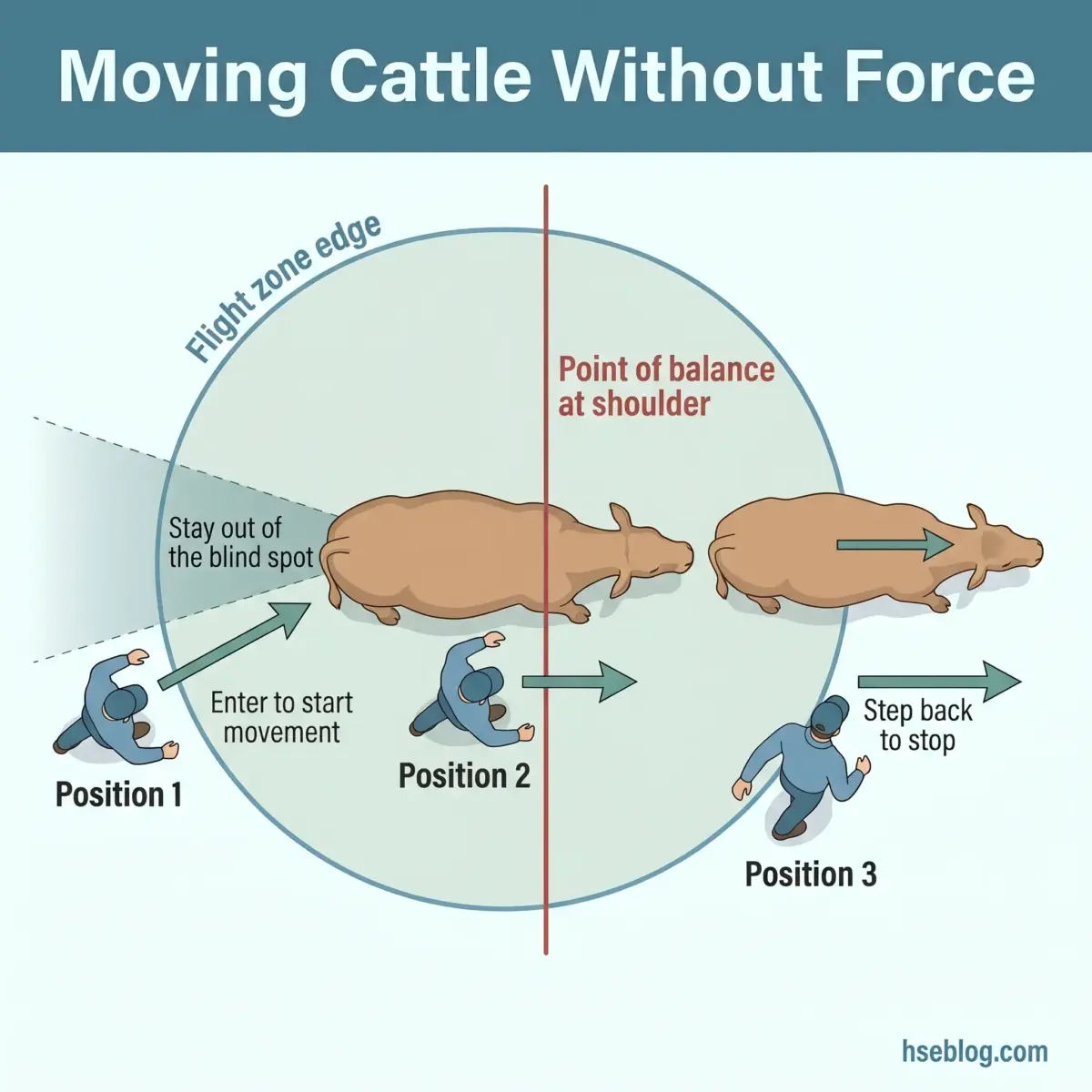
The flight zone is the animal’s personal space — large in wild or unhandled cattle, shrinking to almost nothing in tame ones. The point of balance sits roughly at the shoulder, and it dictates direction.
Translated into handler positioning rather than diagrams as decoration, the rules are simple:
- Penetrate the flight-zone edge to start movement; retreat from it to stop.
- Cross behind the point of balance to drive the animal forward.
- Move ahead of the point of balance to make it back off or slow.
- Lead tame animals, don’t drive them — pressuring a quiet, handled animal often backfires and provokes the reaction you were trying to avoid.
This reduces handler injury, not just animal stress, because a calm animal is a predictable one. Predictability is the safety margin you cannot buy with PPE.
The Main Livestock Handling Hazards
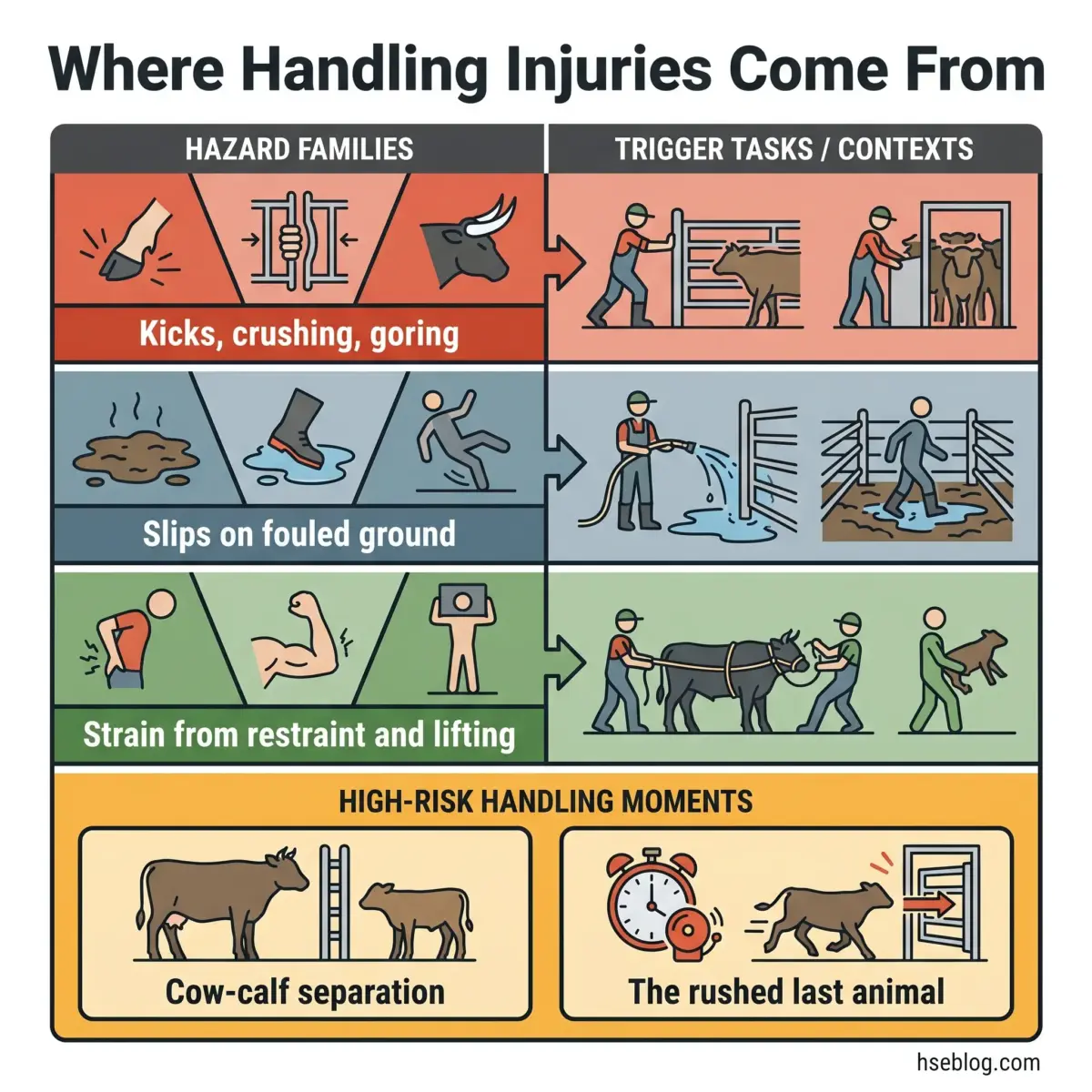
The hazard landscape splits into traumatic injury, falls, musculoskeletal strain, and disease — and the highest-risk moments cluster around a handful of predictable tasks. Map your own operation against these rather than treating them as a flat checklist.
A consistent pattern across HSE investigation summaries is that guards drop at transitions: separating a single animal from the group, the cow-calf split, and the rushed “last animal” at the end of the day. These are not random — they are where a calm system briefly becomes an improvised one.
Physical and traumatic hazards
- Kicks and knockdowns — the most frequent injury mechanism, often to legs and torso.
- Crushing and pinning against fixed structures, gates, or the side of a race.
- Butting and goring, especially from bulls or protective cows.
- Trampling and being dragged, often after a handler loses footing near a moving animal.
Environmental and physical-strain hazards
- Slips, trips and falls on wet, muddy, or fouled surfaces — an underweighted category, with around 29% of US agricultural day-away injuries coming from falls (CDC/NIOSH, 2025).
- Musculoskeletal strain from restraint, lifting, and awkward handling postures during treatment or loading.
Zoonotic Diseases and Health Hazards
Content on zoonotic disease is for HSE practitioner reference. It is not medical advice. Workers with symptoms or specific exposure concerns should consult an occupational physician or qualified medical professional.
Livestock handling carries health hazards as well as injury hazards, and these are easy to underweight because the harm is delayed rather than immediate. Most zoonoses transmit through contact, aerosols, or contaminated surfaces, which means hygiene and biosecurity — not PPE alone — are the primary controls.
| Hazard | Main route of exposure | Primary control |
|---|---|---|
| Leptospirosis | Contact with urine, contaminated water | Cover cuts, wash thoroughly, control rodents |
| Brucellosis | Contact with birth fluids, aborted material | Gloves and protection during calving; stock vaccination policy |
| Q fever | Aerosol from birth products, dust | Ventilation, respiratory protection at calving |
| Ringworm | Direct skin contact with infected animals | Hand hygiene, glove use, treat affected stock |
| E. coli (incl. O157) | Contact with faeces, contaminated surfaces | Hand washing, separate eating areas |
Beyond infection, organic dust, dander, and gases in enclosed sheds drive respiratory and allergic problems. Vaccination of stock, biosecurity routines, and timely occupational-health input are the controls that keep these hazards from becoming chronic.
Best Practices for Safe Livestock Handling
This article provides general HSE knowledge. Life-critical tasks such as bull handling, crush and race work, and restraining cattle for veterinary procedures must be planned and supervised by a competent person with relevant training, jurisdiction-specific authorisation, and a site-specific risk assessment. The information here does not replace that.
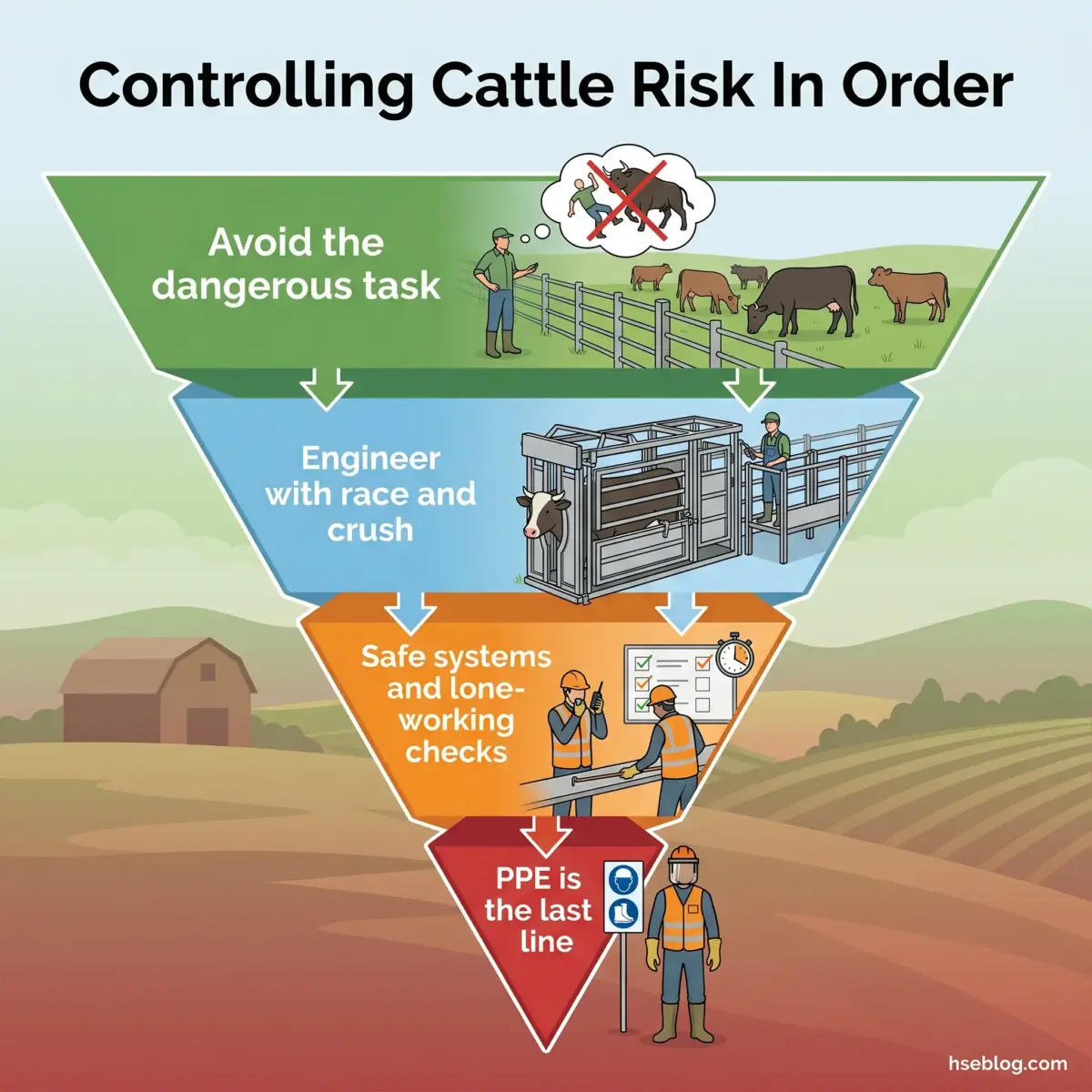
Safe cattle handling follows the hierarchy of control: eliminate or substitute the dangerous task first, engineer it out with proper facilities second, and treat PPE as the last line, never the first. Workers who reach for the hierarchy in that order are managing the right risk.
- Plan the task and the escape route before you start. Decide how the animal moves, where you stand, and where you go if it turns — and never work unrestrained cattle with makeshift gates or hurdles.
- Engineer the hazard out. A suitable race and crush removes far more risk than any amount of handler courage; facility design does the heavy lifting.
- Move calmly and predictably. Stay within the animal’s field of vision, avoid sudden noise, and never strike animals — which is also a welfare-law breach in several jurisdictions.
- Control lone working. Given that 63.4% of GB livestock fatalities occurred to handlers working alone (Public Health, Conway et al., 2025), use check-in systems and accept that some tasks should not be attempted solo at all.
- Build competence, not just compliance. Recognised training pathways — NEBOSH and IOSH qualifications, OSHA outreach in the US, and structured low-stress stockmanship instruction — turn good intentions into reliable handler decisions.
A recurring root cause in the published record is teams treating the crush as optional. The fix is engineering and routine, not exhortation — if the safe method depends on someone being brave that day, the system has already failed.
Handling Facilities: Races, Crushes, and Pens
Well-designed handling facilities are the single biggest engineering control in cattle work, and HSE’s livestock guidance sets out what good looks like. The race guides animals; the crush restrains them; both have to be built for the safe side, not just the fast side.
Race design
- Easy entry and flow — animals enter willingly, with no tight turns that cause baulking.
- Solid, sheeted sides — cut visual distraction so the animal moves forward, not sideways.
- Work doors operated from the safe side — never reach across or into the path of a moving animal.
Crush essentials
- Self-locking yoke or head restraint to hold the animal securely for treatment.
- Rump rail and anti-kick restraint to protect the handler working from behind.
- Secured to the ground with slip-resistant footing and good lighting.
- Never work an animal with an unsecured animal behind it in the race.
Maintenance is a safety control in its own right. Broken gates and makeshift fixes recur as incident factors in the published record (HSE, AIS35), so a damaged crush is a stopped job, not a workaround.
Bull Handling: The Highest-Risk Animal
Bulls cause deaths far out of proportion to their numbers, and the controlling rule is absolute: no one enters an enclosure with a loose bull. A “playful” bull weighing a tonne is as lethal as an aggressive one.
- Acclimate from the start — train bulls to associate people with routine care, and never rely on temperament alone, which can change without warning.
- Use the right aids — bull poles and halters give control; purpose-built pens give protection.
- Ring at the appropriate age and inspect regularly — a worn or damaged ring is a failed control.
- Treat every bull as dangerous — the moment handlers start trusting an individual animal is the moment the margin disappears.
This is exactly the kind of life-critical task the competent-person caveat above exists for. Bull handling should never be improvised by an untrained worker.
Employer and Worker Legal Duties (UK and US)
Regulatory content here reflects general HSE professional understanding of UK and US requirements as of 2025. It is not legal advice. Specific compliance questions, enforcement situations, or prosecution risk should be directed to qualified legal counsel in the applicable jurisdiction.
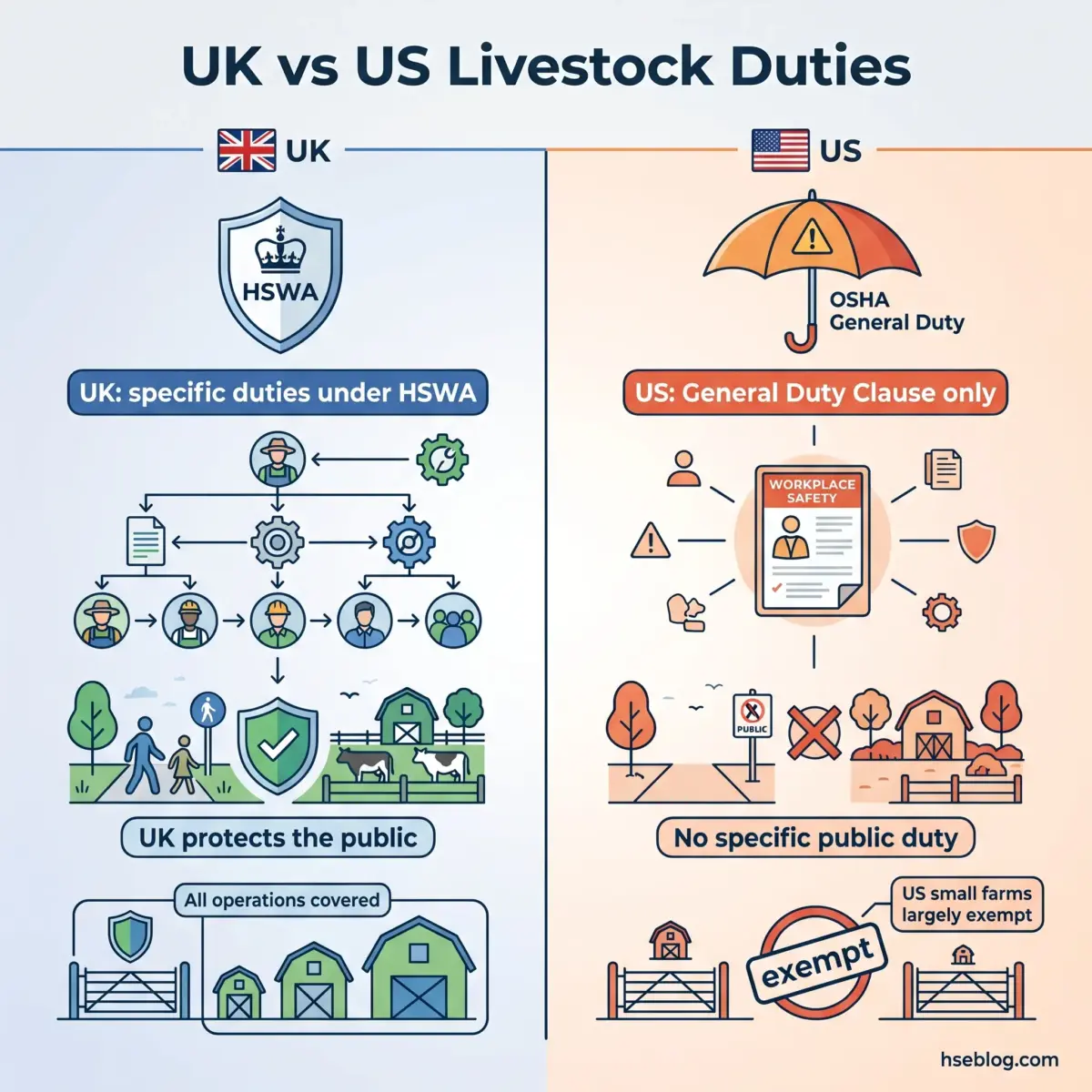
The legal picture is governed by a structural difference, not a numerical one: the UK imposes specific, enforceable livestock-handling duties, while the US has no livestock-handling standard at all. Understanding that gap is what separates an operation that manages risk from one that waits for a citation.
In the UK, the Health and Safety at Work etc. Act 1974 requires employers to ensure, so far as is reasonably practicable, the health and safety of employees under section 2 and of non-employees including the public under section 3 (HSWA 1974, UK). That duty drives risk assessment, safe systems of work, and RIDDOR reporting of reportable incidents.
The practical reading of the US position is the one competitors get wrong. There is no OSHA standard for animal handling; 29 CFR Part 1928 covers tractors, PTO guarding, and field sanitation only (29 CFR 1928, US). The General Duty Clause — OSH Act §5(a)(1) — is the fallback, and farms with ten or fewer employees and no temporary labour camp fall largely outside OSHA enforcement (OSH Act §5(a)(1), US).
| Criterion | UK (HSE) | US (OSHA) |
|---|---|---|
| Legal basis | HSWA 1974, ss.2 & 3 | OSH Act §5(a)(1) General Duty Clause |
| Livestock-specific standard | Yes — guidance incl. AIS35 | No — only 29 CFR 1928 (non-animal) |
| Duty to the public | Yes — explicit under s.3 | Not addressed by federal standard |
| Small-operation coverage | Duties apply | Largely exempt (≤10 employees, no labour camp) |
The misconception that “no OSHA livestock standard” means “no obligation” is dangerous. The General Duty Clause, insurers, and civil liability all fill the gap, so the real US benchmark is voluntary adoption of recognised practice — which is why the HSE competent-person model travels well as good practice for US operations. International readers without a national standard can anchor to the ILO Code of Practice on safety and health in agriculture (ILO, 2011).
The regulatory content in this section was last reviewed in [Month YYYY — to be filled at publish], reflecting standards in force during 2025.
Cattle and the Public: Footpaths and Right-of-Way Risk
Cattle do not only kill workers — a meaningful share of cattle-incident deaths are members of the public crossing fields. HSE characterises cattle incidents as killing four to five people a year in Great Britain, with roughly a quarter being members of the public (HSE, OG-00058).
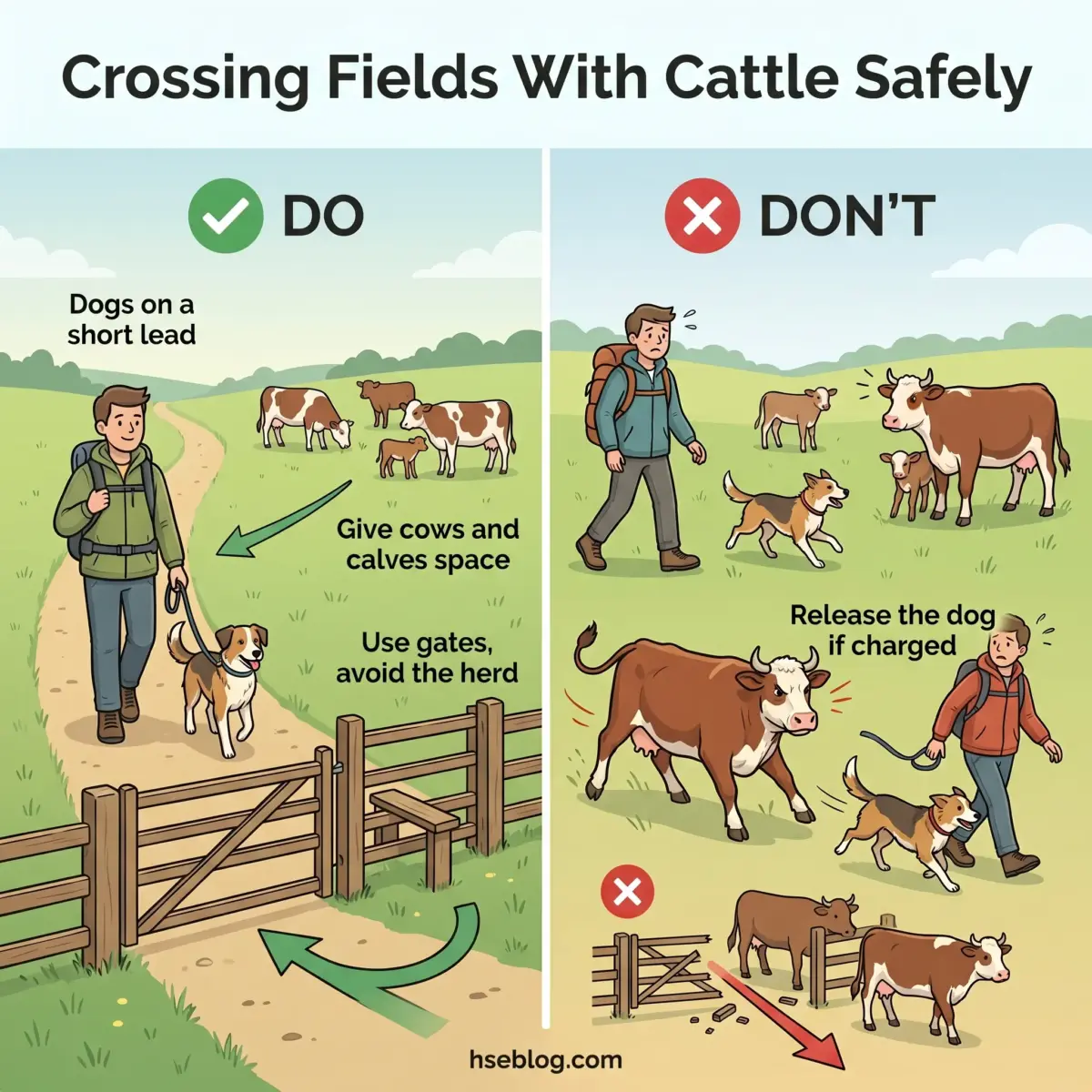
Two factors recur in these public fatalities: cows with calves becoming defensive, and the presence of dogs triggering a protective charge. For any landowner with a public right of way across grazing land, this is a live duty, not a courtesy.
Landowner duties to non-workers flow from section 3 of the HSWA, and HSE’s guidance on cattle and public access in England and Wales sets out route management and signage options (HSE, AIS17EW, 2019). Where the risk is high — recently calved cows, bulls of dangerous breeds on footpaths — the practical control is to keep those animals off fields with public access.
For walkers crossing fields with cattle:
- Do keep dogs on a short lead near cattle, and give cows with calves a wide berth.
- Do move calmly to the field edge and use gates rather than cutting through a herd.
- Don’t get between a cow and her calf, or walk directly toward grazing animals.
- Don’t hold on to your dog if cattle charge — release it, as the dog can outrun the danger and the animals usually follow it, not you.
Frequently Asked Questions
The One Change That Saves the Most Lives
The industry’s central mistake is treating livestock handling safety as a question of individual skill when the evidence points the other way. The people dying are the experienced ones, working alone, often with animals they knew well (Public Health, Conway et al., 2025) — which means competence at the system level, not bravery at the individual level, is what actually protects handlers.
If there is one highest-impact change, it is engineering the dangerous task out before relying on anyone’s judgement. A sound race and crush, a firm rule against entering pens with loose bulls, and an honest lone-working policy remove more risk than any amount of stockmanship layered on top of broken facilities. The gap between the UK’s specific duties and the near-total absence of a US standard does not change the physics — a tonne of cattle behaves the same on either side of the Atlantic.
Read your own operation the way cattle read it: the shadows, the makeshift gate, the single animal pulled from the group at dusk. Fix those, plan for the day a familiar animal does something unfamiliar, and livestock handling stops being one of agriculture’s deadliest tasks and starts being one of its most controllable.