
TL;DR — The Numbers That Define Farm Risk
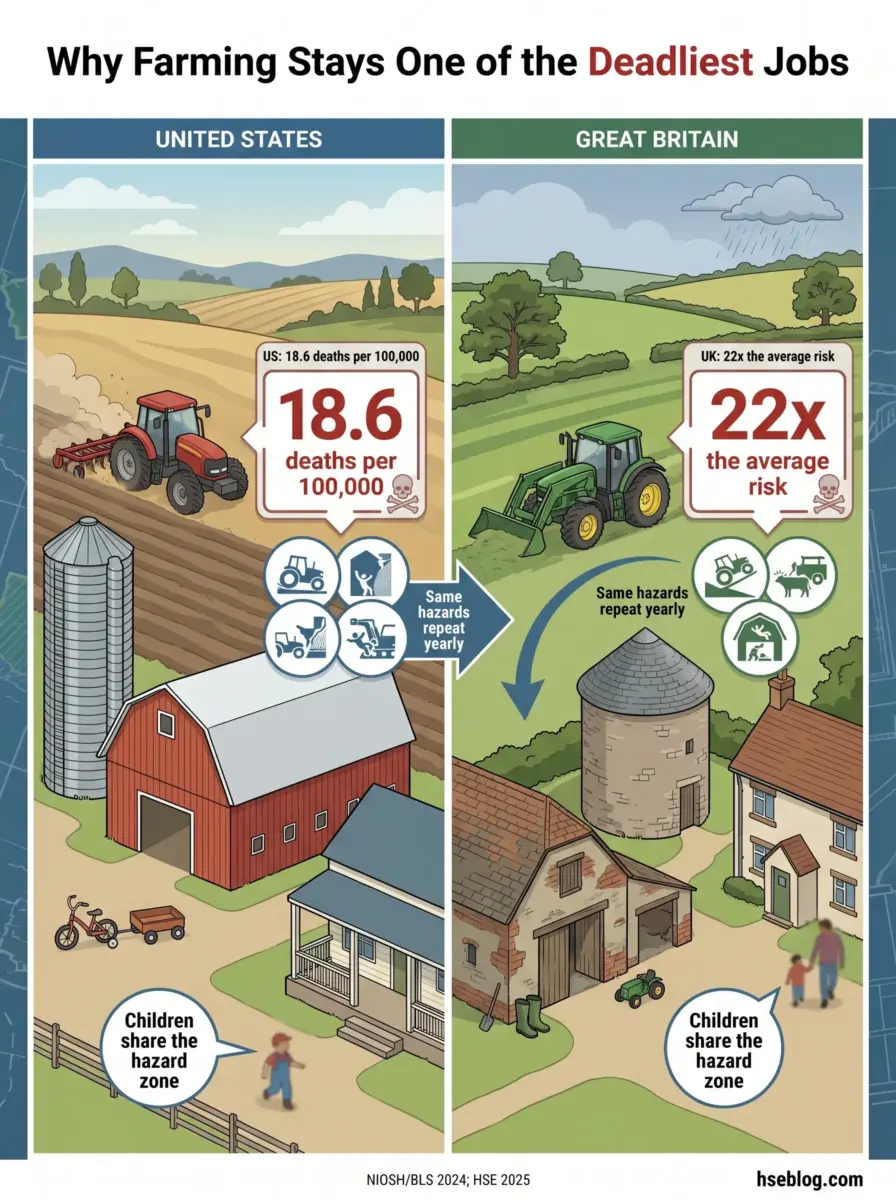
- 18.6 deaths per 100,000 full-time workers (US, 2022) — agriculture, forestry and fishing run roughly five times the all-industry rate of 3.7 (NIOSH/BLS, 2024).
- 23 worker deaths in Great Britain (2024/25) — a fatal-injury rate about 22 times the all-industry average, from a sector that is only ~1% of the workforce (HSE, 2025).
- ~33 children injured on US farms every day — the family-farm structure that keeps the business alive also puts non-workers in the hazard zone (NIOSH/CDC, 2021).
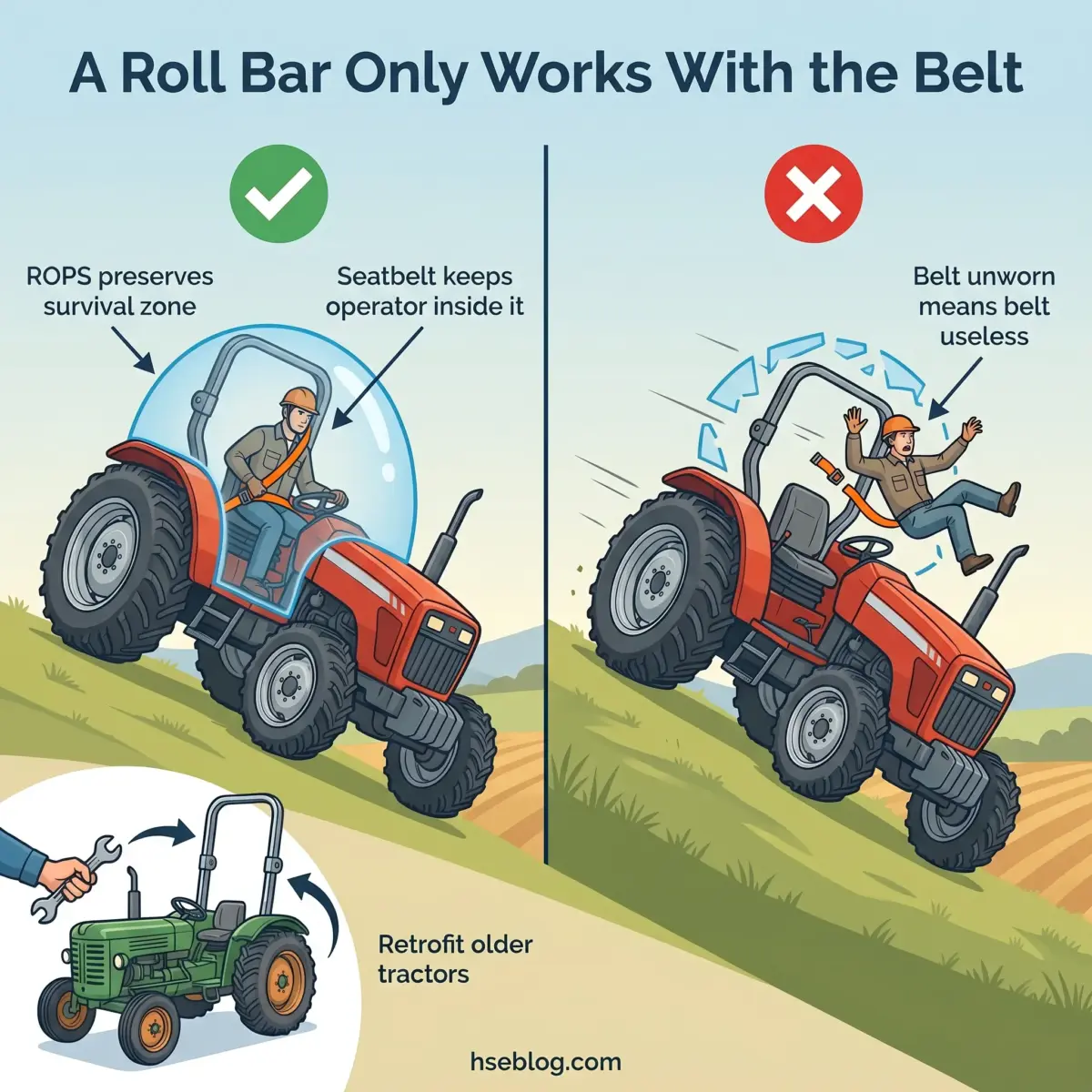
- ROPS + a worn seatbelt is the single highest-impact engineering control in agriculture, converting most tractor overturns from fatal to survivable.
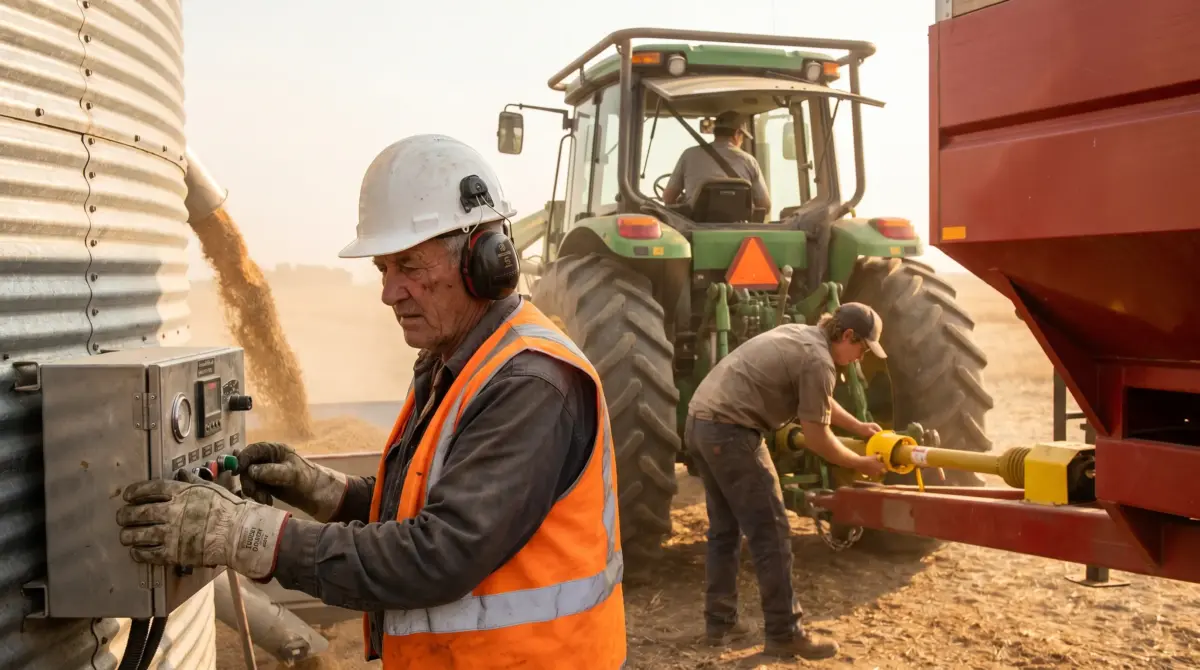
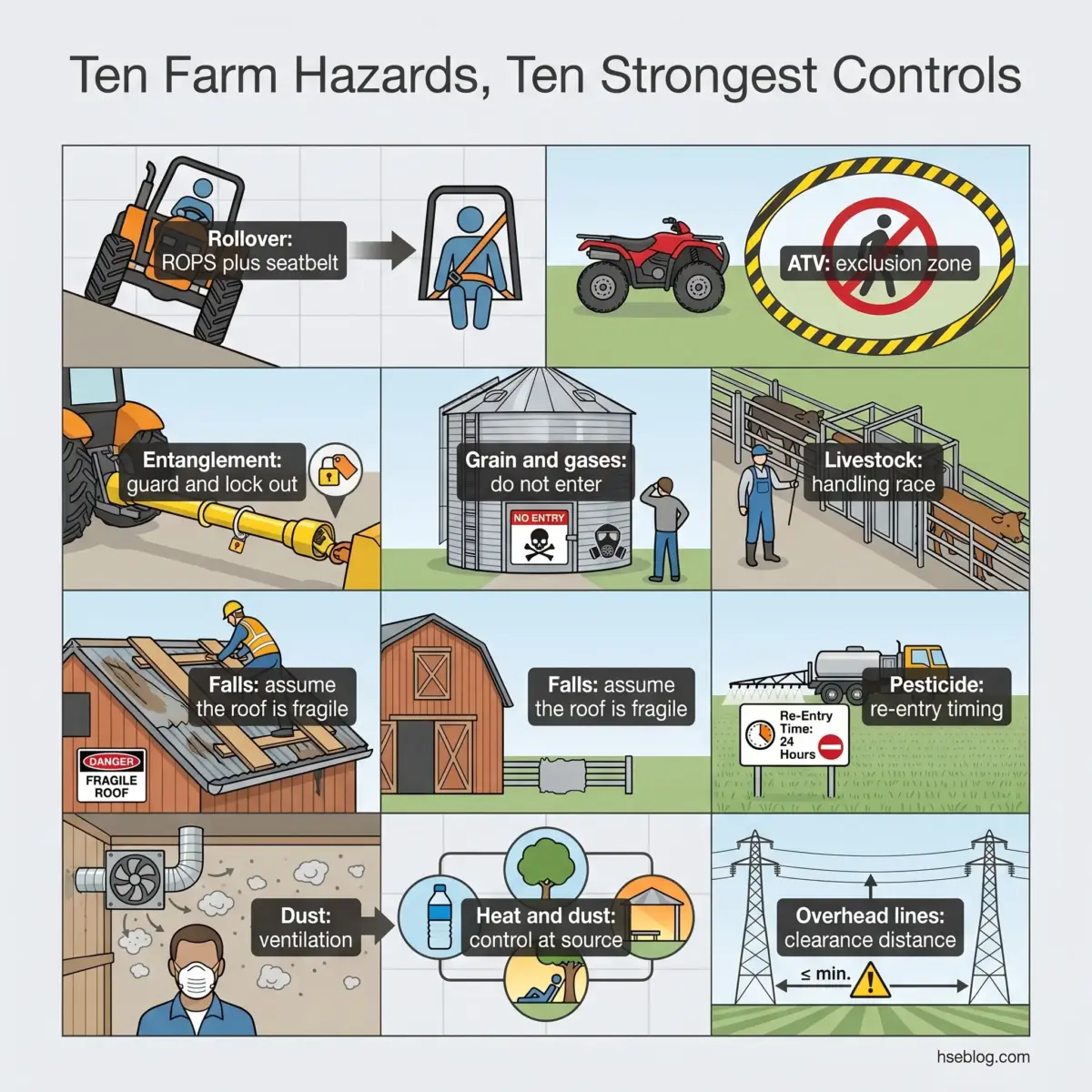
The top 10 farm hazards are tractor and machinery rollovers, vehicle and ATV incidents, machinery entanglement, grain-bin engulfment and confined-space gases, livestock handling, falls from height, chemical and pesticide exposure, respiratory hazards, heat stress, and electrical contact. Each is controlled best by elimination or engineering controls before reaching for PPE — and most farm deaths trace back to a control that existed on paper but failed in the field.
Farming sits near the top of almost every fatality table that exists. In the United States the agriculture, forestry and fishing sector recorded a fatal-injury rate of 18.6 deaths per 100,000 full-time-equivalent workers in 2022, against 3.7 for all industries combined (NIOSH/BLS, 2024); the Bureau of Labor Statistics reported 24.4 per 100,000 for 2023 using a different denominator and reference year (BLS via Rural Health Information Hub, 2024). Both numbers point the same way — this is dangerous work, and the higher figure is not an error so much as a reminder that the true burden depends on how you count.
This article maps the ten hazard families that account for most of those deaths, and pairs each with the control that does the most to stop it. The structure is deliberate: every hazard is tied to a named standard in both the US and UK, ranked controls follow the hierarchy of controls rather than a grab-bag of tips, and each section names the specific way the control tends to break down in practice. The goal is farm safety hazards and controls treated as a disciplined system, not a poster on the barn wall.
Competent-person caveat. This article provides general HSE knowledge. Life-critical work — grain-bin and confined-space entry, manure-pit and silo gas exposure, machine isolation, working at height on fragile roofs — must be planned and supervised by a competent person with relevant training, jurisdiction-specific authorization, and a site-specific risk assessment. The information here does not replace that.
Medical disclaimer. Content covering pesticide and respiratory exposure, heat illness and biological monitoring is for HSE practitioner reference. It is not medical advice. Workers with symptoms or exposure concerns should consult an occupational physician or qualified medical professional.
Legal disclaimer. Regulatory content here reflects general HSE professional understanding of US and GB requirements as of the review date above. It is not legal advice. Specific compliance questions, enforcement situations, small-farm exemption status, or prosecution risk should be directed to qualified legal counsel in the applicable jurisdiction.
What Makes Farming One of the Most Dangerous Industries?
Nearly every farm death is preventable, and almost none involves an exotic, unforeseeable event. The fatalities cluster around the same handful of hazards year after year — which is exactly why a top-ten framing is useful rather than reductive.
The scale is stark in both jurisdictions:
| Measure | Figure | Source |
|---|---|---|
| US sector fatal-injury rate (2022) | 18.6 per 100,000 FTE vs 3.7 all industries | NIOSH/BLS, 2024 |
| US sector fatal-injury rate (2023) | 24.4 per 100,000 (different denominator/year) | BLS via Rural Health Info Hub, 2024 |
| GB worker deaths (2024/25) | 23, ~22× the all-industry rate | HSE, 2025 |
| US non-fatal injuries with days away (2021–22) | 21,020, of which ~29% were falls | NIOSH/BLS, 2024 |
Two cautions sit behind those numbers.
- The figures are floors, not ceilings. NIOSH notes that farm injuries are widely underreported, so the real burden runs higher than any single table shows.
- The gap is implementation, not knowledge. HSE has described the sector’s fatal-injury rate as “stubbornly” flat for decades despite well-established controls — the controls exist; the discipline to maintain them often does not.
Reviewing the published fatality record across both countries, the same families recur: transport and machinery deaths dominate the totals, with confined spaces, livestock and falls close behind. The rest of this article walks each one, with the highest-impact control attached. OSHA’s agricultural hazards and controls guidance and NIOSH’s agricultural injury data underpin the US figures throughout.
How to Use the Hierarchy of Controls on a Farm
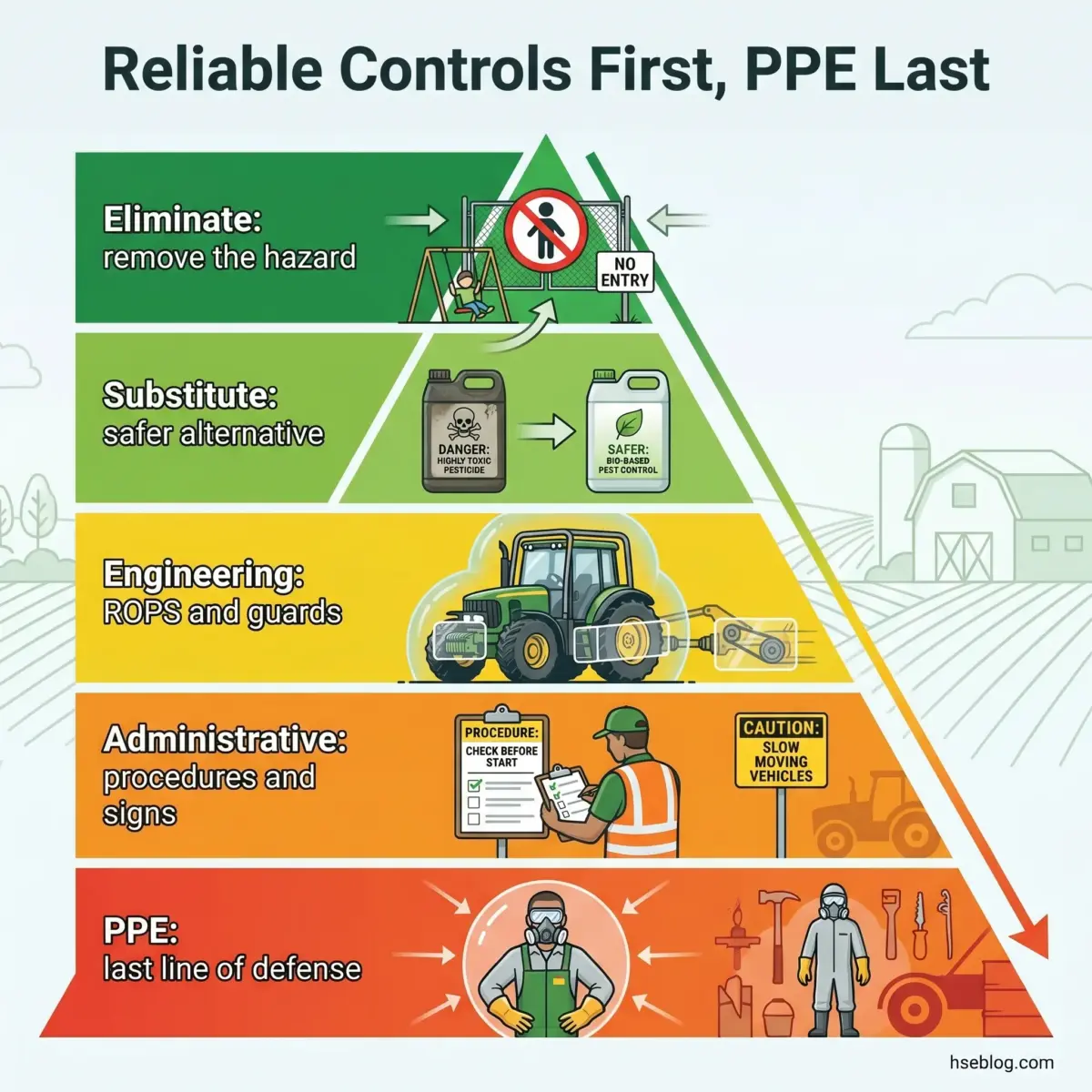
The hierarchy of controls on a farm ranks fixes by reliability, not convenience — and PPE sits last for a reason. The order runs elimination, then substitution, then engineering, then administrative controls, then PPE, with each tier less dependent on a person remembering to do the right thing under pressure.
Here is each tier with a farm-specific application:
- Eliminate — remove the hazard entirely. Keep children and untrained bystanders out of active work zones; design out a confined-space entry rather than managing it.
- Substitute — swap in something less dangerous. Choose a less-toxic chemical formulation or a granular product over a drift-prone spray.
- Engineering — build the control into the equipment. ROPS, PTO guards, machine guarding, auger covers, fixed ventilation.
- Administrative — control behavior through systems. Safe operating procedures, training, permits, signage, exclusion zones.
- PPE — the last line of defense. Respirators, hearing protection, gloves, eye protection — protecting one worker, only while worn correctly.
The recurring error is PPE-first thinking. A farm buys respirators or hi-vis and calls the hazard controlled, when it has really just shifted the entire burden onto worker behavior — and behavior fails on the day someone is tired, rushed, or filling in for an absent colleague.
A consistent failure mode in the published record is the “set-and-forget” control. The ROPS folded down for low-clearance work and never raised again. The guard removed for maintenance and never refitted. The respirator bought but never fit-tested. Each control exists on paper and is absent in the field.
Both legal regimes implicitly demand the higher tiers first. OSHA’s general duty obligation and the UK’s “so far as is reasonably practicable” standard under the Health and Safety at Work etc. Act 1974 (GB) both expect an employer to reach for engineering and design solutions before relying on PPE and instruction.
The Top 10 Farm Hazards and Their Controls
The ten hazards below are ordered roughly by fatality weight, since transport and machinery dominate the death data in both the US and UK. Each module follows the same pattern: what the hazard is and why it kills, an attributed or qualitative data point, controls ranked by the hierarchy, and the governing standard by jurisdiction.
This table is the fastest way to see the whole landscape at once:
| # | Hazard | Highest-impact control (tier) | Key standard (US / UK) |
|---|---|---|---|
| 1 | Tractor & machinery rollover | ROPS + seatbelt (engineering) | 29 CFR 1928.51 / PUWER 1998 |
| 2 | Vehicle, ATV/UTV & runover | Exclusion zones, rider training (eng. + admin) | General Duty / HSWA 1974 |
| 3 | Machinery entanglement | Guarding + lockout/tagout (engineering) | 29 CFR 1910.147 / PUWER 1998 |
| 4 | Grain engulfment & gases | Design out entry; permit + isolation (elim./eng.) | 29 CFR 1910.272 / Confined Spaces Regs 1997 |
| 5 | Livestock handling | Handling-system design (engineering) | General Duty / HSWA 1974 |
| 6 | Falls from height | “Assume fragile,” edge protection (engineering) | General Duty / Work at Height Regs 2005 |
| 7 | Chemical & pesticide | Substitution + REIs/AEZ (subst./admin) | 40 CFR 170 (WPS) / COSHH 2002 |
| 8 | Respiratory dust | Ventilation & suppression (engineering) | OSHA PELs / COSHH 2002 |
| 9 | Heat stress | Water-rest-shade, acclimatization (admin) | General Duty (rule proposed) / HSWA + Mgmt Regs |
| 10 | Electrical / overhead lines | Route survey + clearance (elim./admin) | OSHA subpart S / Electricity at Work Regs 1989 |
1. Tractor and Machinery Rollovers
Tractor overturns have historically been the single largest cause of farm worker death in the US, and rollovers dominate UK transport fatalities too. The control that matters most is also the best-evidenced one in all of agriculture: a roll-over protective structure paired with a worn seatbelt.
The mechanism is brutal in its simplicity:
- Rearward and sideways overturns happen on slopes, near ditch and field edges, and when a front-end loader raises the center of gravity.
- The survival zone is the space a ROPS preserves around the operator — but only if the seatbelt holds the operator inside it.
- Retrofit matters because older machines were never built with protection; US programs such as the National ROPS Rebate Program subsidize fitting structures to legacy tractors.
Controls, ranked:
- Engineering — fit an approved ROPS and a functioning seatbelt; this is the non-negotiable foundation of tractor rollover protection (ROPS).
- Administrative — slope and edge awareness, loader-handling limits, operator training and seatbelt-use policy.
On the regulatory side, the field procedure most aligned with the law is to treat ROPS-plus-seatbelt as standard equipment. In the US, 29 CFR 1928.51 (US) requires the employer to provide an approved ROPS and seatbelt for each tractor over 20 engine horsepower, operated by an employee, manufactured after 25 October 1976. In GB, the Provision and Use of Work Equipment Regulations (PUWER) 1998 (UK) require equipment to be suitable and maintained, which carries the same practical expectation. Internationally, ISO 5700 and ISO 3463 define the ROPS test standards a reader outside both countries should reference.
The lethal combination is a ROPS-equipped tractor with the seatbelt unworn. The structure protects the survival zone — and then the operator is thrown out of it.
2. Vehicle, ATV/UTV and Runover Incidents
Quad bikes, side-by-sides and farm vehicles add a second transport hazard with a distinct signature: it disproportionately kills bystanders and children, not just operators. The fix is rarely “drive better” — it is removing people from the path of the machine.
The main mechanisms:
- ATV/UTV rollovers on slopes and uneven ground, often with no helmet and no rider training.
- Runovers during reversing or moving off, where a second person stands in a blind zone the operator assumed was clear.
- Roadway collisions between slow farm vehicles and faster traffic on rural roads.
Controls, ranked:
- Engineering — fit and use crush protection where available; lighting and marking on road-going machines.
- Administrative — reversing procedures and spotters, enforced exclusion zones around moving vehicles, helmet use and rider training, and a hard rule against carrying passengers on single-rider machines.
There is no single dedicated US standard here; the OSHA general duty obligation and, in GB, the Health and Safety at Work etc. Act 1974 (GB) apply. HSE’s 2024/25 figures included children among public ATV fatalities, which is why the exclusion-zone control is framed around bystanders as much as riders (HSE, 2025).
Runover deaths frequently involve a second person — often a child or an older relative — in a blind zone the operator believed was empty. The failure is a missing exclusion zone, not a lack of operator skill.
3. Machinery Entanglement: PTO Shafts, Augers and Balers
Entanglement happens in rotating and in-running nip points faster than any human reaction can follow. The decisive control is two-part: guard the rotating parts (engineering) and isolate all energy before anyone reaches in (lockout/tagout).
Where it bites:
- PTO shaft entanglement — an unguarded or damaged power take-off shaft catches loose clothing, hair or a draw-cord and winds the worker in within a fraction of a second.
- Augers and balers — in-running parts pull a hand or arm in when someone clears a jam with the machine still live.
Controls, ranked:
- Engineering — maintain PTO guards and U-joint shields intact; keep auger and baler guarding fitted and serviceable.
- Administrative — no loose clothing, hair or jewelry near rotating parts; full isolation before any unjamming.
The governing standards converge on isolation. In the US, 29 CFR 1910.147 (US) — the Control of Hazardous Energy (lockout/tagout, LOTO) — requires energy isolation and verification before servicing or unjamming, applied here to augers, balers and PTO-driven equipment. In GB, PUWER 1998 (UK) requires guarding and safe means of clearing blockages.
The classic fatal sequence in the published record is a worker stepping over a spinning PTO, or reaching into a baler to clear a jam “just for a second” without isolating energy. The most-cited cause of these deaths is bypassing isolation for speed.

4. Grain Bin Engulfment and Confined-Space Atmospheres
This is the most life-critical module in the article, and it deserves the heaviest warning. Flowing grain can submerge a worker in seconds and exert pressure no one can self-rescue from — so the first control is to design out the need to enter at all.
How grain bin engulfment kills:
- Flowing grain behaves like quicksand; a worker standing on it as it unloads is pulled under in seconds.
- Bridged or crusted “out-of-condition” grain collapses without warning, dropping a worker into a void.
- Oxygen-deficient or toxic atmospheres inside the structure can incapacitate before engulfment even becomes the issue.
Controls, ranked:
- Elimination — avoid entry; break bridges and clear blockages from outside the structure wherever possible.
- Engineering / administrative — a confined space entry permit, atmospheric testing before and during entry, lockout of all fill and unload equipment, and a body harness with lifeline and a trained attendant stationed outside.
In the US, 29 CFR 1910.272 (US) governs grain handling facilities and requires entry permits, atmospheric testing, equipment lockout and engulfment safeguards. In GB, the Confined Spaces Regulations 1997 (UK) require avoiding entry where reasonably practicable and, where entry is unavoidable, a safe system of work with rescue arrangements in place before anyone goes in.
If you take one rule from this whole article on how to prevent grain bin entrapment, make it this: nobody enters a bin that is unloading, and nobody enters to rescue without training, equipment and a plan.
Manure-Pit and Silo Gases (Why Rescuers Die Too)
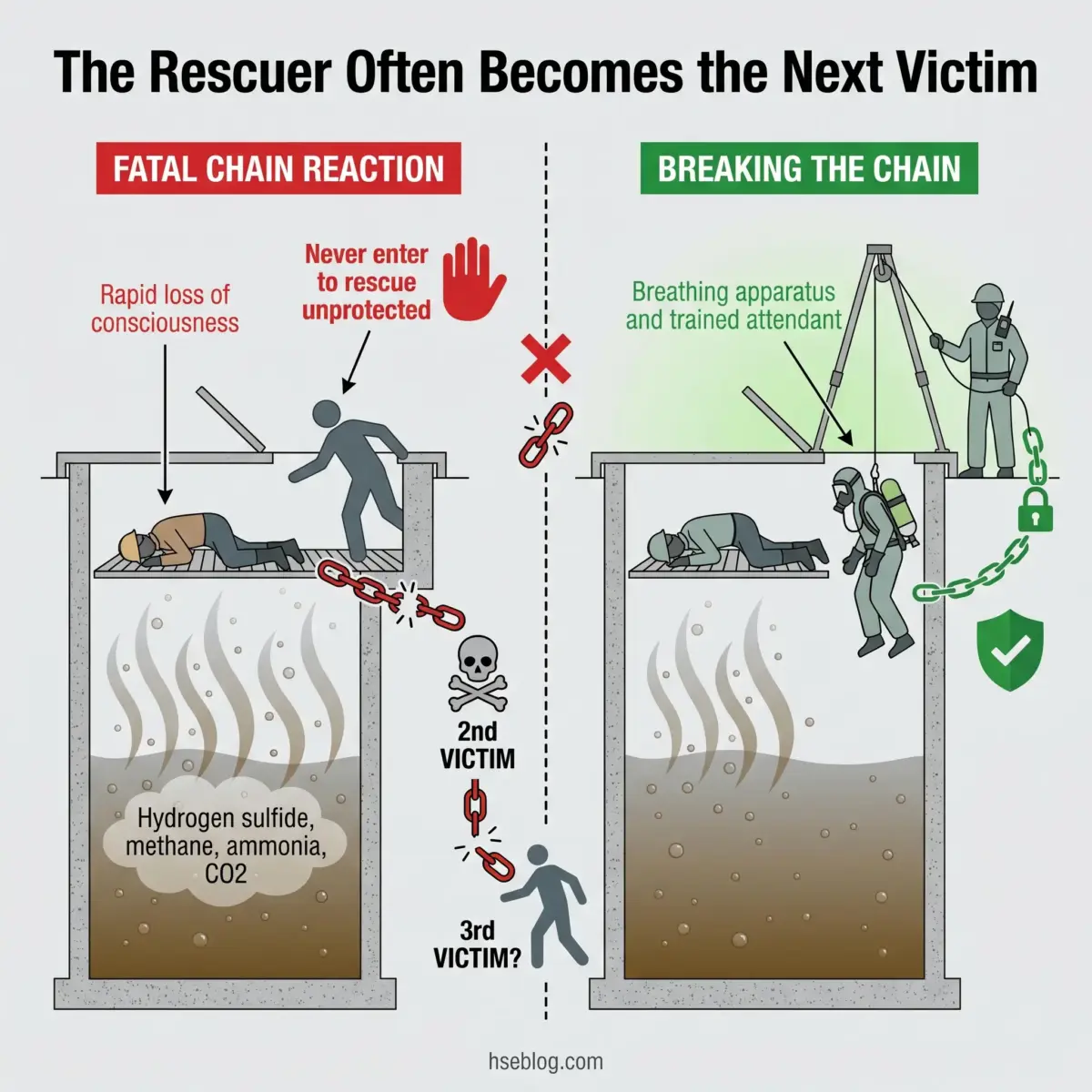
The dangerous gases in manure pits and slurry stores are hydrogen sulfide (H₂S), methane, ammonia and carbon dioxide, with nitrogen dioxide added in silos (“silo filler’s disease”). H₂S in particular can cause rapid loss of consciousness, and at high concentrations it can knock out a person’s sense of smell and their ability to escape almost at once.
Why these incidents multiply:
- The first collapse looks like a slip or faint, so a bystander climbs in to help.
- The same atmosphere overcomes the rescuer, and often a third person after that.
On exposure limits, the published occupational limits for H₂S and grain dust diverge between bodies — the OSHA permissible exposure limit (PEL), the NIOSH recommended exposure limit (REL) and the ACGIH TLV are not the same number. The honest practitioner instruction is to pull the current values directly from the NIOSH Pocket Guide to Chemical Hazards at the time of work and treat the strictest as the planning reference, rather than trusting a number copied from a secondary blog.
Multiple-fatality farm incidents almost always share one signature: an untrained bystander entered to rescue a collapsed colleague and was overcome by the same atmosphere. The control that actually saves lives is a pre-agreed rule of no unprotected entry, even to rescue.
5. Livestock Handling Injuries
Animals cause crush, kick, trample and goring injuries, and in some recent HSE years “injured by an animal” has been the single most common fatal cause in GB agriculture. The control is engineering before bravado — designing handling systems that keep a barrier between human and animal.
Where the danger concentrates:
- Cattle and bulls in confined spaces, especially during loading and movement.
- Maternal aggression around calving, when normally placid animals become unpredictable.
- Routine, low-attention tasks rather than obviously risky ones.
Controls, ranked:
- Engineering — well-designed races, crushes and handling pens with clear escape routes for the handler.
- Administrative — reading flight zones and behavioral cues, never turning your back on a bull, and extra caution at calving and loading.
There is no single dedicated standard for livestock handling safety; the duty falls under the general duty obligation in the US and the Health and Safety at Work etc. Act 1974 (GB), interpreted through risk assessment of the specific animals and tasks.
Livestock incidents spike during familiar, routine jobs — moving stock, loading a trailer — not during tasks the handler treats as dangerous. The pattern is complacency around familiar animals, which is precisely why handling-system design beats relying on the handler’s judgment in the moment.
6. Falls from Height and Falling/Collapsing Objects
Falls from height became the most common cause of agricultural worker death in GB in 2024/25, ahead of moving machinery (HSE, 2025). The dominant control is to treat every farm roof and stack as a trap until proven otherwise — and to plan access before anyone climbs.
The three recurring scenarios:
- Fragile-roof falls through asbestos-cement sheeting and rooflights that look solid and are not.
- Ladder falls from poor condition, wrong angle, or unsecured footing.
- Collapsing bale stacks and falling loads that come down on the person below.
Controls, ranked:
- Engineering — crawling boards and proper roof-access staging, edge protection, and stable, tied bale stacking.
- Administrative — an “assume fragile” default for every roof, a planned access method, and ladder condition and footing checks.
In the US, falls fall under the general duty obligation and applicable construction-style protections when the work qualifies. In GB, the Work at Height Regulations 2005 (UK) require falls — including from fragile roofs and unsafe bale stacking — to be planned, supervised and controlled, and the regulation features directly in HSE bale-stacking and fragile-roof prosecutions. HSE’s fatal injuries in agriculture data tracks this trend.
Falls from fragile roofs recur on jobs treated as quick fixes — “just nipping up to replace a sheet” — where no access plan is made. The hazard is the informality, not the height alone.
7. Chemical and Pesticide Exposure
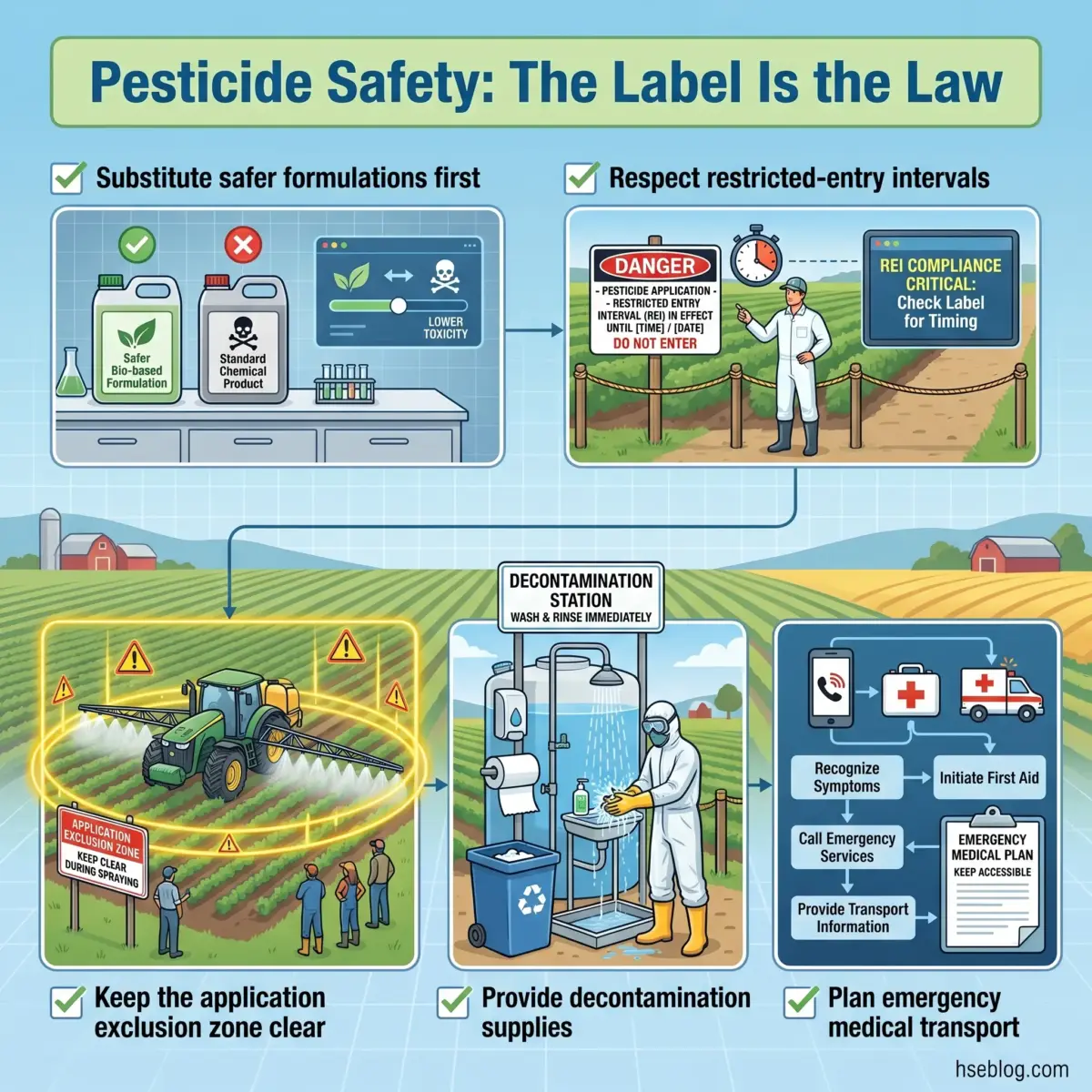
Pesticide harm comes in three forms — acute poisoning, spray drift, and slow chronic exposure — and the controls run from substitution all the way to emergency medical transport. The under-controlled risk is usually the routine, not the dramatic spill.
What the controls have to cover:
- Label-as-law — the product label legally binds use, including restricted-entry intervals (REIs) that keep workers out of treated areas.
- Application exclusion zones (AEZ) — keeping people clear of active application.
- Decontamination and emergency response — wash facilities, spill kits, and a duty to arrange emergency medical transport for exposed workers and handlers.
Controls, ranked:
- Substitution — choose the least-hazardous effective formulation.
- Administrative — observe REIs and AEZs, train handlers, and provide decontamination supplies.
- PPE — chemical-resistant gloves, coveralls and respiratory protection where the label requires.
In the US, the EPA Agricultural Worker Protection Standard — 40 CFR Part 170 (US) — requires annual pesticide safety training, PPE, restricted-entry intervals, application exclusion zones, decontamination supplies, hazard information and emergency medical transport. EPA’s final rule reinstating stronger AEZ requirements took effect on 3 December 2024 (Federal Register, 2024), so application exclusion zones are a current compliance point, not a settled one. In GB, the Control of Substances Hazardous to Health (COSHH) Regulations 2002 (UK) require employers to assess and control exposure to chemicals, pesticides and dusts.
Chronic, low-dose exposure causes more cumulative harm than dramatic spills — skipped gloves, re-entering a treated field too soon, no washing facilities. As covered in the medical disclaimer above, anyone with symptoms or a known exposure should see an occupational physician; pesticide exposure controls reduce risk but do not replace medical assessment.
8. Respiratory Hazards: Grain Dust, Organic Dust Toxic Syndrome and Farmer’s Lung
Respiratory damage on farms is invisible and cumulative, which is exactly why it gets under-prioritized against cuts and crushes. The reliable control is to stop the dust at source with ventilation and suppression, long before reaching for a respirator.
What workers are breathing:
- Grain and organic dust during handling and storage, which also carries a dust-explosion risk in grain facilities.
- Mouldy-crop bioaerosols that cause hypersensitivity pneumonitis, known as farmer’s lung.
- Heavy spore exposure that triggers organic dust toxic syndrome (ODTS), a flu-like reaction after intense exposure.
Controls, ranked:
- Engineering — ventilation and dust suppression at the point of generation.
- PPE — correctly selected and fit-tested respiratory protection where dust cannot be fully controlled.
On limits, grain-dust exposure values diverge between OSHA PELs, NIOSH RELs and the ACGIH TLV, just as they do for H₂S — pull the current figure from the NIOSH Pocket Guide and govern by the strictest. In GB, COSHH 2002 (UK) requires control of exposure to dusts and biological agents, including this category of bioaerosol.
Because the damage is not felt until lung function is already lost, workers routinely treat respiratory protection as optional. Recognizing delayed-onset symptoms matters — and, per the medical disclaimer, persistent breathlessness or recurrent flu-like episodes after dusty work warrant an occupational health referral.
9. Heat Stress and Heat-Related Illness
Heat-related illness ranges from heat exhaustion to heat stroke, and heat stroke is a medical emergency, not a “tough it out” moment. The core control is administrative and old-fashioned: water, rest, shade, and a structured acclimatization ramp for new and returning workers.
The practical fundamentals:
- Water-rest-shade — frequent fluids, scheduled rest in shade, and adjusted work-rate in the heat.
- Acclimatization — building exposure gradually over the first days back, when the body has not yet adapted.
- Recognition — treating confusion, collapse or stopped sweating as an emergency.
The US regulatory picture is in flux, which is itself a freshness point. There is still no single finalized federal heat standard; OSHA’s proposed “Heat Injury and Illness Prevention” rule — which would set heat-index triggers around 80°F (initial) and 90°F (high-heat) — was published in August 2024, held a public hearing through July 2025, and remains stalled, while OSHA’s heat National Emphasis Program lapsed on 8 April 2026 (OSHA; Ogletree Deakins analysis, 2024–2026). In the meantime, the General Duty Clause and several US state plans apply. In GB, there is likewise no numeric maximum working temperature; duties flow from the Health and Safety at Work etc. Act 1974 (GB) and the Management of Health and Safety at Work Regulations 1999 (UK). The proposed 80°F / 90°F triggers are a useful planning benchmark even where they are not yet law.
Heat stroke disproportionately strikes new or returning-from-leave workers in their first days on the job. The missing control is almost always a structured acclimatization ramp — and, as the disclaimer notes, heat illness management is a safety control, not a substitute for medical care.
10. Electrical Hazards: Overhead Power Lines and Farm Wiring
Electrocution on farms clusters around moving tall conductive objects into overhead power lines, plus deteriorated fixed wiring in damp, dusty buildings. The strongest control is to design the contact out — survey routes and set clearance distances before equipment ever moves.
The two failure modes:
- Overhead-line contact by augers, irrigation pipe, tipping trailers and telehandlers raised or moved without checking the line above.
- Deteriorated farm wiring in barns and stores where moisture, dust and rodents degrade insulation.
Controls, ranked:
- Elimination / administrative — route surveys, marked clearance distances, and spotters when moving tall equipment near lines.
- Engineering / administrative — isolation and competent periodic inspection of fixed wiring; never approach a downed line, and keep others back until the utility confirms it is dead.
In the US, overhead-line and wiring hazards fall under OSHA’s general electrical provisions and the general duty obligation. In GB, the Electricity at Work Regulations 1989 (UK) require electrical systems to be safe and maintained, and work near live conductors to be controlled.
Overhead-line electrocutions cluster around moving long conductive objects — irrigation pipe, augers — across fields the worker has crossed safely hundreds of times. Familiarity, not ignorance, is the trap.
Who Is Most at Risk: Children, Older Workers and the Self-Employed
Farm fatalities carry a strong demographic signature in both jurisdictions, and it should change how controls are prioritized on family-run holdings. The same person is often operator, employer, and the parent of the child in the yard — which dissolves the worker/bystander boundary other industries rely on.
Children
- Roughly 33 children are injured on US farms every day, and youth account for a large share of agricultural injury emergency-department visits (NIOSH/CDC, 2021); GB fatalities in recent years have included very young children.
- Controls: designated child-safe zones kept physically separate from work areas, and strict age-appropriate task limits — children are bystanders to be excluded, not junior workers to be supervised.
Older workers
- A large majority of US and GB agricultural fatalities involve workers in the older age bands, where slower reaction times combine with ageing, less-protected equipment.
- Controls: prioritize ROPS retrofits and guarding on the older machines these workers tend to operate, and avoid lone high-risk tasks.
Self-employed and lone workers
- Roughly 65% of GB agricultural fatalities over 2019–2024 were to self-employed workers (HSE), who are least likely to have formal systems, supervision or anyone nearby when something goes wrong.
- Controls: location-sharing, scheduled check-ins, and a realistic emergency plan that accounts for remote response times.
Building a Farm Safety System That Actually Works
Point-controls fail without a management layer, so the final move is to lift from “ten fixes” to one living system. The farms that break the stubbornly flat fatality trend treat the risk assessment as a recurring routine tied to seasonal tasks, not a one-time document filed for an inspector.
A working system has four moving parts:
- A real risk assessment — task-based, written, and reviewed after any incident or near-miss, when new equipment or chemicals arrive, when the workforce changes, and at minimum annually.
- Training and competence records — proof that the people doing high-risk tasks were actually trained, not just told.
- Emergency planning for remote locations — location-sharing, realistic response-time assumptions, and rescue arrangements decided before entry into any confined space.
- Near-miss reporting — capturing the close calls that precede the fatalities, so the control gets fixed before the funeral.
This is also where the YMYL caution earns its place: the controls in this article reduce risk, but life-critical tasks still need a competent person, current training, and legal advice specific to your jurisdiction. For recognized training pathways, point your team toward NEBOSH, IOSH, OSHA outreach, or the equivalent regional scheme.
Frequently Asked Questions
The One Change That Breaks the Curve
The hardest truth in the farm fatality data is that the knowledge already exists. HSE has called the sector’s death rate “stubbornly” flat for decades, and almost every fatality in the published record traces back to a control that was understood, available, and not applied on the day — a seatbelt unworn under a ROPS, a guard left off after maintenance, a bystander who entered a pit to help.
That points to one highest-impact change, and it is not buying more equipment. It is closing the gap between the control on paper and the control in the field — checking that the ROPS is up, the guard is on, the permit is real, and the exclusion zone is enforced, every season, on every machine. Farm safety hazards and controls only work as a maintained system, because the hazard does not take the day off when the discipline does.
If you do one thing after reading this, walk your own holding against the ten hazards above and find the control that exists in writing but not in practice. On most farms, it is already there waiting — and so is the incident it is supposed to prevent.