
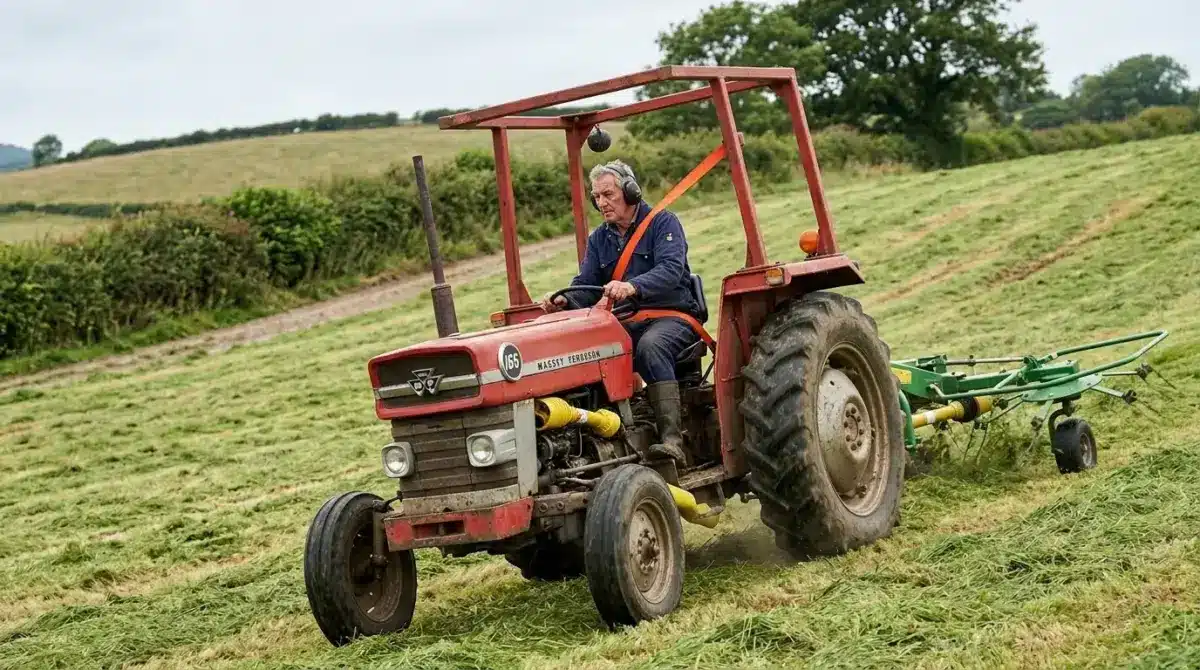
TL;DR — The Numbers That Define Tractor Risk
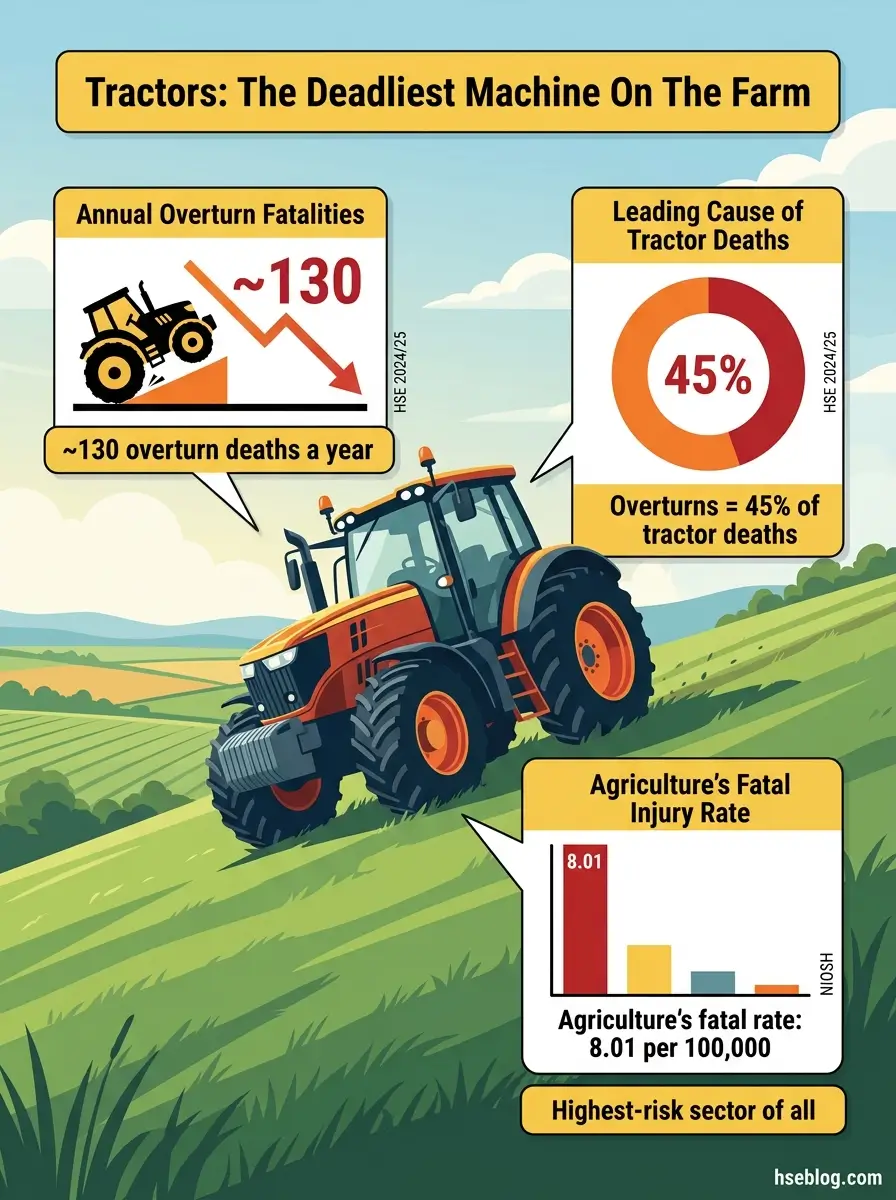
- ~130 overturn deaths a year (US): Overturns are the single leading cause of fatal farm injury (Great Plains Center for Agricultural Health/NIOSH, accessed 2026).
- ~45% of tractor-related fatalities are overturns: Out of 971 tractor-related deaths recorded across 2011–2018 (NIOSH, 2011–2018).
- 8.01 deaths per 100,000 workers: Agriculture holds the highest fatal-injury rate of any sector in Great Britain — roughly 22 times the all-industry average (HSE, 2024/25).
- 540 or 1,000 rpm: The speed a power take-off shaft turns — far faster than any human can react to once clothing catches (Cooperative Extension, 2025).
The most common tractor accidents fall into three groups — overturns, runovers, and power take-off (PTO) entanglement. Overturns are the leading cause of farm deaths, killing about 130 US operators a year (NIOSH). Most are preventable with a rollover protective structure (ROPS) and a buckled seat belt, fully guarded PTO shafts, and a strict shutdown routine before anyone leaves the seat.
Agriculture has had the engineering fix for its deadliest accident since the 1960s, yet the death rate has barely moved. A rollover protective structure paired with a seat belt nearly eliminates overturn fatality — and overturns are still the number-one killer on farms decades after ROPS reached the market. The problem was never a missing invention.
This article breaks tractor safety down by the three mechanisms that actually kill people, because each has its own physics, its own trigger, and its own control. Lumping them into one “common causes” list — the way most dealer blogs do — hides exactly the information an operator needs to stay alive. What follows is the failure-mode analysis behind the headline figures, the controls matched to each hazard, and where the law on ROPS and guarding genuinely binds you.
Why Tractor Safety Matters: The Scale of the Risk
Tractors kill more farm workers than any other single source, and the rate has stayed stubbornly flat for decades. Reviewing the published fatality record makes the point sharply: overturns alone account for around 130 deaths a year in the US (Great Plains Center for Agricultural Health/NIOSH, accessed 2026), and across 2011–2018 there were 971 tractor-related fatalities in agricultural production, roughly 45% of them overturns (NIOSH, 2011–2018).
The pattern is not unique to one country. In Great Britain, agriculture carries the highest fatal-injury rate of any sector — 8.01 per 100,000 workers in 2024/25, about 22 times the all-industry average (HSE, 2024/25), with transport and machinery the leading cause.
What makes those numbers worth dwelling on is their persistence:
- The fix predates the deaths. ROPS has been available since the 1960s, yet overturns remain the top killer — the technology exists; the un-retrofitted machine and the behavioral shortcut do not get fixed.
- It will touch ordinary operators. NIOSH-funded overturn data frames the personal odds bluntly: roughly 1 in 10 operators will overturn a tractor at some point in their working life (GPCAH/NIOSH, accessed 2026).
- The risk skews older. In the UK, nearly 40% of those killed in farm incidents in 2023/24 were over 65 (HSE notification data via NFU, 2024) — the same demographic most likely to be running older, pre-ROPS machines.
A consistent reading across the investigation literature is that fatality clusters track old equipment and defeated safeguards, not an absence of known controls. That reframes the entire subject. The honest question is rarely “what should we invent?” It is “why do the controls we already have keep failing?”
The Three Deadliest Tractor Accident Types (and Why They Happen)
Three mechanisms cause the overwhelming majority of tractor deaths, and they are not interchangeable. An overturn, a runover, and a PTO entanglement each follow a different causal chain and demand a different control — which is precisely why a single flat “common causes of tractor accidents” list does operators a disservice.
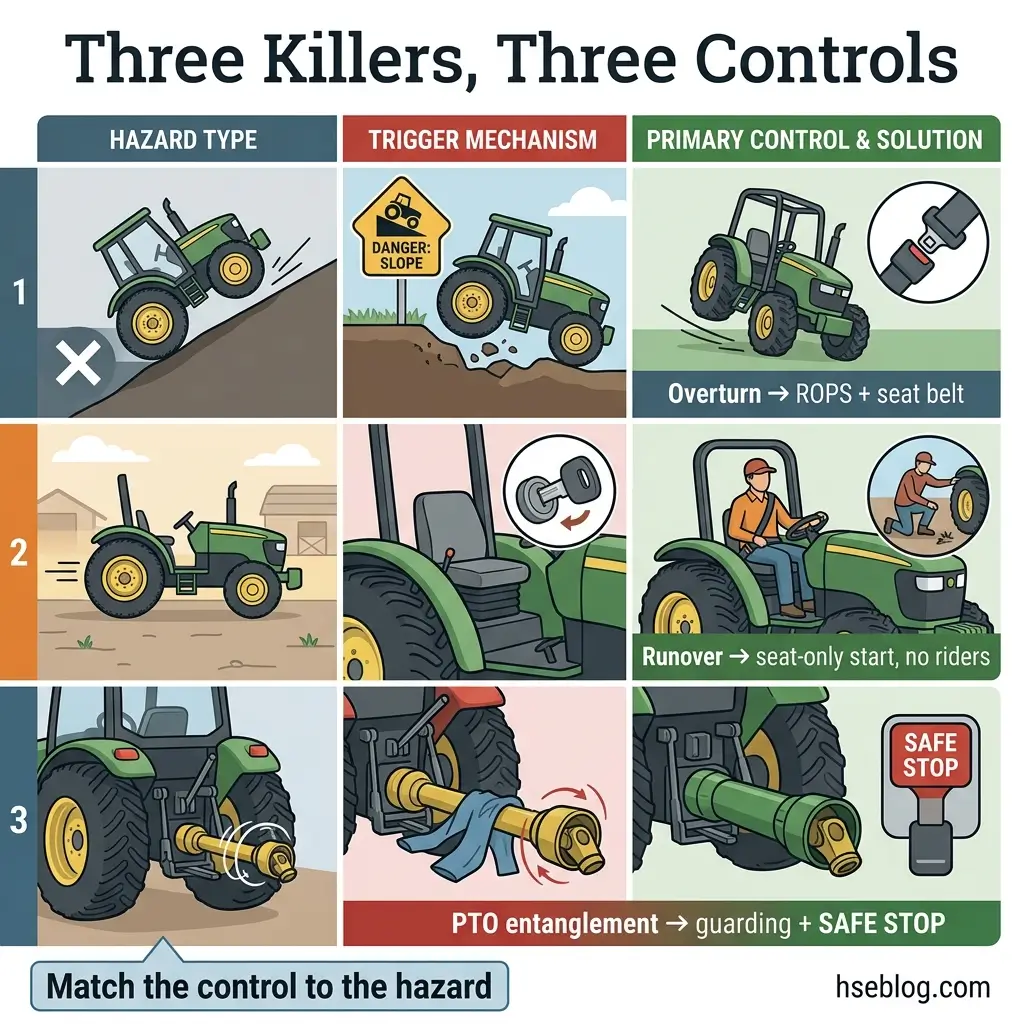
Here is the mapping the rest of this section unpacks:
| Accident type | Main triggers | Primary control |
|---|---|---|
| Overturn (rollover) | Slopes, excessive speed on turns, high/improper hitching | ROPS + buckled seat belt |
| Runover | Bypass starting in gear, extra riders, blind spots | Start from the seat only, no riders, 360° walk-around |
| PTO entanglement | Loose clothing, working near a running shaft | Full-length guarding + SAFE STOP shutdown |
Overturns (Rollovers): The Number-One Killer
An overturn is the deadliest event a tractor can produce, and it happens too fast to escape — a roll completes in under about 1.5 seconds. That single physical fact dismantles the most dangerous belief in farming: that an alert operator can jump clear. Human reaction time does not allow it.
Overturns come in two forms, driven by where the tractor’s center of gravity escapes its base of support:
- Side overturns are the more common. They are triggered by slopes, ditch and bank edges, and excessive speed on turns, where centrifugal force pushes the machine’s mass beyond the wheelbase.
- Rear overturns are driven by rear-axle torque. When a load is hitched too high, or the tractor is pulling against a stuck implement, the front end can lift and the machine flips backward over the operator.
The mechanism most operators misjudge is the slope itself. A consistent pattern across overturn reports is that the fatal slope is usually the routine one — the field crossed a hundred times — not the obviously steep one a driver would naturally respect.
What changes is the variable nobody re-checks: wet ground, a heavier load, a front-end loader raised, or a new attachment shifting the center of gravity. The NIOSH-funded overturn data behind those ~130 annual deaths repeatedly shows experienced operators on familiar terrain under altered conditions. Judging a gradient “by eye and by past success” is the failure point, not inexperience.
Runovers: The Hazard Hiding in Plain Sight
A runover kills when a tractor moves over a person — and a disturbing share of these incidents involve a machine with nobody at the controls. The mechanism splits into three distinct sub-types, each with its own root cause:
- Operator runover (bypass starting). When someone starts a tractor from the ground rather than the seat — reaching across to the starter solenoid — a machine left in gear lurches forward and runs over the person who started it. This is a leading source of unmanned-machine runovers in extension safety literature; the defense is to never defeat the seat or neutral-start interlock and to keep the bypass-start shield in place.
- Fall-from-rider runover. Extra riders fall and go under the wheels. A standard agricultural tractor is a single-seat machine; it legally and physically carries one person.
- Bystander runover. These disproportionately kill children under about nine years old, struck in blind spots or while the tractor reverses (HSE/NIOSH pattern data).
The root cause behind the interlock deaths deserves naming plainly. Operators often wire around the safety-start interlock deliberately, because stopping to climb into the seat feels like a minor inconvenience. The safeguard is not missing — it has been engineered out by the person it was meant to protect. That is a different problem from ignorance, and it needs a different fix: removing the incentive to bypass, not another poster.
PTO Entanglement: Seconds to Catastrophe
A power take-off shaft turns at 540 rpm — about nine rotations every second — or 1,000 rpm on higher-speed implements, roughly 16.6 rotations a second (Cooperative Extension, 2025). At that speed, a sleeve, drawstring, or trouser leg wraps and pulls a limb in before the brain registers contact. PTO safety is, at its core, the discipline of never being near a turning shaft.
The wrap points are specific and worth knowing by sight:
- The PTO stub at the rear of the tractor.
- The driveline (the connecting shaft) running to the implement.
- The unguarded universal joints and connectors — the components most often left exposed when an original guard is lost or removed.
The contexts repeat across the published record. HSE’s guidance on machinery entanglement and its prosecution case histories show the same scenarios again and again: loose clothing near a running shaft, work carried out beside a driveline wrongly believed to be disengaged, and — most often — clearing a blockage on a machine that is still turning. Injuries run to amputation, scalping, and fatal trauma, and these incidents fall heavily on untrained helpers and young people.
The phrase worth carrying off this page is “it was only going to take a second.” Most entanglements occur during a quick, unplanned task where the operator never formally stopped the machine. The entire purpose of a shutdown routine is to interrupt exactly that moment of improvisation.
Other Contributing Causes Operators Underestimate
These causes compound the big three rather than rival them — and dealer blogs tend to list them as if they carried equal weight. Honestly framed, they are accelerants: factors that turn a recoverable situation into an overturn, a runover, or an entanglement.
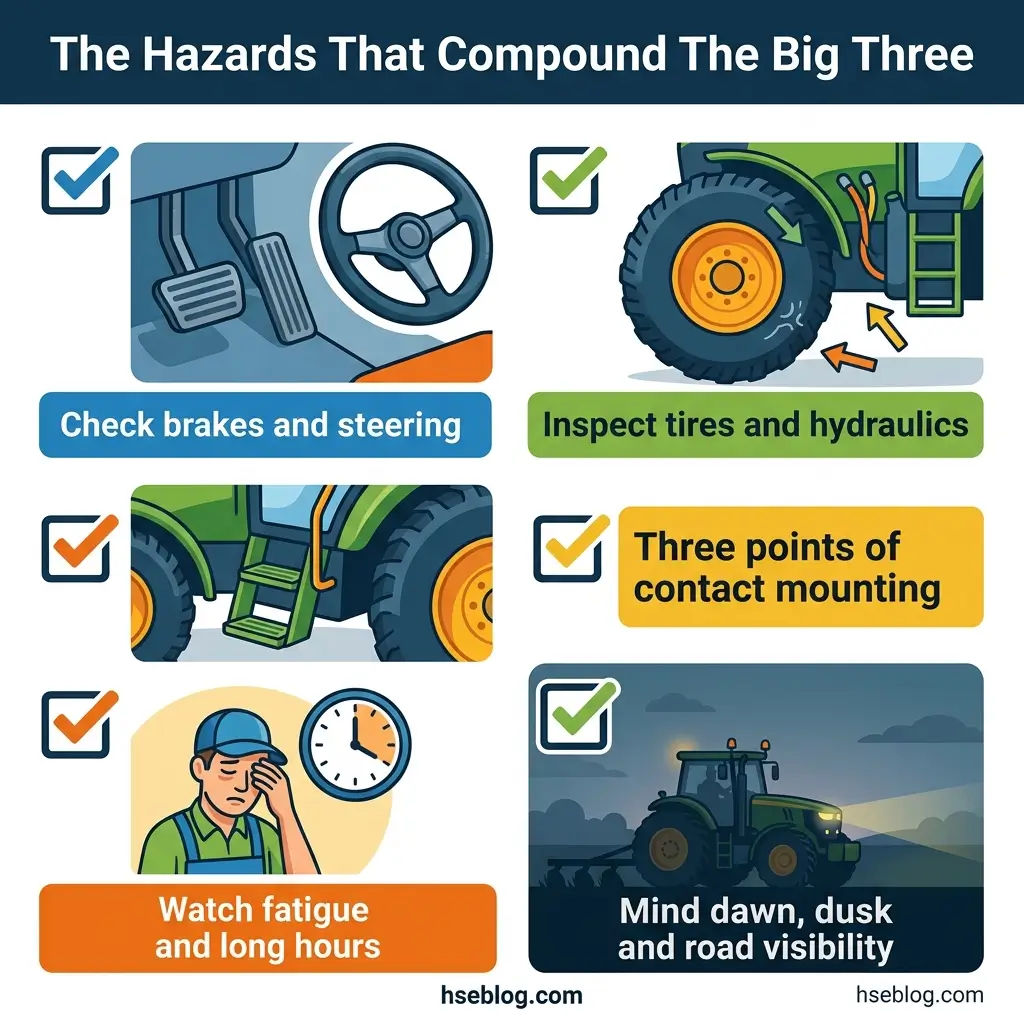
Grouped by category, the contributing factors most often understated are:
- Mechanical neglect. Brake and steering failure, worn tires, and degraded hydraulics — almost always traceable to skipped maintenance rather than sudden breakage.
- Falls while mounting and dismounting. Slips from the steps are among the most frequent lost-time injuries on tractors; maintaining three points of contact when climbing on or off is the basic defense.
- Fatigue and long hours. Harvest schedules erode judgment exactly when slope, load, and traffic decisions matter most.
- Reduced visibility. Dawn, dusk, dust, and public-road transport all cut the operator’s ability to see bystanders and obstacles.
- Road collisions. Mixing a slow, wide machine with faster traffic introduces a hazard the field never presented.
The pattern behind nearly all of these is gradual normalization. Maintenance failures rarely arrive out of nowhere — they announce themselves as small, ignored symptoms: a spongy brake pedal, a guard “left off just for today,” a tire run a season too long. Each gets absorbed into routine until the day the margin disappears.
How to Prevent Tractor Accidents: The Control Hierarchy in Practice
Effective tractor rollover prevention and entanglement control follow the recognized hierarchy of controls — engineering controls first, administrative controls next, and PPE last — not a flat tip list. The value of the hierarchy is that it ranks controls by reliability: a physical barrier that works whether or not anyone remembers it beats a rule that depends on perfect behavior every time.
Competent-person note: This article provides general HSE knowledge. Life-critical work such as operating tractors on slopes, retrofitting ROPS, and working around PTO drivelines must be planned and supervised by a competent person with relevant training, jurisdiction-specific authorization, and a site-specific risk assessment. The information here does not replace that. Recognized training pathways include NEBOSH, IOSH, and OSHA-authorized agricultural safety outreach, or their regional equivalents.
Engineering Controls: ROPS, Seat Belts, and Guarding
The single most effective overturn countermeasure is a ROPS combined with a buckled seat belt — together they near-eliminate overturn fatality. The NIOSH-funded overturn research is unambiguous on the mechanism: a ROPS limits the roll to roughly 90 degrees and creates a survival zone around the operator’s body.
The critical caveat is that the two controls only work as a pair:
- ROPS without a seat belt offers little protection. An unbelted operator is thrown out of the survival zone the structure creates — often into the path of the roll. The belt is what keeps you inside the space the ROPS protects.
- Older tractors can usually be retrofitted. NIOSH’s Cost-effective Rollover Protective Structures (CROPS) program and various rebate schemes exist precisely for the pre-ROPS machines where deaths concentrate. Where no certified ROPS or CROPS fits a given model, NIOSH’s recommendation is to retire the tractor.
- Guard the driveline to the first bearing. Full-length PTO and driveline guarding, plus an intact bypass-start shield, closes the entanglement and unmanned-runover wrap points.
The failure mode that defeats all of this is set-and-forget. Guards come off for maintenance and never go back on; seat belts stay unbuckled “for short jobs.” An engineering control only counts when it is present and used every single time — which is the bridge from hardware to behavior.
Administrative Controls: Training, SAFE STOP, and Safe Systems of Work
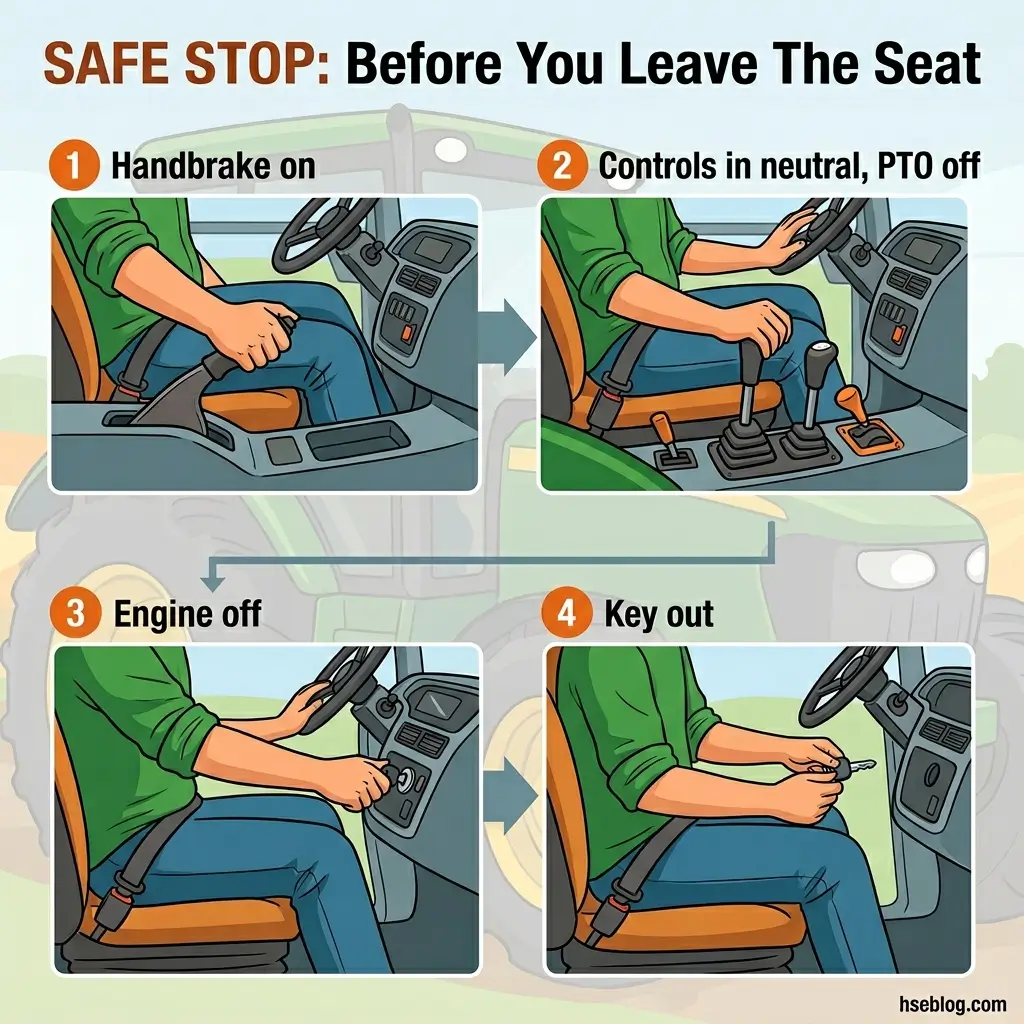
Administrative controls govern how the machine is operated, and the highest-leverage one is a non-negotiable shutdown routine. HSE’s SAFE STOP messaging — reinforced through ongoing Farm Safety Week campaigns in 2024–2025 — exists because most runover and entanglement deaths happen the moment an operator approaches machinery without fully stopping it.
The SAFE STOP sequence, to run before leaving the seat or approaching any part of the machine:
- Handbrake on. Remove any chance of roll or creep.
- Controls in neutral. Disengage the PTO and put transmission controls in neutral.
- Engine off. Stop all rotating power.
- Key out. Remove the means of an accidental restart before you are clear.
Around that routine sit the safe systems that prevent the incident arising in the first place:
- Pre-start 360° walk-around. Check for bystanders, children, and obstructions before starting — the core of tractor runover prevention.
- Plan work on slopes and edges. Choose routes, set speeds for turns, and account for how a raised loader or new attachment shifts the center of gravity.
- One operator, one seat. No extra riders, ever, on a single-seat machine.
- Verified competence. Treat training as competence verification, not a box-tick. OSHA requires employers to deliver tractor operating instructions at assignment and at least annually under 29 CFR 1928.51 (US).
The judgment point here is honest: SAFE STOP rarely fails because people do not know it. It fails because it competes with time pressure. The operators who survive long careers treat it as fixed muscle memory — not a decision to be re-made, and re-negotiated, on every busy afternoon.
PPE and the Limits of Personal Protection
Personal protective equipment is the last line of defense, never the first — and on a tractor it does nothing to stop an overturn or a runover. Its job is narrow: to reduce harm from contact hazards and to make the operator visible.
The PPE that genuinely earns its place:
- Close-fitting clothing, no drawstrings or loose sleeves — the most relevant control near any PTO shaft.
- Sturdy footwear with good grip for safe mounting and dismounting.
- High-visibility clothing on public roads and shared yards.
- Hearing protection for sustained exposure to engine and implement noise.
The dealer-blog habit of listing “helmets and gloves” as tractor safety measures gets the hierarchy backward. No glove prevents a rollover. PPE manages the residual risk left after ROPS, guarding, and safe systems have done the real work — and it should always be understood in that order.
Are ROPS and Tractor Safety Measures Required by Law?
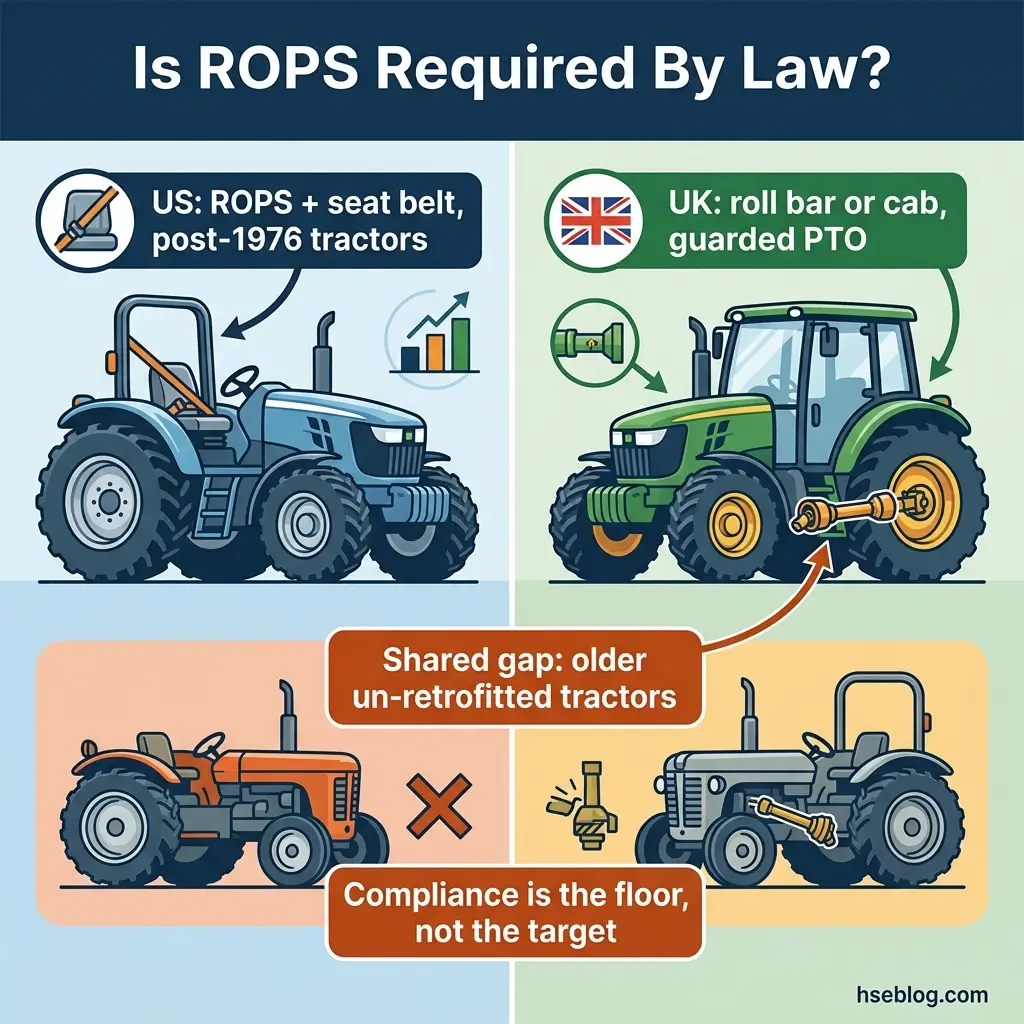
Yes — but the legal requirement is narrower than most operators assume, and the gaps are exactly where the deaths cluster. The honest summary: ROPS and PTO guarding are mandated in both the US and UK, yet the rules exempt older machines and small operations precisely where fatality risk is highest.
Legal disclaimer: The regulatory content here reflects general HSE professional understanding of US and UK requirements as of 2025. It is not legal advice. Specific compliance questions, enforcement situations, or prosecution risk should be directed to qualified legal counsel in the applicable jurisdiction. Regulatory currency: this section was prepared against standards in force in 2025; verify against the current text before relying on it.
United States. When an agricultural tractor exceeds 20 engine horsepower and was manufactured after 25 October 1976, OSHA’s ROPS standard for agricultural tractors (29 CFR 1928.51) requires the employer to provide a ROPS and seat belt, ensure the belt is worn while the tractor is moving, and deliver operating instructions annually. The practical limitation: many small farms with very low employee counts fall outside routine OSHA enforcement, so “not legally required for me” is not the same as “safe.” (The precise small-farm appropriations-rider language should be confirmed against the current text before publishing.)
United Kingdom. The duties flow from the Health and Safety at Work etc. Act 1974: under sections 2 and 3, employers must protect both their employees and non-employees affected by the work, so far as is reasonably practicable. Tractors must carry roll bars or safety cabs and guarded PTO shafts, and PUWER 1998 reinforces the equipment-guarding obligation — the basis on which HSE prosecutes incidents involving unguarded drivelines and untrained workers. PTO guard specification itself is set out in BS EN 12965 (UK/EU).
International best practice. The benchmark to design against is the modern ROPS test standard — ISO 5700 (and ISO 3463), with SAE J2194 and ASAE S519 accepted as equivalents. OSHA’s original codified criteria predate these and remain the US legal text, but OSHA has formally accepted the newer ISO/SAE standards as providing equivalent or superior protection — so specifying to ISO 5700 satisfies the law and exceeds its older wording.
| Jurisdiction | Core requirement | Key gap |
|---|---|---|
| US (OSHA 1928.51) | ROPS + seat belt on >20 hp tractors built after Oct 1976 | Pre-1976 machines; small-farm enforcement exemption |
| UK (HSAWA 1974, PUWER 1998) | Roll bar/safety cab + guarded PTO; duty to employees and others | Older un-retrofitted tractors still in service |
| International (ISO 5700 / SAE J2194) | Performance/test standard for ROPS | Voluntary benchmark, not a standalone legal mandate |
The interpretation worth stating plainly: legal minimums lag behind best practice and exempt the very operations — small farms, older equipment — where overturn deaths concentrate. Treat compliance as the floor, not the safety target.
Frequently Asked Questions
Conclusion
The industry keeps treating tractor safety as a technology problem when it is a maintenance-and-behavior problem. Every one of the three killers — overturn, runover, PTO entanglement — already has a proven control: ROPS with a seat belt, starting from the seat with interlocks intact, and full guarding backed by a non-negotiable SAFE STOP. The death rate has stayed flat not because those controls are missing, but because they get retired with old machines and defeated on busy days.
If there is one highest-impact change, it is to stop tolerating the defeated safeguard — the unbuckled belt “for a short job,” the guard left off “just for today,” the interlock wired around for convenience. Each of those is a control that worked until someone decided it was an inconvenience.
The honest test for any operation is uncomfortable: walk your oldest tractor and ask whether it has a certified ROPS, whether the belt is used every time, and whether the PTO guard is actually on the shaft right now. If the answer to any of those is no, the next overturn or entanglement is already a question of when, not whether — and tractor safety, on that machine, currently exists only on paper.