
TL;DR — Type I vs. Type II Hard Hats
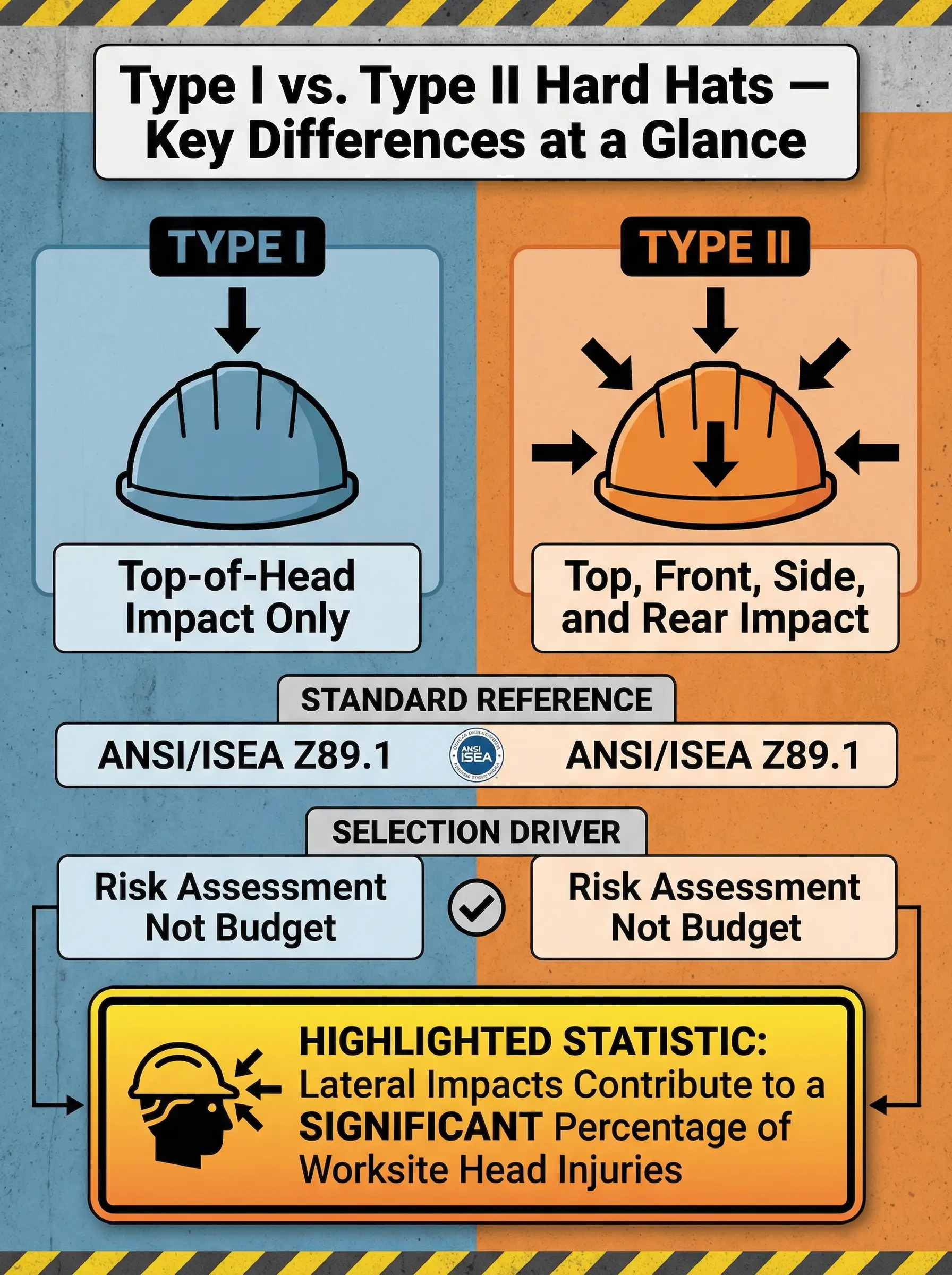
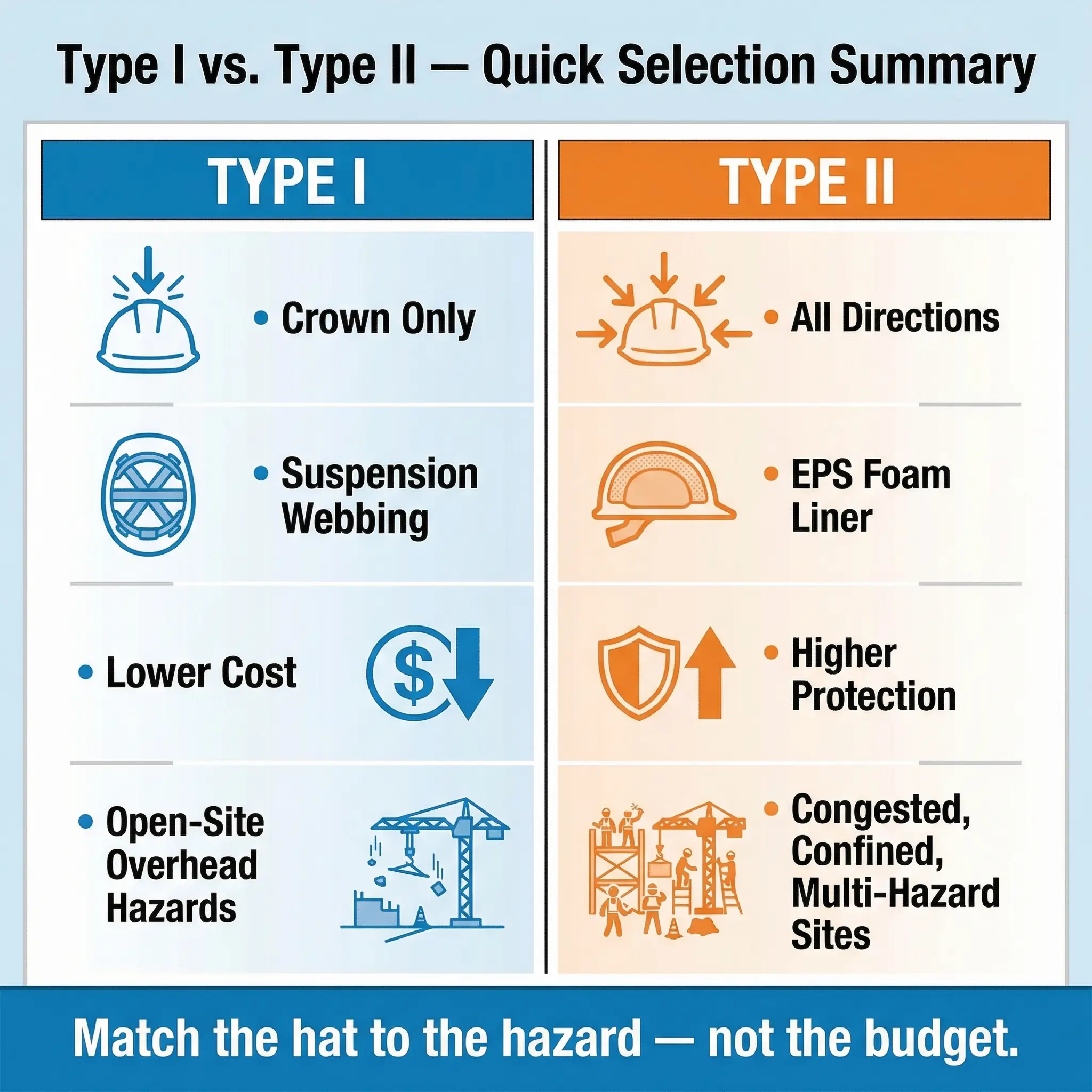
- Type I protects the top of the head only: Designed to reduce the force of impact from objects falling directly onto the crown — but offers no rated protection against lateral, front, or rear impacts.
- Type II protects the top AND sides: Engineered to absorb impacts from all directions — top, front, back, and sides — making it the superior choice for environments with multi-directional strike hazards.
- The standard that defines them is ANSI/ISEA Z89.1: Both types are classified under this American National Standard, with Type II requiring additional lateral impact testing that Type I does not undergo.
- Choosing the wrong type gets people hurt: A Type I hard hat on a worker crawling through pipe racks, working near swinging loads, or operating in confined overhead spaces is an uncontrolled lateral impact waiting to happen.
- Your risk assessment drives the selection — not your budget: Type II hard hats cost more, but the cost difference disappears the moment you compare it against a single skull fracture, craniotomy, or wrongful death claim.
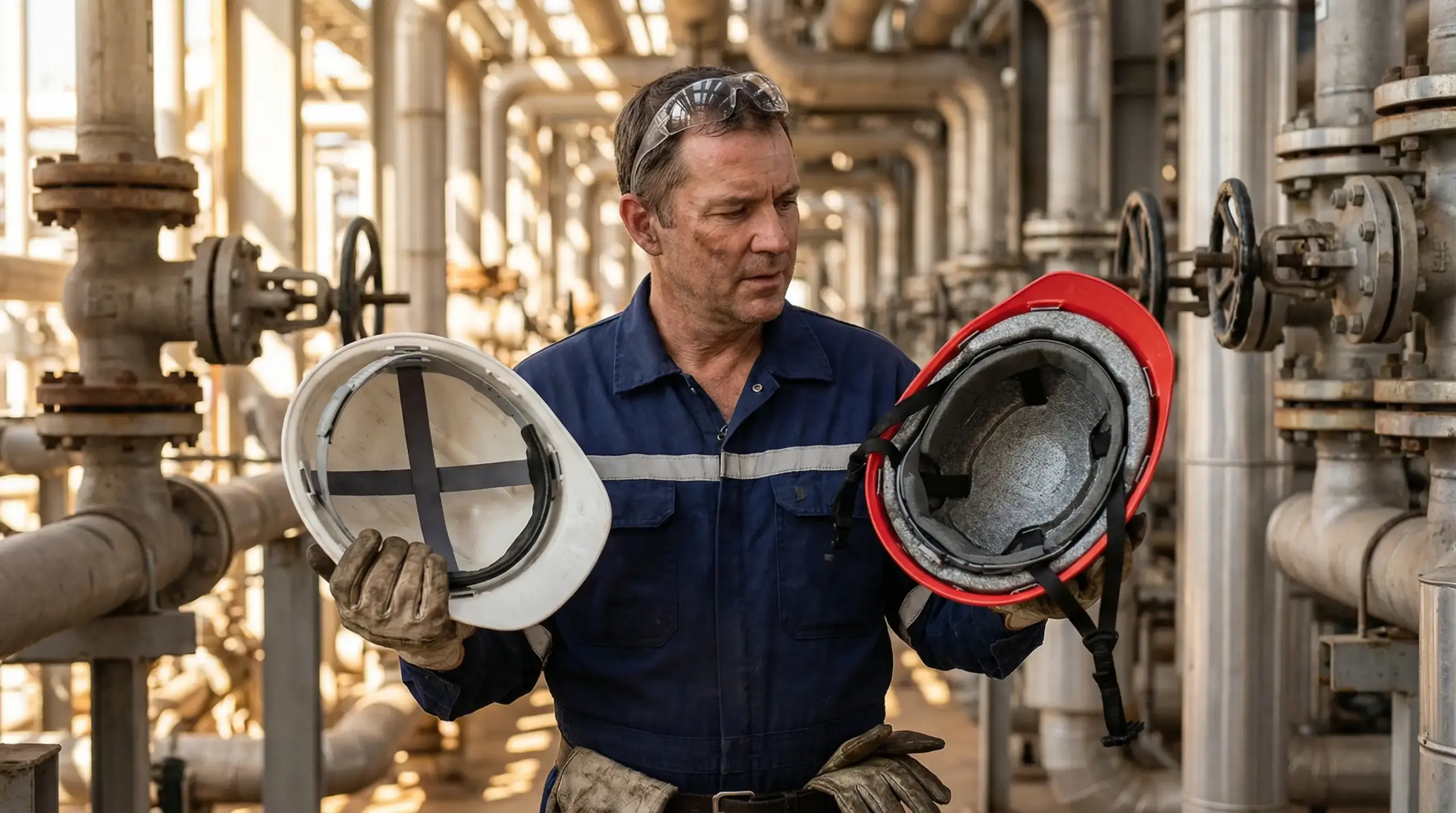
I was reviewing PPE compliance photographs from a refinery turnaround in the Gulf when I spotted something that made me pick up the phone immediately. Thirty-six workers were crawling through a pipe rack jungle — ducking under flanges, squeezing between valve manifolds, turning their heads sideways to navigate tight clearances — and every single one of them was wearing a Type I hard hat. The exposure was lateral and frontal. The hard hats they wore were rated for exactly none of it. I stopped the job scope for that crew within the hour, and we had a very direct conversation with the contractor’s safety lead about what “head protection” actually means when the hazard isn’t falling straight down from the sky.
That incident sits with me because it captures a gap I see repeated across industries — the assumption that a hard hat is a hard hat. It is not. The difference between Type I and Type II hard hats is not a marketing upgrade or a comfort preference. It is a fundamental difference in the direction of impact a helmet is engineered to absorb. Getting this selection wrong means sending workers into environments with uncontrolled head injury exposure, and the injury data confirms that lateral and oblique impacts account for a significant share of traumatic brain injuries on worksites. This article breaks down exactly what separates these two classifications, where each one belongs, where each one fails, and how to make the right selection decision based on your actual site hazards — not your procurement catalogue.
What Defines Type I and Type II Hard Hats Under ANSI/ISEA Z89.1
The classification of hard hats into Type I and Type II is not an informal industry convention — it is defined by a specific testing standard that dictates exactly what forces the helmet must absorb and from which directions. Understanding this standard is the foundation for every selection decision that follows.
ANSI/ISEA Z89.1-2014 (American National Standard for Industrial Head Protection) establishes performance requirements for industrial helmets, including impact attenuation, penetration resistance, and — for Type II — off-center and lateral impact protection.
The standard creates two distinct protection categories, and the testing protocols between them are fundamentally different:
- Type I hard hats are tested for impact attenuation from a blow delivered to the top (crown) of the helmet only. The test drops a weighted striker onto the apex and measures transmitted force to the headform beneath. If the transmitted force stays below the threshold, the helmet passes. No lateral, frontal, or rear impact test is required.
- Type II hard hats must pass the same crown impact test as Type I — but also undergo additional testing for impacts delivered to the front, sides, and rear of the helmet. This requires energy-absorbing material (typically expanded polystyrene or EPS foam liner) to be present around the full interior circumference, not just under the crown.
- Penetration resistance testing applies to both types — a pointed striker is dropped onto the crown to verify that it does not contact the headform. Type II helmets may also be tested for penetration at off-center locations.
- The practical result is binary: Type I is a top-only protector. Type II is an omni-directional protector. There is no “in between” classification, and no Type I hard hat can claim lateral protection regardless of how robust it looks.
Pro Tip: I have seen procurement teams select Type I hard hats and assume they provide “some” side protection because the shell extends down past the ears. Shell coverage is not the same as impact-rated protection. Without the internal EPS foam liner engineered to absorb lateral energy, that side shell is cosmetic — it will crack and transmit full force on a side strike. Always check the ANSI classification printed inside the helmet, not the external shell profile.
How Type I Hard Hats Are Built — And Where They Protect
To understand where Type I hard hats succeed and where they fail, you need to look at what is physically inside the shell. The internal engineering determines the protection envelope — not the external appearance.
A standard Type I hard hat consists of these core components:
- Outer shell: High-density polyethylene (HDPE) or ABS thermoplastic — designed to resist penetration and distribute the force of a top-strike impact across a wider surface area before it reaches the suspension system.
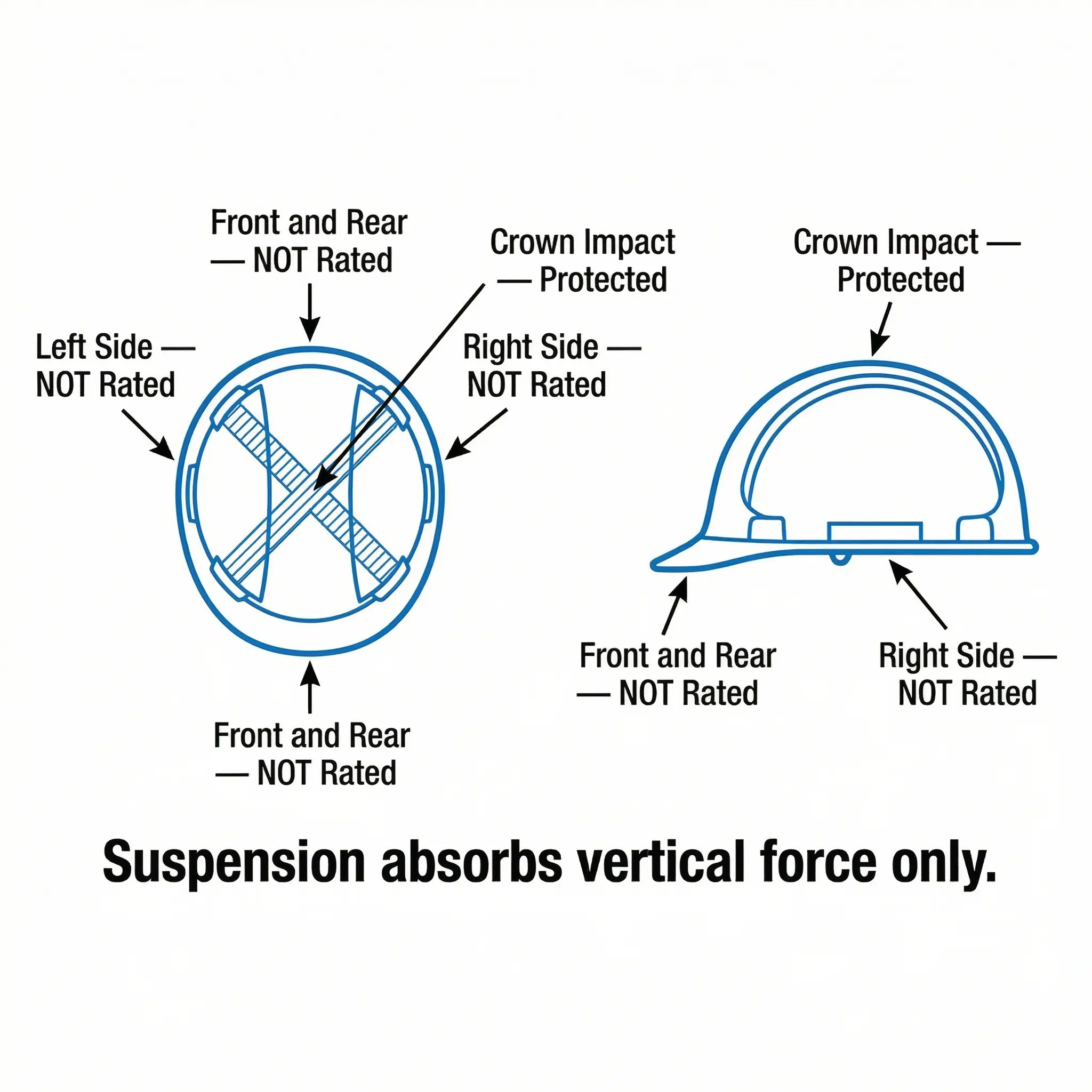
- Suspension system: A network of nylon or polyethylene webbing straps attached to the shell at multiple anchor points. The suspension creates a gap (clearance space) between the top of the wearer’s head and the inside of the shell — typically 30–32 mm minimum. This gap is the energy absorption zone. When an object strikes the crown, the suspension stretches and deforms to decelerate the impact over a longer time interval, reducing peak transmitted force.
- Sweatband and headband: Comfort and fit components that keep the helmet stable on the head. These are not protective elements.
- No lateral foam liner: This is the critical absence. Type I hard hats do not contain expanded polystyrene (EPS) or any rigid foam liner around the sides, front, or rear interior. The suspension system only functions for vertical crown impacts. A lateral blow bypasses the suspension entirely and transmits force directly through the shell into the skull.
Type I hard hats perform well in specific operational contexts where the dominant hazard is objects falling from above onto workers positioned below. These contexts include some traditional construction scenarios — steel erection with overhead crane lifts, formwork operations where debris may fall from upper decks, and general civil works on open sites with overhead exposure.
However, the hazard profile on modern worksites has evolved far beyond “things falling straight down.” And that is precisely where Type I hard hats become a liability rather than a control.
How Type II Hard Hats Are Built — And Why the Difference Matters
The construction of a Type II hard hat addresses the exact vulnerability that Type I leaves exposed — lateral, frontal, and rear energy absorption. The difference is not subtle. It is a fundamentally different internal architecture.
A Type II hard hat adds or modifies these components compared to Type I:
- EPS foam liner (expanded polystyrene): This is the defining feature. A rigid foam liner is moulded to fit the interior circumference of the shell — covering the crown, both temporal regions (sides), the frontal area, and the occipital region (rear). When a lateral impact occurs, the EPS foam crushes and deforms permanently, absorbing kinetic energy that would otherwise transmit directly to the skull. This is the same energy management principle used in motorcycle helmets and climbing helmets.
- Outer shell — often redesigned: Many Type II helmets use a shell geometry that extends lower on the sides and rear compared to traditional Type I designs, providing more coverage area for the foam liner to work against. Some manufacturers use vented shell designs for thermal comfort while maintaining impact integrity — though ventilation disqualifies the helmet from certain electrical protection classes.
- Suspension system — integrated with foam: In Type II helmets, the suspension works in concert with the foam liner rather than independently. Some designs replace traditional webbing with a cradle that nests into the foam, while others retain webbing but add the foam as a secondary absorption layer around and beneath it.
- Chin strap — frequently included or required: Because Type II helmets are typically selected for environments with complex movement, awkward positions, and multi-directional hazards, retention straps become more important. A hard hat that falls off during a lateral impact event provides zero protection. Many Type II models include integrated four-point chin straps.
The impact performance difference is measurable. During ANSI Z89.1 lateral impact testing, the helmet is struck at defined points on the front, sides, and rear. The transmitted force to the headform must remain below the standard’s threshold — typically 150g peak acceleration for off-center impacts. A Type I hard hat subjected to the same lateral test would fail catastrophically, often cracking the shell and transmitting near-full impact force.
Pro Tip: After every significant impact — top or lateral — a Type II hard hat with an EPS liner must be replaced immediately, even if no visible damage is present. The foam crushes permanently on first impact. Unlike a Type I suspension system that can sometimes absorb multiple minor top strikes before degradation, a Type II foam liner is a one-use energy absorber. I have pulled hard hats off workers who said “it only got a small bump” and found the EPS liner cracked through on the interior. That helmet was done. Treat every impact as a replacement trigger.
Real-World Hazard Scenarios — When Type I Falls Short
The argument for Type II over Type I is not theoretical. It comes from incident investigations and near-miss analyses where the direction of impact was the deciding factor between a minor event and a life-changing injury.
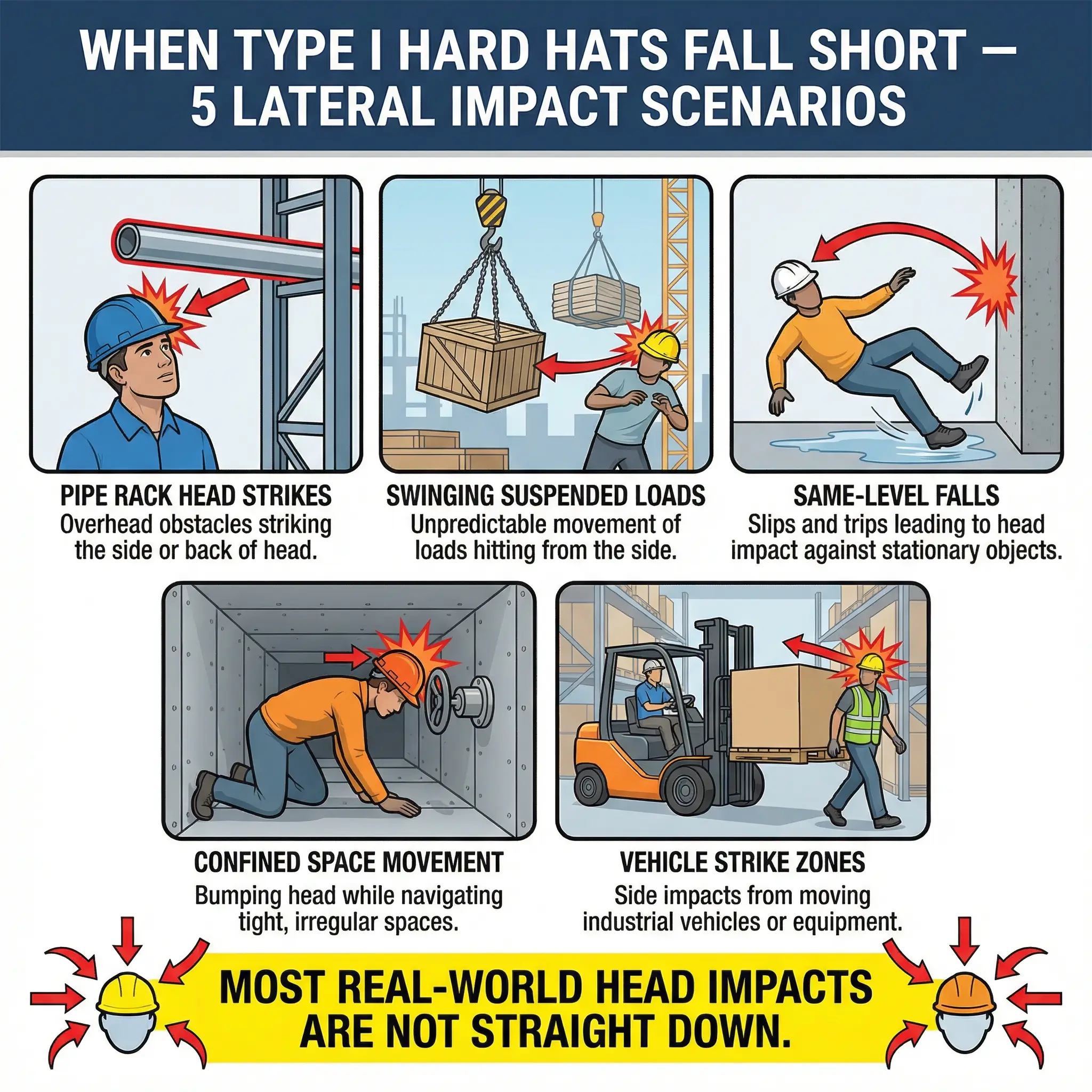
I have investigated or reviewed cases across multiple industries where Type I hard hats failed to protect workers from lateral and oblique impacts. The pattern is consistent — the hazard was not an object falling vertically from height. It was a strike from the side, front, or rear during routine operations. Here are the scenarios that show up repeatedly:
- Pipe rack and structural steel environments: Workers navigating congested pipe racks, walking under low-clearance steel beams, or climbing through scaffolded structures regularly strike their heads against fixed objects from the side or front. The impact is the worker’s head moving into the object — not an object falling onto the worker. Type I hard hats offer no rated absorption for this.
- Swinging and suspended loads: Crane operations, rigging activities, and material hoisting create pendulum-motion hazards. A swinging load or tagline connector strikes horizontally or at an oblique angle. The impact direction is lateral, not vertical.
- Falls to the same level: When a worker trips, slips, or stumbles on an uneven surface and strikes their head against a fixed object — a column base, a valve wheel, a concrete bollard — the impact is almost always lateral or frontal. Type I protection is irrelevant in this scenario.
- Confined space and restricted headroom work: Workers inside tanks, vessels, tunnels, manholes, and crawl spaces are constantly exposed to lateral and overhead-clearance impacts as they move through tight geometries. The hazard is omnidirectional.
- Vehicle and mobile equipment interaction zones: Being struck by a reversing vehicle, a forklift mast, or a swinging excavator boom delivers a lateral or rear impact. These are among the most severe mechanism types for traumatic brain injury on worksites.
- Falling from height (secondary head strike): When a worker falls from elevation — even a short fall from a stepladder — the primary head impact at ground level is rarely on the crown. It is almost always lateral, frontal, or occipital as the body rotates during the fall. Type I hard hats do not protect the point of contact.
The common thread across every one of these scenarios is that the hazard vector is not straight down. It is sideways, forward, backward, or at an angle. And in every case, a Type I hard hat provides the wearer with a false sense of security — the helmet is present, it looks like head protection, but it is not engineered to do anything against the actual impact direction the worker faces.
Side-by-Side Comparison — Type I vs. Type II Hard Hats
Choosing between Type I and Type II becomes much clearer when you lay the specifications, capabilities, and limitations next to each other. The following comparison covers the factors that matter most when making a procurement and deployment decision on site.
| Feature | Type I Hard Hat | Type II Hard Hat |
|---|---|---|
| Impact protection direction | Top of head (crown) only | Top, front, sides, and rear |
| ANSI/ISEA Z89.1 test protocol | Crown impact and penetration | Crown + lateral/off-center impact and penetration |
| Internal energy absorption | Suspension webbing (crown gap) | Suspension + EPS foam liner (full circumference) |
| Lateral impact rated | No | Yes |
| Typical weight | 300–400 g | 400–550 g |
| Typical cost | $8–$25 USD | $25–$70 USD |
| Ventilation options | Common (does not affect impact rating) | Available but may affect electrical class rating |
| Post-impact reuse | May survive minor crown impacts (inspect suspension) | Must be replaced after ANY significant impact (foam is single-use) |
| Chin strap | Optional (often absent) | Frequently integrated or required by site policy |
| Best suited for | Open construction with primarily overhead falling object hazards | Confined spaces, structural steel, pipe racks, work at height, mobile equipment zones, any multi-directional impact environment |
| Common industries | General civil construction, road works, light demolition | Oil and gas, petrochemical, mining, tunnelling, utilities, heavy construction, offshore |
One pattern I consistently see during audits is sites that started with Type I hard hats years ago and never revisited the selection, even after the scope of work evolved to include confined space entries, structural modifications, and mobile plant operations. The hazard profile changed. The head protection did not. That gap is an uncontrolled risk.
Pro Tip: If your site task risk assessment identifies even ONE lateral impact scenario — and most industrial sites will have several — Type II becomes the defensible selection. Choosing Type I when lateral hazards exist is difficult to justify in any post-incident investigation. Regulators and lawyers will ask why the cheaper, lower-rated option was selected when the hazard assessment indicated otherwise.
Electrical Class Ratings — A Separate but Related Decision
Hard hat selection does not stop at impact type. Electrical hazard exposure adds a second classification layer that interacts with the Type I/Type II decision — and getting this wrong creates a different kind of fatal exposure.
ANSI/ISEA Z89.1 classifies hard hats into three electrical classes, and these apply independently to both Type I and Type II helmets:
- Class E (Electrical): Tested to withstand 20,000 volts (phase to ground). Designed for workers exposed to high-voltage conductors and electrical apparatus. The shell must be non-conductive and free of ventilation holes that could allow arc flash or current pathways.
- Class G (General): Tested to withstand 2,200 volts (phase to ground). Provides limited voltage protection suitable for general construction environments where incidental contact with low-voltage circuits is possible. This is the most common default class on construction sites.
- Class C (Conductive): Provides no electrical insulation whatsoever. Often made with aluminium or carbon-fibre shells for weight savings. Suitable only for environments where zero electrical hazard exists — which excludes most industrial and construction worksites.
The interaction with Type I/Type II is straightforward but frequently overlooked during procurement. A vented Type II hard hat — which many manufacturers produce for hot-climate comfort — typically cannot achieve Class E rating because the ventilation openings create potential arc flash pathways. If your site requires both lateral impact protection (Type II) and high-voltage electrical protection (Class E), you must select an unvented Type II helmet — and these options are fewer in the market and more expensive.
During a shutdown at a power generation facility in Southeast Asia, I reviewed the PPE matrix and found that electricians working on 11kV switchgear had been issued vented Type II helmets. The ventilation slots were directly above the temporal regions. If an arc flash event had occurred, those vents would have channelled superheated plasma directly to the scalp. We replaced every unit within 48 hours with unvented Class E Type II helmets. No incident occurred — but the exposure window had been open for weeks before anyone caught it.
How to Conduct a Hard Hat Selection Risk Assessment
Selecting between Type I and Type II is not a catalogue decision or a site manager’s personal preference. It is a risk assessment output. The assessment must be task-specific, hazard-specific, and documented — because in any post-incident investigation, the first question will be: “How did you determine this was the appropriate head protection for this task?”
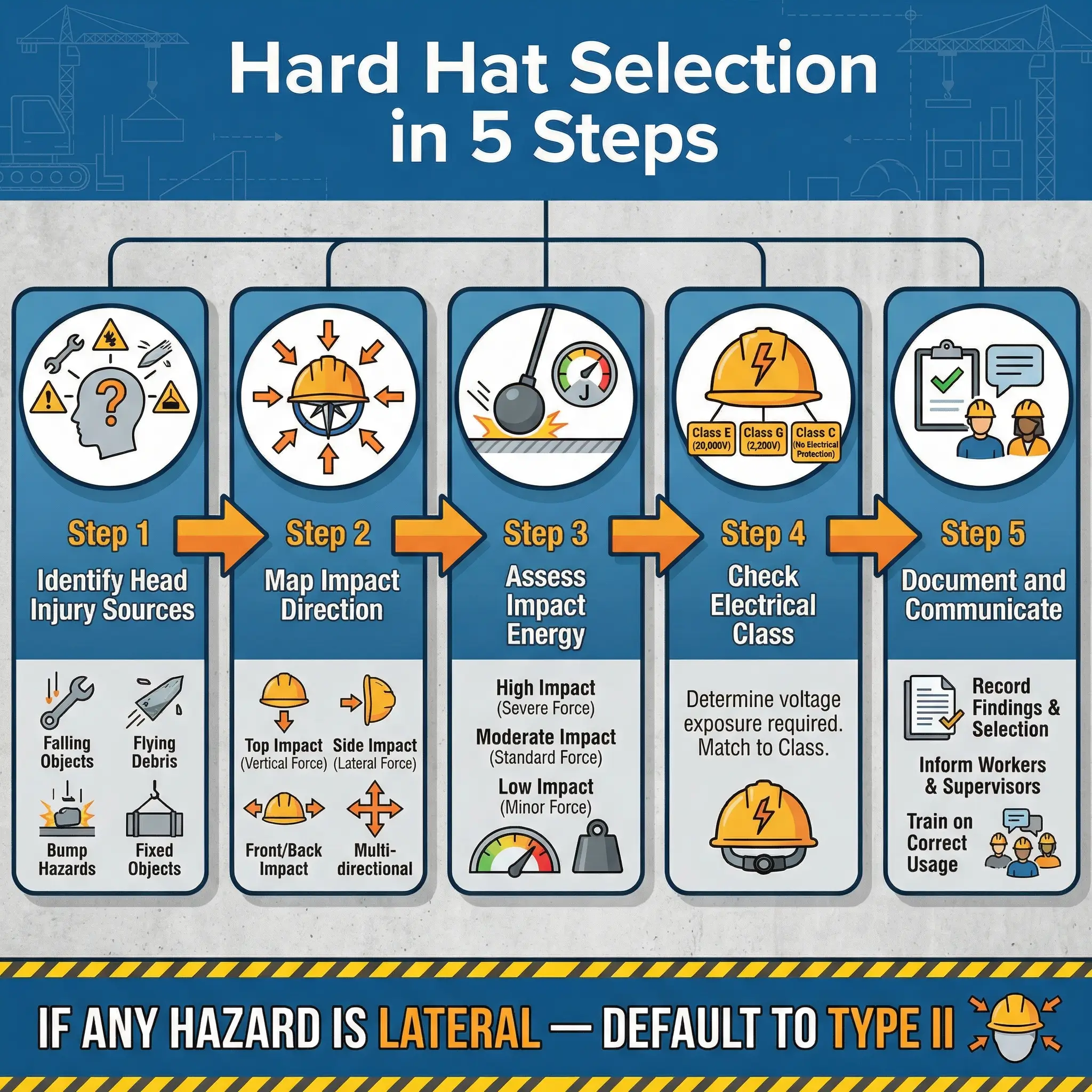
The following steps form a defensible hard hat selection process that I have used across multiple EPC projects and plant operations:
- Identify all head injury hazard sources for each task. Walk the worksite. Observe the task. List every object, structure, equipment piece, or surface that could contact a worker’s head — from above, from the side, from the front, from behind, and from below (in fall scenarios). Do not assume. Observe.
- Determine the direction of potential impact for each hazard. For every hazard source identified, note the most likely impact vector. Falling bolt from overhead? Vertical — crown. Low-clearance pipe flange? Lateral — temporal. Trip hazard near concrete plinth? Lateral or frontal — fall impact. If ANY identified hazard has a non-vertical impact vector, Type II becomes the baseline selection.
- Assess the energy level of potential impacts. A small nut falling two metres carries different energy than a scaffold tube swinging at head height. Higher-energy lateral impacts demand not just Type II classification but also consideration of chinstrap retention, helmet fit, and whether additional face or neck protection is needed.
- Evaluate the electrical hazard environment. Determine whether the task or work area involves proximity to energised electrical conductors, switchgear, overhead power lines, or electrical distribution equipment. Select the appropriate electrical class (E, G, or C) and cross-reference with Type I/Type II availability. Flag any conflicts — particularly vented Type II helmets in electrical environments.
- Document the selection rationale and communicate it. Record which hard hat Type and Class is required for each task or work area, and why. Include this in the task risk assessment, the permit-to-work conditions, and the site PPE matrix. Brief every worker and supervisor on why that specific hard hat was selected — not just which one to wear.
OSHA 29 CFR 1910.135 (General Industry) and 1926.100 (Construction) require employers to provide head protection when there is a danger of head injury from impact, falling or flying objects, or electrical shock and burns. The employer is responsible for ensuring the head protection is appropriate for the hazards present — and “appropriate” means matched to the actual direction and energy of impact, not simply present on the head.
Common Mistakes in Hard Hat Selection and Use
Even when the right hard hat type is selected, the protection it provides can be completely undermined by how it is used, maintained, and managed on site. These are the mistakes I encounter most frequently during site inspections and compliance audits — and each one has either caused or contributed to a real head injury.
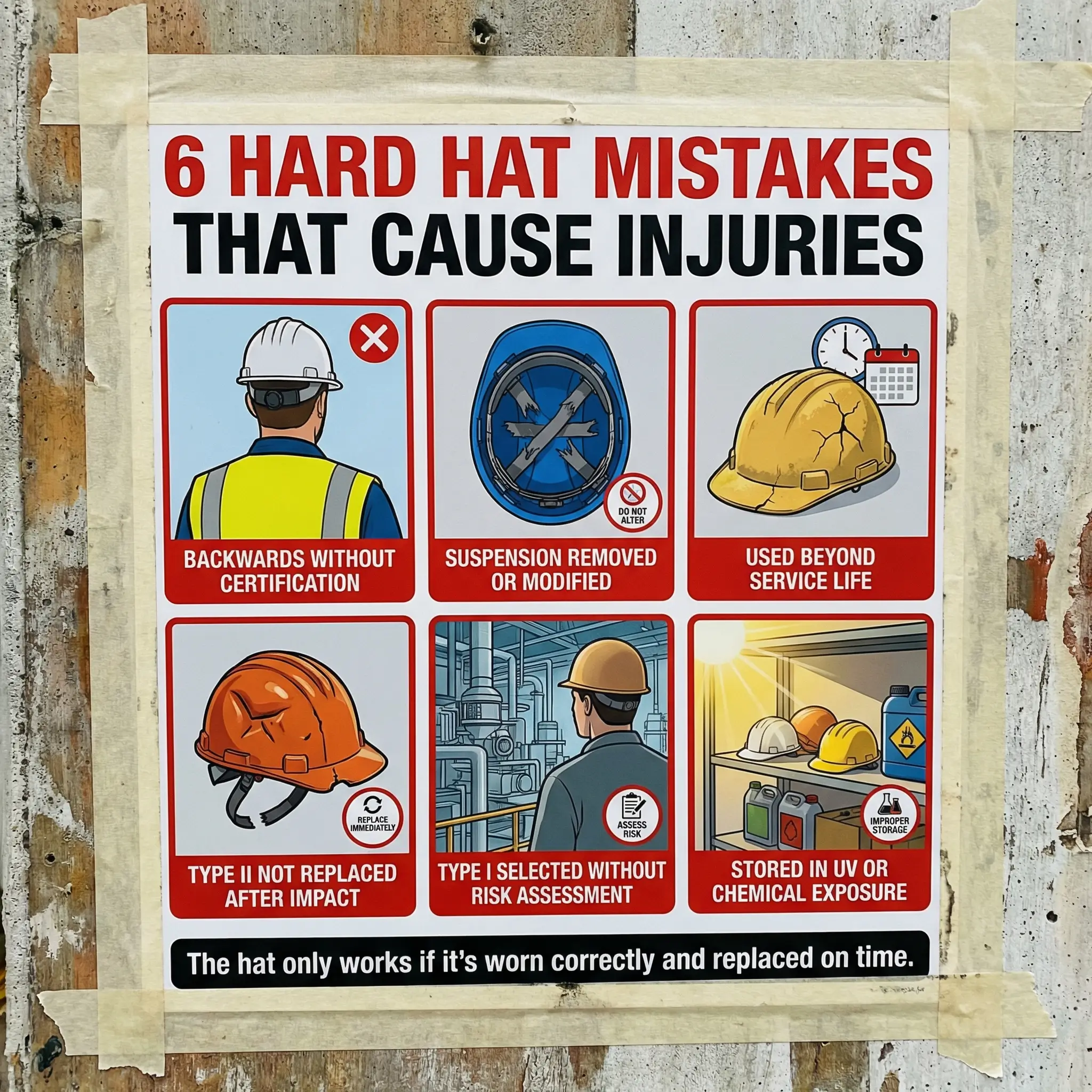
Misuse and mismanagement patterns fall into predictable categories:
- Wearing the hard hat backwards without verifying reverse-wear compatibility. Not all hard hats are certified for reverse wear. Wearing a non-reversible helmet backwards repositions the suspension relative to the shell, reducing crown clearance and potentially moving the brim away from the primary impact zone. If workers prefer reverse wear, procure helmets specifically tested and certified for it.
- Removing or modifying the suspension system. I have found workers who removed suspension straps to “make it lighter” or to fit a beanie underneath in cold weather. Without the suspension, the shell sits directly on the skull. There is zero energy absorption. The helmet becomes a hard plastic hat that transmits full impact force.
- Using hard hats beyond their service life. HDPE and ABS shells degrade under UV exposure over time. Manufacturers typically recommend replacement every 2–5 years from date of issue (not date of manufacture). Suspensions degrade faster — typically every 12 months. I audit hard hat manufacture dates routinely. On one offshore platform, I found helmets still in service that were stamped with manufacture dates seven years prior. The shells were chalky, brittle, and cracked under moderate thumb pressure.
- Failing to replace Type II helmets after an impact. As covered earlier, the EPS foam liner in a Type II hard hat is a single-impact energy absorber. After any significant strike — even one that leaves no visible external damage — the foam may be permanently compressed. The helmet must be removed from service and replaced. Many workers and supervisors do not understand this, because their experience with Type I hard hats taught them that a “bump” is not a big deal.
- Selecting Type I by default without conducting a risk assessment. This is the most widespread and most dangerous mistake. It is also the easiest to fix. If no documented risk assessment supports the Type I selection, it is an unsupported decision — and it will not survive regulatory scrutiny after a lateral impact injury.
- Storing hard hats in direct sunlight, vehicle dashboards, or near chemicals. UV radiation, extreme heat, and chemical exposure (solvents, fuels, hydraulic fluids) accelerate shell degradation. A hard hat stored on a truck dashboard in a Gulf summer can lose significant structural integrity within weeks.
Industry Trends — The Shift Toward Type II as the New Standard
The hard hat market is not standing still. Over the past decade, a clear industry-wide migration from Type I to Type II has been underway — driven by incident data, regulatory evolution, and a growing understanding that lateral impact is the more common and more dangerous injury mechanism on modern worksites.
Several forces are accelerating this transition:
- Incident data consistently shows lateral and oblique impacts dominate head injury statistics. Studies of construction and industrial head injuries reveal that a majority of impacts occur at locations other than the crown — temporal, frontal, and occipital strikes from fixed objects, falls, and horizontal hazards significantly outnumber direct vertical strikes from falling objects.
- Major operators and EPC contractors are mandating Type II across all operations. Several multinational oil and gas operators, mining companies, and infrastructure developers have moved to Type II-only policies on all projects, regardless of task. The risk assessment still occurs — but the default has shifted from “Type I unless you can justify Type II” to “Type II unless you can demonstrate no lateral hazard exists.”
- Regulatory bodies are tightening head protection expectations. While OSHA has not yet mandated Type II specifically, enforcement actions and citations increasingly reference the adequacy of head protection relative to identified hazards — and a Type I selection on a site with documented lateral impact risks is difficult to defend. European EN 397 and EN 12492 standards, along with updated CSA Z94.1 (Canada), reflect stronger expectations for lateral protection.
- Climbing-style and mountaineering-style helmets are entering industrial markets. These designs — with full EPS liners, chin straps, and low-profile fits — were originally developed for work-at-height and rescue operations. They are now being adopted for general industrial use because they inherently provide Type II-equivalent multi-directional protection with better fit and comfort than traditional hard hat designs.
- Workers prefer them. This is not a trivial point. Type II helmets — particularly modern climbing-style designs — tend to fit more securely, sit closer to the head, and feel less top-heavy than traditional Type I hard hats. When workers find their PPE more comfortable, compliance rates increase. I have seen voluntary hard hat compliance jump measurably on sites that switched from loose-fitting Type I caps to snug Type II climbing helmets.
The direction of the industry is clear. Type II is becoming the baseline, not the upgrade. Sites still issuing Type I hard hats as the default should be asking themselves: can we justify this selection against our actual hazard profile — and will that justification hold up if a worker sustains a lateral head injury tomorrow?
Conclusion
The difference between a Type I and a Type II hard hat is not a technical footnote buried in a standard. It is a protection boundary — a line between what is engineered to save a skull and what is not. Type I protects the crown. Type II protects the head. On any worksite where workers move through congested structures, work near swinging loads, enter confined spaces, operate around mobile equipment, or face any realistic chance of a non-vertical head strike, Type II is the only defensible selection.
I have sat across the table from too many incident investigation panels where the hard hat was the wrong type for the hazard. The helmet was present. The helmet was worn. The helmet failed — not because it was defective, but because it was never designed to protect against the impact that actually occurred. That is not a manufacturing failure. It is a selection failure. And selection failures are entirely preventable through a ten-minute task-specific risk assessment that maps the direction of impact before choosing the head protection.
Every hard hat on your site should be there because a risk assessment put it there — not because it was the cheapest option in the supplier’s catalogue. The cost difference between Type I and Type II is a few dollars per unit. The cost difference between the right hard hat and the wrong one is measured in skull fractures, permanent brain injuries, and lives that did not need to end on a worksite. Match the hat to the hazard. Document the decision. Replace it when it takes a hit. That is head protection — not the sticker on the brim.