
TL;DR
- Method selection is a safety decision — each piling technique introduces a distinct hazard profile, so choosing between driven, bored, CFA, or screw piles changes the entire risk assessment.
- Working platforms prevent the most recurrent serious incident — rig overturning on inadequate or deteriorated platforms continues despite 20 years of published guidance (BRE BR 470, 2004).
- Impulse noise from impact driving is underestimated — peak pressures of 110–120 dB cause disproportionate hearing damage that standard time-weighted averages fail to capture.
- CFA piling carries unique fatal hazards — auger entanglement and concrete hose whip have caused multiple fatalities, including a 2024 incident in Queensland (WorkSafe Queensland, 2025).
- No piling method is inherently “safe” — quieter or lower-vibration methods reduce some risks but introduce others that often receive less scrutiny.
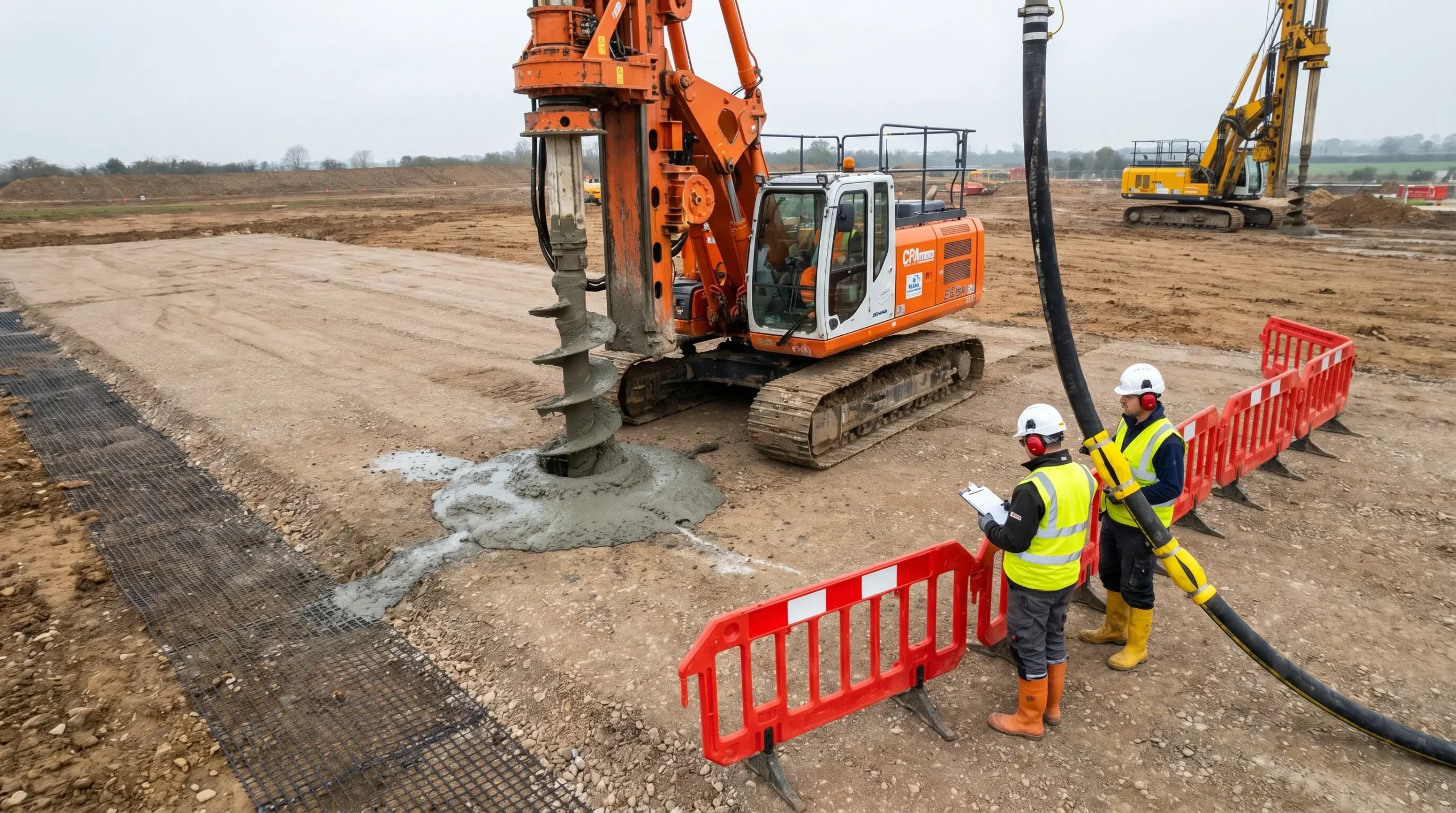
Different piling methods carry distinct safety risks. Driven piling creates impulse noise hazards and ground vibration, bored piling introduces ground-collapse and contaminated-spoil risks, CFA piling adds auger entanglement and concrete hose-whip dangers, and all methods depend on correctly designed working platforms to prevent rig overturning — the single most recurrent serious piling incident across all jurisdictions.
This article provides general HSE knowledge. Life-critical work such as piling operations, rig positioning, and confined-space pile construction must be planned and supervised by a competent person with relevant training, jurisdiction-specific authorization, and site-specific risk assessment. The information here does not replace that.
In June 2024, Van Elle Limited was fined £233,000 after a piling rig mast collapsed and killed an HGV driver at a house-building site in Annan, Scotland (HSE UK, 2024). The prosecution, brought under PUWER Regulation 5, found that a corroded retaining lug — a maintenance failure — caused the mast to fall during transport preparation. A routine inspection would have caught it.
That prosecution captures something the piling industry continues to learn the hard way: the hazards of piling are method-specific and equipment-specific, and generic risk assessments miss them. This article maps each major piling method to its unique hazard signature — driven, bored, CFA, mini, and screw — because when the method changes, the risk assessment must change with it. The coverage spans OSHA (US), HSE UK, EU harmonised standards, and Australian enforcement, with a dedicated section on the working-platform problem that underpins rig stability across all methods.
What Is Piling and Why Does Method Selection Affect Safety?
Piling transfers structural loads through weak surface soils down to competent strata or rock. The same site can often be served by three or four different methods — driven, bored, augered, or screwed — and each one rewrites the hazard register.
That choice is almost always driven by structural design, ground conditions, and cost. Safety implications are addressed after the contract is let, which means the risk assessment is retrofitted to a method that was selected without safety input. The result is a hazard profile the project team inherits rather than one it shaped.
Ground investigation reports inform both engineering suitability and safety planning. Key factors include:
- Soil type and contamination — determines whether spoil requires hazardous-waste handling and whether bore stability needs support fluid.
- Groundwater level — affects excavation risk for bored methods and platform bearing capacity for all methods.
- Proximity to existing structures and underground services — governs vibration limits and strike risk, which differ sharply between driven and bored techniques.
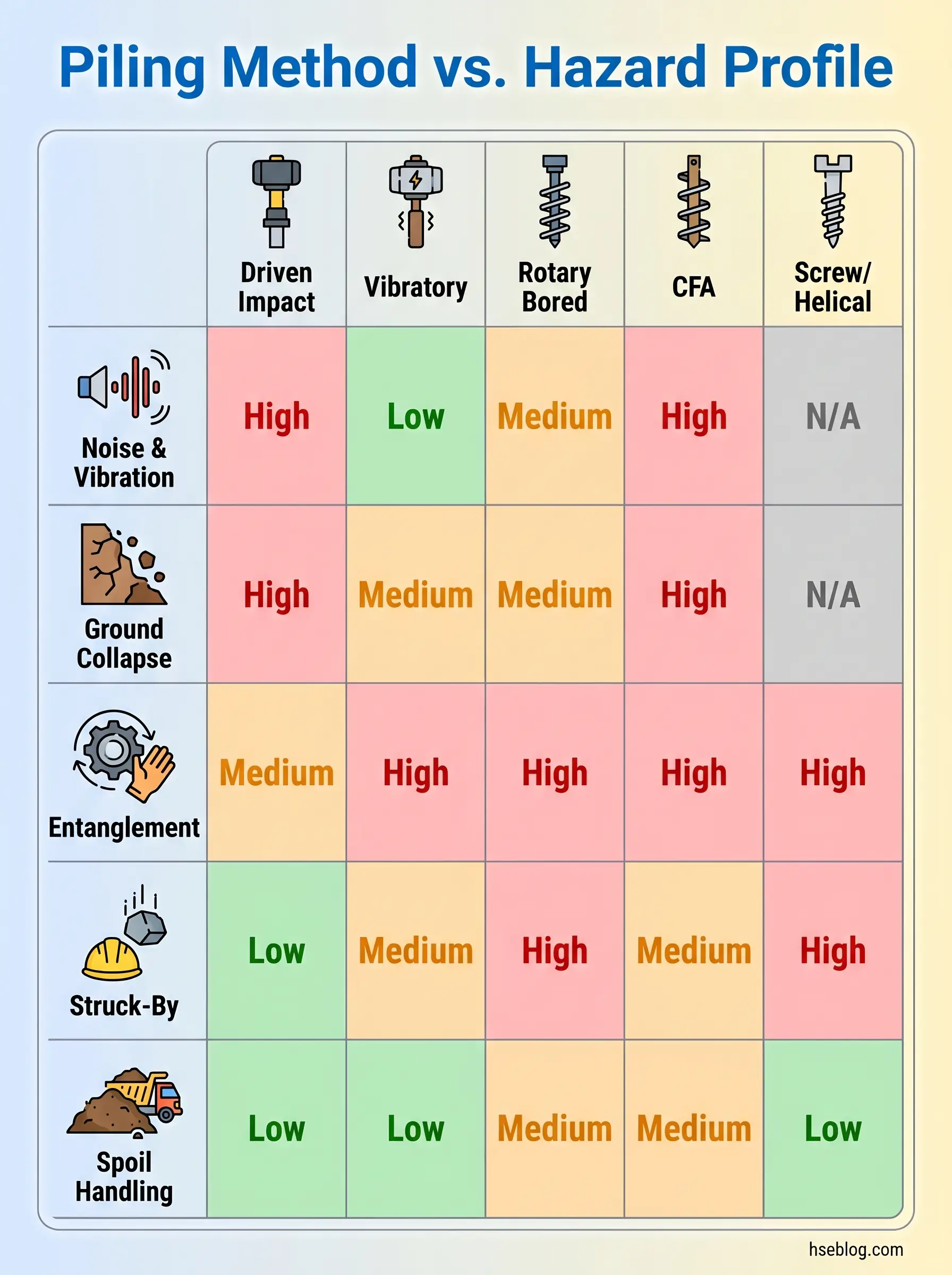
The two primary classification axes are displacement versus replacement (does the pile push soil aside or remove it?) and driven versus bored (is it hammered or drilled?). Every combination produces a different set of dominant hazards, and understanding that mapping is the starting point for any piling risk assessment.
Driven Piling Methods and Their Safety Risks
Impact-driven and vibratory-driven piles share a family of hazards, but their mechanisms differ enough to demand separate assessment. The dominant risks — impulse noise, ground vibration, struck-by incidents, and rig instability — are more acute in driven methods than in any other piling category.
Impact Driving (Drop Hammer, Hydraulic Hammer, Diesel Hammer)
Impact hammers deliver repeated blows to drive precast concrete, steel, or timber piles into the ground. The hazard profile centres on three mechanisms:
- Impulse noise — pile driving generates peak noise levels of approximately 110–120 dB at the operator position (multiple construction safety references, recurring measurement data). Risk assessments that rely solely on 8-hour equivalent continuous noise level (Leq) underestimate the damage, because the acute hearing injury comes from peak sound pressure (Lpeak), not from time-averaged exposure. Under the UK Control of Noise at Work Regulations 2005, the lower exposure action value for peak noise is 135 dB(C) — a threshold impact driving frequently exceeds. OSHA’s ceiling is 140 dB peak.
- Struck-by from pile rebound or misalignment — a pile that deviates during driving can kick sideways. Spalling concrete fragments from precast pile heads create secondary projectile hazards.
- Ground vibration — transmitted energy can damage adjacent structures and sever underground services. BS 5228-2 provides vibration thresholds for cosmetic and structural damage assessment.
Vibratory Driving
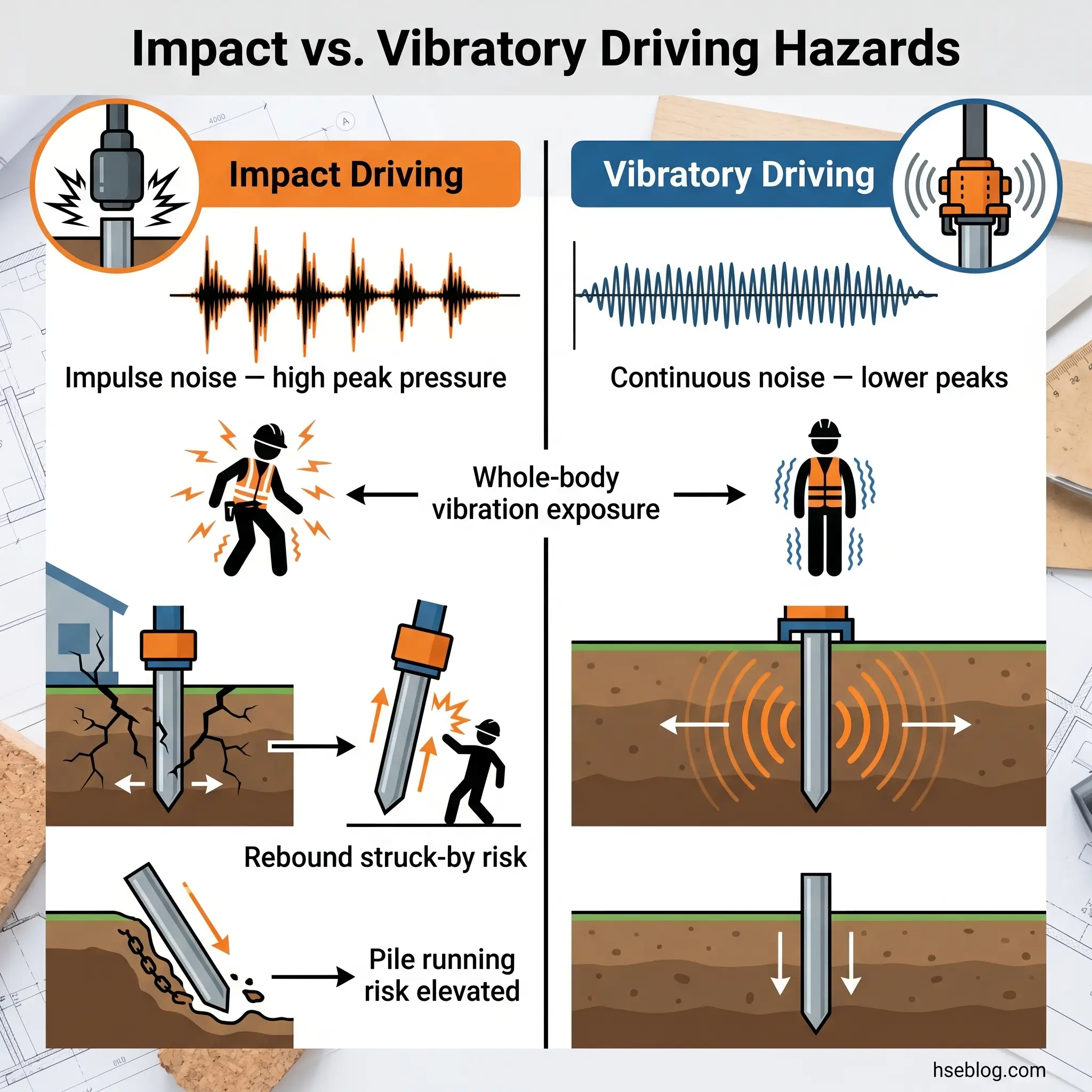
Vibratory methods reduce impulse noise but introduce whole-body vibration exposure for operators and the risk of pile “running” — an uncontrolled descent when the pile passes through a soft stratum and loses frictional resistance. Resonance effects on nearby structures also require monitoring.
| Hazard | Impact Driving | Vibratory Driving |
|---|---|---|
| Noise type | Impulse (high Lpeak) | Continuous (lower Lpeak) |
| Vibration to structures | High | Moderate to high |
| Operator vibration exposure | Low | Elevated (whole-body) |
| Pile “running” risk | Low | Elevated |
| Struck-by (rebound) | Elevated | Low |
Common to both sub-methods: handling long, heavy precast elements during hoisting into leads creates significant rigging hazards under LOLER 1998 (UK). Rig stability on soft ground and overhead power line contact during mast erection apply regardless of hammer type.
Precast Concrete Pile Driving Hazards
Precast piles introduce handling risks that begin before the hammer strikes. Storage stacks can collapse if not blocked correctly. Lifting points must match the manufacturer’s specification — using the wrong pick-up arrangement on a 15-metre pile generates bending moments that crack the element mid-hoist.
During driving, spalling fragments from the pile head are a struck-by hazard that exclusion zones must account for. Pile deviation under hard driving can also misalign the rig, creating instability.
Steel Sheet Piling Hazards
Sheet piling has a distinct risk profile centred on the interlocking mechanism. Sheets under tension can spring apart unpredictably during installation and extraction. Crane-suspended sheets can swing or spin if not guided with tag lines, creating a struck-by envelope larger than for single piles.
Extraction forces during temporary works removal can destabilise adjacent excavations. Under OSHA 29 CFR 1926.651/652, excavations supported by sheet piles require competent-person inspection and engineer-designed systems for depths exceeding 20 feet (US jurisdiction).
Bored Piling Methods and Their Safety Risks
Bored methods trade the noise and vibration signature of driven piling for a fundamentally different hazard set. Ground stability, contaminated spoil, support fluid handling, and concrete placement become the dominant concerns. The risk assessment for a rotary bored pile has almost nothing in common with one written for impact driving — and treating them interchangeably is a recurring gap in site safety documentation.
Rotary Bored Piling
Rotary bored piles are drilled using a Kelly bar or similar tool, with or without temporary casing or bentonite/polymer slurry to support the bore walls. The primary hazards include:
- Open-bore collapse — an unsupported bore in granular soil can collapse without warning. Workers must never approach an unlined bore opening without edge protection and exclusion measures.
- Bentonite/polymer slurry handling — skin and eye contact risks during mixing, transfer, and disposal. Environmental containment is required to prevent slurry discharge to watercourses.
- Reinforcement cage installation — heavy cages, sometimes exceeding 10 metres in length, must be lifted and lowered vertically into deep bores. Rigging failure during this operation has caused struck-by fatalities. LOLER 1998 (UK) governs the lifting plan.
- Tremie concreting — blockages in the tremie pipe create pressure build-up hazards. Concrete overspill at the bore head is a manual-handling and slip hazard.
If the ground is contaminated, all excavated spoil becomes hazardous waste requiring characterisation, segregation, and licensed disposal — a significant additional compliance burden that driven piling avoids entirely.
Continuous Flight Auger (CFA) Piling: Specific Safety Considerations
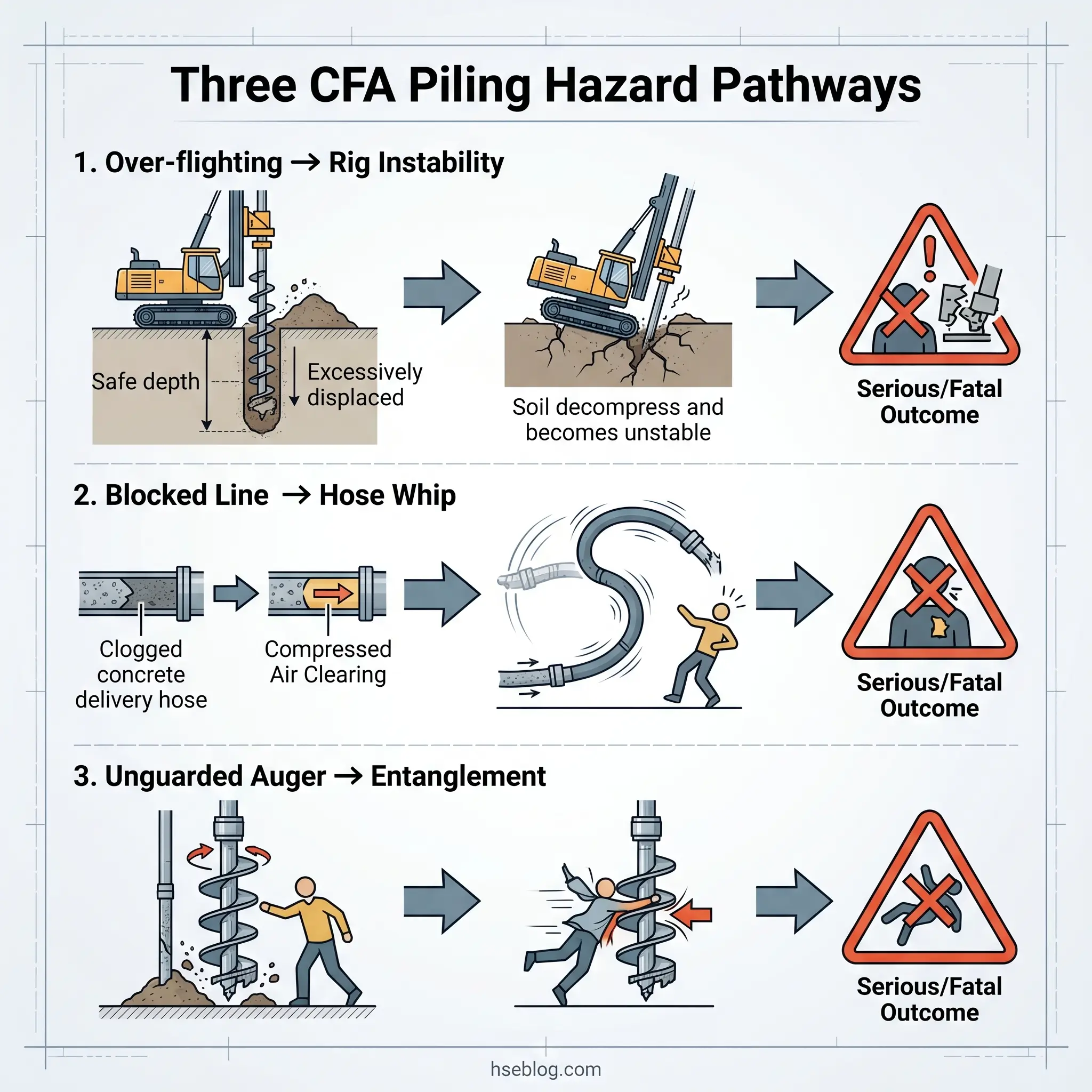
CFA piling warrants standalone treatment because its hazard signature is unlike any other bored method. The auger is drilled to depth while remaining full of soil, then concrete is pumped through the hollow stem as the auger is withdrawn. Three hazards dominate the CFA risk profile:
- Over-flighting — advancing the auger too deep before starting the concrete pump. This decompresses the surrounding soil, can cause ground subsidence, and has caused multiple rig overturning incidents. The Federation of Piling Specialists has documented this failure mode, and it lives in the gap between the piling supervisor’s judgment and the rig operator’s instrumentation. Generic risk assessments rarely address it.
- Concrete hose whip — in 2024, a worker in Queensland was killed when a flexible concrete delivery hose whipped violently after a blockage cleared under compressed air during end-of-day line cleaning (WorkSafe Queensland, 2025). This hazard extends to any concrete delivery system using flexible hose sections, but CFA operations create it routinely during line purging.
- Auger entanglement — HSE UK has identified entanglement in rotating auger strings as a recurring fatality cause on piling rigs. Under PUWER 1998, Regulations 11 and 12, employers must prevent access to dangerous rotating parts using a strict hierarchy: fixed enclosing guards first, then other guards or protection devices. BS EN 16228-1:2014+A1:2021 specifies guarding requirements for drilling and foundation equipment, including restricted-mode operating concepts. HSE UK’s enforcement guidance on entanglement in rotary piling rigs details the expected control standard.
Mini Piling and Micropiling Safety Risks
Small-diameter piling in restricted-access and low-headroom environments shifts the hazard profile toward problems that standard piling risk assessments overlook. The rig may be smaller, but the working conditions are often more constrained and less forgiving.
Mini piling in basements and underpinning scenarios creates a dual audience for the risk assessment — the piling crew and the building occupants — and the control measures frequently conflict. The crew needs ventilation for dust and exhaust fumes; the occupants need dust containment. Noise reverberates in enclosed spaces far more than on open ground, pushing exposure levels above action values even with smaller equipment.
Key hazards specific to mini and micropiling operations:
- Confined or semi-confined working — restricted egress paths, accumulation of exhaust gases from diesel-powered rigs, and limited space for emergency response.
- Manual handling of sectional equipment — repetitive coupling and decoupling of short auger and casing sections creates musculoskeletal injury risk that accumulates over a shift.
- Proximity to live structural loads — underpinning work operates directly beneath existing foundations carrying building loads. Unexpected ground movement can transfer load paths unpredictably.
- Noise amplification — enclosed spaces amplify rig noise. A machine that operates below action values outdoors may exceed them in a basement with reflective surfaces.
Screw Piles and Helical Piling Safety Risks
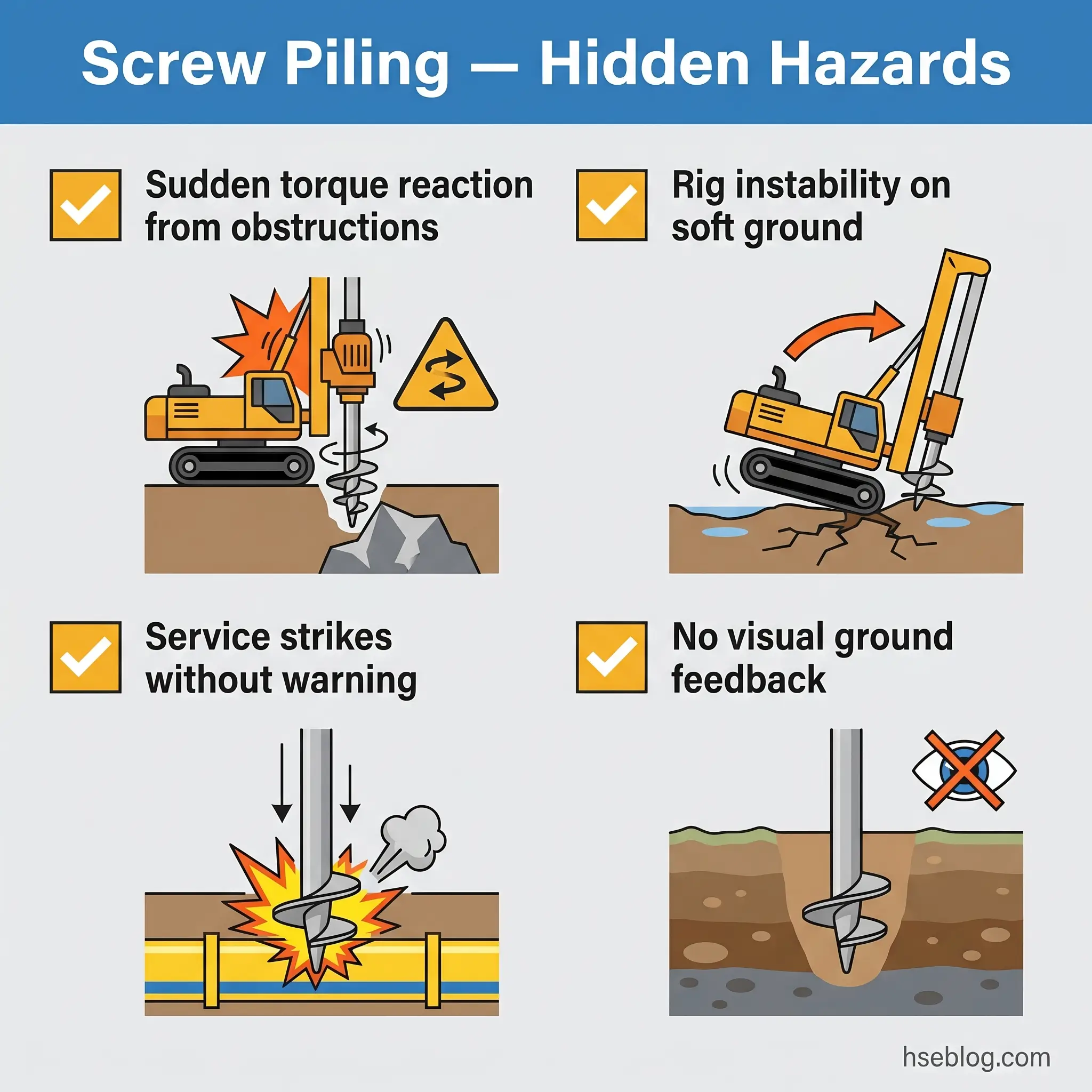
Helical piles are rotated into the ground using torque, with no impact and minimal vibration. The absence of hammering noise creates a cognitive bias worth addressing directly: reduced noise leads site teams to assume reduced risk, and exclusion zones shrink accordingly. Published incident patterns show this assumption is dangerous.
The actual hazard profile of screw piling includes:
- Torque reaction — if the helical plate hits a buried obstruction (rock, concrete, abandoned services), the stored rotational energy can release suddenly, causing violent rig movement.
- Machine stability — smaller, lighter rigs used for screw piling are more susceptible to overturning on uneven or soft ground. The bearing-pressure calculation is just as critical as for larger rigs, but receives less scrutiny.
- Underground service strikes — the rotational cutting action of helical plates can sever cables and pipes with less warning than a bored pile, which at least produces spoil that offers visual feedback on ground conditions.
- Limited ground-condition feedback — unlike bored methods that bring spoil to the surface for inspection, screw piling provides almost no visual confirmation of what the pile is passing through.
The judgment call here is between the genuine benefits of screw piling (lower noise, no spoil, faster installation) and the tendency to under-assess risks precisely because the method appears benign. A risk assessment that rates screw piling as “low risk” without addressing torque reaction and service-strike potential has been written based on the absence of noise rather than the presence of controls.
What Are the Most Common Piling Accidents and How Do They Occur?
Across all piling methods, fatal and serious incidents cluster into six recurring patterns. Each pattern has a distinct causal mechanism, and understanding the mechanism matters more than memorising a list.
Rig Overturning and Instability
This is the single most recurrent serious piling incident. At least three piling rig overturning incidents occurred in a three-year period in the UK alone (Ground Engineering / FPS, 2023) — despite 20 years of published guidance in BRE BR 470. Overturning is almost never a single-cause event. It typically combines an inadequate working platform, a change in rig configuration not communicated to the platform designer, and progressive deterioration of the platform surface during the works that went unmonitored.
Struck-By Incidents
Falling materials during pile hoisting, mast collapse due to maintenance failures, and swinging sheet piles during crane operations account for a significant proportion of piling fatalities. The Van Elle prosecution (HSE UK, 2024) — where a corroded retaining pin caused a mast to collapse — demonstrates that struck-by hazards from equipment failure are a maintenance problem as much as an operational one.
Entanglement in Rotating Parts
HSE UK enforcement action under PUWER Regulations 11 and 12 has focused specifically on auger entanglement on CFA and rotary bored rigs. The guarding hierarchy under PUWER is explicit — fixed enclosing guards first — yet enforcement continues to find rigs operating with inadequate or absent guarding.
Underground Utility Strikes
Piling into uncharted gas mains, electrical cables, or water services occurs across all methods. Permit-to-dig systems, utility surveys (CAT and Genny in the UK, 811 one-call in the US), trial holes, and bridging pile positions over known services are the established controls.
Ground Collapse
Workers falling into unsupported bored-pile excavations or open bores remains a hazard wherever edge protection and exclusion measures are inadequate. This risk is specific to bored and rotary methods where an open hole exists at surface level.
Concrete Hose Whip
The 2024 Queensland fatality during CFA line cleaning with compressed air (WorkSafe Queensland, 2025) brought renewed attention to a hazard that exists wherever flexible concrete delivery hoses are used under pressure. The alert extends the warning beyond piling to all concrete pumping operations.
Safe Working Platforms for Piling Rigs
The working platform is the single most critical control measure for piling rig stability, and it is the area where competitor content — and many site risk assessments — are weakest. Saying “ensure stable ground” is not a control measure. A designed, verified, and maintained working platform is.
BRE Report BR 470 (2004) provides the primary UK design guidance. The EFFC/DFI Guide to Working Platforms (2019) serves as the international reference. The FPS working platform guidance hub links to both the BRE methodology and the FPS platform certificate system.
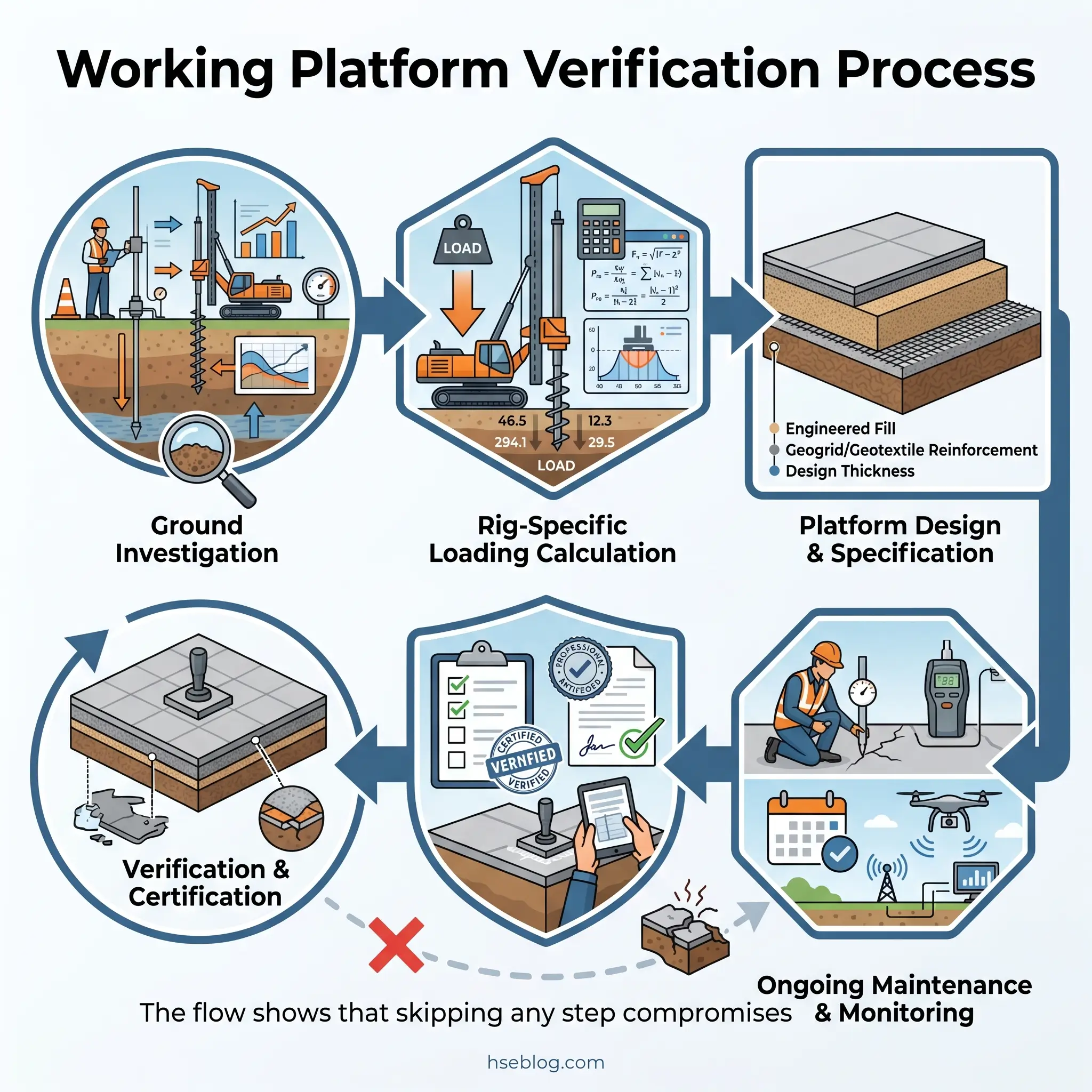
The design process involves more than dividing rig weight by track area. Key steps include:
- Ground investigation — determine the bearing capacity of the formation beneath the platform. This requires geotechnical data, not assumption.
- Rig-specific loading — calculate the maximum bearing pressure under the tracks for the specific rig, including the weight of the pile, hammer, and any crane attachment. Different rig configurations produce different ground pressures.
- Platform design — specify the granular fill type, thickness, and geogrid reinforcement needed to spread the load to acceptable bearing pressure.
- Verification and certification — the FPS Working Platform Certificate records the design basis, the as-built condition, and the rig it was designed for. It is not mandatory, but it provides an auditable record.
- Maintenance and monitoring — platform deterioration from rainfall, rutting, and construction traffic is the failure mode that catches sites between installation and completion. Drainage must be maintained, and the platform must be inspected before each rig move.
A recurring problem across published incident reports: the platform is designed for one rig, but a substitute rig is brought to site after breakdown or programme change without rechecking bearing-pressure compatibility. The replacement rig may have different track widths, different operating weights, or a different centre of gravity — and the original platform design may not accommodate it.
Regulatory Framework for Piling Safety
Piling rigs occupy an awkward position in several regulatory frameworks. In the US, many hydraulic foundation rigs fall outside the scope of both OSHA Subpart N (cranes and derricks) and the specific pile-driving provisions of 29 CFR 1926.603, meaning the employer must rely on the General Duty Clause and manufacturer specifications for equipment not explicitly covered. Understanding which standard governs which aspect of piling work — and where the gaps are — is essential for compliance.
| Jurisdiction | Standard | Key Practical Requirement |
|---|---|---|
| US | OSHA 29 CFR 1926.603 | Employees kept clear during pile hoisting into leads; excavated pits sloped or sheet-piled; hammer blocked when idle |
| US | OSHA 29 CFR 1926.651/652 | Competent-person inspection for sheet piling excavations; protective systems for excavations >5 ft; engineer-designed systems >20 ft |
| UK | PUWER 1998, Regs 11 & 12 | Fixed enclosing guards on rotating parts (augers, drill strings); strict guard-selection hierarchy |
| UK | LOLER 1998 | Lifting plan for pile handling, cage installation, mast erection |
| UK | CDM 2015 | Designer duty to eliminate/reduce piling risks at design stage; principal contractor duty for safe management; competent supervision required |
| UK | Control of Noise at Work Regs 2005 | Lower action value 80 dB(A) / 135 dB(C) peak; exposure limit 87 dB(A) / 137 dB(C) peak |
| EU/UK | BS EN 16228-1:2014+A1:2021 | Common safety requirements for drilling and foundation equipment — guarding, stability, maintenance, risk assessment |
| Industry | BRE BR 470 (2004) | Working platform design, installation, maintenance for tracked plant |
| Industry | FPS guidance | Working platform certificates, piling supervisor training, over-flighting guidance, permit-to-dig templates |
For noise exposure during impact pile driving, OSHA sets a permissible exposure limit of 90 dBA (8-hour TWA), while the UK regulations set a lower exposure action value of 80 dB(A) and an exposure limit of 87 dB(A). The UK thresholds are stricter and should be referenced as the more protective standard when operating in or benchmarking against international practice.
Under CDM 2015, the designer has a duty to consider piling method selection as a design-stage risk decision — not just a contractor-stage operational matter. This is a practical-first reading of the regulation that has implications for how early safety professionals should be involved in foundation design.
Hierarchy of Controls Applied to Piling Hazards
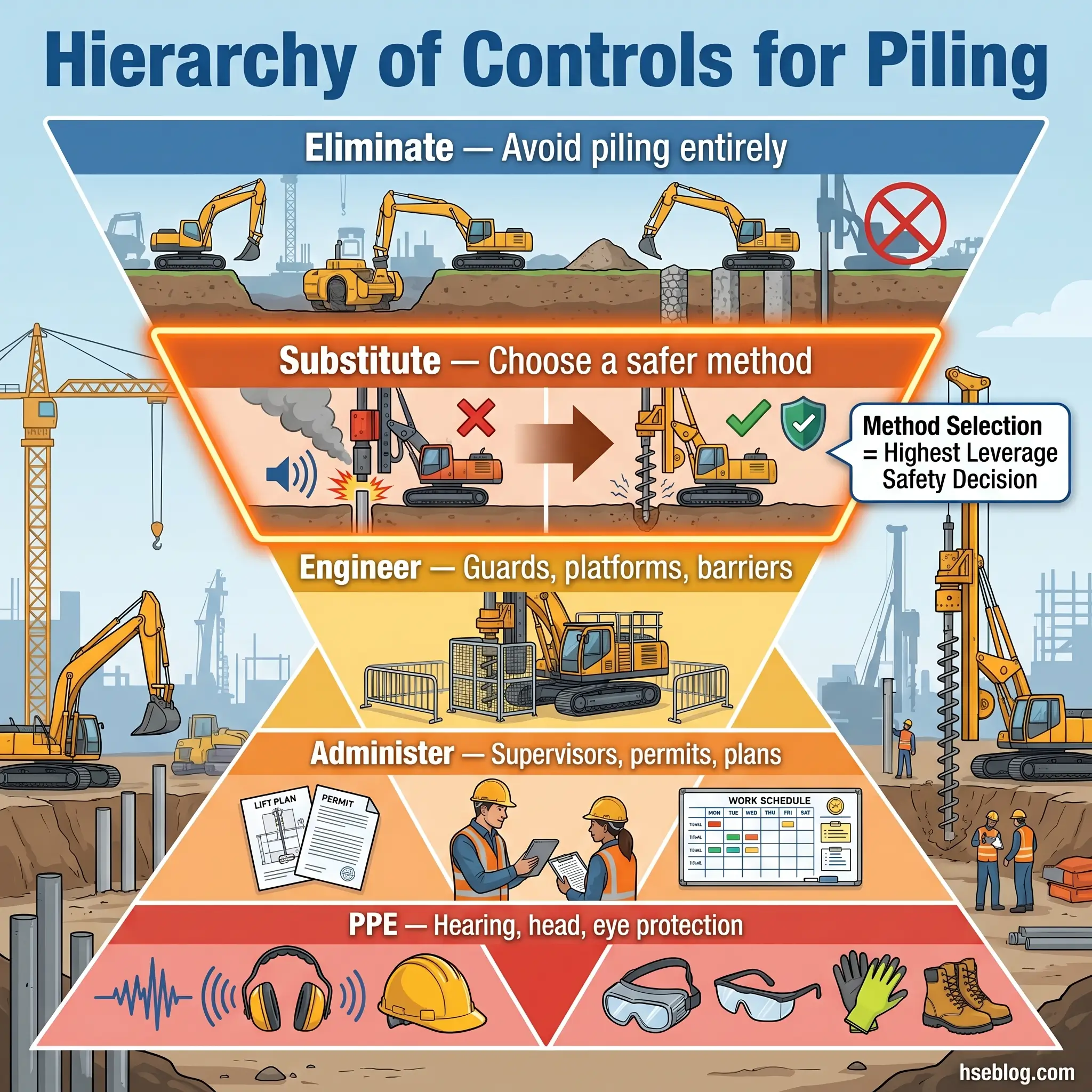
Method selection is where the hierarchy of controls delivers its highest leverage in piling — and it is where the hierarchy is most consistently ignored. Substitution, the second tier, operates at the point of choosing which piling method to use. Everything downstream — engineering controls, administrative systems, PPE — is constrained by that choice.
Elimination
Redesign foundations to avoid piling where geotechnically possible. Ground improvement techniques (vibro-compaction, dynamic compaction, grouting) can sometimes provide adequate bearing capacity without deep foundations. This is a structural engineer’s decision, but HSE professionals should flag it as an option during design-stage risk review.
Substitution
Selecting CFA over impact driving eliminates impulse noise entirely. Selecting screw piles over rotary bored eliminates contaminated-spoil handling. Each substitution removes one hazard set but introduces another — the risk assessment must account for both what is gained and what is inherited.
Engineering Controls
- Rig guarding to BS EN 16228 — fixed enclosing guards on rotating parts, interlocked access panels, restricted-mode operating systems.
- Designed working platforms — engineered granular platforms verified against rig-specific bearing pressures, with geogrid reinforcement where required.
- Exclusion zone barriers — physical barriers, not just painted lines, to prevent pedestrian entry into the rig operating envelope.
- Concrete delivery hose restraints — whip checks and secured connections on flexible hose sections to mitigate hose-whip energy.
Administrative Controls
- Competent-person supervision — a trained piling supervisor present during operations. The FPS Piling Supervisors Safety Training Scheme (UK) provides a structured pathway; OSHA requires a competent person but does not prescribe a specific piling training course.
- Permit-to-dig — mandatory before any piling operation in areas with known or suspected underground services.
- Method statements — pile-specific, not generic. The method statement must address the hazards unique to the selected piling technique.
PPE (Last Line)
- Hearing protection — with Lpeak rating verified against impulse noise levels for impact driving, not just standard NRR.
- Hard hats — mandatory within the exclusion zone for all piling methods.
- Eye protection — during pile trimming, concrete breaking, and any operation producing fragments.
- Respiratory protection — when working with contaminated spoil or in enclosed mini-piling environments with inadequate ventilation.
The judgment that matters most: substitution (method selection) determines the entire hazard landscape for a piling project, yet it is typically made by the structural engineer without safety input. HSE professionals who engage at the design stage — not after the subcontract is awarded — have the greatest opportunity to shape risk outcomes.
Frequently Asked Questions
Conclusion
The piling industry’s persistent lesson is that method selection drives risk. Choosing between driven, bored, CFA, mini, or screw piling does not just change the engineering — it determines which hazards the workforce will face, which standards apply, and which controls must be in place before the rig starts. A risk assessment written for impact driving is dangerously irrelevant to a CFA operation, and vice versa.
What the published incident record shows, consistently, is that the highest-impact change available to most projects is engaging HSE professionals before the piling method is locked in. Substitution-level decisions — selecting CFA over impact driving to eliminate impulse noise, or choosing screw piles to avoid contaminated-spoil handling — are only available at the design stage. Once the subcontract is awarded, the project inherits a hazard profile it can manage but can no longer fundamentally alter.
The working platform remains the control measure most likely to prevent the most serious outcome. Every rig overturning investigation reaches the same finding: the platform was inadequate, deteriorated, or designed for a different rig. Treat the platform as a designed, verified, and maintained safety-critical system — not as “hard standing” — and the single most recurrent piling fatality mechanism loses its foothold.