
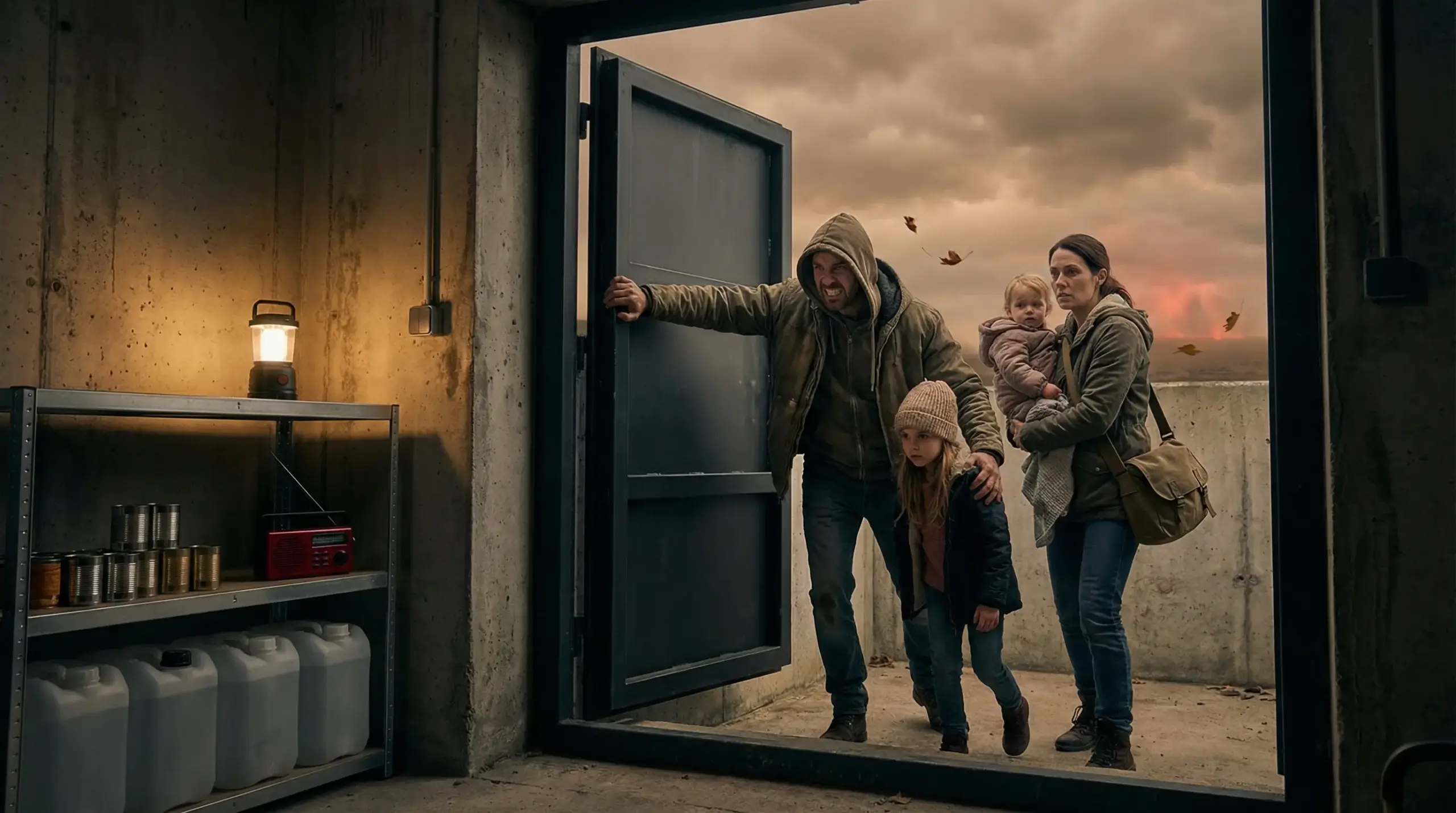
TL;DR
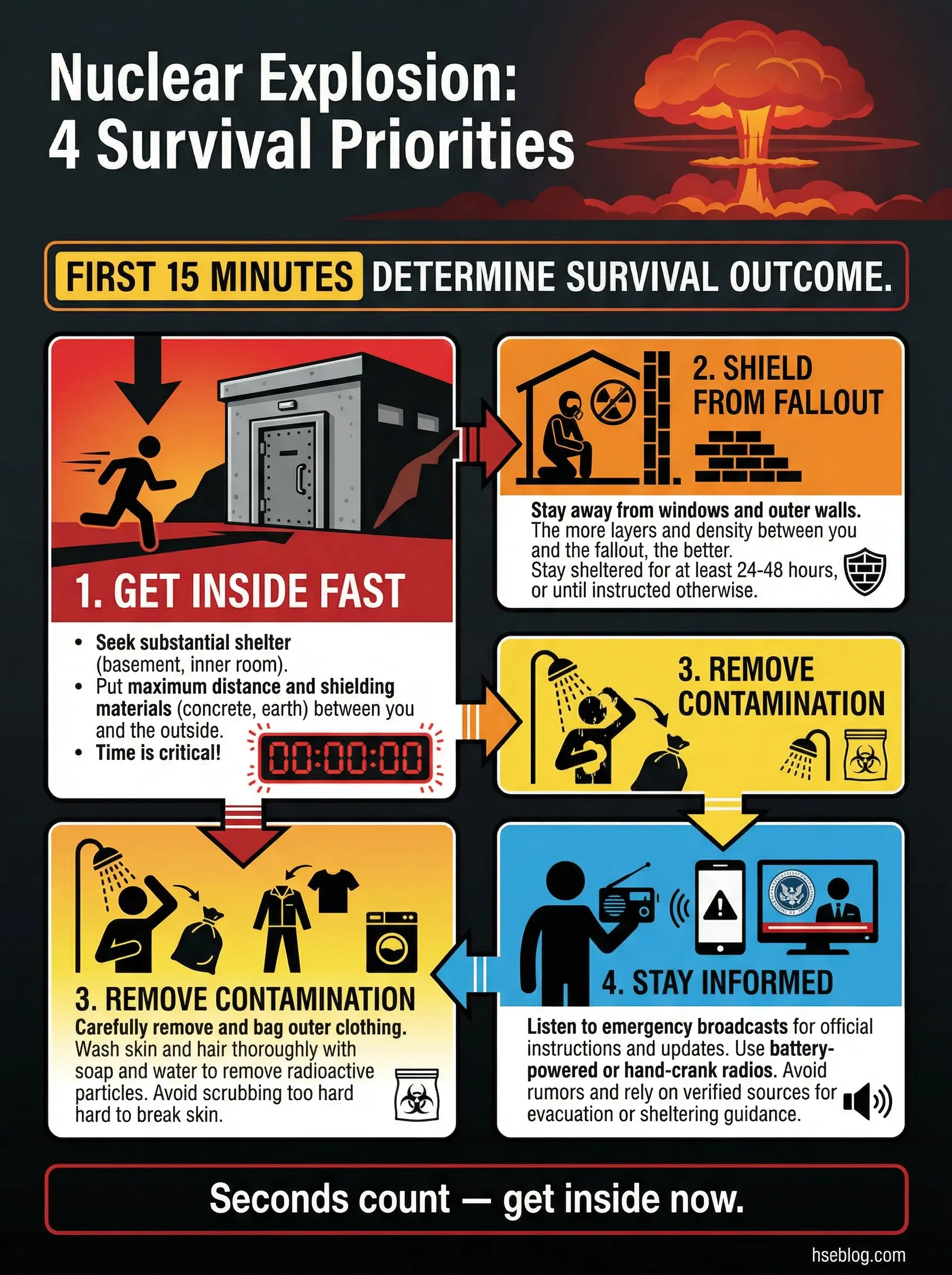
- Get inside immediately: A solid building with thick walls and a basement is your best protection against a nuclear blast wave and radioactive fallout.
- Stay away from windows: Glass becomes lethal shrapnel during a nuclear explosion — move to interior rooms on the lowest floor.
- Shelter in place for 24+ hours: Radioactive fallout loses roughly 80% of its intensity in the first 24 hours — staying inside saves lives.
- Remove contaminated clothing: If caught outdoors during fallout, strip outer layers and shower immediately to remove radioactive particles.
- Know your emergency alerts: Tune into official channels — misinformation during a nuclear emergency kills as fast as radiation.
I was running a tabletop emergency exercise at a chemical complex in the Gulf when the scenario moderator threw in a curveball — a simulated radiological dispersal event combined with a refinery fire. The room froze. Engineers who could dismantle a distillation column in their sleep suddenly had no idea where to go, what to do with their clothes, or how long to stay indoors. That silence told me everything. Even trained industrial workers, people who drill for fire and gas releases monthly, had zero instinct for nuclear or radiological threats. The general public is even less prepared.
A nuclear explosion is not a Hollywood event you watch from a safe distance. It produces a blast wave capable of leveling reinforced structures within a mile, thermal radiation that causes third-degree burns in seconds, and radioactive fallout that contaminates air, water, and soil for days. The decisions you make in the first 10 to 15 minutes after a nuclear detonation will determine whether you survive the next 48 hours. This guide breaks down exactly what to do during a nuclear explosion — and critically, what mistakes will get you killed.
Understanding What a Nuclear Explosion Actually Does
A nuclear explosion is a rapid release of energy from a nuclear reaction — either fission (splitting heavy atoms) or fusion (combining light atoms) — that produces four distinct kill mechanisms, each operating on a different timeline. Understanding these mechanisms is not academic. It directly determines what protective actions work and when.
The following four effects occur in sequence after a nuclear detonation, and each requires a different survival response:
- Electromagnetic pulse (EMP): Arrives at the speed of light. Disables electronics, communications, and power grids instantly. You will likely lose phone service, internet, and broadcast signals within seconds.
- Thermal radiation (light flash): Travels at the speed of light. Causes flash blindness up to 13 miles away on a clear day and ignites clothing, paper, and dry vegetation within several miles of ground zero. Burns are the leading cause of immediate casualties.
- Blast wave: Travels at roughly the speed of sound. Shatters windows, collapses walls, hurls debris, and creates overpressure injuries to lungs and eardrums. This is what levels buildings.
- Radioactive fallout: Arrives minutes to hours later depending on wind and distance. Consists of irradiated dust and debris pulled up into the mushroom cloud, then deposited downwind. This is the longest-lasting threat and the one most people misunderstand.
The U.S. Federal Emergency Management Agency (FEMA) guidance and the International Atomic Energy Agency (IAEA) both emphasize that adequate shelter reduces radiation exposure from fallout by a factor of 10 to 200, depending on the building type. A concrete basement offers a protection factor of approximately 200 — meaning you receive 1/200th of the outdoor dose.
Pro Tip: The bright flash arrives before the blast wave. If you see a sudden, intense white flash and you are several miles from the source, you have 10 to 30 seconds before the blast wave hits. Do not run to a window. Drop to the floor, away from glass, and cover your head.
Immediate Actions During a Nuclear Explosion
The gap between detonation and the arrival of the blast wave is your only window to act. What you do in those seconds — and the first 15 minutes after — will define everything that follows.
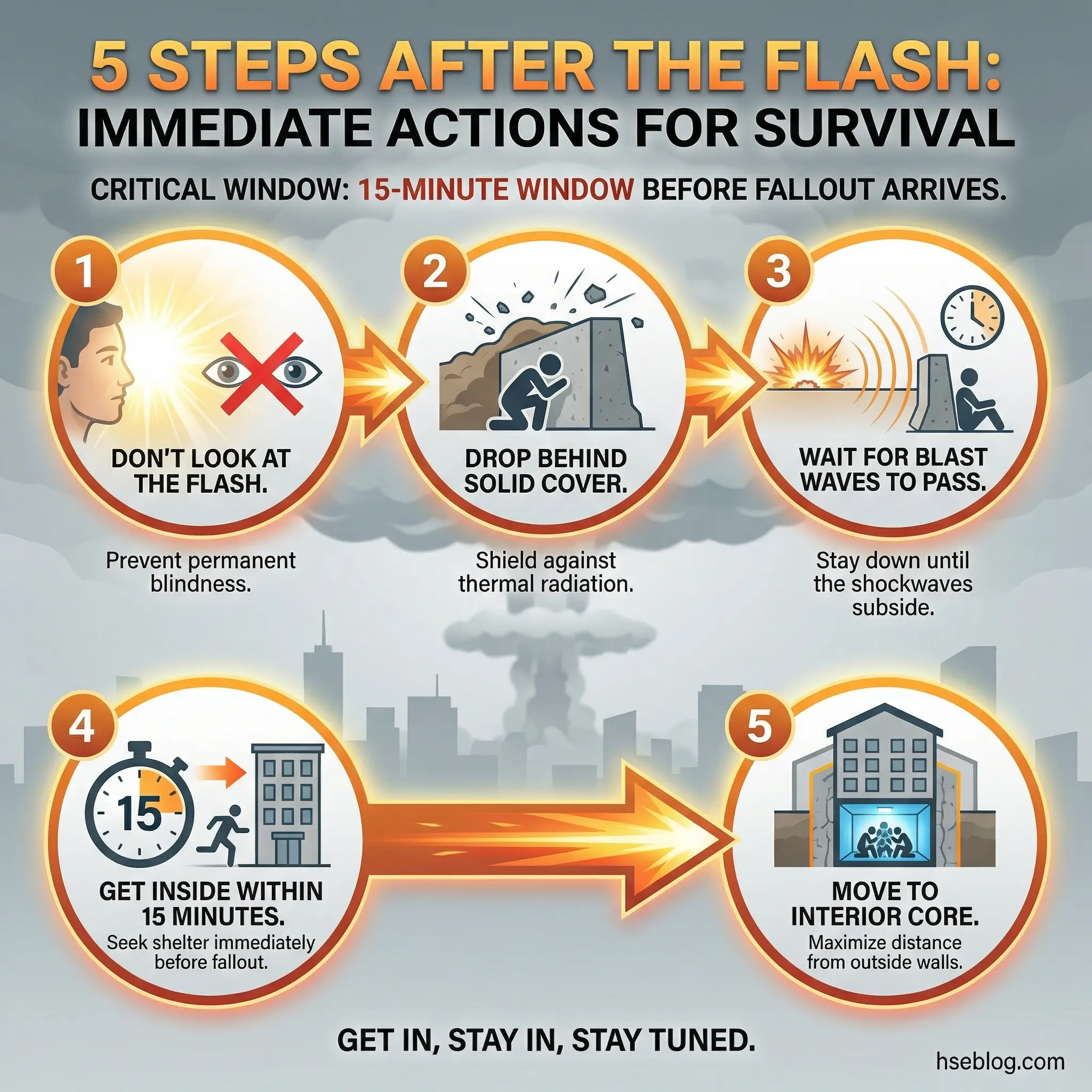
If you are outdoors when a nuclear explosion occurs, follow this sequence without hesitation:
- Do not look at the flash. The thermal pulse causes temporary or permanent blindness. Turn away, close your eyes, and drop flat.
- Get behind solid cover immediately. A concrete wall, a ditch, a vehicle engine block — anything between you and the blast wave. Lie face down with your head away from the blast direction.
- Wait for the blast wave to pass. Two waves will hit — the initial pressure wave and the reflected wave (negative phase). Stay down until both pass. This may take 30 to 60 seconds depending on distance.
- Get inside the nearest solid building within 15 minutes. You are now racing the fallout clock. Reinforced concrete, brick, or stone buildings with basements are ideal. A wood-frame house is better than being outside. A car is the worst option — it offers almost no fallout protection.
- Move to the building’s interior core. Away from exterior walls and windows. The lowest floor or basement provides the best shielding. Every layer of material between you and the outside reduces your radiation dose.
- Seal the space. Close all windows and doors. Turn off ventilation systems, fans, and air conditioning to prevent drawing contaminated air inside.
If you are indoors when the blast occurs, the sequence is simpler but equally critical:
- Move away from windows immediately. Glass lethality extends far beyond the blast damage radius. Even miles from the detonation, the pressure wave shatters windows and turns glass into high-velocity fragments.
- Get to the lowest interior room. Basement first, then a windowless bathroom or hallway on the ground floor.
- Stay put. Do not attempt to evacuate unless your building is structurally compromised and about to collapse. Going outside exposes you to fallout.
Pro Tip: The instinct to run is the deadliest response to a nuclear explosion. Every civil defense study since the Cold War confirms the same conclusion — sheltering in place saves dramatically more lives than evacuation attempts in the first 24 hours.
Sheltering in Place — Why It Works and How to Do It Right
Shelter-in-place during a nuclear emergency is not a suggestion. It is the single most effective survival action available to civilians who are outside the immediate blast zone. The science behind it is straightforward — radioactive fallout decays rapidly, and physical barriers absorb radiation.
The “7-10 Rule” is the foundational principle that governs fallout behavior and shelter timing:
- For every 7-fold increase in time after detonation, the radiation intensity drops by a factor of 10. After 7 hours, radiation is 1/10th of its initial level. After 49 hours (7×7), it is 1/100th. After roughly 2 weeks, it is 1/1,000th.
- The first 24 hours are the most dangerous. Approximately 80% of the total radiation dose a person would receive from fallout is delivered in the first day. Staying sheltered during this period eliminates the vast majority of your exposure risk.
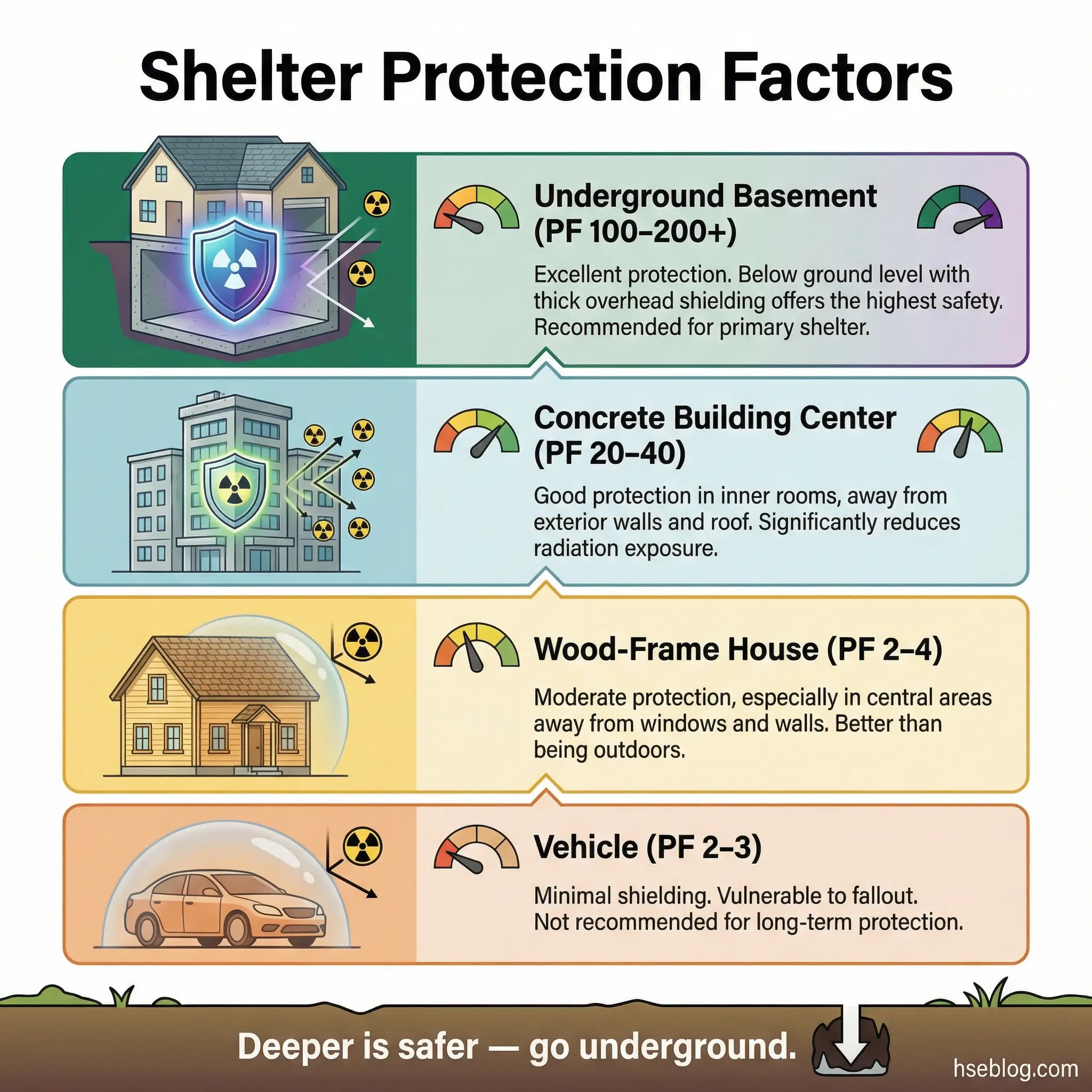
The type of building you shelter in matters enormously. Different structures offer dramatically different levels of protection, measured by a “Protection Factor” (PF):
| Shelter Type | Protection Factor | Practical Meaning |
|---|---|---|
| Open air (no shelter) | 1 | Full exposure — worst case |
| Vehicle (car, truck) | 2–3 | Almost no meaningful protection |
| Wood-frame house | 2–4 | Minimal protection; better than outdoors |
| Brick or concrete building (upper floor) | 10–20 | Moderate protection |
| Brick or concrete building (center, ground floor) | 20–40 | Good protection |
| Multi-story concrete building (interior room, 3+ floors above ground) | 50–100 | Strong protection |
| Underground basement (concrete, 3+ feet of earth above) | 100–200+ | Best available civilian protection |
Where you position yourself inside the building matters as much as the building itself. Interior walls add shielding. Each floor between you and the roof adds shielding. Distance from exterior walls reduces your dose. A person sitting in the center hallway of a concrete building’s ground floor receives a fraction of what someone near a window on the top floor receives — in the same building.
Pro Tip: If you are in a weak structure (wood-frame house, mobile home) and a stronger building is within a 5-minute walk, move to the stronger building within the first 15 minutes — before heavy fallout arrives. After fallout begins settling, stay where you are. The exposure from walking through active fallout will exceed the dose reduction from a better shelter.
Radioactive Fallout — What It Is and How to Decontaminate
Radioactive fallout is not invisible gas. It is physical material — dust, ash, soil particles, and debris — that has been irradiated and pulled into the atmosphere by the explosion’s fireball. It falls back to earth like dirty snow or fine sand, contaminating everything it contacts. Understanding this physical nature changes how you respond.
Fallout particles settle on skin, hair, clothing, vehicles, and building surfaces. External contamination is the primary risk for survivors outside the immediate blast zone. The good news — external contamination can be removed.
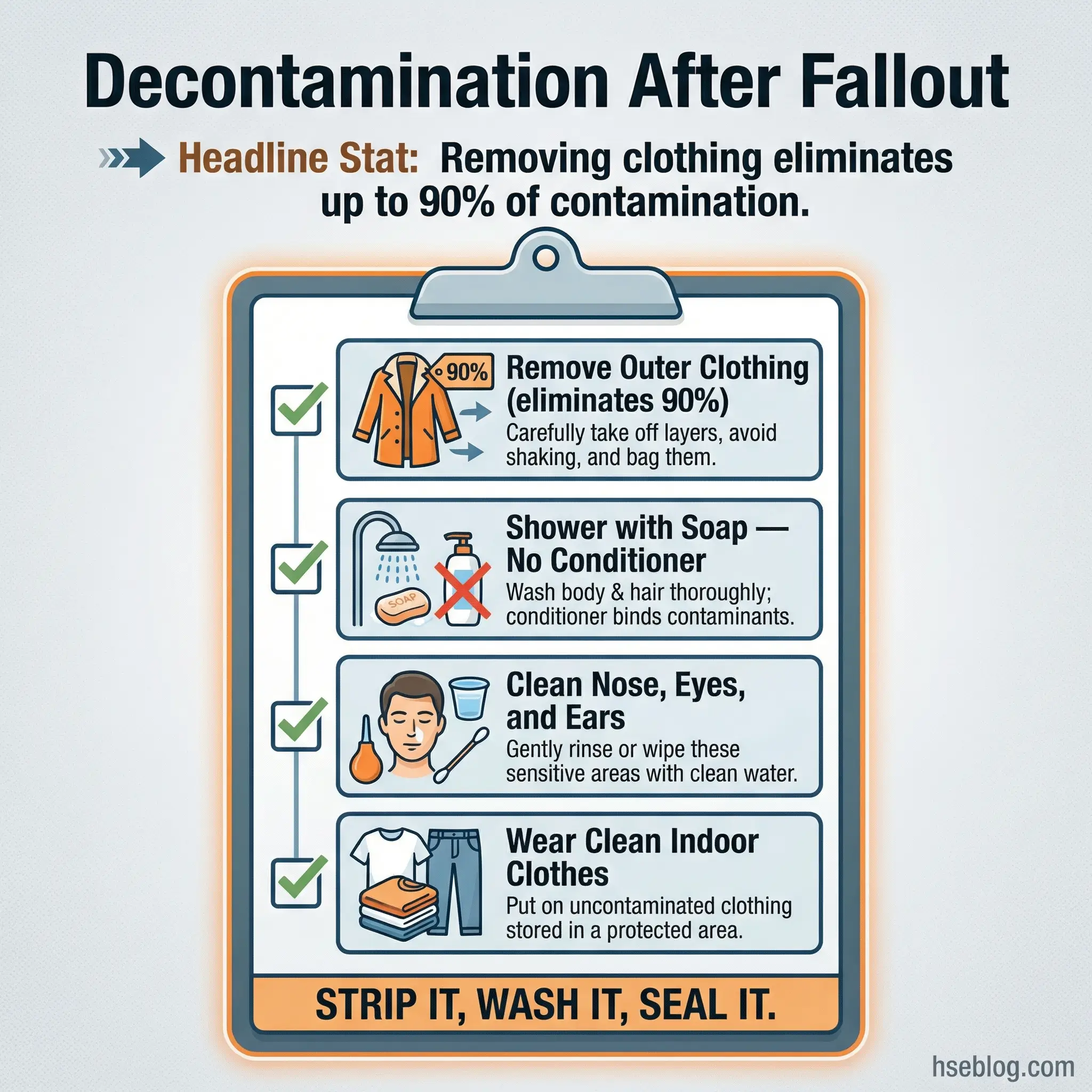
If you were outdoors during or after the detonation and may have been exposed to fallout, take these decontamination steps as soon as you reach shelter:
- Remove all outer clothing before entering the shelter. Bag it and leave it outside the door. Removing clothing alone eliminates up to 90% of external contamination.
- Shower with soap and warm water. Scrub gently — do not abrade the skin. Abrasions allow radioactive particles to enter the body through broken skin. Wash hair with shampoo only, not conditioner — conditioner binds particles to hair.
- Do not use conditioner on hair. This point is critical enough to repeat. Hair conditioner’s chemical structure causes radioactive particles to adhere more tightly to hair strands, making decontamination harder.
- Blow your nose, wipe eyelids, and clean ear canals. Radioactive particles collect in these areas. Use clean, damp cloths.
- Put on clean clothing from inside the shelter. Anything stored indoors before the event is uncontaminated.
If no shower is available, wipe exposed skin with clean, damp cloths or uncontaminated wipes. Even dry brushing of clothes and hair removes significant contamination. Any decontamination is better than none.
Internal contamination — inhaling or ingesting radioactive particles — is the harder problem. This is why sealing your shelter space, covering your nose and mouth if caught outdoors, and avoiding contaminated food and water are critical. A damp cloth over the nose and mouth filters a significant percentage of particulate fallout from inhaled air.
The IAEA’s General Safety Guide (GSG-2) on criteria for use in preparedness and response for a nuclear or radiological emergency emphasizes that early sheltering and decontamination are the most effective dose-reduction measures for the general public.
Common Mistakes That Get People Killed During a Nuclear Emergency
I have reviewed dozens of civil defense exercise after-action reports and historical case studies from nuclear test communities. The same errors repeat across every scenario — whether simulated or real. These are not obscure edge cases. They are the default behaviors that untrained people fall into under panic.
The following mistakes consistently appear in post-exercise evaluations and real-world radiation emergency debriefs:
- Running outside to find family members. This is the most emotionally understandable and the most lethal mistake. Leaving shelter during the first 24 hours to search for loved ones exposes you to peak fallout radiation. Pre-establish a family reunification plan before an emergency, not during one.
- Driving away from the area. Roads will be blocked by debris, disabled vehicles (EMP), and panicked traffic. A car offers almost no radiation protection (PF of 2–3). You are safer in a concrete building basement than in a car 20 miles away.
- Crowding near windows to see what happened. Windows shatter from blast overpressure at distances far beyond the structural damage zone. Even if the building stands, windows become fragmentation hazards. Move to interior rooms.
- Consuming unprotected food and water. Any food or water that was open or exposed outdoors after the blast is potentially contaminated. Use only sealed, stored supplies. Tap water from a covered reservoir or underground pipes is generally safer than surface water, but official guidance should be followed.
- Refusing to remove clothing. People resist stripping down, especially in group shelters. That reluctance costs lives. Contaminated clothing continues irradiating the wearer and everyone nearby. Modesty is not worth a lethal dose.
- Ignoring official information channels. Rumors spread faster than fallout. People who act on social media rumors instead of official emergency broadcasts (Emergency Alert System, NOAA Weather Radio, government broadcasts) make poor decisions about when to evacuate and where to go.
Pro Tip: Create a family emergency communication plan now — before anything happens. Designate an out-of-area contact person. Agree on a meeting point. Confirm that every family member knows the shelter-in-place protocol. Rehearse it once. That single conversation eliminates the deadliest impulse — running outside to find each other during peak fallout.
Emergency Supplies and Preparedness Before a Nuclear Event
Preparedness for a nuclear explosion follows the same core logic as any major disaster — but with specific additions for radiation protection and extended sheltering periods.
FEMA, the American Red Cross, and the IAEA all recommend maintaining emergency supplies that can sustain your household for at least 72 hours without outside assistance. For a nuclear event, extending this to 14 days is the more realistic planning target, since fallout contamination may prevent safe outdoor movement for that long.
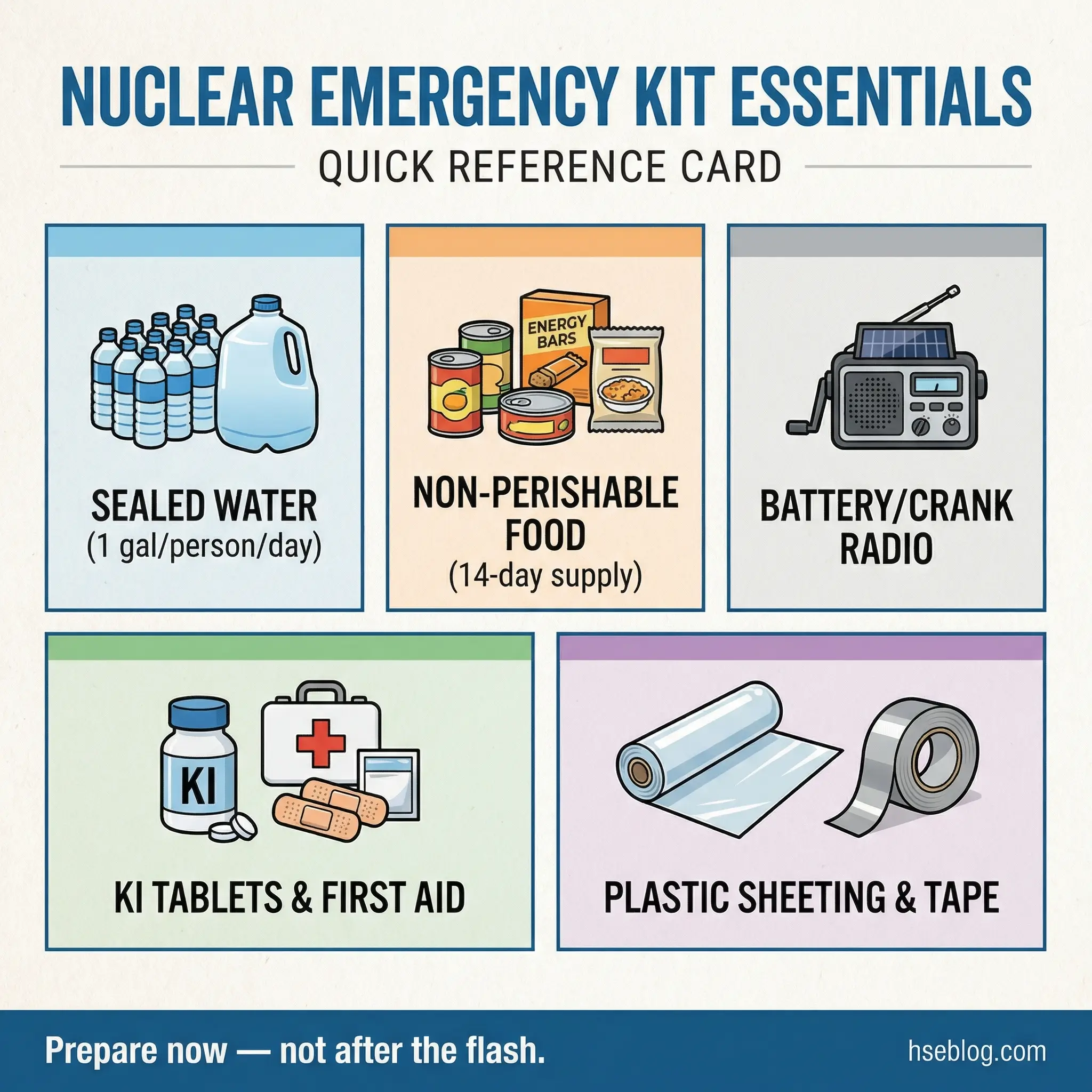
The following supplies should be pre-positioned in your home or designated shelter location:
- Water: One gallon per person per day. Sealed containers only. For a family of four, a 14-day supply means 56 gallons — plan storage accordingly.
- Non-perishable food: Canned goods, dried foods, energy bars. Include a manual can opener. Nothing requiring water to prepare if your water supply is limited.
- Battery-powered or hand-crank radio: Your only reliable link to official emergency information when power and cell networks are down. NOAA Weather Radio frequencies carry Emergency Alert System broadcasts.
- First aid kit: Include potassium iodide (KI) tablets if available. KI protects the thyroid gland from absorbing radioactive iodine — one of the most dangerous fallout isotopes. It must be taken within hours of exposure to be effective and should only be taken when directed by public health authorities.
- Plastic sheeting and duct tape: For sealing windows, doors, and ventilation openings in your shelter room. Pre-cut sheets to fit your window dimensions.
- Flashlights and extra batteries: Assume total power loss. Do not rely on rechargeable devices.
- Sanitation supplies: Garbage bags, ties, disinfectant, and a bucket for emergency sanitation if plumbing fails.
- N95 or P100 respirator masks: Effective at filtering radioactive particulate matter from inhaled air. Store enough for every household member.
- Change of clothes in sealed bags: For each person. Stored indoors, these remain uncontaminated and ready for use after decontamination.
Supplies alone are not enough. Preparedness includes knowing your community’s emergency drill procedures, identifying the strongest shelter-capable buildings in your daily routine (workplace, school, commute route), and understanding how radiation exposure works so you can make rational decisions under stress.
When and How to Evacuate After a Nuclear Explosion
Evacuation is not the first response to a nuclear explosion — it is the last. Shelter-in-place is the default survival strategy for the first 24 hours minimum. Evacuation happens only when authorities issue a specific instruction to move, based on fallout patterns, wind direction, and radiation monitoring data.
Understanding when evacuation becomes appropriate — and how to do it safely — prevents the single most common fatal error in nuclear emergency response:
- Wait for official evacuation orders. Self-evacuation during active fallout deposits radiation on your skin, in your lungs, and in your vehicle. Unless your building is structurally unsafe, stay sheltered.
- Evacuate perpendicular to the wind. Fallout plumes travel downwind. Moving crosswind (perpendicular to wind direction) gets you out of the contaminated zone faster than moving directly away from the blast.
- Cover all exposed skin. Long sleeves, gloves, hat, sealed shoes. Cover nose and mouth with a damp cloth or respirator. Minimize skin and airway exposure during transit.
- Do not shelter in vehicles long-term. A car is a transit tool, not a shelter. Drive to a designated evacuation center or a building with adequate protection factors. Do not sit in a parked car thinking you are safe.
- Decontaminate upon arrival at a clean zone. Even if you feel fine, remove outer clothing and wash before entering a clean shelter. You may be carrying fallout particles that will irradiate everyone around you.
FEMA’s Planning Guidance for Response to a Nuclear Detonation recommends that individuals in the “Dangerous Fallout Zone” (DFZ) shelter for at least 24 hours, while those in the “Light Damage Zone” may self-evacuate after initial sheltering if a safe route exists.
The 24-hour mark is not arbitrary. It corresponds directly to the decay curve — at 24 hours, outdoor radiation levels have dropped enough that brief, directed movement becomes survivable with minimal protection. Before that threshold, the math does not favor leaving shelter under any scenario except structural collapse.
Understanding Radiation Exposure Risks and Health Effects
Radiation from a nuclear explosion affects the human body differently depending on the dose received, the exposure duration, and whether contamination is external or internal. Knowing these distinctions helps you understand why the shelter and decontamination steps above are so critical.
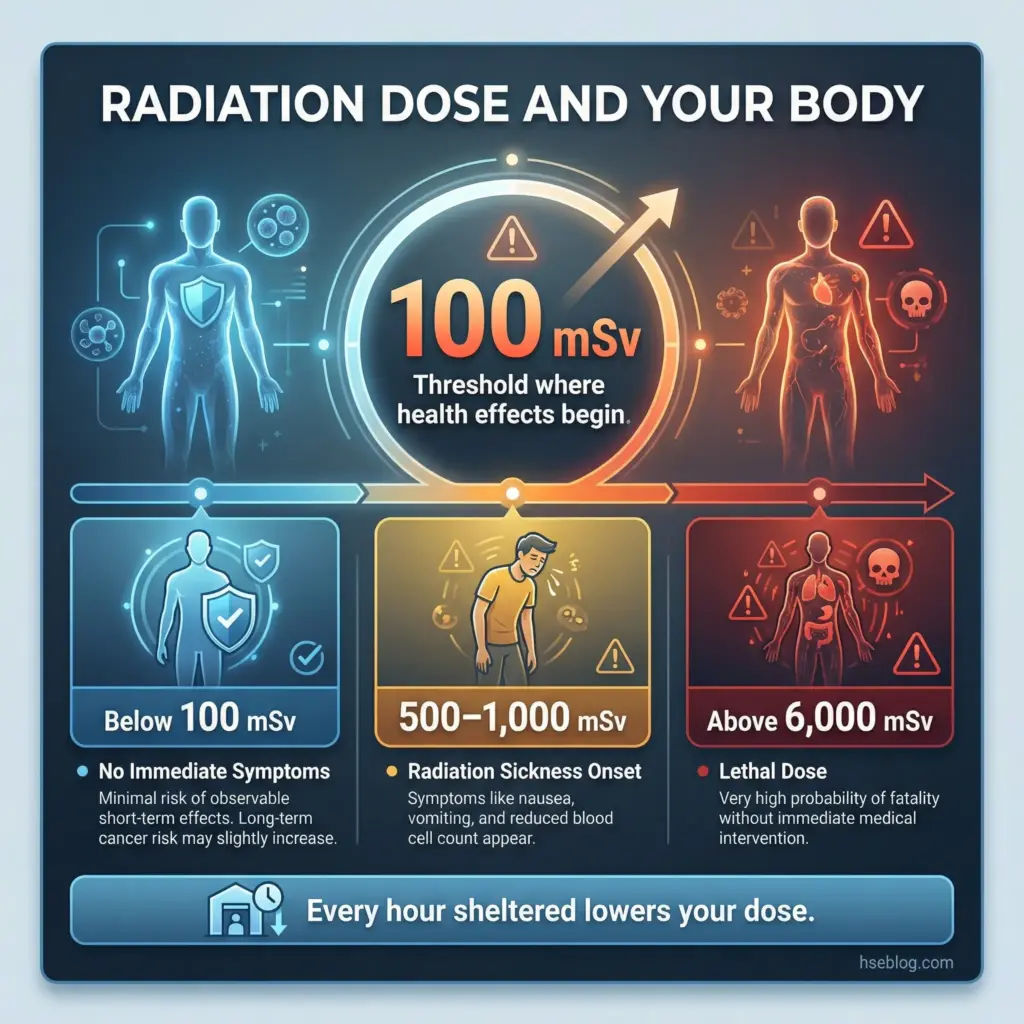
Radiation dose is measured in millisieverts (mSv) or rem (1 rem = 10 mSv). The health effects follow a dose-dependent pattern:
| Dose (mSv) | Health Effect | Timeline |
|---|---|---|
| Below 100 | No immediate symptoms; slightly elevated long-term cancer risk | Years to decades |
| 100–500 | Mild nausea, fatigue; blood cell count changes detectable | Hours to days |
| 500–1,000 | Moderate radiation sickness; nausea, vomiting, hair loss; medical treatment needed | Hours to weeks |
| 1,000–2,000 | Severe radiation sickness; significant mortality without medical intervention | Days to weeks |
| 2,000–6,000 | Acute radiation syndrome; high fatality rate even with treatment | Days to weeks |
| Above 6,000 | Lethal dose; survival extremely unlikely | Hours to days |
These numbers reinforce a simple truth: every hour you spend in adequate shelter during the first 24 hours prevents dose accumulation that could push you from “no symptoms” to “medical emergency.” The protection factor of your shelter literally determines which row of that table applies to you.
Children, pregnant women, and elderly individuals are more vulnerable to radiation effects. Radioactive iodine specifically targets the thyroid gland, which is why potassium iodide (KI) distribution is a standard public health response — it saturates the thyroid with stable iodine, blocking uptake of the radioactive form. KI does not protect against other radiation types or isotopes. It is one tool, not a cure-all.
Pro Tip: If you experience nausea, vomiting, or diarrhea within hours of potential radiation exposure, seek medical attention as soon as it is safe to move. Early-onset vomiting is a clinical indicator of significant dose and triggers a different medical response protocol. Do not dismiss it as stress.
Conclusion
A nuclear explosion is a survivable event for the vast majority of people outside the immediate blast zone — but only if those people know what to do and act on it within minutes. The science is unambiguous. Getting inside a solid building, moving to the interior and lowest level, staying sheltered for at least 24 hours, and decontaminating properly will prevent the overwhelming majority of fallout-related casualties. These are not theoretical recommendations. They are backed by decades of nuclear testing data, civil defense research, and radiological emergency planning by agencies worldwide.
The mistakes that kill people in a nuclear emergency are not complicated. They are predictable and preventable — running outside, driving into fallout, ignoring contaminated clothing, and acting on panic instead of information. A 15-minute family conversation about shelter locations, emergency supplies, and communication plans eliminates most of those errors before they ever occur.
No one chooses to face a nuclear explosion. But the people who survive one will be those who treated emergency preparedness as a personal responsibility — not something governments handle on their behalf. The shelter you identify today, the supplies you store this week, and the plan you discuss with your family tonight are the only things standing between survival and a preventable death. That is not dramatic language. That is field reality.