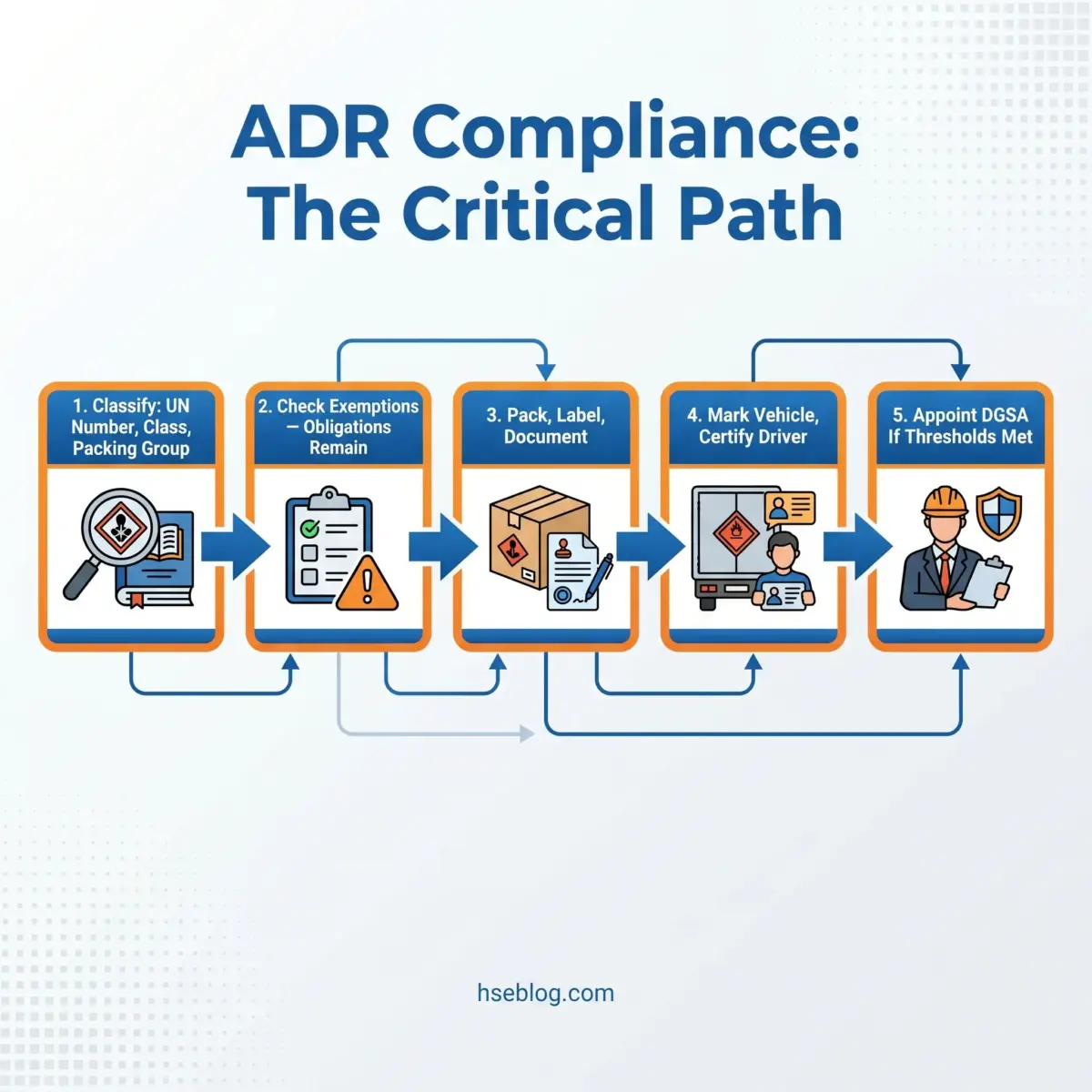
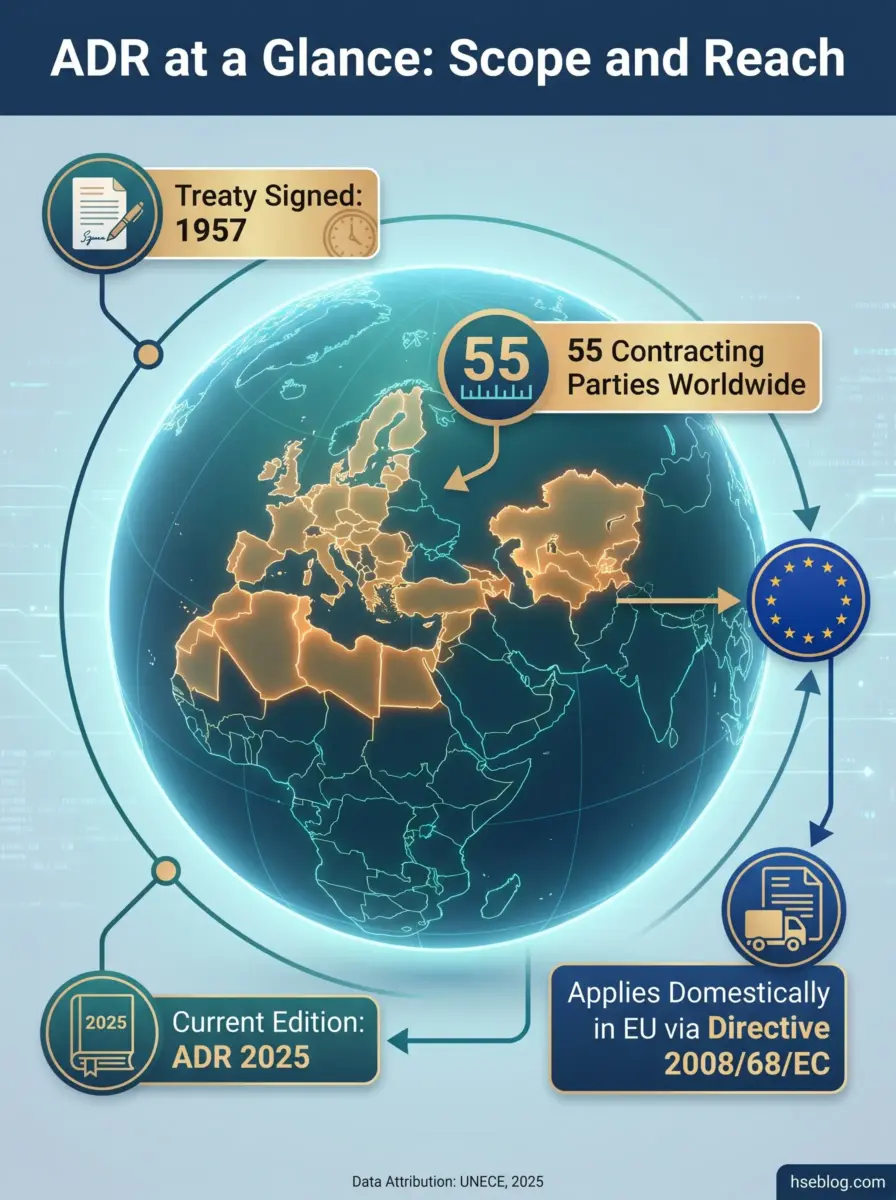
ADR stands for the Agreement concerning the International Carriage of Dangerous Goods by Road — a United Nations treaty signed in Geneva in 1957 that governs how hazardous materials are classified, packaged, labelled, documented, and transported by road. Currently binding on 55 countries (UNECE, 2025), ADR is revised every two years, with ADR 2025 the edition now fully mandatory since 1 July 2025.
What Is ADR? Meaning and Purpose of the Dangerous Goods Agreement
The full title originates from the French: Accord relatif au transport international des marchandises Dangereuses par Route. The acronym follows the French word order — a detail that occasionally confuses English-speaking operators encountering it for the first time.
Concluded on 30 September 1957 and entering into force on 29 January 1968, ADR is a treaty administered by the United Nations Economic Commission for Europe (UNECE). As of 2025, 55 states are contracting parties (Wikipedia, citing UNECE treaty status, 2025), spanning not only Europe but countries across Central Asia, North Africa, and the Caucasus. In 2020, the word "European" was dropped from the agreement's working title to better reflect this geographic reality.
A persistent misconception among duty holders is that ADR applies only to cross-border shipments. In practice, EU Directive 2008/68/EC extends ADR's requirements to domestic transport within all EU member states. The UK achieves the same through the Carriage of Dangerous Goods and Use of Transportable Pressure Equipment Regulations 2009 (CDG Regulations). The practical effect is that a delivery van carrying gas cylinders across a single town is operating under the same classification and packaging framework as an international tanker crossing three borders. Anyone involved in dangerous goods transport — whether carrier, packer, loader, or consignor — operates within ADR's reach, and the UNECE's official ADR information page is the primary reference for the treaty's current scope and edition.
Structure of ADR: How Annexes A and B Are Organised
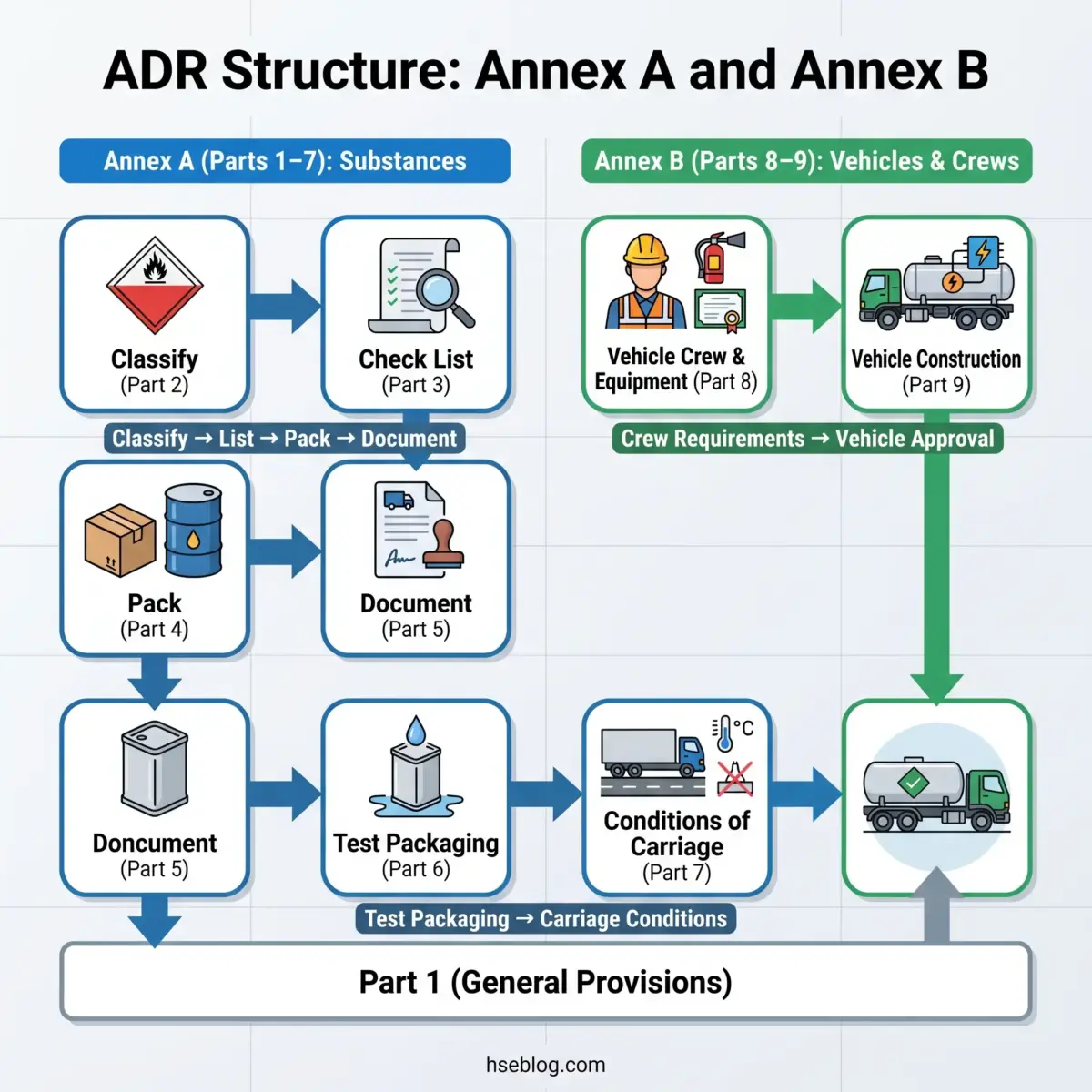
The operative core of the agreement is Article 2, which states that dangerous goods may be carried by road provided they comply with the conditions in two annexes. Annex A (Parts 1–7) governs the substances themselves — classification, listing, packaging, consignment procedures, and conditions of carriage. Annex B (Parts 8–9) governs the vehicles, their crews, and operational requirements.
The logical sequence mirrors a real consignment workflow. Part 2 of Annex A establishes how to classify the substance based on its physical, chemical, and toxicological properties. Part 3 contains Table A of Chapter 3.2 — the dangerous goods list — which assigns each substance its UN number, proper shipping name, class, packing group, labels, packaging instructions, and special provisions. Part 4 specifies packing and tank provisions. Part 5 addresses consignment procedures and documentation. Part 6 covers construction and testing standards for packagings, intermediate bulk containers (IBCs), and tanks. Part 7 sets the conditions of carriage — loading, unloading, and handling.
Annex B then picks up the operational side. Part 8 covers vehicle crew requirements, equipment, operational procedures, and documentation that must travel with the vehicle. Part 9 addresses vehicle construction and approval standards — type approval for tank vehicles, EX/II and EX/III vehicles for explosives, and FL vehicles for flammable substances.
In my experience reviewing ADR compliance across different operations, Part 3 — specifically Table A — is the operational heart of daily practice. Most compliance questions begin and end with finding the correct row in Table A and following the instructions outward: which packaging instruction applies, which labels are required, which special provisions modify the default rules.
One structural feature worth understanding is that ADR aligns deliberately with the UN Recommendations on the Transport of Dangerous Goods (the Model Regulations). This parent framework also feeds into the IMDG Code for sea transport, ICAO Technical Instructions for air, and RID for rail. The classification system, UN numbers, and packing group assignments are consistent across all four modes. An operator who understands ADR's structure can navigate the other modal regulations with significantly less friction — the architecture is intentionally parallel.
The Nine ADR Dangerous Goods Classes
ADR classification is based on the dominant hazard a substance presents during transport. The system recognises nine primary classes, several of which contain subdivisions reflecting distinct hazard behaviours.
| Class | Name | Subdivisions | Examples | Packing Groups |
|---|---|---|---|---|
| 1 | Explosives | 1.1–1.6 (mass explosion to insensitive) | Dynamite, detonators, fireworks | N/A (compatibility groups instead) |
| 2 | Gases | 2.1 Flammable, 2.2 Non-flammable/non-toxic, 2.3 Toxic | Propane, nitrogen, chlorine | N/A |
| 3 | Flammable Liquids | — | Petrol, ethanol, solvents | I, II, III |
| 4 | Flammable Solids | 4.1 Flammable solids, 4.2 Spontaneously combustible, 4.3 Dangerous when wet | Sulphur, white phosphorus, sodium | I, II, III |
| 5 | Oxidisers | 5.1 Oxidising substances, 5.2 Organic peroxides | Ammonium nitrate, benzoyl peroxide | I, II, III (5.1); types A–G (5.2) |
| 6 | Toxic & Infectious | 6.1 Toxic, 6.2 Infectious | Arsenic, cyanides, Category A pathogens | I, II, III (6.1); N/A (6.2) |
| 7 | Radioactive Material | — | Uranium hexafluoride, medical isotopes | N/A (transport index instead) |
| 8 | Corrosives | — | Sulphuric acid, sodium hydroxide | I, II, III |
| 9 | Miscellaneous | — | Lithium batteries, dry ice, asbestos | III (typically) |
Each entry in the dangerous goods list carries a four-digit UN number — a universal identifier consistent across all transport modes. Packing groups add a secondary risk-severity layer: Group I indicates great danger, Group II medium danger, and Group III minor danger. Classes 1, 2, 6.2, and 7 use alternative severity systems instead.
A pattern worth flagging: Class 9 has expanded significantly in practical importance. The growth of lithium battery transport — driven by battery-powered equipment, electric vehicles, and consumer electronics — means many operators who never previously handled regulated dangerous goods now do so. A warehouse shipping replacement laptop batteries is handling Class 9 dangerous goods, whether the logistics team recognises it or not.
Transport Categories and Their Role in Exemption Thresholds
Each dangerous goods entry in Table A is also assigned a transport category, ranging from 0 (most dangerous — no threshold exemption available) to 4 (least regulated). These categories drive the small-loads exemption under ADR 1.1.3.6, which is covered in detail in the next section.
For mixed loads containing substances from different transport categories, ADR uses a points-based calculation. Each kilogram or litre of substance is multiplied by a factor corresponding to its transport category (category 1 × 50, category 2 × 3, category 3 × 1). If the total across all substances stays below 1,000 points, the small-loads exemption applies. Column 15 of Table A provides the transport category for each entry.
The judgment call here is straightforward but frequently missed: operators must check every substance on the vehicle, not just the one they consider "most dangerous." A load that appears comfortably below the threshold for its primary substance can exceed 1,000 points once three or four different products are factored in.
ADR Exemptions: When Full Compliance Is Not Required
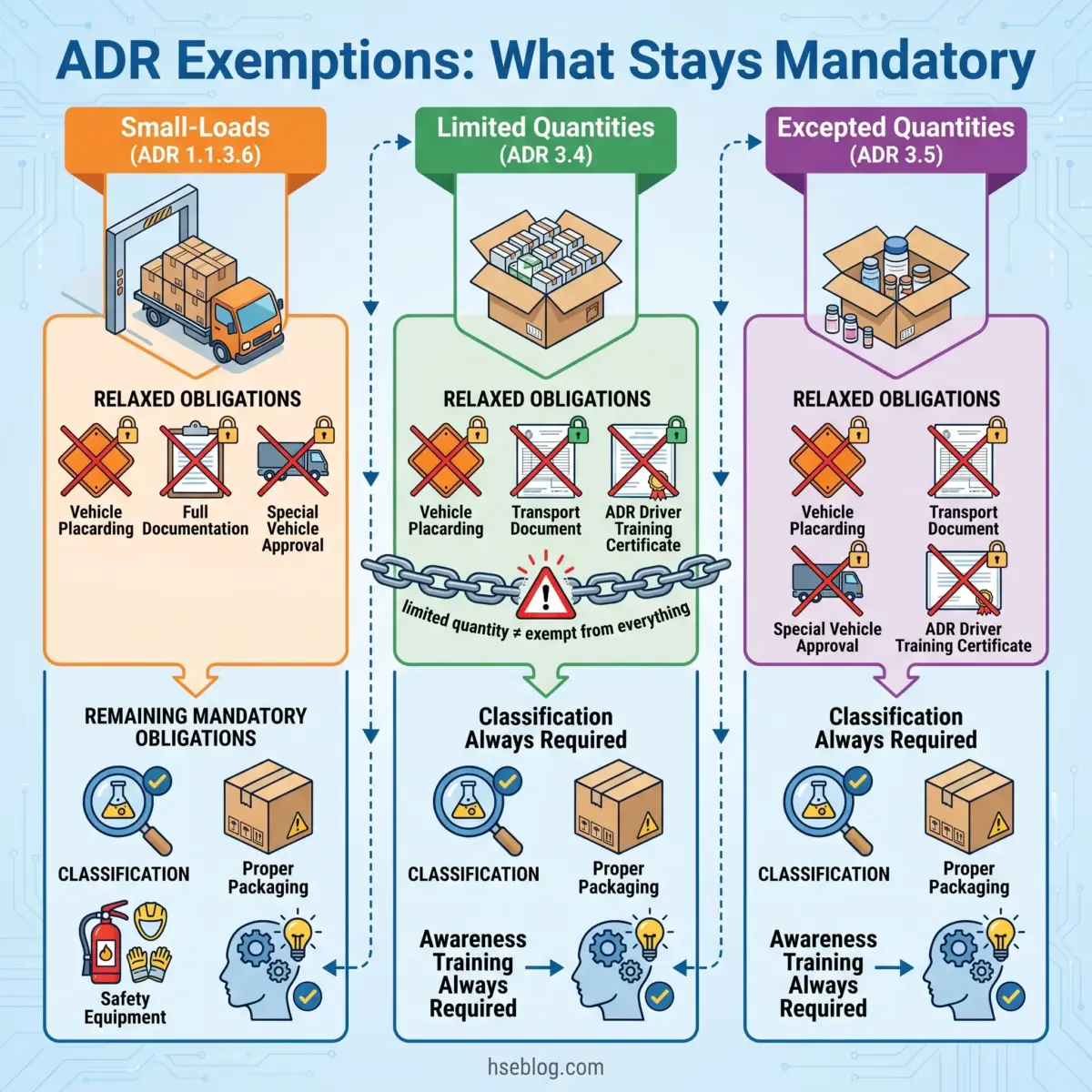
This is where the most consequential compliance errors occur. ADR provides several exemption pathways, each relaxing specific obligations while keeping others fully in force. Treating any exemption as a blanket release from all ADR requirements is the single most common — and most dangerous — misunderstanding in dangerous goods transport.
General exemptions under ADR 1.1.3 cover specific situations where ADR's full requirements do not apply. These include transport by private individuals for personal use, carriage ancillary to the undertaking's main activity (limited to 450 litres per packaging, not exceeding small-load thresholds), machinery or equipment containing dangerous goods as integral components, transport by emergency services, and empty uncleaned packagings that previously contained dangerous goods (ADR 1.1.3.5).
The small-loads exemption (ADR 1.1.3.6) applies when the total quantity on a transport unit falls below the threshold determined by transport categories, as described above. This exemption relaxes requirements for vehicle placarding, ADR vehicle certification, and — prior to ADR 2025 — the driver's ADR training certificate. However, packaging, package labelling, awareness training under ADR 1.3, and fire extinguisher requirements remain mandatory. The HSE guidance on ADR and CDG Regulations provides detailed GB-specific interpretation of how these thresholds apply.
Limited quantities (ADR 3.4) apply to dangerous goods packed in small inner packagings within retail-type combination packaging. The threshold is determined by the maximum inner-packaging size specified in Column 7a of Table A — not by the total quantity on the vehicle. Packages must carry the LQ diamond mark. Limited-quantity consignments are exempt from most vehicle marking, documentation, and crew training requirements under the pre-2025 rules.
Excepted quantities (ADR 3.5) cover even smaller amounts, identified by an "E" code in Table A. These are subject to fewer requirements still, but classification and marking remain mandatory.
The critical misconception — and I encounter this interpretation repeatedly across different operational contexts — is the belief that "limited quantity" means "exempt from everything." It does not. Classification must still be correct. Inner-packaging limits must be respected. The LQ diamond must be applied. Awareness training under ADR 1.3 is still required for all personnel. And under ADR 2025, drivers carrying limited-quantity loads now need training certificates. The phrase "We're exempt — it's only limited quantities" should trigger an immediate compliance review.
Who Needs an ADR Driver Training Certificate?
ADR Chapter 8.2 establishes a two-tier system for personnel competence. The first tier — the ADR Driver Training Certificate — applies to drivers of vehicles carrying dangerous goods above the small-load thresholds or in tanks. The second tier — awareness training under ADR 1.3 — applies to everyone else involved in dangerous goods transport: packers, loaders, warehouse staff, and office personnel with dangerous goods responsibilities.
The ADR Driver Training Certificate covers a basic course (for packaged goods), with optional specialisations for tank transport and class-specific modules for Class 1 (explosives) and Class 7 (radioactive material). Certificates are valid for five years, renewable through a refresher course taken in the final year before expiry. All contracting parties mutually recognise each other's certificates — a driver certified in one country can operate across all 55 contracting party states.
ADR 2025 introduced a significant expansion. Under the new ADR 8.2.3, training certificates are now mandatory for vehicle crews involved in limited-quantity carriage. Before this change, limited-quantity drivers could operate without formal ADR certification. The operational impact is substantial: fleets that previously carried LQ loads without certified drivers now need to budget for training, schedule courses, and maintain certificate records. The UK Government guide to ADR driver qualification provides practical guidance on training routes and certification.
Awareness training under ADR 1.3 has no prescribed accreditation for the training provider — but it must be appropriate to the person's responsibilities, cover the general hazards of dangerous goods, and be refreshed periodically. The absence of a formal accreditation requirement does not mean the training can be informal or cursory. Competent authorities expect documented evidence that training has been delivered, understood, and recorded.
What Is a Dangerous Goods Safety Adviser (DGSA)?
Under ADR 1.8.3, any undertaking involved in the carriage of dangerous goods — as carrier, packer, filler, loader, or unloader — must appoint a Dangerous Goods Safety Adviser. The DGSA must hold a vocational training certificate obtained through examination, valid for five years.
The DGSA's duties include monitoring compliance with ADR requirements, advising on procedures, preparing the annual report required under ADR 1.8.3.3, and investigating incidents involving dangerous goods. The role can be filled by an employee or an external consultant, and one DGSA can serve multiple undertakings.
Exemptions under ADR 1.8.3.2 exist for undertakings whose dangerous goods activities are limited to small loads in transport category 3 only (packages, not exceeding thresholds) or where dangerous goods transport is neither the main nor the ancillary activity of the business. However, these exemptions are narrower than many operators assume.
The DGSA appointment question is where small and medium-sized enterprises frequently miscalculate. A construction firm taking gas cylinders, adhesives, and diesel to site may consider dangerous goods transport incidental to its main activity. That assessment may hold — until volumes exceed the small-load thresholds, at which point the exemption from DGSA appointment may no longer apply. The HSE guidance on DGSA requirements explains how GB-specific exemptions under the CDG Regulations interact with the international ADR requirements. Operators undertaking international carriage should note that GB domestic exemptions do not apply once the shipment crosses a border.
ADR Documentation, Labelling, and Vehicle Marking Requirements
Every consignment of dangerous goods under full ADR compliance requires a chain of documentation, marking, and labelling that connects the substance to every handler from origin to destination.
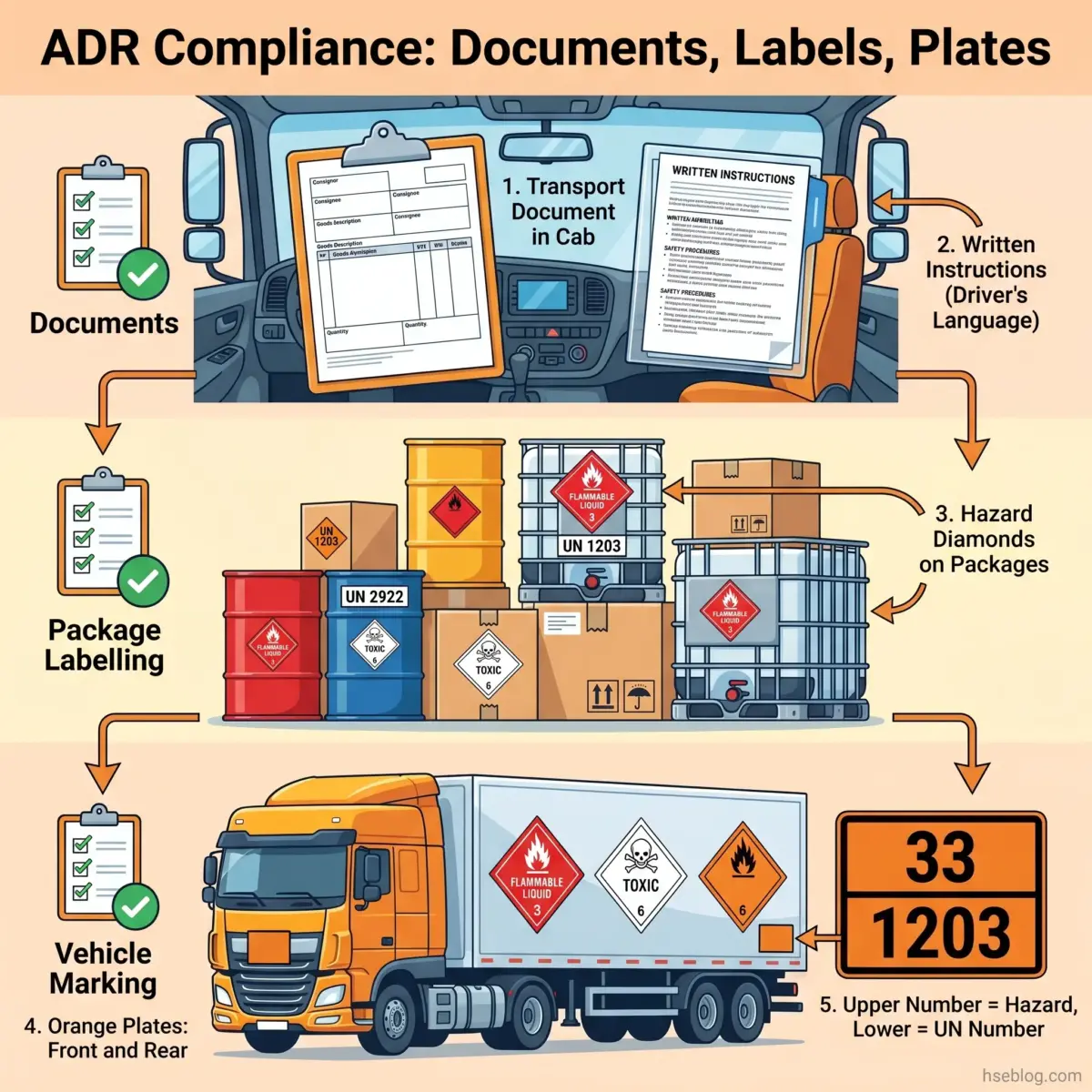
The transport document (ADR 5.4.1) must include the UN number prefixed with "UN," the proper shipping name, the hazard class and subsidiary risk (if any), the packing group, the total quantity, the sender and consignee details, and a signed declaration that the goods are offered for transport in accordance with ADR. Written instructions — standardised four-page documents in a language the driver can read — must be available in the cab (ADR 5.4.3).
ADR 2025 introduced a change that sounds administrative but creates a genuine operational shift: transport documents must now be carried in the driver's cab rather than attached to packages. Shippers who previously attached paperwork to pallets or shrink-wrapped loads now need a reliable process to get copies into the cab before departure. This requires coordination between warehouse and dispatch functions that did not previously exist in many operations.
Package labelling follows a precise system. Hazard class diamonds (minimum 10cm × 10cm) identify the primary and subsidiary hazards. The UN number, preceded by "UN," appears on the package. Handling labels for liquids and orientation arrows indicate correct positioning.
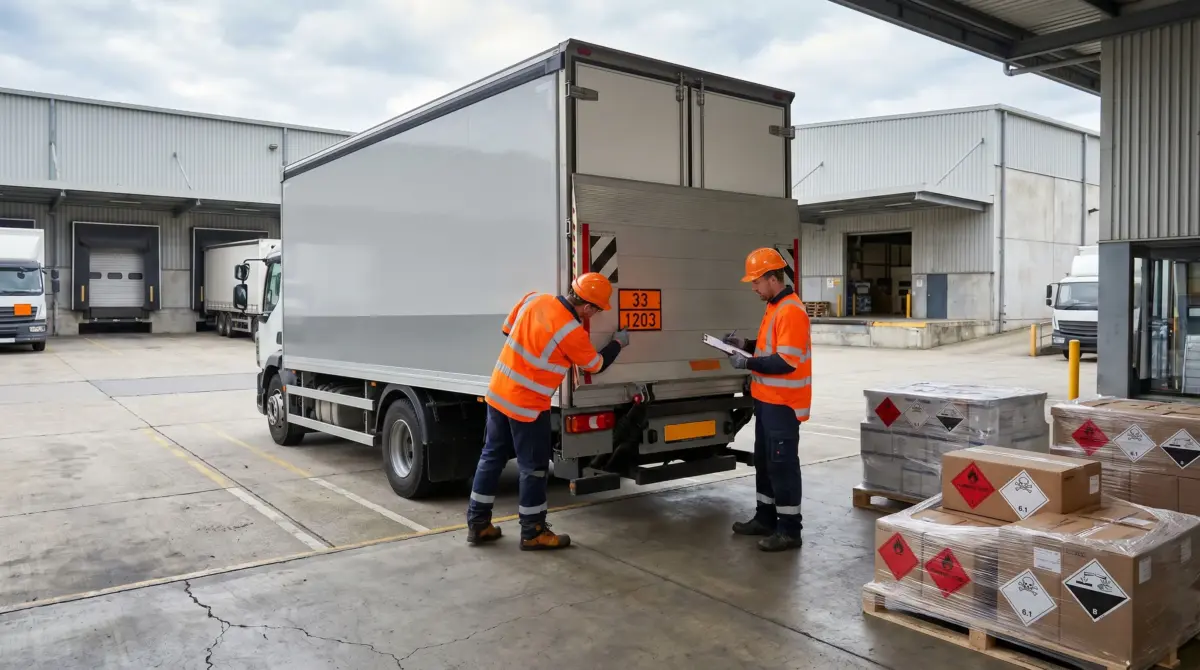
Vehicle marking operates on two levels. Orange plates — rectangular, reflective, with black borders — are displayed front and rear. A plain orange plate (no numbers) indicates a mixed load below the substance-specific placarding threshold. A numbered plate displays the Kemler hazard identification code in the upper half and the UN substance number in the lower half. The Kemler code communicates the hazard type: 33 indicates a highly flammable liquid, an "X" prefix means the substance reacts dangerously with water.
Tunnel restriction codes (A through E) assigned to each substance determine which road tunnels the vehicle may enter. Code A permits all tunnels; Code E prohibits virtually all. Route planning for dangerous goods vehicles must account for these restrictions — a detail that catches out operators unfamiliar with the system.
What Changed in ADR 2025? Key Updates Now in Force
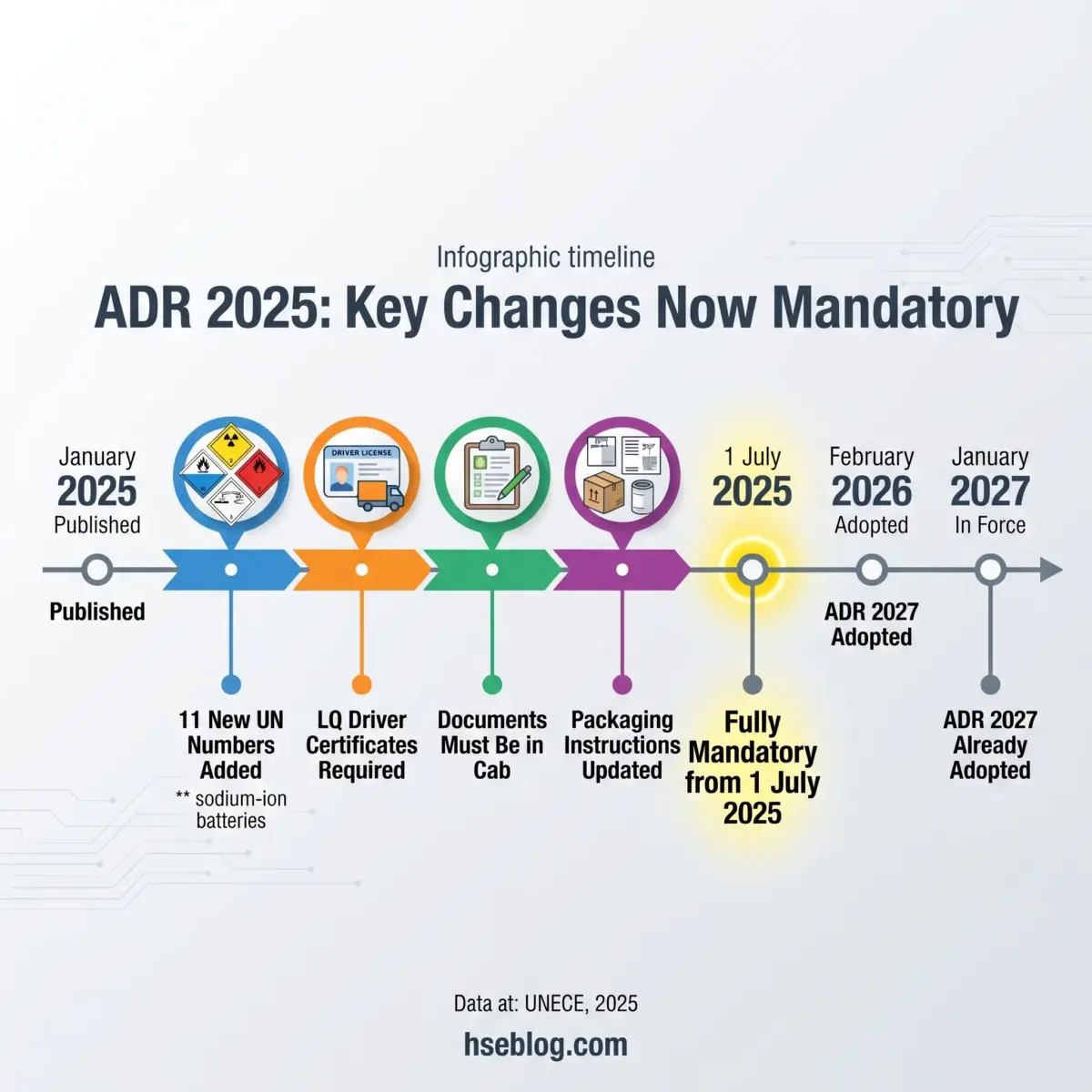
ADR 2025 became fully mandatory on 1 July 2025, ending the six-month transition period from ADR 2023 (UNECE, 2025). The Irish HSA summary of ADR 2025 changes provides a regulatory-grade overview of the amendments. The most operationally significant changes fall into four areas.
Classification. ADR 2025 introduced 11 new UN numbers (multiple sources, 2025), most notably UN 3551, UN 3552, and UN 3558 for sodium-ion batteries and sodium-ion battery-powered equipment — reflecting the growth of alternative battery technologies beyond lithium-ion. The reclassification threshold for butadiene mixtures (UN 1010) was lowered from 40% to 20%, bringing more formulations into regulated territory. The "S" and "T" subdivisions for explosives now include objects, not just substances.
Training. ADR 8.2.3 now requires driver training certificates for vehicle crews carrying limited-quantity consignments. This is the single most impactful change for operators who previously relied on the limited-quantity pathway to avoid formal driver certification.
Documentation. Transport documents must now be carried in the driver's cab (ADR 8.1), formalising a practice that was already standard on well-managed operations but was not universally enforced.
Packaging. A new packaging instruction, P303, applies to sodium salt of trifluoromethyltetrazole. A new provision, AP12, permits bulk carriage of asbestos waste in container-bags under specified conditions.
Looking ahead, UNECE Working Party WP.15 adopted the consolidated amendments for ADR 2027 (document ECE/TRANS/WP.15/274) in February 2026. These will enter into force on 1 January 2027, with the usual six-month transition. The sodium-ion battery provisions signal that ADR is tracking technology adoption closely — operators involved in electric vehicle and alternative energy logistics should expect continued regulatory expansion.
How ADR Relates to Other Dangerous Goods Transport Regulations
ADR does not exist in isolation. It is one component of a global system built from the UN Recommendations on the Transport of Dangerous Goods — commonly called the Model Regulations. The Model Regulations provide the parent classification system, UN number assignments, and packing group framework. Each transport mode then implements this framework through its own regulation: ADR for road, RID (under COTIF/OTIF) for rail, the IMDG Code (under IMO) for sea, and the ICAO Technical Instructions (supplemented by the IATA Dangerous Goods Regulations) for air.
EU Directive 2008/68/EC ties three of these together for EU member states by applying ADR (Annex I for road), RID (Annex II for rail), and ADN (Annex III for inland waterways) to domestic transport. The UK's CDG Regulations 2009 serve the same function for Great Britain, with separate regulations applying in Northern Ireland.
The intermodal alignment is a practical advantage. A consignment properly classified and packaged under ADR is already substantially compliant for sea or rail transport — the classification, UN numbers, and packing group assignments are identical. The differences emerge in packaging specifications (maritime stowage requirements, for instance), quantity limits (air transport imposes far stricter limits), operational procedures (sea segregation tables have no direct ADR equivalent), and documentation format. In my assessment, understanding ADR thoroughly gets an operator roughly 80% of the way to multimodal compliance — but the remaining 20% is precisely where errors cluster, because operators assume the alignment is complete when it is not.
Operators crossing between modes should verify the specific modal regulation's requirements for each consignment. The proper shipping name, UN number, and packing group will be the same — the conditions of carriage will not.
Frequently Asked Questions
How many countries are signed up to ADR?
As of 2025, 55 states are contracting parties to the ADR agreement (UNECE, 2025). These include all EU member states plus countries across Central Asia, North Africa, and the Caucasus. The 2020 removal of "European" from the agreement's working title reflects this broader membership. New accessions are processed through the UN Secretary-General, and the contracting party count has grown steadily since the treaty entered into force in 1968.
Do I need an ADR certificate to carry diesel in a van?
That depends on the quantity and whether an exemption applies. Diesel (UN 1202, transport category 3) may be carried below the ADR 1.1.3.6 small-load threshold without a driver training certificate — but awareness training under ADR 1.3, correct packaging, and a fire extinguisher remain mandatory. Under ADR 2025, if the diesel is carried as a limited-quantity consignment, driver training certificates are now required under ADR 8.2.3. Check both the quantity thresholds and the specific exemption conditions before concluding certification is unnecessary.
What is the difference between ADR and CDG Regulations?
ADR is the international UNECE treaty governing dangerous goods road transport across 55 contracting parties. The CDG Regulations (Carriage of Dangerous Goods and Use of Transportable Pressure Equipment Regulations 2009) are UK/GB domestic legislation that gives ADR legal force in Great Britain. The CDG Regulations include GB-specific exemptions and derogations that do not apply to international carriage. Operators crossing borders from GB must comply with the full ADR requirements, not just the domestic CDG provisions.
How often is ADR updated?
ADR is revised biennially — every two years, with odd-year editions (2023, 2025, 2027). Each new edition enters into force on 1 January, with a six-month transition period during which the previous edition may still be applied. From 1 July, the new edition becomes the only version in force. UNECE Working Party WP.15 adopted the ADR 2027 amendments in February 2026, and these will enter into force on 1 January 2027.
What happens if you transport dangerous goods without ADR compliance?
Penalties vary by jurisdiction but consequences are severe. They can include fines, vehicle immobilisation at roadside checks, seizure and confiscation of the consignment, loss of operator licence through the good-repute assessment under EU Regulation 1071/2009, and criminal prosecution for serious infringements. EU Directive 2025/1801 (EU, 2025) now categorises ADR infringements by severity — most serious, very serious, and serious — providing a standardised enforcement framework across member states.
Can lithium batteries be shipped under ADR exemptions?
Small lithium batteries meeting the criteria in UN 3481 (lithium ion, packed with equipment) or UN 3091 (lithium metal, packed with equipment) may qualify for limited-quantity or special provision exemptions — notably Special Provision 188, which sets cell and battery energy thresholds. Larger batteries, damaged or defective batteries, and prototype batteries require full ADR compliance, including specific packaging instructions. ADR 2025 also introduced new UN numbers for sodium-ion batteries (UN 3551, 3552, 3558), with a recommended — but not yet mandatory — 30% state-of-charge cap during transport.
Conclusion
ADR is evolving in response to the materials the global economy now moves. The introduction of sodium-ion battery classifications in ADR 2025, the expansion of driver training to limited-quantity carriage, and the cab-document requirement are not isolated administrative updates — they reflect a regulatory system actively keeping pace with changing supply chains. With ADR 2027 amendments already adopted by WP.15 and entering force in January 2027, the biennial revision cycle ensures that gaps between new technologies and their regulatory frameworks stay narrow.
For operators, the practical takeaway is that ADR compliance is not a one-time achievement. The exemption framework, while generous in scope, demands careful application — transport categories must be calculated correctly, limited-quantity obligations understood fully, and DGSA appointment thresholds honestly assessed. The most common failures in dangerous goods transport compliance are not caused by wilful disregard but by outdated assumptions: that the previous edition still applies, that limited quantities mean total exemption, or that a small fleet carrying gas cylinders and fuel falls outside ADR's reach.
The system works when the people operating within it understand its architecture. Classification drives everything downstream — packaging, labelling, documentation, vehicle requirements, driver qualifications. Get the classification right, follow the row in Table A, and the rest of the ADR framework becomes navigable. That structural understanding is what separates compliant operations from those operating on assumptions that stopped being correct two revision cycles ago.