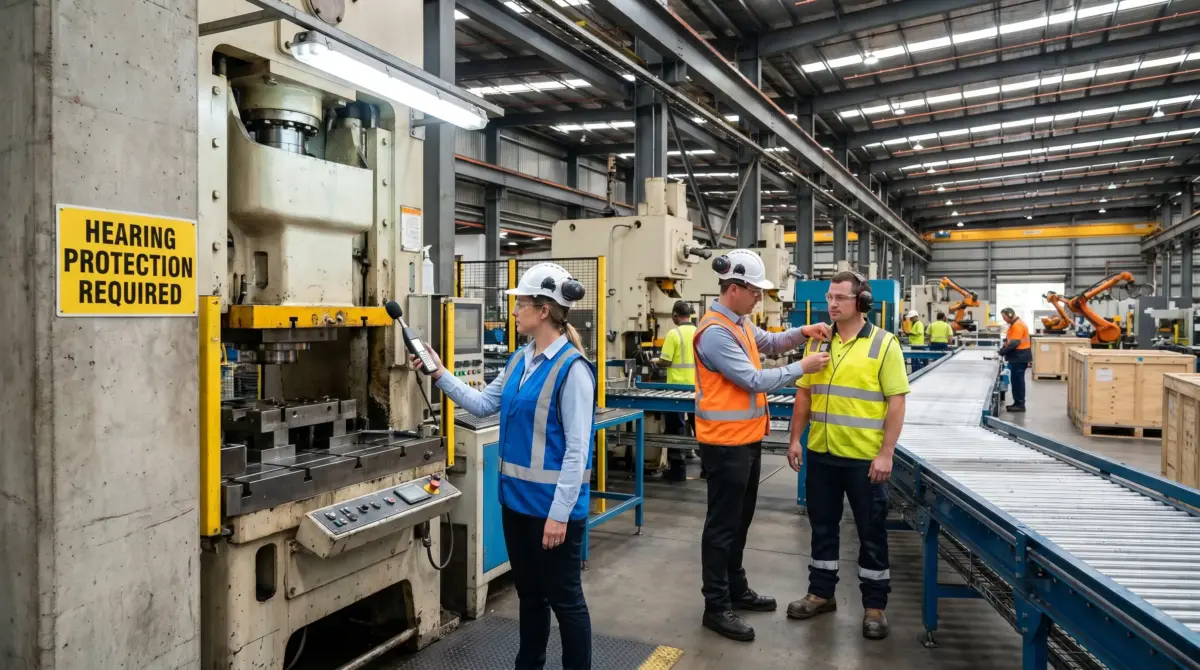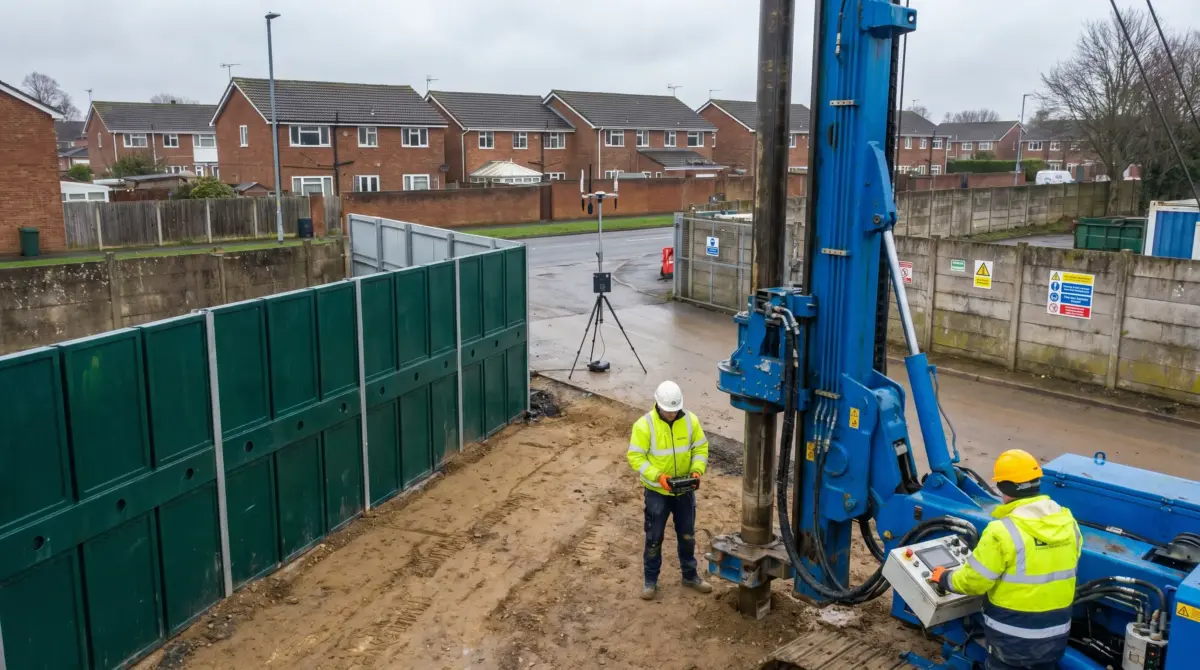
Noise control during piling works requires a three-pronged approach: engineering controls that select the quietest geotechnically feasible piling method, pathway controls using acoustic barriers and equipment shrouds, and occupational health measures including hearing conservation programs, real-time noise monitoring, and administrative scheduling. Effective control aligns these measures with jurisdiction-specific regulatory frameworks — BS 5228 (UK), OSHA 29 CFR 1926.52 (US), or EU Directive 2003/10/EC — and ties each to defined trigger levels and corrective actions within a formal noise management plan.
This article provides general HSE knowledge. Life-critical work such as piling noise assessment, hearing conservation program design, and occupational noise exposure monitoring must be planned and supervised by a competent person with relevant training, jurisdiction-specific authorization, and site-specific risk assessment. The information here does not replace that. For formal qualifications, readers should consider NEBOSH, IOSH, or OSHA outreach training pathways in occupational health and noise management.
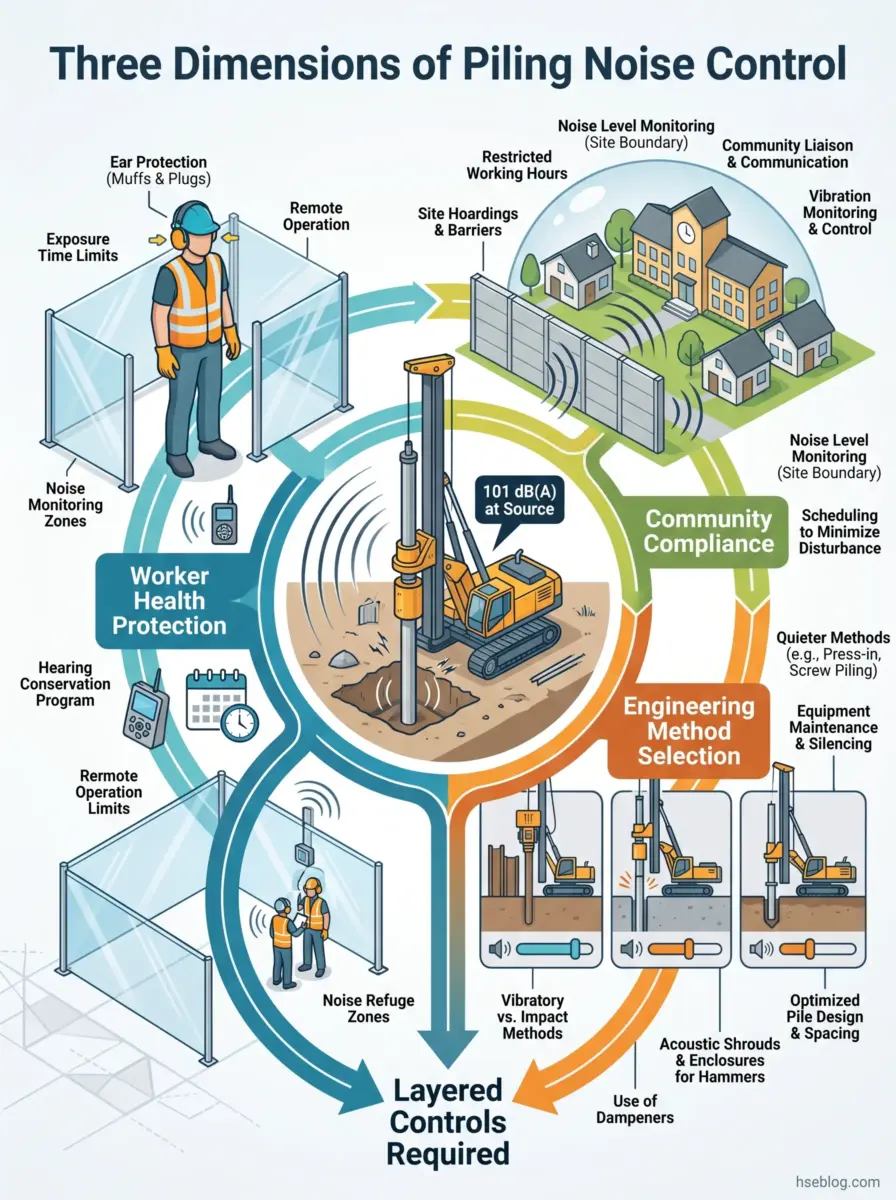
Impact pile drivers produce approximately 101 dB(A) at reference distance — the highest noise level among all common construction equipment categories (Environmental Noise Control / FHWA Construction Noise Handbook, 2025). That figure sits above the threshold for pain and well beyond every occupational exposure limit in force globally, yet it represents only one component of the noise problem piling creates.
The consequences extend across three dimensions that most guidance treats separately. Workers on the piling crew face noise-induced hearing loss — construction has the highest five-year hearing loss incidence at 9% among major industry sectors (Masterson & Themann, NIOSH, 2024). Communities near the site face sustained disturbance that triggers enforcement action when noise conditions are breached. And the project itself faces delays and cost escalation when noise complaints force unplanned method changes. This article addresses all three dimensions in a single resource, covering engineering method selection, regulatory compliance across UK, US, and EU frameworks, worker health protection, acoustic barrier performance, real-time monitoring, and community engagement — with practitioner-level interpretation of when each control measure works and when it fails.
Why Piling Works Are One of Construction's Loudest Operations
Impact pile driving regularly generates noise levels between 95 and 120 dB(A) at 10 metres — louder than a chainsaw and well above every occupational exposure limit in force anywhere in the world. What makes piling uniquely difficult to control is the dual-source nature of the noise it produces.
The first source is the point-source impact at the hammer-anvil interface, where each blow generates an intense, impulsive sound pulse. The second is the line-source resonance that radiates along the pile shaft itself, particularly with steel piles, where the entire length of the pile acts as a vibrating column transmitting sound outward.
This dual mechanism is why piling noise is harder to attenuate than noise from most other construction equipment. Wrapping an enclosure around the hammer addresses the impact source, but the pile shaft continues to radiate.
Noise Levels by Piling Method
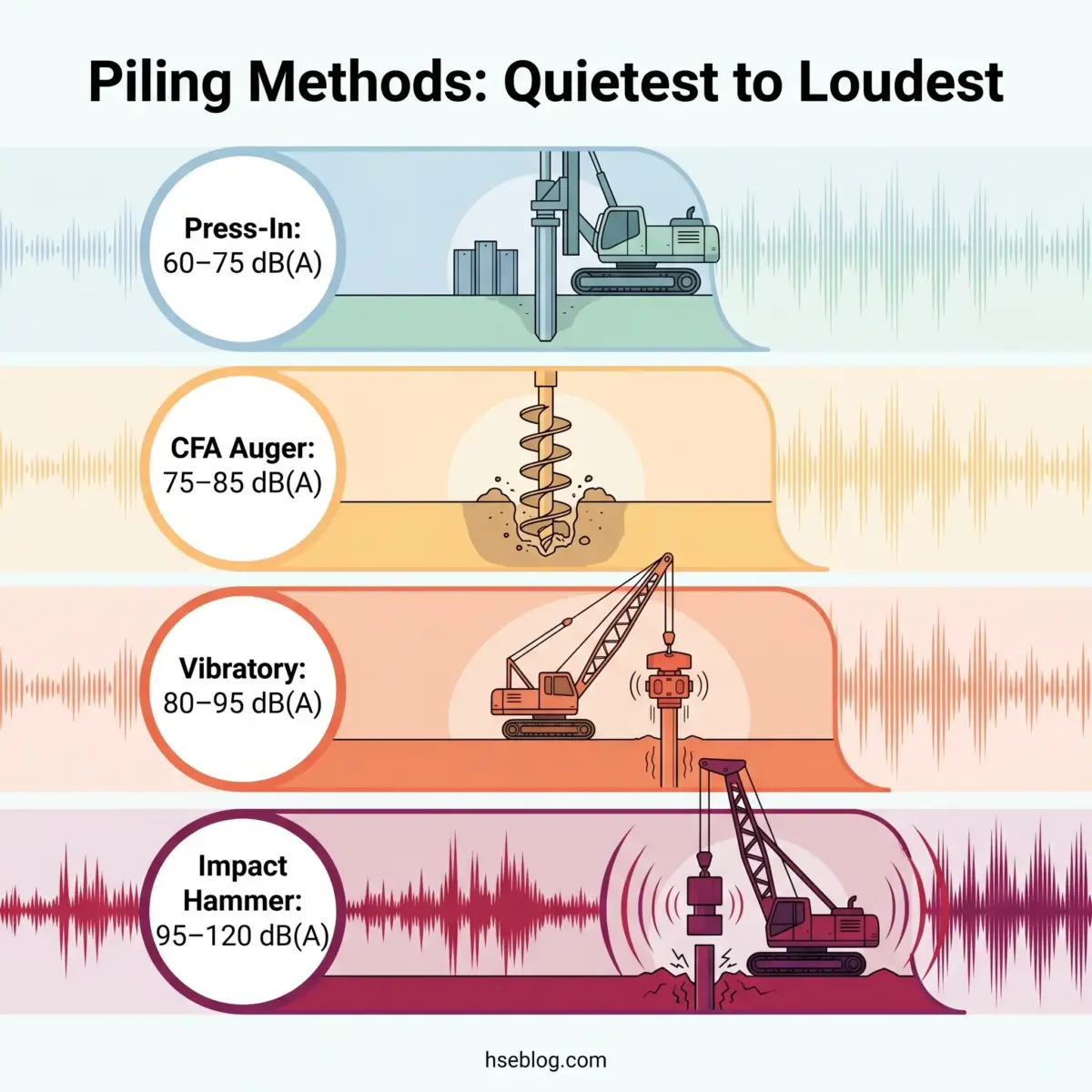
Real-world noise varies significantly depending on the piling method selected, the ground conditions, and the pile material. The following table presents typical ranges — but a critical practitioner observation applies: published manufacturer dB(A) figures consistently understate real-world noise, particularly in hard ground conditions or reflective urban environments where readings can exceed rated levels by 10–15 dB(A).
| Piling Method | Typical dB(A) at 10m | Best Suited For | Key Limitation |
|---|---|---|---|
| Impact hammer | 95–120 | High-capacity bearing piles, hard ground | Highest noise and vibration levels |
| Vibratory hammer | 80–95 | Sheet piles, granular soils | Resonance risk in certain soils; still significant noise |
| CFA (continuous flight auger) | 75–85 | Urban sites, cohesive soils | Limited pile length and load capacity |
| Hydraulic press-in (silent piling) | 60–75 | Sheet piles in soft-to-medium soils | Needs starter piles; unsuitable for very hard ground without augering |
Steel piles produce significantly more noise than concrete piles of comparable size due to their resonant properties. The distinction between airborne noise (affecting workers and nearby communities) and ground-borne vibration (affecting building structures) is also critical — they are related phenomena but require different control strategies.
Regulatory Framework for Piling Noise Control
The gap that most commonly catches projects off guard is that worker-exposure limits and community noise limits operate on entirely different measurement bases. A project can be fully compliant with occupational exposure rules while simultaneously breaching an environmental noise condition imposed by the local planning authority.
Understanding which framework applies — and where thresholds conflict — is the foundation for any credible noise management plan.
UK Framework
BS 5228-1:2009+A1:2014 (UK) is the primary code of practice for noise control on construction and open sites. It provides noise prediction methodology, equipment-specific noise data — including piling equipment in Annexes C and D — and the ABC assessment method for determining significance of impact relative to ambient noise levels.
The Control of Pollution Act 1974 (UK) provides the enforcement mechanism:
- Section 60 empowers local authorities to impose noise controls on construction works, including specifying hours, equipment, and methods.
- Section 61 enables contractors to apply for prior consent before works begin, agreeing noise levels, working hours, and Best Practicable Means (BPM) measures in advance.
US Framework
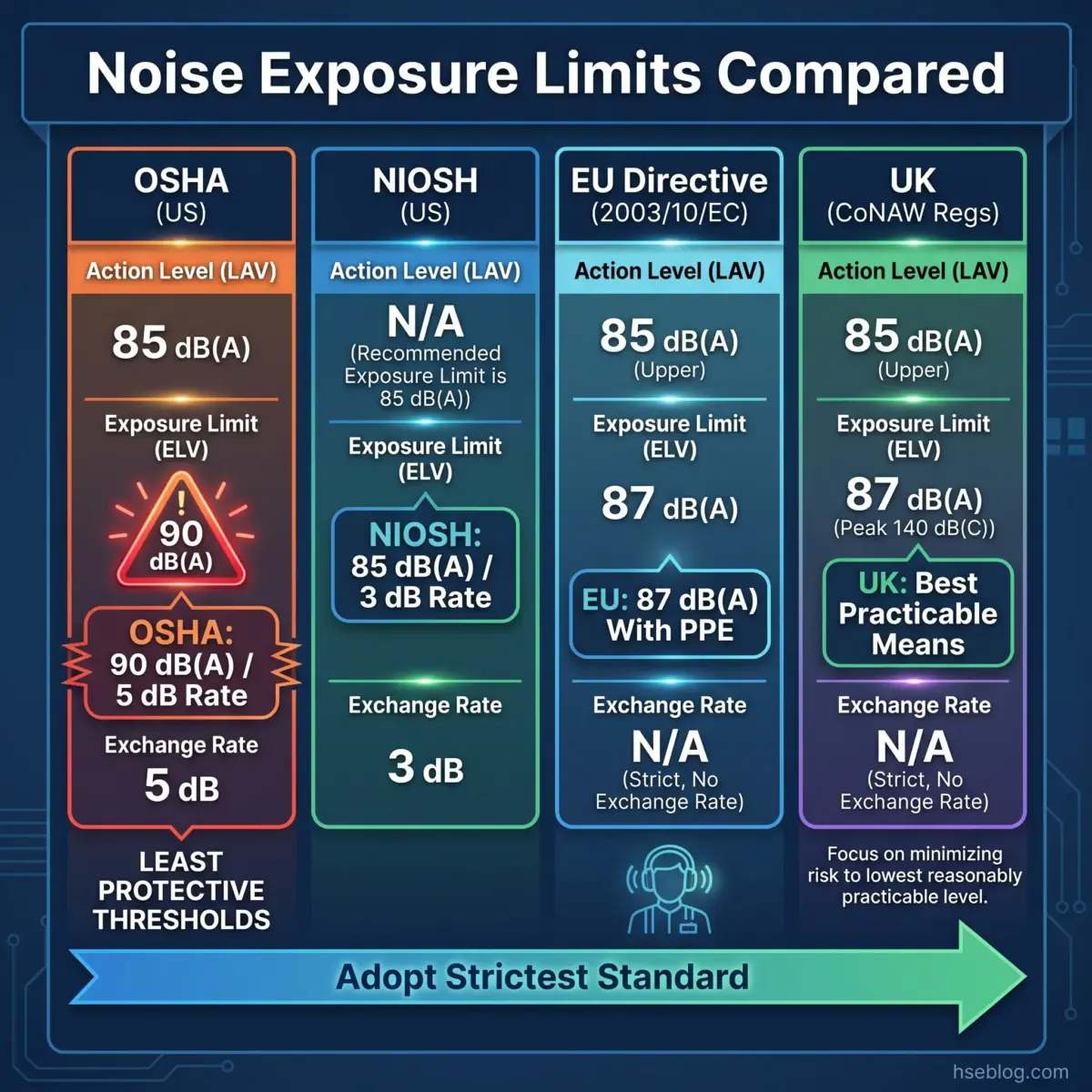
OSHA 29 CFR 1926.52 (US) sets a permissible exposure limit (PEL) of 90 dB(A) TWA over 8 hours with a 5 dB exchange rate. The hearing conservation program trigger sits at 85 dB(A) TWA.
NIOSH's recommended exposure limit (REL) is more protective: 85 dB(A) TWA with a 3 dB exchange rate. The NIOSH threshold is scientifically stronger — the 3 dB exchange rate reflects the equal-energy principle, meaning every 3 dB increase halves the permissible exposure time. Many employers adopt the NIOSH standard as a best-practice target even where OSHA's limit is the legal minimum.
EU Framework
EU Directive 2003/10/EC establishes a three-tier system:
- 80 dB(A) daily — lower exposure action value: make hearing protection available, provide information and training.
- 85 dB(A) daily — upper action value: hearing protection mandatory, noise reduction program required, hearing zones designated, health surveillance initiated.
- 87 dB(A) daily — exposure limit value: must not be exceeded, and this limit accounts for the attenuation provided by hearing protection.
Jurisdiction Comparison: Key Thresholds
| Threshold | OSHA (US) | NIOSH (US) | EU Directive 2003/10/EC | BS 5228 / UK |
|---|---|---|---|---|
| Action level | 85 dB(A) TWA | 85 dB(A) TWA | 80 dB(A) (lower) / 85 dB(A) (upper) | Site-specific via ABC method |
| Exposure limit | 90 dB(A) TWA | 85 dB(A) TWA (recommended) | 87 dB(A) (with PPE attenuation) | No single limit; BPM principle |
| Exchange rate | 5 dB | 3 dB | 3 dB | 3 dB (aligned with ISO) |
| Community noise | Local ordinances | — | Local transposition | S60/S61 + local authority conditions |
For international operations, adopting the stricter EU/NIOSH thresholds as the baseline standard is the practical recommendation. The OSHA 5 dB exchange rate is an outlier that materially underestimates cumulative exposure risk.
Section 61 Prior Consent: The UK's Pre-Approval Process
Section 61 of the Control of Pollution Act 1974 (UK) is the mechanism most directly relevant to piling projects in England and Wales. It is frequently misunderstood — and frequently underused.
The process works as follows:
- Apply to the local authority at least 28 days before works commence. The application must describe the proposed works, methods, hours, and the noise mitigation measures that constitute Best Practicable Means.
- The authority reviews and either grants consent (with or without conditions) or refuses within 28 days. If the authority does not respond within that window, consent is deemed granted.
- Consent conditions typically specify maximum noise levels at the nearest sensitive receptor, permitted working hours, required mitigation measures, and monitoring obligations.
- The legal protection is significant: a contractor operating within Section 61 consent conditions has a statutory defence against Section 60 enforcement. Without consent, the authority can impose restrictions unilaterally — often at the worst possible moment.
In practical terms, BPM does not mean "the quietest possible method regardless of cost." It means the method that achieves the best noise outcome that is reasonably practicable given technical feasibility, cost, and the operational requirements of the works. Auditors and local authority officers interpret this as a genuine balancing test, not a blank cheque for the noisiest option.
Engineering Controls: Selecting Quieter Piling Methods
The single highest-impact noise control decision on any piling project is made before a single pile is driven — when the piling method is selected. The difference between the loudest and quietest commercially available methods spans more than 40 dB(A), which represents a perceived noise reduction of more than 90%.
The common failure mode, however, is selecting a method based solely on noise performance without confirming geotechnical suitability. Ranking from quietest to loudest, with the trade-offs that actually govern method selection:
- Hydraulic press-in (silent piling) — 60–75 dB(A) at 10m. Giken-type machines press piles into the ground using reaction force from previously installed piles. Virtually eliminates impact noise. Limitations: requires starter piles (which may need a different, noisier method), unsuitable for very hard ground without augering assistance, higher cost per metre, and generally limited to sheet piles and certain tubular pile types.
- CFA (continuous flight auger) piling — 75–85 dB(A) at 10m. No hammering at all — the auger drills to depth, then concrete is pumped as the auger is withdrawn. Well suited to urban sites and cohesive soils. Limitations: restricted pile lengths compared to driven piles, lower load capacity for high-rise foundations, and unsuitable for sites requiring driven steel sections.
- Vibratory pile driving — 80–95 dB(A) at 10m. Faster installation than impact driving with lower noise. Limitations: resonance risk in certain soil conditions can amplify ground-borne vibration, potentially damaging adjacent structures — trading a noise problem for a vibration problem.
- Impact pile driving with noise-reducing modifications — 95–120 dB(A) at 10m. Cushioned pile caps, reduced drop height, and controlled blow energy can lower output by 5–10 dB(A) from unmodified operation. Pre-augering or pre-drilling reduces ground resistance and therefore the hammer energy needed per blow.
The judgment call here is between accepting an intermediate-noise method that is geotechnically certain from the start versus specifying the quietest method and risking a mid-project method change when ground conditions defeat it. In most operational contexts, the balance favours the method with confirmed geotechnical suitability — because an unplanned switch from silent piling to impact driving mid-project generates more cumulative noise, more community complaints, and more cost than planning for an intermediate method from day one.
Acoustic Barriers and Shrouds for Piling Equipment
Even after the quietest feasible method has been selected, pathway controls between the noise source and receivers provide the next layer of reduction. Properly specified and installed, these measures achieve meaningful attenuation — but their real-world performance depends entirely on installation quality.
Acoustic barriers are frequently installed but then undermined by gaps — at joints, at ground level, or where site access gates are left open during piling. A barrier with a 200mm gap at the base can lose more than half its theoretical performance. Barrier effectiveness is only as good as its weakest point.
Temporary Site Acoustic Barriers
These are freestanding or scaffold-mounted panels positioned around the piling area perimeter. Performance characteristics:
- Achievable reduction: 10–15 dB(A) when properly installed with no gaps.
- Critical factors: Barrier mass (heavier panels attenuate more), height (must break the line of sight between source and receiver), and continuity (every gap degrades performance).
- Transparent acoustic panels are available where site visibility is needed for crane operations or traffic management — they maintain attenuation while allowing visual monitoring.
Equipment-Mounted Shrouds and Hammer Enclosures
These wrap around the impact zone and pile cap, addressing noise at the point of generation:
- Achievable reduction: 15–20+ dB(A) at source — significantly more effective than perimeter barriers alone.
- Design specificity: Each shroud must be designed or adapted for the specific hammer model and pile section in use; a generic enclosure that doesn't seal properly around the equipment provides minimal benefit.
Power Pack Acoustic Treatment
Diesel and hydraulic power packs are a significant secondary noise source that is frequently overlooked in piling noise assessments. Acoustic louvres and enclosures around power units can contribute measurable reductions — often 5–10 dB(A) — at relatively low cost.
The Layered Approach
The most effective noise control combines source-level shrouds with site-perimeter barriers for cumulative reduction. A shroud providing 15 dB(A) reduction at the hammer plus a perimeter barrier providing 10 dB(A) reduction at the site boundary does not yield a simple arithmetic 25 dB(A) total — acoustic physics means the combined effect is typically 15–20 dB(A) at the receptor — but the layered approach still significantly outperforms either measure alone.
What Does a Piling Noise Management Plan Include?
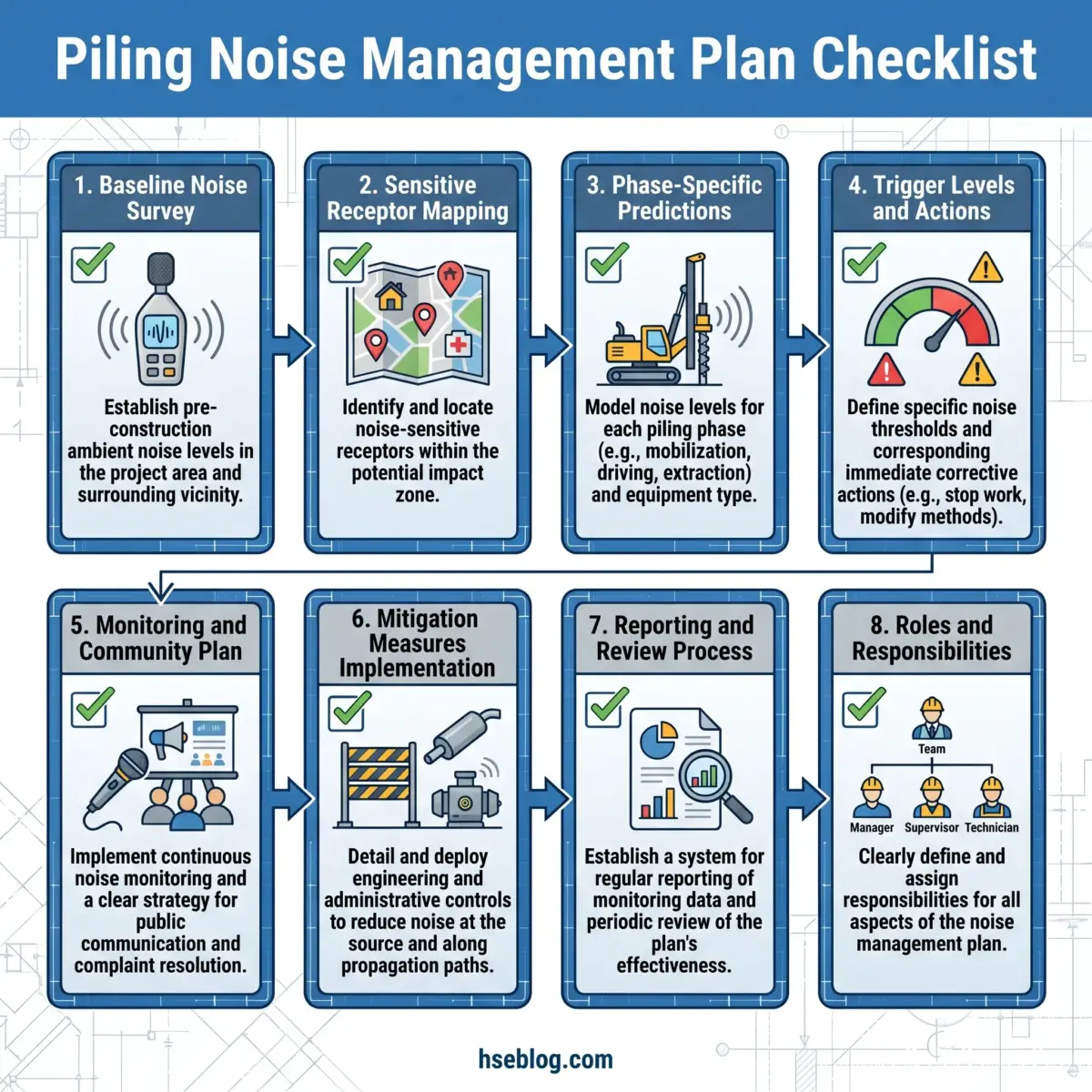
A noise management plan specific to piling operations must connect every predicted noise level to a defined corrective action. Plans that state "monitor noise and take action if levels are exceeded" without defining what action will be taken at what threshold are functionally useless — they satisfy a document requirement without providing operational guidance.
The essential components, tied to regulatory expectations under BS 5228 (UK), Section 61 consent applications, and local authority planning conditions:
- Baseline ambient noise survey — measured before works commence, at the nearest noise-sensitive receptors, to establish the reference against which piling noise will be assessed. Without a credible baseline, significance of impact cannot be determined using BS 5228's ABC method.
- Identification of noise-sensitive receptors — residential properties, schools, hospitals, care homes, and other sensitive premises, with measured distances from each piling location.
- Noise predictions for each piling phase — using equipment-specific source data from BS 5228-1 Annexes C and D (UK), corrected for distance, ground absorption, and barrier attenuation. Predictions must use realistic source levels, not manufacturer optimism.
- Proposed mitigation measures mapped to each phase — specifying which engineering controls, barriers, shrouds, and administrative measures apply during each stage of piling.
- Working hours restrictions — defining when high-noise piling activities will and will not take place, typically aligned with local authority conditions or Section 61 consent.
- Noise monitoring protocol — specifying monitor locations, measurement frequency, trigger levels (amber and red), and the specific corrective actions triggered at each level.
- Community engagement and complaints-handling process — pre-commencement notification, project contact details, complaint investigation timeline, and feedback loop.
- Roles and responsibilities — named individuals accountable for noise management decisions: site manager, environment manager, piling subcontractor supervisor, noise consultant.
Real-Time Noise Monitoring During Piling Operations
Continuous real-time monitoring has fundamentally changed how piling noise is managed on site. The shift from periodic manual measurements — a technician walking to the boundary with a handheld meter every few hours — to IoT-connected sound level meters with automated threshold alerts represents the most significant operational improvement in construction noise management over the past five years (multiple industry sources, 2025).
Equipment and Placement
Class 1 or Class 2 sound level meters are positioned at three strategic locations:
- Nearest noise-sensitive receptor facade — this is where compliance is ultimately judged.
- Site boundary — provides early warning before noise reaches receptor levels.
- Reference position near the source — correlates piling activity with measured noise, enabling identification of which operations are driving exceedances.
IoT-connected monitors transmit data via cellular or Wi-Fi to cloud dashboards, enabling remote oversight by the project environmental team, the noise consultant, and — where required by consent conditions — the local authority.
Trigger-Level Response System
The most effective approach uses a tiered alert system:
- Amber trigger (approaching the consent or planning limit) — review current operations, check barrier integrity, consider reducing hammer energy or switching to augering for the current section.
- Red trigger (at or exceeding the limit) — stop or immediately modify the piling operation, investigate the cause, implement additional controls before resuming.
Behavioural Impact
Real-time monitoring changes behaviour on site. When the piling crew can see a live dB(A) readout — mounted on a visible display near the rig — operators self-regulate. They adjust hammer energy, pause during residential quiet hours, or switch techniques for difficult sections without waiting for a manager's instruction.
The monitoring system works best when the feedback loop includes the operators, not just the project manager reviewing data after the shift. Data logging also builds the compliance evidence base that is essential for defending Section 61 consent conditions (UK) and for responding to community nuisance claims with documented measurements rather than assertions.
Protecting Workers from Piling Noise Exposure
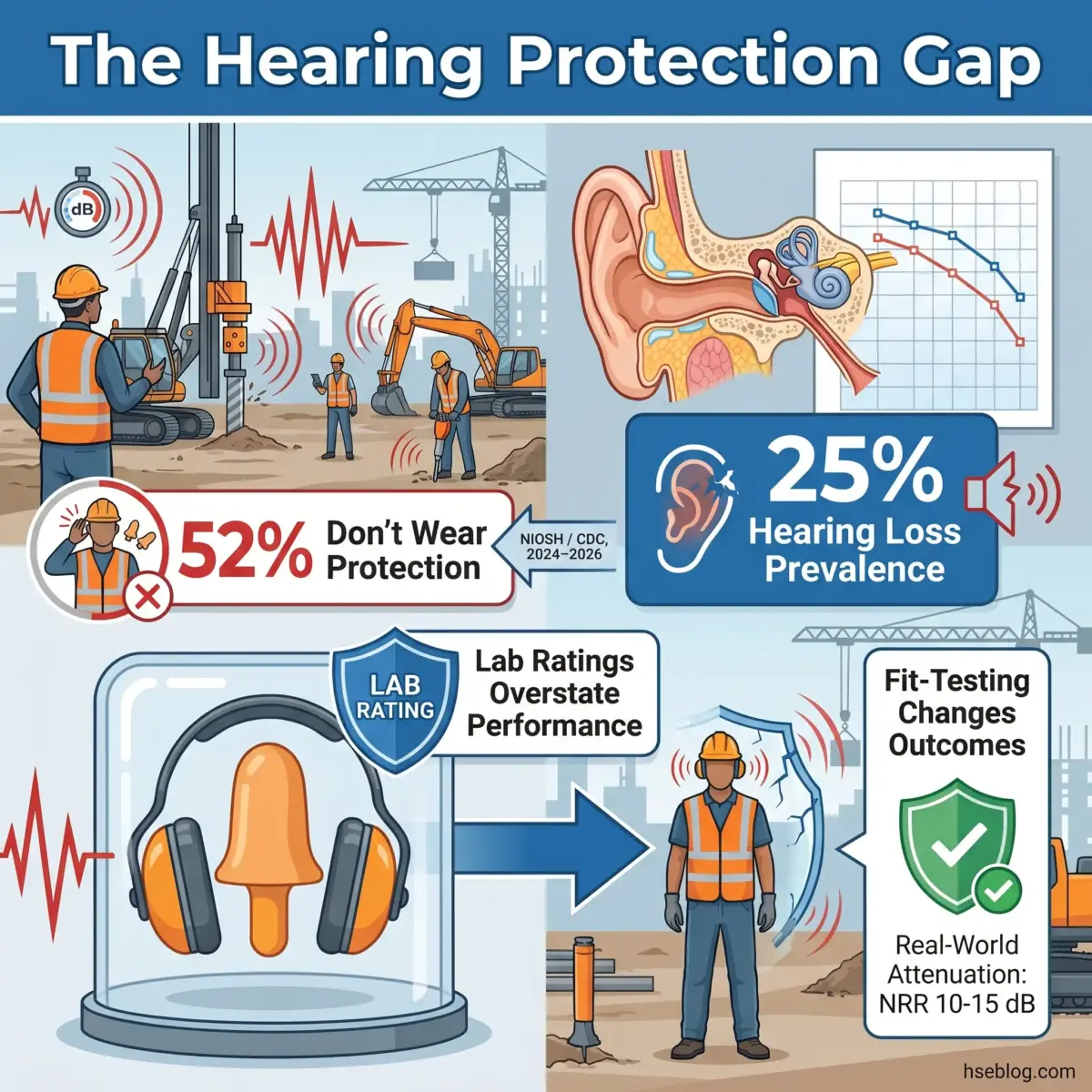
Approximately 13% of all US construction workers have hearing difficulty (NIOSH / CDC, 2026). Construction ranks among the top three sectors for prevalence of noise-induced hearing loss, with 25% of noise-exposed workers affected, and has the highest five-year hearing loss incidence at 9% among major industry sectors (Masterson & Themann, NIOSH, 2024). Piling crews sit at the extreme end of this exposure spectrum.
The misconception that providing hearing protection means workers are protected is one of the most persistent and dangerous gaps in occupational noise management. NIOSH data shows that 52% of noise-exposed construction workers report not wearing hearing protection (NIOSH / CDC, 2026). Fit-testing, comfort, availability of the correct NRR/SNR rating, and consistent supervisor enforcement matter more than the attenuation rating printed on the packaging.
Noise Exposure Calculation
A 110 dB(A) task limited to 30 minutes per day still contributes significantly to the daily dose when combined with other noisy tasks across the shift. Under the NIOSH 3 dB exchange rate, 110 dB(A) permits only approximately 1.5 minutes of unprotected exposure before the recommended daily limit is reached. Under OSHA's 5 dB exchange rate (US), the permissible time is longer — but still well under an hour.
Hearing Protection Selection
For impact pile driving, dual protection — properly fitted earplugs combined with earmuffs — may be necessary to achieve sufficient real-world attenuation. Key considerations:
- NRR/SNR derating: Laboratory ratings overstate field performance. NIOSH recommends derating NRR values by 50% for earmuffs and 50% for formable plugs to estimate real-world attenuation.
- Comfort and wearability: Protection that is uncomfortable or interferes with communication will be removed. Selection must balance attenuation with practical wearability across a full shift.
- Fit-testing: Individual ear canal geometry varies. Pre-formed plugs that seal well on one worker may provide minimal attenuation on another.
Hearing Conservation Program Requirements
Under OSHA 29 CFR 1926.52 (US), exposures at or above 85 dB(A) TWA trigger a hearing conservation program. EU Directive 2003/10/EC (EU) requires health surveillance at the upper action value of 85 dB(A). Given that piling routinely exceeds these thresholds, audiometric testing is effectively mandatory for piling crews under both frameworks.
Program elements include baseline audiometric testing before noise exposure begins, annual follow-up audiometry, training on noise hazards and correct use of hearing protection, and record retention for the duration required by the applicable jurisdiction.
The Overlooked Factor: Ototoxic Co-Exposure
Solvents, fuels, and certain chemicals commonly present on construction sites can compound noise-induced hearing damage through ototoxic interaction. NIOSH has identified this co-exposure risk, but most piling noise guidance ignores it entirely. Workers exposed to both high noise and ototoxic chemicals face accelerated hearing loss beyond what noise exposure alone would predict — a factor that should inform both exposure assessment and health surveillance frequency.
Community Engagement and Complaint Prevention
Projects that invest in community engagement before piling starts receive fewer complaints — not because the noise is lower, but because residents who understand why piling is needed, how long it will last, and who to call if it becomes intolerable are far less likely to escalate to the local authority. The relationship between proactive communication and successful Section 61 consent compliance (UK) is direct and well-documented.
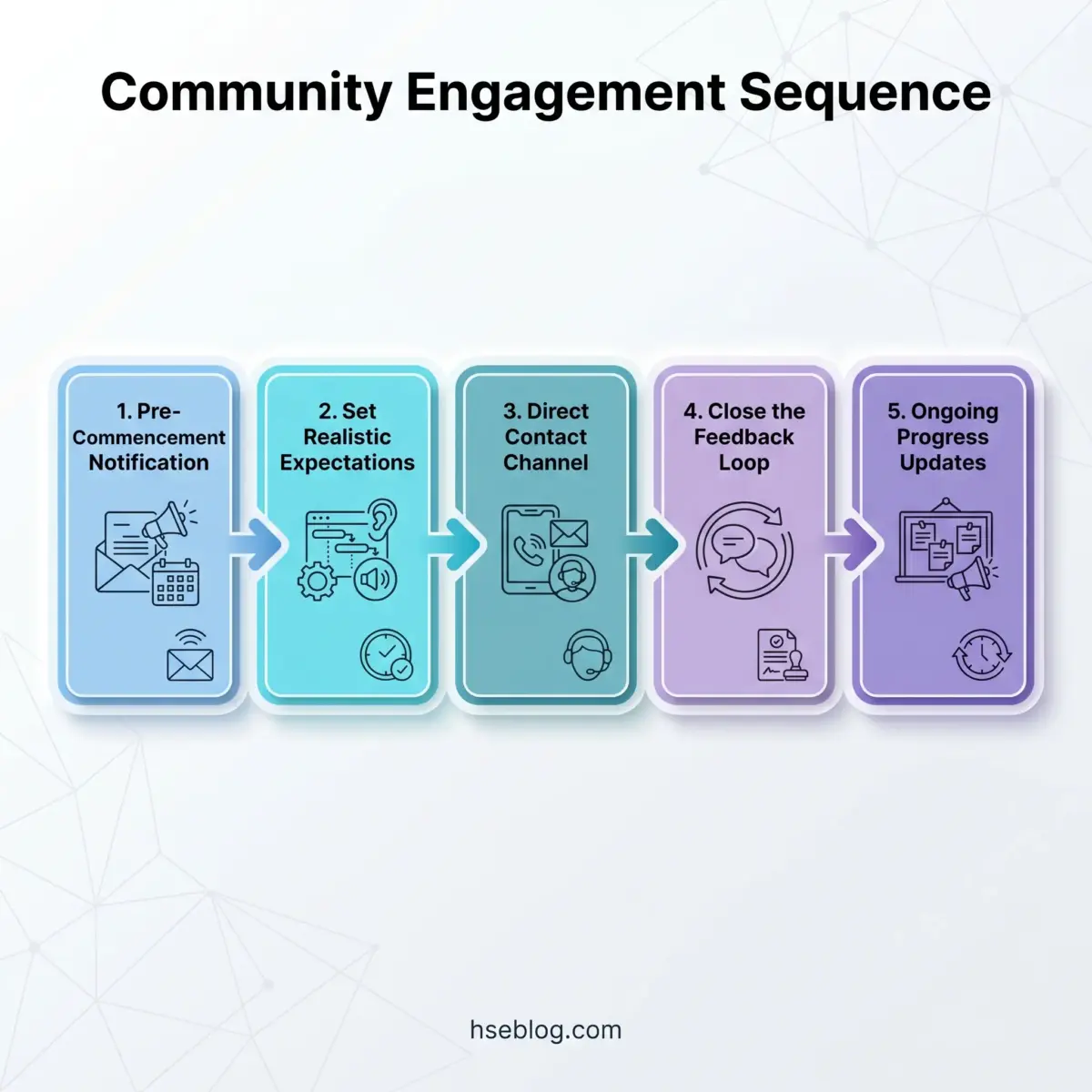
Effective community engagement for piling operations follows a structured sequence:
- Pre-commencement notification — letter drops to all properties within a defined radius (typically guided by the noise predictions), supplemented by community meetings for larger or longer-duration projects. The notification should state the piling start date, expected duration, working hours, and the noise reduction measures in place.
- Set realistic expectations — never promise "minimal disruption" for impact piling. Residents who were told the work would be barely noticeable and then experience 90+ dB(A) at their facade are the ones who file complaints. Honesty about what to expect builds more tolerance than optimism.
- Provide a direct contact — a project hotline or named individual, not a general contractor switchboard. Response time matters: complaints acknowledged within 24 hours and investigated within 48 hours prevent escalation.
- Close the feedback loop — when a complaint is received and investigated, report back to the complainant with what was found and what action was taken. The absence of follow-up is what converts a single complaint into sustained opposition.
- Maintain ongoing communication — weekly or fortnightly updates during active piling, especially if schedules change. If piling overruns its notified duration, communicate the revised timeline before residents discover it themselves.
Frequently Asked Questions
How loud is pile driving in decibels?
Impact pile driving typically generates 95–120 dB(A) at 10 metres, with vibratory methods producing 80–95 dB(A) and hydraulic press-in (silent piling) operating at 60–75 dB(A). Real-world readings in hard ground or acoustically reflective urban settings regularly exceed published manufacturer averages by 10–15 dB(A). As a rough rule, noise from a point source drops approximately 6 dB per doubling of distance.
Is there a legal noise limit for piling near residential areas?
No single universal limit exists. In the UK, limits are set through Section 61 consent conditions or local authority requirements, often assessed against BS 5228's ABC significance method. In the US, community noise limits are governed by local municipal ordinances — there is no federal construction noise standard for community impact. The applicable limit must always be confirmed with the local authority before piling begins.
What is the difference between OSHA and NIOSH noise exposure limits?
OSHA's permissible exposure limit under 29 CFR 1926.52 (US) is 90 dB(A) TWA with a 5 dB exchange rate, meaning permissible exposure time halves every 5 dB above 90. NIOSH's recommended exposure limit is 85 dB(A) TWA with a 3 dB exchange rate, which is substantially more protective because each 3 dB increase halves permissible time. The NIOSH standard reflects the equal-energy principle and is widely adopted as best practice even though OSHA's limit remains the legal requirement.
Can acoustic barriers really reduce piling noise?
Properly installed acoustic barriers achieve 10–15 dB(A) reduction at the receiver, and equipment-mounted shrouds can achieve 15–20+ dB(A) at source. Effectiveness depends on barrier mass, height relative to the source, and continuity — even small gaps at ground level or at panel joints can halve the barrier's theoretical performance. Combining source-level shrouds with perimeter barriers provides the best cumulative result.
How does silent piling work, and is it always an option?
Hydraulic press-in piling — the Giken-type method — works by using reaction force from previously installed piles to press the next pile into the ground, operating at 60–75 dB(A). It eliminates hammering entirely. However, it is not universally applicable: it requires starter piles installed by another method, struggles in very hard ground without augering assistance, costs more per metre than impact driving, and is generally limited to sheet piles and certain tubular sections.
Do piling workers need audiometric testing?
Under most regulatory frameworks, yes. OSHA 29 CFR 1926.52 (US) requires a hearing conservation program including baseline and annual audiometric testing when worker exposure reaches 85 dB(A) TWA. EU Directive 2003/10/EC requires health surveillance at the upper exposure action value of 85 dB(A). Since piling routinely exceeds both thresholds, audiometric testing is effectively mandatory for any crew member working near active piling operations.
The pattern the industry most consistently gets wrong with piling noise is treating it as a single problem with a single solution. Noise control during piling works fails when projects rely on one control measure in isolation — a quiet method that hits geotechnical limits, a barrier with gaps, or hearing protection that 52% of workers don't actually wear.
The highest-impact change is adopting the three-pronged approach from the planning stage: select the quietest method confirmed as geotechnically viable, layer pathway controls with attention to installation quality rather than specification alone, and build a worker protection program around fit-tested hearing protection and audiometric surveillance rather than a box of earplugs on the site office shelf. Tie all three to a noise management plan with defined trigger levels that connect specific dB(A) readings to specific corrective actions.
The regulatory landscape across the UK, US, and EU frameworks converges on one principle despite differing thresholds: noise exposure must be reduced as far as reasonably practicable before relying on personal protective equipment. For piling — where source levels routinely exceed 100 dB(A) — this means engineering and administrative controls are not optional extras around hearing protection. They are the primary obligation, and hearing protection covers only the residual exposure that remains after those controls have been applied.