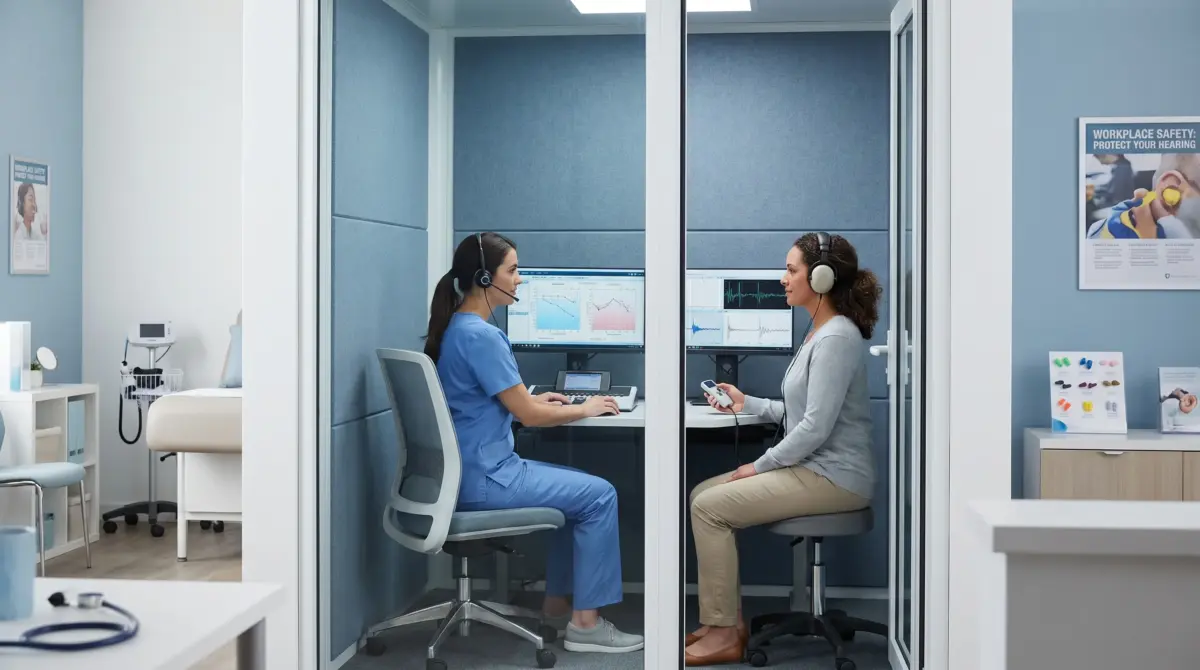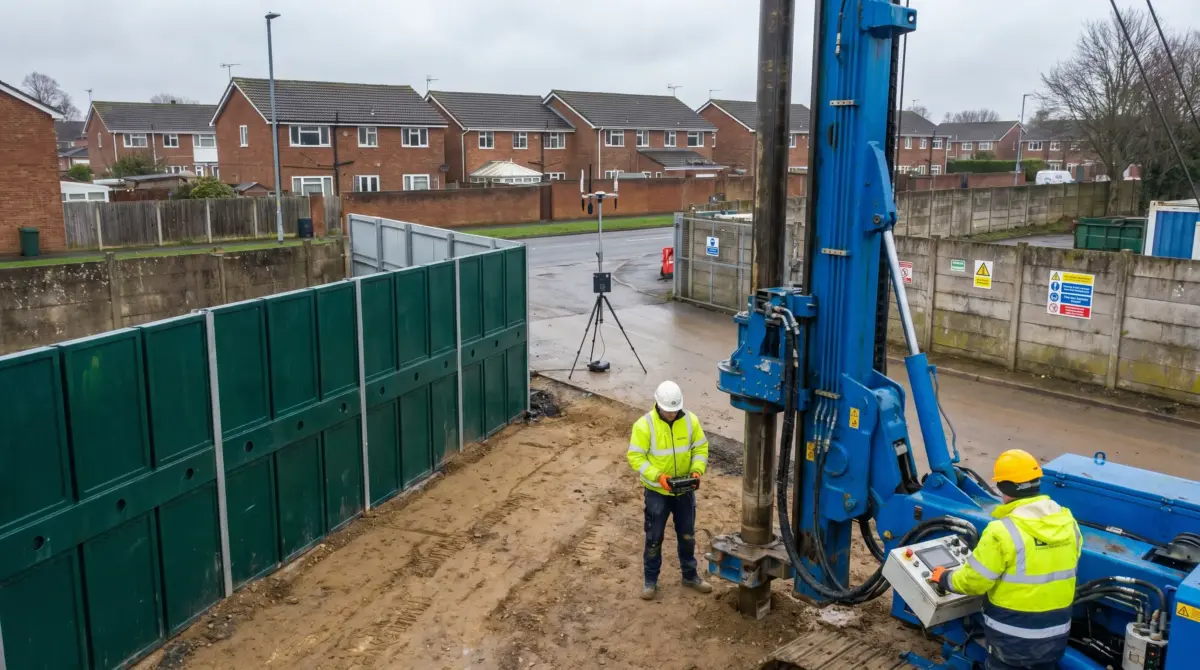

A noise risk assessment is a structured process for identifying noise hazards in the workplace, estimating employees' noise exposure, comparing that exposure against regulatory action values and limits, and determining what control measures are needed to protect hearing. It goes beyond simply measuring noise — it is the management document that records risks, assigns responsibilities, and sets review dates for ongoing compliance.
This article provides general HSE knowledge. Life-critical work such as occupational noise measurement, exposure evaluation, and hearing conservation program design must be planned and supervised by a competent person with relevant training, jurisdiction-specific authorization, and site-specific risk assessment. The information here does not replace that. Recognized training pathways include NEBOSH, IOSH, OSHA Outreach, and BOHS/AIOH occupational hygiene qualifications.
What Is a Noise Risk Assessment and Why Is It Required?
A noise risk assessment is the management decision document that determines who is exposed to hazardous noise, whether their exposure exceeds regulatory thresholds, and what the employer will do about it. It is a legal requirement — not a discretionary best practice — once worker exposure is likely to reach or exceed the lower action value.
The legal triggers differ by jurisdiction, but the obligation is universal across the UK, EU, and US frameworks.
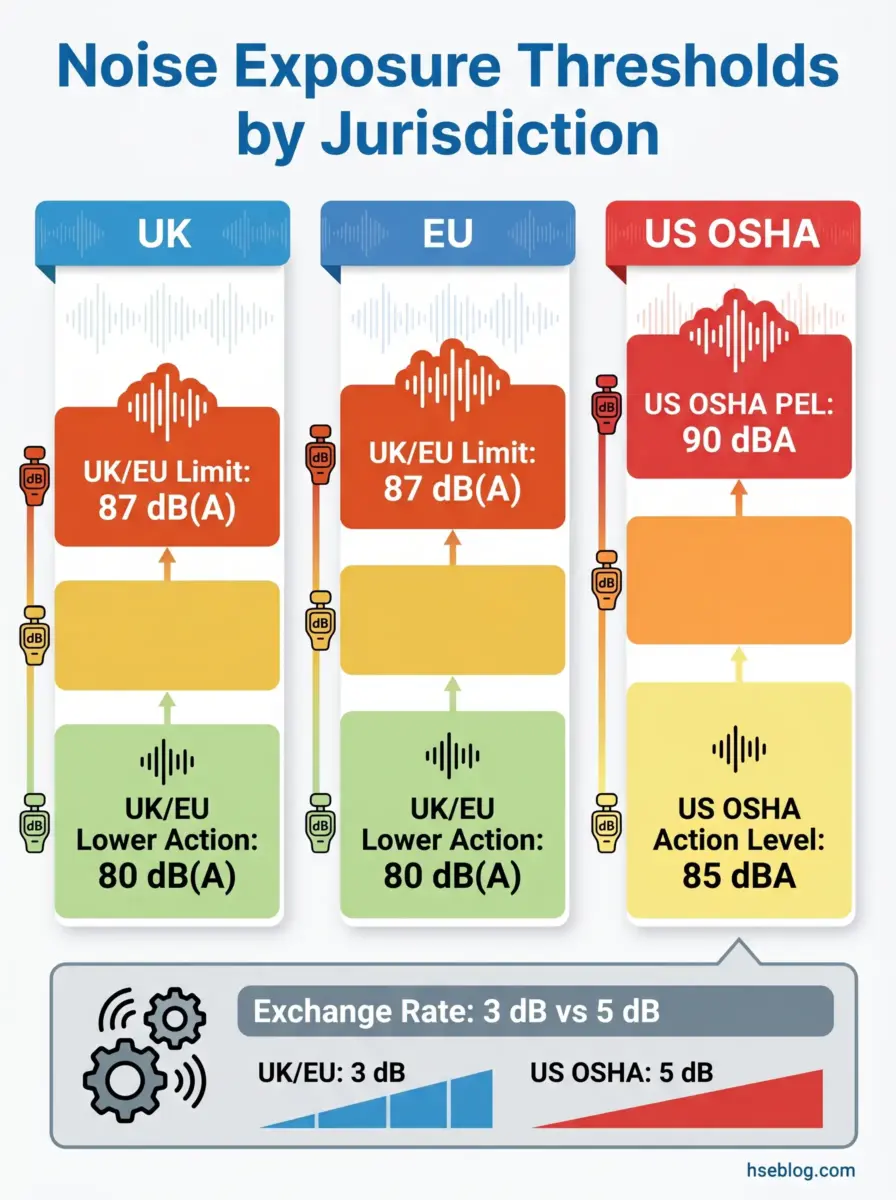
| Threshold | UK (2005 Regulations) | EU (Directive 2003/10/EC) | US OSHA (29 CFR 1910.95) |
|---|---|---|---|
| Lower trigger for action | 80 dB(A) daily / 135 dB(C) peak | 80 dB(A) daily / 135 dB(C) peak | 85 dBA TWA (action level) |
| Upper trigger | 85 dB(A) daily / 137 dB(C) peak | 85 dB(A) daily / 137 dB(C) peak | 90 dBA TWA (PEL) |
| Exposure limit value | 87 dB(A) daily / 140 dB(C) peak | 87 dB(A) daily / 140 dB(C) peak | 90 dBA TWA (PEL) |
| Exchange rate | 3 dB (equal-energy) | 3 dB (equal-energy) | 5 dB |
A compliant assessment must deliver four outcomes: a reliable exposure estimate, comparison against the applicable action and limit values, identification of required controls, and identification of employees who need health surveillance.
Approximately 22 million US workers are exposed to hazardous noise at work each year (CDC/NIOSH, 2025). Globally, disability-adjusted life years from occupational noise-induced hearing loss reached approximately 7.85 million in 2021 — a 104% increase since 1990 (Gong et al., Frontiers in Public Health, 2025). These figures make noise one of the most widespread occupational health hazards, yet one of the most consistently under-assessed.
Noise Risk Assessment vs. Noise Survey: Understanding the Difference
The single most common source of confusion in practice is treating a noise survey report as a completed risk assessment. A noise survey — the measurement exercise — produces data on sound levels and exposure durations. It is the evidence base. It is not the finished product.
The noise risk assessment is the management document built on top of that data. It must state:
- Who is exposed and at what levels
- Whether exposures exceed the relevant action values or limit values
- What controls are already in place and what further controls are needed
- Who is responsible for implementing each action, and by when
- When the assessment will be reviewed
Organizations that receive a consultant's noise survey report and file it as their "noise risk assessment" have completed neither the legal nor the practical requirement. The survey tells you the numbers. The risk assessment tells you what you are going to do about them.
Step 1 — Determine Whether a Noise Risk Assessment Is Needed
An employer must carry out a noise risk assessment whenever workers are likely to be exposed at or above the lower action value — 80 dB(A) LEP,d under UK/EU regulations, or 85 dBA TWA under OSHA 29 CFR 1910.95 (US). The initial determination of whether this threshold is likely to be reached does not always require formal measurement.
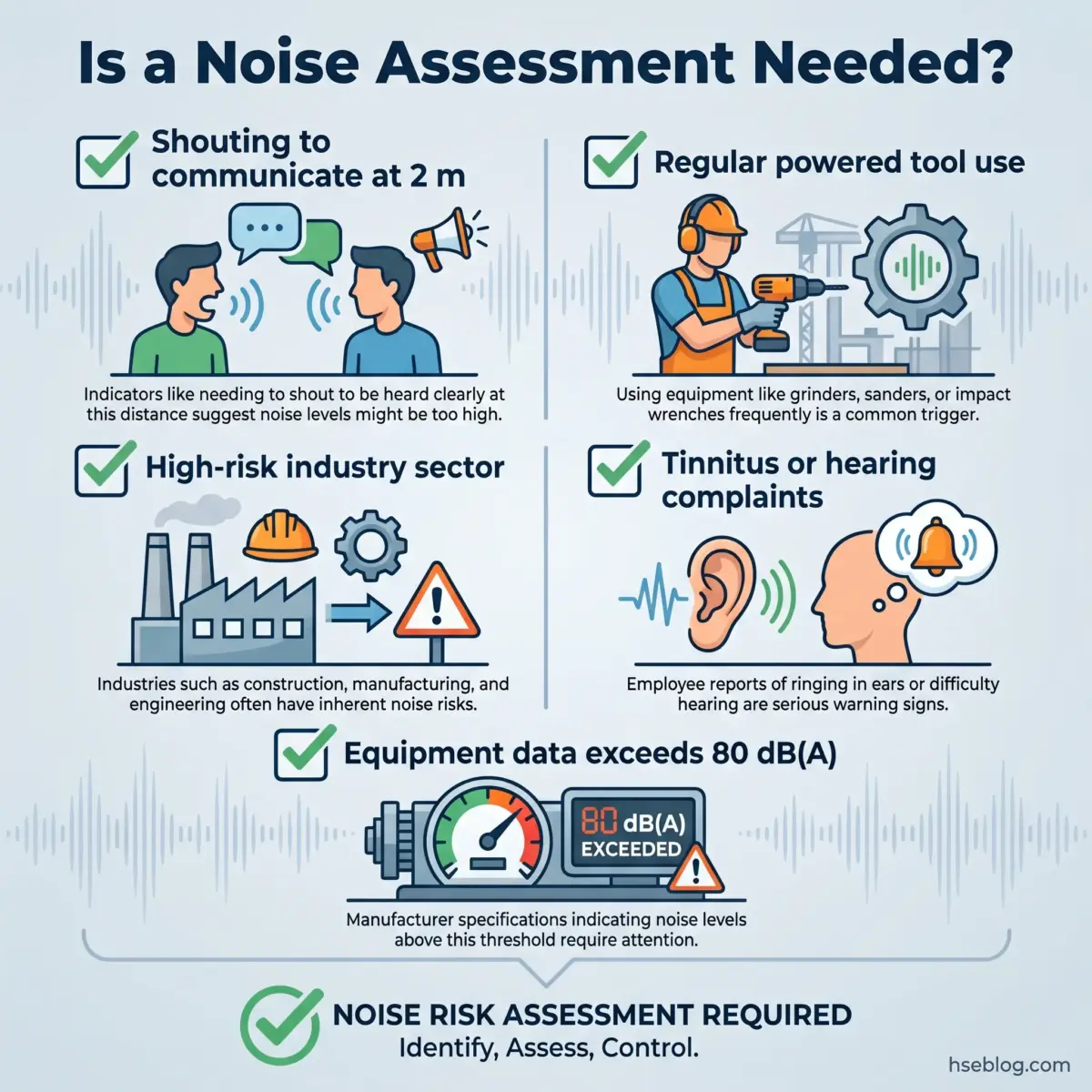
HSE UK guidance provides practical "ready reckoner" indicators that signal a noise assessment is needed:
- Raised-voice test. Workers must shout to be heard at 2 meters apart during normal conversation attempts.
- Tool and equipment type. Regular use of powered tools, pneumatic equipment, impact processes, or grinding operations.
- Industry profile. Sectors where assessment is almost always required include construction, manufacturing, entertainment and live music, mining, and agriculture.
- Employee symptoms. Reports of tinnitus, temporary dulled hearing after shifts, or difficulty hearing in quiet environments.
- Manufacturer data. Equipment noise emission data in operating manuals exceeds 80 dB(A) at the operator position.
A common pitfall is limiting the screening to main production areas while overlooking compressor rooms, loading bays, generator enclosures, and maintenance workshops. These spaces produce intermittent but intense exposures that a floor-level walkthrough alone will miss.
Reassessment is triggered by new equipment installation, changes in process or production volume, layout modifications, or when more than two years have passed since the last assessment — whichever comes first. OSHA 29 CFR 1910.95(d)(1) (US) requires re-monitoring whenever changes in production, process, equipment, or controls increase noise exposures.
Step 2 — Plan the Assessment and Gather Baseline Information
The quality of a noise risk assessment is largely determined before anyone picks up a meter. Poor planning produces measurements that are technically accurate but fail to represent the exposure patterns workers actually experience — particularly those who rotate between noisy and quiet tasks throughout a shift.
Preparation Checklist
Before measurement begins, the assessor should gather:
- Facility layout plans with known noise sources marked, including auxiliary areas such as plant rooms, pump houses, and loading docks
- Shift patterns and task durations for each job role, since exposure calculations depend on how long each task occupies the working day
- Equipment inventories with manufacturer-stated noise emission levels where available
- Previous assessment reports and any existing audiometric data that may indicate historical exposure problems
- Similar exposure groups (SEGs) — clusters of workers who share sufficiently similar exposure profiles that measuring a representative sample characterizes the group
Identifying SEGs correctly is a judgment call that directly affects how many measurements are needed. Group workers by task profile and location, not by job title alone — two "operators" on different lines may have completely different noise exposures.
Selecting the Right Measurement Strategy
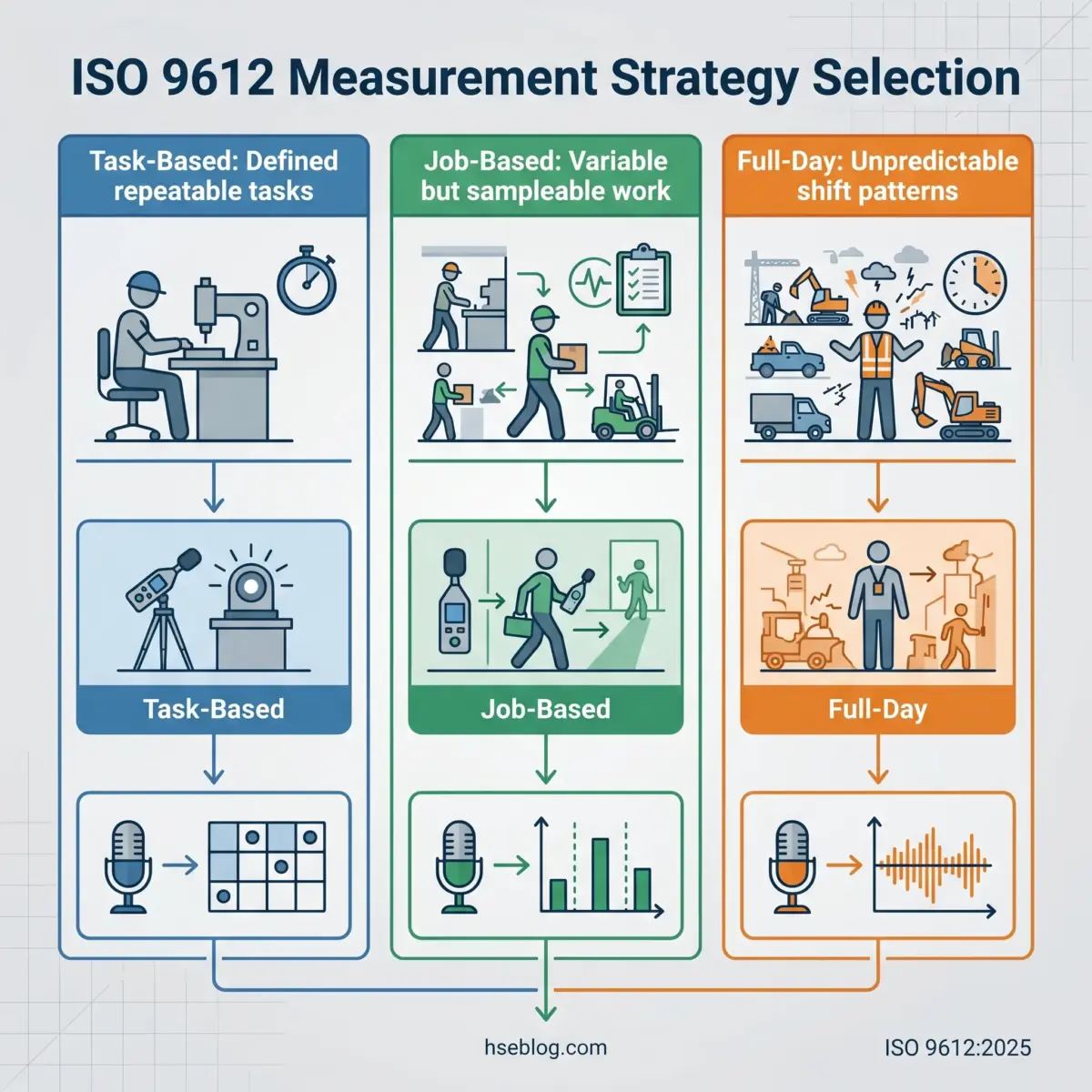
ISO 9612:2025, published in May 2025 and superseding the 2009 edition, specifies three measurement strategies. The choice depends on how predictable and structured the work pattern is.
| Strategy | Best When | Approach |
|---|---|---|
| Task-based | Workers perform defined, repeatable tasks | Measure each task separately; calculate composite exposure from task durations |
| Job-based | Work patterns are variable but can be sampled randomly | Take random samples across the shift; statistical analysis determines exposure |
| Full-day | Work patterns are unpredictable or highly variable | Measure the entire shift continuously with personal dosimeters |
The task-based approach gives the most diagnostic information — it tells you which specific task drives the exposure, making control targeting straightforward. Full-day measurement is simpler to execute but reveals less about where the risk originates.
Step 3 — Conduct Noise Measurements
Measurement is the evidence-gathering phase, not the assessment itself. The goal is to produce exposure data that is representative, defensible, and detailed enough to inform control decisions. NIOSH guidance on measuring and understanding workplace noise exposure provides a solid technical foundation for this phase.
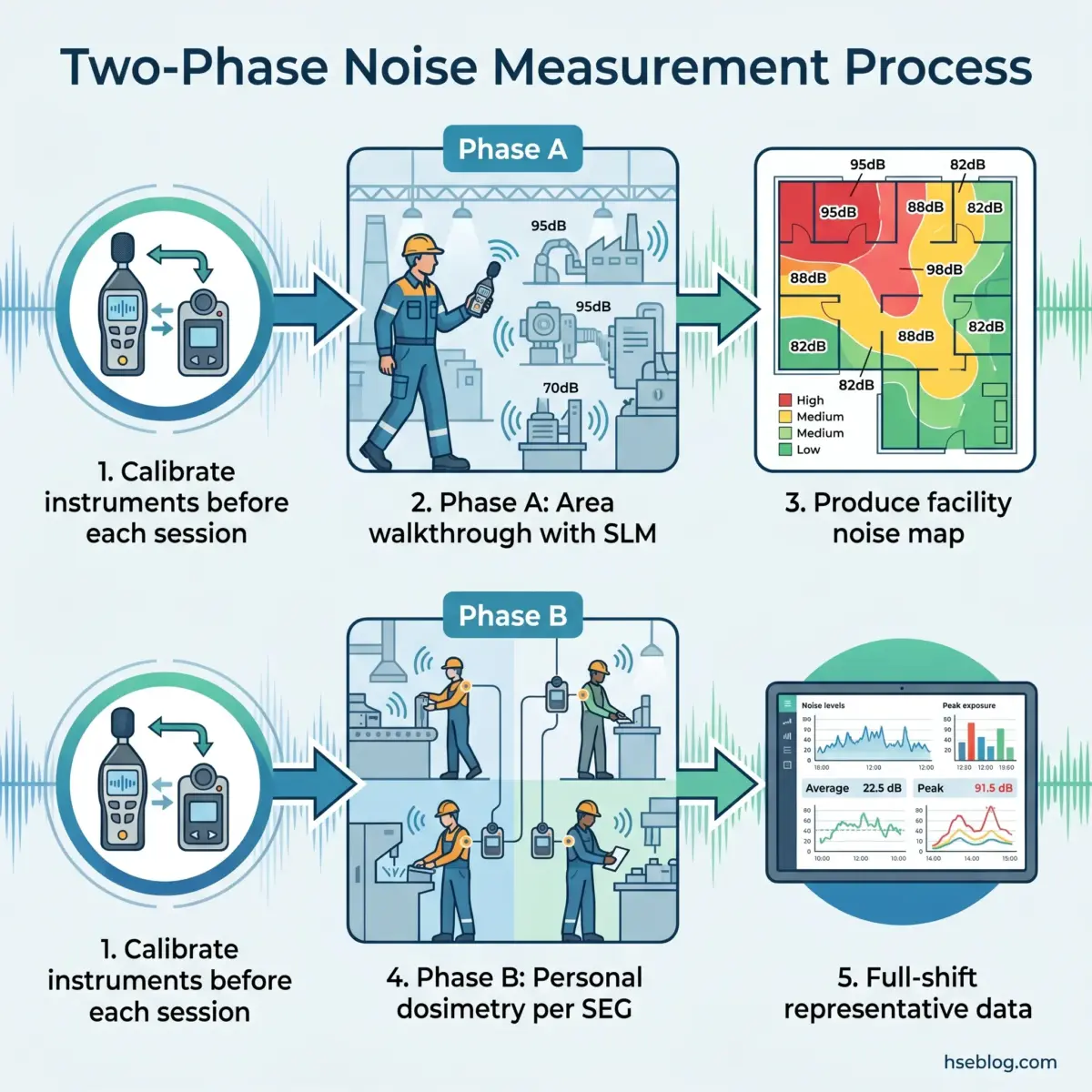
Phase A — Area Walkthrough Survey
The first pass uses a handheld sound level meter (Class 2 minimum per IEC 61672) to map noise levels across the facility.
- Calibrate the SLM before and after each measurement session using a field calibrator — any drift exceeding ±0.5 dB invalidates the session
- Measure at operator position, approximately 10 cm from the ear, at each identified noise source and workstation
- Use A-weighting (dB(A)) for the continuous/average measurements that determine hearing risk
- Use C-weighting (dB(C)) when measuring peak or impulse noise — regulatory peak limits are stated in C-weighted values
- Document conditions — which machines were running, production load level, ventilation status — because a measurement without context is uninterpretable
The walkthrough survey identifies which areas and tasks require detailed personal dosimetry. It also produces the raw data for a noise map — a facility plan showing sound pressure levels by zone.
Phase B — Personal Noise Dosimetry
Where the walkthrough identifies exposures likely to approach or exceed action values, personal noise dosimeters worn by representative workers from each SEG provide the individual exposure data needed for the risk assessment.
Dosimeters should run for at least one full representative shift. A consistent error across published noise investigation reports is measuring only during peak production and treating that as representative of the full working day. Setup and cleanup periods, shift handovers, and breaks reduce the daily time-weighted average — but ignoring them inflates or deflates the result depending on whether the noise source runs continuously.
Handle difficult noise types deliberately:
- Intermittent noise — capture start/stop patterns over the full shift rather than sampling only the "on" period
- Impulsive noise — ensure the dosimeter's peak measurement function is enabled and the instrument responds fast enough (≤50 microseconds rise time)
- Variable noise — the full-day strategy from ISO 9612:2025 is usually the most appropriate approach
The NIOSH Sound Level Meter app is a useful screening tool during walkthroughs, but it does not meet regulatory requirements for compliance measurements. Calibrated, certified instruments are non-negotiable for the data that will underpin the risk assessment record.
Step 4 — Evaluate Noise Exposure Against Regulatory Thresholds
This is the analytical core of the assessment — the stage where raw measurement data becomes a compliance determination. The assessor calculates each worker's (or SEG's) daily personal noise exposure level (LEP,d) and compares it against the applicable action values and exposure limit values. OSHA's occupational noise exposure overview provides the US-specific framework.
The Exchange Rate Problem
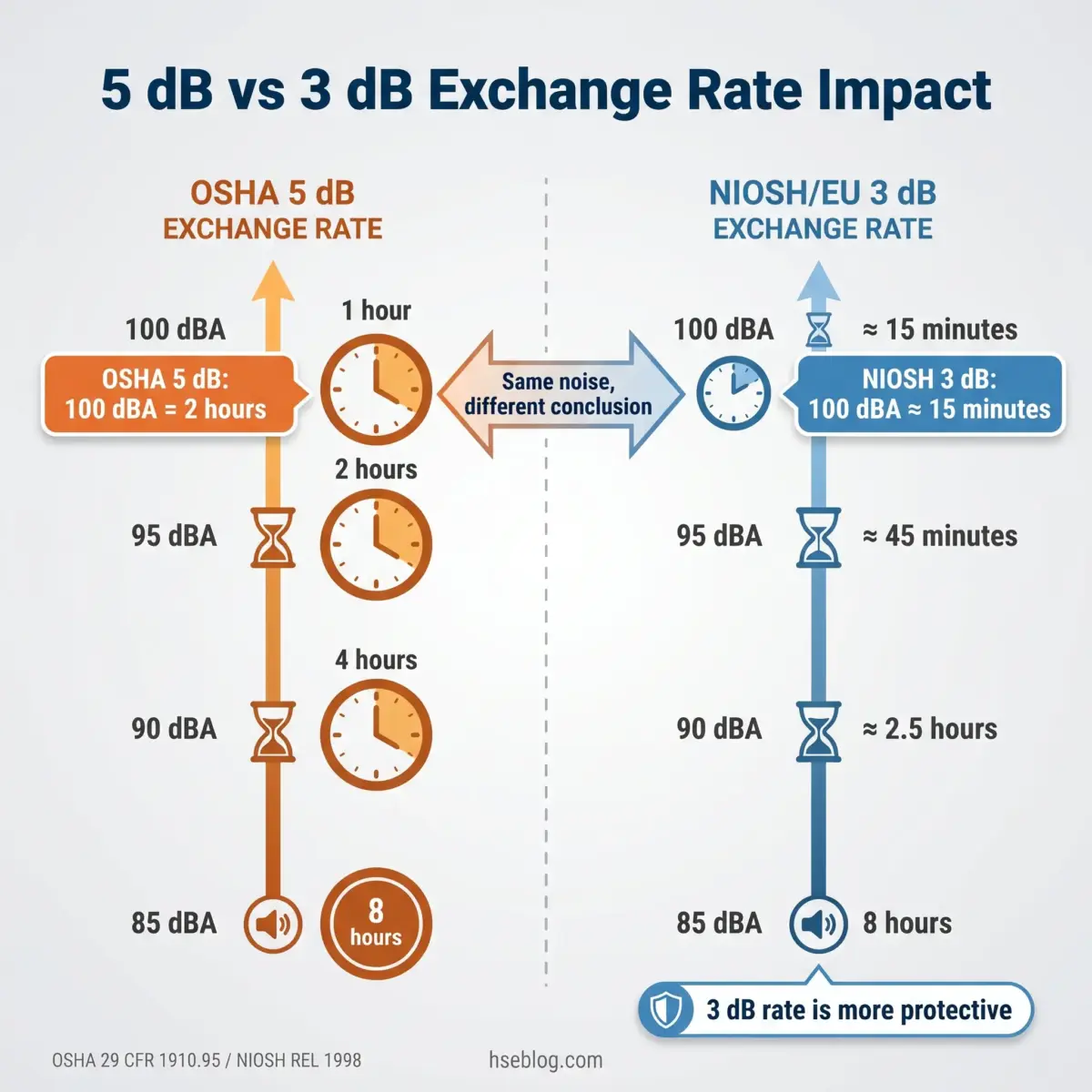
The single most consequential technical difference between jurisdictions is the exchange rate — the rule that determines how much additional noise halves the permissible exposure time.
- OSHA (US) uses a 5 dB exchange rate. At 90 dBA, the PEL allows 8 hours. At 95 dBA, it allows 4 hours. At 100 dBA, 2 hours.
- NIOSH, UK, and EU use a 3 dB exchange rate (equal-energy principle). At 85 dBA, the REL/EAV allows 8 hours. At 88 dBA, 4 hours. At 91 dBA, 2 hours.
The practical impact is stark. A worker exposed to 100 dBA has 2 hours of permissible exposure under OSHA — but only approximately 15 minutes under the NIOSH recommended exposure limit. An assessment that applies only the OSHA criterion may conclude a worker is compliant while the same exposure significantly exceeds the NIOSH/EU threshold.
Organizations operating internationally, or those aiming for best practice rather than bare legal compliance, should default to the 3 dB equal-energy principle. The scientific consensus, reflected in NIOSH's 1998 revised criteria and EU Directive 2003/10/EC, is that the 3 dB rate more accurately represents the dose-response relationship for noise-induced hearing loss.
Multi-Task Exposure Calculation
Workers who move between tasks at different noise levels need a fractional exposure calculation. The daily exposure is calculated as:
LEP,d = 10 × log₁₀ (Σ for each task: [duration / reference duration] × 10^(Leq/10))
In practice, most assessors use HSE's online noise exposure calculator or equivalent software rather than computing this manually. The critical input is accurate task duration data — which is why the planning phase (Step 2) matters so much.
Step 5 — Identify At-Risk Employees and Vulnerable Groups
Every worker whose daily noise exposure reaches or exceeds the lower action value must be identified in the assessment. But a competent assessment goes further — it identifies individuals at heightened risk whose hearing may be damaged at exposure levels that would be tolerable for most of the workforce.
Populations Requiring Additional Consideration
- Pre-existing hearing loss. Workers with documented audiometric deficits are more susceptible to further damage and may not perceive warning signals in noisy environments.
- Ototoxic co-exposures. Certain industrial solvents (toluene, xylene, styrene) and heavy metals (lead, mercury) are ototoxic — they damage hearing through chemical pathways that compound noise-induced injury. A noise risk assessment should cross-reference COSHH/chemical exposure data.
- Ototoxic medications. Some antibiotics (aminoglycosides), chemotherapy agents, and high-dose aspirin are ototoxic. While medical records are private, health surveillance questionnaires can flag this risk factor.
- Young and new workers. Workers new to noisy environments often lack the experience to recognize when noise is hazardous, and they may be less likely to use hearing protection consistently.
- Maintenance workers and contractors. This is a consistently overlooked population. Maintenance technicians who enter high-noise areas for short but extremely intense repair tasks may show a low daily time-weighted average — but their peak exposures can exceed limit values, and their exposure pattern falls outside the SEGs defined for production workers.
Approximately 28% of all US workers have been exposed to hazardous noise, with 16% exposed in the last year (CDC/NIOSH, 2026, citing Masterson, Morata & Themann, 2025). Among those exposed, 53% report not wearing hearing protection (CDC/NIOSH, 2021). These numbers confirm that exposure identification alone is insufficient — the assessment must address the behavioral and systemic factors that determine whether controls actually protect people.
Step 6 — Select and Implement Noise Control Measures
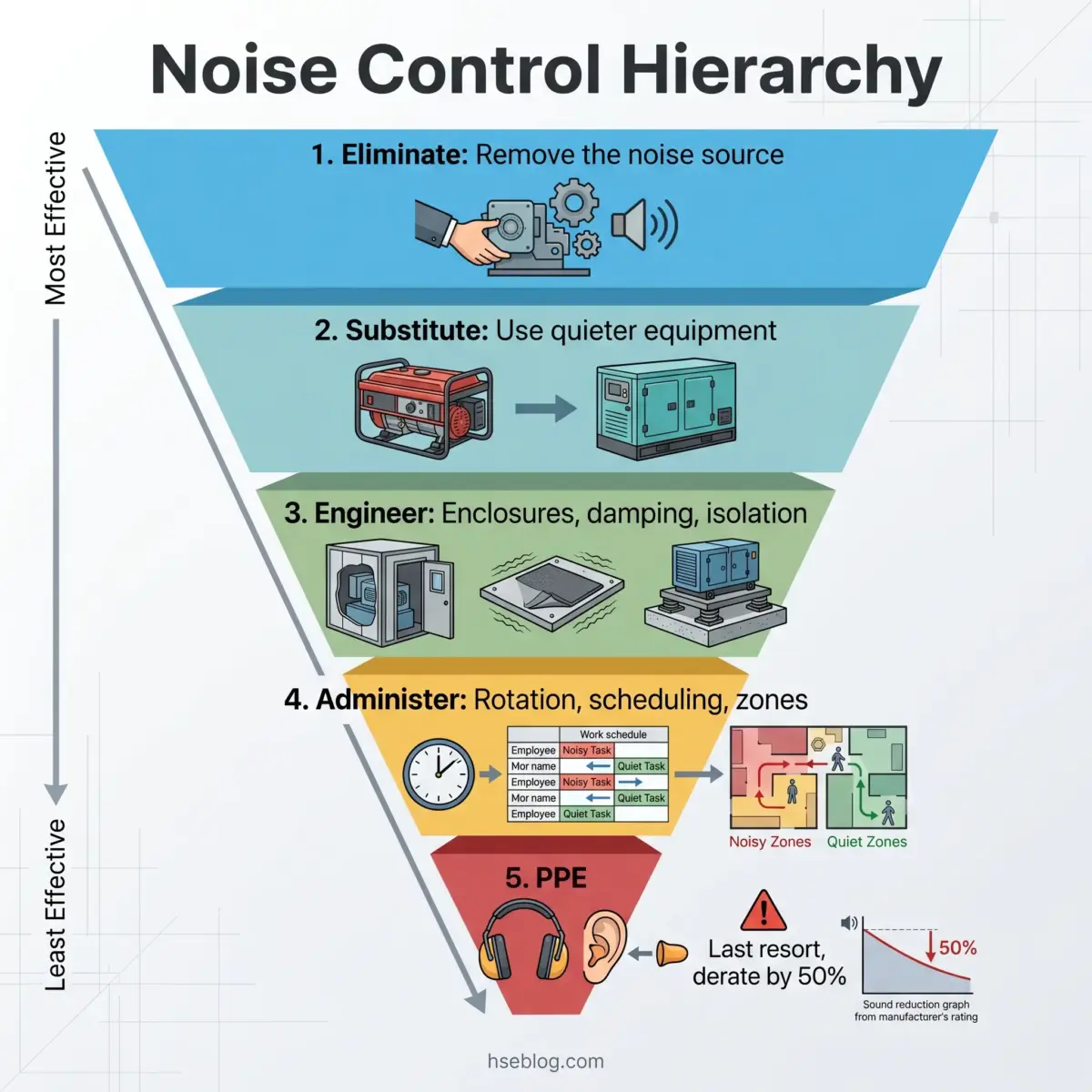
Hearing protection is the most common response to noise — and the least reliable one. The hierarchy of controls applied to noise demands that employers exhaust higher-order measures before relying on PPE. Regulators in both the US (OSHA 29 CFR 1910.95, US) and UK (Control of Noise at Work Regulations 2005, UK) consistently cite the failure to evaluate engineering controls as a compliance deficiency.
Hierarchy Applied to Noise
Elimination. Remove the noise source entirely. Replace pneumatic impact tools with hydraulic or electric alternatives. Redesign a process to eliminate a noisy step.
Substitution. Replace noisy equipment with quieter models. A "buy quiet" procurement policy — requiring noise emission data as part of equipment purchase specifications — is one of the most cost-effective long-term controls.
Engineering controls. These are the workhorses of noise reduction:
- Acoustic enclosures around machines or compressors
- Vibration-isolation mounts to prevent structure-borne noise transmission
- Silencers on exhausts and air discharge points
- Damping treatments on vibrating panels and conveyor systems
- Maintenance-driven noise reduction — worn bearings, misaligned components, and loose panels generate noise that proper maintenance eliminates
Administrative controls. Limit exposure through scheduling and work organization:
- Job rotation to distribute noise exposure across more workers, reducing individual LEP,d
- Scheduling high-noise operations during periods of lowest occupancy
- Designating and marking hearing protection zones
- Providing quiet rest areas to reduce cumulative exposure
PPE — Hearing protection. When higher-order controls cannot reduce exposure below action values, hearing protection fills the remaining gap. Selection criteria must account for:
- Real-world attenuation. Laboratory NRR/SNR ratings substantially overestimate field performance. OSHA recommends derating NRR by 50% for estimation purposes. Real-world attenuation is typically 50% or less of the rated value due to poor fit, inconsistent wear, and comfort-driven modification.
- Type suitability. Earplugs, earmuffs, or custom-moulded protectors — the choice depends on the noise spectrum, comfort, communication needs, and compatibility with other PPE.
- Fit testing. Individual fit verification is the only way to confirm that a protector delivers adequate attenuation for a specific wearer.
Step 7 — Document Findings and Create an Action Plan
The assessment record is the deliverable that proves compliance and drives implementation. Without it, every preceding step is undocumented professional opinion.
Under UK regulations (Control of Noise at Work Regulations 2005, UK), the employer must record the significant findings of the assessment and the measures taken or planned. OSHA 29 CFR 1910.95(m) (US) requires noise monitoring records to be retained for at least 2 years and audiometric records for the duration of the affected employee's employment.
What the Record Must Contain
- Noise sources identified — location, type, and measured levels
- Measurement data — instruments used, calibration records, dates, conditions, and methodology (referencing ISO 9612:2025 strategy where applicable)
- Exposure estimates — LEP,d for each SEG or individual, with the calculation method stated
- Risk evaluation — comparison against applicable action values and limit values, with jurisdiction clearly identified
- Controls in place — existing engineering, administrative, and PPE measures
- Further actions required — the action plan
The Action Plan
The action plan is the component most often missing from otherwise adequate assessments. It transforms the assessment from a static report into a management tool.
| Action Required | Responsible Person | Target Date | Review Date |
|---|---|---|---|
| Install acoustic enclosure on compressor unit | Engineering Manager | [Date] | [Date] |
| Issue fit-tested hearing protection to SEG-3 workers | HSE Officer | [Date] | [Date] |
| Schedule audiometric baseline for new hires in Zone A | Occupational Health | [Date] | [Date] |
| Implement "buy quiet" clause in procurement policy | Procurement Lead | [Date] | [Date] |
The most useful assessment documents function as living references linked directly to training records, PPE issue logs, and health surveillance schedules. A report filed in a cabinet and retrieved only during audits delivers compliance on paper but not protection in practice.
Step 8 — Establish Health Surveillance and Audiometric Monitoring
Audiometric testing is the verification mechanism that closes the loop between exposure assessment and actual hearing outcomes. When the risk assessment identifies employees exposed at or above the upper action value, health surveillance moves from recommended to mandatory.
Under UK regulations (Control of Noise at Work Regulations 2005, UK), health surveillance is required for all employees regularly exposed above the upper exposure action value of 85 dB(A), and for any employee at risk even at lower levels due to individual susceptibility. Under OSHA 29 CFR 1910.95(g) (US), a baseline audiogram must be obtained within 6 months of first exposure at or above the 85 dBA action level, with annual audiograms thereafter.
OSHA requires a 14-hour quiet period before baseline testing — hearing protectors may substitute for this quiet period if a quiet environment is not feasible, though this compromises baseline accuracy.
When Audiometric Results Demand Action
A standard threshold shift (STS) — defined by OSHA as an average shift of 10 dB or more at 2000, 3000, and 4000 Hz in either ear — triggers specific employer obligations:
- Notify the affected employee within 21 days
- Refit or re-evaluate hearing protection
- Refer for clinical evaluation if indicated
- Review the noise risk assessment to determine whether current controls are adequate
The feedback loop is where most hearing conservation programs fail. Approximately 11% of all US workers have hearing difficulty and about 8% have tinnitus (CDC/NIOSH, 2026). Audiometric results showing threshold shifts should trigger a reassessment of noise controls — not just an entry in the employee's medical file.
Content covering health surveillance and audiometric monitoring is for HSE practitioner reference. It is not medical advice. Workers with specific symptoms or exposure concerns should consult an occupational physician or qualified medical professional.
How Often Should a Noise Risk Assessment Be Reviewed?
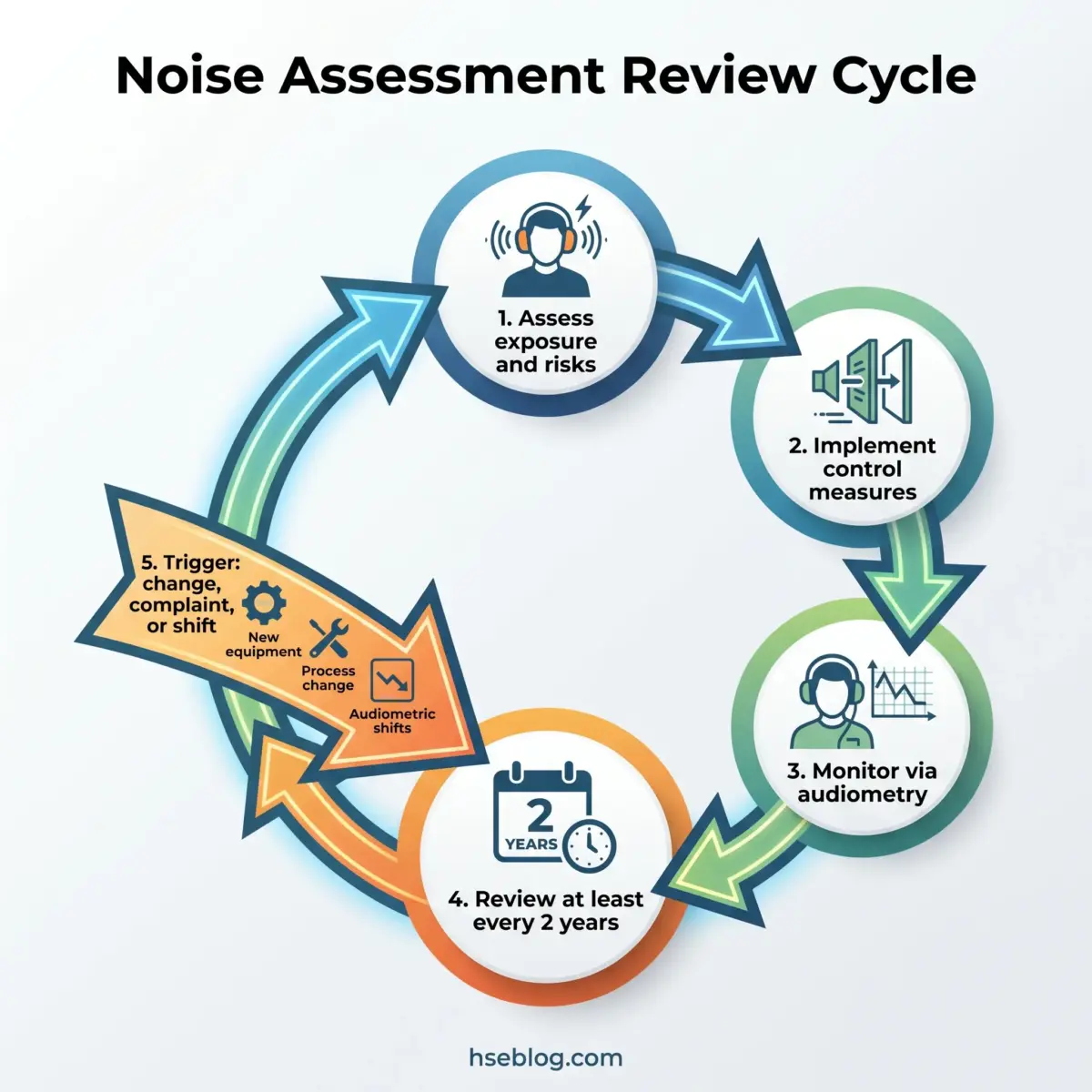
A noise risk assessment must be reviewed at least every two years, even if conditions appear unchanged — and immediately whenever a material change affects noise exposure. HSE UK guidance (L108) specifies this minimum review cycle.
The judgment call is recognizing what constitutes a "material change." These are the common triggers:
- New equipment — any machine purchase, replacement, or relocation
- Process changes — altered production methods, speeds, volumes, or shift patterns
- Layout modifications — moving partitions, removing barriers, or relocating workstations relative to noise sources
- Employee complaints — reports of tinnitus, hearing difficulty, or perceived noise increase
- Audiometric findings — threshold shifts detected in surveillance, which may indicate that current controls are failing
- Post-maintenance changes — equipment that becomes noisier after maintenance or modification
A scheduled review date alone is insufficient. The assessment must be integrated into the organization's management-of-change process so that any equipment purchase, layout change, or production increase automatically triggers a noise exposure check before the change is implemented — not after workers have already been exposed.
Frequently Asked Questions
Can I do a noise risk assessment without professional equipment?
Initial screening can rely on observation, the raised-voice test, and manufacturer-stated noise emission data. These methods can establish whether a formal assessment is likely to be needed. However, once you need quantified exposure estimates for compliance purposes, a calibrated Class 2 sound level meter is the minimum instrument requirement. Smartphone apps — including NIOSH's SLM app — are useful screening tools, but they generally do not meet regulatory requirements for compliance measurements and should not be cited as the basis for an assessment record.
What is the difference between dB(A) and dB(C) in a noise assessment?
A-weighting filters sound to approximate how the human ear perceives different frequencies, reducing emphasis on very low and very high frequencies. It is the standard weighting for measuring average noise exposure and is used in all daily exposure (LEP,d) calculations. C-weighting captures the full frequency range with minimal filtering, including low-frequency energy that A-weighting attenuates. Regulatory peak noise limits — such as the UK's 135 dB(C) lower EAV peak and 140 dB(C) ELV peak — are stated in C-weighted values because peak events often contain significant low-frequency energy.
What is the difference between OSHA's 5 dB and NIOSH's 3 dB exchange rate?
The exchange rate determines how much additional noise halves the permissible exposure duration. Under OSHA's 5 dB rate (29 CFR 1910.95, US), increasing noise from 90 dBA to 95 dBA halves the allowed time from 8 hours to 4 hours. Under NIOSH's 3 dB rate, increasing from 85 dBA to 88 dBA halves the time from 8 hours to 4 hours. The 3 dB rate — called the equal-energy principle — is considered more scientifically accurate and is the basis for UK, EU, and most international standards. The difference is substantial at high noise levels: at 100 dBA, OSHA permits 2 hours; NIOSH permits roughly 15 minutes.
Do I need a competent person to carry out a noise risk assessment?
UK regulations (Control of Noise at Work Regulations 2005) require the assessment to be made by, or based on the advice of, a competent person. For straightforward environments with limited noise sources, an in-house HSE officer with appropriate training may be competent. Complex environments — multiple variable sources, impulsive noise, ototoxic co-exposures — typically require an occupational hygienist or acoustic consultant. OSHA does not prescribe specific qualifications but requires that noise measurements are technically valid, which in practice demands trained operators using calibrated equipment.
Can hearing protection be the only control measure for noise?
No. Regulations in both the US and UK/EU require employers to reduce noise exposure through engineering and administrative controls so far as is reasonably practicable before relying on PPE. Hearing protection is a supplementary measure that fills the gap between what higher-order controls achieve and the target exposure level. Relying solely on hearing protection is a compliance failure — and an effectiveness failure, because real-world attenuation is typically 50% or less of the laboratory-rated NRR value, due to poor fit, inconsistent wear, and comfort-driven modifications.
What records must be kept after completing a noise risk assessment?
OSHA 29 CFR 1910.95(m) (US) requires noise monitoring records to be retained for at least 2 years and audiometric test records for the duration of the affected employee's employment. UK regulations require records to be kept as long as they remain relevant to current risk management. In practical terms, given the latency of noise-induced hearing loss — symptoms may appear decades after exposure — retaining all assessment and audiometric records for a minimum of 40 years is a defensible approach that protects both employees and employers against future claims.
Conclusion
The pattern that consistently undermines noise risk assessments is not a lack of equipment or measurement skill — it is the gap between measuring noise and managing noise exposure. Organizations that commission a noise survey, receive a report, and file it have completed the easy half. The assessment itself — the document that identifies who is at risk, compares exposure against jurisdictional thresholds, selects controls using the hierarchy rather than defaulting to earplugs, assigns responsibilities, sets deadlines, and links to audiometric surveillance — is where the legal obligation and the protective value reside.
The single highest-impact change most organizations can make is closing the feedback loop between audiometric monitoring and control review. Over 1.5 billion people worldwide suffer from hearing impairment (World Health Organization, 2021), and a significant share of occupational cases were preventable at the point where a threshold shift was detected but no reassessment followed. When audiometric data shows deterioration, the controls have failed — and the noise risk assessment must be reopened, not just the employee's medical file.
Every step in this process exists because noise-induced hearing loss is irreversible, cumulative, and entirely preventable through competent assessment and sustained management attention. The standard — whether OSHA's PEL, the UK's exposure limit value, or NIOSH's recommended exposure limit — is only as protective as the assessment that applies it.