

TL;DR
- Article 19 of ILO C155 requires workers to cooperate with employers in fulfilling workplace safety obligations
- Recommendation 16 of R164 expands worker duties into specific, actionable responsibilities on the ground
- Worker cooperation is a legal duty, not a voluntary choice — it underpins every functioning safety system
- Reporting hazards and using PPE correctly are non-negotiable obligations workers owe to themselves and their colleagues
- No safety system works without active, informed, and accountable worker participation at every level
During an ISO 45001 surveillance audit at a cement manufacturing facility in the Gulf, I asked a group of plant operators one question: “What are your safety responsibilities under international labour standards?” The room went silent. These were experienced workers — seven, ten, fifteen years on the job — and not one could articulate what their own legal obligations looked like under the ILO framework their employer had committed to. The company had ratified policies aligned with ILO Convention C155. Posters referenced it. But the workers on the receiving end of those obligations had never been told what the convention actually required of them.
That gap — between an organization’s stated commitment to international safety standards and its workers’ actual understanding of their own duties — is one of the most dangerous blind spots I encounter on audits. Article 19 of ILO Convention C155 and Recommendation 16 of R164 exist precisely to define the worker’s role in occupational safety. They are not abstract policy language. They describe specific, practical responsibilities that every worker must fulfil to make a safety management system function. This article breaks down both provisions, explains how they translate to real site behavior, identifies common failures, and gives you the practical knowledge to apply them on the ground.
What Article 19 of ILO Convention C155 Actually Says
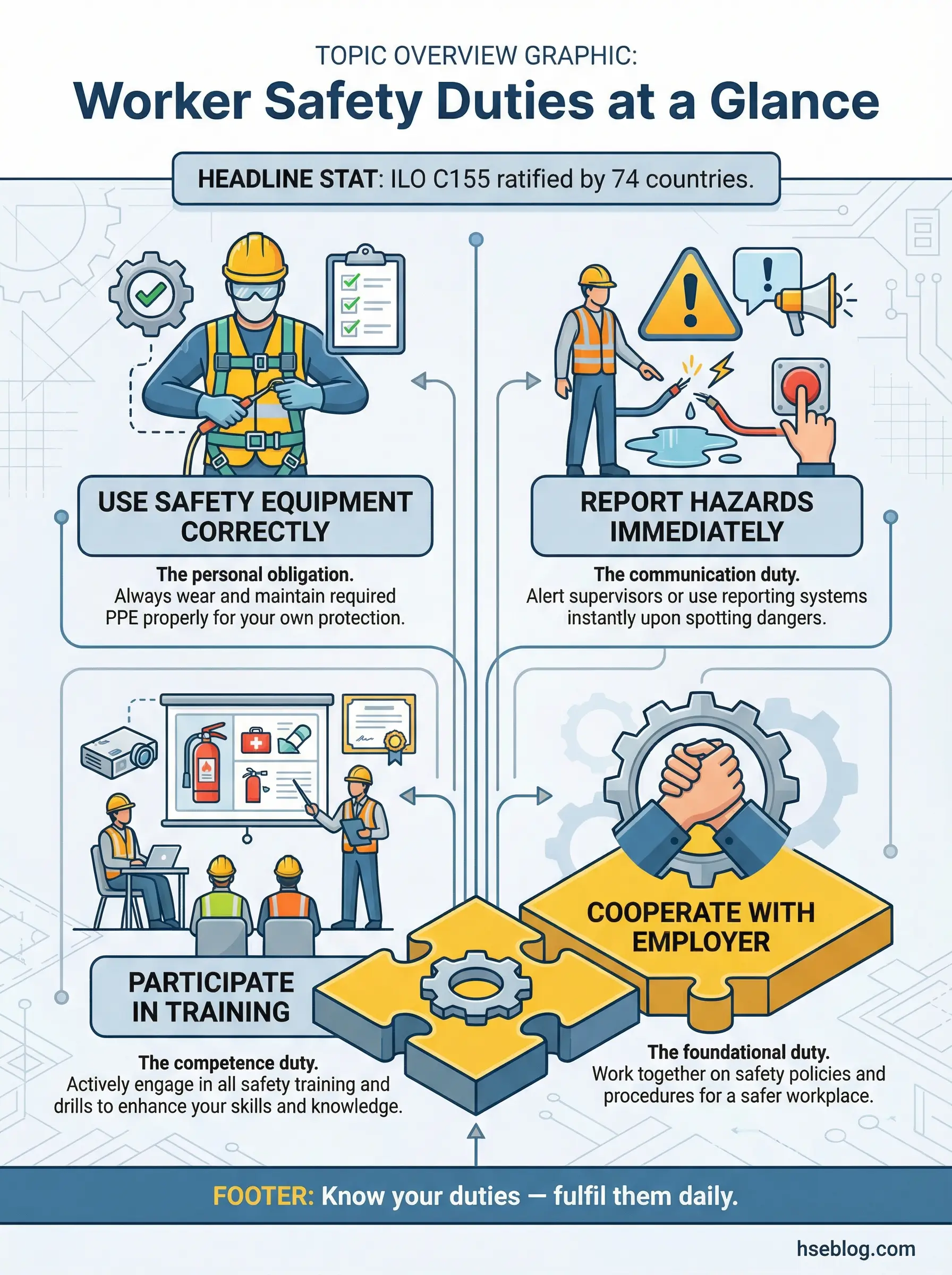
ILO Convention C155 — the Occupational Safety and Health Convention, 1981 — establishes the broad framework for workplace safety at the national and enterprise level. Most of its articles address government obligations and employer duties. Article 19, however, shifts focus squarely onto the worker. It establishes the principle that occupational safety is a shared responsibility, and that workers have specific, binding duties within that system.
Article 19 contains two core requirements placed directly on workers:
- Cooperation with the employer: Workers must cooperate with their employer in the fulfilment of the obligations placed upon the employer under C155. This is not a suggestion or a cultural aspiration — it is a treaty-level duty that member states must translate into national law upon ratification.
- Care for self and others: Workers must take reasonable care for their own safety and health, and for the safety and health of other persons who may be affected by their acts or omissions at work. This mirrors the “duty of care” concept embedded in national frameworks like the UK Health and Safety at Work Act 1974, Section 7.
Article 19 of C155 states that arrangements at the level of the undertaking shall require workers to cooperate in the fulfilment of OSH obligations and to take reasonable care for the safety of themselves and others affected by their acts or omissions.
The language is deliberate. “Cooperate” means active participation, not passive compliance. “Reasonable care” means applying the training, knowledge, and controls provided — not just showing up and hoping someone else manages the risk. I have seen this distinction tested in real enforcement situations. On a refinery turnaround project in Southeast Asia, an experienced scaffolder bypassed a tag-out procedure because he believed it was slowing the schedule. When challenged, he argued that safety was “the company’s job.” The investigation report cited Article 19 directly — cooperation is not optional, and individual non-compliance breaches the worker’s own legal duty.
Pro Tip: When delivering toolbox talks on worker responsibilities, avoid lecturing about “international conventions.” Instead, frame it as: “You have a legal duty to cooperate with every safety rule on this site — not because the company says so, but because the law says so.” That changes the dynamic from corporate instruction to personal accountability.
How Recommendation 16 of R164 Expands Worker Duties
Convention C155 sets the legal foundation. Recommendation R164 — the Occupational Safety and Health Recommendation, 1981 — builds on it with practical, detailed guidance. Where Article 19 of C155 tells workers to cooperate and take reasonable care, Recommendation 16 of R164 tells them exactly what that cooperation looks like on the ground.
Recommendation 16 lists specific duties that workers should carry out within the enterprise-level safety arrangements. These duties go well beyond passive rule-following — they demand informed, active participation in the safety management system.
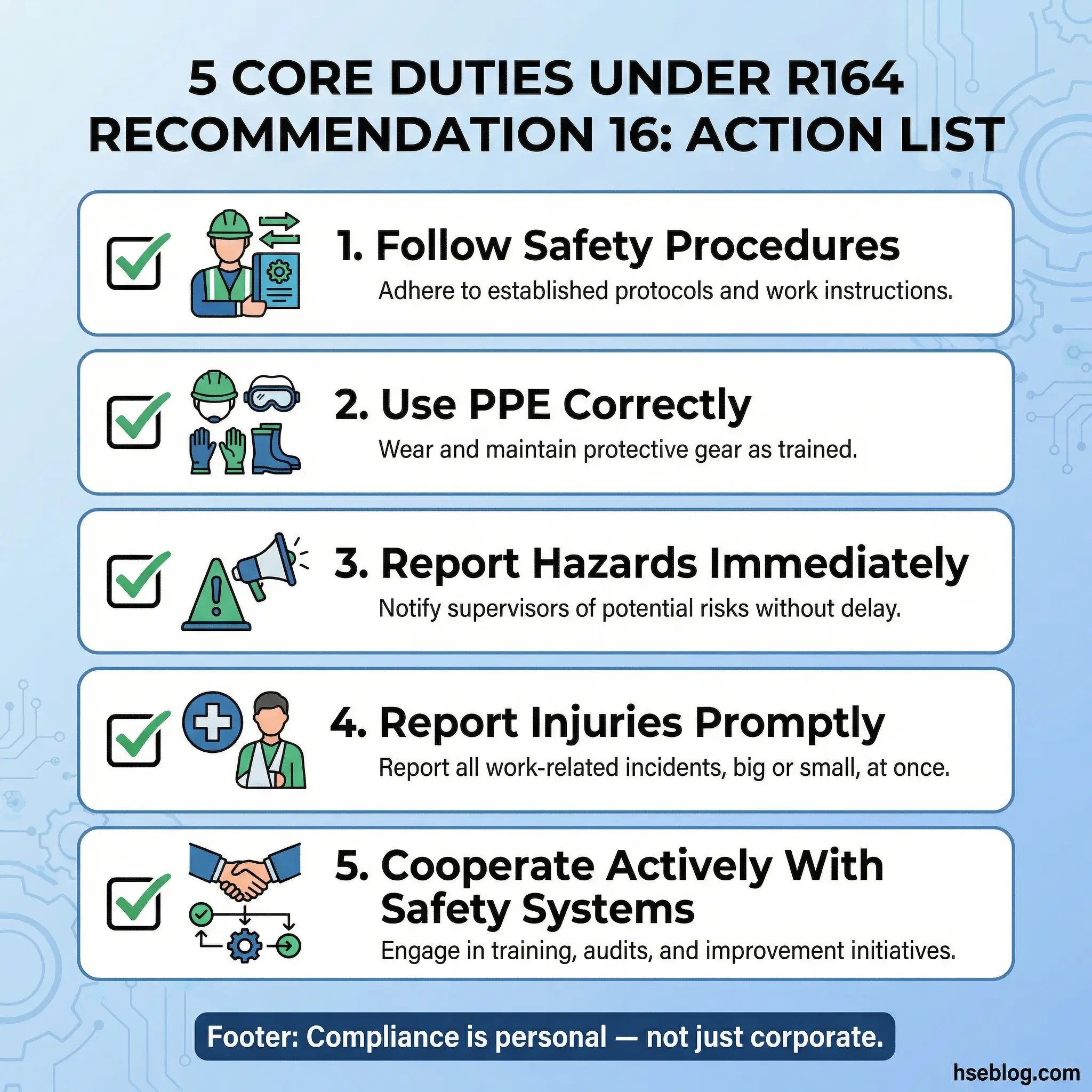
The key worker responsibilities under Recommendation 16 of R164 include:
- Comply with prescribed safety instructions: Workers must follow the safety procedures, work instructions, and safe systems of work established by the employer. This includes permit-to-work conditions, standard operating procedures, and site-specific rules.
- Use safety devices and protective equipment correctly: Every piece of PPE, every machine guard, every ventilation system provided must be used as intended. Workers must not disable, bypass, or neglect safety devices.
- Report hazards and dangerous situations immediately: Workers have an affirmative duty to report any condition they consider dangerous to their immediate supervisor or safety representative. This includes near-misses, equipment defects, and unsafe behaviors by colleagues.
- Report any work-related injury or health issue: Occupational injuries, symptoms of occupational illness, and any adverse health effects linked to work exposure must be reported promptly. Concealing injuries or “toughing it out” violates this duty.
- Cooperate with the employer and other workers: Cooperation extends beyond following rules — it includes participating in safety committees, attending training sessions, and supporting safety representatives in their functions.
What separates Recommendation 16 from vague corporate safety slogans is its specificity. Each duty is tied to a concrete action a worker must perform. During a management system audit at a logistics hub in Northern Europe, I reviewed incident records and found that 40% of reported near-misses had been flagged by workers who explicitly referenced their “duty to report” under the company’s ILO-aligned policy. The reporting culture was strong — not because workers were naturally inclined to fill in forms, but because the duty had been explained, reinforced, and built into the management system as a non-negotiable expectation.
Pro Tip: Map each R164 worker duty directly to your site induction checklist. When a new worker signs off on induction, they should be acknowledging each specific responsibility — not a generic “I will follow safety rules” statement.
The Relationship Between C155 Article 19 and R164 Recommendation 16
Understanding how these two instruments connect is critical for anyone building or auditing a safety management system. They are not interchangeable documents. They serve different legal and practical functions, and confusing them weakens both your compliance posture and your workers’ understanding of their obligations.
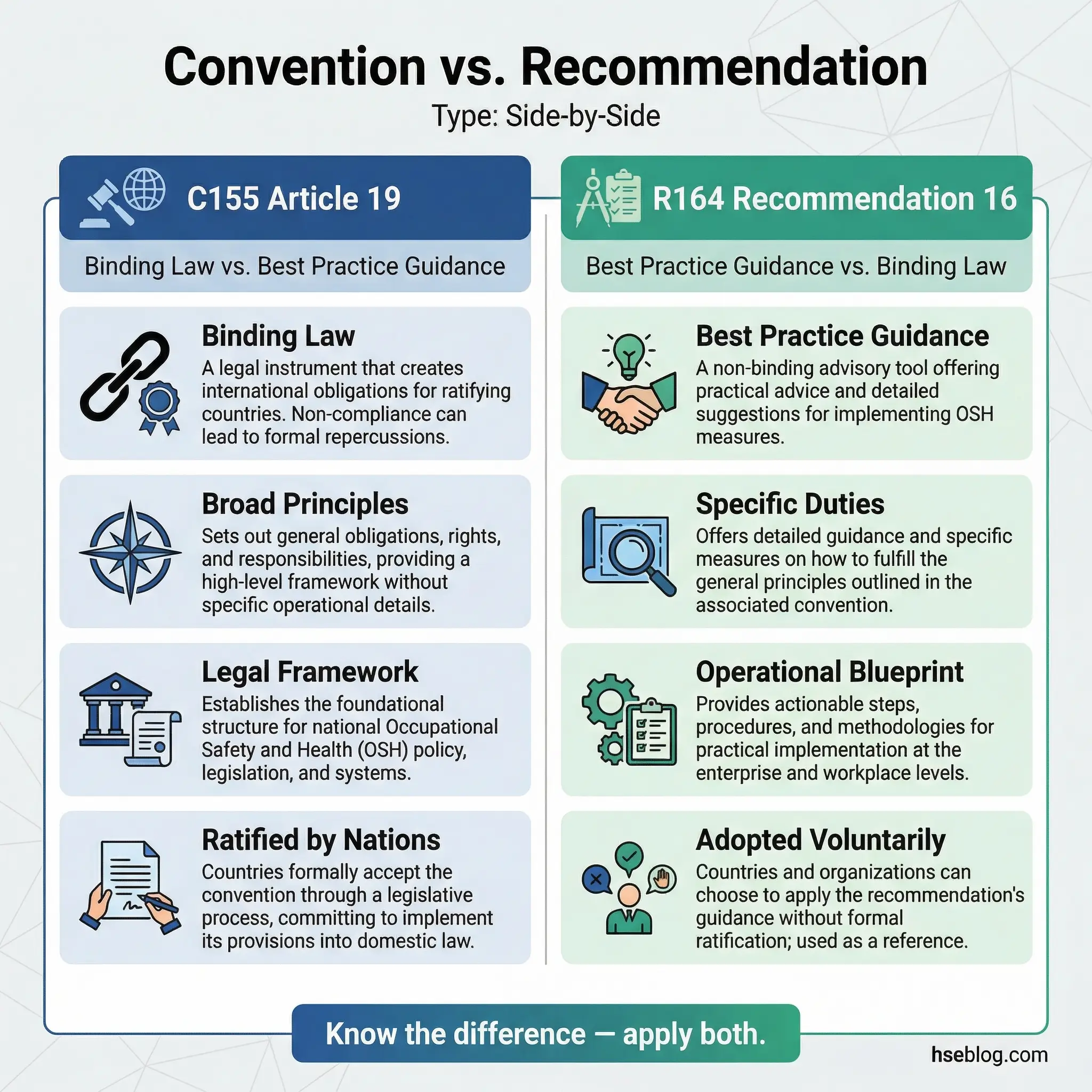
The following table clarifies the distinction between the Convention and the Recommendation:
| Aspect | C155 Article 19 (Convention) | R164 Recommendation 16 (Recommendation) |
|---|---|---|
| Legal status | Binding on ratifying member states | Non-binding guidance; best practice |
| Scope | Establishes the principle of worker cooperation and reasonable care | Details specific worker duties and practical responsibilities |
| Enforcement | Must be translated into national law; enforceable through legislation | Informs national policy; not directly enforceable |
| Level of detail | Broad — two overarching obligations | Specific — five or more defined duties |
| Practical function | Sets the legal framework for worker accountability | Provides the operational content for site-level implementation |
| Relationship | The foundation | The application manual |
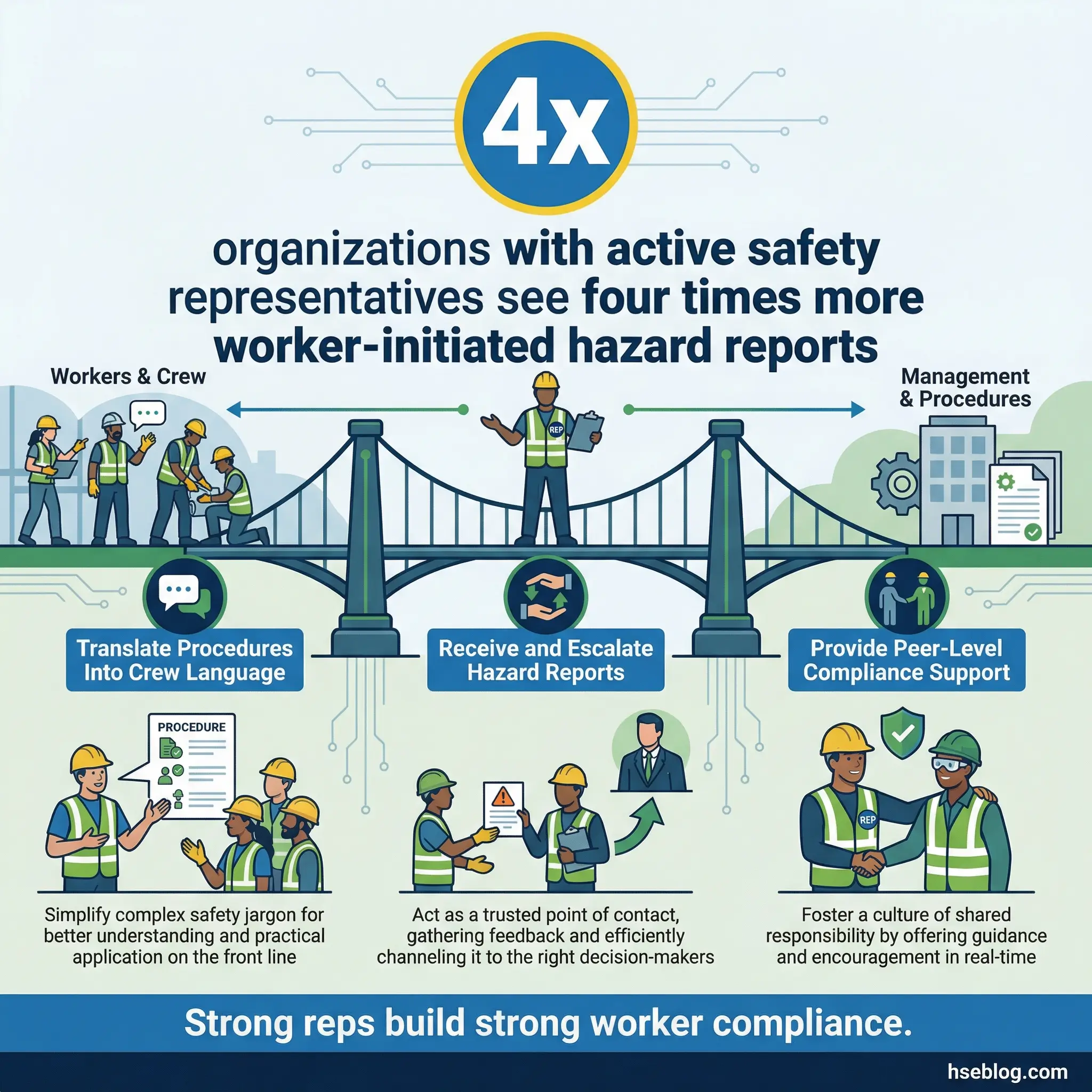
In practice, a well-designed safety management system uses Article 19 as the legal anchor and Recommendation 16 as the operational blueprint. I recall auditing a water treatment plant construction project where the HSE manager had built the entire worker responsibility section of the site safety plan around R164 Paragraph 16. Each duty was translated into a site-specific rule, backed by a training module, and tracked through monthly compliance observations. The result was measurable: lost-time injury rates dropped by 35% over two years, and worker-initiated hazard reports increased fourfold.
Recommendation R164 supplements Convention C155 by providing detailed, practical guidance that transforms broad legal principles into enterprise-level worker duties.
The mistake I see most often is organizations treating C155 and R164 as interchangeable labels. They cite “ILO requirements” without specifying whether they mean the binding convention or the non-binding recommendation. This creates confusion during external audits and, more importantly, during incident investigations when the question of worker responsibility becomes central.
Worker Cooperation in Practice: What It Looks Like on Site
The word “cooperation” in Article 19 carries more weight than most workers — and many managers — realize. Cooperation is not just obeying instructions. It is an active, ongoing engagement with the safety management system that requires workers to think, participate, communicate, and take ownership of safety outcomes alongside their employer.
Here is what genuine worker cooperation looks like on a real job site, based on situations I have directly observed or investigated:
- Attending and engaging in toolbox talks: Not just signing the attendance sheet, but asking questions, flagging concerns from the previous shift, and confirming understanding of the day’s specific risks. On a pipeline construction project in Central Asia, I observed a welder challenge the toolbox talk content because the weather conditions had changed overnight. That is cooperation.
- Participating in risk assessments: Workers contribute their frontline knowledge to task-specific risk assessments and method statements. A crane operator who identifies a wind-speed concern before the lift proceeds is fulfilling this duty.
- Supporting safety representatives: Cooperation means assisting elected or appointed safety representatives in carrying out inspections, collecting feedback, and raising concerns through formal channels.
- Stopping unsafe work: Where stop-work authority exists, using it is the highest form of cooperation. I have signed off on incident reports where a worker stopped a confined space entry because the gas test readings were borderline. That single decision prevented a potential fatality.
- Using control measures as designed: This means wearing the correct PPE for the task, not a generic substitute. It means following the permit-to-work conditions exactly — not the version the crew “usually” follows.
Pro Tip: During site inspections, ask workers: “How did you cooperate with safety today?” If they can only answer “I wore my helmet,” they do not understand cooperation as defined by C155 Article 19. Target your training accordingly.
Common Failures in Worker Responsibility: Where the System Breaks Down
Knowing what workers should do is only half the picture. Understanding where and why they fail to meet these responsibilities is what separates a theoretical safety programme from one that actually prevents injuries. I have investigated enough incidents and audited enough management systems to identify recurring patterns of worker responsibility failure.
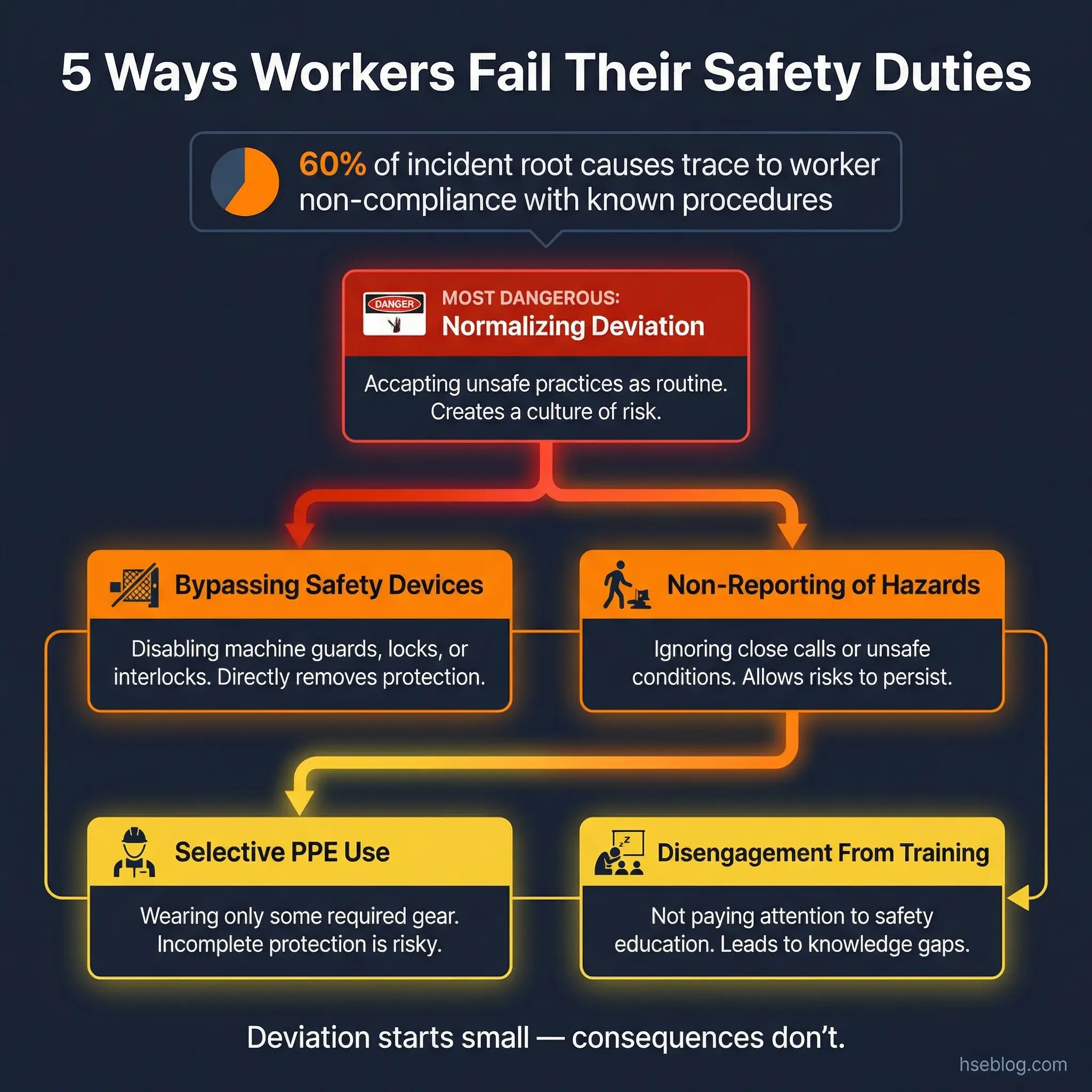
The following failures appear across industries, geographies, and organizational sizes — they are systemic, not isolated:
- Non-reporting of hazards and near-misses: Workers withhold reports because they fear blame, believe nothing will change, or consider the hazard too minor. This directly violates Recommendation 16’s reporting duty and deprives the management system of critical risk intelligence.
- Selective PPE compliance: Workers wear the PPE that is visible to supervisors (hard hat, high-visibility vest) but neglect less visible items (hearing protection, safety glasses, cut-resistant gloves). During a noise survey at a metal fabrication plant, I found 60% of workers in the grinding bay had hearing protection hanging around their necks rather than inserted in their ears.
- Bypassing safety devices: Machine guards removed “for faster production.” Interlocks defeated with zip ties. Gas detectors left in the control room instead of carried into the field. Each of these violates the R164 duty to use safety devices correctly.
- Failure to participate in training: Workers attend mandatory training physically but disengage mentally. They sign attendance logs for sessions they slept through. The duty to cooperate includes genuine engagement in competency development.
- Normalizing deviation: Over time, workers accept shortcuts as standard practice. A procedure that requires three people gets done by two. A lockout step gets skipped because “we’ve always done it this way.” This drift from standard is one of the most dangerous forms of non-cooperation.
The root cause behind most of these failures is not worker laziness or deliberate defiance. In my experience, it is almost always a training gap, a supervision gap, or a system gap. Article 19 places duties on workers — but those duties only function when the employer has fulfilled the corresponding obligations under Articles 16 and 17 of C155 to provide safe systems, adequate training, and effective supervision.
Why Worker Responsibilities Cannot Exist in Isolation
One of the most common misapplications of Article 19 and Recommendation 16 that I encounter during audits is employers using worker responsibilities as a shield against their own accountability. I have sat in incident review meetings where a senior manager pointed to Article 19 and argued: “The worker had a duty to cooperate. He didn’t. The failure is his.” That argument collapses under scrutiny every time.
Worker responsibilities under C155 and R164 are explicitly designed as complementary obligations — they function only within a system where the employer has already met a comprehensive set of duties. The ILO framework is structured this way deliberately.
The employer must provide before the worker can comply:
- Safe systems of work that are documented, communicated, and practically achievable
- Adequate information and training so the worker understands what the procedures are, why they exist, and how to follow them
- Appropriate PPE and safety equipment that fits, functions, and is available when needed
- Competent supervision that monitors compliance, corrects deviations, and reinforces standards
- A reporting system that is accessible, responsive, and free from retaliation
- Consultation mechanisms that give workers a genuine voice in safety decisions
When I investigate incidents where worker non-compliance is cited as a contributing factor, my first question is always: “What did the employer provide, and was it adequate?” In over a decade of field experience, I have never once found a case where pure worker failure existed in a vacuum. There is always a system failure underneath — a missing procedure, an inadequate training record, a supervisor who looked the other way, or a PPE supply chain that broke down weeks before the incident.
Worker duties under ILO C155 and R164 are not standalone obligations. They are the second half of a two-part system in which employer duties must be fulfilled first.
Pro Tip: If you are an HSE professional preparing for an audit or incident investigation, always assess employer compliance with C155 Articles 16–18 before evaluating worker compliance with Article 19. The worker’s obligation to cooperate presupposes that there is something competent to cooperate with.
Practical Steps to Implement C155 Article 19 and R164 Recommendation 16 on Site
Translating international convention language into site-level practice requires deliberate effort. These provisions do not implement themselves, and posting the text on a notice board accomplishes nothing. The following steps have worked consistently across projects I have managed or audited, from petrochemical facilities to infrastructure construction sites.
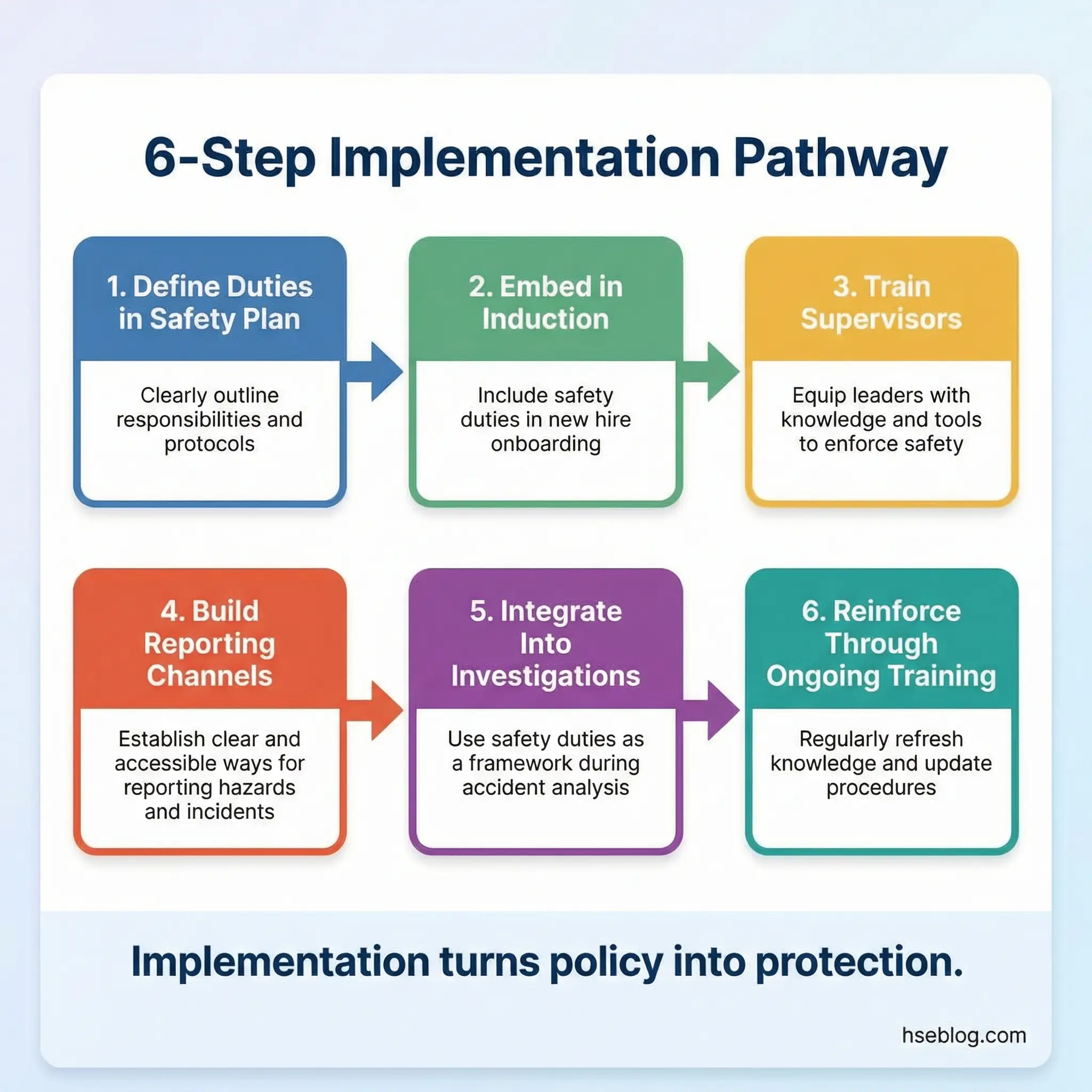
Effective implementation follows a structured approach:
- Incorporate worker duties into the site safety plan: Write each Recommendation 16 duty as a specific, measurable site rule. Replace “workers shall cooperate” with “all workers shall participate in daily pre-start briefings and sign the task risk assessment before commencing work.”
- Build worker duties into the induction programme: Dedicate a module of site induction to worker responsibilities under the ILO framework. Explain each duty with site-specific examples. Test comprehension before sign-off.
- Train supervisors to monitor and reinforce cooperation: Supervisors must know what cooperation looks like so they can recognize it, reinforce it, and correct its absence. Provide supervisors with observation checklists aligned to Recommendation 16 duties.
- Establish accessible, no-retaliation reporting channels: A worker cannot fulfil the duty to report hazards if the reporting system is inaccessible, bureaucratic, or punitive. Simplify reporting. Respond visibly to every report.
- Include worker responsibilities in investigation protocols: When investigating incidents, assess worker compliance with Article 19 duties as a standard investigation element — not to assign blame, but to identify where the cooperation system failed.
- Review and update worker duty communication regularly: Worker responsibilities are not a one-time induction topic. Reinforce them through toolbox talks, safety stand-downs, and periodic refresher training tied to real incident lessons.
The Role of Safety Representatives in Supporting Worker Duties
Recommendation 16 of R164 does not operate in a vacuum — it connects directly to the role of workers’ safety representatives, whose function is recognized across ILO instruments and most national safety frameworks. Safety representatives act as the bridge between the workforce and management, and their effectiveness directly influences whether workers can fulfil their duties under Article 19.
In every strong safety culture I have assessed, the safety representative played a specific, practical role in enabling worker compliance:
- Translating procedures into frontline language: Safety representatives rewrite complex management system documents into language the crew actually understands and uses. On a tunneling project in Western Australia, the safety rep created single-page “duty cards” for each R164 obligation — laminated and kept in every worker’s pocket.
- Receiving and escalating hazard reports: Workers often report hazards to their safety representative before going to a supervisor. The representative must know how to document, escalate, and follow up.
- Monitoring compliance without punitive authority: Safety representatives observe work practices and provide peer-level feedback. They are not enforcement officers — they are support systems that reinforce the cooperation duty.
- Participating in incident investigations: Representatives ensure the worker perspective is captured during investigations. This prevents the “blame the worker” bias that distorts root cause analysis.
Pro Tip: Measure the effectiveness of your safety representative system by tracking one metric: the ratio of worker-initiated hazard reports to supervisor-initiated reports. If supervisors are finding most hazards, the representative system is underperforming and workers are not fulfilling their reporting duty.
Conclusion
Article 19 of ILO Convention C155 and Recommendation 16 of R164 together define the worker’s role in occupational safety — not as a passive recipient of employer-driven rules, but as an active, accountable participant in a system designed to prevent harm. Every worker who enters a site carries a legal and moral duty to cooperate, to use the protections provided, to report what they see, and to take reasonable care for the people around them. These are not theoretical obligations. They are the practical foundation on which every toolbox talk, every permit, and every risk assessment depends.
The most effective safety management systems I have audited share one characteristic: workers understand their own responsibilities as clearly as they understand their employer’s. They know that cooperation is not compliance theater — it is a personal commitment that directly prevents injuries. When workers and employers both fulfil their respective duties under C155 and R164, the gap between policy and practice closes, and the management system starts protecting people instead of just producing paperwork.
No convention, no regulation, and no management system can protect a worker who does not participate in their own safety. The framework exists. The responsibilities are defined. The only question is whether the people on the ground — workers and supervisors alike — treat those duties as real obligations or as words on a page they never read. That difference, in my experience, is the difference between a site where people go home safe and one where someone eventually does not.