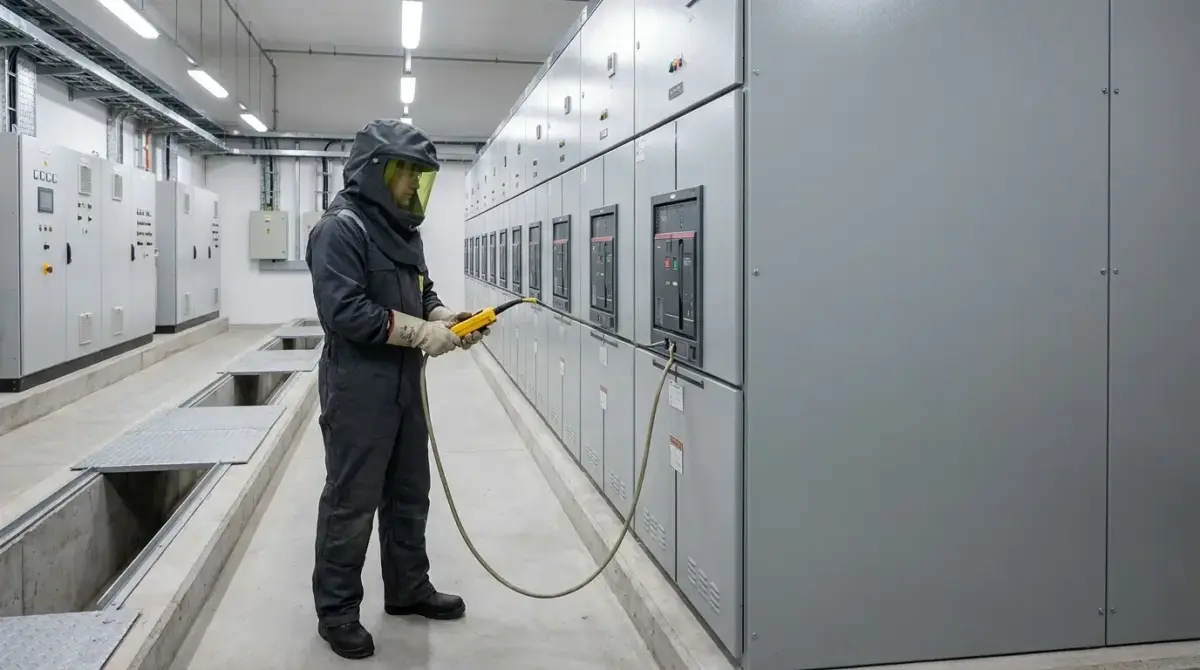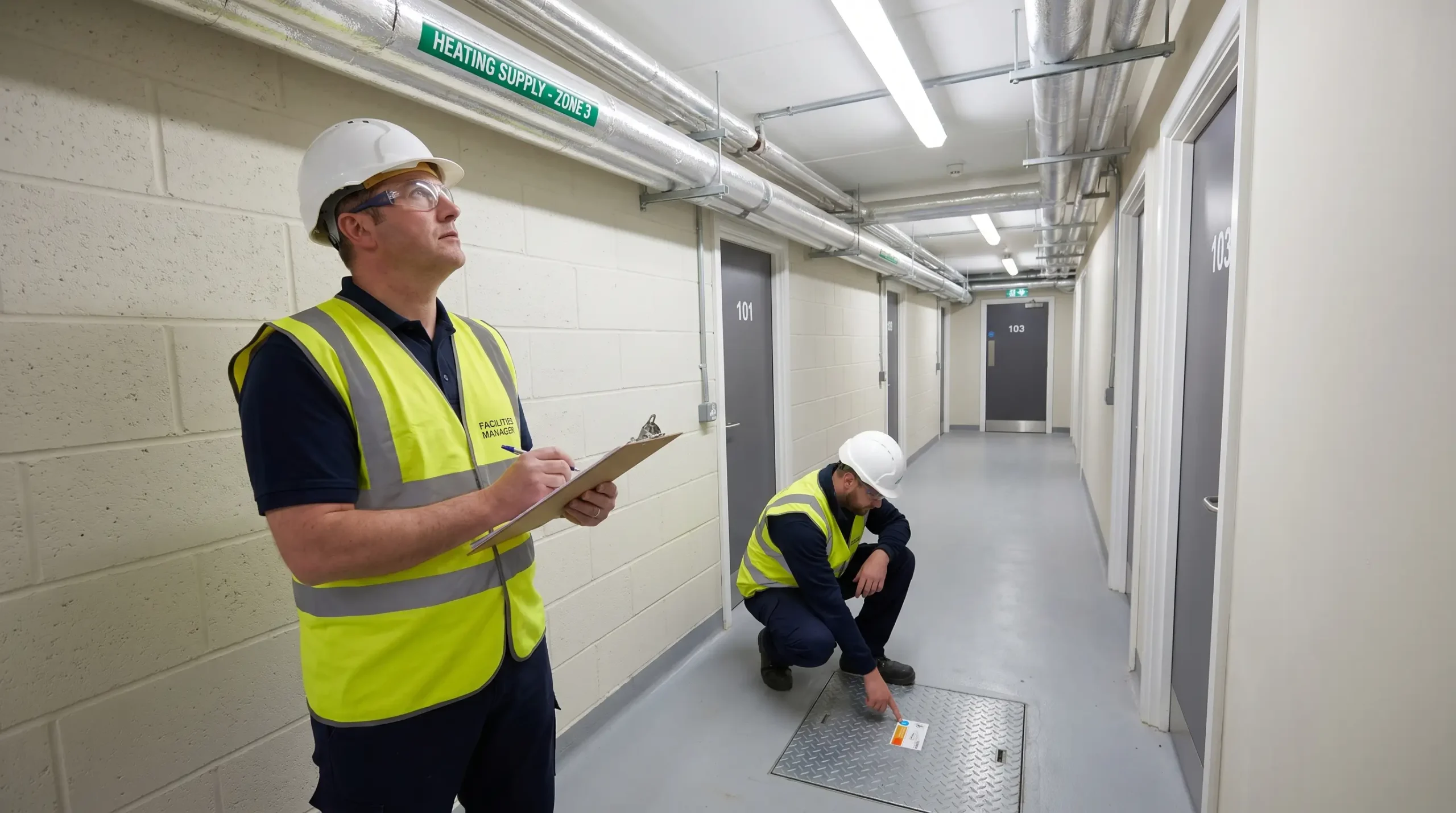
An asbestos register is a live compliance document that records the identification, location, type, quantity, condition, and risk assessment of all known and presumed asbestos-containing materials (ACMs) in a building. Under UK law (CAR 2012, Regulation 4), it must be kept current and made available to anyone who may disturb ACMs. In Australia, WHS Regulations 2011 (Clause 425) impose equivalent duties on the person with management or control of a workplace.
What Is an Asbestos Register and Why Is It a Legal Requirement?
An asbestos register is not a one-off report — it is a structured, continuously maintained record of every known and presumed asbestos-containing material in a building. Its purpose is to ensure that anyone who might disturb building fabric — a plumber accessing ceiling voids, an electrician drilling into walls, or a demolition crew preparing for strip-out — knows exactly where asbestos is before they start work.
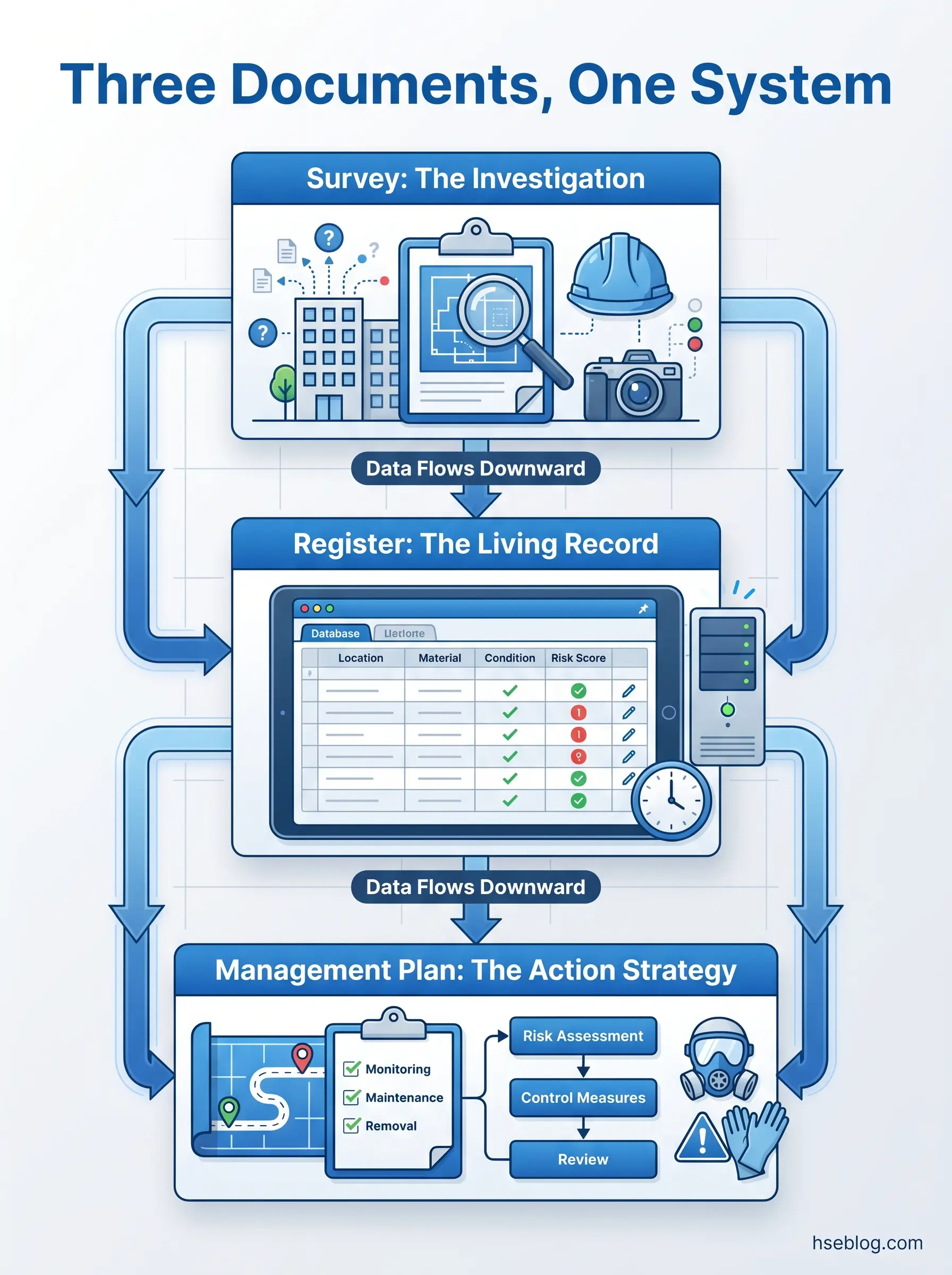
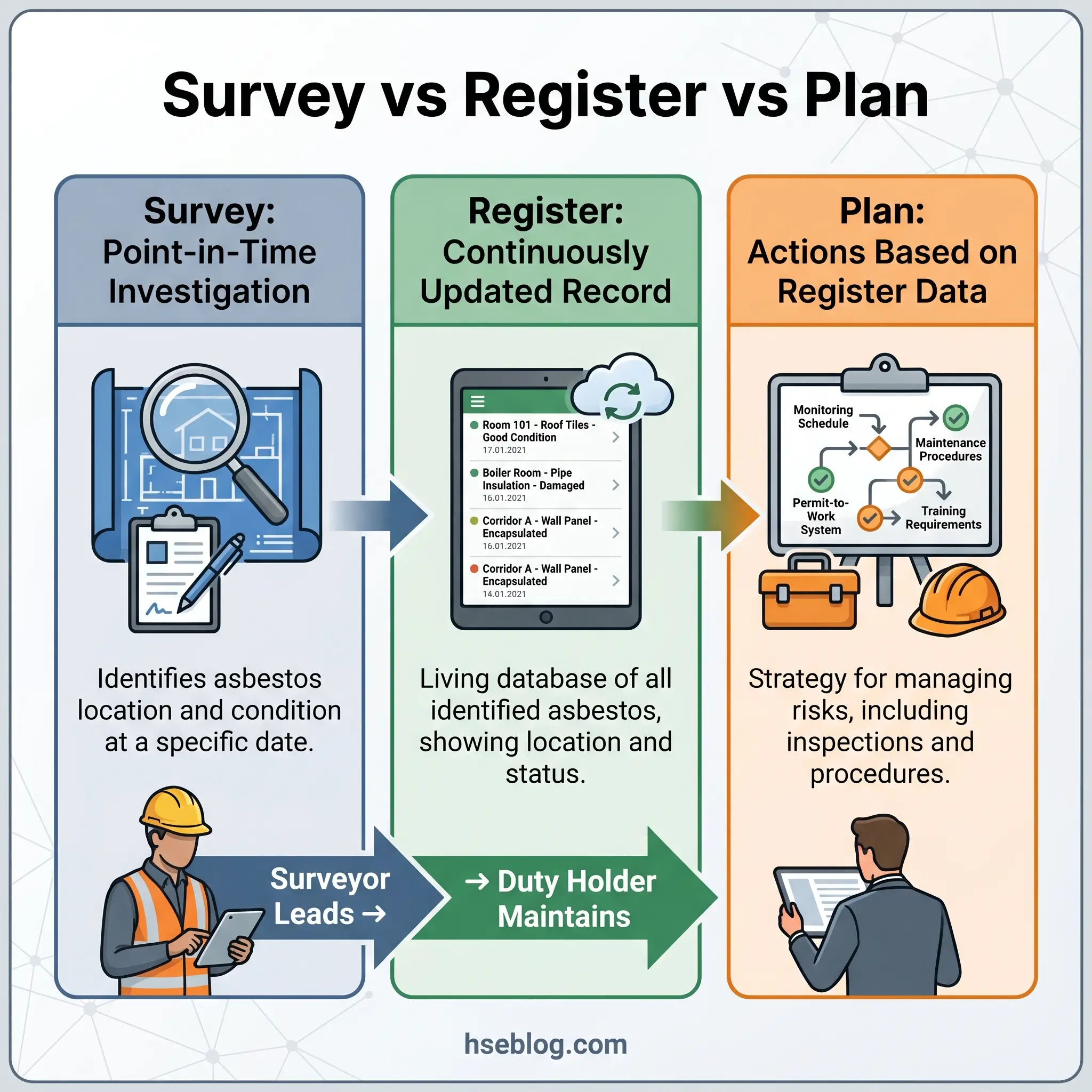
Three documents serve different functions in asbestos management, and conflating them is one of the most common compliance errors:
- The survey is the investigation — a competent person inspects the building and collects data.
- The register is the structured record — it organises survey findings into a format that can be maintained and consulted indefinitely.
- The management plan is the action strategy — it specifies what will be done about each ACM based on the register's risk assessments.
The register sits between the survey and the plan. Without a current register, the management plan operates on stale information.
The legal obligation to maintain a register applies across multiple jurisdictions, though the specific legislation and scope differ:
| Jurisdiction | Governing Law | Who It Applies To | Key Threshold |
|---|---|---|---|
| UK | CAR 2012, Regulation 4 | Duty holder: person with maintenance/repair obligation for non-domestic premises | Non-domestic premises; common parts of domestic buildings |
| Australia | WHS Regulations 2011, Clause 425 | PCBU with management or control of a workplace | Workplaces with buildings/structures built or refurbished before 31 December 2003 |
| US | OSHA 1910.1001 / 1926.1101; AHERA (schools) | Employers; school authorities | No direct building-level register duty equivalent to UK, but exposure monitoring records and AHERA school inspections serve analogous functions |
| EU | Directive 2009/148/EC | Implemented at national level | Requires risk assessment before maintenance/demolition; register specifics vary by member state |
One of the most persistent compliance failures is treating the register as a filing cabinet item. It gets produced after a management survey, bound into a folder, shelved alongside the fire risk assessment, and forgotten until an HSE inspector asks for it or a contractor demands to see it before starting work. At that point, the register may be three or four years out of date — ACMs may have been disturbed, removed, or deteriorated, and the register reflects none of it.
The register only functions as a safety tool if it is actively used as the reference point before any maintenance, refurbishment, or contractor access.
What Must an Asbestos Register Contain?
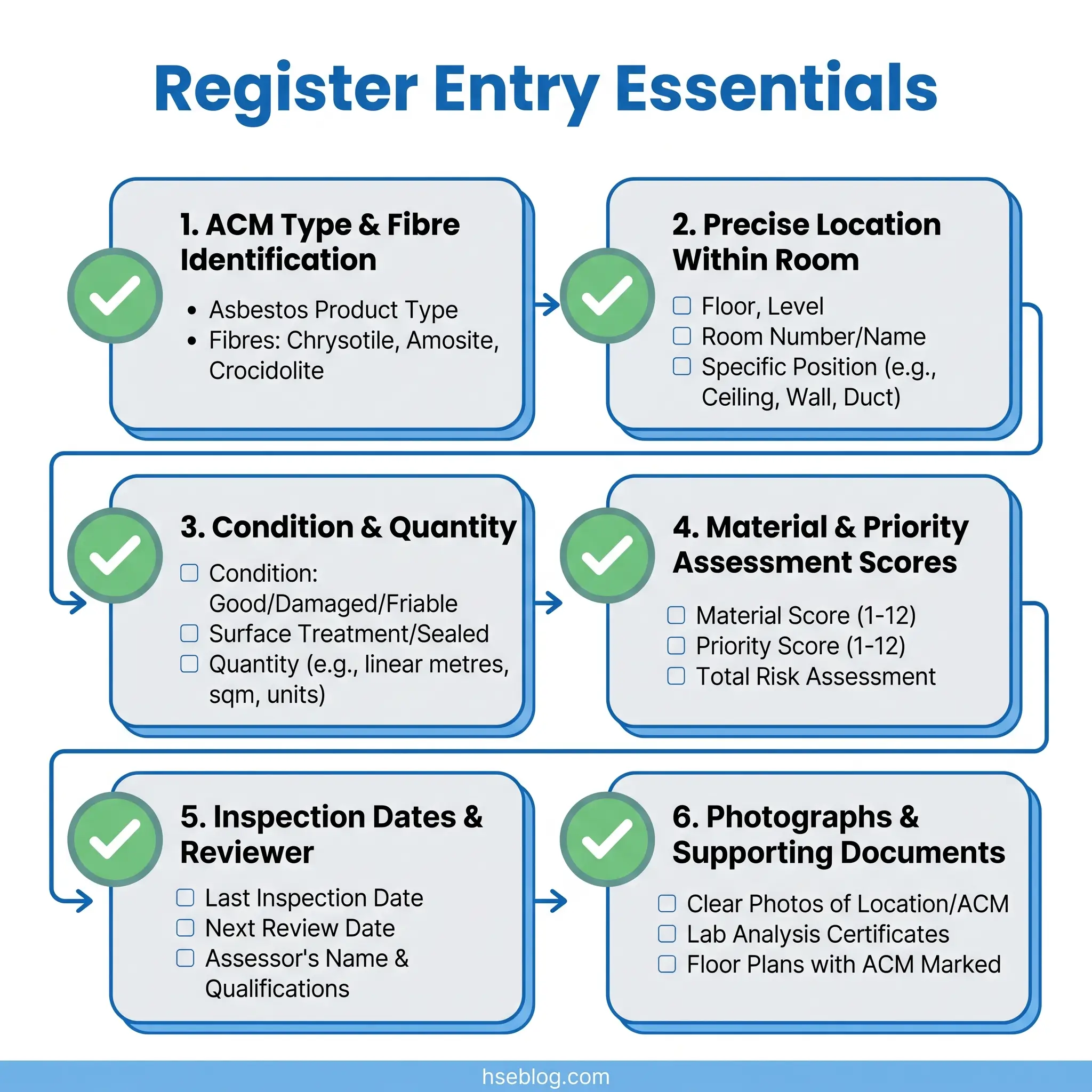
Every compliant asbestos register records the same core categories of information, though the depth and scoring methodology may vary between jurisdictions and surveying practices. The mandatory contents, drawn from CAR 2012 Regulation 4, the HSE Approved Code of Practice L143, and the HSE's register guidance, are as follows:
- Identification of all known and presumed ACMs. Every material confirmed or presumed to contain asbestos must appear in the register — including areas where asbestos is presumed because access for sampling was not possible.
- Location details — specific enough to find the ACM. Building, floor, room, and precise position within the room. A register entry that reads "amosite insulation — Plant Room" is far less protective than one reading "amosite insulation — pipework lagging, hot water main, east wall, 0.5m above floor level, Plant Room 2A."
- ACM type. The product type — chrysotile cement board, amosite pipe lagging, sprayed coating, floor tiles, textured coatings, and so on.
- Asbestos fibre type (where known). Chrysotile (white), amosite (brown), crocidolite (blue), or mixed. Fibre type affects the material assessment score because amphibole fibres (amosite, crocidolite) carry higher toxicity weighting than serpentine (chrysotile).
- Quantity or extent. The approximate area (m²), length (linear metres), or number of items for each ACM occurrence.
- Condition assessment. Current state: good condition, low damage, medium damage, or high damage. This feeds directly into the material assessment.
- Material assessment score. A numerical rating of fibre-release potential (see subsection below).
- Priority assessment score. A numerical rating of disturbance likelihood (see subsection below).
- Overall risk score. The combined material and priority score that determines the management response — monitor, encapsulate, seal, or remove.
- Date of original identification and most recent inspection. Without dates, there is no way to judge whether the condition assessment is current.
- Records of inaccessible areas. Where access was not possible during the survey, the register must record the location and the basis for the presumption of asbestos.
- Photographs (recommended). HSE guidance recommends photographs confirming ACM location and condition. Not strictly mandatory in every jurisdiction, but their absence weakens the register's usefulness for anyone who was not present during the survey.
In Australian jurisdictions, the register must also record details of activities likely to damage or disturb ACMs — connecting the register more directly to operational risk.
The granularity of location data is where register quality diverges most dramatically between a document that merely satisfies a regulatory checkbox and one that genuinely protects workers. A maintenance electrician sent to rewire a distribution board needs to know whether the wall behind that board contains asbestos insulating board — not just that "AIB is present on Floor 2."
Material Assessment: How Fibre-Release Risk Is Scored
The material assessment evaluates how readily an ACM can release respirable fibres into the air — its intrinsic hazard potential independent of whether anyone disturbs it.
Four variables drive the score, following the algorithm approach set out in HSG227:
- Product type (friability). Sprayed coatings and loose-fill insulation score highest because they release fibres with minimal disturbance. Cement-bonded products (roof sheets, floor tiles) score lowest because fibres are locked within a matrix.
- Extent of damage or deterioration. An ACM in good condition scores lower than one showing visible surface damage, exposed fibres, or water staining.
- Surface treatment. A painted, sealed, or encapsulated ACM scores lower than one with an exposed, untreated surface.
- Asbestos fibre type. Amphibole fibres (amosite, crocidolite) receive a higher weighting than chrysotile because of their greater biopersistence and carcinogenic potency.
Each variable receives a numerical score, and the combined total produces the material assessment rating for that ACM occurrence. The surveyor conducting the management survey typically provides this assessment in the survey report — the duty holder's role is to verify that the assessment aligns with currently observed conditions, not to recalculate it from scratch.
Priority Assessment: Likelihood of Disturbance
Where the material assessment is surveyor-led, the priority assessment demands input from the person who actually knows the building — the duty holder. This is the assessment that published enforcement patterns show is most frequently deficient.
The priority assessment scores variables including:
- Occupant activity level. A storage room accessed monthly scores differently from an open-plan office occupied eight hours daily.
- Likelihood of maintenance work. ACMs near building services (pipework, electrical risers, ceiling voids above distribution boards) have a higher disturbance probability than ACMs in areas maintenance teams rarely access.
- Frequency and type of area use. High-traffic corridors, plant rooms, and communal areas generate more vibration, impact, and potential contact.
- Extent of potential exposure. How many people could be affected, and for how long, if fibres were released?
The combined material and priority scores produce the overall risk rating that drives management decisions: low-risk ACMs may be managed in situ with periodic monitoring, while high-risk ACMs demand encapsulation, sealing, or removal.
The most dangerous registers are those where the priority assessment was completed entirely by a surveyor who walked through the building once. A boiler room scored "low disturbance likelihood" because the surveyor visited on a quiet day — while the maintenance team enters that room weekly. The priority assessment only produces reliable results when the person who knows the building's operational patterns validates or corrects the surveyor's initial assessment.
How an Asbestos Register Differs from an Asbestos Survey and Management Plan
The distinction between survey, register, and management plan is straightforward in principle but routinely blurred in practice. A common practitioner frustration is receiving a survey report that has been loosely reformatted into a "register" by the surveying company, but which lacks the priority assessment, omits action dates, and contains no provision for ongoing updates. That document is a survey report dressed as a register — it meets the data-gathering requirement but not the ongoing management requirement.
| Feature | Asbestos Survey | Asbestos Register | Asbestos Management Plan |
|---|---|---|---|
| Purpose | Investigate and identify ACMs | Record and risk-assess all ACMs as a living reference | Specify actions based on register data |
| Who produces it | Competent person / UKAS-accredited surveyor | Surveyor (initial), duty holder (ongoing) | Duty holder, informed by register |
| How often updated | New survey when required (refurbishment, demolition, or where register identifies gaps) | Continuously — annual review (UK), at least every five years (Australia) | Updated whenever register data changes or actions are completed |
| Legal reference (UK) | CAR 2012, Regulation 4; L143 | CAR 2012, Regulation 4; HSG227 | CAR 2012, Regulation 4; L143 |
| Legal reference (Australia) | WHS Regulations, various clauses | WHS Regulations, Clause 425 | WHS Regulations, Clause 429 |
The register exists to bridge the gap between a point-in-time survey and ongoing operational management. Every time an ACM is removed, encapsulated, re-inspected, or discovered during unplanned work, the register must be updated before the management plan can respond accurately.
In Australian jurisdictions, WHS Regulations explicitly require the register to be reviewed and, if necessary, revised at least every five years — even if no changes have been observed. This periodic review mandate does not exist in identically prescriptive terms in UK legislation, but the HSE's own guidance (L143) expects at least annual review of register contents as part of the wider management review cycle.
Who Is Responsible for Creating and Maintaining the Register?
Responsibility for the asbestos register does not sit with the surveyor — it sits with the person who controls the building. The surveyor produces the initial data. Ongoing maintenance of the register is the duty holder's legal obligation.
UK: The Duty Holder Under CAR 2012
Under Regulation 4 of the Control of Asbestos Regulations 2012, the duty holder is every person who has, by virtue of a contract or tenancy, an obligation for maintenance or repair of non-domestic premises. Where no such contractual obligation exists, the duty holder is the person in control of the premises or of access to them.
The practical reading of this clause on most multi-occupancy sites is that the landlord holds the duty for common areas and building structure, while tenants may hold duties for their demised areas depending on lease terms.
Australia: The PCBU
Under the WHS Regulations, the Person Conducting a Business or Undertaking (PCBU) with management or control of the workplace must prepare and keep the asbestos register. This duty attaches to the entity managing the workplace, not the building owner per se — though the two are often the same.
The Multi-Tenancy Gap
In multi-tenancy commercial buildings, register responsibility frequently falls through the gap between landlord and tenant:
- The landlord assumes the tenant manages asbestos in their own fit-out areas.
- The tenant assumes the landlord's register covers the whole building.
- Neither is correct. Lease terms determine the split, but the register must cover the entire building without gaps.
A single coordinated register maintained by the managing agent — with each party contributing data for their areas of responsibility — is the only approach that consistently prevents blind spots.
The duty holder must also ensure the register is available to anyone likely to work on or disturb the building fabric. This includes contractors, maintenance teams, emergency services, and (in Australian jurisdictions) any worker at the workplace. A register locked in a site manager's office, inaccessible outside business hours, fails this test even if its contents are otherwise compliant.
How Often Must an Asbestos Register Be Updated?
Annual re-inspection is the practical standard for competent asbestos management — regardless of the minimum regulatory floor in any given jurisdiction.
The specific frequencies and triggers differ:
Minimum Review Periods
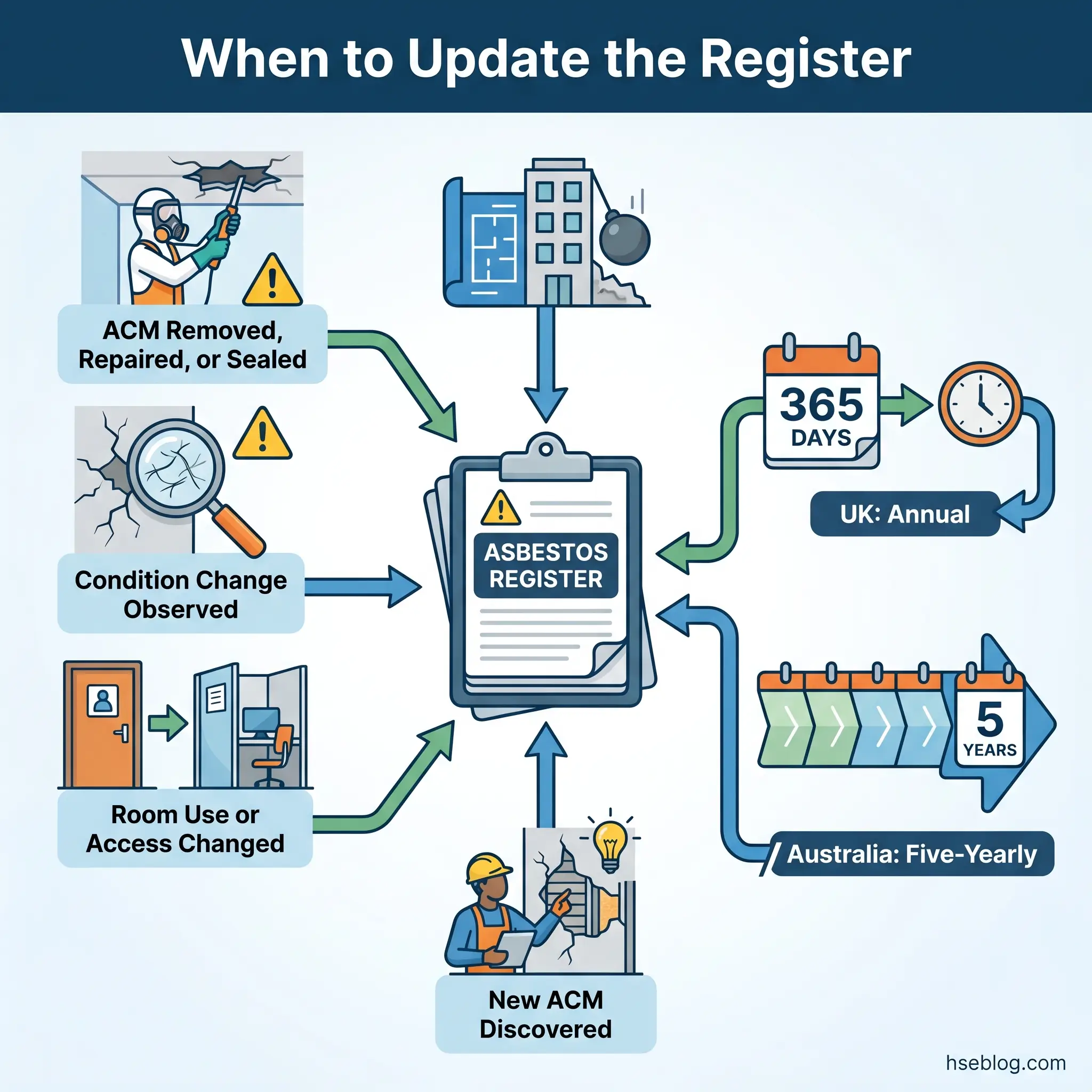
- UK (HSE guidance, L143): At least annually as part of the asbestos management review, or sooner if any change affects the risk from an ACM.
- Australia (WHS Regulations, Clause 425): At least every five years, or sooner if ACMs are removed, disturbed, or sealed; the management plan changes; or a health and safety representative requests a review.
Event-Driven Triggers (Universal)
These events require an immediate register update, regardless of scheduled review dates:
- ACM removed, repaired, or encapsulated. The register must reflect the current state — a register still listing removed ACMs misleads contractors.
- New areas surveyed. Previously inaccessible areas opened during refurbishment may reveal ACMs not in the original register.
- ACM condition deteriorated. Visible damage, water ingress, or physical impact changing the condition assessment.
- Room use changed. A storage area converted to a workshop alters the priority assessment.
- Refurbishment or demolition planned. A refurbishment/demolition survey may be required, and its findings must feed back into the register.
- New ACM discovered during maintenance work. Any unexpected find during building work demands immediate recording.
Registers that are "updated annually" in name only — where someone ticks a review date without physically inspecting ACM conditions — provide false assurance. A meaningful annual review involves walking the building, visually inspecting each recorded ACM location, noting any condition change, and documenting the reviewer's name and date. If the review can be completed in ten minutes from a desk, it is not a review.
What Happens If You Don't Have an Asbestos Register?
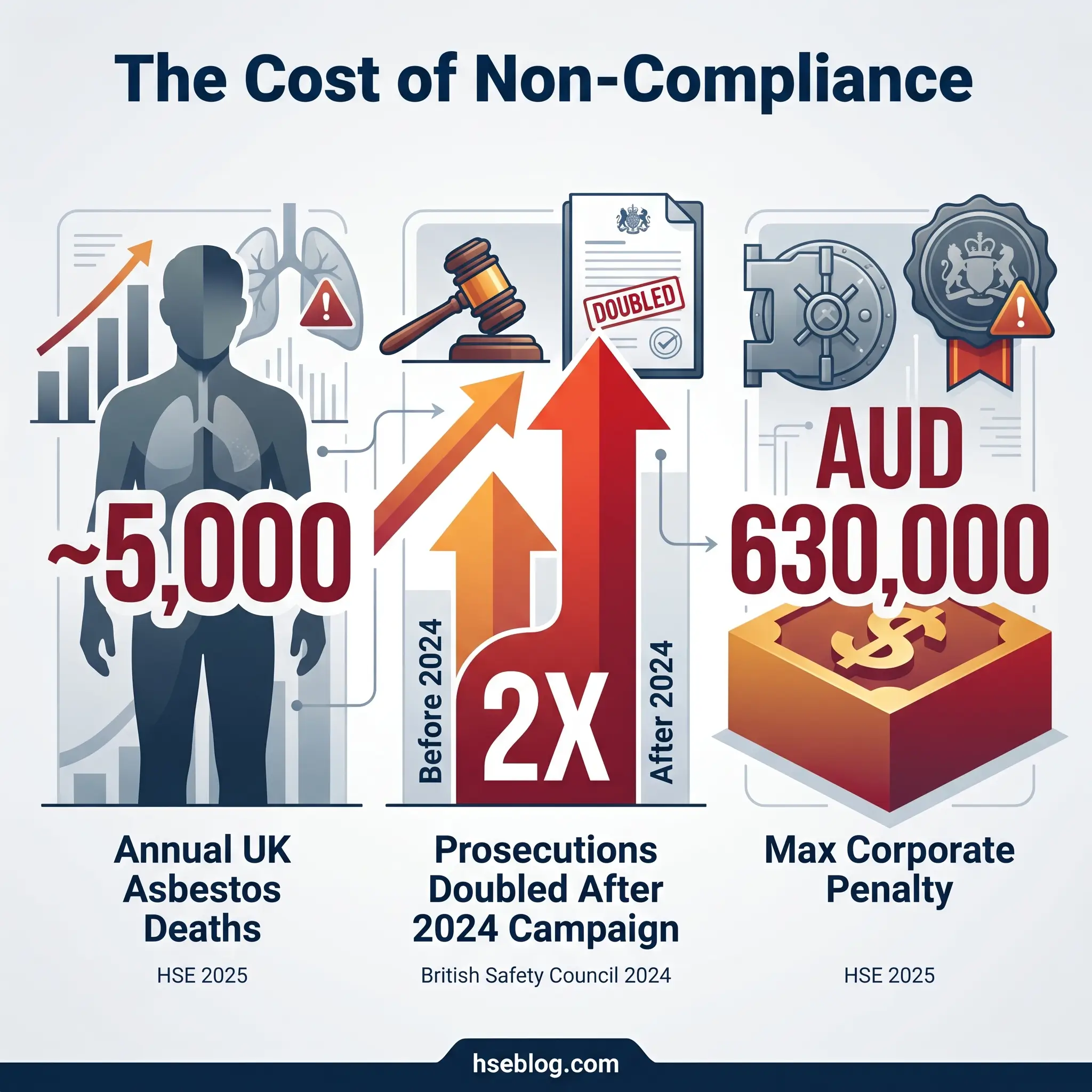
Approximately 5,000 asbestos-related disease deaths occur every year in Great Britain (HSE, 2025), including 2,218 mesothelioma deaths in 2023 alone (HSE, 2025) — substantially lower than the 2011–2020 annual average of 2,508, but still reflecting decades of past exposure. An absent or deficient register does not cause these deaths directly, but it creates the conditions for future uncontrolled exposure.
Enforcement Consequences
The enforcement landscape has shifted. Asbestos prosecutions under CAR 2012 more than doubled in the six months following HSE's "Asbestos: Your Duty" campaign launch in January 2024 compared to the prior six months (British Safety Council, 2024). The pattern is clear: HSE increasingly prosecutes for management failures — absent or outdated registers and plans — rather than waiting for an exposure incident to trigger reactive enforcement.
In the UK, breach of Regulation 4 of CAR 2012 is a criminal offence. HSE can issue improvement notices, prohibition notices, or prosecute. Fines have reached hundreds of thousands of pounds, and custodial sentences have been imposed on directors in the most serious cases.
In Australia, penalties under the WHS Act can reach AUD 630,000 for a corporation and five years imprisonment for individuals.
Practical Safety Risk
Without a register, contractors and maintenance workers have no way to know where ACMs are located before they start work. The result is accidental disturbance — drilling into asbestos insulating board, cutting through asbestos cement, or disturbing lagging during pipework repairs — with fibre release into occupied areas.
Liability Exposure
A poorly maintained or absent register can serve as evidence of negligence in personal injury claims. Where a worker develops an asbestos-related disease and the employer or building owner cannot demonstrate that a compliant register was in place and accessible, the liability position is significantly weakened.
The register's absence is no longer just an enforcement gap waiting to be discovered. In the current regulatory climate, it is an active trigger for prosecution.
Asbestos Register Template: What a Compliant Register Looks Like
The best registers are structured around building zones or rooms rather than around ACM types. The reason is practical: the person consulting the register — a plumber, electrician, or demolition contractor — thinks in terms of "where am I working?" not "what type of asbestos exists in this building generally?"
Core Structural Elements
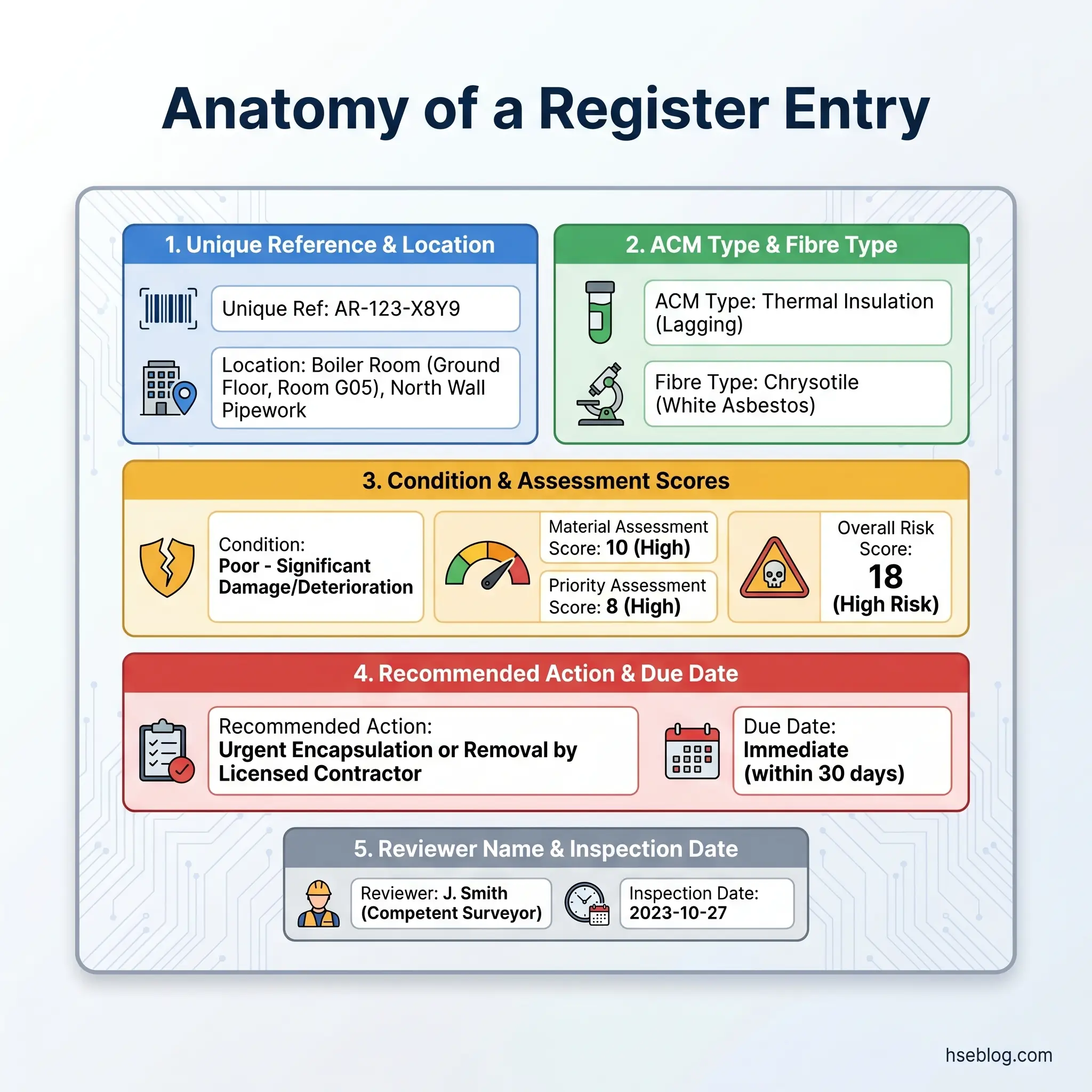
A compliant register template includes the following fields for each ACM entry:
- Unique reference number — a systematic identifier per ACM occurrence (e.g., B1-GF-PR01-001).
- Building / floor / room / precise location — specific enough for a contractor unfamiliar with the building to locate the ACM without assistance.
- ACM type and asbestos fibre type — product description and fibre identification (if known from analysis).
- Condition assessment — good, low damage, medium damage, high damage.
- Material assessment score — numerical rating per HSG227 algorithm.
- Priority assessment score — numerical rating validated by the duty holder.
- Overall risk score — combined rating driving the management response.
- Recommended action and due date — monitor, encapsulate, seal, or remove, with a target completion date.
- Action completed date — recorded once the action is carried out.
- Reviewer name and inspection date — accountability for each review cycle.
Official Templates
HSE provides both an example register and a blank register template in PDF and Word format. Safe Work Australia's model code of practice includes an example register format aligned with WHS Regulations.
These templates provide the minimum structural framework. Many organisations add fields for photograph references, laboratory sample numbers, next re-inspection dates, and links to the corresponding management plan actions.
Digital vs Paper
HSE confirms that registers can be maintained in paper or electronic format. For single-building duty holders, a well-maintained paper register may be adequate. For portfolios with multiple buildings, electronic systems offer substantial advantages: version control, automated review reminders, multi-user access, and the ability to generate contractor-specific extracts showing only the ACMs in areas where work is planned.
Regardless of format, the critical test is whether a contractor unfamiliar with the building can locate every recorded ACM from the register alone — without needing to call the site manager for clarification.
Frequently Asked Questions
Is an asbestos register the same as an asbestos survey?
No. The survey is the investigation — a competent person inspects the building, takes samples, and identifies ACMs. The register is the structured, ongoing record produced from those survey findings. A survey report is a point-in-time snapshot. The register is a live document that must be updated whenever conditions change, ACMs are removed or disturbed, or new areas are surveyed. Treating a survey report as a register is a compliance failure because the survey report lacks the ongoing maintenance framework the register requires.
Do domestic properties need an asbestos register?
In the UK, Regulation 4 of CAR 2012 applies to non-domestic premises and common parts of domestic buildings — such as stairwells, corridors, and plant rooms in blocks of flats. Privately owned houses used solely for residential purposes are excluded from the duty to manage, though an asbestos survey remains advisable before any renovation work. In Australia, the register requirement applies to workplaces; premises used only for residential purposes are excluded.
Can I create my own asbestos register or does it need a professional?
The register itself can be compiled and maintained by the duty holder. However, the underlying data — the identification, sampling, and material assessment of ACMs — must come from a competent person. In the UK, this means a surveyor accredited by UKAS or holding equivalent recognised qualifications. In practice, most surveying firms produce the initial register from their management survey. The duty holder's critical role is validating the priority assessment against actual building use and maintaining the register through its lifetime.
How long must asbestos records be kept?
The register is a living document maintained for as long as any ACM — known or presumed — remains in the building. It is not a document with an expiry date. Separately, UK regulations require employee health records related to asbestos exposure to be kept for 40 years. Even after all ACMs have been removed, retaining historical register records is advisable for liability protection. A complete removal history demonstrates that the duty holder managed asbestos systematically.
Does an asbestos register need to include presumed asbestos?
Yes. Both UK and Australian regulations require the register to include materials presumed to contain asbestos. This applies where access for sampling was not possible during the survey, or where the duty holder has chosen to presume materials contain asbestos rather than commission intrusive testing. The register must record the location and the basis for the presumption. Presumed areas should not be treated as permanent entries — they should trigger follow-up access when the opportunity arises (during planned maintenance or refurbishment) to confirm or disprove the presumption.
Who should have access to the asbestos register?
The register must be readily available to anyone who may disturb ACMs during their work. This includes contractors, in-house maintenance teams, emergency services, and — in Australian jurisdictions — any worker at the workplace and health and safety representatives. "Readily available" means accessible at the point of need, not locked in a site office that no one can reach outside business hours. For buildings with multiple contractors, a pre-work briefing referencing the relevant register sections is the most reliable access method.
Where Asbestos Registers Commonly Fail
Reviewing registers across different building types reveals consistent failure patterns. These are not obscure edge cases — they are the errors that appear most frequently in enforcement actions and compliance audits.
Insufficient Location Granularity
The most widespread deficiency. "Floor tiles — Ground Floor" does not help a contractor working in a specific room. Registers that describe location at building or floor level rather than room and position level fail the basic utility test.
Unvalidated Priority Assessments
The surveyor's draft priority assessment is based on a single walkthrough. If the duty holder never reviews it against actual building activity patterns — who works where, how often maintenance teams access each area, what equipment generates vibration near ACMs — the priority scores do not reflect reality.
Stale Review Dates
A register showing "Last reviewed: 2019" in a building that has undergone fit-out changes, tenant turnover, and routine maintenance is not a current document. It may technically contain the right ACMs, but its condition assessments and priority scores are unreliable.
Presumed Areas Treated as Permanent
Where access was not possible during the survey, the register correctly records a presumption. The failure occurs when that presumption entry sits unchanged for years, even after maintenance work has opened up the area — and no one updated the register or arranged confirmatory sampling.
Removed ACMs Still Listed as Present
When ACMs are removed under a licensed removal project, the register must be updated to reflect the removal — including the date, the removal contractor, and the waste consignment note reference. Registers that still list removed ACMs mislead every subsequent contractor who consults them.
HSE launched a formal consultation in November 2025 proposing amendments to the Control of Asbestos Regulations 2012, including proposals to improve asbestos survey quality standards and clarify the four-stage clearance process (HSE, 2025). Any resulting regulatory changes could tighten register content standards further. Duty holders tracking these proposals through the HSE consultation page should consider how their current registers would stand up to strengthened requirements.
Separately, while the US EPA's 2024 finalisation of a ban on ongoing chrysotile asbestos uses (US EPA, 2024) concerns import and use rather than building registers directly, it signals the continuing global trajectory toward stricter asbestos management — reinforcing the importance of robust building-level records in every jurisdiction.
Conclusion
The asbestos register is not a document you produce once and archive. It is the operational backbone of building asbestos management — the reference that determines whether a contractor drills safely or unknowingly releases respirable fibres into an occupied space.
Three failures account for most non-compliant registers: location data too vague for a contractor to act on, priority assessments the duty holder never validated, and review dates that have long since passed without a physical re-inspection. Addressing these three weaknesses transforms a register from a regulatory checkbox into a document that genuinely protects the people working in and maintaining the building.
With HSE enforcement patterns shifting toward proactive prosecution of management failures and a formal consultation on strengthening CAR 2012 survey quality standards underway, the register is no longer a document that gets attention only after something goes wrong. The question for every duty holder is whether the register on file today would withstand an inspector's review tomorrow — and whether a contractor picking it up for the first time could locate every ACM without making a phone call.