The duty to manage asbestos, established under Regulation 4 of the UK's Control of Asbestos Regulations 2012, requires anyone responsible for the maintenance or repair of non-domestic premises to identify whether asbestos-containing materials are present, maintain a written register of their location and condition, prepare and implement a management plan to control exposure risks, and provide that information to anyone liable to disturb the materials. Non-compliance is a criminal offence carrying penalties up to unlimited fines and two years' imprisonment.
Regulatory content in this article reflects general HSE professional understanding of UK, US, and Australian requirements as of 2025. It is not legal advice. Specific compliance questions, enforcement situations, or prosecution risk should be directed to qualified legal counsel in the applicable jurisdiction.
Approximately 5,000 people still die every year in Great Britain from diseases caused by asbestos exposure (Health and Safety Executive, 2025). That figure makes asbestos the single largest cause of work-related death in the UK — not falls, not machinery, not chemical exposure. The material responsible was banned in 1999, yet the buildings containing it remain in use, and the legal duty to manage what is left inside them is enforceable, specific, and carries criminal penalties.
This article sets out exactly what the duty to manage asbestos requires in law and in practice. It covers who qualifies as a dutyholder, what the obligations involve operationally, where compliance most commonly fails, how enforcement is escalating, and how equivalent duties differ across the UK, US, and Australia. Where the law is clear, the requirements are stated directly. Where compliance consistently breaks down — and it does, in predictable ways — the failure patterns are identified so they can be prevented.
What Is the Duty to Manage Asbestos?
The duty to manage asbestos is a proactive, ongoing legal obligation requiring those responsible for non-domestic buildings to find, assess, and control asbestos-containing materials (ACMs) within them.
In the UK, this duty is codified in Regulation 4 of the Control of Asbestos Regulations 2012 (CAR 2012). The obligation first entered UK law through the Control of Asbestos at Work Regulations 2002 and came into force in May 2004. CAR 2012 consolidated and replaced earlier regulations, but the core duty remained: if you are responsible for maintaining a non-domestic building, you must take reasonable steps to determine whether ACMs are present and manage the risk they pose.
The scope is deliberately broad:
- Non-domestic premises — offices, factories, warehouses, shops, hospitals, schools, public buildings, and any commercial or industrial property.
- Common areas of certain domestic buildings — corridors, stairwells, foyers, lift shafts, roof spaces, and external communal areas in purpose-built flats and converted houses.
A critical feature of Regulation 4 is the presumption principle. Materials must be presumed to contain asbestos unless there is strong evidence to the contrary. Glass, solid wood, brick, and stone are obviously excluded — but plasters, ceiling tiles, floor tiles, insulation, textured coatings, and pipe lagging in pre-2000 buildings carry the presumption until a competent survey determines otherwise.
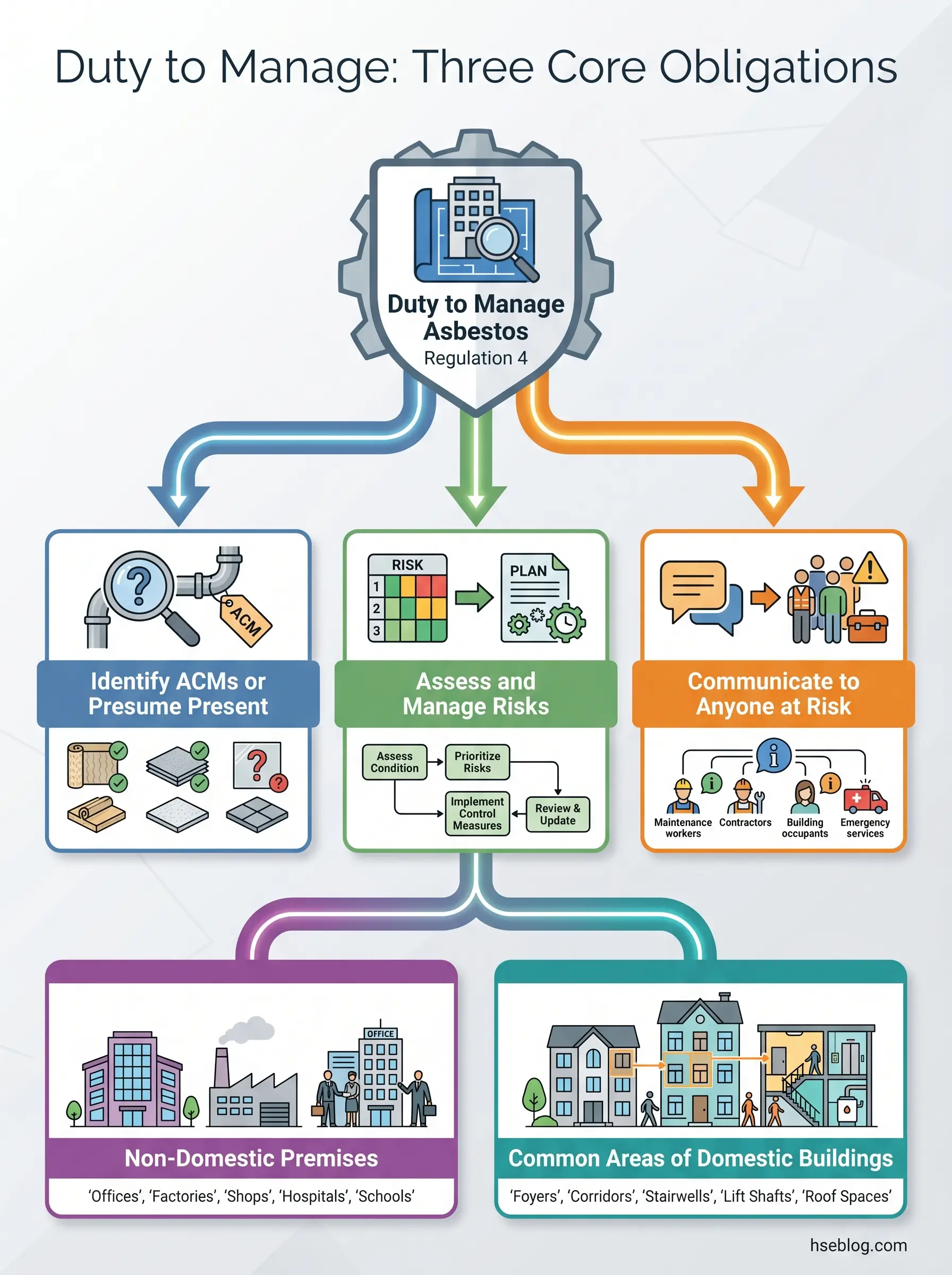
A recurring failure mode — visible across HSE enforcement notices and prosecution case files — is treating this duty as a one-off compliance exercise. Commission a survey, file the report, move on. Regulation 4 does not work that way. The duty is explicitly continuous: it requires monitoring, review, and action at regular intervals. A survey report gathering dust in a site office does not meet the obligation any more than an expired fire extinguisher meets fire safety requirements.
An estimated 300,000 non-domestic buildings constructed before 1999 in Great Britain still contain asbestos (IOSH, 2025). The duty to manage is the legal mechanism for ensuring those buildings do not become the source of the next generation of asbestos disease.
Who Is the Dutyholder Under Asbestos Regulations?
The dutyholder is the person who bears the legal obligation — and where multiple parties share responsibility for a building, there can be multiple dutyholders, each answerable for their portion.
Regulation 4(1) defines the dutyholder as every person who has, by virtue of a contract or tenancy, an obligation in relation to the maintenance or repair of non-domestic premises. Where no such contractual obligation exists, or where the position is unclear, the duty defaults to whoever has control of the premises or has a relationship with it that gives them effective control.
This is where compliance most frequently breaks down in practice — not through deliberate neglect, but through genuine confusion about who holds the duty.
Dutyholder Identification by Building Scenario
| Building Scenario | Who Holds the Duty | Common Pitfall |
|---|---|---|
| Owner-occupied commercial building | Building owner | Assuming the facilities contractor holds the duty |
| Single-tenant leased property | Depends on lease — typically whoever holds the repair obligation | Lease silent on maintenance; duty falls into a gap |
| Multi-tenancy building | Owner for common parts; tenants for their demised areas (per lease terms) | No coordination between dutyholders |
| Managing agent appointed | Agent may become dutyholder if they take on repair obligations | Agent assumes advisory role only, but contract says otherwise |
All non-dutyholders who have information about asbestos in the building have a legal obligation to cooperate with the dutyholder. This includes former occupants, previous surveyors, and contractors who may have encountered ACMs during earlier work.
When the Duty Applies to Domestic Properties
A persistent misconception is that domestic properties are entirely exempt from the duty to manage. They are not — at least, not entirely.
Individual private dwellings are excluded. A homeowner has no Regulation 4 obligation for their own house. But common areas of multi-occupancy domestic buildings fall squarely within scope.
This includes foyers, corridors, stairwells, lifts, lift shafts, roof spaces, external yards, outhouses, and garages serving purpose-built flats or converted houses. Private rooms within a shared house — shared kitchens or bathrooms — are not classified as common areas and fall outside the duty.
Social housing providers and housing associations frequently underestimate the scope of their obligations in communal areas. Roof voids and risers — areas that maintenance workers access routinely but residents rarely see — are particularly prone to being overlooked, despite being exactly the locations where ACMs from the building's original construction are most likely to remain undisturbed.
What Does the Duty to Manage Require in Practice?
The duty translates into a sequence of concrete actions. Each one is a legal requirement, not a recommendation — and each one must be demonstrable to an inspector.
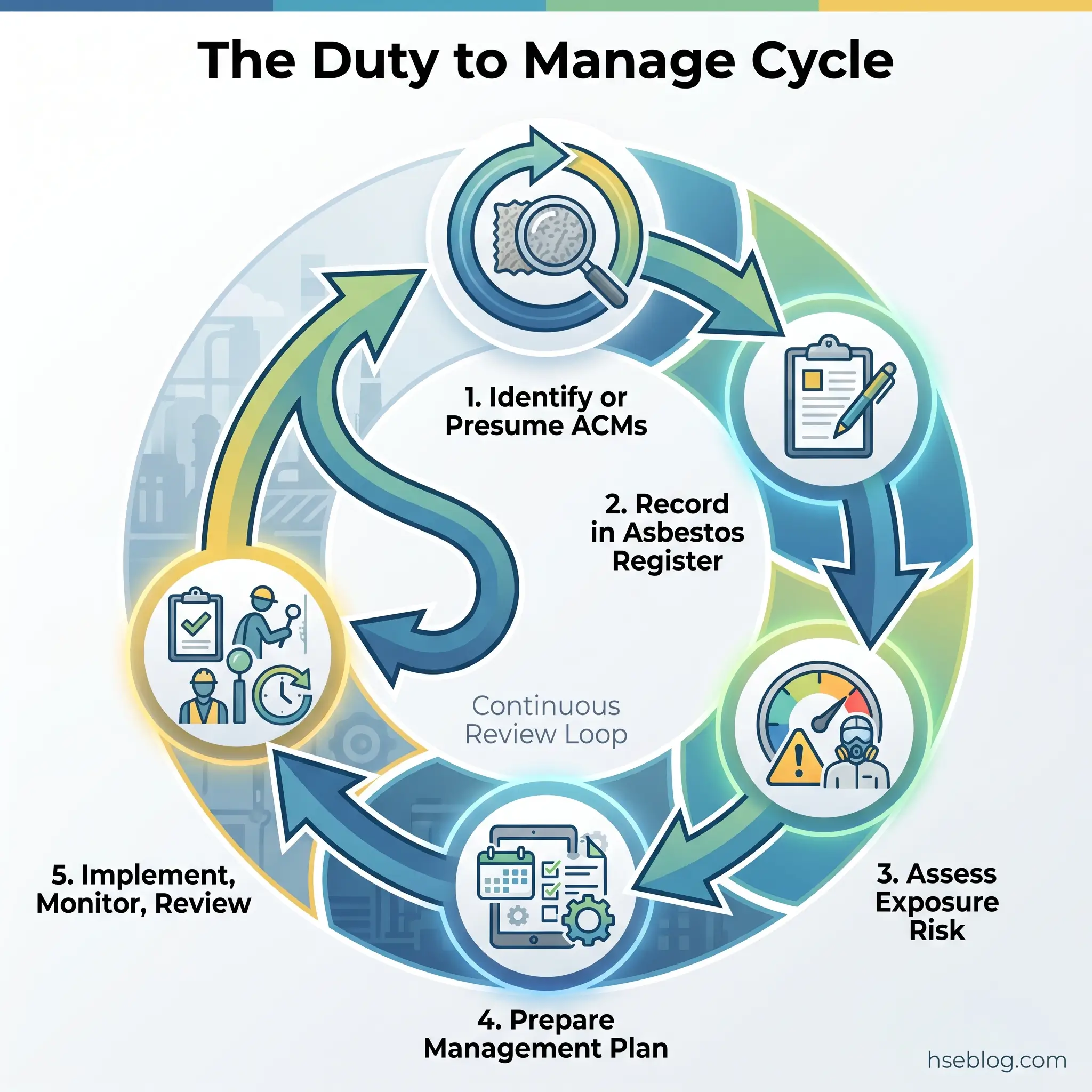
The required actions, in the order Regulation 4 and the HSE Approved Code of Practice L143 set out:
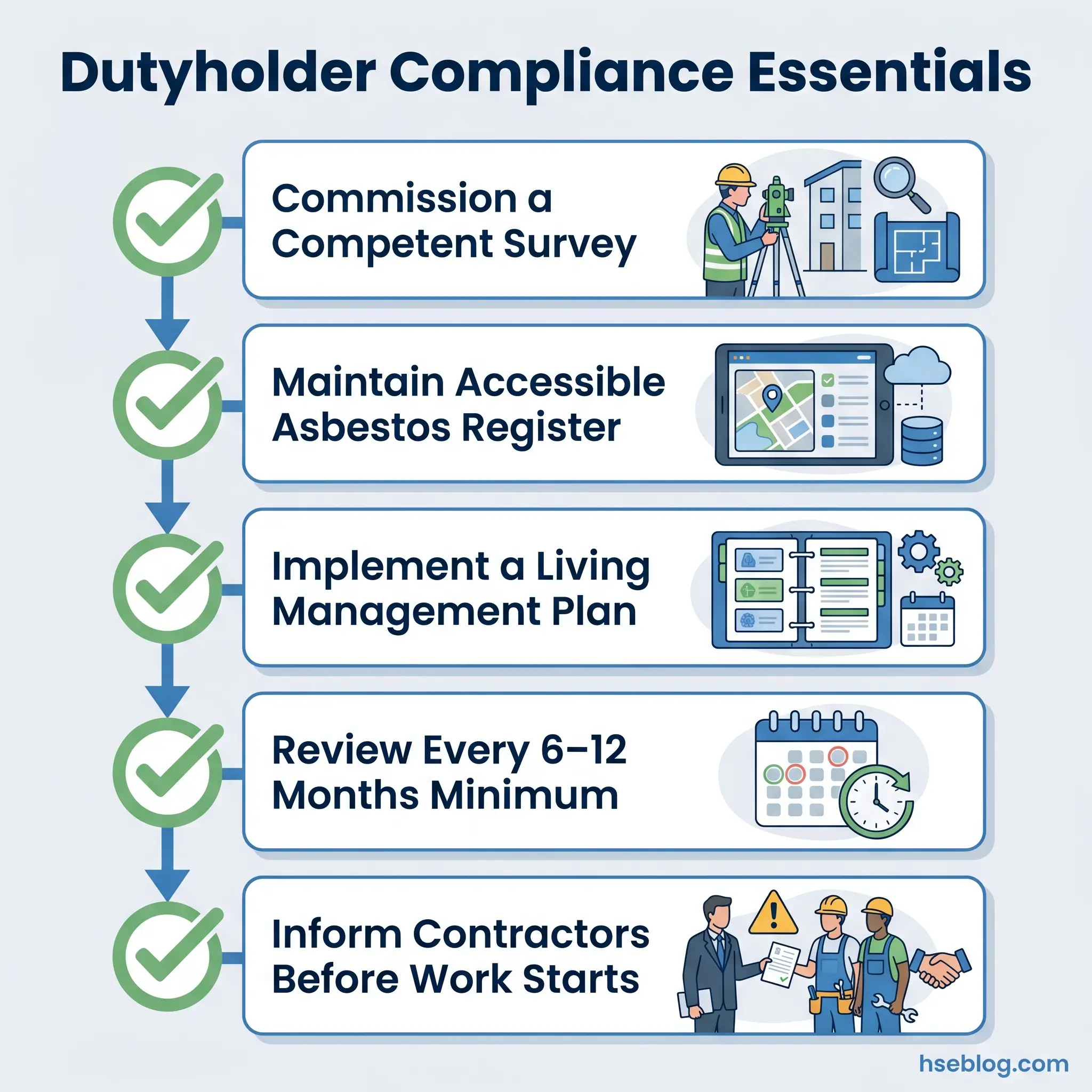
- Take reasonable steps to determine whether ACMs are present. This means commissioning a management survey for occupied buildings, or a refurbishment/demolition survey where structural work is planned. It does not mean guessing, and it does not mean assuming a post-1999 building is clear without evidence.
- Presume materials contain asbestos unless strong evidence proves otherwise. The burden is on the dutyholder to disprove the presence of asbestos — not on anyone else to prove it is there.
- Maintain a written asbestos register. The register must record the location, type, and condition of every confirmed or presumed ACM. It must be kept at the premises and be accessible to anyone who needs it — not locked in a head-office filing cabinet.
- Conduct a risk assessment for each identified or presumed ACM. The assessment considers the material's condition, its likelihood of being disturbed, and the potential for fibre release. A damaged, friable ACM in a high-traffic corridor presents a fundamentally different risk profile than encapsulated cement board in an undisturbed plant room.
- Prepare a written asbestos management plan. The plan must specify what control measures are in place for each ACM, who is responsible for implementing them, how ACM condition will be monitored, and what happens when something changes.
- Implement the plan and take action. Monitor ACM condition at defined intervals. Ensure maintenance work does not disturb ACMs without proper controls. Arrange licensed removal where required. Update the register after every intervention.
- Review the plan regularly — minimum every 6 to 12 months — and immediately after any significant change. Significant changes include building alterations, new tenants, damage to ACMs, or any incident involving potential asbestos disturbance.
- Provide information to anyone liable to disturb ACMs. This includes maintenance contractors, fit-out teams, IT cabling installers, emergency services, and any other person whose work could bring them into contact with asbestos materials.
The practical test for compliance is straightforward: if a contractor arrives to carry out maintenance, can they — before starting work — access the asbestos register and identify exactly which materials in their work area are confirmed or presumed ACMs? If the answer is no, the duty is not being met.
Asbestos Surveys: Types, Timing, and Legal Requirements
A management survey commissioned at the wrong time, or relied on for the wrong purpose, is one of the most expensive compliance errors a dutyholder can make.
Two types of asbestos survey exist under UK practice, and the distinction between them is not optional.
Management Survey vs Refurbishment and Demolition Survey
| Feature | Management Survey | Refurbishment & Demolition (R&D) Survey |
|---|---|---|
| Purpose | Locate ACMs that could be damaged during normal occupation and foreseeable maintenance | Locate all ACMs before structural work, including those hidden within the building fabric |
| Intrusiveness | Non-destructive or minimally intrusive — samples from accessible surfaces | Fully intrusive — requires access behind walls, above ceilings, within floor voids |
| When required | For all non-domestic premises as part of ongoing asbestos management | Before any refurbishment, renovation, or demolition work in the surveyed area |
| Building occupancy | Can be conducted during normal occupation | The area must be vacated; surveyor certifies fitness for reoccupation |
| Inaccessible areas | Must be recorded and presumed to contain asbestos | All areas must be accessed — no presumptions accepted |
| Competence standard | Competent person; HSE recommends UKAS-accredited surveyor | Competent person; HSE recommends UKAS-accredited surveyor |
A building may need both survey types simultaneously. The management survey covers ongoing occupation; the R&D survey covers a specific area planned for structural work. They serve different purposes and are not interchangeable.
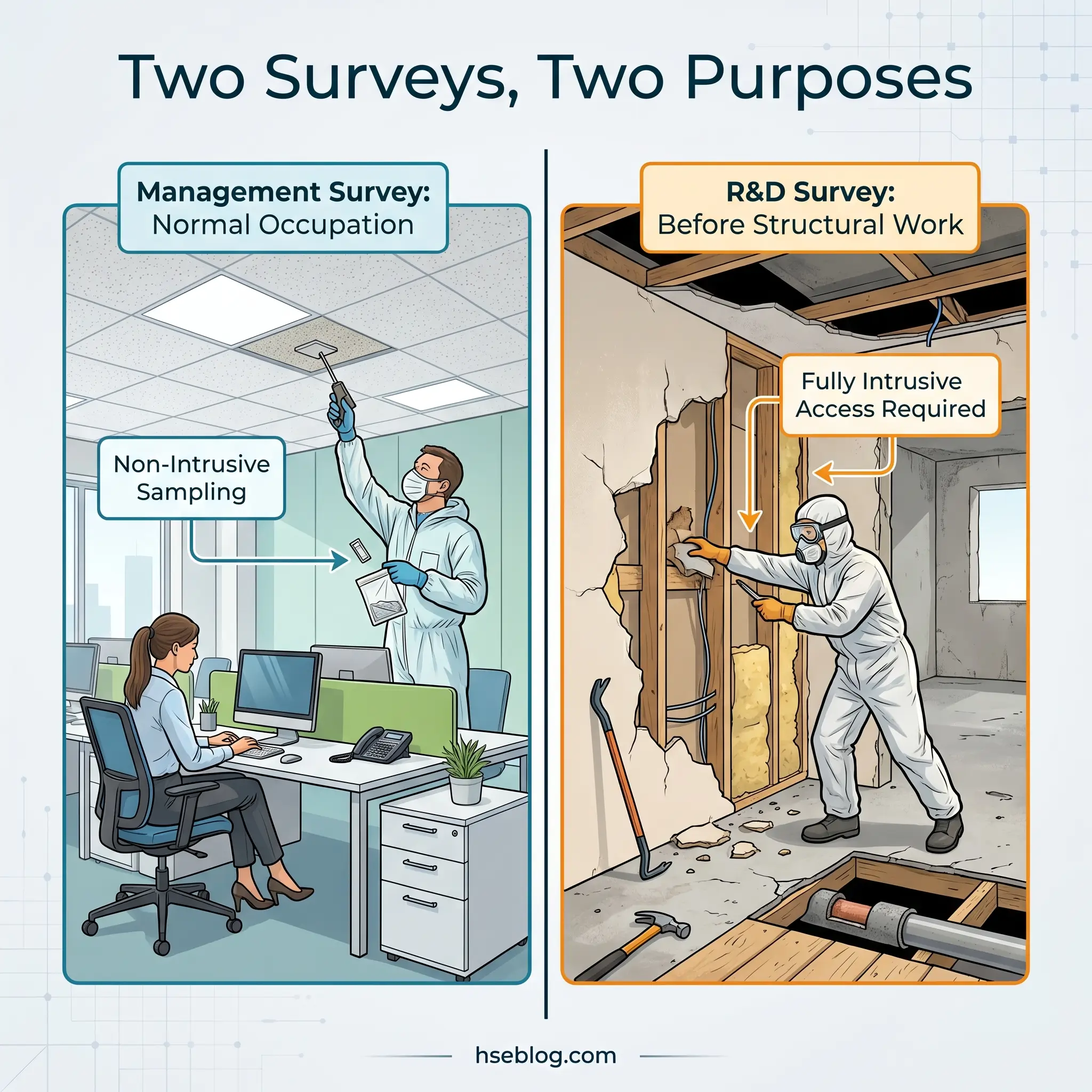
The judgment call that trips dutyholders most often is assuming a management survey already on file covers areas about to undergo refurbishment. It does not. A management survey is designed for "leave in place and manage" decisions. It does not assess what is hidden behind walls, within floor voids, or above fixed ceilings. Commissioning an R&D survey after demolition has already started — rather than before — turns a manageable compliance obligation into a potential criminal offence.
Writing and Maintaining an Asbestos Management Plan
The management plan is where the duty to manage either becomes operational reality or collapses into paperwork. A plan that exists only as a PDF on a SharePoint site no one checks does not satisfy Regulation 4 — regardless of how thoroughly it was written.
A legally compliant asbestos management plan must contain, at minimum:
- ACM register linkage — location, type, and condition of every confirmed or presumed ACM, cross-referenced to the asbestos register and survey report.
- Risk ratings — each ACM assessed for material condition and likelihood of disturbance, with a priority rating driving the control response.
- Control measures — specific actions assigned to each ACM: encapsulation, labelling, restricted access, monitoring schedule, planned removal, or a combination.
- Named responsibilities — roles or named individuals accountable for each element of the plan's implementation. "The facilities team" is not a named responsibility.
- Communication protocols — how asbestos information reaches contractors, maintenance staff, emergency services, and new occupants before they carry out work.
- Monitoring schedule — defined intervals for re-inspecting ACM condition, with criteria for escalation.
- Emergency procedures — what happens if ACMs are accidentally disturbed, damaged, or discovered during work.
What Separates a Compliant Plan from a Failing One
The management plans most likely to fail enforcement scrutiny share a common trait: they were written as a one-off consultant deliverable and never touched again.
The strongest plans are those embedded in the building's day-to-day operations. They connect directly to contractor induction processes, permit-to-work systems, and maintenance scheduling. When a plumber is called to fix a leaking pipe on the third floor, the permit-to-work process should automatically trigger a check against the asbestos register for that location — before any work begins.
Annual auditing of the plan is essential. The audit should verify that monitoring inspections are being carried out at the scheduled intervals, that records of asbestos-related work are complete, that the register has been updated after any interventions, and that communication protocols are functioning — not just documented.
What Are the Penalties for Non-Compliance with the Duty to Manage Asbestos?
Non-compliance with Regulation 4 is a criminal offence under UK law. The penalties are designed to reflect the lethal consequences of asbestos exposure — and the enforcement trend over the past two years shows regulators are applying them with increasing severity.
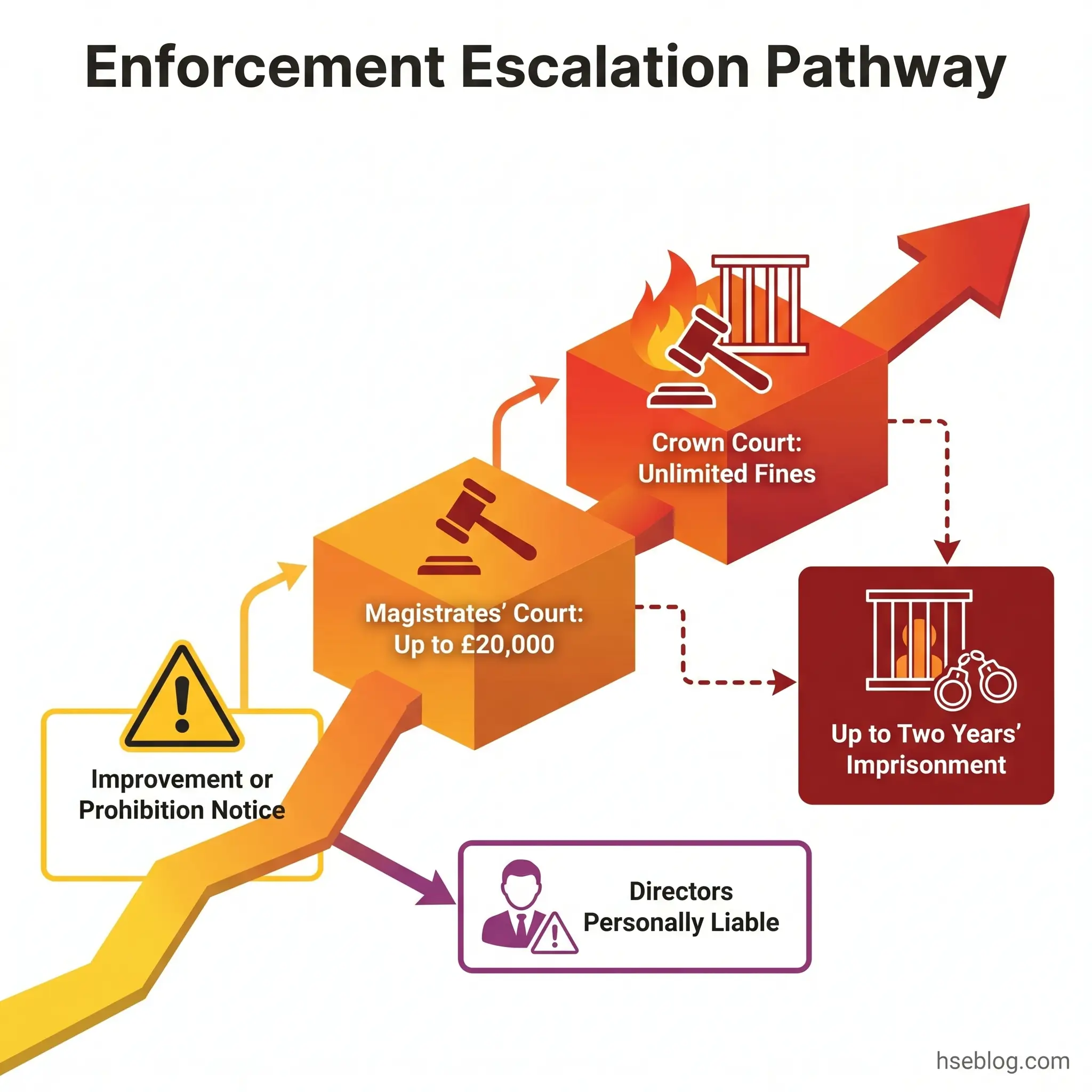
The penalty structure operates on two tiers:
- Magistrates' court — fines up to £20,000 per breach and/or up to six months' imprisonment.
- Crown Court — unlimited fines and/or up to two years' imprisonment.
Before prosecution, HSE can issue improvement notices (requiring remedial action within a specified timeframe) or prohibition notices (stopping work or building use immediately). These are enforcement tools, not warnings — ignoring a notice is itself a criminal offence.
Personal Liability for Directors
Under Section 37 of the Health and Safety at Work etc. Act 1974 (UK), company directors and officers can be prosecuted individually where an offence is committed with their consent, connivance, or neglect. This is not theoretical.
In March 2024, a company director received an eight-month immediate custodial sentence following the illegal removal of approximately 10 tonnes of asbestos insulating board from a building in Winchester. The sentence reflected not just the immediate danger created but the deliberate circumvention of asbestos regulations — exactly the kind of enforcement outcome that HSE's "Asbestos: Your Duty" campaign, launched in January 2024, was designed to produce.
The prosecution trend is measurable. Following the launch of the "Asbestos: Your Duty" campaign, prosecutions more than doubled in the six months after launch compared to the six months before (British Safety Council, 2024). The increase included a notable rise in personal director prosecutions and custodial sentences — signalling that HSE is targeting decision-makers, not just corporate entities.
The financial arithmetic reinforces the point. The cost of maintaining a compliant asbestos management system — surveys, register, management plan, periodic monitoring — is a fraction of the cost of a single prosecution, before accounting for remediation orders, business disruption, and reputational damage.
How Do Asbestos Management Duties Differ Across Jurisdictions?
Organisations managing property portfolios across borders need to understand that compliance in one jurisdiction does not guarantee compliance in another. The obligations are structurally different, even where the underlying goal — preventing asbestos exposure — is the same.
Three-Jurisdiction Comparison
| Feature | UK | US | Australia |
|---|---|---|---|
| Primary legislation | Control of Asbestos Regulations 2012, Reg 4 | OSHA 29 CFR 1910.1001 / 1926.1101; EPA AHERA/NESHAP | Model WHS Regulations (state/territory adoption) |
| Who holds the duty | Person with maintenance/repair obligation for premises | Employers and building/facility owners (separately) | PCBUs with management or control of a workplace |
| Duty framed around | Premises | Employers and building owners | Workplaces |
| Presumption requirement | Presume ACMs unless strong evidence otherwise | Treat PACM in pre-1980 buildings as asbestos | Presume ACMs unless identified by competent person |
| Register required | Yes — asbestos register | No single equivalent; records required under OSHA | Yes — asbestos register |
| Management plan required | Yes — written plan, reviewed 6–12 monthly | Operations & Maintenance program (EPA/OSHA) | Yes — asbestos management plan |
| Schools | Covered under Regulation 4 (same as other non-domestic) | Stricter EPA AHERA regime — inspection + 3-year re-inspection cycle | Covered under WHS Regulations |
| Notification to occupants | Information must be given to anyone who may disturb ACMs | Building owner must notify employees and tenants of ACM locations | Information must be provided to workers and others |
| Administration | National (HSE) | Federal (OSHA/EPA) + state-level | State/territory regulators adopting model code |
The US has no single "duty to manage" equivalent. Obligations are distributed across OSHA standards for general industry (29 CFR 1910.1001, US) and construction (29 CFR 1926.1101, US), EPA regulations for schools (AHERA, US) and demolition/renovation (NESHAP), and state-level requirements that can impose additional obligations. Building owners must identify ACMs, treat presumed asbestos-containing materials (PACM) as asbestos in pre-1980 buildings, notify employees and tenants, and maintain an Operations & Maintenance program.
Australia's framework is structurally closer to the UK's. The Safe Work Australia Model Code of Practice requires persons conducting a business or undertaking (PCBUs) with management or control of a workplace to maintain an asbestos register and asbestos management plan. The key difference is administration: obligations are adopted at state and territory level, meaning requirements can vary across jurisdictions within Australia.
The practical implication is clear. A UK-compliant asbestos management system does not automatically satisfy US or Australian requirements — particularly around notification obligations, health surveillance, training standards, and the definition of who holds the duty.
What Is Changing? HSE's 2025 Consultation on Asbestos Regulation Reform
HSE launched a formal consultation on 10 November 2025 proposing amendments to CAR 2012 and associated guidance. The consultation closed on 9 January 2026, and outcomes are pending government approval.
Three proposals were put forward:
- Independent analyst appointment (Regulatory). Under the current four-stage clearance process following asbestos removal, the analyst who certifies the area as safe for reoccupation can be appointed by the removal contractor. The proposal would require the analyst to be appointed independently by the client or dutyholder, removing the conflict-of-interest risk inherent in the current arrangement.
- Survey quality improvement (Non-Regulatory). HSE proposed improved guidance and interventions to raise the quality of asbestos surveys, helping dutyholders commission competent surveys from UKAS-accredited surveyors and avoid the substandard survey reports that undermine the entire management process.
- Clarification of Notifiable Non-Licensed Work (Non-Regulatory). The definition and management requirements for NNLW with asbestos would be clarified, reducing ambiguity around which non-licensed work triggers notification and medical surveillance obligations.
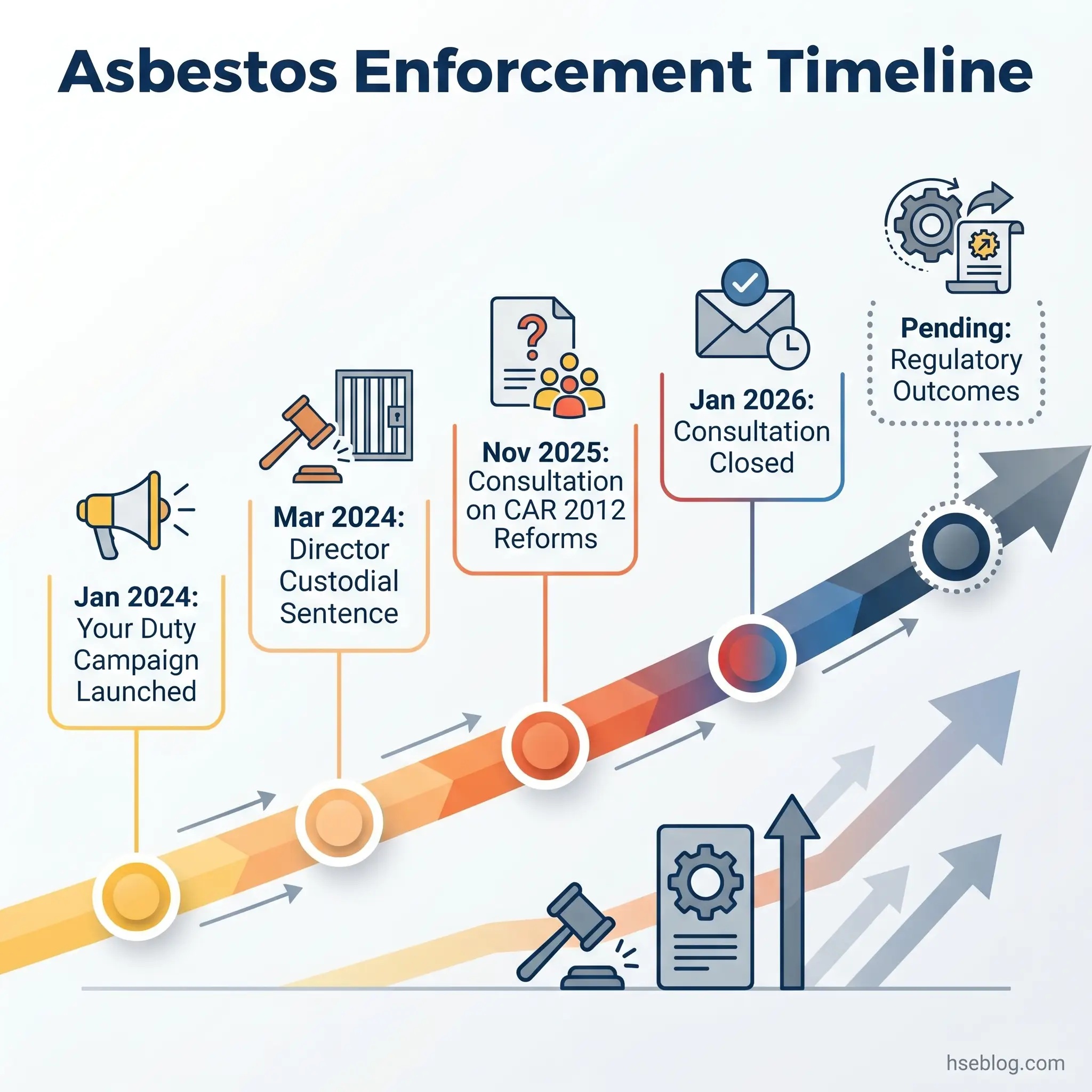
Alongside the consultation, HSE's 2025–26 Business Plan targets 700 planned inspections of asbestos management in public sector buildings and 800 inspections for asbestos contractor licence compliance (HSE/BOHS, 2025). Combined, these represent over 10% of HSE's total 14,000-inspection target for the year — a significant concentration of enforcement resource on a single hazard.
Even before any regulatory changes are enacted, the consultation signals where scrutiny is intensifying. Dutyholders who treat these proposals as an early warning — particularly around survey quality and analyst independence — will be better positioned than those who wait for enforcement to arrive.
Frequently Asked Questions
Does the duty to manage asbestos apply to buildings built after 2000?
The duty applies to all non-domestic premises regardless of construction date. Buildings completed entirely from new materials after the 1999 UK ban are unlikely to contain ACMs. However, Regulation 4 still requires the dutyholder to make a reasonable assessment rather than assume safety based on age alone. Recycled materials, pre-ban stock, or imported products may have introduced asbestos into post-2000 construction. The assessment — even if it concludes no ACMs are present — must be documented.
Can a landlord delegate the duty to manage asbestos to a tenant?
The duty follows the maintenance and repair obligation. If a lease explicitly assigns maintenance responsibility to the tenant for their demised area, the tenant becomes a dutyholder for that space. The landlord cannot abdicate their duty for common parts or areas where they retain maintenance obligations under the lease. In multi-tenancy buildings, this commonly results in multiple dutyholders who must cooperate — the obligation to share asbestos information between them is a legal requirement under Regulation 4, not a courtesy.
How often should an asbestos management survey be updated?
No fixed statutory re-survey interval exists. The asbestos management plan — including the register — must be reviewed every 6 to 12 months at minimum, and immediately after any significant change to the premises. Condition monitoring of identified ACMs is distinct from a full re-survey. If condition monitoring reveals deterioration, damage, or disturbance, that finding may trigger the need for a new survey of the affected area. The review cycle and the re-survey decision are separate compliance obligations.
What is the difference between licensed and non-licensed asbestos work?
Licensed work, requiring an HSE licence in the UK, covers higher-risk removal activities: asbestos insulation, asbestos coating, and asbestos insulating board. Non-licensed work covers lower-risk activities on other ACMs — such as removing undamaged asbestos cement sheeting. A subset of non-licensed work is classified as Notifiable Non-Licensed Work (NNLW), which requires notification to the enforcing authority, brief written records, and medical surveillance. The classification determines which contractors can legally carry out the work and what controls must be in place.
Can I manage asbestos by leaving it in place?
Leaving ACMs in situ is a legitimate and often preferable management strategy. Both HSE guidance (UK) and EPA guidance (US) confirm that intact, undisturbed asbestos presents negligible risk, and that poorly executed removal can create a hazard where none previously existed. The conditions are that the material must be in good condition, unlikely to be disturbed by foreseeable activities, and subject to ongoing condition monitoring at defined intervals. The decision to manage in place must be documented in the management plan with a clear rationale and monitoring schedule.
What should I do if asbestos is accidentally disturbed?
Stop all work immediately. Evacuate the area and restrict access — no one enters without appropriate RPE and training. Notify the dutyholder and, if applicable, the enforcing authority. Do not attempt to clean up ACM debris without trained and, where required, licensed personnel. The area should be assessed by a competent person, and air monitoring may be necessary before reoccupation is permitted. Record the incident, update the asbestos register and management plan, and review whether the disturbance indicates a broader failure in the communication or permit-to-work process.
Conclusion
The duty to manage asbestos is entering a period of active regulatory evolution. HSE's 2025 consultation on CAR 2012 amendments, its escalating enforcement programme — with 1,500 targeted asbestos inspections planned for 2025/26 — and the measurable increase in prosecutions and custodial sentences since the "Asbestos: Your Duty" campaign all point in one direction: the gap between holding an asbestos survey and actually managing asbestos is closing, and the consequences for dutyholders who have not closed it themselves are becoming more personal and more severe.
For dutyholders managing existing compliance systems, the priority is operational. Verify that the management plan is a working document, not an archived one. Confirm that contractor induction and permit-to-work processes actively reference the asbestos register. Ensure condition monitoring is happening at the scheduled intervals and that findings are recorded and acted on — not just filed.
For those managing property across jurisdictions, the structural differences between UK, US, and Australian obligations are material enough to require jurisdiction-specific compliance review. Meeting one framework does not discharge obligations under another. The 2,218 mesothelioma deaths recorded in Great Britain in 2023 (Health and Safety Executive, 2025) — each one traceable to exposure that happened decades ago — are a measure of what the duty to manage exists to prevent. The obligation is not archival. It is ongoing, and it is enforced.