
UN packaging codes are a standardised marking system printed on containers certified for transporting dangerous goods. Each code identifies the packaging type, construction material, hazard-level rating (Packing Group I, II, or III), weight or pressure capacity, and manufacturing origin. The system is defined by the UN Recommendations on the Transport of Dangerous Goods and adopted into binding law by national and modal transport regulators worldwide.
What Are UN Packaging Codes and Why Do They Matter?
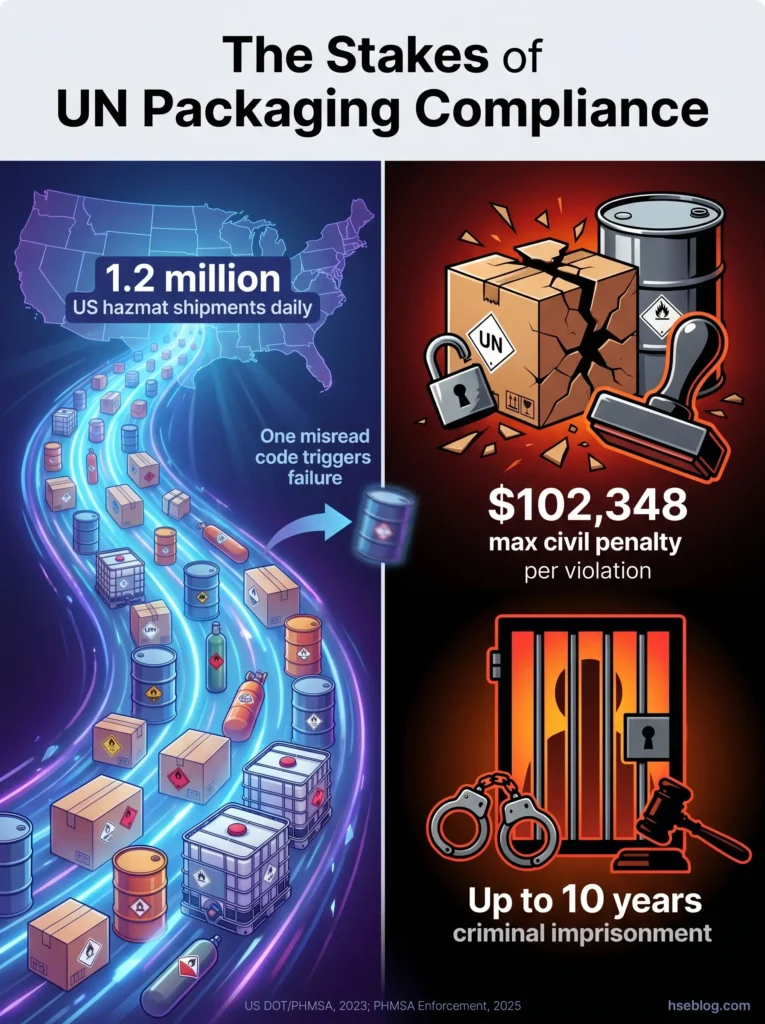
A single character misread on a UN packaging code — confusing an "S" for liquid capability, or selecting "Z" when the substance demands "Y" — can place a hazardous material inside a container that was never tested for that level of danger. The regulatory consequence under US law alone reaches civil penalties of up to approximately $102,348 per violation, with criminal penalties including up to five years' imprisonment for knowing violations and ten years where death or bodily injury results (49 U.S.C. §5124; PHMSA enforcement guidance, current). The operational consequence can be a containment failure in transit — a leaking drum, a ruptured jerrican, a fire in a cargo hold.
UN packaging codes are not product labels. They describe the packaging container itself: what it is made of, what it was tested to withstand, and what hazard level it is rated for. The system originates from the UN Recommendations on the Transport of Dangerous Goods — commonly called the "Orange Book" — first published in 1956 by the UN ECOSOC Sub-Committee of Experts and now in its 23rd revised edition (2023), with the 24th revised edition adopted by the Committee of Experts on 6 December 2024. The UN Recommendations themselves are non-binding, but national regulators (DOT/PHMSA in the US, ADR contracting parties in Europe) and modal regulators (IATA for air, IMO for sea) adopt the system into enforceable law. The scale of what that law governs is significant: more than 3.3 billion tons of hazardous materials are transported annually in the United States alone, representing over 1.2 million shipments per day (US DOT / PHMSA, 2023).
A widespread misconception deserves correction at the outset. Many shippers and warehouse handlers assume that the UN symbol on packaging means the container is universally approved for any dangerous good. It does not. The UN marking is a capability certificate — it states what the packaging was tested for, not what it may legally carry for any given shipment. Shippers must still match the code against the relevant packing instruction for the specific substance and transport mode. Failing to make that match is where incidents begin.
How to Read a UN Packaging Code: Section-by-Section Breakdown
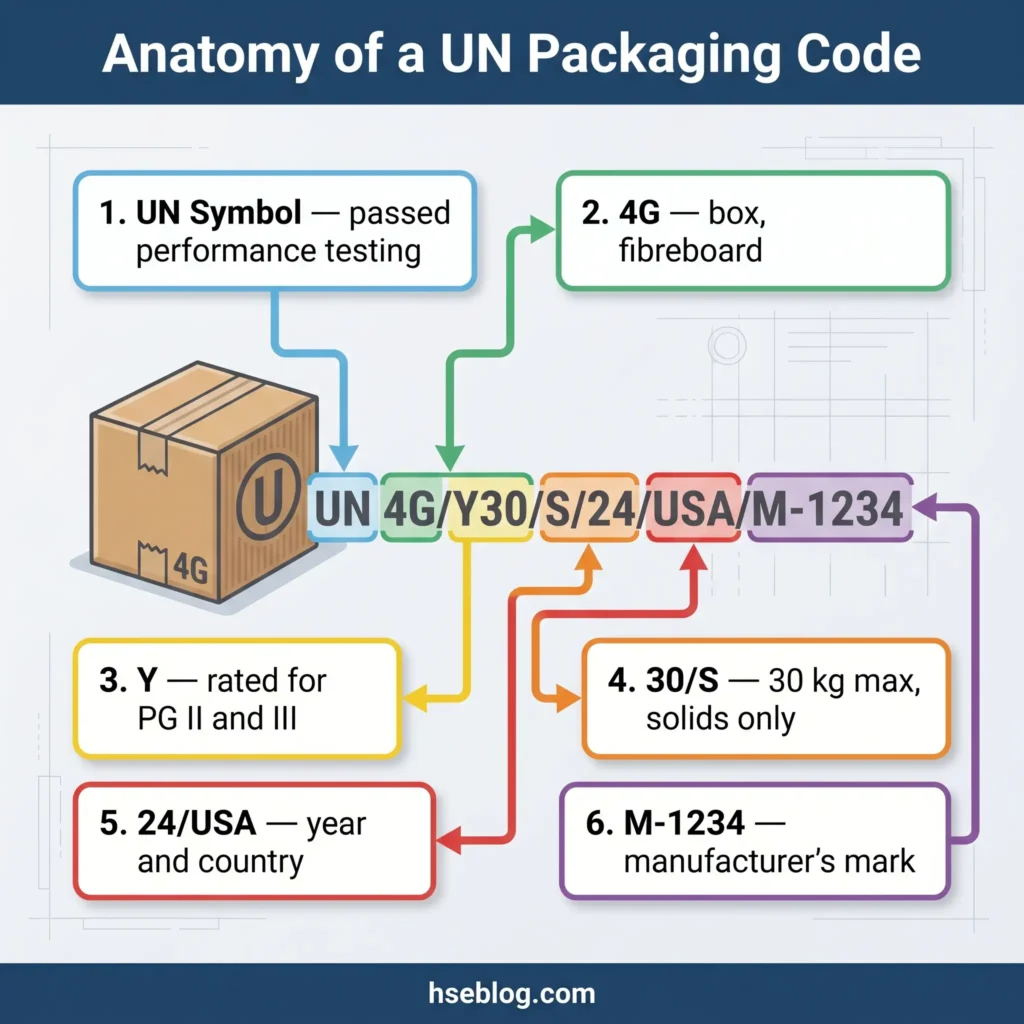
The practical skill this article builds is reading a UN marking and understanding exactly what each segment communicates. Consider a marking stamped on a fibreboard box: UN 4G/Y30/S/24/USA/M-1234. Each segment carries a specific, testable meaning.
Segment 1 — The UN Symbol. The embossed circle containing the letters "u" and "n" (or the letters "UN" in capital letters for packaging manufactured in the US under 49 CFR §178.502) confirms that this packaging has passed UN performance testing conducted by an accredited laboratory. A common misconception: the United Nations does not itself test or certify packaging. Testing is performed by accredited third-party laboratories, and certification is issued by a national competent authority or designated body.
Segment 2 — Packaging Identification Code (4G). This segment contains two or three sub-elements: the packaging type number (4 = box), the material of construction letter (G = fibreboard), and an optional subcategory number. This is the segment that tells you exactly what physical object you are looking at.
Segment 3 — Performance Standard (Y). The letter indicates the highest packing group for which this packaging has been tested. Y means it was tested at medium severity and may hold Packing Group II or III materials. The upward-compatibility rule applies: X-rated packaging (tested to PG I severity) can contain PG II and PG III goods, but Z-rated packaging (tested to PG III only) cannot hold PG II or PG I materials.
Segment 4 — Gross Mass or Density/Pressure (30/S). For solids, this shows the maximum gross mass in kilograms followed by "S" — here, 30 kg maximum gross mass for solids or inner packaging. For liquids, this segment instead shows the maximum specific gravity followed by the hydrostatic test pressure in kPa (e.g., 1.4/150).
Segment 5 — Year and Country of Manufacture (24/USA). The last two digits of the year of manufacture (24 = 2024) and the country of manufacture identified by the vehicle registration code used in international road traffic.
Segment 6 — Manufacturer's Mark (M-1234). The code assigned to the packaging manufacturer by the national competent authority, allowing traceability back to the production source.
The judgment call for practitioners reviewing packaging in the field: segments 3 and 4 are where errors cost the most. A performance letter mismatch or a solid/liquid misread can put the wrong substance in the wrong container — and neither the driver nor the receiving warehouse may catch it until something fails.
Packaging Type Numbers (1–7): Quick Reference
All seven packaging type numbers defined under the UN Model Regulations:
| Number | Type | Common Examples |
|---|---|---|
| 1 | Drum | Steel drums (1A1, 1A2), plastic drums (1H1, 1H2) |
| 2 | Barrel | Wooden barrels with bung (2C1), removable head (2C2) |
| 3 | Jerrican | Steel jerricans (3A1, 3A2), plastic jerricans (3H1, 3H2) |
| 4 | Box | Fibreboard boxes (4G), plywood boxes (4D), steel boxes (4A) |
| 5 | Bag | Woven plastic bags (5H1–5H4), paper bags (5M1, 5M2) |
| 6 | Composite packaging | Plastic inner/steel outer drum (6HA1), glass inner/fibreboard outer (6PG2) |
| 7 | Pressure receptacle | Gas cylinders, tubes, bundles of cylinders |
Types 1–6 are governed by Chapter 6.1 of the UN Model Regulations. Type 7 — pressure receptacles — falls under Chapter 6.2 with distinct construction, testing, and marking requirements. Treating them interchangeably is a classification error.
Material of Construction Letters (A–P): Complete Guide
The full set of material-of-construction codes assigned in the UN system:
| Letter | Material |
|---|---|
| A | Steel (all types) |
| B | Aluminium |
| C | Natural wood |
| D | Plywood |
| F | Reconstituted wood |
| G | Fibreboard |
| H | Plastic |
| L | Textile |
| M | Paper (multi-wall) |
| N | Metal (other than steel or aluminium) |
| P | Glass, porcelain, or stoneware |
Note that the letter E is not assigned. This gap trips up anyone attempting to decode an unfamiliar code by working through the alphabet sequentially. If you encounter a code with "E," the marking is either non-standard or misread.
Subcategory Numbers and Composite Codes Explained
The optional third character in the packaging identification code refines the description further. For drums and jerricans, the subcategory distinguishes closure design: 1 indicates a closed (non-removable) head, and 2 indicates an open (removable) head. A steel drum marked 1A1 has a fixed top with a bung opening; 1A2 has a full removable lid. The distinction matters for filling, cleaning, and reconditioning operations.
For bags, subcategory numbers distinguish wall construction — single-wall, multi-wall, water-resistant, and sift-proof variants each carry a different numeral.
Composite packaging uses a distinct code format that begins with 6, followed by two letters and a type number. The first letter after the 6 identifies the inner receptacle material; the second identifies the outer packaging material. For example, 6HA1 means a plastic (H) inner receptacle within a steel (A) outer drum with a non-removable head (1).
Reversing those two letters changes the code meaning entirely — 6AH1 would designate a steel inner receptacle within a plastic outer, a fundamentally different construction. In the published enforcement record, this reversal appears in documentation errors more often than practitioners expect. When reviewing composite packaging codes, always read inner-then-outer, left to right.
Additional suffix letters carry specific meanings: W indicates equivalent packaging manufactured to a different specification but demonstrated to meet the same performance standard. V indicates variation testing — the packaging is approved for use with a variety of inner packagings of differing sizes and types within the tested outer, providing flexibility for combination packaging. T designates salvage packaging (UN Model Regulations 6.1.5.1.11). U marks special packaging for infectious substances (6.3.5.1.6).
What Are UN Packing Groups and How Do X, Y, and Z Relate to Them?
The performance letter on the UN marking — X, Y, or Z — is the single most safety-critical character on the packaging. It determines whether the container is rated to hold the substance inside it. Getting this wrong is not a paperwork issue; it is a containment-integrity issue.
The UN system classifies dangerous goods into three packing groups based on the degree of danger they present:
| Performance Letter | Packing Group Certification | Danger Level | Test Severity | Example Substances |
|---|---|---|---|---|
| X | PG I, II, and III | Great danger | Highest | Fuming nitric acid (PG I) |
| Y | PG II and III only | Medium danger | Medium | Toluene (PG II) |
| Z | PG III only | Minor danger | Lowest | Diesel fuel (PG III) |
The upward-compatibility principle is straightforward: packaging tested at a higher severity can always contain materials of lesser danger. X-rated packaging handles everything. Z-rated packaging handles only the lowest-danger category.
Not all dangerous goods carry a packing group assignment. Some Division 2.1 flammable gases, Division 6.2 infectious substances, and certain other categories follow specific packing instructions rather than the X/Y/Z system. For these, the packing instruction itself — not the performance letter — governs packaging selection.
A recurring enforcement pattern reveals where this goes wrong in practice. Shippers select Z-rated packaging because it is less expensive, then discover at audit or inspection that their substance is classified PG II. The cost differential between Z-rated and Y-rated packaging is typically marginal. The penalty differential is not — civil penalties up to $102,348 per violation (PHMSA, 2025) dwarf any savings. Always verify the packing group against the Dangerous Goods List before selecting packaging: Column 4 of the Hazardous Materials Table in 49 CFR §172.101 (US) or Column 4 of the IMDG Code Dangerous Goods List (maritime).

UN Packaging Code for Solids vs. Liquids: Key Differences
The marking format changes depending on whether the packaging is certified for solids or liquids, and this variation is one of the most frequent sources of confusion in dangerous goods shipping. The difference is concentrated in Segment 4 of the code — the capacity and test-pressure field.
Solids marking: The segment shows a number followed by the letter "S." Example: 30/S means the packaging is rated for a maximum gross mass of 30 kg when containing solids or when used as inner packaging within combination packaging.
Liquids marking: The segment shows two numbers separated by a slash — the maximum specific gravity followed by the hydrostatic test pressure in kPa. Example: 1.4/150 means the packaging is rated for liquids up to a specific gravity of 1.4, tested to withstand 150 kPa of hydrostatic pressure. When no specific gravity figure is shown, the default assumption under the UN Model Regulations is 1.2.
| Element | Solids Format | Liquids Format |
|---|---|---|
| Capacity indicator | Max gross mass (kg) | Max specific gravity |
| Test indicator | "S" | Hydrostatic pressure (kPa) |
| Example marking | Y30/S | Y1.4/150 |
| Meaning | 30 kg max, solids/inners | SG ≤1.4, tested to 150 kPa |
The field error that appears consistently across enforcement records: shippers see the "S" designation and assume the packaging can hold limited quantities of free liquids. It cannot. The "S" rating means the packaging was not subjected to the hydrostatic pressure test or the leakproofness test required for liquid containment. Placing liquids in S-rated packaging is a containment failure waiting to happen.
For air transport, IATA imposes an additional requirement that ground and sea regulations do not: all single packaging for liquids must pass a 95 kPa internal pressure test simulating the reduced cabin pressure at altitude (FAA guidance on dangerous goods packaging for air transport). Packaging certified for surface transport of liquids may not automatically qualify for air.
When packaging bears two separate UN markings — one with the S designation and one with a specific gravity/pressure format — it means the packaging was tested and approved under both protocols. The shipper must consult the correct approval certificate matching the actual state of matter being shipped.
UN Performance Tests: How Packaging Earns Its Code
A UN packaging code is not a manufacturer's claim. It is evidence that the packaging passed a defined battery of performance tests conducted by an accredited testing laboratory under controlled conditions. Understanding what those tests involve explains why the codes carry regulatory weight.
The core tests vary by packaging type, but the standard battery for most non-bulk packaging includes the drop test (packaging dropped from a height determined by packing group — PG I packaging is dropped from a greater height than PG III), the leakproofness test (internal air pressure applied to detect leaks, required for liquid packaging), the hydrostatic pressure test (sustained water pressure applied to liquid containers), the stacking test (a compressive load simulating the weight of stacked packages in a warehouse or shipping container sustained for 24 hours), and the cooperage test (specific to wooden barrels). A vibration test simulating road and rail transport conditions applies to certain packaging categories.
The practical implication that matters most: certification is valid only when the packaging is assembled and closed exactly as it was during testing. This means following the manufacturer's closure instructions precisely — the specified closure torque, the correct gasket, the right liner, the proper banding or sealing method. A different closure method, liner, or gasket can invalidate an otherwise compliant package. Reviewing PHMSA enforcement actions, closure-instruction violations are among the most commonly cited deficiencies. The packaging itself may be perfectly manufactured, but if the shipper closes it differently from the tested configuration, the UN marking no longer guarantees performance.

Where to Find UN Packaging Code Requirements in Key Regulations
One of the more useful shortcuts in dangerous goods compliance: the clause numbering across major regulations is deliberately aligned because IMDG, IATA, ADR, and national regulations all derive from the same UN Model Regulations structure. Once you know the UN chapter reference — 6.1.2.7 for packaging identification codes — you can usually locate the equivalent provision in any modal or national regulation quickly. This saves significant research time when verifying compliance across multiple transport modes.
| Regulation | Clause Reference | Coverage |
|---|---|---|
| UN Model Regulations | Chapter 6.1, Section 6.1.2.7, Section 6.1.3 | Packaging identification codes, marking requirements |
| US 49 CFR | §178.502 (ID codes); §§178.504–178.523 (type-specific); §173.22 (shipper responsibility) | Identification code format, construction/testing/marking by type, shipper obligations |
| IMDG Code (maritime) | Section 6.1.2.7, Section 6.1.3 | Packaging codes and marking for sea transport |
| IATA DGR (air) | Section 6.0.3 | Packaging codes for air transport + 95 kPa requirement |
| ADR 2025 (European road) | Part 6, Chapter 6.1 | Construction, testing, marking — mirrors UN with ADR-specific provisions |
| Canadian TDG | Section 5.2 (TP14850) | Packaging standards for Canadian domestic and cross-border transport |
Sites cited under 49 CFR §173.22 typically show a disconnect between the shipper's substance classification and the packaging selected — the shipper knew what the substance was but did not verify that the packaging code matched the required packing instruction. The regulatory framework places this responsibility squarely on the shipper, not the packaging manufacturer or the carrier.
Common Mistakes When Interpreting UN Packaging Codes
The incident record for non-bulk hazmat packaging in the United States — 164,789 incidents over the 2011–2020 period (PHMSA Incident Statistics, 2021) compared to 15,743 for bulk packaging — confirms that the packaging category most commonly bearing UN markings is also the category generating the most incidents. Many of these trace back to errors in interpreting or applying the UN code system.
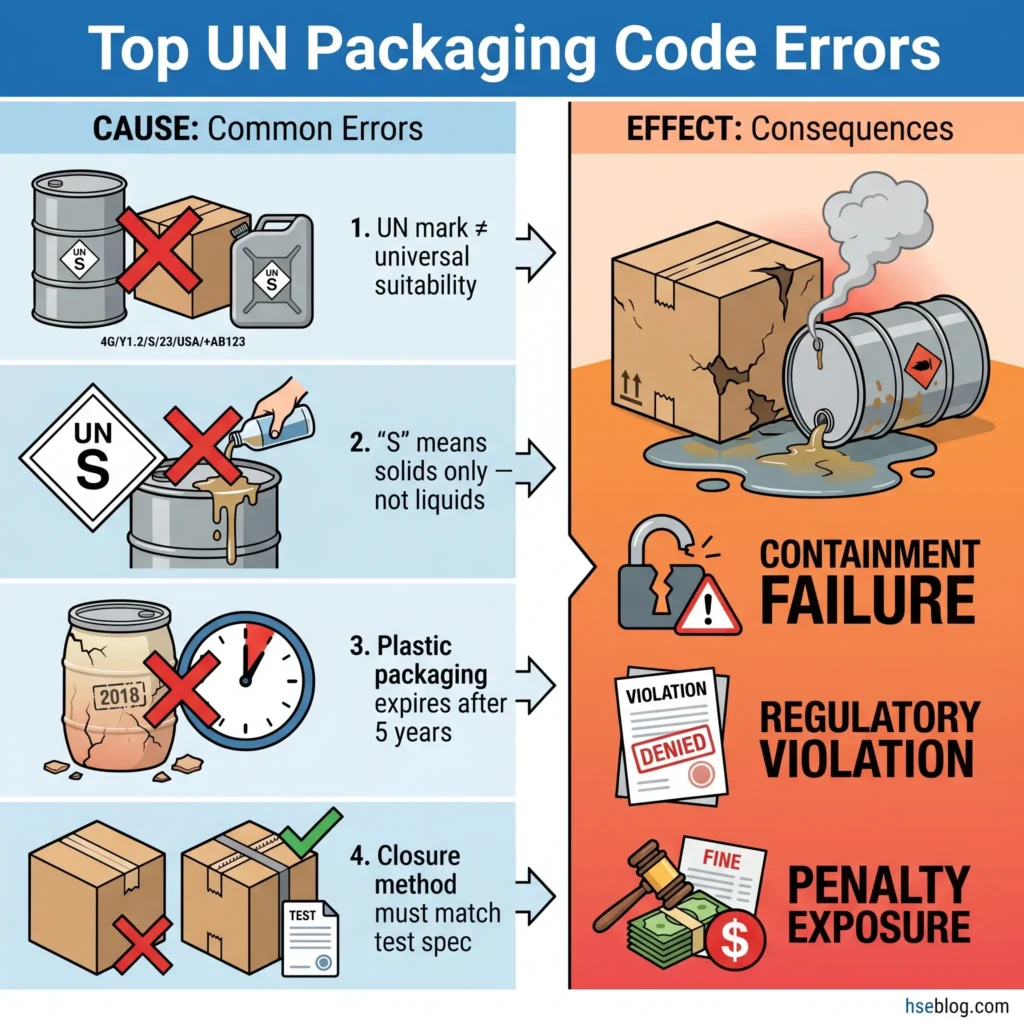
1. Assuming any UN-marked packaging suits any dangerous good. The UN marking confirms what the packaging was tested to withstand. It does not confirm suitability for a specific substance. The shipper must match the packaging code to the packing instruction assigned to the substance in the Dangerous Goods List for the applicable transport mode.
2. Reading "S" as liquid-capable. As covered in the solids vs. liquids section, the "S" designation means the packaging was tested for solids or inner packaging only. No hydrostatic pressure or leakproofness testing was conducted.
3. Using plastic packaging past its five-year service life. Plastic drums, jerricans, and composite packaging with plastic inner receptacles have a maximum service life of five years from the date of manufacture stamped on the marking. The material degrades — UV exposure, chemical interaction, and environmental stress reduce structural integrity over time. Using expired plastic packaging is a violation regardless of visible condition.
4. Reversing inner/outer letters in composite codes. In the 6HA1 format, the first letter (H) is always the inner receptacle and the second (A) is always the outer packaging. Transposing them in shipping documentation misidentifies the packaging construction.
5. Ignoring manufacturer closure instructions. The UN certification applies to the packaging as tested — including the closure method, torque specification, gasket type, and liner. Deviating from these instructions invalidates the certification even if the packaging itself is new and undamaged.
6. Neglecting chemical compatibility. The UN code confirms physical performance (drop resistance, pressure tolerance, stacking strength). It does not confirm chemical compatibility between the packaging material and the substance. A plastic drum rated 1H1/X may pass every performance test but fail if the product dissolves or permeates the plastic over time.
7. Treating packaging selection as a one-time decision. When a product formulation changes, when a supplier switches packaging manufacturers, or when the transport mode shifts — especially from ground to air — the packaging code must be re-evaluated against the current packing instruction. This dynamic reassessment step is where compliance programmes most consistently break down.
Recent Regulatory Updates Affecting UN Packaging Codes
The regulatory landscape for UN packaging is in an active update cycle. Two developments are most relevant for shippers and compliance professionals working with UN packaging codes in 2025.
The UN Model Regulations 24th revised edition was adopted by the Committee of Experts on 6 December 2024, with electronic publication expected by September 2025. Key packaging-related changes include clarified provisions for solids liable to become liquid during transport (a problem area for substances near their melting point that could shift from S-rated to liquid-rated packaging requirements mid-journey), new allowances for recycled plastic in flexible intermediate bulk containers (FIBCs), and exemptions for small-quantity packaging of environmentally hazardous liquids. These changes will cascade into national and modal regulations over the following one to three years as IATA, IMDG, ADR, and national authorities incorporate them.
In the United States, PHMSA published a harmonization final rule effective 10 May 2024, aligning 49 CFR with the 22nd revised edition of the UN Model Regulations and the 2023–2024 ICAO Technical Instructions. Separately, PHMSA adjusted civil penalty amounts upward for 2025 via a December 2024 final rule, with maximum per-violation penalties now exceeding $102,000 and penalties for violations resulting in death or serious injury reaching approximately $238,809 (PHMSA, 2025).
Regulatory cycles create a compliance lag that shippers must manage. The UN publishes revised Model Regulations; then national regulators take one to three years to incorporate the changes. During this transition period, which set of requirements applies depends on the jurisdiction and the mode of transport. Shippers operating across multiple modes and borders should track the UN revision cycle and anticipate downstream regulatory changes rather than reacting to them after enforcement begins.
Frequently Asked Questions
Can you use X-rated packaging (Packing Group I) to ship Packing Group III materials?
Yes. The upward-compatibility principle means X-rated packaging, tested at the highest severity, is certified for PG I, II, and III materials. There is no prohibition on using higher-rated packaging for lower-hazard substances. The reverse, however, is prohibited — Z-rated packaging cannot contain PG I or PG II goods under any circumstances. Selecting the correct performance letter is a minimum compliance requirement, not a "best fit" exercise.
How long is a UN packaging certification valid?
For most packaging materials, no fixed expiration applies to the certification itself. However, plastic packaging and IBCs carry a maximum service life of five years from the date of manufacture. Metal and fibreboard packaging can be reused while in serviceable condition, subject to inspection. Revalidation and retest periods vary by national competent authority. The manufacture date stamped on the marking is the reference point — always check it before reuse.
What is the difference between UN packaging codes and UN numbers?
These serve entirely different functions. A UN packaging code (e.g., 4G/Y30/S) describes the container — its type, material, and performance rating. A UN number (e.g., UN1203 for gasoline) identifies the substance. One characterises the package; the other identifies the product. Both must be present on a compliant dangerous goods shipment, but they appear in different locations and communicate different information to handlers and regulators.
Does the UN itself test and certify packaging?
No. The United Nations establishes the test criteria and the marking system through the Model Regulations, but testing is conducted by accredited third-party laboratories in each country. Certification is issued by the relevant national competent authority or its designated body. The UN marking signifies compliance with internationally agreed performance criteria — not organisational approval from the UN itself.
Are UN packaging requirements different for air transport compared to ground?
Yes, and the difference is operationally significant. IATA mandates that all single packaging for liquids pass a 95 kPa internal pressure test simulating reduced atmospheric pressure at cruising altitude — a requirement that does not apply to road, rail, or sea transport. Packaging fully compliant for surface modes may not qualify for air. The applicable packing instruction in the IATA Dangerous Goods Regulations (current 66th edition, 2025) governs what packaging is permitted for each substance by air.
What does the "V" suffix mean on UN packaging (e.g., 4GV)?
The "V" indicates the packaging passed variation testing under UN Model Regulations provisions. It is approved for use with a variety of inner packagings — differing sizes, quantities, and types — within the tested outer packaging. This provides greater flexibility for shippers using combination packaging, as they do not need a separate UN approval for every permutation of inner packaging configuration, provided the tested parameters are not exceeded.
Conclusion
The pattern the industry most consistently gets wrong with UN packaging codes is treating them as a static, one-time compliance exercise. A code is selected when the product is first shipped, entered into a database, and never revisited — until an audit, an incident, or a modal change exposes the gap. Formulations change. Suppliers switch packaging manufacturers. A product that moved exclusively by road is now booked on an air freight consolidation. Each of these events can invalidate a packaging selection that was compliant last month.
The single highest-impact change a shipping operation can make is building packaging-code verification into the change-management process rather than leaving it in the initial product-setup workflow. When the substance classification changes, the packaging code is re-evaluated. When the transport mode changes, the packing instruction is rechecked. When the packaging supplier changes, the new manufacturer's closure instructions are verified against the UN test configuration. This dynamic reassessment — treating the UN packaging code as a living compliance element rather than a fixed label — is what separates operations that pass enforcement scrutiny from those that generate violations.
For professionals looking to deepen their competence in dangerous goods packaging and transport compliance, recognised training pathways include IATA Dangerous Goods Regulations courses, DGSA (Dangerous Goods Safety Adviser) certification under ADR, DOT/PHMSA hazmat employee training under 49 CFR §172.704, and IOSH or NEBOSH specialist modules covering hazardous substance transport.
Regulatory content in this article reflects general HSE professional understanding of the cited jurisdictions as of early 2025. It is not legal advice. Specific compliance questions, enforcement situations, or prosecution risk should be directed to qualified legal counsel in the applicable jurisdiction.