Laser Safety Signs: Types and Placement Requirements

Two industrial workers in blue uniforms and safety glasses operate a laser cutting machine in a factory, with one monitoring the equipment while the other manages the cutting process on metal material.

TL;DR Laser safety signs are class-driven hazard markers required wherever a laser-controlled area exists. Under ANSI Z136.1, Class 2/2M/3R areas take a CAUTION sign, Class 3B and Class 4 areas take a WARNING or DANGER sign, and temporary controlled areas take a NOTICE sign — each posted conspicuously at every entry point to the controlled … Read more

Safety Culture Maturity Model: 5 Stages Explained

Three industrial workers wearing hard hats and safety vests discuss operations at an oil refinery or chemical plant, with one gesturing toward equipment while others listen.

TL;DR A safety culture maturity model describes how an organisation’s safety culture evolves through sequential stages — most commonly five: pathological, reactive, calculative, proactive, and generative. Each stage reflects a deeper level of leadership commitment, worker ownership, and open reporting, progressing from indifference toward safety being fully embedded in everyday work. On 6 July 1988, … Read more

UV Curing Hazards in Printing: Radiation & Chemical Risks

Worker in blue gloves operates an industrial UV printing machine in a modern print facility, with colorful printed materials feeding through the equipment and ink cartridges visible nearby.

TL;DR — The Numbers That Govern a UV Print Shop UV curing in printing carries two hazard families: non-ionising UV radiation from the curing lamps, which causes photokeratitis and skin damage, and chemical exposure to uncured inks containing acrylate monomers and photoinitiators that can permanently sensitise skin. Mercury lamps add ozone and heat. Control depends … Read more

Metal Fabrication Safety: Hazards & Controls by Hierarchy

Industrial metalworking workshop with two workers in blue uniforms operating machinery; one welds metal components while another operates equipment, with organized metal sheets and fabrication tools visible throughout the facility.

TL;DR Metal fabrication exposes workers to machine injuries, burns and fire, toxic welding fume, eye and hearing damage, vibration, and chemical contact. The most effective response controls each hazard through the hierarchy of controls — elimination and engineering first, PPE last — while meeting specific OSHA and HSE requirements such as machine guarding, lockout/tagout, and … Read more

Insulation Resistance Testing: Purpose, Procedure & Interpretation Guide

Two electricians in safety gear inspect an industrial electrical panel with orange bus bars and wiring, with one holding a multimeter and the other recording data on a tablet in a warehouse facility.

TL;DR Insulation resistance testing is a non-destructive diagnostic procedure that applies a controlled DC voltage across electrical insulation and measures the resulting leakage current to quantify insulation quality. It detects degradation from moisture, contamination, thermal aging, or mechanical damage before it leads to equipment failure, electric shock, or fire. The test is performed using a … Read more

UN Packaging Codes for Dangerous Goods Explained | Full Guide

Two warehouse workers in safety vests and hard hats inspect a blue chemical drum on a pallet, with a forklift and shelving units visible in the industrial storage facility.

TL;DR UN packaging codes are a standardised marking system printed on containers certified for transporting dangerous goods. Each code identifies the packaging type, construction material, hazard-level rating (Packing Group I, II, or III), weight or pressure capacity, and manufacturing origin. The system is defined by the UN Recommendations on the Transport of Dangerous Goods and … Read more

Banksman Hand Signals: Roles, Duties & Training (UK Guide)

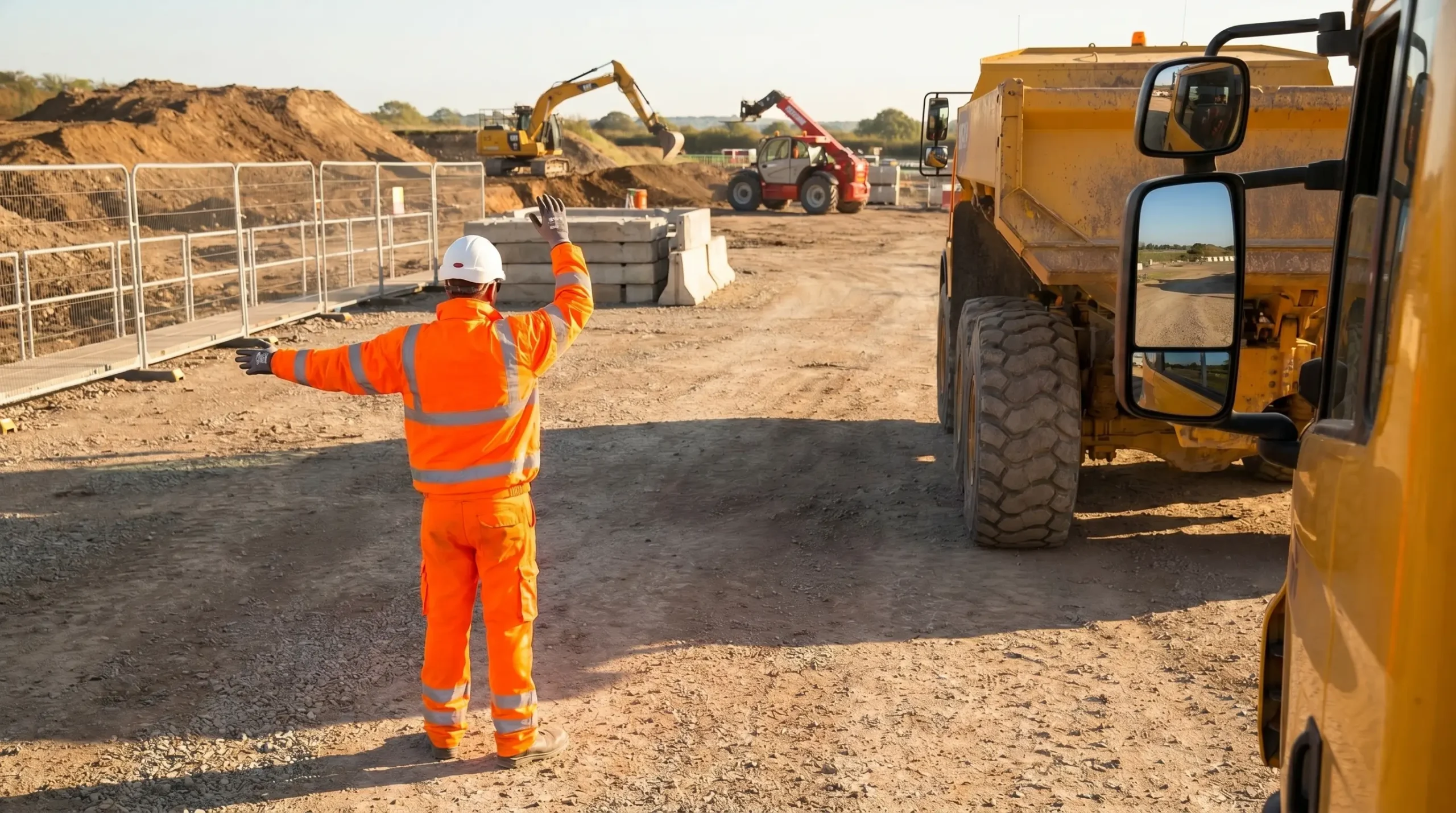
Construction site worker in orange safety vest and hard hat directing heavy machinery, with excavators and dump trucks operating in the background among dirt piles and metal barriers.

TL;DR A banksman — also called a traffic marshal — is a trained operative who directs vehicle and mobile plant manoeuvres on a worksite using standardised hand signals. Under the UK’s Health and Safety (Safety Signs and Signals) Regulations 1996, nine core signals cover start, stop, movement direction, distance, and emergency stop. The role is … Read more

What is DSEAR? Regulations & Employer Duties Explained

Two workers in orange safety suits and hard hats inspect industrial equipment in a hazardous zone facility, with one pointing at machinery while holding a tablet displaying technical diagrams.

DSEAR — formally cited as Statutory Instrument 2002 No. 2776 — is the principal UK legislation governing fire, explosion, and corrosion risks arising from dangerous substances in the workplace. It applies to any premises where such substances are present, used, stored, or produced. The regulations didn’t emerge in isolation. They implement two EU Directives into … Read more

What Are Hard Hats? Types, Classes & Field Safety Guide

Construction worker in safety gear adjusting hard hat while holding level on steel beam framework at active building site with crane in background.

TL;DR I was walking a concrete pour on a high-rise project in the Gulf when a coupling pin dropped from four storeys above. It struck a rigger’s hard hat dead centre, split the shell clean through, and knocked him to his knees. He walked away with a bruise on his neck. Without that hard hat, … Read more

Categories PPE

50 Substance Abuse Group Activities That Empower Recovery

50 Substance Abuse Group Activities That Empower Recovery

TL;DR I walked into a relapse prevention group at an employee assistance program (EAP) facility connected to a large logistics operation. Twelve workers sat in a circle, arms crossed, jaws tight. The facilitator opened with a lecture on “why drugs are bad.” Within five minutes, half the room had mentally checked out. One participant was … Read more