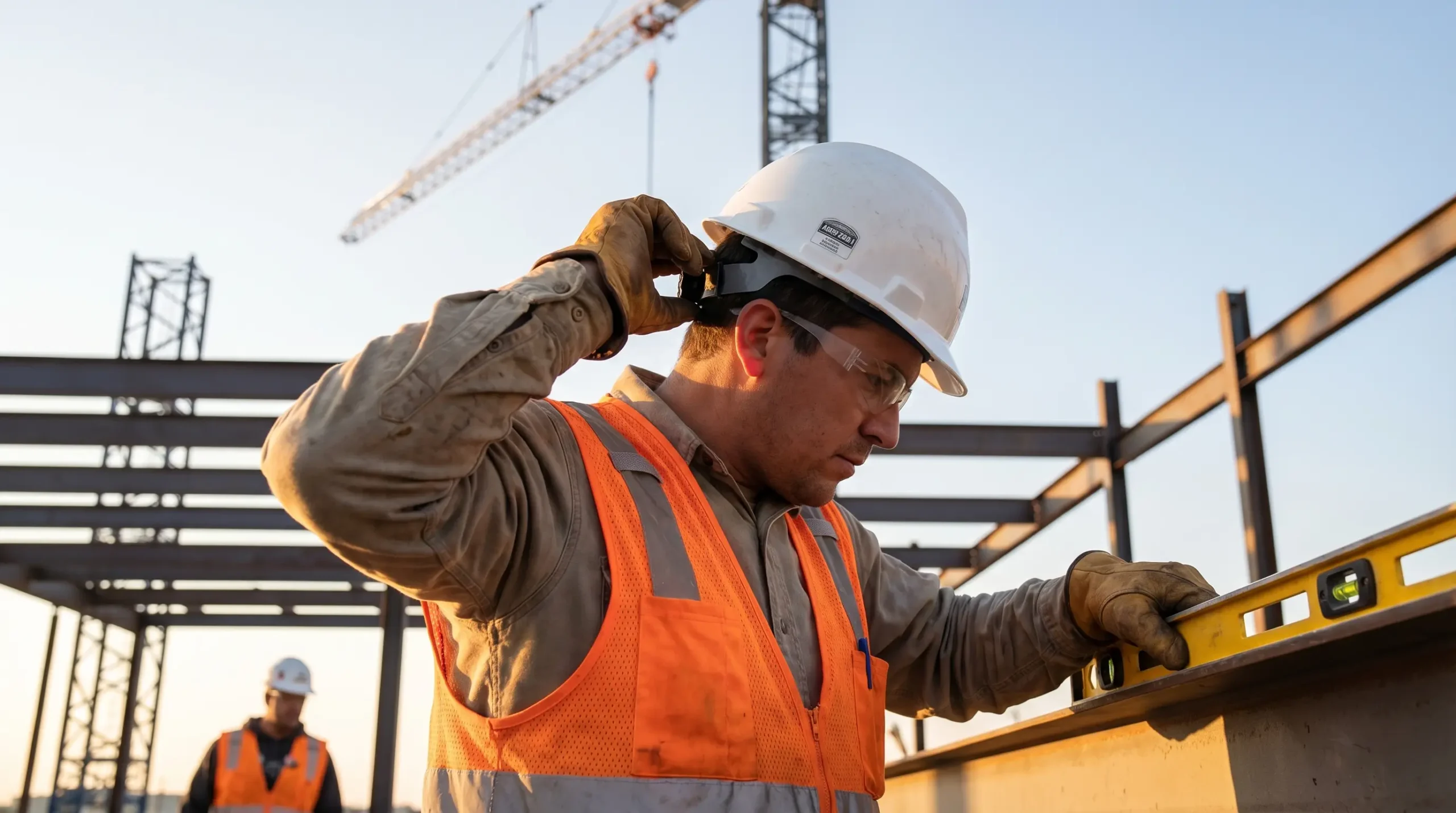
I was walking a concrete pour on a high-rise project in the Gulf when a coupling pin dropped from four storeys above. It struck a rigger's hard hat dead centre, split the shell clean through, and knocked him to his knees. He walked away with a bruise on his neck. Without that hard hat, I would have been writing an incident report with a very different outcome. That single moment — the crack of impact, the fractured shell on the ground, a man standing up alive — is why I never let anyone step past a site hoarding without head protection.
Hard hats remain one of the most fundamental and widely mandated pieces of personal protective equipment across every heavy industry on the planet. Despite their simplicity, they are misunderstood, misused, and neglected more often than any other PPE category. This article covers what hard hats actually are, how they work, the types and classes available, the standards that govern them, and the field-tested practices that make the difference between a hard hat that saves a life and one that fails when it matters.
What Are Hard Hats and How Do They Work?
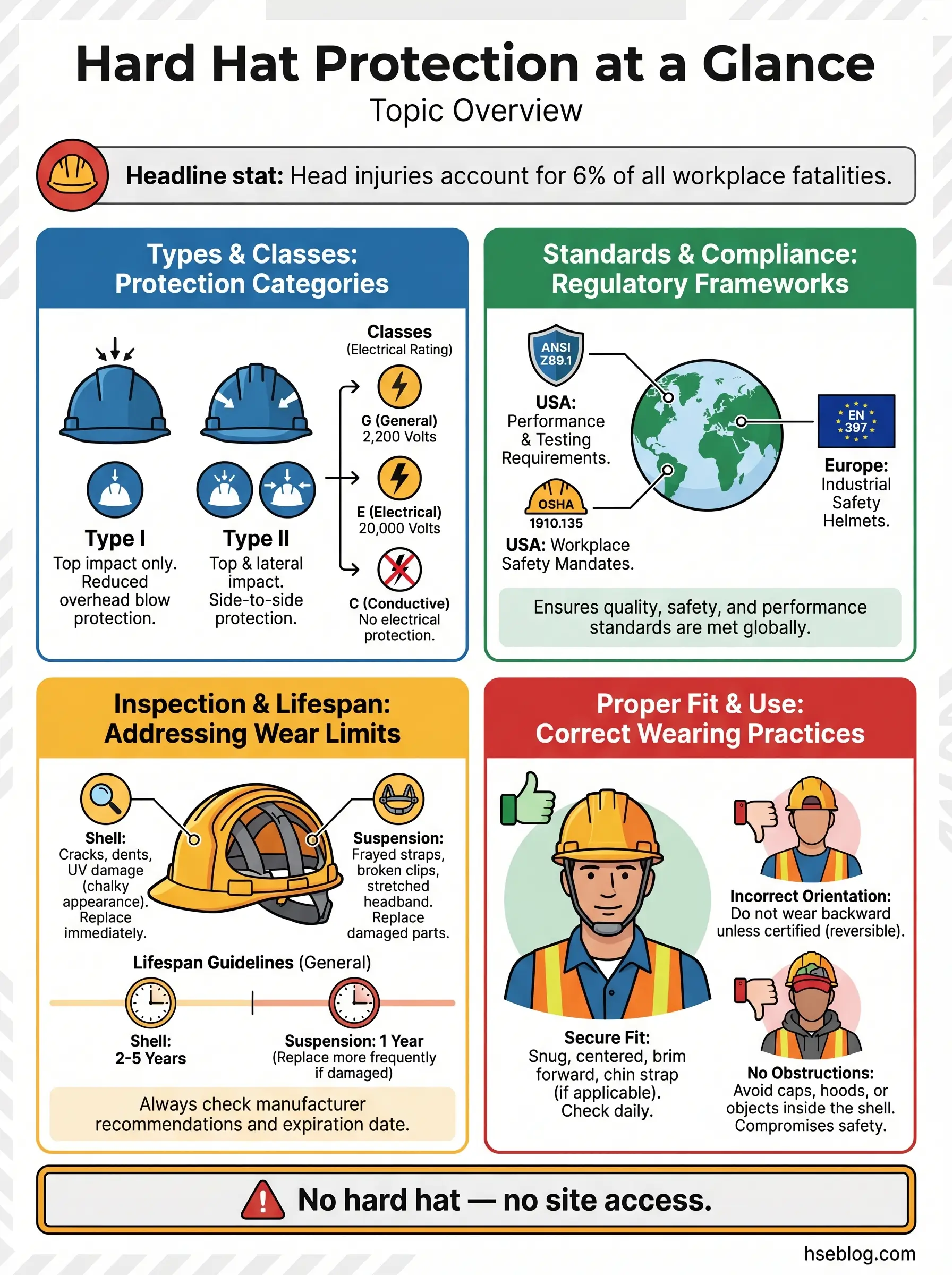
A hard hat is a rigid head protection device engineered to reduce the force of impact from falling objects, lateral blows, and — depending on the class — electrical contact. It consists of two functional components: the outer shell and the internal suspension system. Understanding how those two elements work together is the difference between treating a hard hat as a piece of plastic and recognizing it as an engineered safety system.
The outer shell is typically made from high-density polyethylene (HDPE), ABS thermoplastic, or fiberglass-reinforced resin. Each material has trade-offs relevant to specific work environments:
- HDPE (most common): Lightweight, resistant to moisture, cost-effective — the standard choice for general construction and infrastructure work
- ABS thermoplastic: Higher impact resistance than HDPE, better suited to environments with frequent exposure to sharp or heavy falling objects
- Fiberglass-reinforced resin: Superior heat resistance and structural rigidity — used in foundries, welding environments, and petrochemical facilities where thermal exposure is a concern
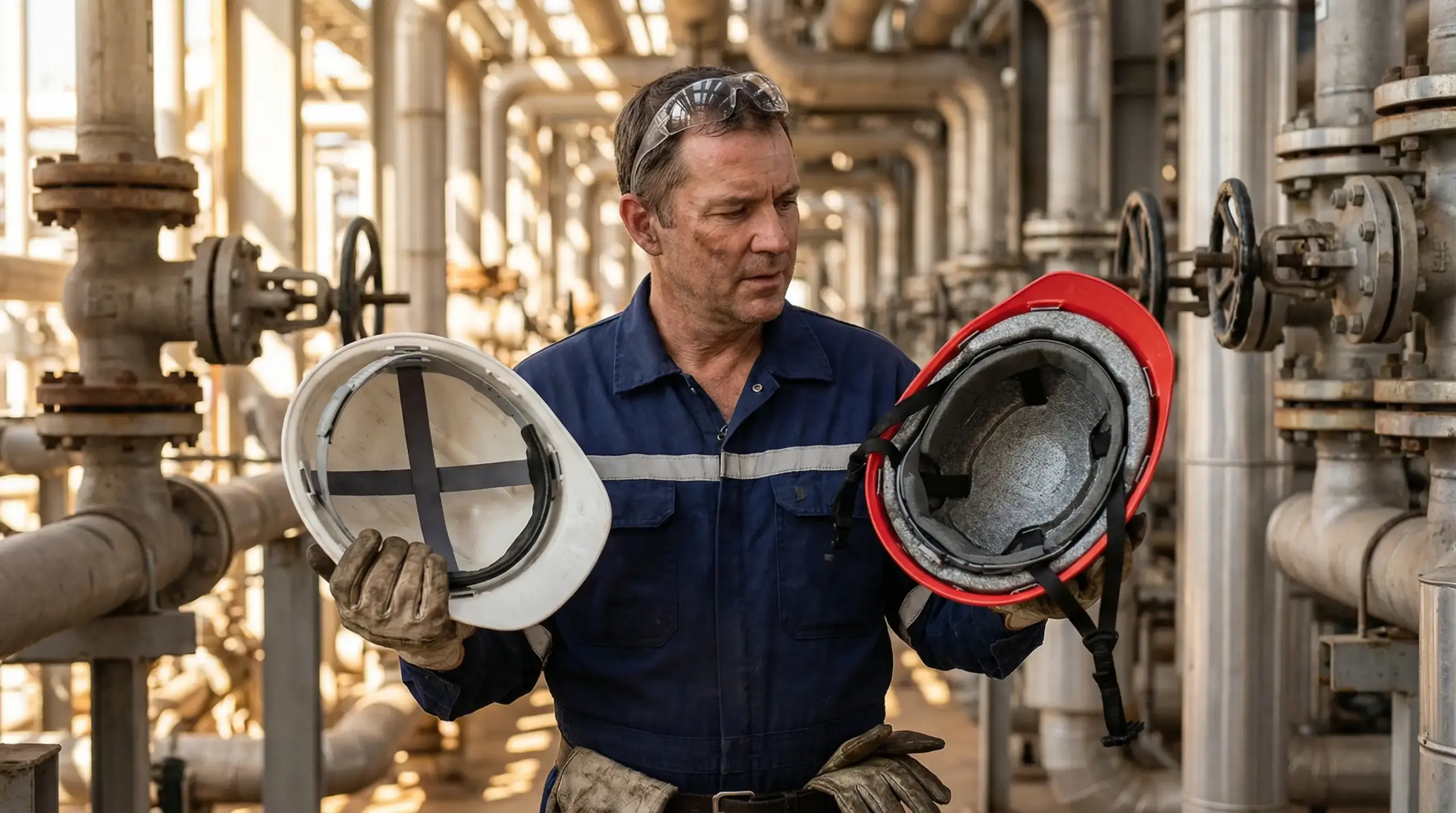
The internal suspension system is where the real engineering lives. A network of adjustable nylon or polyethylene straps — the harness and headband — creates a gap between the shell and the wearer's skull. When an object strikes the shell, the suspension absorbs and distributes the force across the entire crown rather than transmitting it as a concentrated point load.
Without that suspension gap, a hard hat is just a bowl. The energy dissipation happens in the space between the shell and the skull — typically 25–32 mm of clearance. Anything less compromises the system.
Pro Tip: I've pulled hard hats off workers who had removed the rear adjustment knob or flattened the suspension straps to make it "more comfortable." Every one of those helmets was mechanically useless. If the suspension isn't properly tensioned and maintaining clearance, the shell has nothing to distribute force into. Check suspension integrity as seriously as you check the shell.
Types of Hard Hats: Type I vs. Type II
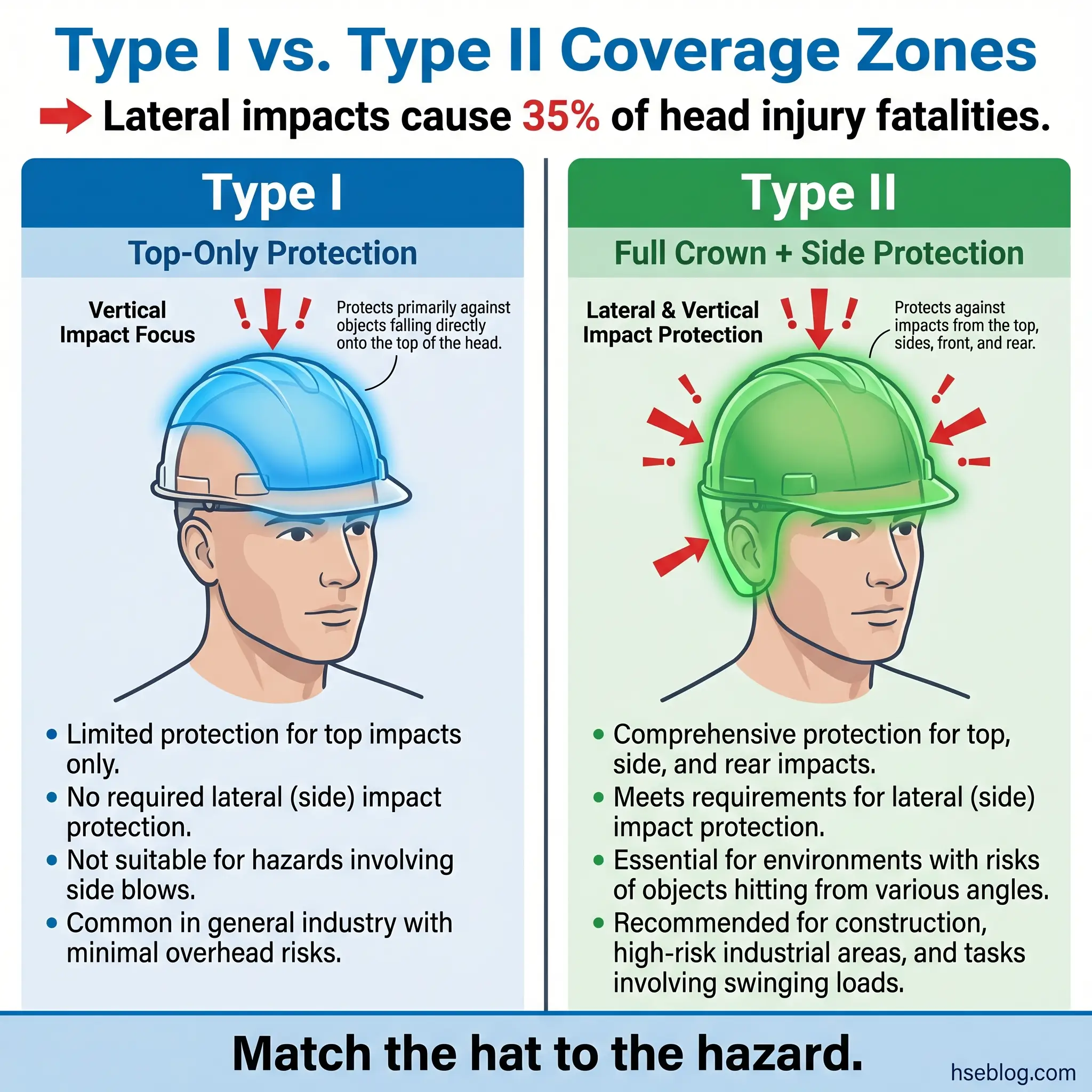
The most important classification any site supervisor needs to understand is the distinction between Type I and Type II hard hats. This is not a quality ranking — it is a protection coverage designation that dictates which hazards the helmet is rated for.
| Feature | Type I | Type II |
|---|---|---|
| Protection zone | Top of head only | Top and sides of head |
| Impact absorption | Vertical impacts (falling objects) | Vertical and lateral impacts |
| Common use | General construction, utilities | Confined spaces, climbing, steel erection |
| Typical industries | Road work, general trades, warehousing | Oil and gas, mining, tower work, utilities at height |
| Standard reference | ANSI/ISEA Z89.1 | ANSI/ISEA Z89.1 |
Type I hard hats have been the industry default for decades. They protect against objects falling straight down onto the crown — the classic dropped bolt, tool, or material scenario. They do not provide meaningful protection against lateral blows to the temples, sides, or back of the head.
Type II hard hats incorporate additional impact-absorbing material — usually expanded polystyrene (EPS) foam liner — around the full interior. This foam compresses on impact from any direction, providing lateral protection that Type I designs lack entirely.
The choice between Type I and Type II should be driven by a site-specific hazard assessment, not by procurement cost or what the last project used:
- Choose Type I when the primary head hazard is falling objects from above and workers operate in open areas with minimal lateral strike risk
- Choose Type II when workers are in congested spaces, working at height, entering confined spaces, or operating near moving equipment where side impacts are foreseeable
- Default to Type II if your hazard assessment identifies any credible lateral impact scenario — the cost difference is negligible compared to the protection upgrade
Pro Tip: On a mining operation in Western Australia, we switched the entire underground crew from Type I to Type II after three lateral impact incidents in one quarter — two from low-hanging rock bolts and one from a loader bucket. None of the Type I helmets would have absorbed those hits. The switch wasn't a policy change; it was a hazard-driven correction that should have been made during the original risk assessment.
Electrical Classification: Class E, Class G, and Class C
Beyond impact type, hard hats are classified by their electrical protection rating. This is a critical distinction for anyone working near energized conductors, switchgear, or overhead power lines. Getting this wrong doesn't just mean a compliance finding — it means electrocution.
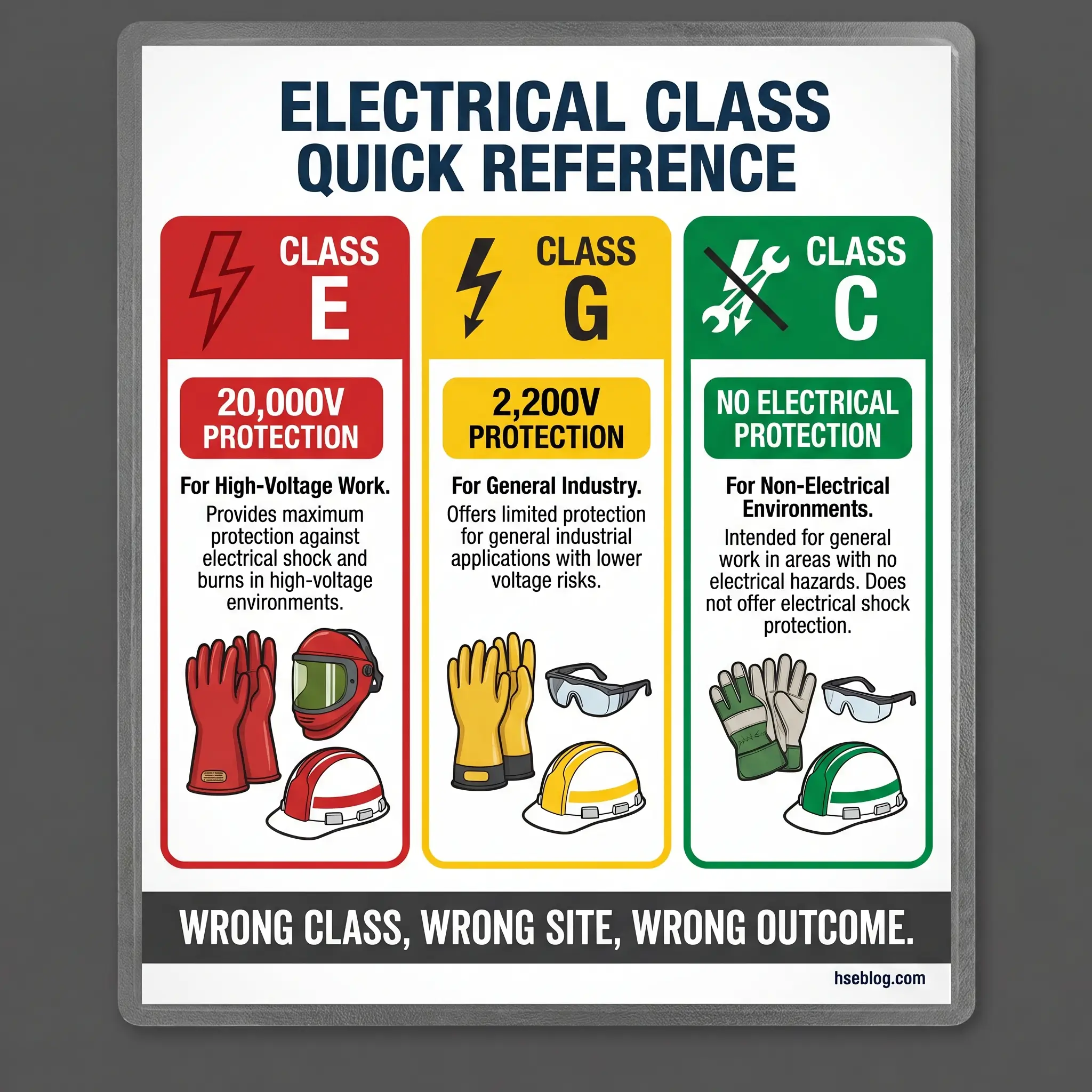
The three electrical classes are defined under ANSI/ISEA Z89.1 and determine the voltage the shell can withstand:
- Class E (Electrical): Tested to withstand 20,000 volts (phase to ground). Required for high-voltage electrical work, utility line crews, and substations
- Class G (General): Tested to withstand 2,200 volts. Suitable for general construction and industrial environments where low-voltage contact is a foreseeable hazard
- Class C (Conductive): Provides zero electrical insulation. Often ventilated for comfort. Used only in environments with absolutely no electrical hazard — typically controlled manufacturing or food processing settings
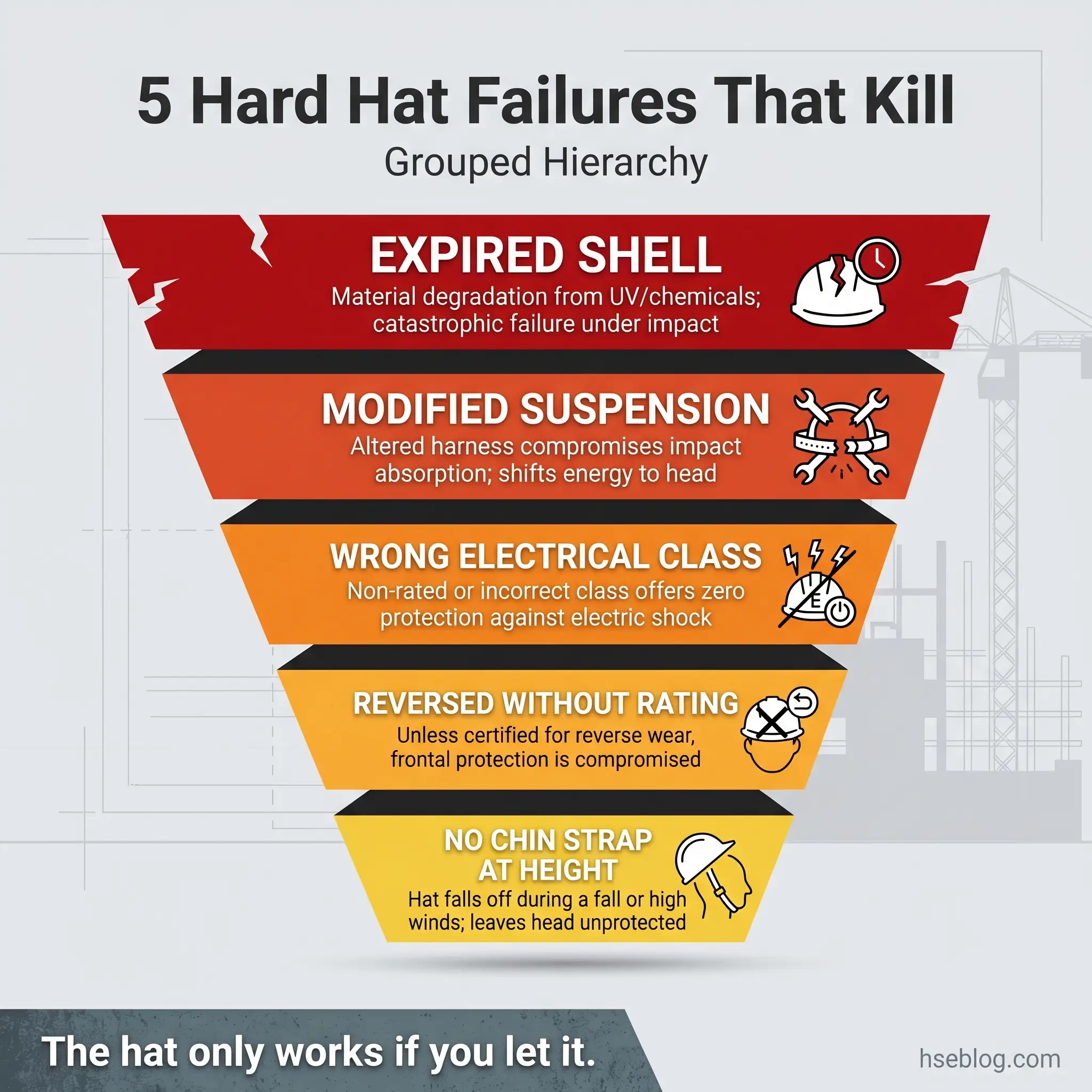
The critical field mistake I encounter repeatedly is workers wearing Class C ventilated hard hats on construction sites where overhead power lines or temporary electrical installations exist. Ventilation holes in Class C shells breach the electrical insulation entirely. One brush against a live conductor, and the ventilation slot becomes the current path to the skull.
OSHA 29 CFR 1926.100 requires head protection for employees working in areas where there is a possible danger of head injury from impact, falling or flying objects, or electrical shock and burns.
The following selection criteria should guide every procurement decision and site-level PPE assignment:
- Near any energized electrical source above 2,200V → Class E mandatory
- General construction with potential low-voltage contact → Class G minimum
- Controlled environment, no electrical hazard confirmed by assessment → Class C acceptable
- When in doubt → Class G. It costs the same as Class C and provides baseline electrical protection
Key Standards Governing Hard Hat Performance
Hard hats are not unregulated products. Every legitimate hard hat sold for occupational use must meet a recognized performance standard that defines impact resistance, penetration resistance, flammability, and — where applicable — electrical insulation. Understanding which standard applies to your jurisdiction is a compliance requirement, not optional knowledge.
The two primary standards that govern hard hat performance globally are:
- ANSI/ISEA Z89.1 (United States): The American National Standards Institute standard that defines Type I/II classifications and Class E/G/C electrical ratings. Widely adopted across North America, the Middle East, and Asia-Pacific regions
- EN 397 (Europe): The European standard for industrial safety helmets. Specifies impact absorption, penetration resistance, and flame resistance. Includes optional performance requirements for very low temperature (−20°C/−30°C), molten metal splash, lateral deformation, and electrical insulation (440V AC)
There are important differences between these two frameworks that affect cross-border projects and multinational operations:
- Lateral protection: EN 397 does not inherently require lateral impact protection the way ANSI Type II does. EN 12492 (climbing helmets) and EN 14052 (high-performance industrial helmets) address lateral and multi-directional impact more comprehensively
- Electrical testing: ANSI Z89.1 Class E tests to 20,000V. EN 397's optional electrical test covers only 440V AC — significantly lower. On international projects, do not assume an EN 397 helmet provides equivalent electrical protection to a Class E helmet
- Temperature rating: EN 397 includes specific optional tests for extreme cold (−20°C and −30°C), which ANSI Z89.1 does not address explicitly
Pro Tip: On multinational EPC projects, I've seen procurement teams order EN 397 helmets for sites where the electrical hazard assessment called for Class E protection. The helmets arrived, passed the goods receipt inspection visually, and went straight to the workforce. It took an electrical safety audit to catch the gap. Always verify that the standard printed inside the shell matches the electrical class your site risk assessment requires.
Hard Hat Lifespan, Inspection, and Replacement
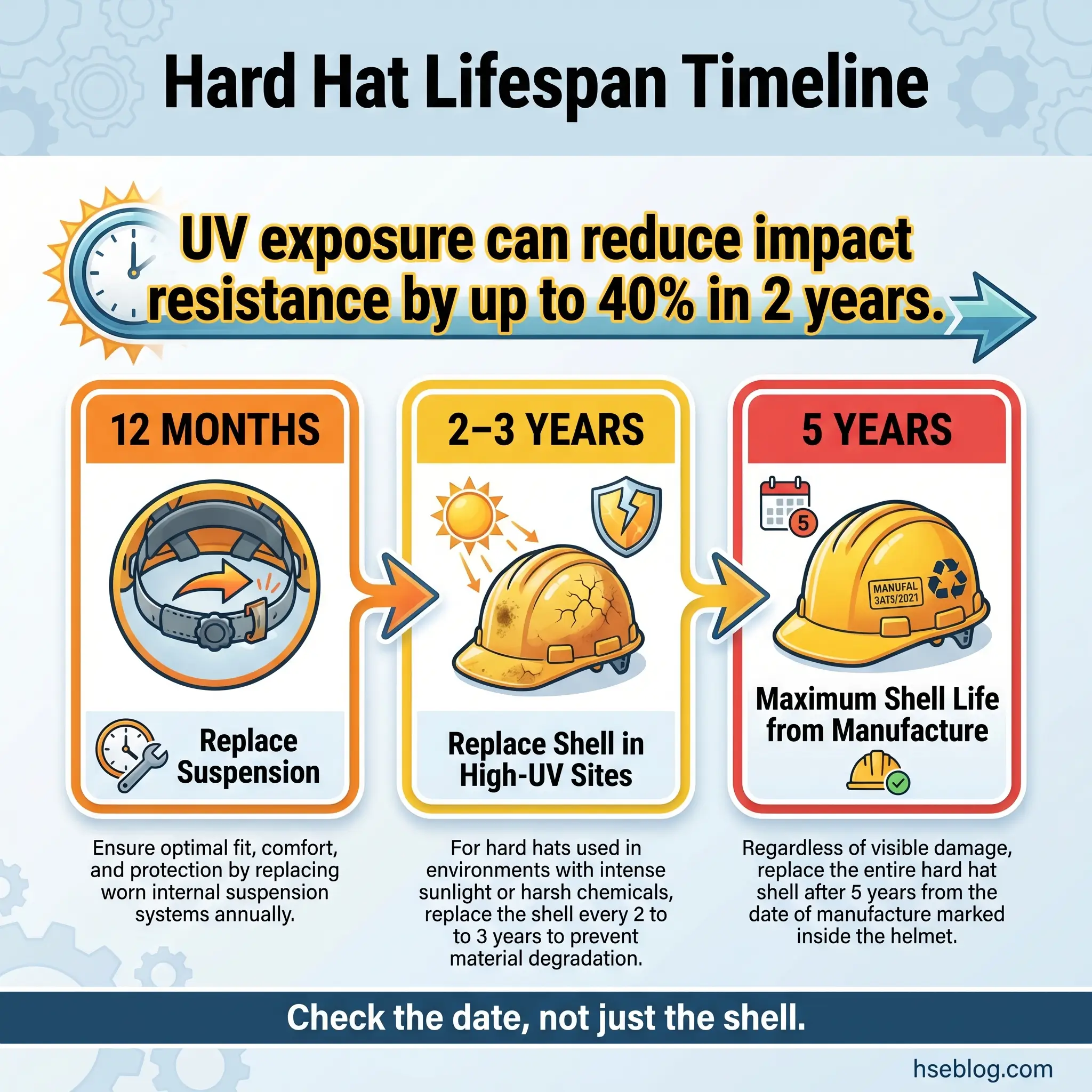
Every hard hat degrades over time. The shell material breaks down under UV radiation, chemical exposure, temperature cycling, and simple mechanical wear. A hard hat that looks intact on the surface may have lost a significant portion of its impact resistance. This is one of the most under-managed aspects of head protection programs I encounter during audits.
The following lifespan guidelines reflect both manufacturer recommendations and field-validated degradation patterns:
- Shell replacement: Most manufacturers recommend replacing the outer shell every 5 years from the date of manufacture — not the date of first use. Some HDPE shells in high-UV environments (desert sites, tropical regions) should be replaced at 2–3 years
- Suspension replacement: The internal suspension system should be replaced every 12 months, regardless of shell condition. Sweat, UV exposure, and mechanical stretching degrade the straps and their energy-absorbing properties
- Immediate replacement triggers: Any hard hat that has sustained an impact — even without visible damage — must be replaced. Micro-fractures in the shell and compression in the suspension may not be visible but will compromise future performance
A reliable inspection routine should be part of every shift start. The following checks take less than 30 seconds and should be non-negotiable:
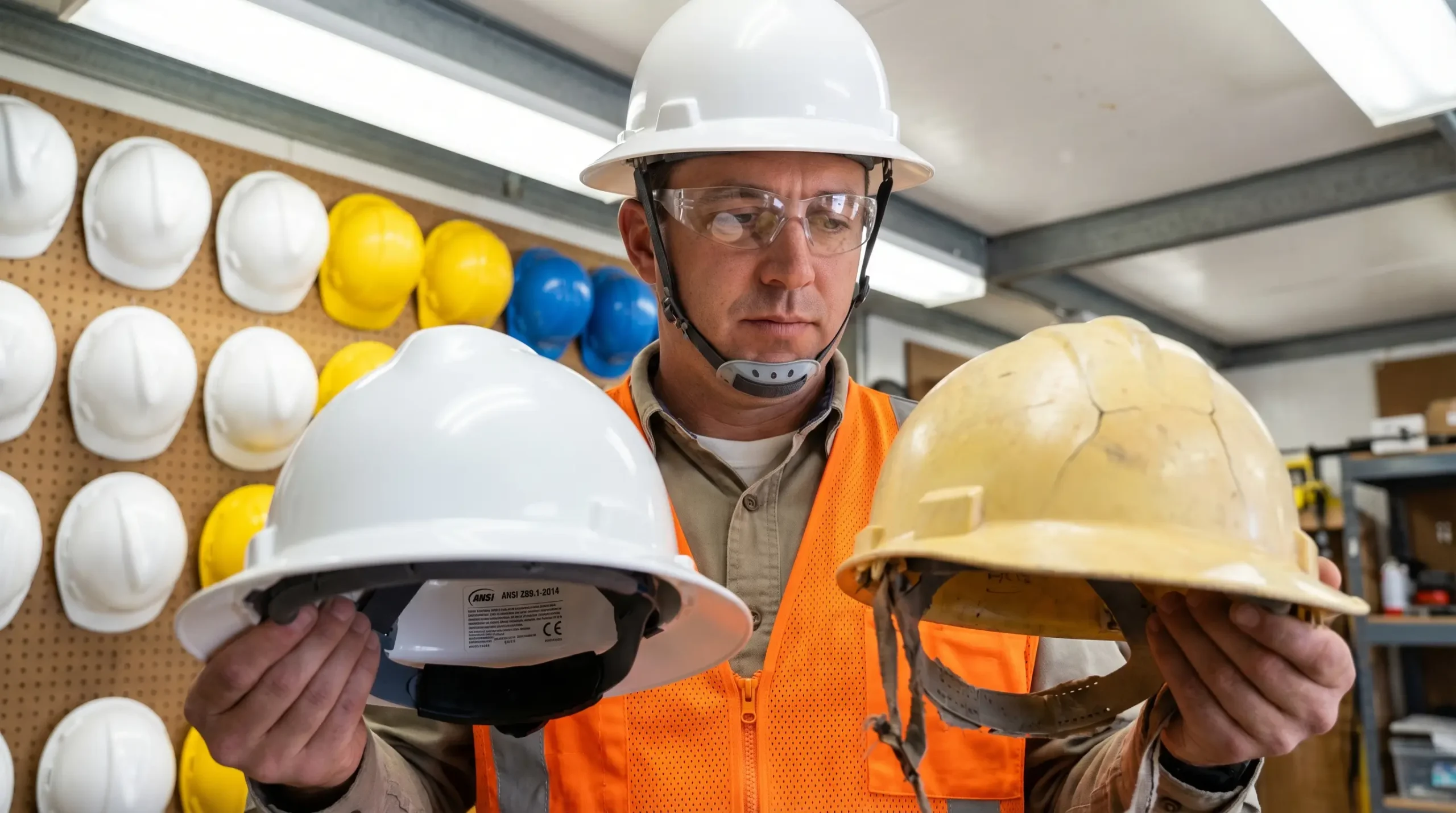
- Shell check: Run your fingers across the entire outer surface. Feel for cracks, dents, gouges, or soft spots. Flex the brim gently — if it cracks or doesn't spring back, the material has degraded
- UV degradation test: Look for chalking, fading, or a dull matte finish on the shell surface. These are signs of polymer breakdown from UV exposure
- Suspension check: Inspect every strap for fraying, cuts, stretching, or loss of elasticity. Check that the headband adjustment mechanism locks and holds
- Clearance test: With the hard hat on your head, press down on the crown. You should feel a distinct gap between the top of your head and the inside of the shell. If the shell contacts your head, the suspension has failed
- Marking verification: Confirm the manufacture date, standard marking (ANSI or EN), Type, and Class are still legible inside the shell
A hard hat with an expired shell or a degraded suspension is not PPE. It is a false sense of security sitting on someone's head.
Common Hard Hat Mistakes I See on Every Site
After a decade of site inspections and PPE audits across construction, oil and gas, and mining projects, the same hard hat violations repeat with frustrating consistency. These are not obscure compliance gaps — they are basic errors that directly increase the probability of a fatal head injury.
The most frequent mistakes fall into predictable categories:
- Wearing the hard hat backwards without a reverse-donning rating. Unless the manufacturer explicitly certifies the helmet for reverse wearing (with the brim facing backward) and the ANSI/EN markings confirm it, a reversed hard hat reduces protection. The suspension geometry is directional — flipping it changes the energy distribution path
- Stacking accessories improperly. Attaching non-approved stickers, paint, or aftermarket accessories to the shell can mask cracks, trap chemicals against the surface, and — with solvent-based adhesives — actually degrade the polymer. Only use manufacturer-approved accessories
- Removing or modifying the suspension. Workers cut straps, remove the rear ratchet, or stuff padding under the harness to "improve comfort." Every modification compromises the engineered clearance and force distribution
- Ignoring expiration dates. Hard hats do not last forever. I've confiscated helmets on site with manufacture dates eight and nine years old — shells so UV-degraded they cracked when squeezed by hand
- Using the hard hat as a bucket, seat, or storage container. This sounds minor, but sitting on a hard hat or carrying tools inside it introduces stress fractures and deforms the shell geometry
- Failing to secure the chin strap when required. In working at height hazards, wind-exposed areas, or any task involving bending and overhead reach, an unsecured hard hat will fall off at the moment of impact — exactly when it is needed most
Pro Tip: During a toolbox talk on a steel erection project in Northern Europe, I asked the crew to hand me their hard hats. Three out of fourteen had manufacture dates over six years old. Two had modified suspensions. One had a crack along the brim that the worker described as "just cosmetic." Every one of those helmets was removed from service before the shift started. Build hard hat inspections into your daily pre-task briefings — not quarterly audits.
When Hard Hats Are Required: Regulatory Expectations
Regulatory frameworks across every major jurisdiction mandate hard hat use in defined hazard conditions. These requirements are not discretionary — they carry enforcement weight, and non-compliance results in citations, stop-work orders, and personal liability for supervisors.
The key regulatory triggers for mandatory hard hat use include:
- OSHA 29 CFR 1926.100 (Construction): Requires head protection where there is danger of head injury from impact, falling or flying objects, or electrical shock and burns. The employer must ensure that head protection meets ANSI Z89.1
- OSHA 29 CFR 1910.135 (General Industry): Mirrors the construction requirement for general industry environments — manufacturing, warehousing, maintenance operations
- HSE UK (Personal Protective Equipment at Work Regulations): Requires employers to provide suitable head protection where risk assessment identifies a head injury hazard that cannot be controlled by other means. Employers must ensure compliance with EN 397 or equivalent
- ISO 45001:2018 Clause 8.1.2: Requires organizations to establish processes for the elimination of hazards and reduction of OH&S risks using the hierarchy of controls, with PPE — including head protection — as the last line of defence
The hierarchy of controls still applies. Hard hats are the final barrier, not the first. Before mandating head protection, the risk assessment should confirm whether engineering controls (toe boards, netting, secured tools), administrative controls (exclusion zones, overhead work permits), or elimination measures can reduce the head hazard at its source.
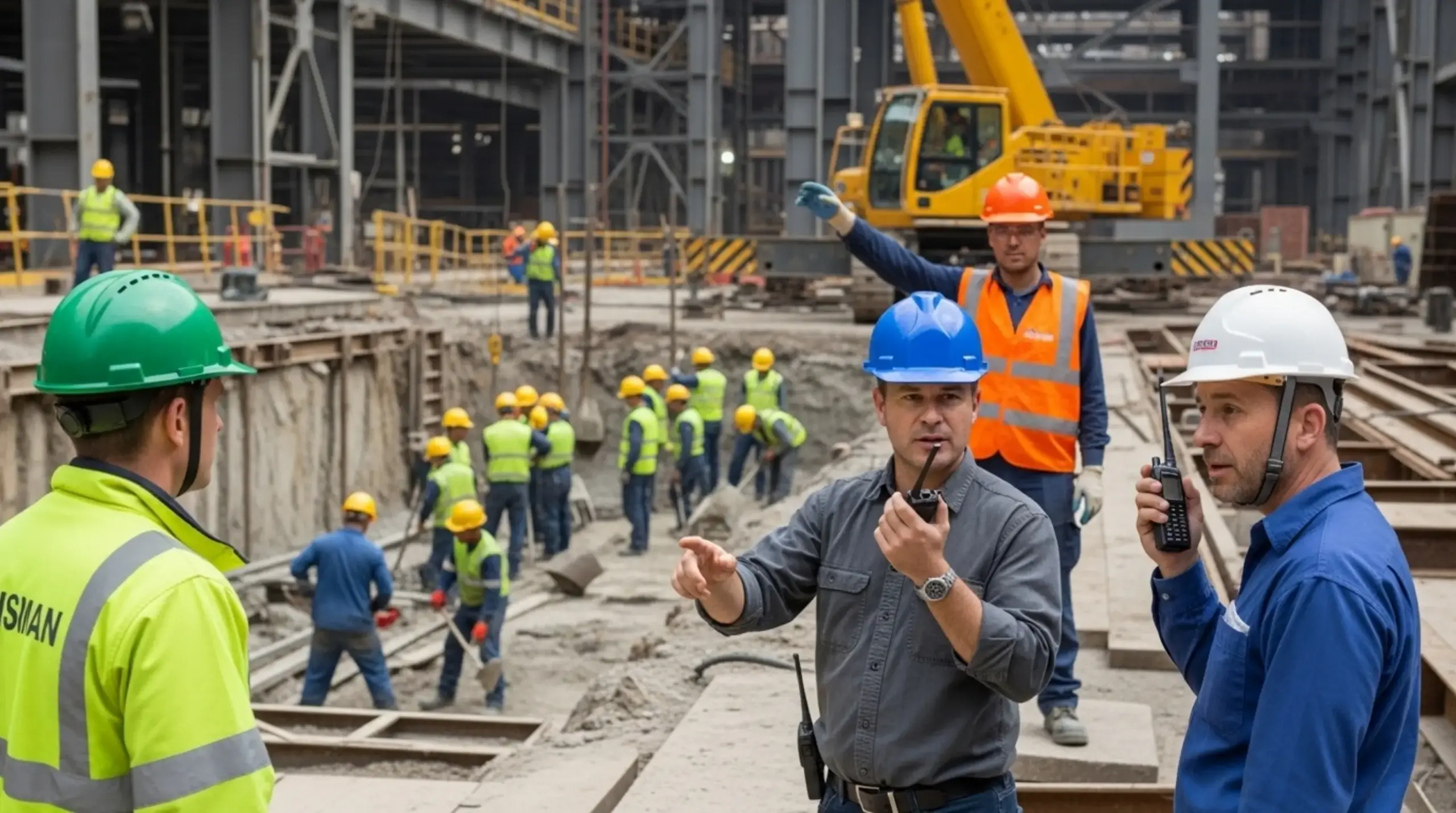
That said, in the real world of active construction sites, simultaneous operations, and constantly changing overhead exposures, hard hats remain mandatory across the entire site boundary — not just in specific zones. The moment you start defining "hard hat zones" and "no hard hat zones" on an active project, you create gaps in protection that workers will exploit.
Conclusion
Hard hats are the most visible piece of PPE on any work site, and that visibility creates a false sense of simplicity. They are not just plastic shells. They are engineered impact-absorption systems with specific type classifications, electrical ratings, material properties, and lifespan limits — all of which must be matched to the actual hazards workers face. Treating them as generic, one-size-fits-all equipment is how head injuries happen on sites that technically have a hard hat policy.
The field reality is that most hard hat failures are not product failures. They are management failures — wrong type selected, expired shells left in circulation, damaged suspensions ignored, electrical class mismatched to the work environment. Every one of those failures is preventable through proper hazard assessment, procurement discipline, and daily inspection routines that take less than a minute per helmet.
No hard hat programme works unless it starts with a genuine commitment to matching the right head protection to the right hazard, replacing equipment before it fails, and treating every hard hat on site as a life-critical system — because that is exactly what it is.