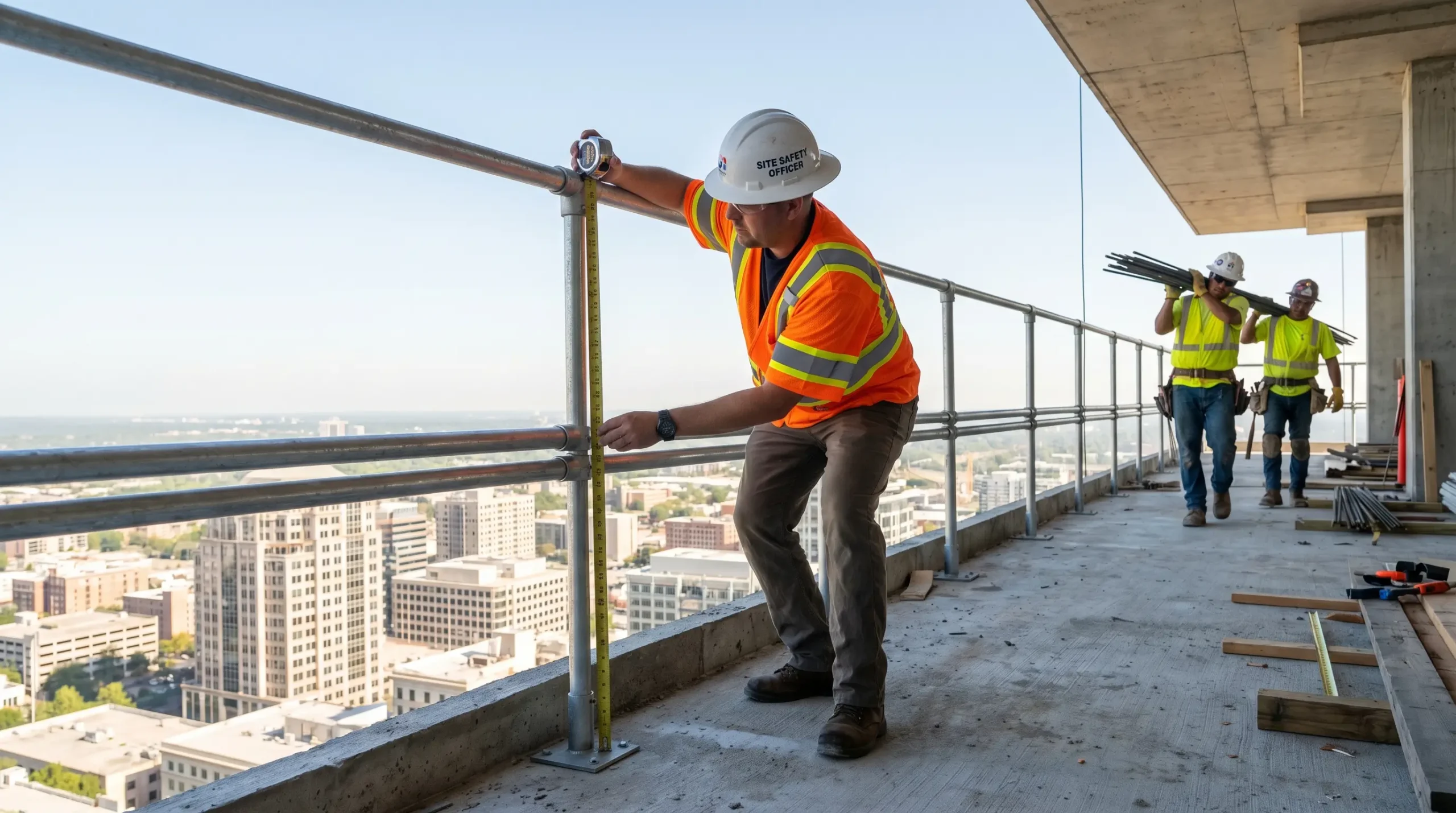
I stopped a concrete pour on a high-rise project in the Gulf three years ago because the perimeter guardrails on the ninth floor had been removed overnight. The formwork crew needed access for panel placement, so they unbolted an entire 40-foot section and left nothing — no chain, no warning line, no barricade. Workers were arriving for the morning shift and walking within two feet of a 90-foot drop. The foreman's explanation was simple: "We were going to put them back after the pour." That single decision — treating guardrails as optional furniture instead of life-critical infrastructure — is how falls kill people.
OSHA guardrail requirements exist because passive fall protection saves lives without relying on individual behavior. Unlike harnesses that must be worn correctly, or safety nets that require precise placement, a guardrail system physically blocks the fall path. When these systems fail to meet OSHA specifications — wrong height, missing components, insufficient strength — they create a dangerous illusion of protection. This article breaks down every dimensional, structural, and compliance requirement for guardrail systems under OSHA's construction and general industry standards, with the field context you need to inspect, install, and enforce them correctly.
What Are OSHA Guardrail Requirements?
OSHA guardrail requirements are the federal specifications that define how guardrail systems must be designed, installed, and maintained to prevent workers from falling off open edges, platforms, walkways, and elevated surfaces. These requirements are codified in two primary standards: 29 CFR 1926.502 for the construction industry and 29 CFR 1910.29 for general industry.
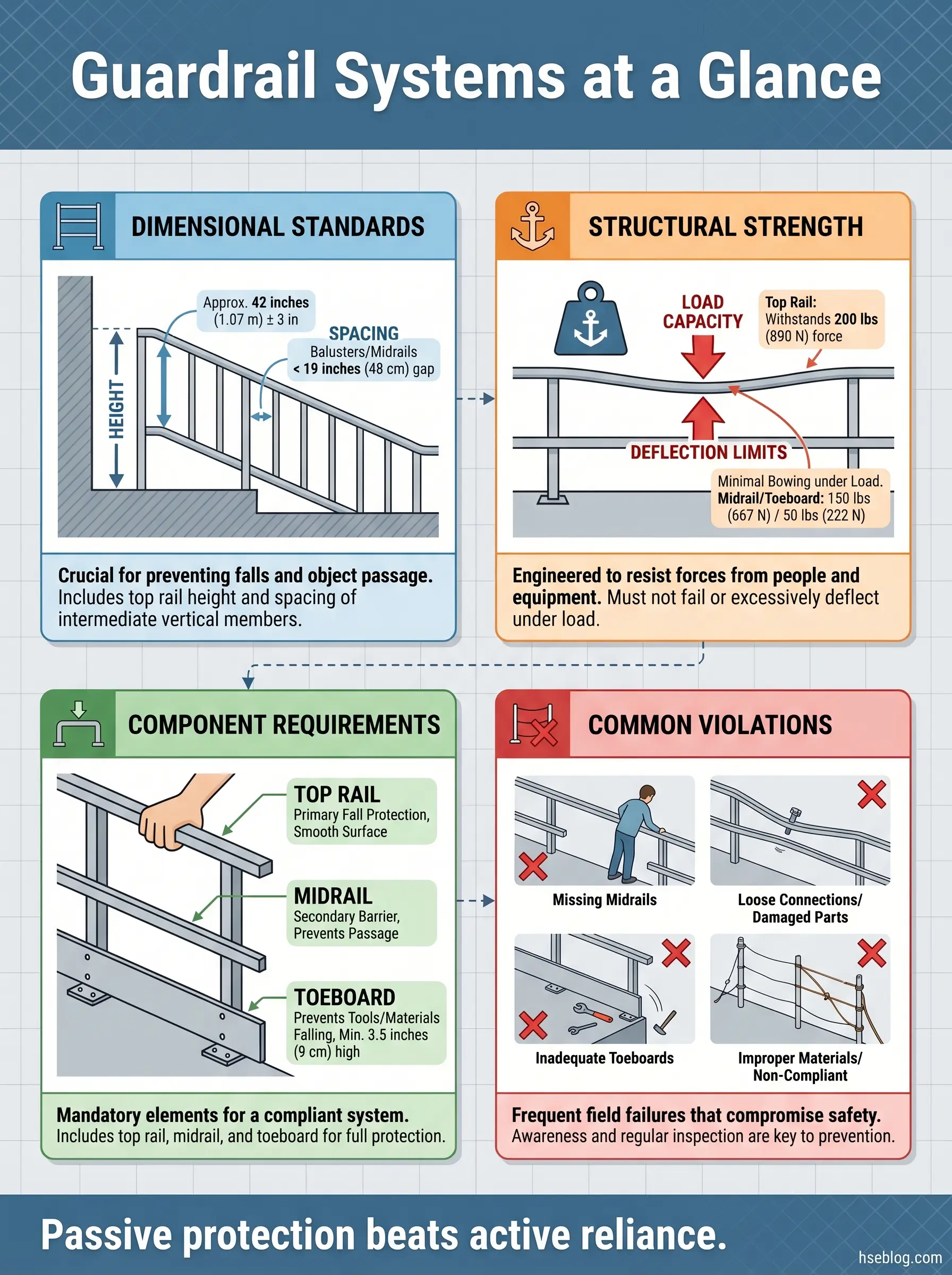
A guardrail system under OSHA's definition consists of three primary components working together to create a continuous barrier along an unprotected edge. Each component has specific dimensional and performance criteria that must be met simultaneously — partial compliance is non-compliance.
The three required components are:
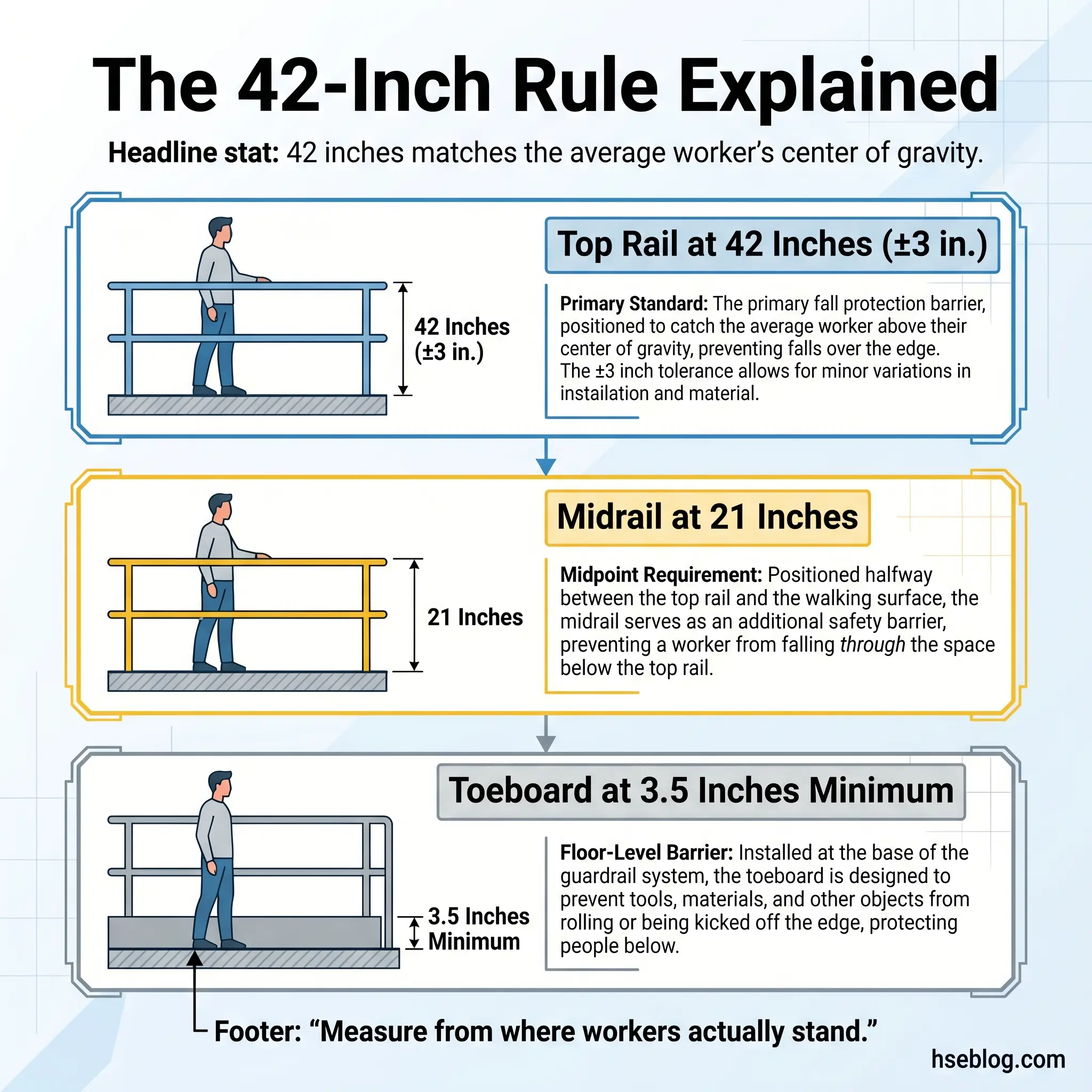
- Top rail: The uppermost horizontal member, positioned at 42 inches (±3 inches) above the walking-working surface. This is the primary barrier that prevents a worker from going over the edge.
- Midrail: A horizontal member installed midway between the top rail and the walking surface, typically at 21 inches. It closes the gap that would otherwise allow a worker to slide or roll under the top rail.
- Toeboard: A vertical barrier along the floor level, at least 3.5 inches tall, that prevents tools, materials, and debris from falling off the edge and striking workers below.
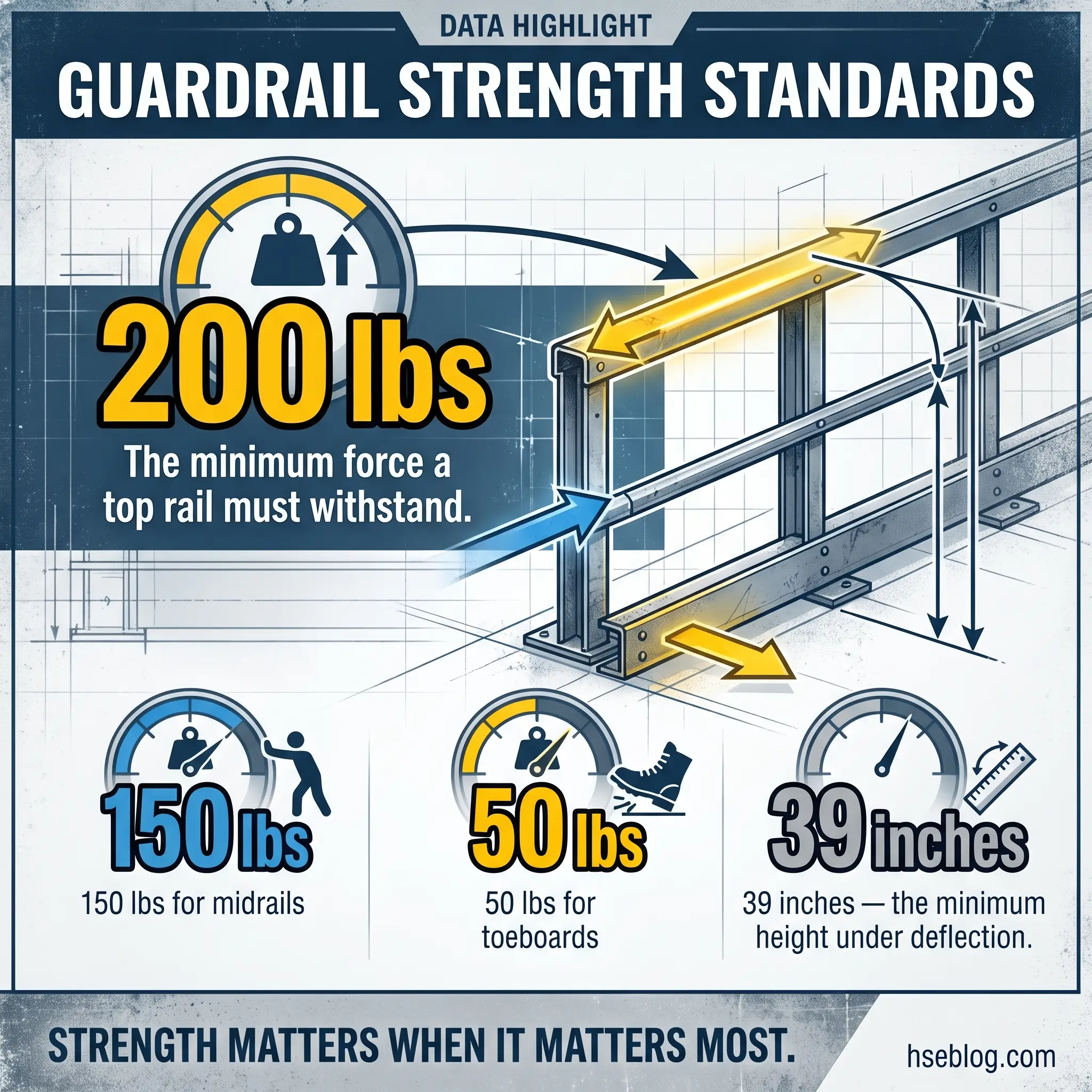
29 CFR 1926.502(b): "Guardrail systems shall be capable of withstanding, without failure, a force of at least 200 pounds applied within 2 inches of the top edge, in any outward or downward direction, at any point along the top edge."
Pro Tip: During inspections, I carry a tape measure and a fish scale. The tape confirms dimensions in seconds. The fish scale, hooked to the top rail with a controlled pull, gives a rough field indicator of structural rigidity. If a top rail flexes noticeably under hand pressure alone, it will not survive a 200-pound impact load.
OSHA Guardrail Height Requirements: The 42-Inch Standard
The height specification is the single most frequently verified — and most frequently violated — dimension in guardrail compliance. OSHA requires the top edge of the top rail to stand 42 inches above the walking-working surface, with a tolerance of plus or minus 3 inches. That gives a compliant range of 39 to 45 inches.
This 42-inch standard reflects anthropometric data on center-of-gravity height for an average adult worker. A rail set too low allows a worker's upper body momentum to carry them over the edge during a stumble or impact. A rail set too high creates a tripping hazard or interferes with material handling operations — both of which lead crews to remove it.
Several field conditions consistently produce non-compliant guardrail heights:
- Surface buildup beneath the rail: Gravel, concrete debris, or accumulated material on the walking surface effectively raises the floor level and reduces the clearance between surface and top rail. I have measured guardrails that were installed at a correct 42 inches but measured only 34 inches after six weeks of concrete overspray accumulated on the deck.
- Uneven substrates: On sloped surfaces or surfaces with grade changes, the 42-inch measurement must be taken from the highest point of the walking surface within the protected zone — not from the lowest point or from the base post anchor.
- Post settlement or deflection: Guardrail posts anchored in soft soil, temporary fill, or improperly cured concrete can settle over time, dropping the top rail below compliant height.
- Improper installation against parapet walls: When guardrails are mounted atop low parapet walls, the 42-inch measurement is taken from the walking surface — not from the top of the parapet. A 24-inch parapet with an 18-inch rail on top equals 42 inches of total barrier height. But if the parapet surface becomes a walking surface (workers standing on it), the measurement changes entirely.
Pro Tip: Measure guardrail height from the actual surface workers stand on — not from the structural deck or the original design surface. Conditions change. Surfaces build up. Re-measure monthly on active construction sites.
Midrail and Toeboard Specifications
The midrail and toeboard are the components most frequently omitted on job sites — and the ones that turn a guardrail system from compliant to citeable in a single inspection finding. I have written more corrective actions for missing midrails than for any other single guardrail deficiency. Crews often install top rails and skip the rest, treating the midrail as optional.
OSHA does not consider it optional. The midrail closes the opening between the top rail and the walking surface, preventing workers from falling through, sliding under, or being pushed beneath the top rail during a stumble. Without a midrail, a guardrail system has an opening large enough for an adult to pass through — which defeats the entire purpose of the barrier.
The specific requirements for midrails and toeboards are:
- Midrail height: Must be installed midway between the top rail and the walking surface. With a 42-inch top rail, the midrail sits at approximately 21 inches. OSHA does not specify a tolerance band for midrail height, but the midpoint positioning must be maintained as the top rail height varies within the 39–45 inch range.
- Midrail load capacity: Must withstand at least 150 pounds of force applied in any downward or outward direction at any point along the midrail. This is lower than the top rail's 200-pound requirement, but it is still a significant structural demand.
- Toeboard height: Minimum 3.5 inches from the walking surface to the top edge of the toeboard. There is no maximum height specified, but practical installation rarely exceeds 6 inches.
- Toeboard gap: No more than 0.25 inches (¼ inch) of clearance between the bottom of the toeboard and the walking surface. This tight clearance prevents small tools, fasteners, and debris from sliding under and becoming falling object hazards.
- Toeboard strength: Must withstand at least 50 pounds of force applied in any direction at any point.
One common workaround that fails OSHA scrutiny is using a single wire rope as a midrail. While OSHA permits wire rope as a top rail material under specific conditions (flagged, minimum ¼-inch diameter, no more than 3 inches of deflection), wire rope midrails must meet the same deflection limits. In practice, wire rope midrails sag under their own weight across spans greater than 8 feet, creating openings that exceed the permissible gap.
Acceptable Midrail Alternatives
OSHA allows alternatives to a traditional horizontal midrail if they provide equivalent protection. Understanding what qualifies — and what does not — prevents both violations and unnecessary material costs.
The following alternatives can replace a standard midrail if installed correctly:
- Intermediate vertical members (balusters): Spaced no more than 19 inches apart. This spacing prevents a worker's body from passing between uprights. Common on stairway guardrails and permanent platform railings.
- Mesh or screen panels: Solid or perforated panels filling the space between top rail and walking surface. Must meet the same load requirements. Common in industrial facility guardrails and mezzanine railings.
- Additional horizontal rails: Two or more intermediate rails spaced evenly, each meeting load requirements. Used on heavy industrial platforms where impact resistance is prioritized over visibility.
Key field distinction: Caution tape, flagging, and plastic chain are NOT midrail alternatives. They do not meet any load capacity requirement and create a false sense of barrier protection.
Structural Load and Deflection Requirements for OSHA Guardrails
Guardrail dimensions mean nothing if the system collapses under the force it was designed to resist. Every guardrail failure I have investigated — and I have investigated seven in the last decade — traces back to structural deficiency rather than dimensional error. The rails were the right height. They simply were not strong enough.
OSHA specifies minimum force resistance and maximum deflection for each guardrail component. These are performance-based requirements — OSHA does not prescribe specific materials, cross-sections, or connection types, but the installed system must meet these thresholds regardless of how it is built.
The structural requirements break down as follows:
| Component | Minimum Load Resistance | Maximum Deflection | Load Application Point |
|---|---|---|---|
| Top rail | 200 lbs outward/downward | Must not deflect to below 39 inches | Within 2 inches of top edge, any point along length |
| Midrail | 150 lbs outward/downward | No specific limit, but must maintain barrier function | Any point along the midrail |
| Toeboard | 50 lbs in any direction | No specific limit stated | Any point along the toeboard |
| Posts | Must support top rail loads without failure | No specific limit, but post failure = system failure | Force transferred from top rail |
The deflection criterion for the top rail is particularly important: when 200 pounds of force is applied, the top rail may bend or flex, but it must not deflect to a height below 39 inches. If it does, the system has effectively lowered its protective barrier under load — exactly the moment when barrier height matters most.
Pro Tip: Aluminum guardrail systems are lighter and easier to install, but they require closer post spacing than steel systems to meet the 200-pound load requirement across the same span. Always check the manufacturer's span tables before installation — do not assume equal post spacing across different materials.
Construction vs. General Industry: Key Differences in OSHA Guardrail Standards
One of the most common compliance errors I encounter — especially on sites where maintenance and construction activities overlap — is applying the wrong standard. A facility maintenance manager installs guardrails to general industry specifications on a section of roof where construction work is actively underway. The guardrails meet 1910.29 but fail 1926.502. The result is a citeable violation and, more critically, inadequate protection for the specific risk profile of construction work.
The two OSHA standards share the same core guardrail dimensions but differ in trigger heights, application contexts, and some performance details. The following table clarifies the critical distinctions:
| Requirement | General Industry (1910.29) | Construction (1926.502) |
|---|---|---|
| Trigger height for guardrail protection | 4 feet above lower level | 6 feet above lower level |
| Top rail height | 42 inches (±3 inches) | 42 inches (±3 inches) |
| Top rail load | 200 lbs | 200 lbs |
| Midrail requirement | Required | Required |
| Toeboard requirement | Required where falling objects hazard exists | Required where falling objects hazard exists |
| Wire rope top rail | Permitted with conditions | Permitted with conditions (flagged every 6 feet, ¼-inch minimum diameter) |
| Steel/plastic banding as top rail | Not permitted | Not permitted |
| Surface treatment | Smooth surface to prevent puncture or laceration | Smooth surface to prevent puncture or laceration |
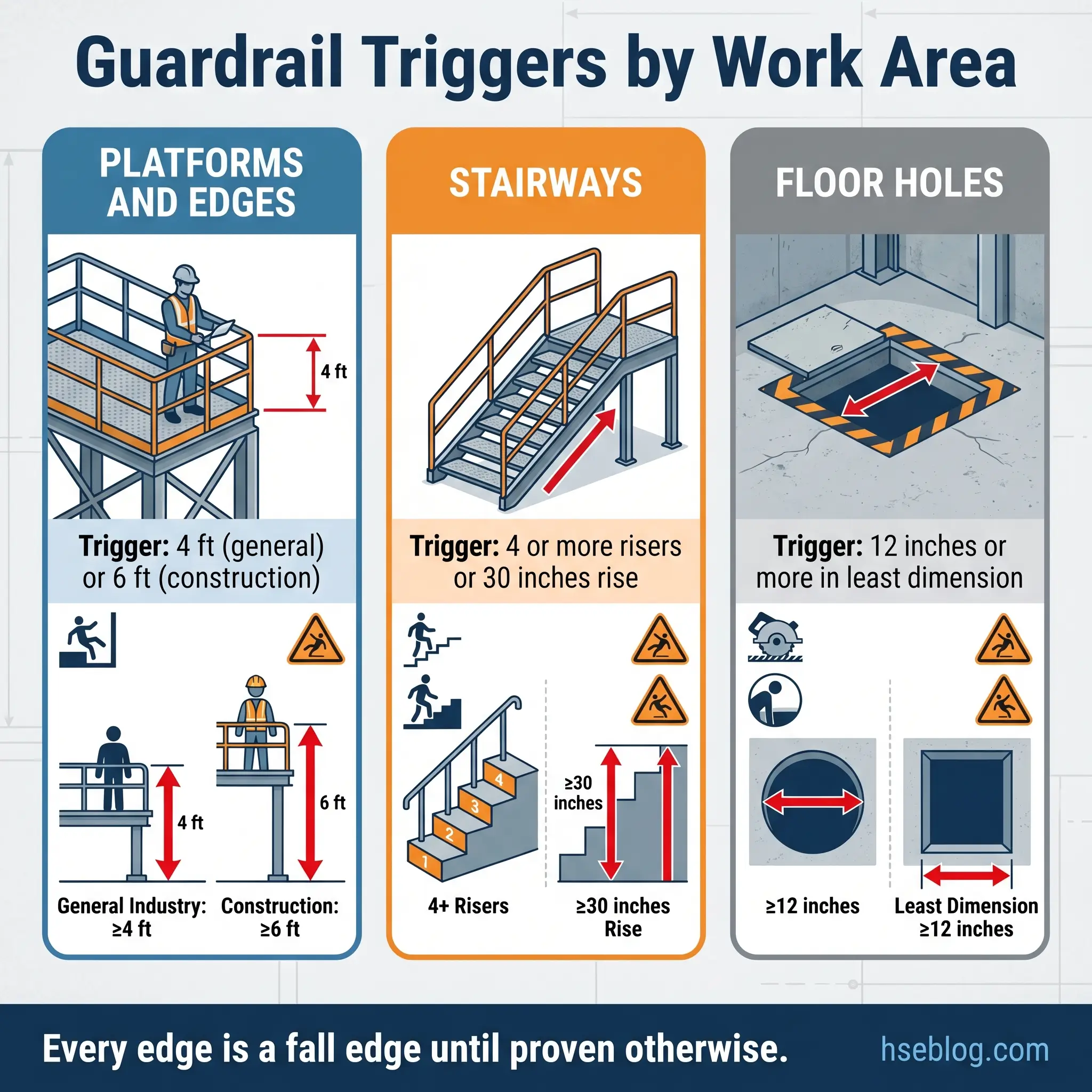
The trigger height difference is the most operationally significant distinction. General industry requires fall protection — including guardrails — at any edge 4 feet or more above a lower level. Construction sets this threshold at 6 feet. That 2-foot gap means a 5-foot drop in a manufacturing facility requires guardrails, while the same 5-foot drop on an active construction site does not technically trigger the OSHA guardrail requirement — though good practice and most company policies mandate protection regardless.
- Overlap zones matter: When construction work occurs inside an operating facility, the question of which standard applies depends on the nature of the work, not the location. Construction activities fall under 1926 even inside a general industry building.
- State plan states may differ: Twenty-two states operate OSHA-approved state plans that can set stricter requirements than federal OSHA. Some state plans require fall protection at heights lower than the federal trigger.
Most Common OSHA Guardrail Violations on Job Sites
After conducting hundreds of site inspections across construction, manufacturing, and energy projects, the same guardrail failures appear with discouraging consistency. These are not obscure technical violations — they are visible, preventable deficiencies that directly expose workers to fatal fall hazards.
The following violations account for the majority of guardrail-related citations I have observed and documented:
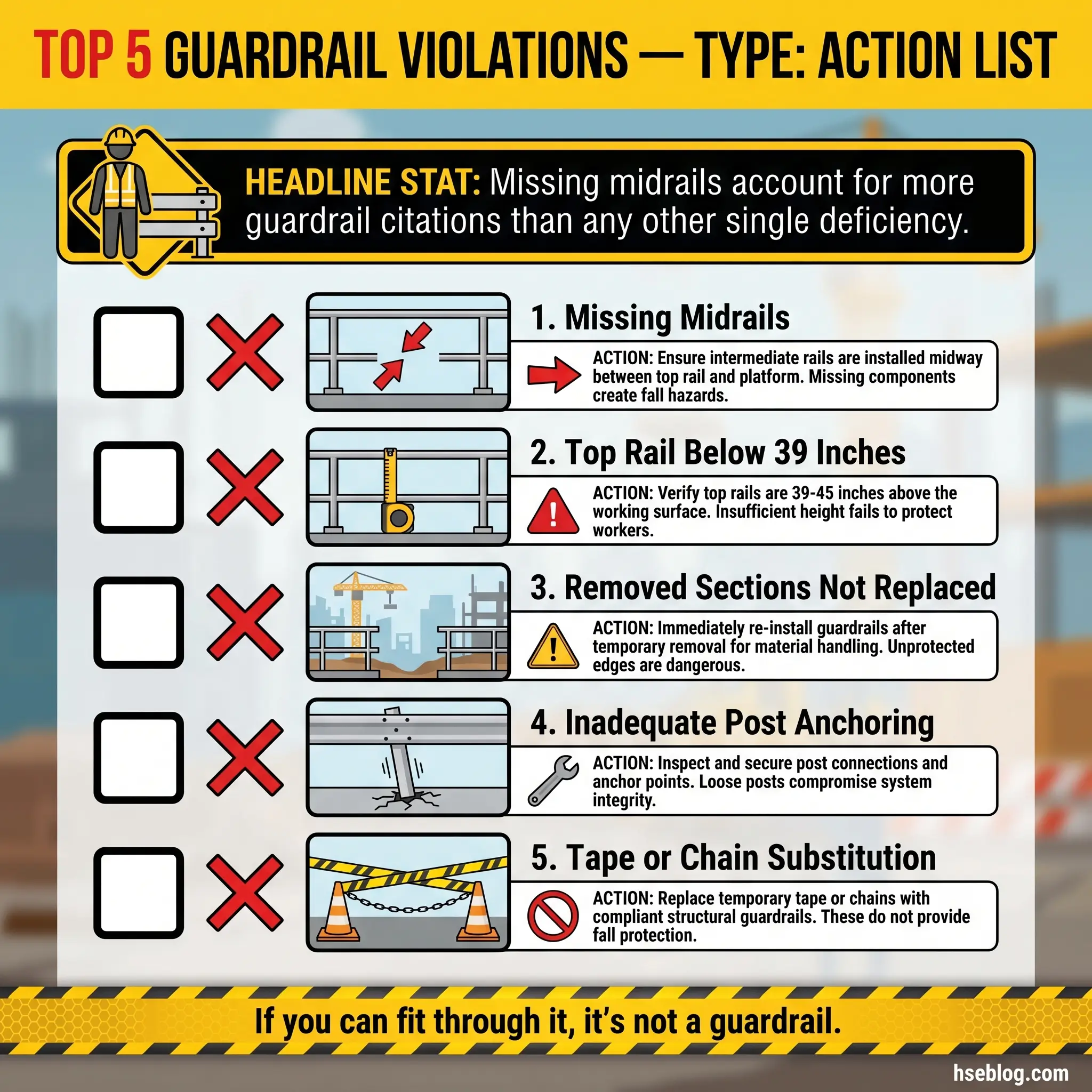
- Missing midrails: The single most common finding. Crews install top rails and toeboards but leave the midrail gap open. This creates a 38-inch opening — large enough for a worker to fall through headfirst during a stumble.
- Top rail height below 39 inches: Usually caused by surface buildup, post settlement, or installation error. Workers lean on short rails and their center of gravity shifts over the edge.
- Guardrail sections removed and not replaced: Crews remove guardrails for material access, crane lifts, or equipment movement and fail to reinstall them immediately. The "temporary" removal becomes permanent until someone falls or an inspector arrives.
- Inadequate post anchoring: Posts set in loose soil, clamped to surfaces without proper base plates, or welded with insufficient penetration. The guardrail looks correct but pulls free under a 200-pound lateral load.
- Wire rope top rails without flagging: Wire rope guardrails must be flagged with high-visibility material at no more than 6-foot intervals in construction. Unflagged wire rope at 42 inches is nearly invisible in low light conditions and at construction site distances.
- Using caution tape or plastic chain as a guardrail substitute: This is not a guardrail system under any OSHA definition. It has zero load capacity and provides zero physical barrier. Yet I find it deployed as "edge protection" on at least one out of every five sites I inspect.
Pro Tip: When you find a removed guardrail section, do not just write a corrective action. Ask WHY it was removed. If the work process requires repeated guardrail removal, the answer is a self-closing gate, a swing gate, or a redesigned material handling sequence — not a cycle of removal and reinstallation.
Guardrail Material and Surface Requirements
OSHA does not mandate specific guardrail materials — steel, aluminum, wood, fiberglass, and wire rope are all permissible if the installed system meets the dimensional and load requirements. The flexibility in material choice is intentional. Different work environments demand different solutions. A corrosion-resistant fiberglass system makes sense in a chemical processing facility. A heavy steel pipe rail suits a permanent mezzanine edge. Treated lumber guardrails remain common on wood-frame construction sites.
Regardless of material, every guardrail component must meet these surface and construction criteria:
- Smooth surfaces: The top rail and midrail must have surfaces smooth enough to prevent snagging of clothing, puncture wounds, or laceration injuries. Raw-cut pipe ends, exposed bolt threads, and splintered lumber all violate this requirement.
- No steel or plastic banding: Neither standard permits steel banding or plastic banding as a top rail material. These materials lack the rigidity and load capacity required and can cause severe laceration injuries under force.
- Wire rope conditions: When wire rope is used as a top rail, it must be at least ¼-inch diameter, flagged at intervals no greater than 6 feet with high-visibility material, and must not deflect below 39 inches under the 200-pound load test. Wire rope is not a midrail substitute unless it independently meets the midrail deflection and load requirements.
- Wood guardrails in construction: Lumber used for guardrails under 1926.502 must be construction grade or equivalent. I have seen sites use pallets, shipping crate boards, and reclaimed lumber for guardrails — none of which meet construction grade strength requirements and all of which create splinter and fracture hazards.
Field reality: The most structurally reliable guardrail material on a construction site is only as good as its connection points. A properly rated steel top rail bolted to a post with a single undersized bolt fails at the connection, not at the rail. Inspect connections, not just components.
Guardrail Requirements for Specific Work Areas
OSHA guardrail requirements apply universally wherever an unprotected edge exists above a lower level at the applicable trigger height. But specific work areas carry additional requirements or unique installation challenges that field teams routinely mishandle.
The following areas require particular attention during guardrail planning and inspection:
Stairways and Stair Landings
Stairway guardrail requirements under OSHA differ slightly from platform and edge guardrails. The top rail height on stairways is measured vertically from the stair tread nosing, and the 42-inch requirement applies along the stair's upper surface. Stairways with four or more risers, or rising more than 30 inches in height, require a stair rail system on each unprotected side and edge.
- Open-sided stairways (no wall on one or both sides) must have guardrail systems along the open side(s)
- Stair rail top rail height must be between 36 and 42 inches measured from the leading edge of the stair tread
- Midrails or balusters are required in the same configurations as platform guardrails
Roof Edges
Rooftop work is where guardrail compliance failures become fatalities most frequently. Low-slope roof edges on commercial and industrial buildings present uniform fall exposure across long perimeters. Temporary guardrail systems with weighted bases (non-penetrating systems) are the standard solution, but they introduce specific challenges.
- Weighted base guardrails must be positioned far enough from the edge that a deflected rail under load does not extend past the roof edge. Most manufacturers specify a minimum 42-inch setback from the leading edge.
- Parapets function as guardrails only if they meet the 39–45 inch height requirement. A 30-inch parapet is not a guardrail — it is a tripping hazard at a fatal edge.
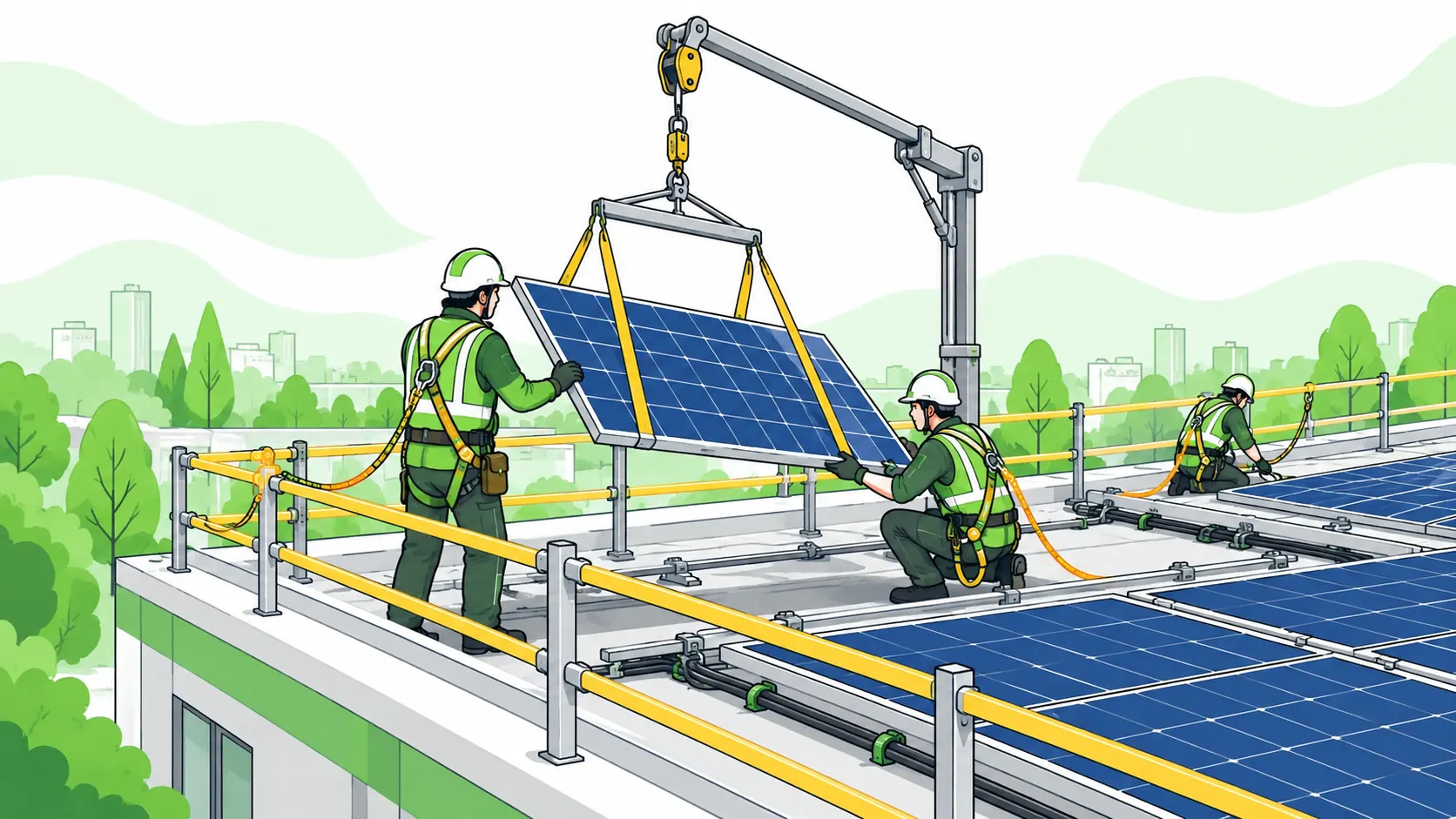
- Roof access points (ladders, hatches, stairway exits) require guardrails or self-closing gates that automatically close after each passage.
Holes and Openings
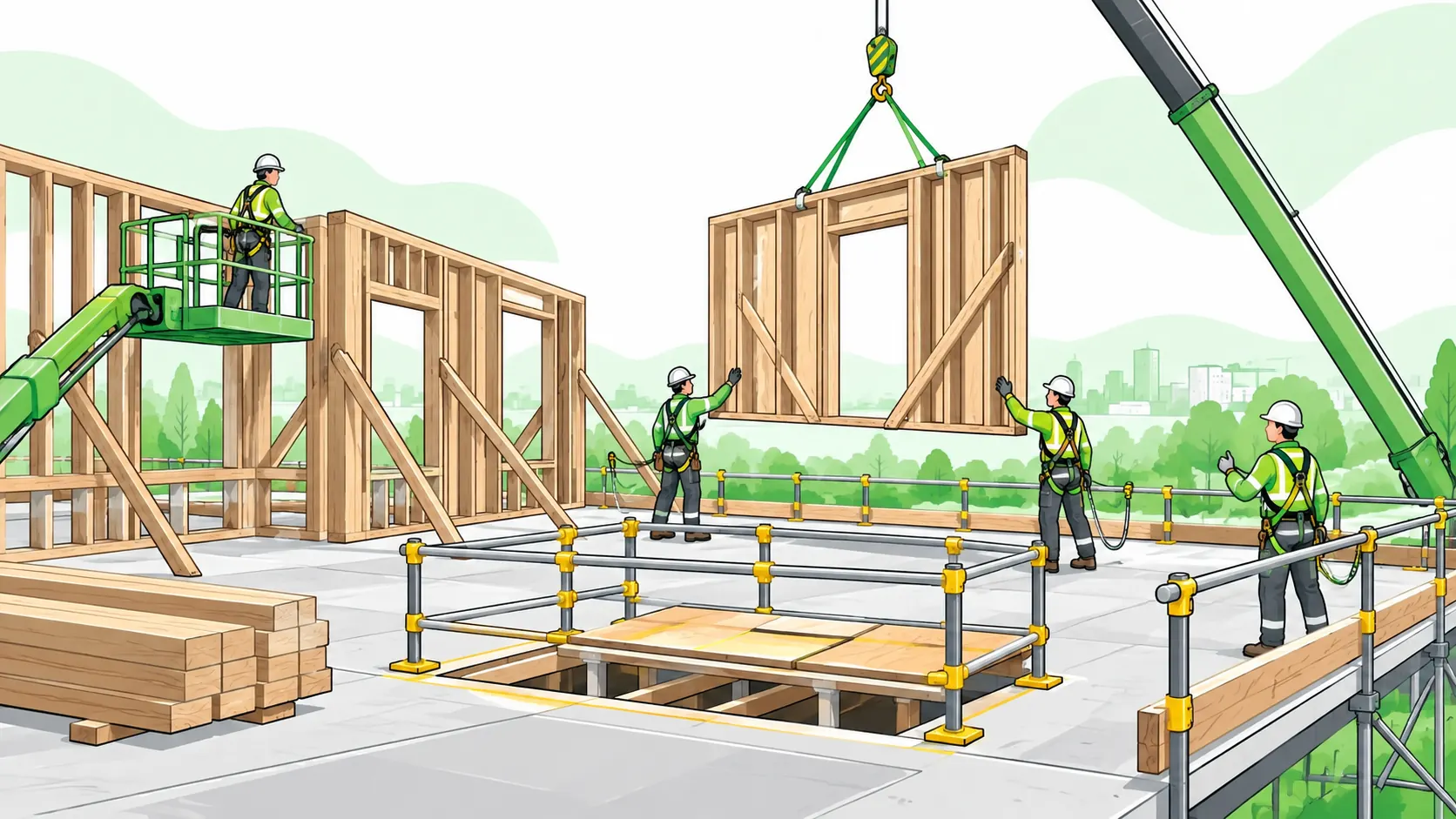
Floor holes and wall openings are subject to guardrail or cover requirements depending on their dimensions. A hole more than 2 inches in its least dimension but less than 12 inches requires a cover. A hole 12 inches or more in its least dimension requires either a cover capable of supporting twice the maximum intended load or a guardrail system around all exposed sides.
- Floor hole covers must be marked "HOLE" or "COVER" to prevent unauthorized removal
- Wall openings with a drop of 4 feet or more (general industry) or 6 feet or more (construction) and a bottom edge less than 39 inches above the walking surface require guardrails
Inspection and Maintenance of Guardrail Systems
Installing a compliant guardrail system is not a one-time event. Guardrails degrade, get struck by equipment, suffer connection loosening from vibration, and get modified by crews who need access through the barrier. A guardrail that was compliant on Monday can be non-compliant by Wednesday if no one inspects it.
OSHA requires that guardrail systems be inspected by a competent person — someone capable of identifying existing and predictable hazards and authorized to take corrective action. The frequency and rigor of inspection should match the operational tempo.
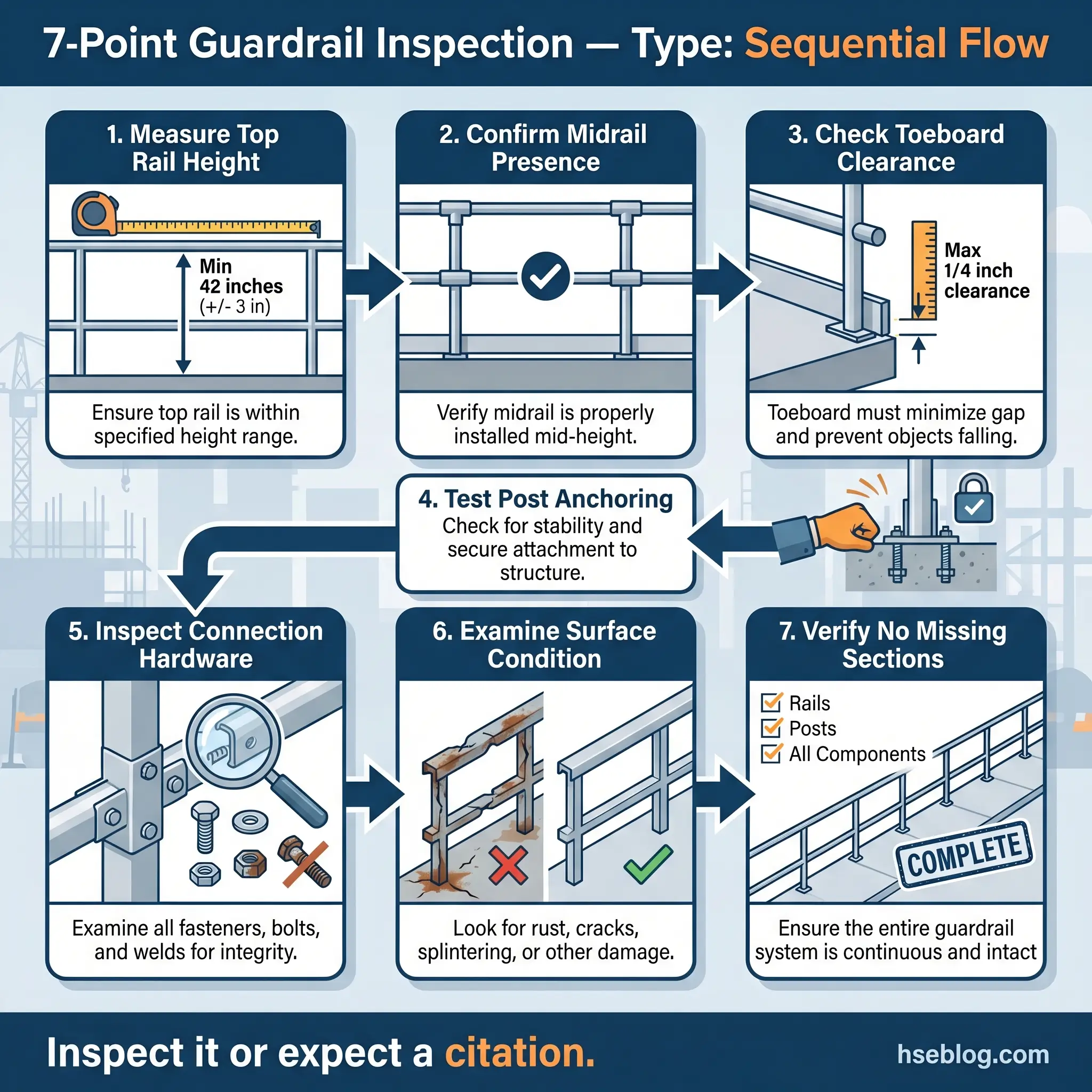
An effective guardrail inspection covers these checkpoints at minimum:
- Verify top rail height at multiple points along the span — not just at the posts. Sagging between posts can drop the mid-span height below 39 inches even when post-mounted ends read 42 inches.
- Confirm midrail presence and height at every guardrail section. Check that midrails have not been removed, relocated, or repurposed.
- Inspect toeboard attachment and measure clearance from walking surface. Toeboards shift, especially on temporary systems.
- Test post anchoring with a firm lateral push. Movement at the base indicates either anchor failure or inadequate base plate bearing.
- Check connection hardware — bolts, clamps, couplers, pins. Vibration from construction equipment and wind loading loosens connections steadily over time.
- Examine surface condition of all rail members. Corrosion, splintering, cracking, and sharp edges from impact damage create secondary hazards.
- Verify that no sections have been removed without equivalent temporary protection (warning lines, controlled access zones, or personal fall arrest systems) in place.
Pro Tip: Photograph guardrail conditions during every inspection and log them with dates. When OSHA investigates a fall, one of the first requests is documentation of inspection history. A verbal "we check them every day" does not survive an enforcement inquiry. Timestamped photos do.
Conclusion
OSHA guardrail requirements are not complicated. Forty-two inches for the top rail. Twenty-one inches for the midrail. Three and a half inches for the toeboard. Two hundred pounds of load resistance. These numbers are fixed, documented, and non-negotiable — and yet guardrail deficiencies remain among the most frequently cited fall protection violations year after year. The gap between knowing the standard and enforcing it on every shift, at every edge, through every crew change, is where workers die.
The strength of a guardrail system is that it does not depend on human behavior to function. A worker does not need to clip in, don a harness, or remember a procedure. The barrier is simply there. But that passive reliability only holds if the system was installed correctly, inspected regularly, and never treated as disposable. Every removed section, every missing midrail, every post anchored in loose soil is a decision to gamble with someone's life.
Guardrails protect people who do not know they need protecting — the worker carrying a load who cannot see the edge, the apprentice who has never worked at height, the supervisor walking a perimeter during a night shift. Build them right. Inspect them daily. Refuse to accept anything less than full compliance. The standard exists because the falls are real.