

TL;DR
- If your laser is Class 1 or 1M → no area warning sign is normally required, though the manufacturer’s product labels still apply.
- If your laser is Class 2, 2M, or 3R → post a CAUTION sign where exposure is possible (advisory under ANSI Z136.1).
- If you run any laser above Class 2 → laser safety signs become mandatory at controlled-area entrances, not optional.
- If your laser is Class 3B or Class 4 → a WARNING or DANGER sign is required at every entrance to the laser-controlled area.
- If you defeat an interlock, align, or service a higher-class laser → add a NOTICE sign marking the temporary controlled area.
Laser safety signs are class-driven hazard markers required wherever a laser-controlled area exists. Under ANSI Z136.1, Class 2/2M/3R areas take a CAUTION sign, Class 3B and Class 4 areas take a WARNING or DANGER sign, and temporary controlled areas take a NOTICE sign — each posted conspicuously at every entry point to the controlled area.
There is a comfortable assumption on many sites that a laser warning sign is a laser warning sign — that any yellow-and-black placard with a starburst on the door satisfies the requirement. It does not. ANSI, OSHA, the FDA, and the international IEC standard each define different signal words, different formats, and different placement rules, and they do not fully agree with one another. A sign that looks correct can still be wrong for the class on the other side of the door.
That gap matters because Class 3B and Class 4 lasers cause permanent retinal injury faster than the human blink reflex can react, and the sign at the threshold is often the only warning between a person and an unguarded beam. Getting laser safety signs right — the correct type for the class, the required information on the face, and the exact placement at every entry — is one of the cheapest and most scrutinized controls in any laser safety program. This article sets out the sign types, what each one must contain, where they belong, and how the US and international standards diverge.
Regulatory note: The regulatory content here reflects general HSE professional understanding of United States (OSHA, ANSI, FDA) and international (IEC, ISO, EN) requirements as of 2026. It is not legal advice. Specific compliance questions, citations, or enforcement situations should be directed to qualified counsel and your facility’s Laser Safety Officer in the applicable jurisdiction.
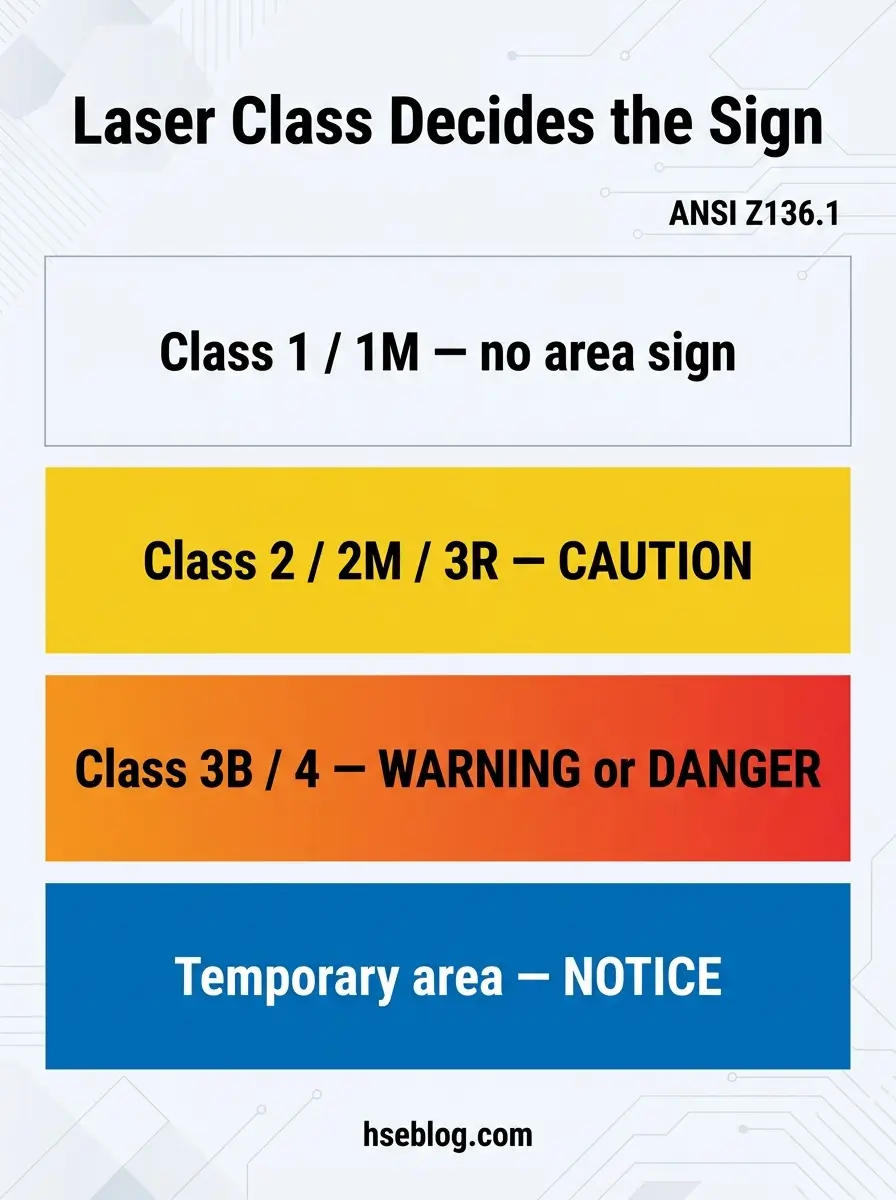
Laser Class Drives the Sign — Not the Room or the Application
The laser’s class decides everything about its signage. Before you choose a placard, you classify the laser by its potential to injure the eye or skin during use, and that class — assigned by the manufacturer under the Federal Laser Product Performance Standard or IEC 60825-1 — dictates whether you need a sign at all and which signal word it carries.
Lower-hazard classes
These rarely trigger area signage, because the beam is either harmless or self-limiting under normal use.
- Class 1 and 1M — Safe under normal operation; Class 1M only becomes a concern with optical aids. Embedded products like laser printers and most barcode scanners sit here, and generally need no area warning sign.
- Class 2 and 2M — Visible, low-power beams where the natural aversion response (blinking, looking away) protects the eye. A CAUTION sign is used where someone could be exposed.
- Class 3R — Low-to-moderate risk; hazardous mainly for deliberate intrabeam viewing or use with optics. Also grouped under CAUTION signage.
Higher-hazard classes
This is where signage stops being advisory and becomes mandatory.
- Class 3B — Direct and specular (mirror-like) reflections injure the eye; diffuse reflections are usually safe. These require a posted controlled area.
- Class 4 — The highest hazard. Beams injure the eye and skin, ignite materials, and produce hazardous diffuse reflections and laser-generated air contaminants. OSHA’s Technical Manual sets the Class IV (its older numbering) threshold at a continuous-wave output of 500 mW (OSHA Technical Manual, Section III, Chapter 6).
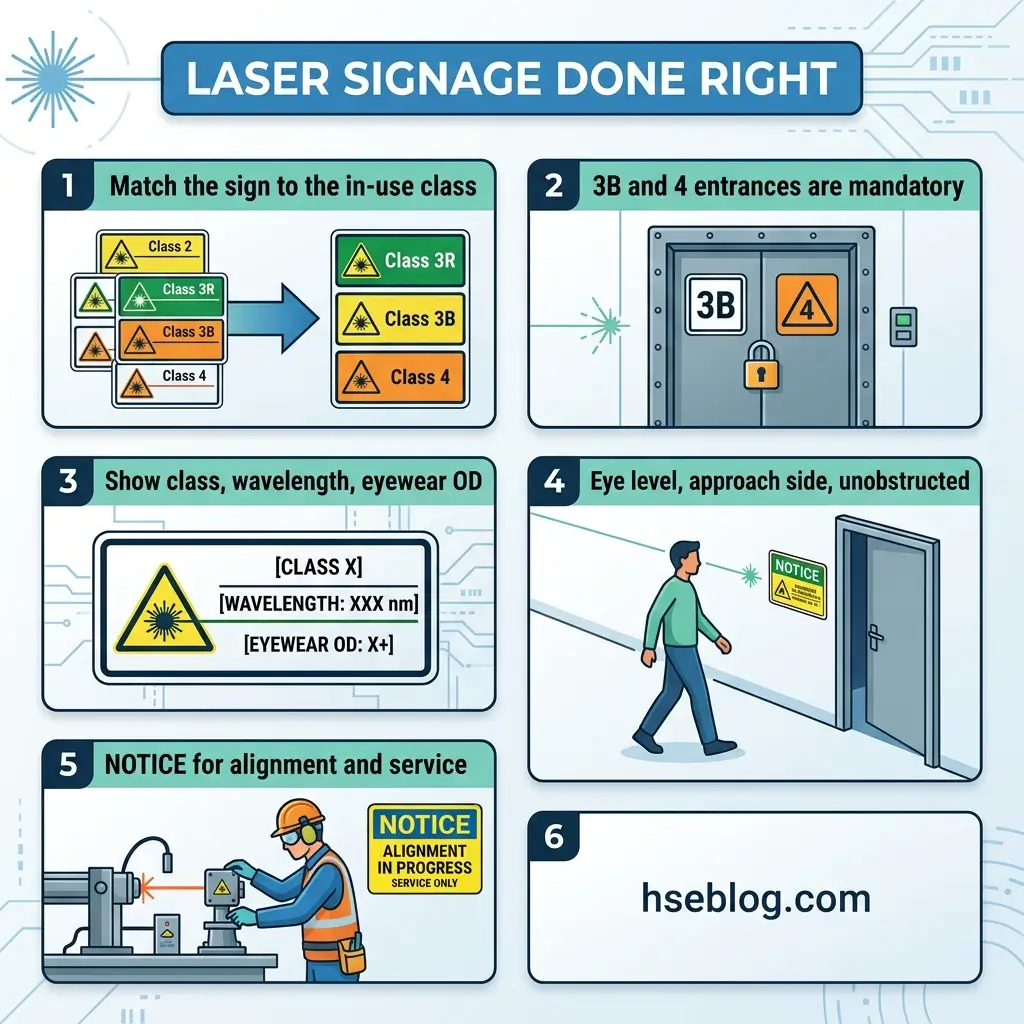
The practical reading is a “should versus shall” distinction that auditors test for. Under ANSI Z136.1, Class 2/2M/3R areas should be posted, while Class 3B and Class 4 areas shall be posted — a recommendation versus a requirement, and the line where a missing sign becomes a genuine finding.
Which Signal Word Goes With Which Class
Ask three suppliers which signal word belongs on a Class 3B laser sign and you may get three answers — and all of them can cite “ANSI.” The confusion is real, and it comes from the standard changing over time rather than anyone being careless.
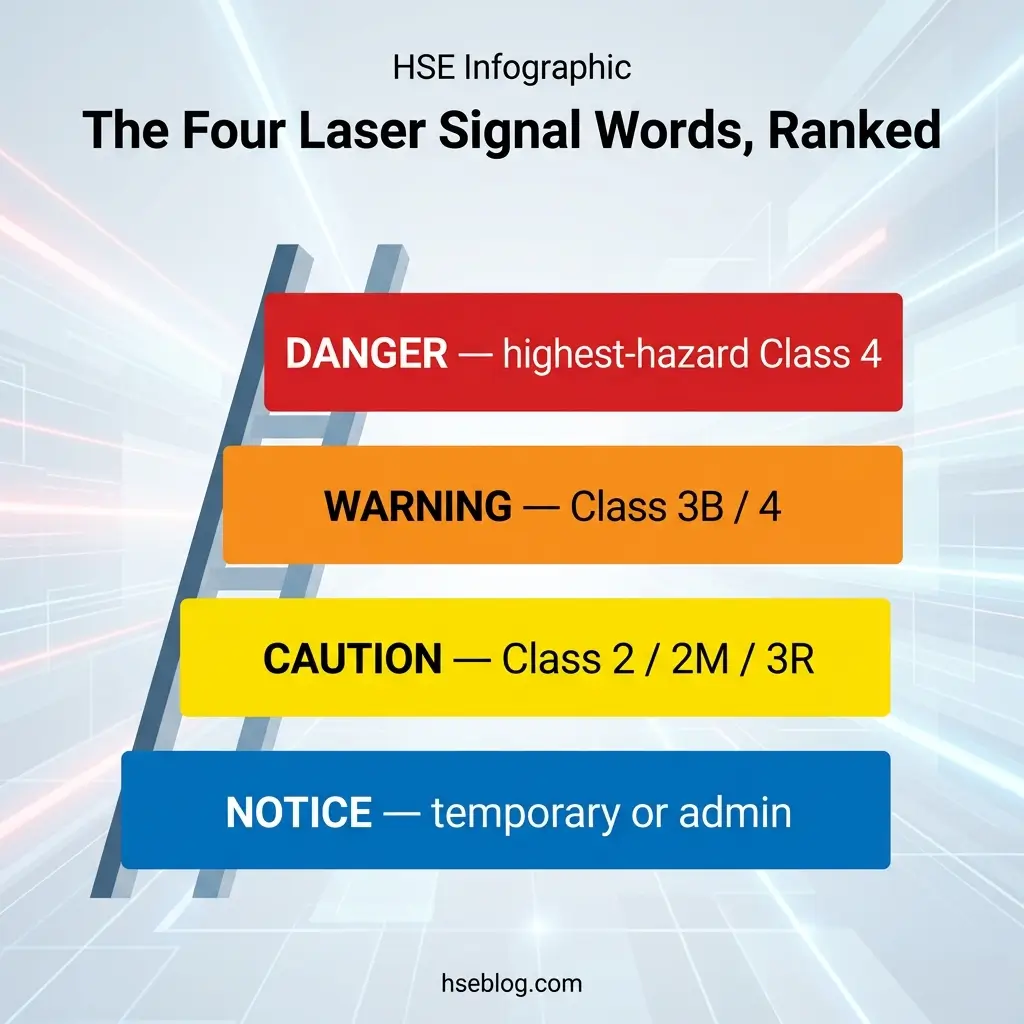
Current ANSI Z136.1 (the 2014 and 2022 editions) builds its signs on the ANSI Z535.2 sign standard, which uses a three-tier severity ladder. Older editions used a simpler two-tier scheme, and a lot of legacy signage and secondary guidance still reflects it. Here is how the current standard assigns the words.
| Signal word | Applies to (ANSI Z136.1 area signs) | What it communicates | Status |
|---|---|---|---|
| NOTICE | Temporary controlled areas; alignment; service; storage | Administrative or temporary condition | Used as conditions require |
| CAUTION | Class 2, 2M, 3R | Potential hazard; careful behavior still needed | Recommended (“should”) |
| WARNING | Class 3B and Class 4 controlled areas | Hazardous situation that can cause serious injury | Mandatory (“shall”) |
| DANGER | Highest-hazard Class 4 — exposed/high-power beams | Imminent hazard; serious injury or death | Mandatory, LSO-authorized |
The judgment call sits between WARNING and DANGER for Class 4. Most facilities reserve DANGER for the worst cases — multi-kilowatt output or exposed free-space beams — and that decision is made by the Laser Safety Officer, not chosen off a catalogue. Several university programs explicitly require LSO sign-off before a DANGER area sign goes up.
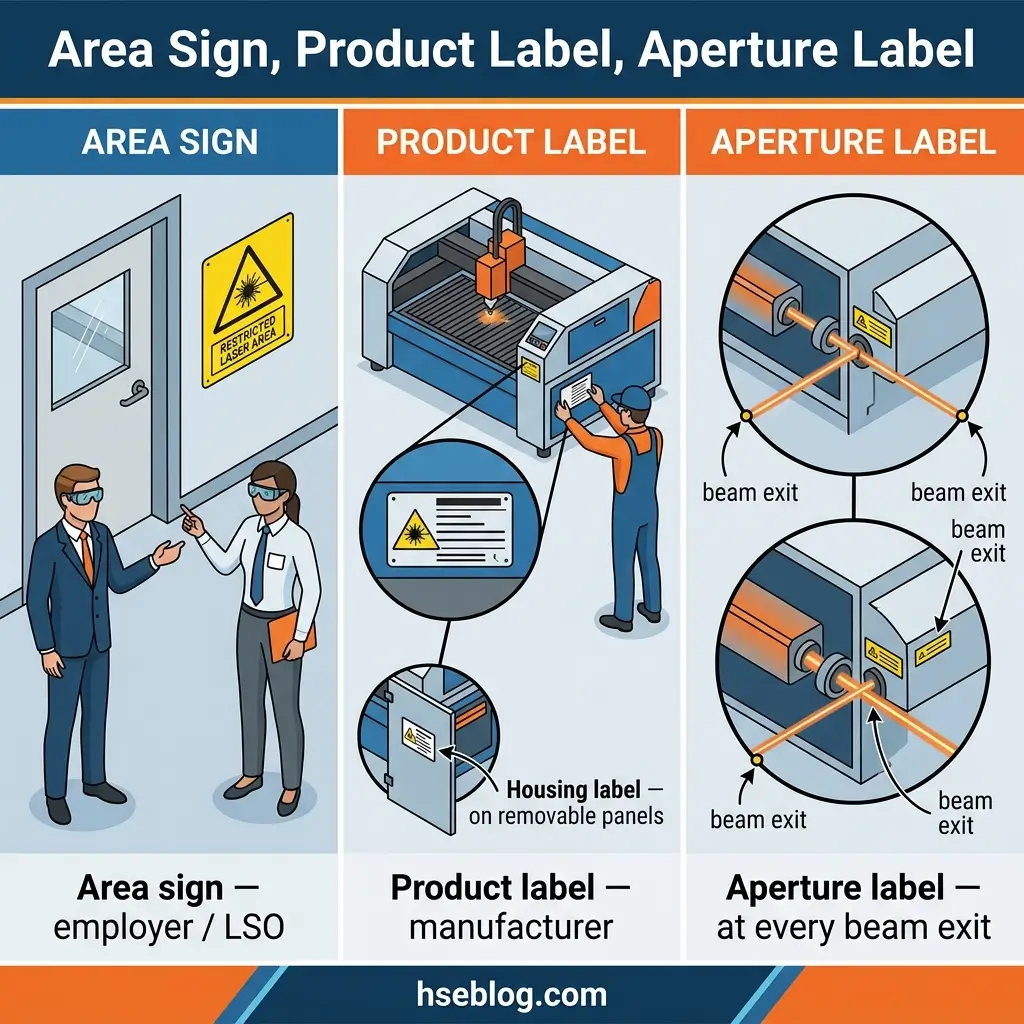
Signs Versus Labels: Two Standards Doing Two Different Jobs
Two separate documents govern the markings on a laser installation, and conflating them is one of the most persistent errors I see. A manufacturer’s product label does not satisfy your area-posting duty, and an area sign on the wall does nothing for the device itself.
Area signs — your responsibility, governed by ANSI Z136.1
These are the placards posted at the boundary of a laser-controlled area. The employer and LSO own them, they are matched to the in-use class, and they carry the signal word, hazard message, and laser parameters discussed above.
Product labels — the manufacturer’s responsibility
These are affixed to the laser device by its maker before it ships.
- In the US, the Federal Laser Product Performance Standard (21 CFR 1040.10), administered by the FDA’s Center for Devices and Radiological Health, dictates the class-based wording, which leans on “DANGER” for higher classes.
- Internationally, IEC 60825-1 (and its European twin, EN 60825-1) requires the yellow laser-warning triangle — the ISO 7010 W004 symbol, a black starburst on a yellow triangle — plus classification and explanatory labels.
Aperture and housing labels — easy to miss
- Aperture labels mark the opening where the beam exits and are required on Class 3R, 3B, and 4 products (and most Class 2). Each emitting aperture needs its own.
- Protective-housing labels must be affixed to removable panels — university guidance places one in a conspicuous location every 3 metres on long enclosures — warning of the class accessible if the panel comes off.
A device classified Class 1 with all housings in place but containing an embedded Class 4 source still needs those interior housing labels, because servicing exposes the real hazard.
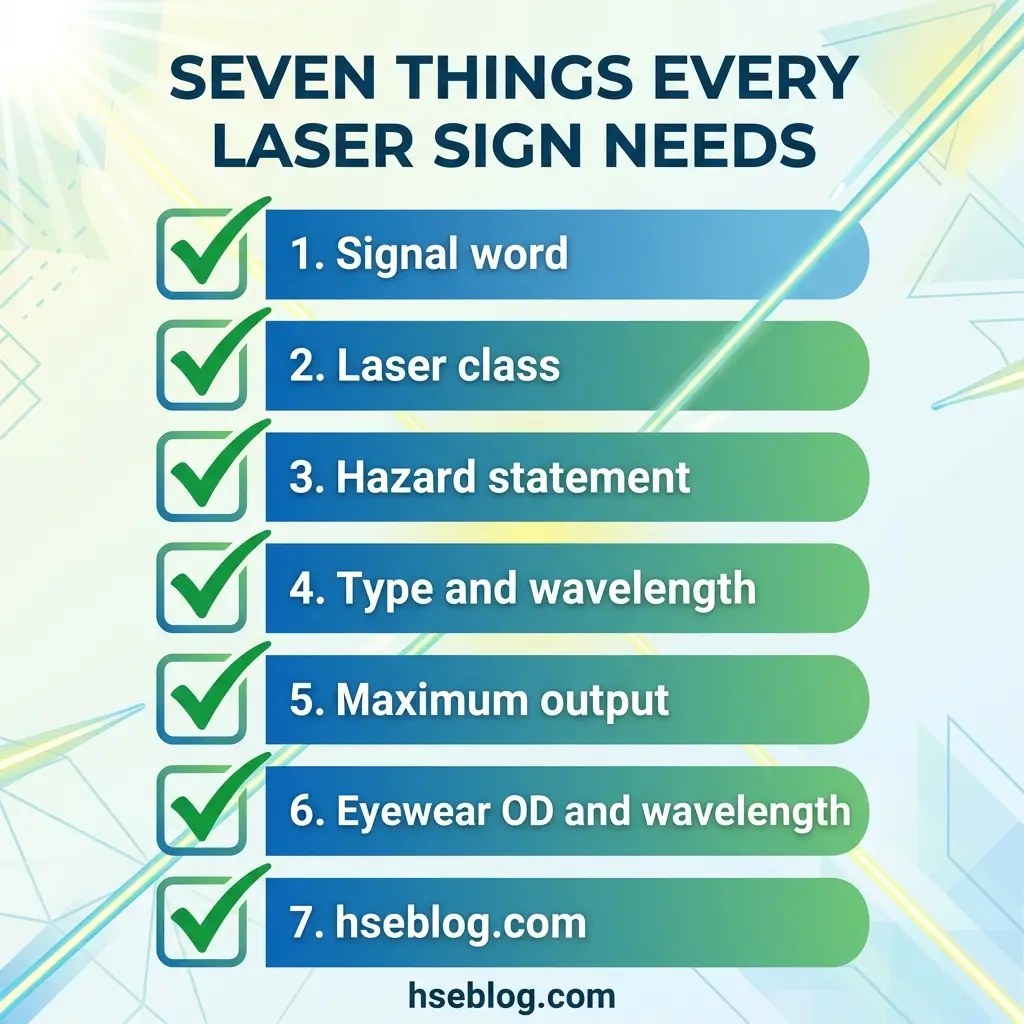
What a Compliant Laser Area Sign Must Contain
The most common audit finding is not a missing sign — it is a sign that says too little. A generic “Laser In Use” sticker with no class, no wavelength, and no eyewear information fails the standard even though something is posted on the door.
A compliant ANSI Z136.1 area sign for a controlled area carries the following, and an inspector doing a hazard evaluation will look for each one (consistent with University of Colorado Boulder EHS guidance):
- The correct signal word — CAUTION, WARNING, or DANGER, matched to the in-use class.
- The laser hazard symbol — the sunburst, with the ANSI attention triangle on current signs.
- The laser class — stated plainly (e.g., “Class 4 Laser”).
- A precautionary or hazard statement — for example, avoid eye or skin exposure to direct or scattered radiation.
- Laser type and wavelength — the emitting medium and nanometre value, which determine eyewear selection.
- Maximum output power — and pulse duration where the laser is pulsed.
- Required PPE — including the optical density (OD) and wavelength of the protective eyewear needed to enter.
That last point is where signs fail people most quietly. A sign that demands eyewear but omits the OD and wavelength leaves a worker unable to confirm their goggles actually protect against the beam in that room — protection is wavelength-specific, and the wrong filter offers a false sense of safety.
Where Laser Signs Go: Placement Requirements That Hold Up
Placement is where good intentions quietly fail. A perfectly worded Class 4 sign helps no one if it sits behind an open door, at knee height, or facing away from the person walking in. The governing principle across both ANSI Z136.1 and the OSHA Technical Manual is that signs belong wherever a person makes a decision to enter or stay.
Work outward from the hazard:
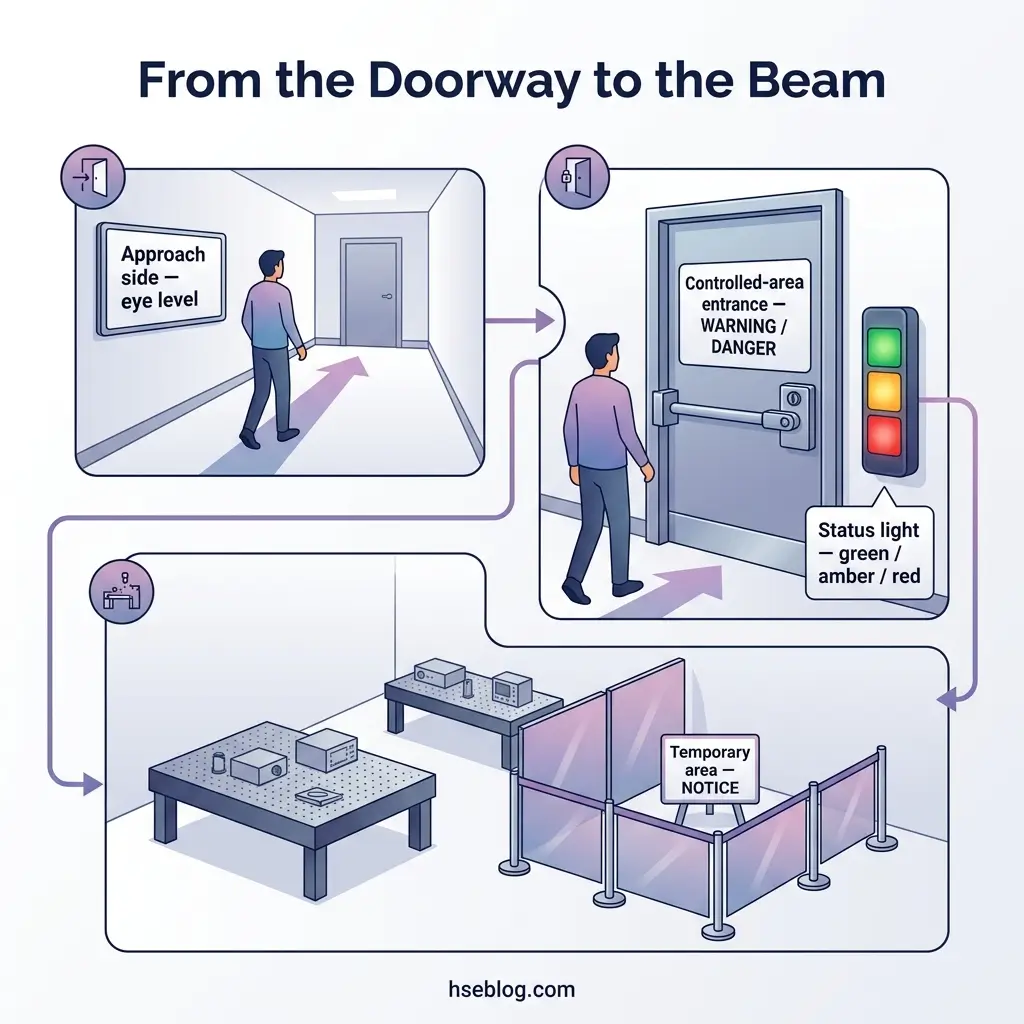
- At every entrance to the laser-controlled area. Each door and access point into the controlled area gets a sign — posted whenever the laser is energised and capable of exceeding the maximum permissible exposure. A controlled area is established for Class 3B and Class 4 whenever the beam path is not fully enclosed, and it encompasses the full Nominal Hazard Zone (NHZ).
- On the approach side, at eye level, unobstructed. The sign must be readable before entry, not discovered after. Faded, sun-bleached, or partly hidden signs are treated as no sign.
- At the boundary of a temporary controlled area. During alignment or servicing — when housings are off or interlocks defeated — a NOTICE sign marks the temporary controlled area, in addition to any standing posting. Guidance such as the Berkeley Lab ES&H manual treats this temporary posting as a distinct requirement.
- Paired with status indicators for Class 3B and 4. Best practice ties an illuminated indicator into the laser’s power state — commonly green (off/safe), amber (powered, not emitting), red (beam live) — mounted at the entrance and changing automatically with the system, so nothing depends on an operator remembering to flip a switch.
The alignment case deserves emphasis. ANSI Z136.1 notes that laser incident reports repeatedly show the highest ocular-hazard risk arises during alignment — precisely when protective housings are open and standing signage no longer reflects the real exposure. The temporary NOTICE posting exists for exactly that window, and it is the one most often skipped.
The International Picture: ANSI, OSHA, IEC, and a Standard Stuck in 1999
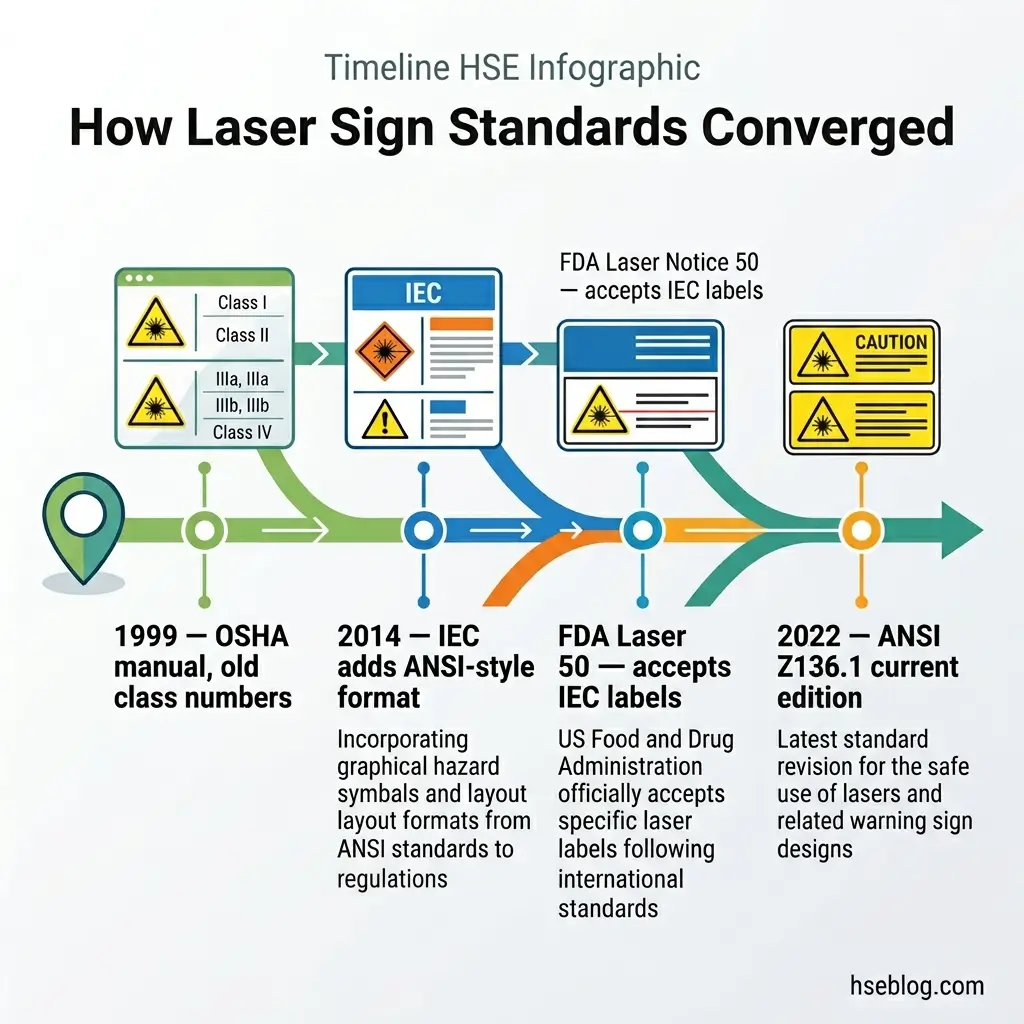
OSHA’s own manual still uses the obsolete Roman-numeral classes — Class I through Class IV — because the laser chapter of the OSHA Technical Manual dates from 1999 and has never been renumbered to the Arabic-numeral classes that ANSI and IEC adopted years ago. The hazards are identical; only the labels on the page differ, which is a recurring source of confusion when people cross-reference the two.
This is where jurisdictional clarity earns its keep. The four reference points do not line up neatly.
| Standard / body | Jurisdiction | What it governs | Signal-word approach |
|---|---|---|---|
| ANSI Z136.1-2022 | US (referenced by OSHA) | Area signs and the user’s laser safety program | CAUTION / WARNING / DANGER (three-tier) |
| OSHA Technical Manual | US (enforcement) | Inspection criteria for controlled areas | DANGER and NOTICE formats; older class numbering |
| 21 CFR 1040.10 (FDA/CDRH) | US | Manufacturer product labels | Class-based; “DANGER” wording common |
| IEC / EN 60825-1; ISO 7010 | International / EU | Product labels and the warning symbol | Triangle symbol; optional ANSI-style panel since 2014 |
Two developments are worth weaving into any current program. First, the 2014 edition of IEC 60825-1 introduced an alternative label format aligned with ISO 3864-2 and ANSI Z535.4, adding colour-coded DANGER/WARNING/CAUTION panels alongside the traditional triangle — a deliberate step toward harmonisation. Second, the FDA’s Laser Notice No. 50 lets manufacturers use IEC classification and labelling for the US market, so a single international label set can now satisfy both regimes. As of 2025–2026, ANSI Z136.1-2022 remains the operative parent standard in the US (Laser Institute of America), having revised the 2014 edition.
Where the standards specify different thresholds for the same hazard, the operationally safe move is to post to the stricter requirement and state the jurisdiction on the sign. A controlled area built to ANSI’s content rules will generally satisfy an OSHA inspector working from the older manual; the reverse is not always true.
Frequently Asked Questions
Conclusion
Walk your own facility this week and stop at the entrance to every space where a Class 3B or Class 4 laser operates. Read the sign as a stranger would. Does it name the class, the wavelength, and the optical density of the eyewear needed to step inside — or does it just say “Laser In Use” and leave a person to guess?
Then ask the harder question. When your team aligns or services that laser — housings off, interlock bypassed, beam live — is there a NOTICE sign on the boundary, or does the standing placard quietly misrepresent the exposure for the most dangerous task of the week? That single gap, between routine signage and the temporary controlled area, is where the published incident record concentrates.
Laser safety signs are the least expensive control you will ever install and among the most visible evidence of whether a laser program is genuinely managed or merely decorated. Match the sign to the class, put the required information on its face, place it where decisions are made, and keep it current as the work changes — and the placard on the door does the job it was always meant to do.