
TL;DR — The numbers that frame the risk
- Engineered nanomaterials measure 1–100 nanometres — small enough that the same substance can behave very differently than its bulk form (NIOSH, 2009).
- NIOSH recommends carbon nanotube and nanofibre exposure stay below 1.0 µg/m³ of respirable elemental carbon as an 8-hour average — the lowest level current methods can reliably measure (NIOSH, 2013).
- The nanoscale titanium dioxide limit is 8× stricter than the fine-particle limit — 0.3 mg/m³ versus 2.4 mg/m³ (NIOSH, 2011).
- One carbon nanotube, MWCNT-7, is classed “possibly carcinogenic to humans” (Group 2B) by IARC; most other types remain unclassified (IARC, 2014).
Nanotechnology safety is the practice of controlling worker exposure to engineered nanomaterials — particles under 100 nanometres whose large surface area and biopersistence can make them more hazardous than the same chemical in bulk. The dominant exposure route is inhalation, and the strongest controls are substitution, enclosure, local exhaust ventilation with HEPA filtration, and health surveillance.
A persistent and dangerous assumption sits underneath a lot of nanomaterial handling: if a substance is safe to work with in its everyday bulk form, its nanoscale version must be safe too. The published toxicology says otherwise — NIOSH set the recommended limit for ultrafine titanium dioxide eight times lower than for the fine-particle form of the very same compound (NIOSH, 2011), and IARC has flagged one specific carbon nanotube as possibly carcinogenic while its bulk-carbon cousins carry no such label (IARC, 2014).
That gap between intuition and evidence is the core challenge in nanotechnology safety. The particles are too small to see, often too small to measure routinely, and capable of reaching deep lung tissue that coarser dust never touches. This article covers how nanomaterials harm the body, where workers actually get exposed, what exposure limits exist across jurisdictions, and the engineering and administrative controls that hold up in practice.
Why Nanoscale Particles Behave Differently From Their Bulk Form
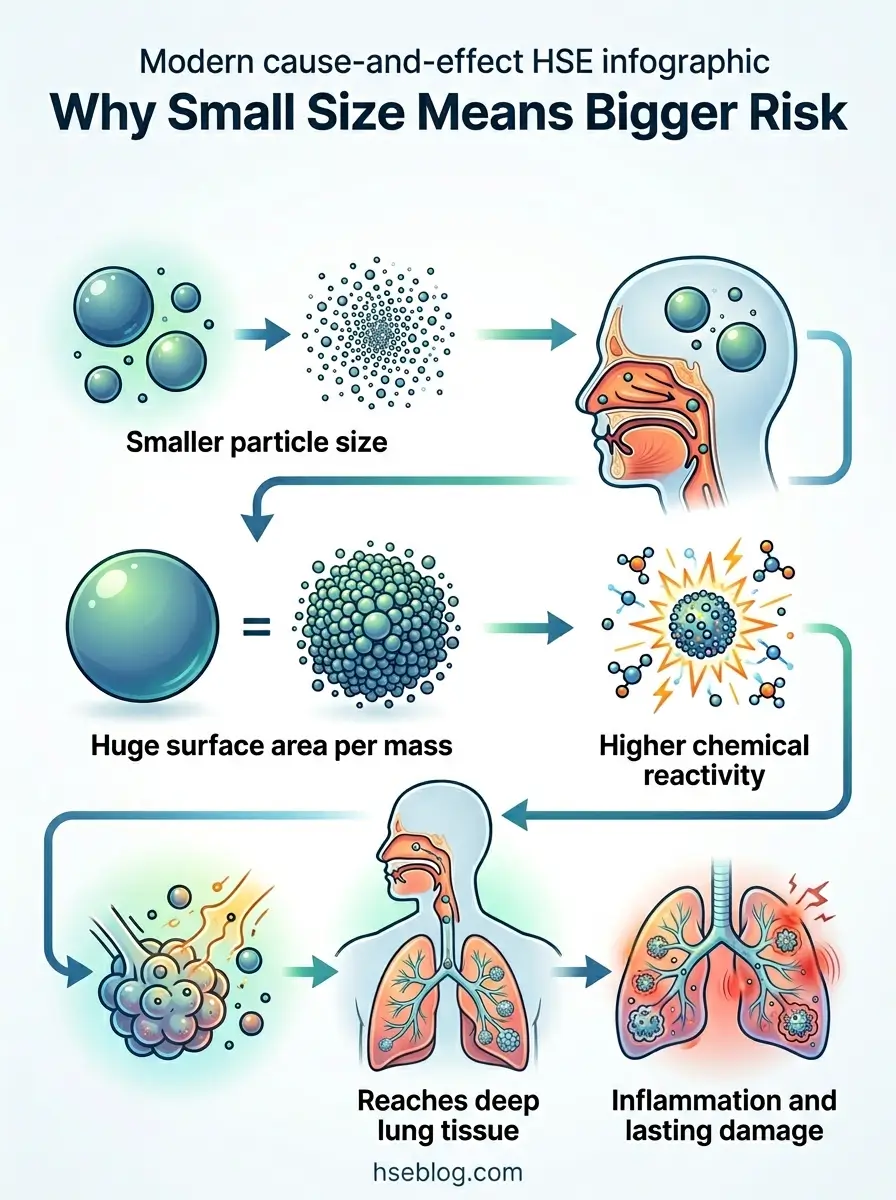
The hazard of a nanomaterial is not driven by chemistry alone — it is driven by size, shape, surface area, and how long the particle survives inside the body. Two materials with identical chemical formulas can pose very different risks once one of them is engineered to the nanoscale.
Surface area changes everything
When you divide a gram of material into nanoparticles, its total surface area expands enormously. That surface is where reactions happen — oxidation, catalysis, interaction with cell membranes — so a high-surface-area particle is biologically far more active than the same mass of coarse powder.
NIOSH explicitly built its titanium dioxide assessment around surface area as the critical dose metric, concluding that ultrafine and fine particles fit the same dose-response curve when dose is expressed by surface area rather than mass (NIOSH, 2011). That single decision is why the nanoscale limit ended up so much lower.
Deposition reaches deeper
Coarse dust tends to deposit in the upper airways, where the body can clear it. Nanoparticles behave more like a gas — HSE guidance notes that for the air velocities found in normal workplaces, airborne nanoparticles can effectively be treated as having no inertia, so they follow air currents and penetrate to the deepest alveolar regions.
Biopersistence decides the long game
A particle the body cannot dissolve or remove stays in contact with tissue for years. For high-aspect-ratio shapes such as long, rigid fibres, that persistence is the trigger for the most serious concerns, which the next section addresses directly.
What Engineered Nanomaterials Do Inside the Lung
A consistent finding across the animal literature is that some inhaled nanomaterials cause pulmonary inflammation and fibrosis, and that the fibre-shaped ones raise specific cancer concerns. The effect depends heavily on the material — this is not a single hazard but a family of them.
Medical disclaimer: Content covering exposure effects and health surveillance here is for HSE practitioner reference. It is not medical advice. Workers with specific symptoms or exposure concerns should consult an occupational physician or qualified medical professional.
The documented and suspected effects most relevant to occupational settings include:
- Pulmonary inflammation and granuloma formation — a common early response to deposited nanoparticles in animal studies.
- Pulmonary fibrosis — scarring of lung tissue that reduces gas exchange; NIOSH linked its carbon nanotube limit directly to reducing inflammation and fibrosis risk (NIOSH, 2013).
- Oxidative stress — photocatalytic forms of titanium dioxide can release free radicals under light, driving inflammation and potential genetic damage.
- Fibre-pattern carcinogenicity — the asbestos-style concern, discussed below.
The fibre pathogenicity question
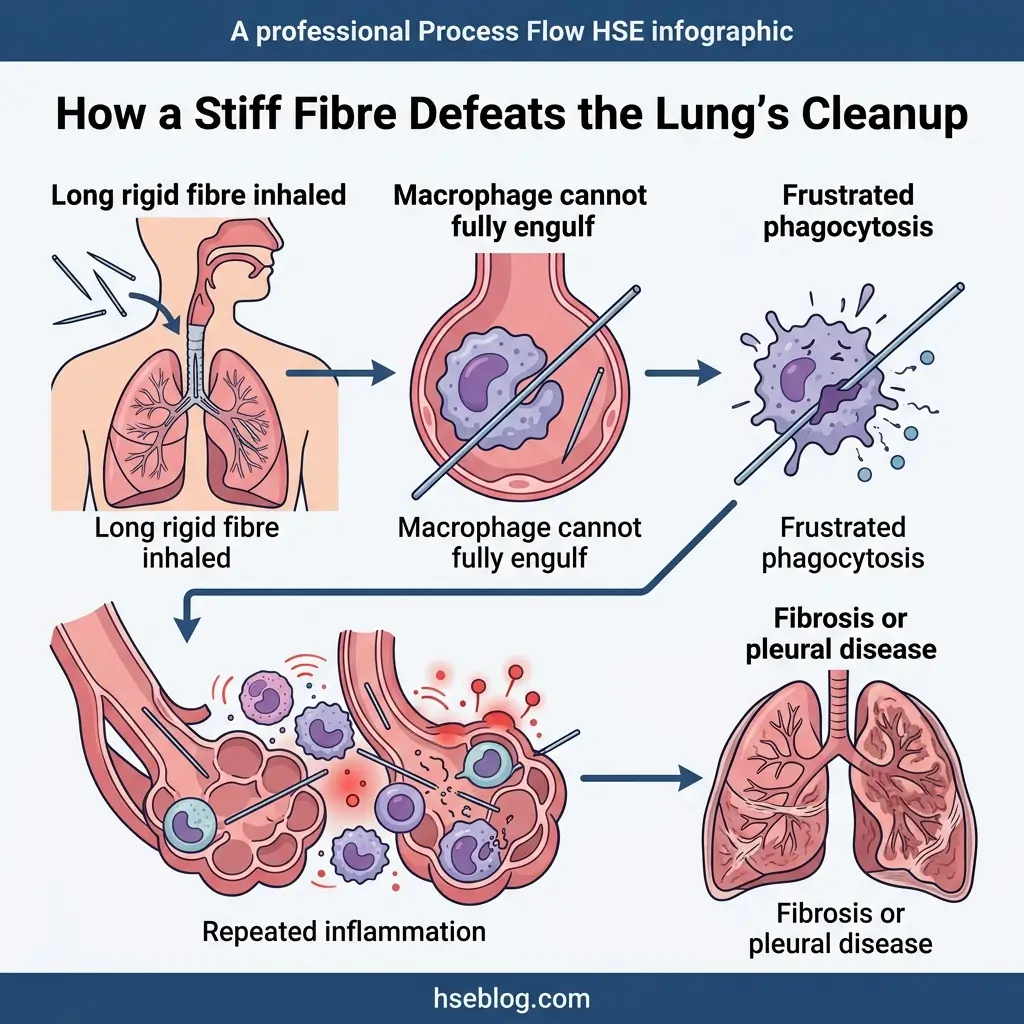
The reason carbon nanotubes draw asbestos comparisons is structural, not chemical. Long, thin, rigid, biopersistent fibres share the geometry that makes asbestos pathogenic — a model researchers call the fibre pathogenicity paradigm.
When a fibre is too long for a lung macrophage to fully engulf, the cell undergoes “frustrated phagocytosis,” releasing inflammatory signals repeatedly without ever clearing the fibre. In rodent studies, certain multi-walled carbon nanotubes have produced mesothelioma, the same pleural cancer associated with asbestos.
The evidence is specific, and overstating it helps no one. In 2014 the International Agency for Research on Cancer classified one well-characterised nanotube — MWCNT-7, also known as Mitsui-7 — as Group 2B, possibly carcinogenic to humans, while single-walled and most other multi-walled nanotubes were placed in Group 3, not classifiable due to insufficient evidence (IARC, 2014). The honest practitioner reading: treat long, rigid, biopersistent nanotubes with asbestos-grade caution, but do not claim all nanomaterials are carcinogens — they are not.
How Workers Actually Get Exposed
Exposure to engineered nanomaterials concentrates around a handful of tasks, and inhalation is the route that matters most. Skin contact and ingestion are real but secondary concerns; the air pathway drives the controls.
The published workplace-monitoring record points consistently to disturbance energy as the key variable — the more energetically you handle a dry, dusty nanopowder, the more becomes airborne. A 2025 study of titanium dioxide workplaces in Singapore found that of 30 personal samples, the readings that exceeded the NIOSH limit came from bulk loading and spraying activities, not from low-energy lab work (Annals of Work Exposures and Health, 2025).
The highest-emission tasks form a recognisable list:
| Task | Why it releases particles | Typical setting |
|---|---|---|
| Transferring or weighing dry powder | Pouring and scooping generate airborne dust | Manufacturing, labs |
| Spraying or aerosol application | Deliberately disperses material into the air | Coatings, downstream use |
| Sonication or high-energy mixing | Breaks agglomerates back into primary particles | R&D, formulation |
| Cutting, sanding, or machining composites | Releases embedded nanomaterial from the matrix | Maintenance, fabrication |
| Cleaning spills and reactor maintenance | Disturbs settled material | Across all sectors |
The judgment that matters here is recognising that a material bound in a solid composite poses little inhalation risk until someone cuts, grinds, or burns it. The risk assessment has to follow the material across its whole life, not just the bagged powder stage.
Are There Legal Exposure Limits for Nanomaterials?
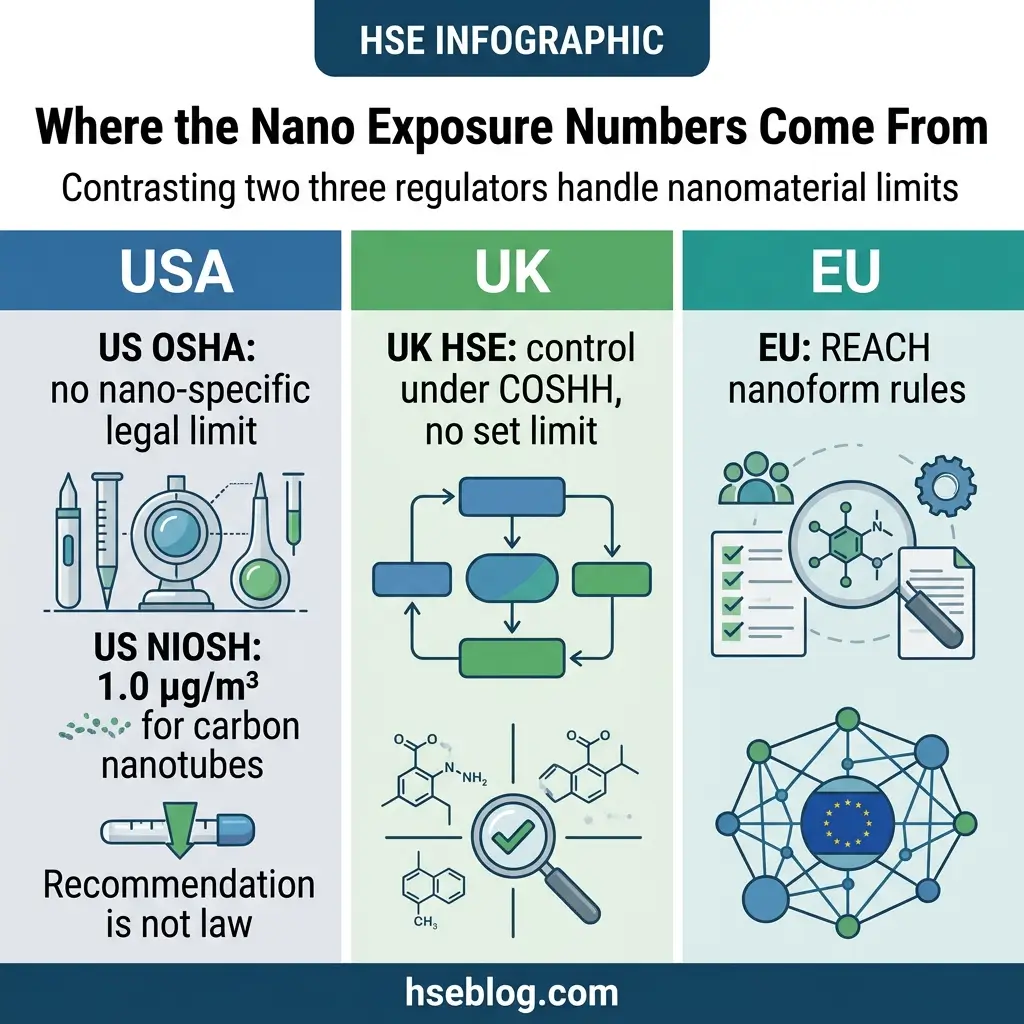
For most engineered nanomaterials, the short answer is no enforceable limit exists — and the longer answer is a patchwork that varies sharply by jurisdiction. This is one of the most misunderstood points in nanotechnology safety, because the absence of a legal limit is too often read as the absence of a hazard.
United States
OSHA has not issued a nanomaterial-specific permissible exposure limit. As the agency’s own nanotechnology health-effects guidance explains, existing general-industry standards apply instead — respiratory protection under 29 CFR 1910.134, eye and hand protection under Subpart I, and sanitation under 1910.141.
NIOSH fills the gap with Recommended Exposure Limits, which are authoritative but not legally enforceable:
- Carbon nanotubes and nanofibres: 1.0 µg/m³ of respirable elemental carbon, 8-hour average — set at the limit of quantification, meaning NIOSH effectively recommends exposure stay as low as current methods can detect (NIOSH, 2013).
- Nanoscale titanium dioxide: 0.3 mg/m³, against 2.4 mg/m³ for fine TiO2 (NIOSH, 2011).
The compliance gap is stark: OSHA’s old permissible limits for graphite (5 mg/m³) and carbon black (3.5 mg/m³) sit thousands of times above the NIOSH nanotube recommendation, so leaning on those legacy numbers offers no real protection for nanoscale carbon.
United Kingdom
There are no specific Workplace Exposure Limits for nanoparticles, but the duty to control is unambiguous. HSE guidance HSG272, Using nanomaterials at work, brings nanomaterials squarely under the Control of Substances Hazardous to Health Regulations 2002 (as amended), and calls for a precautionary approach for carbon nanotubes and other biopersistent high-aspect-ratio nanomaterials.
European Union and international
REACH now carries nanoform-specific information requirements, and EU-OSHA issued updated practitioner guidance on manufactured nanomaterials in 2025, built around a structured seven-step risk-assessment approach. Internationally, ISO/TR 12885 documents health and safety practices for occupational nanotechnology settings.
Where these frameworks disagree, the rule I apply is simple: treat the strictest credible figure as the working target, label its jurisdiction, and never present a recommendation as if it were law.
Building an Exposure-Control Program That Holds Up
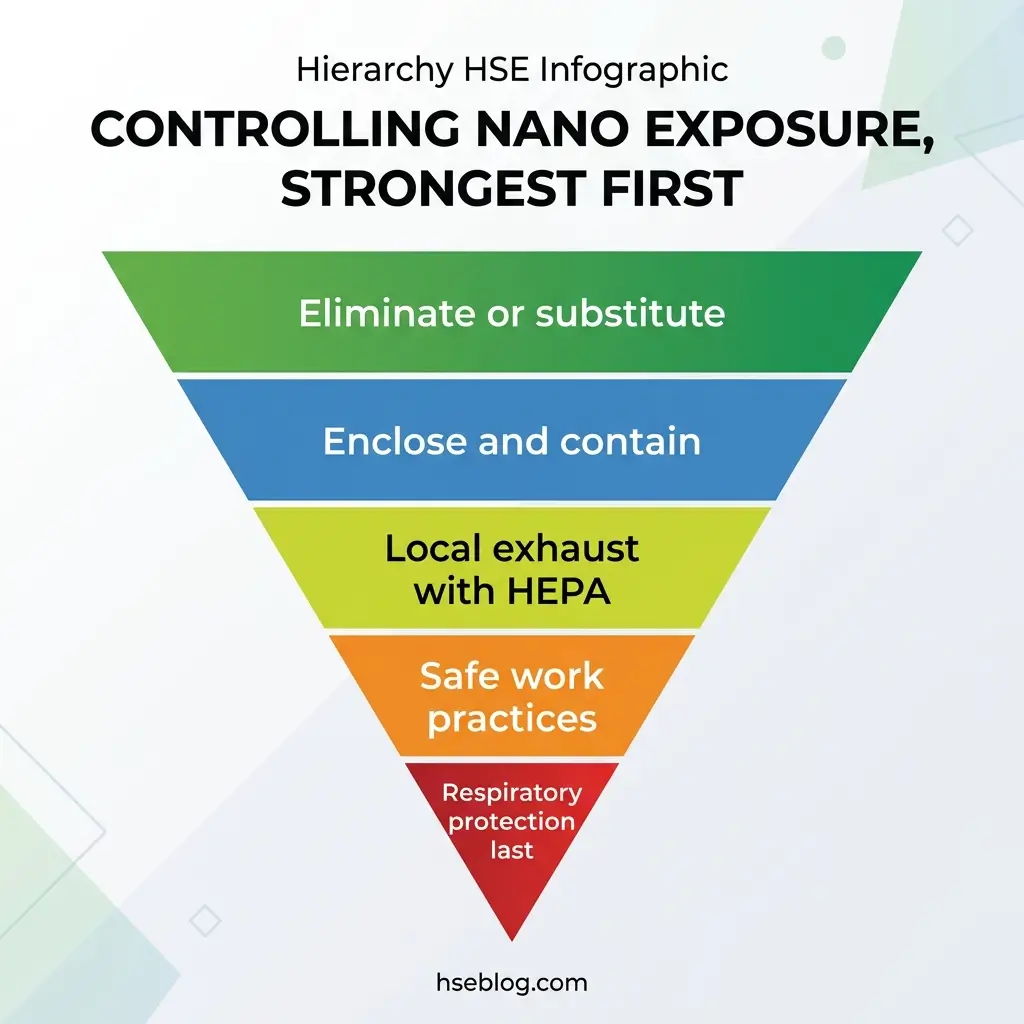
Effective nanomaterial control follows the standard hierarchy, but the engineering and work-practice details are specific enough that generic dust controls fall short. Strongest controls go first, and respiratory protection is a last resort — not the plan.
Applied to nanomaterials, the hierarchy reads like this:
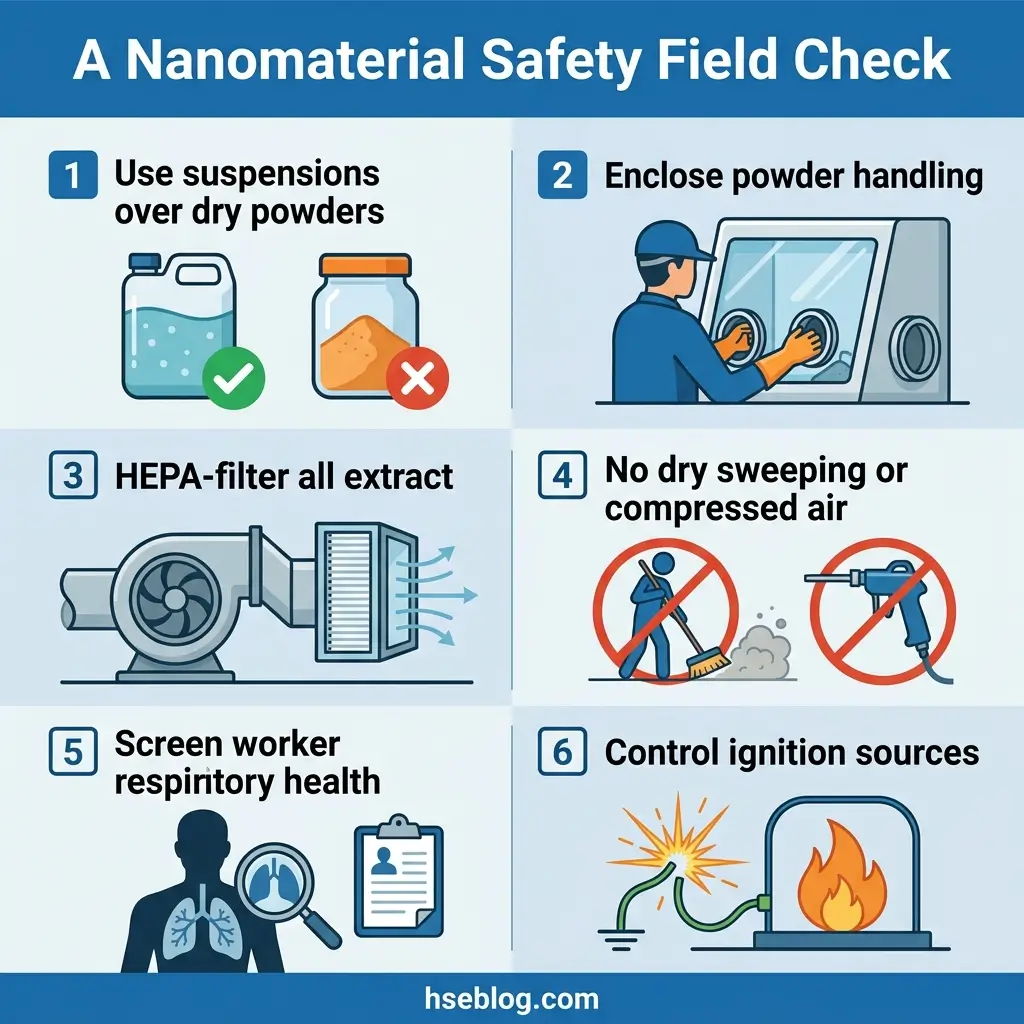
- Eliminate or substitute. Ask whether the nanomaterial is needed at all, then whether it can be used in a bound form — a slurry, paste, or suspension instead of a dry powder. Handling material in liquid suspension is one of the most reliable ways to cut airborne release.
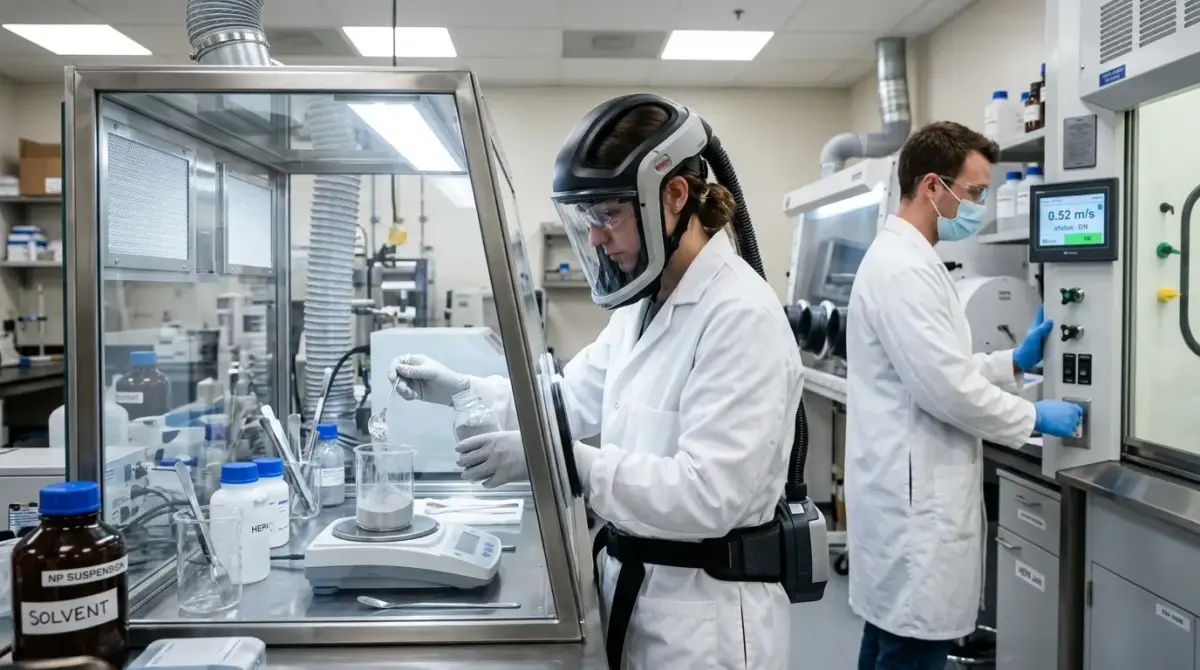
- Contain at source. A ventilated enclosure or glove box around powder handling, weighing, and sonication is the primary engineering control. NIOSH and EU-OSHA both favour enclosure backed by local exhaust ventilation.
- Filter the extract. Exhaust air should pass through HEPA — or, for higher assurance, ULPA — filtration before recirculation or discharge. A counter-intuitive but important point: HEPA filters do capture nanoparticles efficiently, because particle physics at the nanoscale works in the filter’s favour.
- Get the work practices right. This is where many programs quietly fail. Dry sweeping and compressed-air cleaning are prohibited; spills are cleaned by wet wiping or with a HEPA-filtered vacuum. Horizontal laminar-flow “clean benches” must never be used, because they blow contaminated air straight at the operator’s face.
- Add PPE last. Where respiratory protection is genuinely the only available control, UK guidance points to a full-face respirator at assigned protection factor 40, preferably powered for use beyond an hour. PPE supplements the controls above; it does not replace them.
A practical complication runs through all of this: you often cannot routinely measure whether your controls are working, because nanoparticle sampling is specialised and expensive. This is why control banding tools — CB Nanotool, Stoffenmanager Nano, NanoSafer — have become standard practice. They assign hazard and exposure bands from material and process characteristics, leaning heavily on dustiness, and default to containment when key data are missing. They are a starting point for prioritising controls, not a substitute for the precautionary defaults above.
Monitoring, Health Surveillance, and the Dust-Explosion Blind Spot
Verifying controls and watching worker health are where a nanotechnology safety program proves itself — and where one major physical hazard tends to get forgotten entirely. A toxicology-only mindset misses that many nanopowders are also combustible.
Monitoring and surveillance
Because routine measurement is hard, monitoring combines targeted air sampling during high-emission tasks with real-time particle-counting to spot leaks and control failures. The aim is less about chasing a single number and more about confirming that enclosures and ventilation are actually containing emissions.
On the health side, NIOSH recommends medical screening programs to catch early signs of respiratory disease in exposed workers, and the case for surveillance keeps strengthening. A 2024 study in the nanocomposite sector reported an association between cumulative nanomaterial exposure and worse pulmonary function, with evidence pointing to inflammation as the mediating pathway (Particle and Fibre Toxicology, 2024). Surveillance is how you detect that drift before it becomes disease.
The dust-explosion hazard most articles skip
Nanopowders carry the same fundamental dust-explosion risk as any fine combustible dust — and their extreme surface area can make them readily ignitable. Laboratory explosion-severity testing has confirmed measurable explosivity for combustible nanopowders including carbon black and multi-walled carbon nanotubes.
The practitioner consequences are concrete:
- In the UK, the fire and explosion risk pulls combustible nanopowders under DSEAR — the Dangerous Substances and Explosive Atmospheres Regulations — in addition to COSHH.
- Ignition control matters as much as exposure control — earthing, bonding, and elimination of ignition sources around powder handling.
- Overpressure can defeat your dust controls — testing has shown that an explosion’s overpressure can momentarily overwhelm a local exhaust system, briefly releasing material.
Reviewing this material as a body of work, the clearest lesson is that nanomaterial safety is two problems wearing one label: a long-term inhalation-health problem and an immediate fire-and-explosion problem. A program that solves only the first is half a program.
Frequently Asked Questions
Conclusion
The frameworks around nanotechnology safety are still maturing, and that direction of travel should shape how you build a program today. NIOSH’s surface-area-based limits, the IARC fibre classifications, REACH’s nanoform requirements, and EU-OSHA’s 2025 guidance all point the same way — toward precaution scaled to particle shape and biopersistence rather than chemical name alone.
What is emerging fastest is the “Safe by Design” idea: engineering nanomaterials to be less hazardous from the outset rather than controlling dangerous ones after the fact. Until that matures, the working assumption that protects people is straightforward — a substance that is harmless in your hand can be hazardous in the air, and the absence of a legal limit is never proof of safety.
For any operation handling engineered nanomaterials, the most uncomfortable question to answer honestly is this: if your enclosure failed during a powder transfer tomorrow, would your monitoring catch it, and could your team prove the fibres they breathed were not the long, rigid, biopersistent kind?