
TL;DR
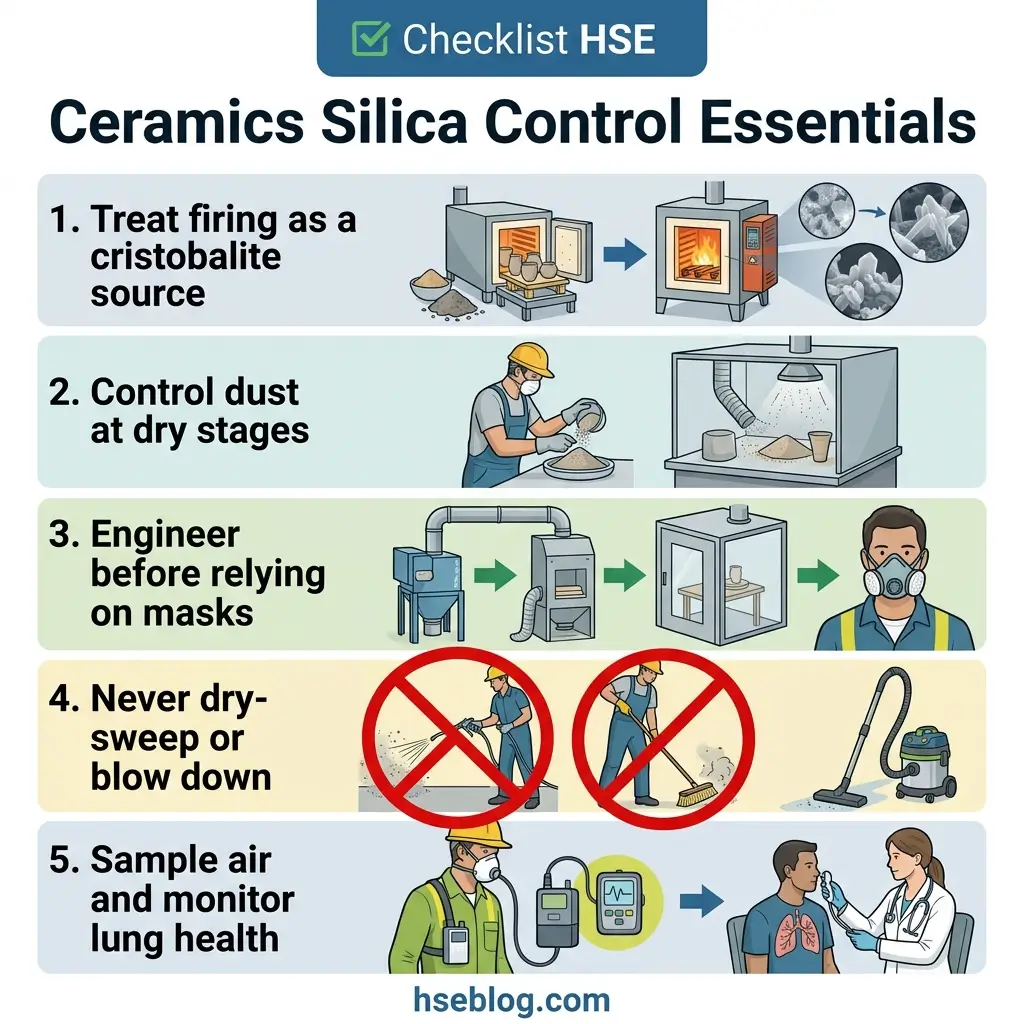
- Treat firing as a hazard step, not just a shaping step — kiln heat converts quartz in clay bodies into cristobalite, a more damaging form of crystalline silica.
- Control dust at the dry moments — weighing, mixing, glaze handling, greenware sanding and post-firing cleanup generate almost all respirable crystalline silica exposure.
- Engineer before you mask — enclosure, local exhaust ventilation and wet methods come first; respirators are the last line, not the plan.
- Never dry-sweep or blow down — use M-class vacuums and damp methods, because dry cleaning re-suspends settled silica across the whole workspace.
- Check the air and the workforce — exposure sampling and lung-health surveillance are how you confirm the controls actually hold.
Controlling respirable crystalline silica in ceramics means cutting airborne quartz and cristobalite dust at its source. The strongest measures are substituting lower-silica materials, enclosing and ventilating dry processes with local exhaust ventilation, wet cleaning instead of sweeping, and adding respiratory protection only where engineering controls cannot keep exposure below the applicable limit.
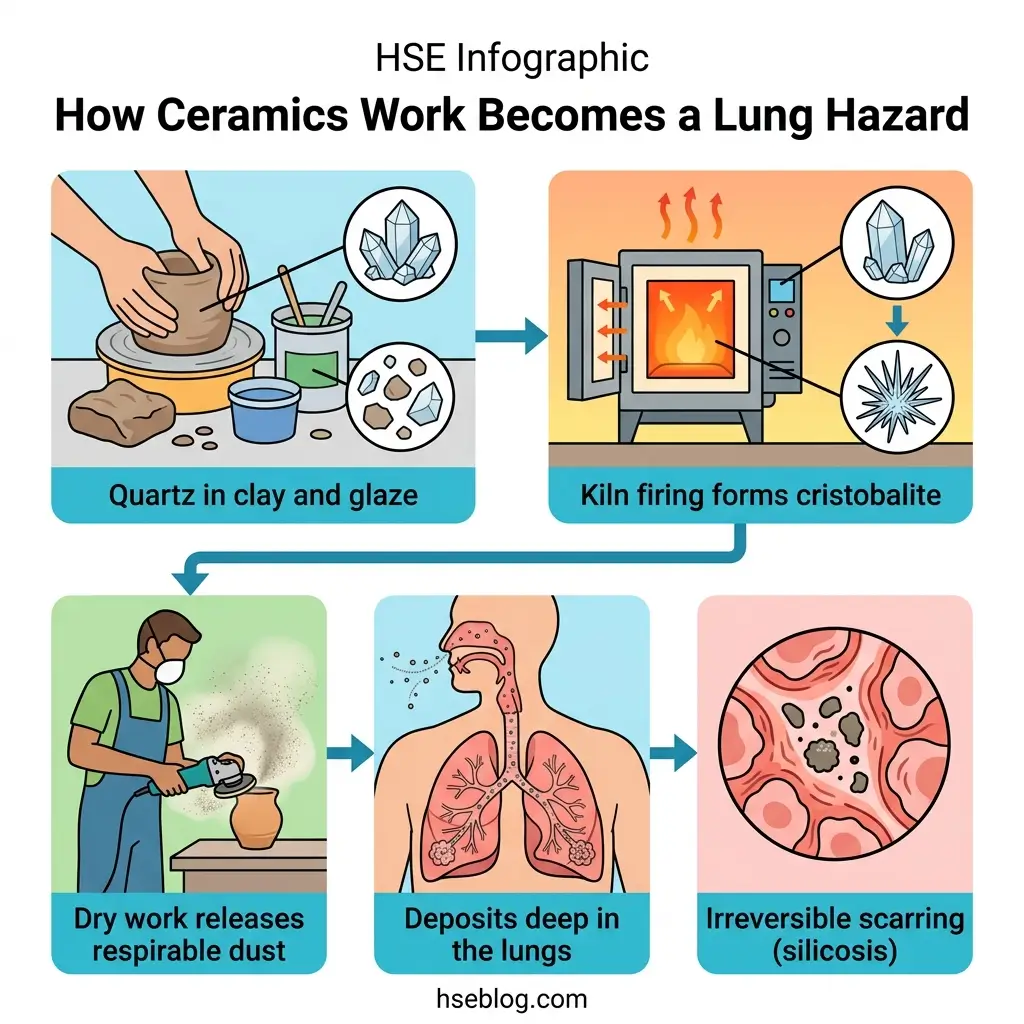
A ceramics kiln quietly changes the hazard it handles. As ware passes through stoneware temperatures, quartz in the clay body can convert to cristobalite, a form of crystalline silica that health agencies rate as more damaging to the lungs than the quartz it started as.
That makes respirable crystalline silica in ceramics a two-sided problem: some dust arrives in the raw materials, and more is created inside the process itself. The stakes are permanent — silicosis does not heal, and crystalline silica is a recognised lung carcinogen — so the control measures below are built around cutting exposure at every stage where fine dust escapes.
Why Crystalline Silica in Ceramics Behaves Differently From Other Dust
The dust from ceramics is not one substance but several, and firing can push it toward the most harmful form. That single fact is why ceramics silica deserves its own control thinking rather than a borrowed construction plan.
Only the finest particles matter for disease. The respirable fraction is small enough to bypass the upper airways and reach the alveoli, where the body cannot clear it.
Three crystalline forms show up in this work, and the regulations treat all of them together:
- Quartz — the common crystalline silica in clays, feldspars and the silica flour used to adjust bodies and glazes.
- Cristobalite — formed when silica-bearing material is heated in the kiln; heating silica-containing materials during kiln and ceramic manufacturing can form cristobalite and tridymite, and agencies rate cristobalite as more damaging to lung tissue than quartz. CDC
- Tridymite — a less common high-temperature form, also generated by firing and covered by the same exposure limits.
Once these particles settle in the deep lung, scavenger cells try to engulf them and are destroyed in the process, triggering the slow scarring that becomes silicosis. The International Agency for Research on Cancer classifies crystalline silica as a Group 1 carcinogen, so the same dust also carries a lung-cancer risk. swiftRMS
A common but dangerous assumption is that fired, hardened ware is inert. In practice, grinding, sanding or sweeping up after firing can release cristobalite — the higher-hazard form — which is why post-kiln tasks deserve as much attention as raw-material handling. The US National Institute for Occupational Safety and Health sets out the cristobalite point plainly in its overview of silica and worker health.
Where Respirable Crystalline Silica Comes From in Ceramics Production
Exposure in ceramics clusters around dry, dusty moments rather than the whole craft. Wet forming releases very little; the real risk lives in powder handling, dry finishing and cleanup.
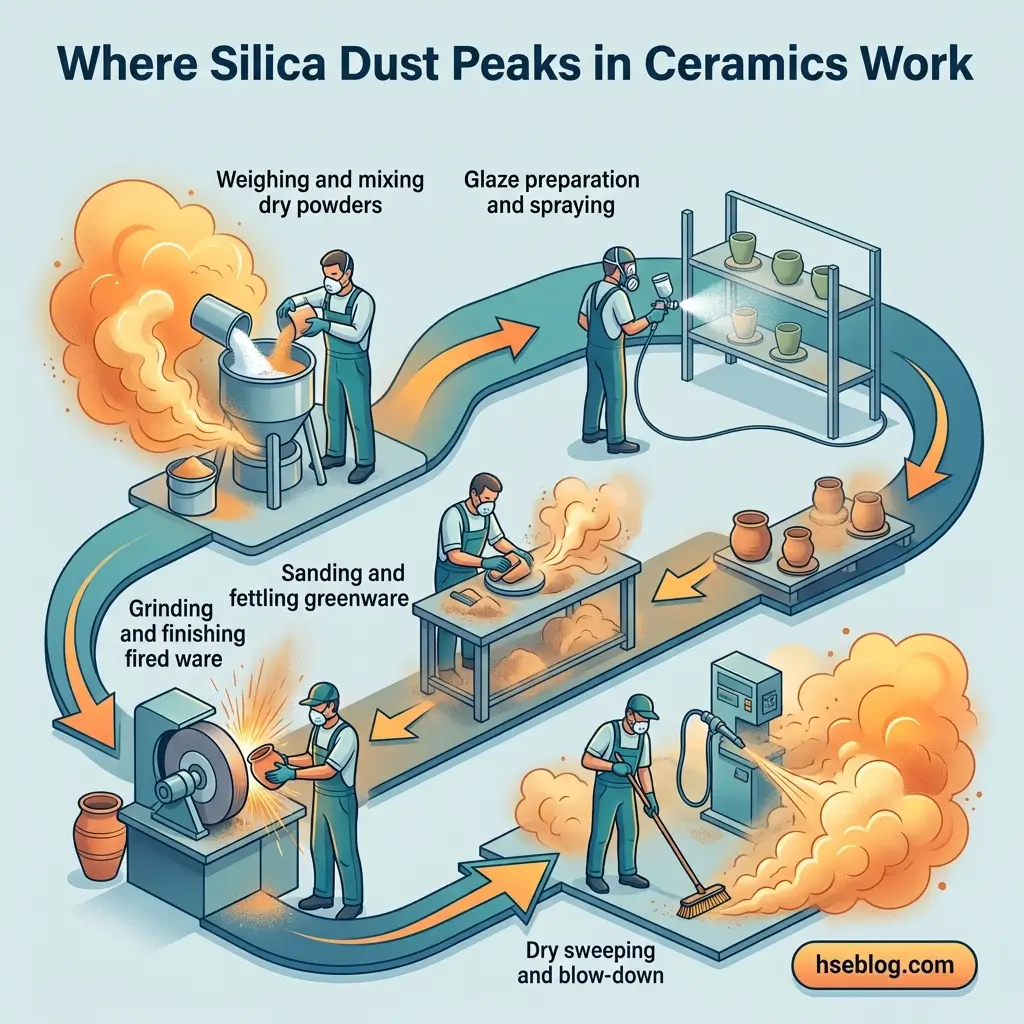
Raw material and glaze preparation
Weighing and blending dry clay, silica flour and glaze powders is usually the single largest source of airborne silica. Fine powders drift, settle and re-suspend long after the task ends.
- Decanting and weighing dry glaze and body ingredients.
- Mixing dry batches before water is added.
- Sieving and blunging operations that agitate fine material.
Forming and drying
Wet throwing, casting and hand-building with damp clay generate little respirable dust. The exposure appears once the clay dries and is worked again.
Firing and finishing fired ware
Firing is where cristobalite forms, but the dust it creates is mostly released later — when someone handles, grinds or finishes the fired piece, scrapes kiln shelves, or maintains refractory and kiln-wash surfaces.
Housekeeping and cleaning
This is the quiet peak. Dry sweeping and compressed-air blow-down lift settled silica straight back into the breathing zone, and sanding or fettling dry greenware does the same. A consistent finding once exposure gets measured is that the cleanup routine, not the making, produces the worst readings of the day.
Silica Exposure Limits Across the US, UK, EU and Australia
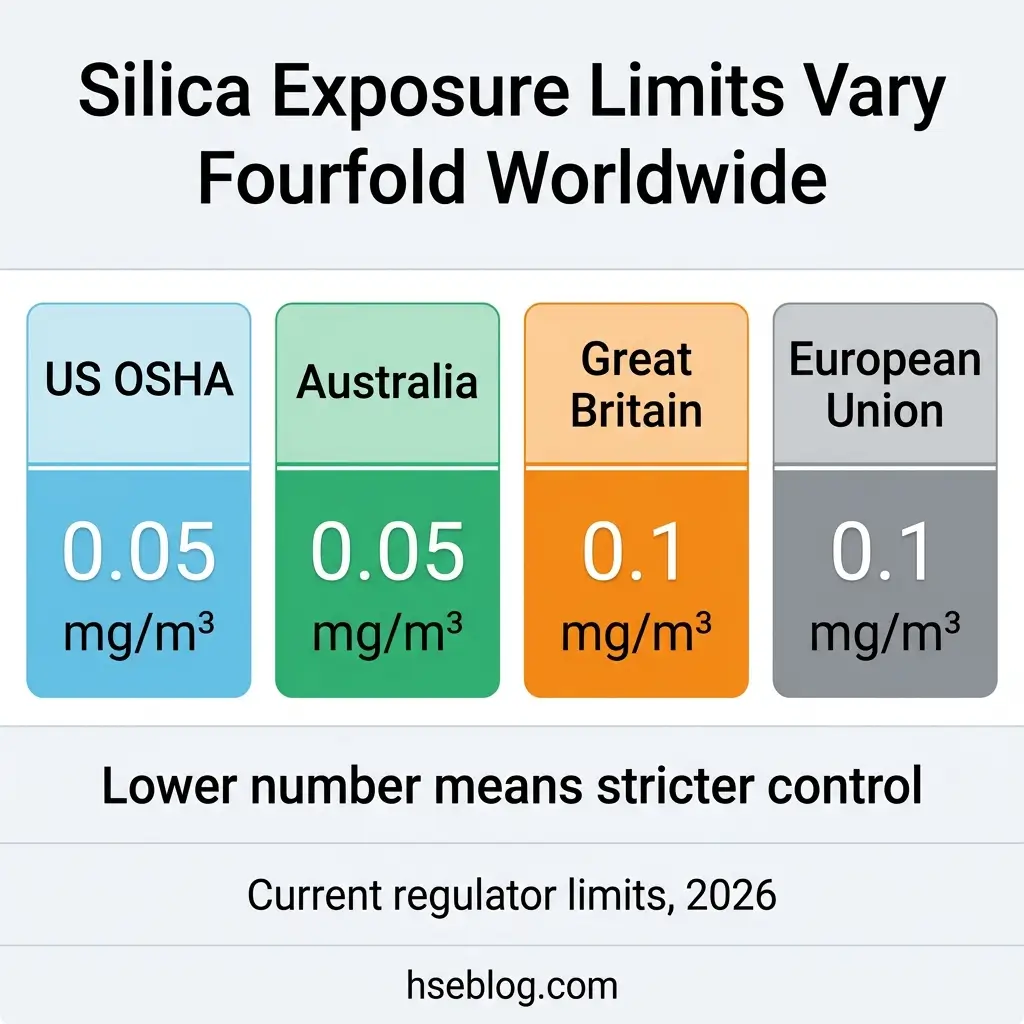
No single silica limit governs ceramics worldwide, and the numbers vary by up to fourfold. Identifying which figure applies is the first step in setting a defensible control target.
| Body / jurisdiction | 8-hour limit for RCS | Type |
|---|---|---|
| ACGIH (US, advisory) | 0.025 mg/m³ | Advisory TLV — most protective |
| OSHA (US) | 0.05 mg/m³ | Legal PEL, 29 CFR 1910.1053 (action level 0.025) |
| NIOSH (US, advisory) | 0.05 mg/m³ | Recommended REL |
| Safe Work Australia | 0.05 mg/m³ | Legal WES (halved from 0.1 in 2020) |
| Great Britain (HSE) | 0.1 mg/m³ | Legal WEL (EH40, under COSHH) |
| European Union | 0.1 mg/m³ | Binding OEL (Carcinogens and Mutagens Directive) |
The variance is real and it matters operationally. OSHA’s general industry standard sets a permissible exposure limit of 50 micrograms per cubic metre as an 8-hour average, with an action level of 25 micrograms — half the legal limit that Great Britain has held at 0.1 mg/m³ since 2006, a figure the EU also adopted in 2020. Australia halved its own workplace exposure standard to 0.05 mg/m³ in 2020, and the advisory ACGIH value sits lower still. Occupational Safety and Health Administration + 4
Where standards conflict, the more protective figure is the safer planning basis. A control design that merely meets the British WEL of 0.1 mg/m³ would fail OSHA’s general industry rule, so treat the stricter 0.05 mg/m³ — or lower — as the working target.
Two practical points follow for ceramics specifically:
- Ceramics manufacturing is general industry, not construction. In the US it falls under 29 CFR 1910.1053, which requires exposure assessment, written control plans and medical surveillance — not the separate construction standard.
- The limit is a ceiling, not a safe level. British COSHH requires exposure to be reduced as low as reasonably practicable regardless of the number, and the EU framework reinforces the same duty through the binding occupational exposure limit of 0.1 mg/m³ set under the Carcinogens and Mutagens Directive. European Agency for Safety & Health at WorkNepsi
Control Measures for Respirable Crystalline Silica in Ceramics
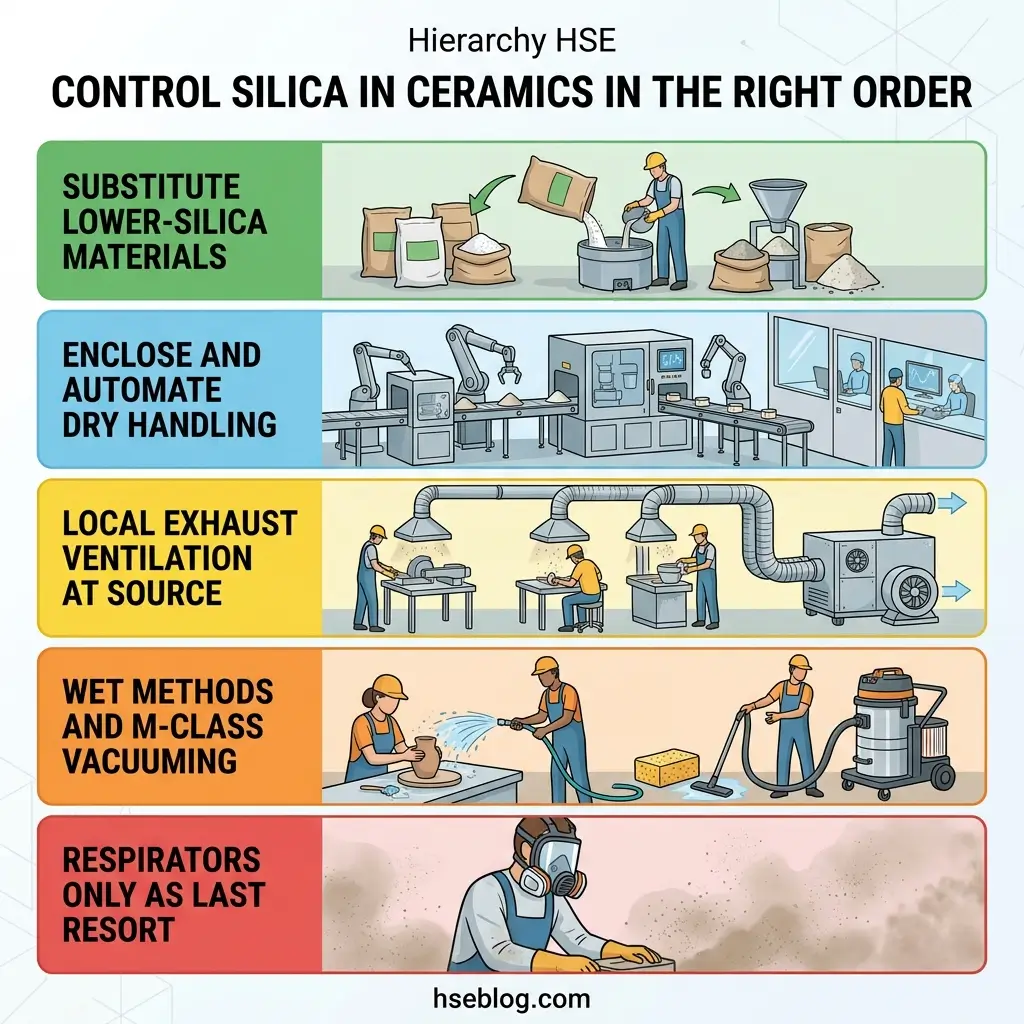
The reliable way to control ceramics silica is to attack it in order of effectiveness, top-down. Remove or substitute first, engineer next, and rely on people and protective equipment only after that.
Substitute and reduce the silica at source
Cutting the hazard out beats containing it. Silica is functional in bodies and glazes, so full removal is rarely possible — but the load can often be lowered.
- Choose lower-silica clay bodies and glazes where the product allows.
- Buy pre-mixed wet clay and ready-made glazes to avoid weighing dry powder.
- Favour damp or pelletised materials over fine silica flour.
The judgment call is honest: where silica genuinely cannot be reduced, the remaining controls have to work harder, not be waved through.
Enclose and ventilate the dusty processes
Local exhaust ventilation (LEV) is the workhorse control for the dry stages. It only helps, though, when the capture point sits at the source rather than a fan blowing in the corner.
- Enclose or automate dry mixing and weighing.
- Fit LEV at glaze spray booths, dry-material handling and finishing benches.
- Use on-tool extraction for grinding and drilling fired ware, and downdraft benches for fettling.
Ventilation degrades silently. In Great Britain, COSHH requires LEV to undergo a thorough examination and test at least every 14 months, and an unmeasured system should never be assumed to be working. The European ceramics sector is one of the signatory industries to the NEPSI agreement, whose good-practice task sheets describe capture techniques for exactly these tasks.
Use wet methods and controlled cleaning
Water is a cheap, powerful control. Wet sponging instead of dry sanding greenware, keeping surfaces damp, and wet-cutting fired ware all suppress dust before it becomes airborne.
Cleaning is where most programmes fail. Replace the broom and the airline with M-class or HEPA vacuums and wet wiping, because dry sweeping and compressed air simply redistribute the finest, most dangerous particles.
Add respiratory protection as the last layer
Respirators are a backstop, not a substitute for the controls above. They belong where engineering cannot hold exposure below the limit, or for short, high-exposure tasks.
- Use FFP3 as a minimum for brief work, and a half-mask with P3 filters or a powered respirator for prolonged tasks.
- Face-fit test every tight-fitting respirator, and expect a clean-shaven seal.
- Remember that surgical and nuisance dust masks offer no meaningful protection against respirable silica.
Health Surveillance and Exposure Monitoring in Ceramics Work
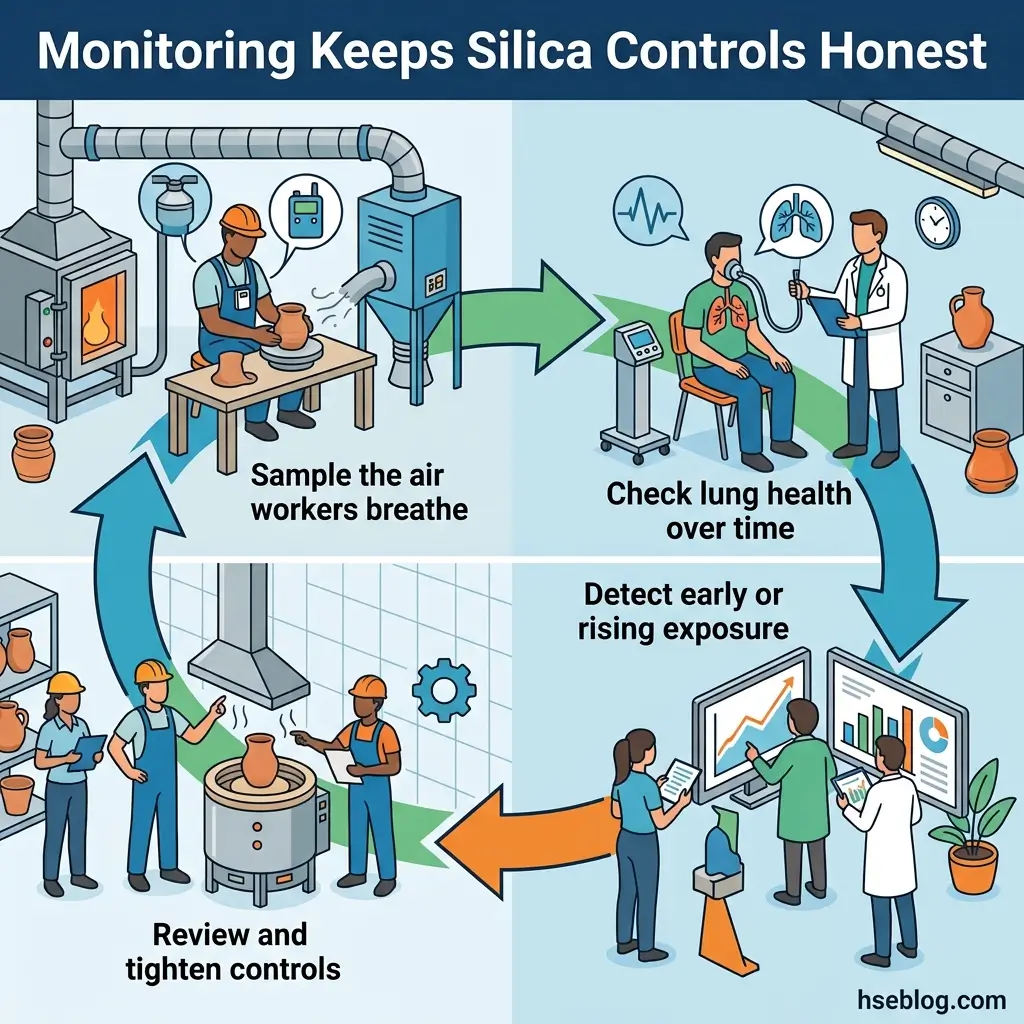
Controls can fail quietly, so two independent checks confirm they are working: sampling the air workers breathe, and monitoring their lung health over time. Both become legal duties in most jurisdictions once a real exposure risk exists.
This section covers health surveillance and exposure monitoring for HSE practitioner reference. It is not medical advice. Workers with respiratory symptoms or specific exposure concerns should consult an occupational physician or qualified medical professional.
Air monitoring tells you the size of the problem. Personal sampling in the breathing zone, taken during representative tasks, is what allows a genuine comparison against the applicable limit.
- Sample real tasks, not quiet moments, and repeat when materials or processes change.
- Where exposure could approach or exceed the limit, monitoring is an obligation rather than a nicety.
Health surveillance catches harm early, before it becomes disability. It is a risk-based scheme of repeated checks — typically symptom review and lung-function testing, with imaging where indicated — and it must feed back into the risk assessment when a problem appears.
Regulatory attention here is sharpening. In March 2025, HSE refreshed its guidance on health surveillance for those exposed to respirable crystalline silica (G404) and named ceramics among the industries that should review their duties. Surveillance is a check on control, not a replacement for it, as the updated HSE guidance makes clear; a detected case is a signal to review the controls, not simply to record the diagnosis. ConstructionsafetyKingfisherps
Frequently Asked Questions
Bringing the Controls Together
Managing respirable crystalline silica in ceramics comes down to a short sequence, applied in order. Reduce the silica where the product allows, enclose and ventilate the dry processes, wet-clean instead of sweeping, and treat respirators as the final layer rather than the strategy.
Two failure modes account for most avoidable exposure, and both are easy to miss. Dry cleaning re-suspends everything the controls just captured, and treating fired dust as inert ignores the cristobalite that the kiln itself produced. Confirm the whole system with air sampling and lung-health surveillance, and pick the more protective exposure limit as the target when jurisdictions disagree.
The regulatory direction of travel is downward, so a programme built to the stricter figure will age well rather than needing a rebuild. In ceramics, the dust that scars lungs is often the dust nobody sees settling on a shelf overnight — which is exactly why the cleanup routine deserves the same scrutiny as the kiln schedule.