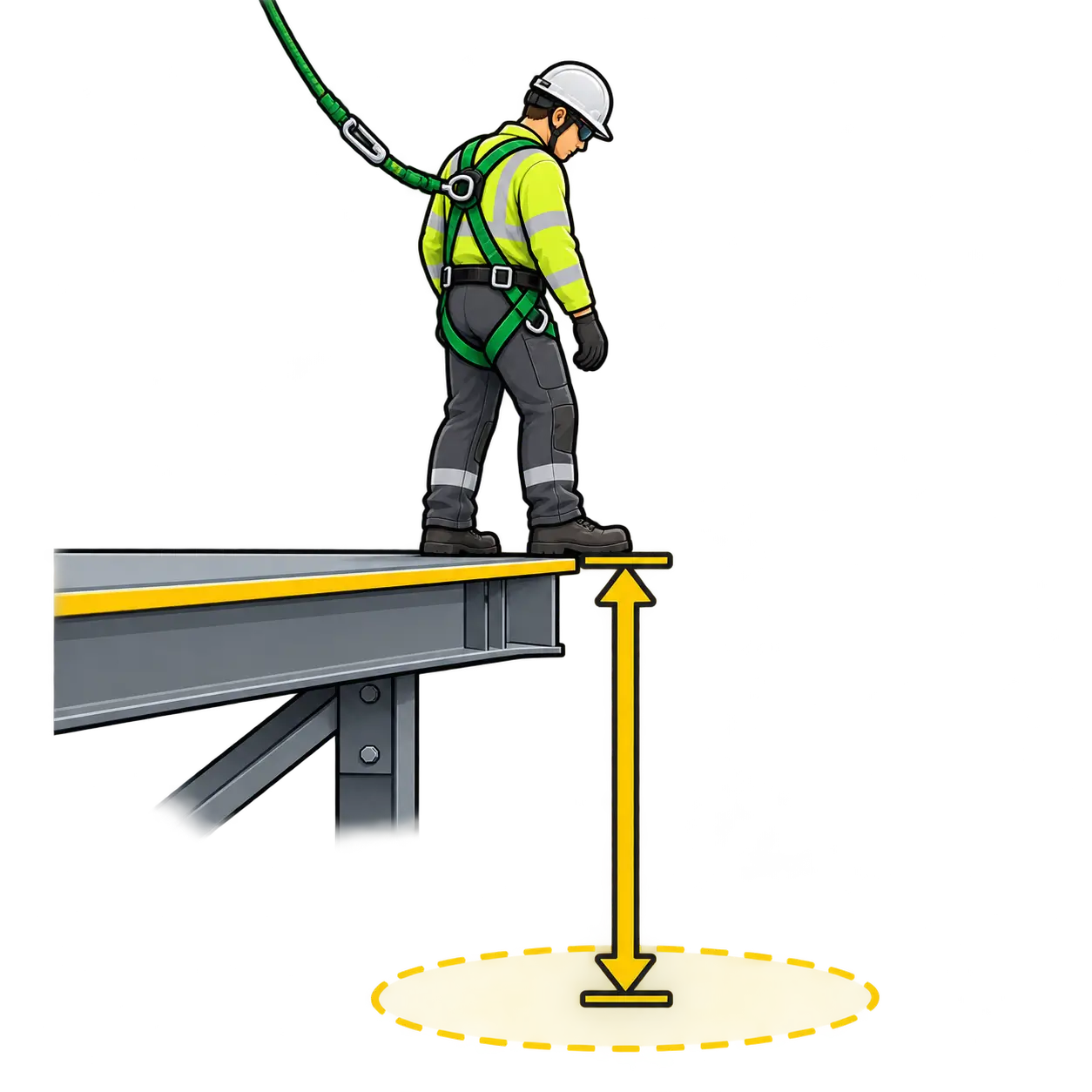

What is fall clearance?
Fall clearance is the vertical distance required below a worker for a personal fall arrest system (PFAS) to stop the fall without the worker hitting the ground, a deck, or equipment. It is a planning check for lanyards and self-retracting lifelines (SRLs) — not a substitute for a competent-person fall-protection plan.
Typical OSHA-style planning adds free-fall distance, deceleration (shock pack), D-ring / harness stretch, and a safety factor. Horizontal lifelines and swing falls need extra allowance. Use the free calculator below, then read the formula notes.
Fall Clearance Calculator
Fall clearance · Personal fall arrest
Estimate minimum clearance for a PFAS: free fall + deceleration + harness stretch + safety factor, with optional lifeline sag. Planning aid — confirm manufacturer data and your competent-person plan.
Formula: Required Clearance = Free Fall + Deceleration + Harness Stretch + Safety Factor (+ Sag)
- Keep every input in the same unit (feet or metres).
- Deceleration and stretch come from the manufacturer — defaults are only starting points.
- If required clearance exceeds available space, redesign before work at height.
The formula
Required clearance = Free fall + Deceleration + Harness stretch + Safety factor (+ Sag / swing)
- Free fall — distance from fall onset until the arrest device engages (often near lanyard length when the anchor is at D-ring height).
- Deceleration — shock-absorber deployment (often about 3.5 ft / 1.07 m; check the manufacturer).
- Harness stretch — D-ring slide and harness elongation (commonly ≈ 1 ft / 0.3 m).
- Safety factor — clearance margin (often 3 ft / 0.9 m).
- Sag / swing — HLL deflection or swing-fall extra distance when applicable.
Worked examples
- 6 ft shock-absorbing lanyard at D-ring height: 6 + 3.5 + 1 + 3 ≈ 13.5 ft (≈ 4.1 m) below the walking surface if that is how your procedure measures clearance.
- SRL overhead with short free fall: free fall may be much smaller — always use the device manual.
- If available clearance is less than required, change the anchor, use an SRL, switch to restraint, or lower the work surface risk.
How to read the result
- Required ≤ available — clearance looks adequate for the numbers entered; still verify manufacturer data and swing hazards.
- Required > available — do not rely on this PFAS set-up; redesign the system.
- When available clearance is blank, use the required figure as the minimum space you must provide below the worker.
Key concepts
- Fall restraint vs fall arrest — restraint prevents reaching the edge; arrest stops a fall after it starts and needs clearance.
- Free-fall distance — limited by regulation and equipment (often max 6 ft / 1.8 m for many lanyard systems — confirm locally).
- Anchor location — above D-ring reduces free fall; below D-ring increases it.
- Competent person — site-specific plans, anchorage strength, and training remain mandatory.
How to reduce required clearance
- Anchor overhead and use an SRL rated for the edge condition.
- Shorten free fall; avoid anchoring at the feet when arrest is required.
- Prefer restraint or work platforms so arrest is not needed.
- Account for swing fall and toolkit / tool-lanyard snag hazards.
Frequently asked questions
Is 13.5 ft always enough for a 6 ft lanyard?
No. That figure is a common textbook example for one set of assumptions. Manufacturer deceleration, harness model, anchor height, and safety factor change the total. Always recalculate with your equipment data.
Does this meet OSHA 1926.502?
It is a planning aid that follows common OSHA-style clearance components. It does not certify compliance. Your competent person must apply the regulation, equipment instructions, and site conditions.
Should I include horizontal lifeline sag?
Yes when an HLL is used. Enter sag or deflection in the optional field so required clearance includes that extra drop.
What units does the calculator use?
Feet or metres — pick one system and keep every input in that unit. The result uses the same unit.