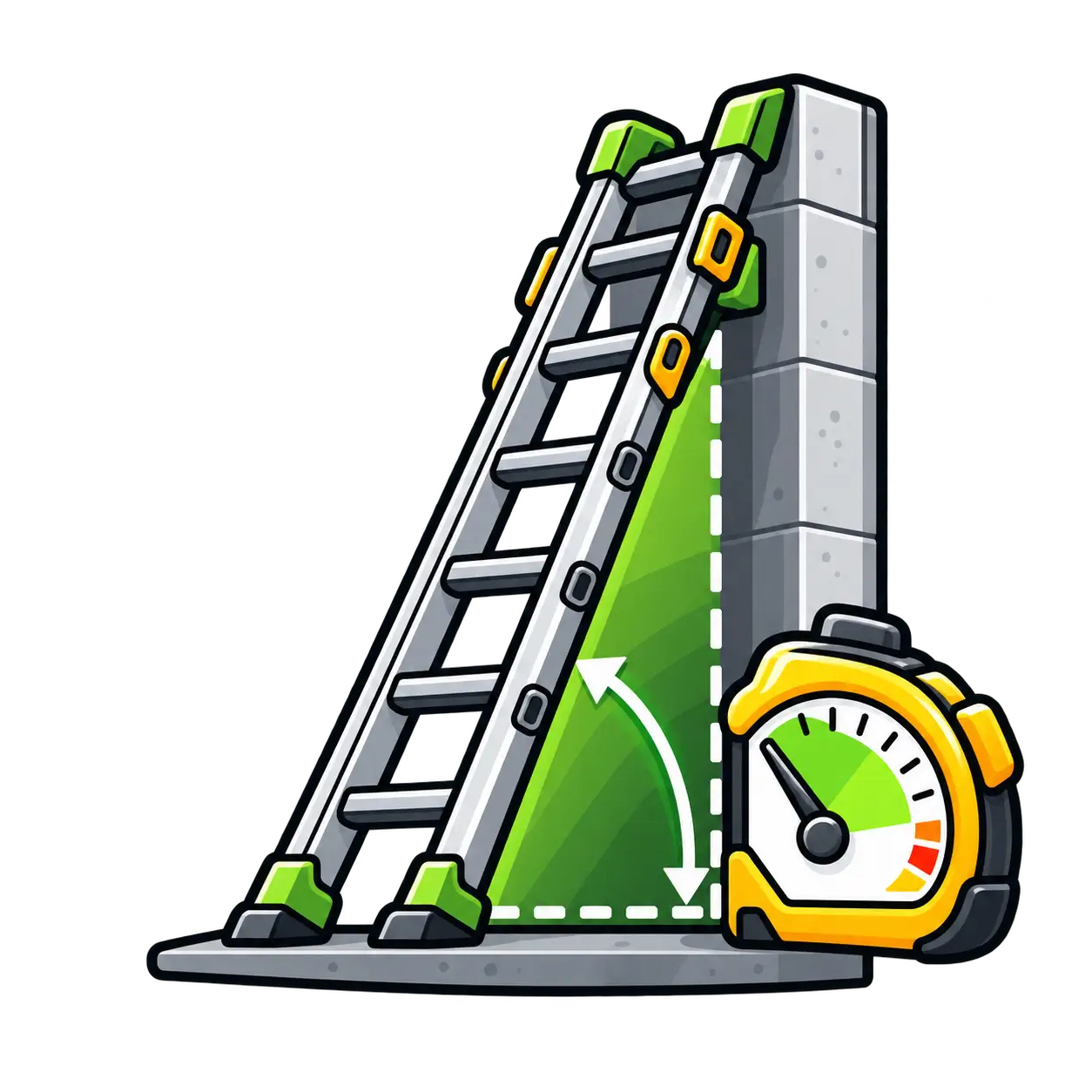


What is the OSHA 4-to-1 ladder rule?
For every 4 units of height to the top support, place the ladder base 1 unit out from the wall or structure. That yields a ladder angle of about 75.5° from the horizontal — stable for climbing without being too upright or too flat.
Enter the height to the top support below to get base distance, minimum ladder length, and angle. For access ladders to a landing, add the usual rail extension above the upper landing.
Ladder Angle Calculator
Ladder angle · OSHA 4-to-1
For every 4 units of height to the top support, set the base 1 unit out. Optional 3 ft / 0.9 m extension above a landing for access ladders.
Formula: Base = Height ÷ 4 · Length = √(H² + Base²) (+ extension above landing)
- Height is vertical distance to the top support — not the ladder’s labelled length.
- Mark the base distance before raising the ladder on firm, level ground.
- Inspect feet, rails, and locks; use three points of contact when climbing.
Base = Height ÷ 4
Ladder length (to support) = √(H² + Base²)
For access ladders to a landing, OSHA expects the side rails to extend at least 3 ft (0.9 m) above the upper landing — add that extension when you need the minimum manufactured length to buy or select.
Worked examples
- Height 16 ft → base = 4 ft; length to support ≈ 16.5 ft; with 3 ft above landing ≈ 19.5 ft rail length needed.
- Height 4 m → base = 1 m; length to support ≈ 4.12 m.
How to read the result
- Mark the base distance on the ground before raising the ladder.
- Choose a ladder whose working length covers height to support plus any required extension above the landing.
- On uneven ground, level the base; do not “make up” angle by pushing the feet in or out unsafely.
Safe ladder practice
- Three points of contact when climbing; face the ladder.
- Secure or have the ladder held when required; check locks and spreaders on stepladders.
- Do not overload; check the duty rating.
- Keep belt buckle between the rails; do not over-reach — move the ladder instead.
- Inspect rails, feet, and rungs before each use.
Frequently asked questions
Is 4-to-1 the same worldwide?
OSHA’s 4-to-1 rule is the US portable-ladder set-up many trainers teach. Other jurisdictions may phrase angle or ratio guidance differently — follow local regulations and manufacturer instructions.
Does height mean ladder length?
No. Height is the vertical distance to the top support (e.g. eaves or landing). Ladder length is longer because of the slant, and longer again if rails must extend above a landing.
What angle should I see?
About 75.5° from the horizontal when the 4-to-1 base distance is correct. A quick field check is roughly one-quarter of the working height out from the wall.
Can I use this for stepladders?
The 4-to-1 rule is for leaning portable ladders. Stepladders must be fully opened and locked on a firm level surface — do not lean a closed stepladder like an extension ladder.