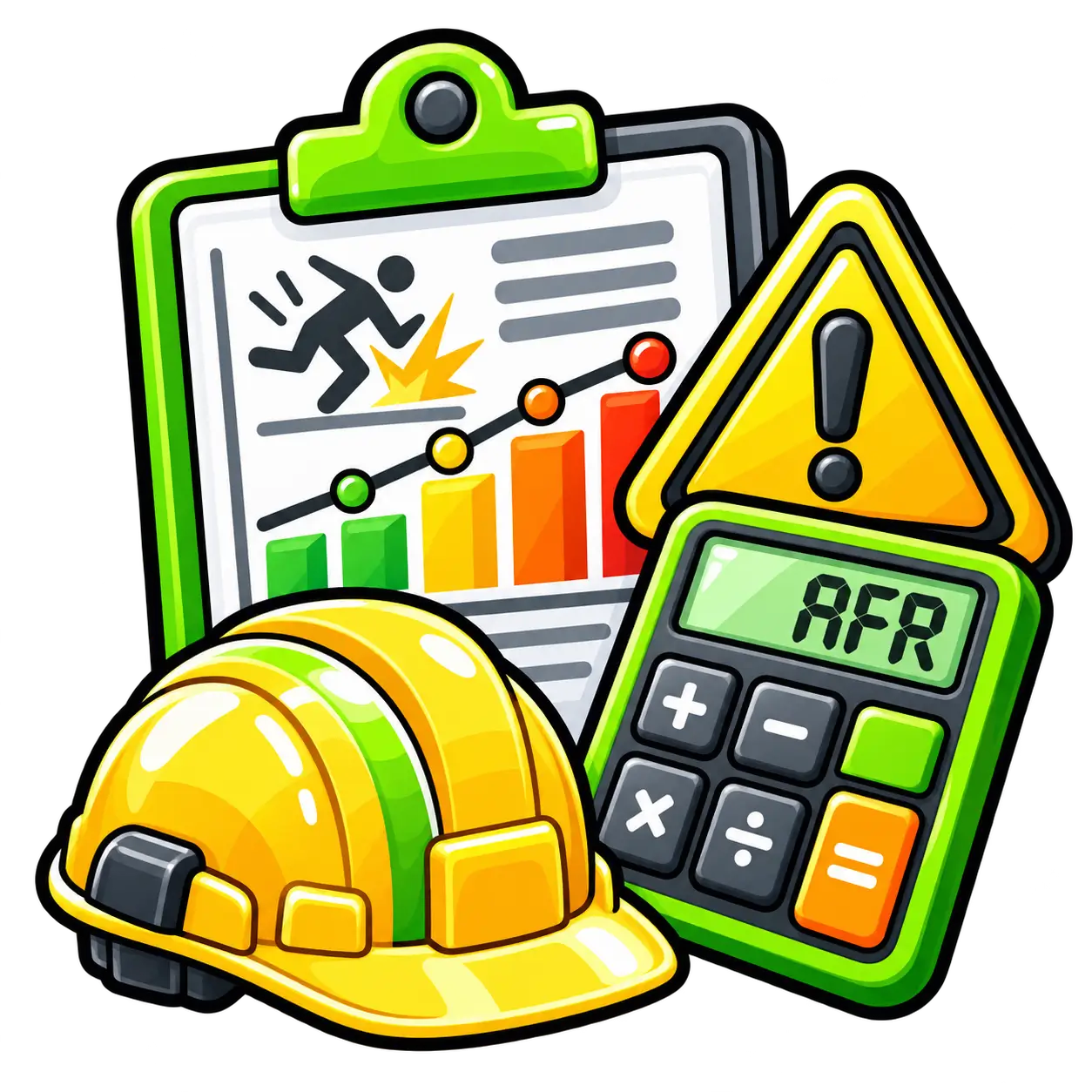


What is AFR?
AFR (Accident Frequency Rate) is a lagging safety indicator that counts how many workplace accidents occur per 1,000,000 hours worked. It normalises frequency so sites of different sizes can be compared — but only when they use the same definition of “accident”.
Unlike LTIFR (lost-time only) or TRIFR (OSHA-style recordables), AFR often follows a company or client definition that may include or exclude first-aid cases. Lock that definition before you benchmark.
This free AFR calculator runs the international million-hour formula in your browser and shows an OSHA-style figure on a 200,000-hour base for the same inputs.
Accident Frequency Rate Calculator
AFR · Accident Frequency Rate
Accidents per 1,000,000 hours worked. Lock your organisation’s definition of “accident” before comparing peers — it may differ from OSHA recordables used in TRIFR or LTIFR.
Formula: AFR = (Accidents × 1,000,000) ÷ Total Hours Worked
- Write the accident definition next to every AFR you report or benchmark.
- Use one reporting period for both accident count and hours.
- Do not mix million-hour AFR with OSHA 200,000-hour rates without converting (÷ or × 5).
How to calculate AFR
The standard international formula is:
AFR = (Number of Accidents × 1,000,000) ÷ Total Hours Worked
| Input | What to enter |
|---|---|
| Number of Accidents | Events that match your written AFR definition for the period. State whether first-aid-only cases are included. |
| Total Hours Worked | Hours worked by people in scope for the same period, including overtime. Prefer timesheet or payroll hours. |
Worked example
A site records 5 accidents and 800,000 hours worked:
AFR = (5 × 1,000,000) ÷ 800,000 = 6.25
The OSHA-style rate on a 200,000-hour base for the same data is 1.25 (AFR ÷ 5). Always state which base you are using.
What counts as an accident for AFR
Classification is where most AFR comparisons fail.
- Write it down: put the accident definition next to every AFR you publish.
- Stay consistent: do not tighten or loosen the definition mid-year without documenting a break in the series.
- vs TRIFR/LTIFR: if your AFR uses OSHA recordables, it should reconcile with TRIFR; if it includes first aid, it will usually sit higher.
AFR vs LTIFR, TRIFR, and incident rate
LTIFR counts lost-time injuries only on a million-hour base.
TRIFR usually counts recordables on a million-hour base; OSHA incident rate / TRIR uses 200,000 hours for the same recordables.
For identical counts and hours: OSHA-style = AFR ÷ 5 when AFR uses a million-hour base.
Browse every free tool on the safety calculators hub.
How to interpret your AFR result
There is no universal “good” AFR — especially when definitions differ.
- Oil and gas (strong programmes): often well below 1 per million hours on strict definitions.
- Manufacturing / mixed industry: commonly cited ranges sit roughly around 2–8.
- Construction: typically wider and often higher — site type and reporting culture matter a lot.
A falling AFR from under-reporting is not an improvement. Pair AFR with near-miss leading indicators and with severity metrics, such as the days-lost figure from an LWR calculation tool.
Tips for accurate AFR reporting
- Lock the reporting period before you count accidents or hours.
- Document contractor inclusion and keep it consistent.
- Reconcile AFR with LTIFR/TRIFR when definitions overlap.
- Review clusters of similar accidents — they often signal control gaps before rates spike further.
- Never place a million-hour AFR next to an OSHA 200,000-hour benchmark without converting.
Frequently asked questions
How do I calculate AFR?
Multiply the number of accidents by 1,000,000, then divide by total hours worked in the same period. Example: 5 accidents and 800,000 hours → (5 × 1,000,000) ÷ 800,000 = 6.25.
What is the difference between AFR and LTIFR?
Both often use a million-hour base. LTIFR counts only lost-time injuries. AFR counts whatever your organisation defines as an “accident,” which may be broader or narrower than LTIs. Always state the definition.
What is the difference between AFR and TRIFR?
TRIFR usually means total recordable injuries on a million-hour base. AFR may use the same count — or a different company definition. If both use the same cases and hours, the numbers match; if not, do not compare them directly.
What is a good AFR?
It depends on industry and how “accident” is defined. World-class industrial programmes often sit below 1 per million hours on strict definitions, while other sectors run higher. Compare peers like-for-like and track your own trend.
Should contractor hours be included?
Include them if contractors are in your reporting scope — and keep that choice consistent every period. Many clients require contractor accidents and hours in project statistics. State the scope on every report.