
TL;DR
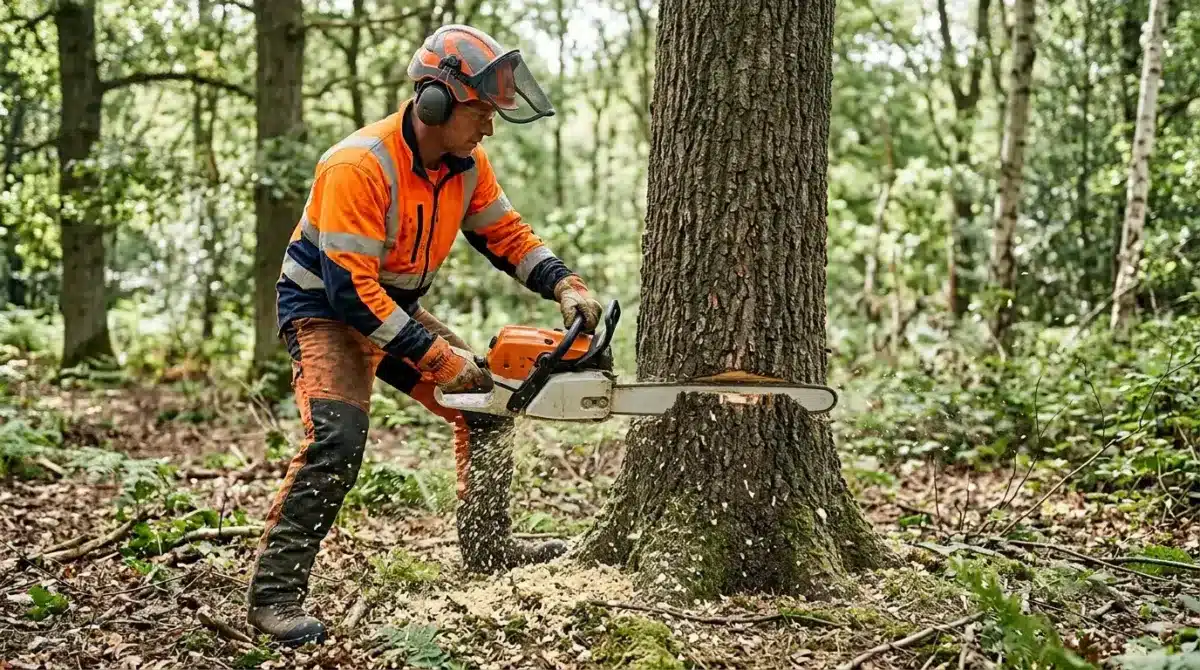
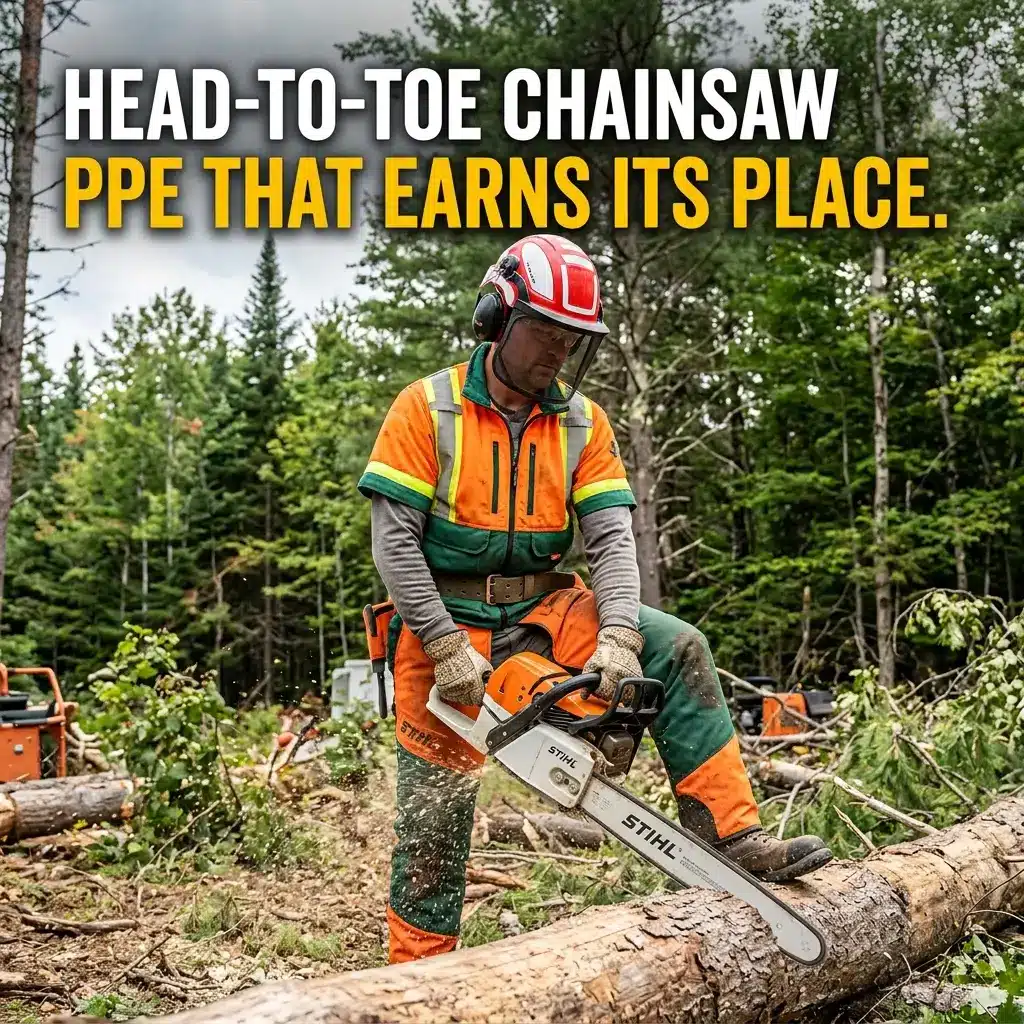
- Match PPE to the saw, not the season. Cut-resistant leg protection, a helmet with visor and ear defence, gloves, and protective boots are the baseline for any chainsaw work.
- Certified leg protection stops the chain by jamming it — but a European chain-speed class and a US pass/fail rating are not interchangeable ratings.
- Training is a legal duty, not an add-on. US employers must certify operator training; UK operators generally need a task-specific Certificate of Competence.
- Kickback causes the most severe injuries and reverses the saw faster than a person can react — engineered controls exist because technique alone cannot beat it.
- Know your ceiling. Heavy lean, rot, wood under tension, and cutting above shoulder height all demand competence beyond entry-level operation.
Chainsaw safety rests on three things working together: correctly certified PPE, proven operator competence, and disciplined cutting technique. Each covers a different way the tool causes harm. Remove any one — skip the chaps, hand a saw to an untrained user, or let the bar drift above the shoulder — and the other two rarely hold on their own.
A running chainsaw is one of the few hand tools that can kill in under a second. On a professional saw the cutting chain travels at close to 60 miles per hour, and its teeth are shaped to tear material away rather than slice it cleanly. A wound from that chain is ragged, contaminated, and slow to heal — closer to a gouge than a cut. That behaviour, not the tool’s size, is why it demands a level of preparation most power tools never require.
The numbers back up the caution. Each year, roughly 36,000 people in the United States are treated in hospital emergency departments for chainsaw injuries (CDC, 2024), and the risk climbs sharply after storms, when untrained operators clear fallen trees. This article covers what chainsaw safety actually requires across three fronts — the PPE that earns its place, the training the law expects, and the operating technique that keeps the operator behind the saw and out of the kickback path.
Why Chainsaws Demand a Different Level of Respect
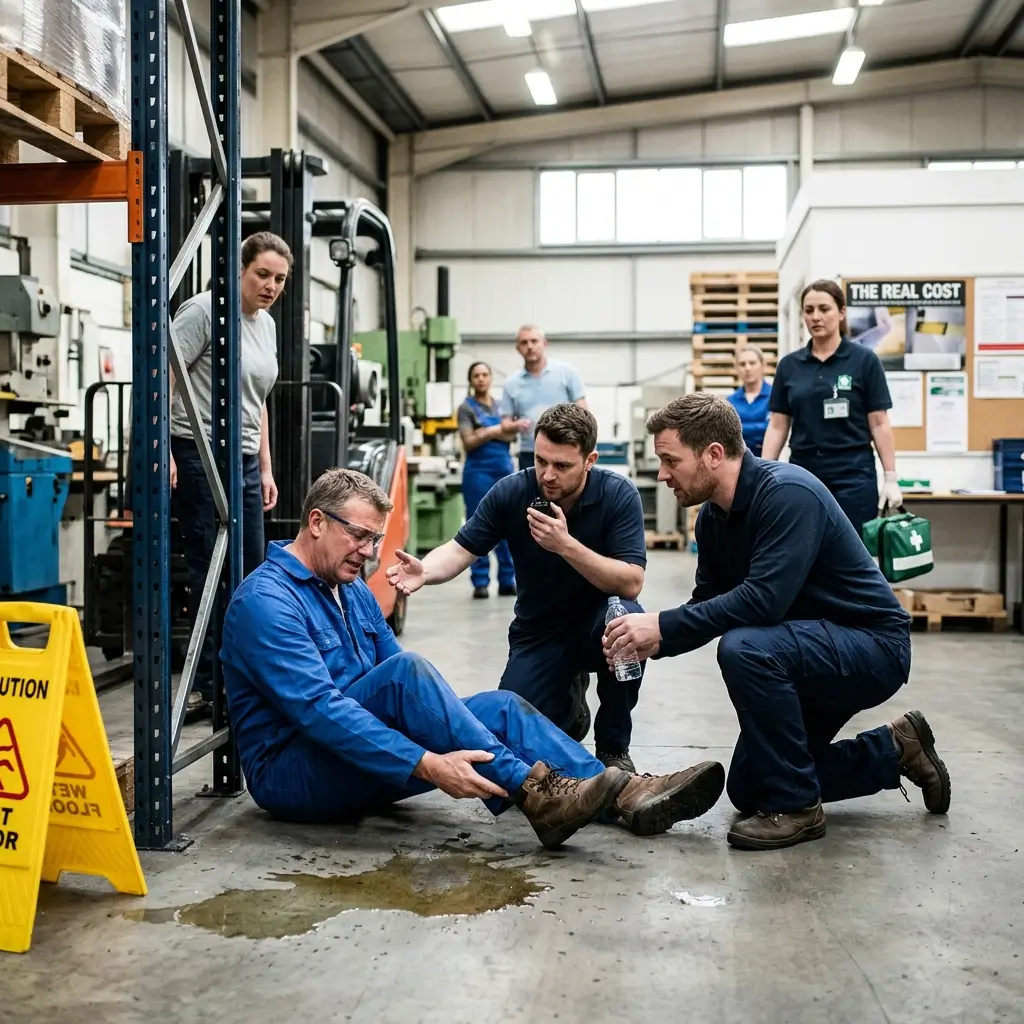
Most serious chainsaw injuries come from a small set of mechanisms, and understanding them is the foundation of every control that follows. The tool doesn’t fail randomly — it hurts people in predictable ways.
The dominant patterns show up clearly in the injury record. Analysis of US emergency data found that the hand and fingers and the left leg are the most commonly injured sites, and around 80% of chainsaw injuries are lacerations (Hammig, Advances in Emergency Medicine, 2015). The left side dominates because most operators are right-handed, placing the left leg and left hand closest to the bar during a slip.
Three mechanisms account for the majority of harm:
- Chain contact. Direct contact with the moving chain produces deep lacerations or amputation. This is the injury PPE is built to blunt.
- Kickback. The bar nose reverses violently toward the operator’s head and upper body — covered in its own section below because it drives the most severe outcomes.
- Struck-by. Falling limbs (often called “widow-makers”), springpoles releasing stored tension, rolling logs, and split trunks injure operators who never touch the chain.
Beyond the immediate cuts sit the slower hazards: hand-arm vibration syndrome from prolonged gripping, noise-induced hearing loss, and carbon monoxide from two-stroke exhaust in enclosed spaces. These matter because occasional users tend to dismiss them entirely.
The occupational toll is concentrated where you’d expect. An estimated 127,944 people were treated in US emergency departments for chainsaw-related injuries between 2018 and 2022, with landscaping accounting for the most occupational cases (Penn State Extension, 2024). Volume of exposure, not carelessness, puts frequent users at the front of the queue.
Chainsaw PPE: What Each Layer Actually Stops
Chainsaw PPE is the last line of defence, and each item addresses a specific failure. It works only when the technique and the saw’s own guards have already been overwhelmed — which is exactly why it has to be right.
The headline item is cut-resistant leg protection, and its mechanism is worth understanding. Chaps and protective trousers are built from layers of long, loosely bound synthetic fibres. When the chain cuts in, those fibres are pulled out and wrap around the drive sprocket, clogging the mechanism and stalling the chain — often within a single rotation. They don’t resist the cut so much as sacrifice themselves to stop the motor.
A full working set covers the operator head to foot:
- Head and face — a forestry helmet with an integrated mesh visor and ear defence; head protection to ANSI Z89.1 (US) or EN 397, and eye protection to ANSI Z87.1.
- Hearing — protection sufficient to reduce noise exposure to 90 decibels or less under US rules, though forestry and logging record some of the highest hearing-loss rates of any noisy industry.
- Legs — certified chaps or trousers (detail below), fastened snugly and covering the full thigh to just below the boot top.
- Feet — protective boots with chainsaw-resistant uppers to EN ISO 17249 plus a protective toe.
- Hands — gloves with cut protection on the back of the left hand, the most exposed point in a slip.
A common and dangerous belief is that chaps are optional for a “quick job.” The injury data says otherwise: short, unplanned tasks are exactly where operators are caught without protection.
Where the standards trip people up is certification, because a rating in one region does not translate to another. The blocking performance is tested differently, so a European metres-per-second class cannot be converted into a North American pass/fail result.
| Region | Leg-protection standard | Basis of rating |
|---|---|---|
| Europe / international | EN ISO 11393-2:2019 | Chain-speed classes: Class 1 (20 m/s), Class 2 (24 m/s), Class 3 (28 m/s); Designs A (front), B (chaps), C (360°) |
| United States | ASTM F1897-25 | Pass/fail cut-resistance and durability test |
| Canada | ASTM F3325 | Four design classes |
| Australia / New Zealand | AS/NZS 4453 | Mirrors EN ISO 11393 |
The freshness point for buyers: ASTM updated the US leg-protection specification to ASTM F1897-25 in 2025, so newly purchased protection should reference that revision. When operations span regions, verify the certificate and label for each garment rather than assuming one mark satisfies all.
Chainsaw Training and Certification: The Legal Baseline
Training is where regulators draw a hard line, and it is not satisfied by watching a video. In both the US and the UK, letting an untrained person run a saw at work is a compliance failure before any injury occurs.
In the United States, the only OSHA standard that speaks directly to chainsaws is the logging operations rule, 29 CFR 1910.266 (US). It requires employers to provide training, to certify that each operator has received it, and to equip saws with a chain brake and other safety features. Tree care that isn’t logging falls under general industry standards and the General Duty Clause, with the voluntary consensus standard ANSI Z133 (US) — Safety Requirements for Arboricultural Operations — setting the practical benchmark, including a documented job briefing before each job.
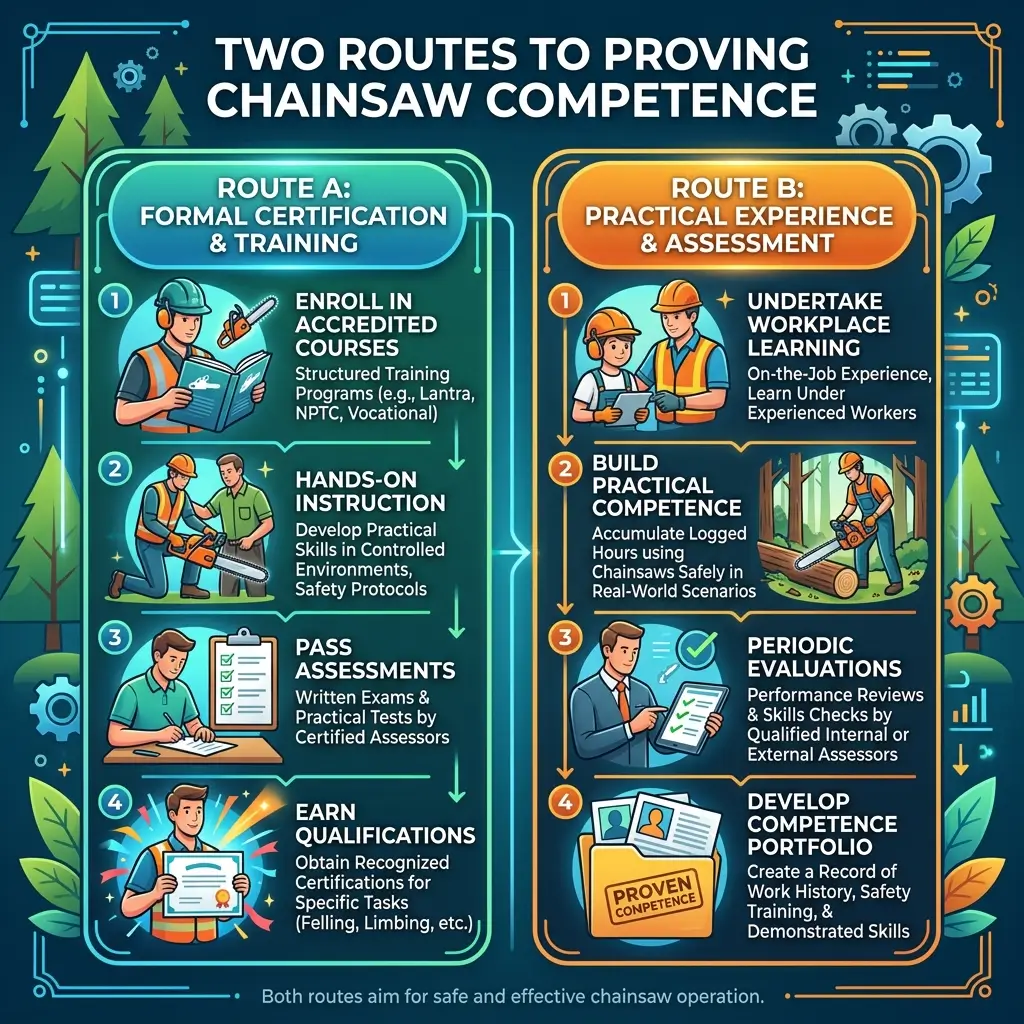
The UK takes a competence-based route. Under the Approved Code of Practice supporting regulation 9 of PUWER 1998 (UK), anyone using a chainsaw at work must be adequately trained and competent for the specific task. In practice that means a task-specific Certificate of Competence — separate units for cross-cutting, felling small trees, aerial work, and windblown trees — with AFAG (UK) guidance describing accepted good practice.
The two systems answer the same question differently:
- United States — the employer certifies training; ANSI Z133 defines the competence expected in arboriculture.
- United Kingdom — an independent Certificate of Competence proves the operator can do the specific task.
- Both — training is tied to the task, not the tool in general; a felling certificate does not authorise aerial cutting.
A current UK development is worth tracking. As of 2024, the HSE and AFAG have been assessing whether alternative schemes such as the European and International Chainsaw Certificates meet UK competence expectations (HSE/AFAG), reflecting a cross-border workforce.
The other half of training is knowing your ceiling. Certain operations sit well beyond entry-level skill, and OSHA flags them explicitly: trees on unstable ground or steep slopes, heavy-leaning trees, stems with rot, trees prone to splitting, and cutting above shoulder height or from a ladder or tree. Recognising when a job exceeds your competence is itself a trained judgement — and the point at which many serious incidents could have been prevented by stopping.
This article provides general HSE knowledge. Life-critical work such as tree felling and aerial chainsaw operation must be planned and supervised by a competent person with relevant training, jurisdiction-specific authorisation, and a site-specific risk assessment. The information here does not replace that.
Safe Chainsaw Operation: From Pre-Start Checks to the Cut
Safe operation is a sequence, and skipping steps is where control is lost. The discipline is boring by design — the operators who avoid injury are the ones who run the same checks every time, regardless of how small the job looks.
Before the saw starts, the setup does most of the safety work:
- Inspect the saw. Check the chain brake, throttle interlock, chain catcher, chain tension, and all handles and bolts against the manufacturer’s instructions. A saw with a disabled safety device does not get used.
- Fuel with a margin. Refuel at least 10 feet from any ignition source, using an approved container of no more than 5 gallons, and never on a hot engine.
- Read the work area. Clear obstacles and retreat paths, identify overhead “hangers” and any electrical lines, and keep bystanders at least twice the height of the tree being felled.
- Start it correctly. Start on the ground or firm support with the chain brake engaged — never “drop-start” by dropping the saw and pulling the cord in mid-air.
The way the saw is held determines whether a slip becomes an injury. Keep both hands on the handles with the left thumb fully wrapped under the front handle, maintain firm footing, and never cut with the bar above shoulder height, where control and the chain brake both become far less effective.
Felling, limbing, and bucking each carry distinct risks:
Felling
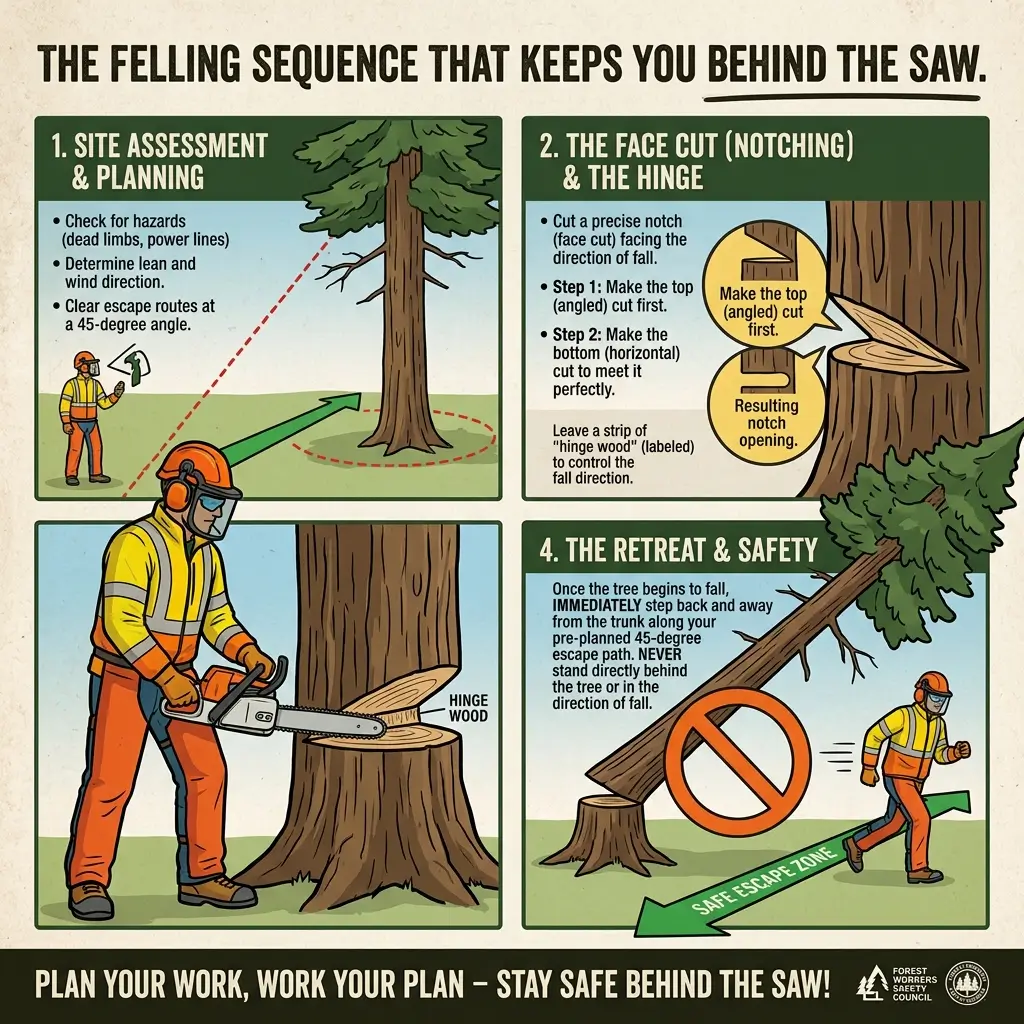
A controlled fell uses a three-cut method — a notch (or face cut) on the fall side, a matching hinge of uncut wood, and a back cut. The hinge steers the tree; cutting through it removes all control. Plan an escape route roughly 45 degrees back from the fall line and move along it as the tree commits.
Limbing and Bucking
Limbing removes branches from a felled tree; bucking cuts the trunk to length. Both demand attention to wood under tension: a limb or log can store spring energy and release it violently when cut. Position yourself on the uphill side, watch for the chain catching on the far side of a log, and engage the chain brake whenever you carry the saw more than a short distance.
For the full official operating sequence, OSHA’s chainsaw fact sheet sets out the work-area, starting, and cutting rules in detail.
Kickback: The Mechanism Behind the Most Serious Injuries
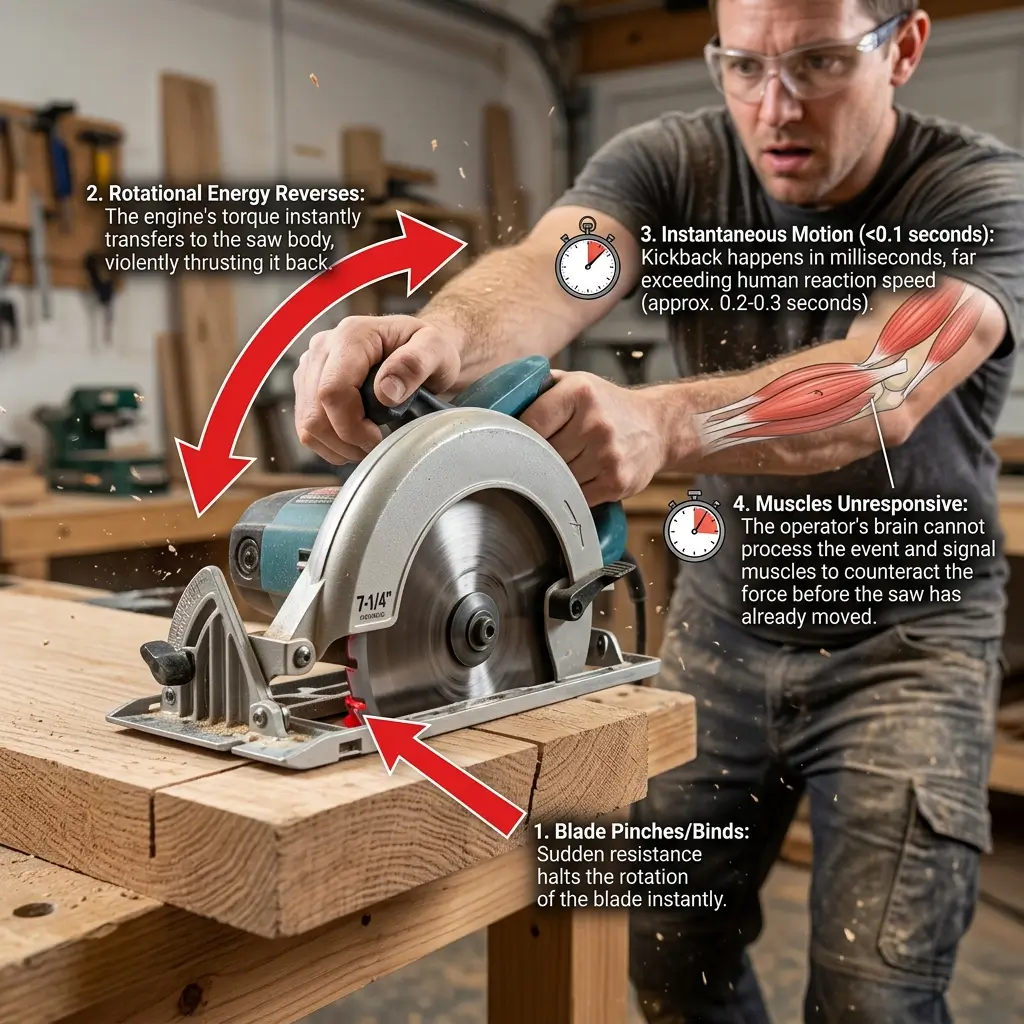
Kickback deserves its own attention because it produces the injuries operators fear most — strikes to the head, face, and neck. It happens faster than human reaction time, which is precisely why technique alone cannot be the only defence.
Kickback comes in two forms, and both start at the guide bar:
- Rotational kickback. The upper quadrant of the bar nose — the “kickback zone” — contacts an object, and the chain’s reaction drives the bar up and back in an arc toward the operator’s head. This is the violent, fast version.
- Linear kickback (pinch or pull-in). The wood closes on the chain in the cut, throwing the saw straight back toward the operator or snatching it forward.
Because no operator can out-react a rotational kickback, saws are engineered to absorb it. These features are not optional extras:
- Chain brake — a band that stops the chain, triggered either by the operator’s hand striking the front guard or by inertia when the saw rotates upward suddenly.
- Low-kickback chain — designed to reduce the energy generated when the nose contacts wood.
- Reduced-kickback guide bar — a narrow-radius nose that shrinks the kickback zone.
Technique closes the remaining gap. Keep the bar nose out of the cut, be aware of the object you’re cutting into, maintain a firm wrapped grip, and never cut with the tip. A widespread misconception is that the chain brake will always save the operator; it reduces severity but is a backstop, not a substitute for keeping the tip clear.
The through-line across investigations is consistent, and the HSE states it plainly: most fatal and major chainsaw injuries involve operators taking shortcuts and not following good practice guidance (HSE). Kickback is dangerous, but it is rarely a surprise to those who respect the tip.
Building a Chainsaw Safety Program That Holds Up
For anyone responsible for a crew, individual competence is not enough — the system around the operator has to hold. A program is what turns good intentions on a quiet day into consistent practice on a bad one.
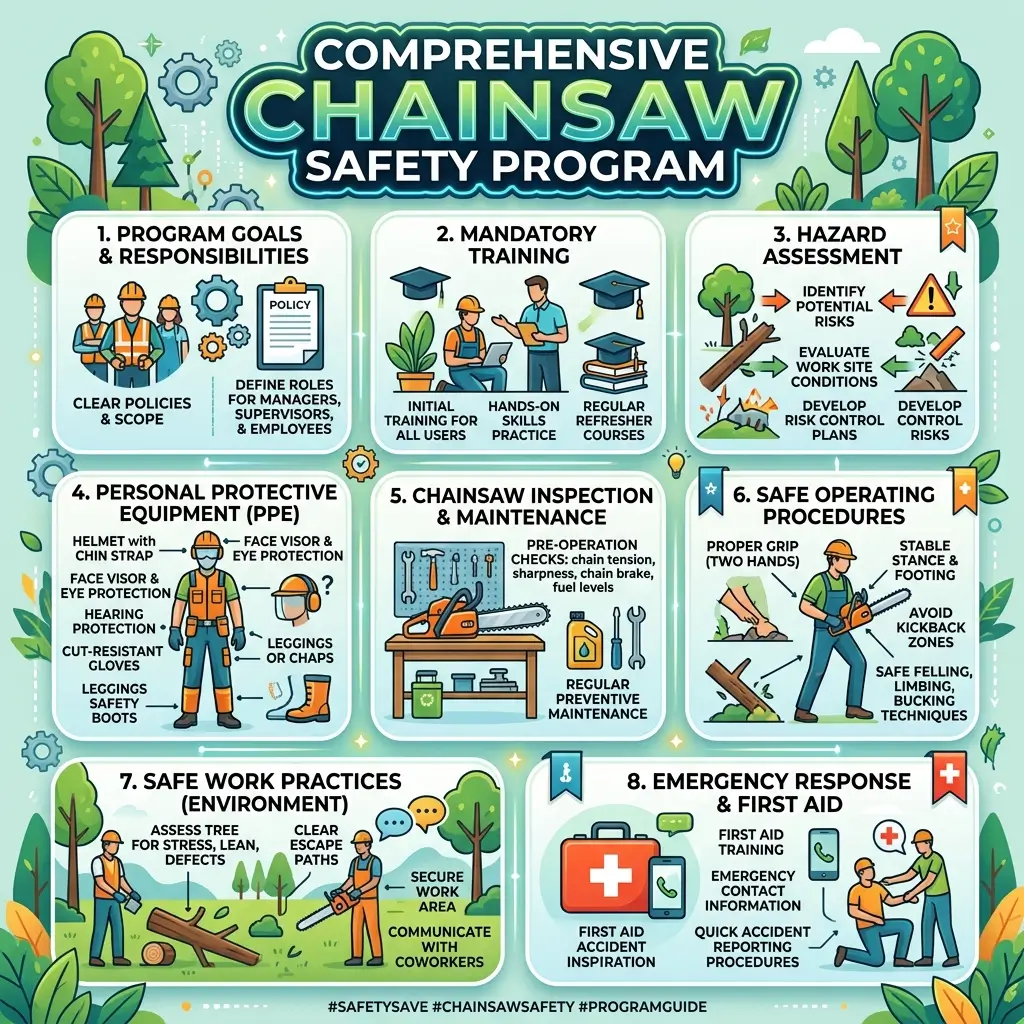
The elements below form a defensible chainsaw safety program:
| Program element | What it delivers |
|---|---|
| Task-based risk assessment | Identifies the specific hazards of each cutting job before work starts |
| Verified competence records | Proof each operator is trained and authorised for the task they’re doing |
| PPE issue and inspection | Ensures certified, in-date protection is worn, not stored in the truck |
| Saw maintenance regime | Keeps chain brakes, catchers, and cutting attachments functioning |
| Emergency and first-aid plan | Never working alone; trained first aid and rapid access to help |
| Toolbox talks and near-miss review | Reinforces practice and captures the warnings before the injury |
Two elements carry disproportionate weight. Never working alone is a hard rule, not a preference — a serious chainsaw wound can cause life-threatening blood loss in minutes, and a lone operator has no one to render aid or call for help. Maintenance is the other: a neglected chain brake or a bypassed chain catcher quietly removes the very features that make kickback survivable.
The program also needs a currency date. Regulatory content here reflects general HSE professional understanding of US and UK requirements as of 2025, and standards such as ANSI Z133 and the ASTM leg-protection specification are revised on cycles — so a program should be reviewed against the current editions rather than assumed to hold indefinitely.
Frequently Asked Questions
The Lesson Worth Carrying
The field keeps relearning the same thing: chainsaw injuries are rarely caused by a lack of information and almost always by a shortcut. The HSE’s own investigations point to operators skipping good practice, not to gaps in the guidance — the knowledge to prevent most incidents already exists.
If there’s a single highest-impact change, it’s treating PPE, competence, and technique as one system rather than three optional boxes. The operator who wears certified chaps but has never been trained to read a leaning tree is exposed; so is the skilled feller who left the chaps in the truck for “just one cut.” Neither gap shows up until the moment it matters.
Respect for the tip of the bar, honesty about the limits of your competence, and the discipline to run the same checks on the smallest job as the largest — that is what chainsaw safety comes down to. The saw will never give you back the half-second you didn’t plan for.