
TL;DR
- 3 mg/m³ hardwood, 5 mg/m³ softwood — the UK workplace exposure limits over an 8-hour average; for mixtures, the hardwood 3 mg/m³ limit applies to all wood dust present (HSE, EH40/2005).
- 2 mg/m³ — the EU binding limit for hardwood dust since 17 January 2023, stricter than the UK figure (Directive 2017/2398, EU-OSHA).
- Group 1 carcinogen — wood dust is classified as carcinogenic to humans, linked to cancer of the nasal cavity and sinuses (IARC Monograph, 1995; reaffirmed 2012).
- 78% failing — of more than 1,000 woodworking sites HSE inspected in 2022/23, over three-quarters were not adequately protecting workers, producing 402 enforcement actions (HSE, 2023).
What Counts as Dangerous Wood Dust Exposure
Wood dust exposure causes occupational asthma, dermatitis and — for hardwoods — cancer of the nasal cavity and sinuses. UK employers must keep exposure below the workplace exposure limit and as low as reasonably practicable, primarily through local exhaust ventilation (LEV) captured at source, examined at least every 14 months, and supported by health surveillance.
The wood dust that threatens health is the fraction you cannot see. Coarse chippings drop to the floor, but the fine inhalable particles thrown off by sanding, sawing and routing stay airborne and settle invisibly on ledges, beams and light fittings. HSE is blunt on this: settled dust holds the fine particles most likely to reach deep into the lungs.
Disturb that settled layer with a broom or an air line and it becomes breathable again. This article covers what wood dust exposure does to the body, what the exposure limits demand across jurisdictions, and what a compliant LEV system actually looks like — because the gap between “we have extraction” and “our extraction controls the dust” is where most enforcement action lands.
How Wood Dust Harms the Respiratory System and Skin
Wood dust is not chemically simple. Alongside cellulose and lignin, it carries resin acids, moulds, endotoxins and species-specific compounds, and the health effect depends on which of these reach the airways or skin.
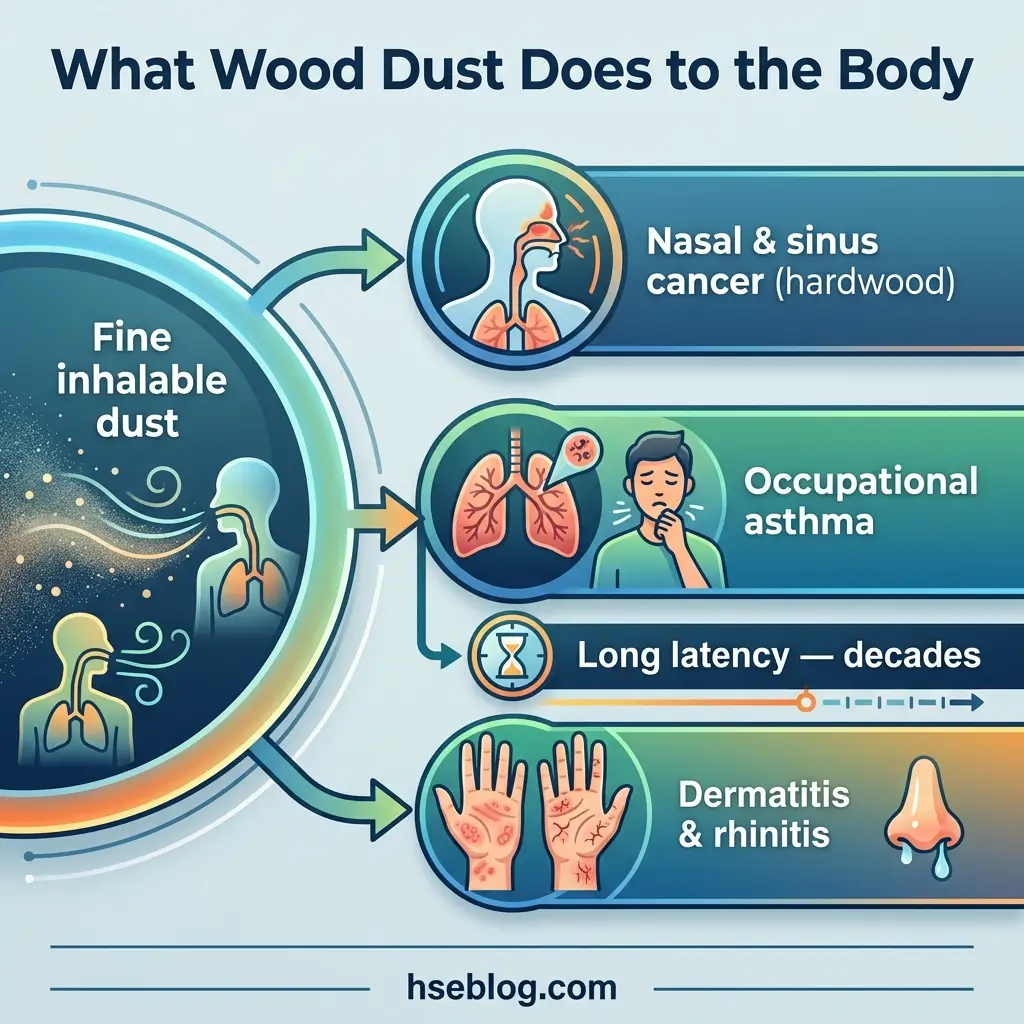
The damage falls into three broad categories:
- Respiratory disease — asthma, rhinitis, chronic bronchitis and reduced lung function from repeated inhalation of the inhalable fraction.
- Cancer — adenocarcinoma of the nasal cavity and paranasal sinuses, most strongly associated with hardwood dust.
- Skin and eye effects — irritant dermatitis, conjunctivitis and allergic reactions from contact with sap compounds and fine particles.
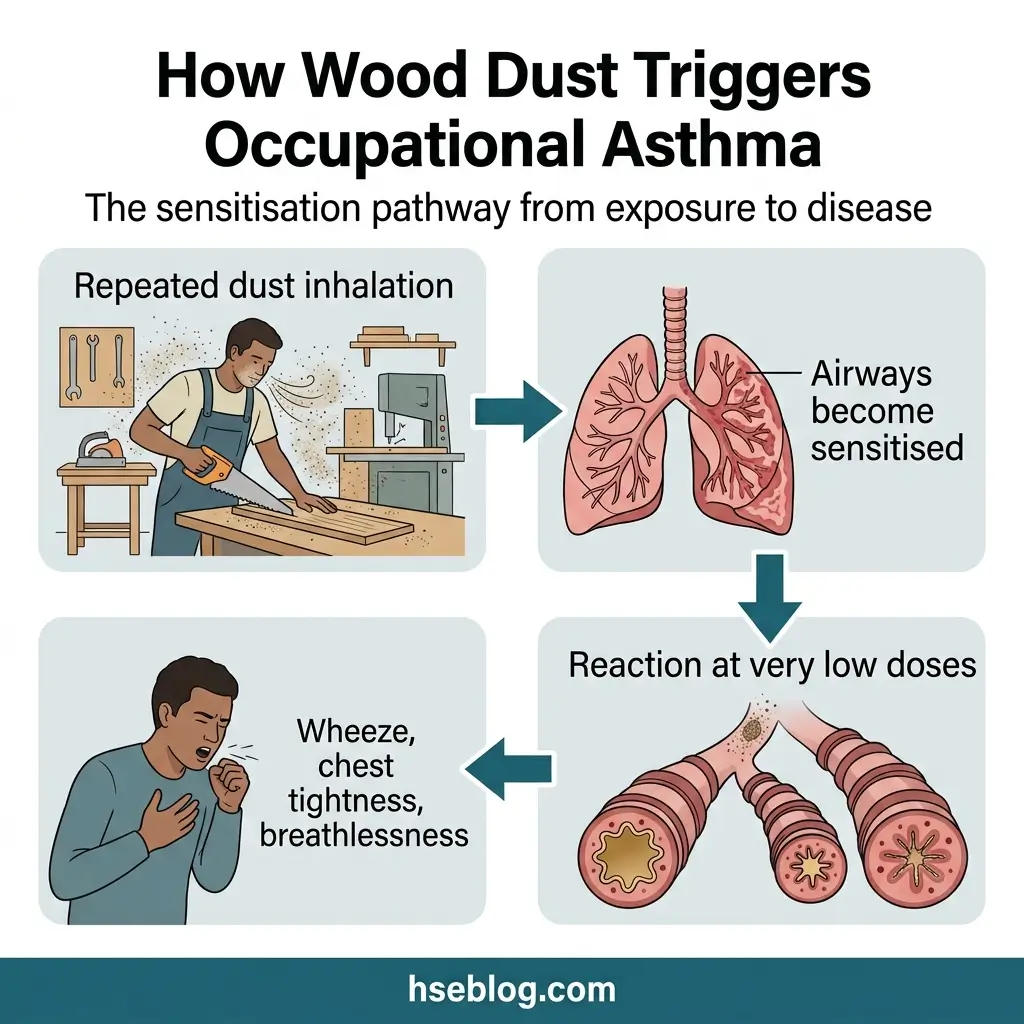
A point that gets missed on the shop floor: sensitisation is a one-way door. Once a worker’s airways or skin become sensitised to wood dust, severe reactions can be triggered by concentrations far below the level that first caused the problem. That is why “keeping it a bit dusty is fine for the old hands” is a dangerous belief — length of service offers no protection, and often the opposite.
The medical reality also runs on a long clock. Sinonasal cancer typically develops decades after exposure begins, so a clean-looking workforce today tells you nothing about exposures that were tolerated ten or twenty years ago.
Content covering health effects, exposure and surveillance here is for HSE practitioner reference. It is not medical advice. Workers with respiratory symptoms or exposure concerns should consult an occupational physician or qualified medical professional.
The Cancer Risk: Hardwood Dust and Sinonasal Disease
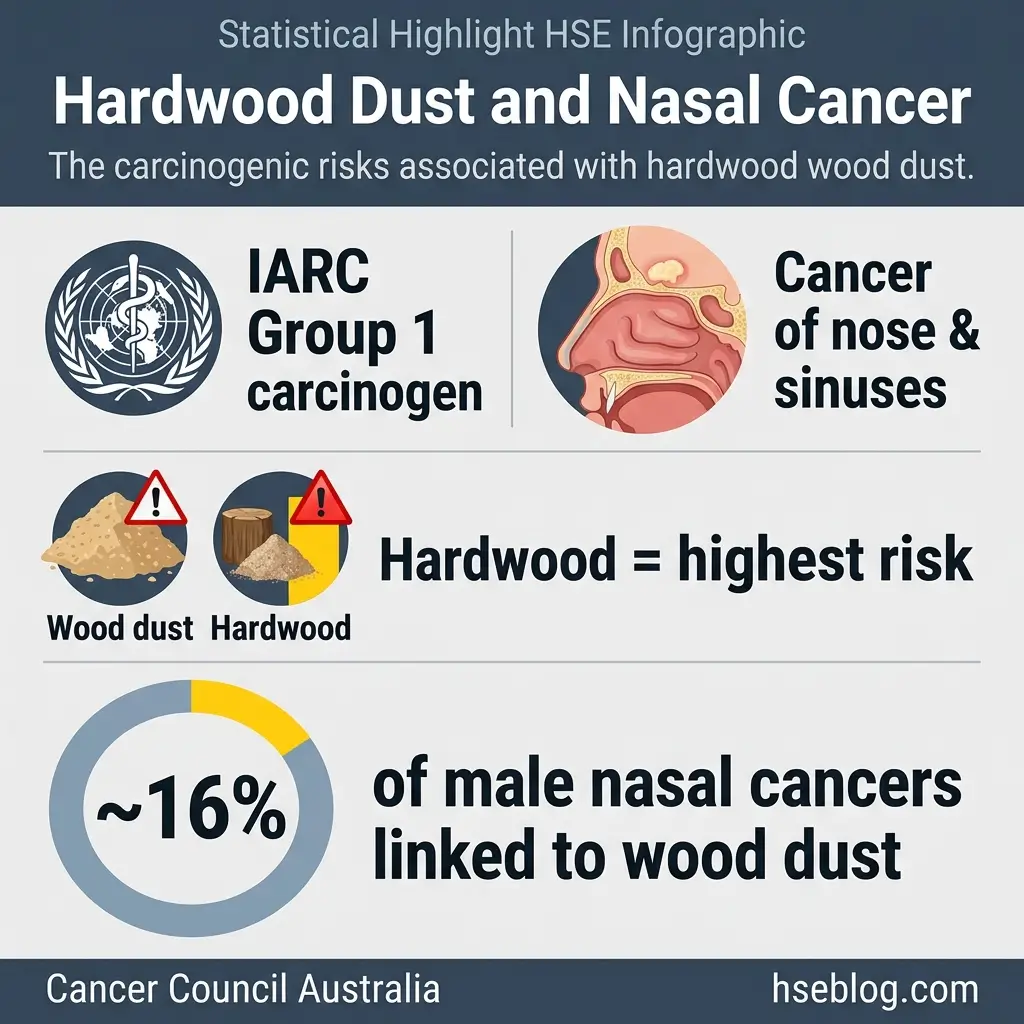
The carcinogenic evidence is settled at the highest level. The International Agency for Research on Cancer classifies wood dust as a Group 1 carcinogen — carcinogenic to humans — based on sufficient evidence in people, with the clearest link to cancer of the nasal cavity and paranasal sinuses (IARC Monograph, 1995).
The risk is not uniform across timber types.
- Hardwoods (oak, beech, walnut, mahogany, birch, ash) carry the strongest association, particularly with a rare tumour type, adenocarcinoma.
- Softwoods show a smaller excess risk, more often linked to squamous cell carcinoma.
- Composite boards such as MDF and chipboard are treated as hardwood for control purposes, because their composition usually cannot be assumed to be softwood.
The mechanism is chronic insult. Fine hardwood particles deposit in the nose and sinuses, where they impair the mucociliary clearance that should sweep them out. Persistent inflammation and cellular change over many years can end in malignancy — a rare cancer in the general population, but one for which occupational wood dust is a leading cause. By one estimate, around 16% of nasal and sinus cancers in men are attributable to wood dust exposure (Cancer Council Australia).
MDF adds a second carcinogen to the same breath. The dust carries wood particles and formaldehyde-based resin residue, and formaldehyde is itself an IARC Group 1 carcinogen. The combined load is the reason MDF exposure deserves control to the most stringent practicable level, not merely to the headline limit. The detail of the IARC evaluation is set out in the IARC monograph on wood dust and formaldehyde.
Occupational Asthma and Respiratory Sensitisation
Asthma is the more immediate hazard, and the numbers make the occupational link plain. HSE reports that carpenters and joiners are around four times more likely to develop asthma than other UK workers.
Occupational asthma from wood dust works through sensitisation. The immune system reacts to the dust — or to a specific agent within a particular timber — and after that point, exposure provokes airway inflammation, wheeze, chest tightness and shortness of breath. The condition can force a skilled worker out of the trade entirely.
Western red cedar deserves separate mention as a hazard that breaks the usual hardwood/softwood logic:
- It is technically a softwood, yet it is a potent respiratory sensitiser.
- Its plicatic acid content can trigger asthma at concentrations well below the hardwood limit.
- ACGIH recommends a threshold limit value of 0.5 mg/m³ for western red cedar specifically because of its asthma effects.
The practical lesson is that a single blanket limit does not capture species-specific risk. A workshop switching a production line to cedar cannot assume the controls that held softwood exposure in check will still be adequate. That is a judgment call best made before the timber arrives, not after the first symptoms appear.
Wood Dust Exposure Limits: What the Numbers Require
Legal limits for wood dust exposure differ sharply by jurisdiction, and the differences matter for any operation that trades or benchmarks internationally. The UK sets its workplace exposure limits (WELs) in EH40/2005 under COSHH; the figures are 8-hour time-weighted averages for the inhalable fraction.
| Jurisdiction | Hardwood dust | Softwood dust | Basis (8-hr TWA) |
|---|---|---|---|
| EU (binding OEL) | 2 mg/m³ | Set nationally | Directive 2017/2398, since Jan 2023 |
| UK (WEL) | 3 mg/m³ | 5 mg/m³ | EH40/2005, COSHH 2002 |
| US (OSHA PNOR) | 15 mg/m³ total / 5 mg/m³ respirable | Same | 29 CFR 1910.1000 |
Two things stand out. The EU binding limit of 2 mg/m³ for hardwood dust — in force since 17 January 2023 and stricter than the UK’s 3 mg/m³ — is the more protective figure and the direction of travel across Europe (Directive 2017/2398). The US position sits at the opposite end: OSHA regulates wood dust as a particulate not otherwise regulated at 15 mg/m³, a nuisance-dust limit applied to a substance the WHO calls a Group 1 carcinogen. The full text of the EU limit sits in Directive (EU) 2017/2398.
Where limits differ, treat the stricter as your working target. And treat none of them as a “safe” level.
- For a Group 1 carcinogen, no exposure threshold is known to be safe.
- UK COSHH requires exposure to carcinogens and asthmagens to be reduced to as low as reasonably practicable (ALARP), not merely below the WEL.
- The common error is managing to the limit as if it were a target. The limit is a ceiling you should be operating well beneath.
Regulatory content here reflects general HSE professional understanding of UK and EU requirements as of 2026. It is not legal advice. Specific compliance or enforcement questions should be directed to qualified legal counsel in the applicable jurisdiction.

LEV Requirements: Extraction That Actually Controls the Dust
Local exhaust ventilation is the primary engineering control for wood dust, and it is where inspectors find most failures. HSE’s 2022/23 inspection programme identified LEV and respiratory protection as the two biggest problem areas across woodworking sites (HSE, 2023). Having a system is not the same as controlling exposure with it.
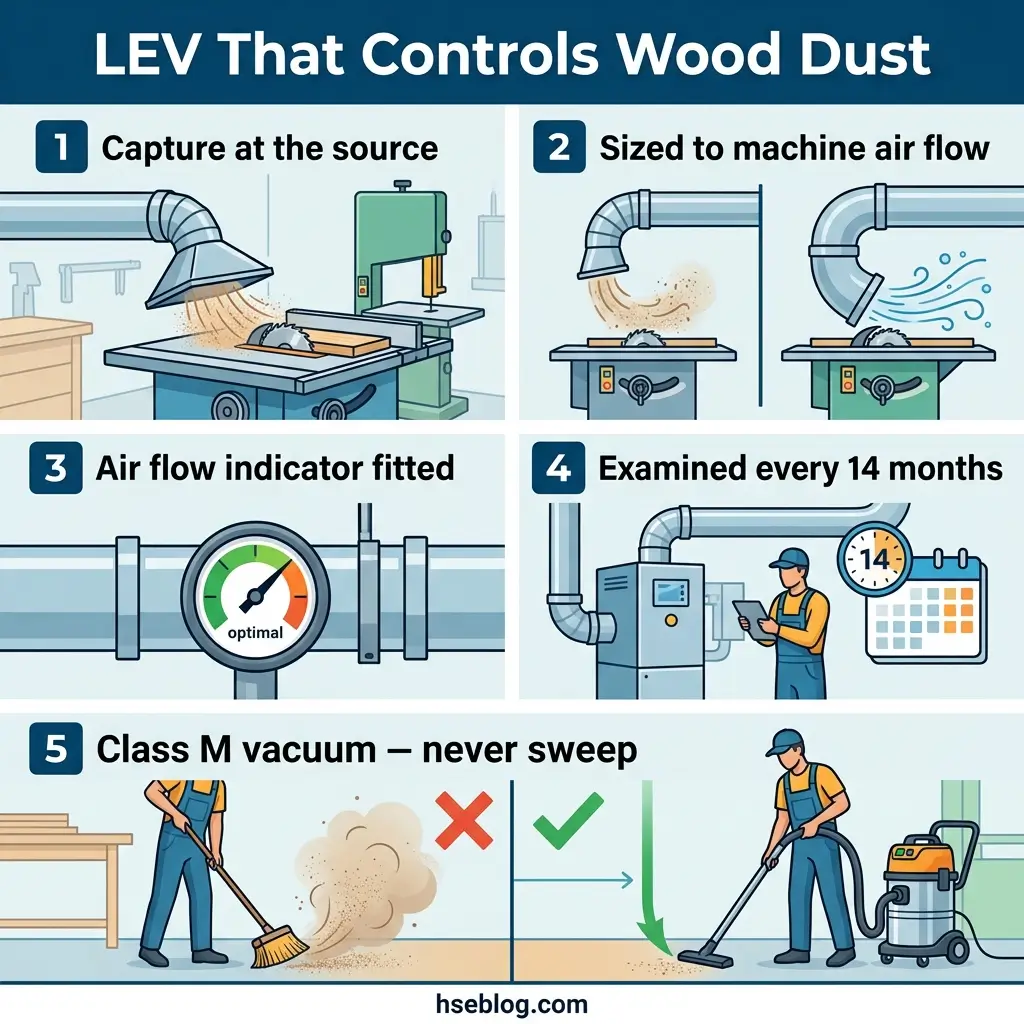
A compliant, effective LEV setup meets these requirements:
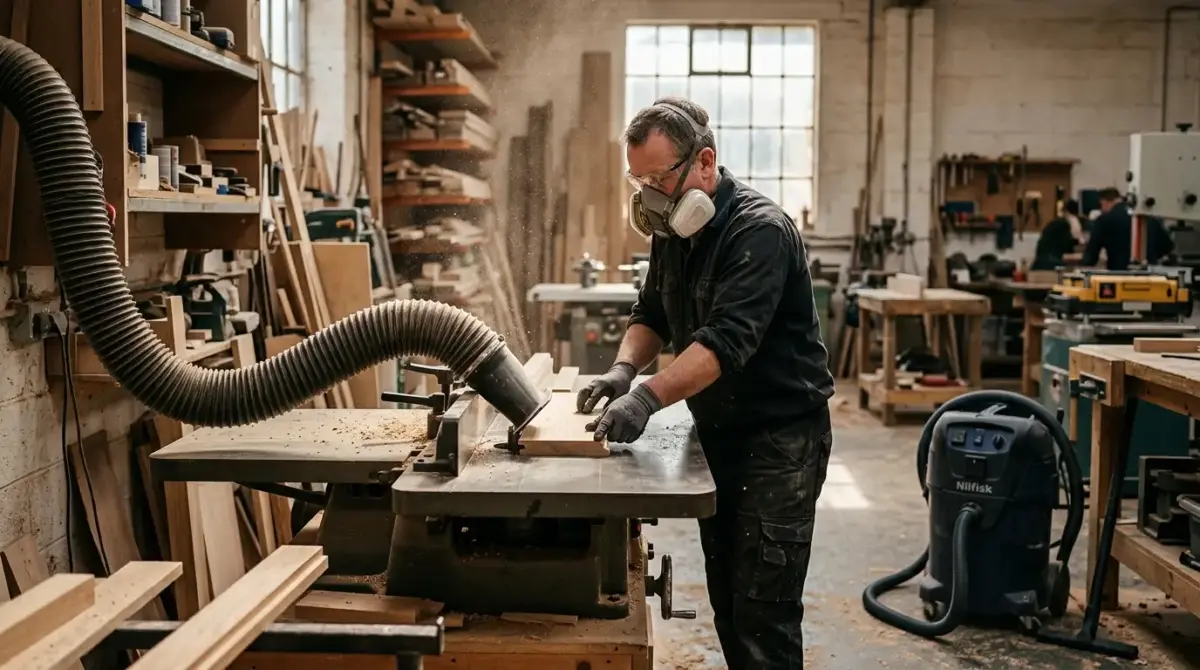
- Capture at source. The extraction hood sits as close as possible to where dust is generated — on the machine, not across the room — so dust is drawn away before it enters the breathing zone.
- Designed to the right air flow. The system is sized to the machines connected, using the manufacturer’s volume flow rates and extraction cross-sections, with adequate transport velocity so dust does not settle inside the ductwork.
- Visible performance feedback. Air flow indicators show operators whether the system is pulling correctly; a dust lamp (Tyndall beam) reveals escaping fine dust the naked eye misses.
- Thorough examination and test every 14 months. COSHH Regulation 9 makes it a legal requirement to have LEV examined and tested by a competent person at least once every 14 months, with the results recorded in a logbook.
- Correct cleaning. Never dry-sweep or use compressed air lines, which re-aerosolise settled dust; clean up with an industrial vacuum rated at least Class M.
- RPE as a supplement, not the control. For heavy tasks such as sanding, tight-fitting respiratory protection is worn in addition to extraction — face-fit tested, worn clean-shaven, with the right filter.
The recurring failure pattern is worth naming, because it is so consistent across the enforcement record: extraction that was specified years ago for a different machine layout, dampers left shut, no examination within the 14-month window, and reliance on a dust mask to paper over a failing hood. HSE’s own research found that even at sites selected for good practice, 17.6% of hardwood and mixed-dust measurements still exceeded the 3 mg/m³ limit (HSE, published in Annals of Work Exposures and Health, 2024). If the good performers slip that often, an unmanaged workshop has no realistic chance of compliance. HSE’s practical expectations are set out in its wood dust guidance.
The order of priority is the part people invert. Substitution and process change come first, LEV carries the main load, housekeeping keeps it that way, and RPE fills the gap. Reaching for masks before fixing the extraction is the mistake that turns up in prosecution after prosecution.
Health Surveillance and Exposure Monitoring Obligations
Engineering controls tell you what should be happening; monitoring and surveillance tell you what actually is. UK employers working with wood dust owe both, and the two answer different questions.
Exposure monitoring — is the air within the limit?
Personal air sampling measures what individual workers actually breathe during representative tasks. It is carried out by a competent person using the HSE inhalable-dust method (MDHS 14/4), on a day reflecting typical or worst-case production, and the results confirm whether controls are keeping exposure below the WEL and driving toward ALARP.
Health surveillance — is anyone being harmed?
Because wood dust causes asthma, early detection protects workers before damage becomes permanent. A suitable programme, run with occupational health input, should:
- Establish a baseline respiratory assessment before exposure, or as soon as possible after it starts.
- Repeat assessments at appropriate intervals, usually annually, and more often for new starters.
- Use a respiratory questionnaire plus spirometry, interpreted by an occupational health professional for individuals and for similarly exposed groups.
- Keep a health record for each worker and act on results — reviewing controls or reassigning workers where problems appear.
The point of surveillance is not the paperwork. A cluster of new wheeze on spirometry is a signal that a control has failed, and it should trigger a return to the risk assessment — not a fresh box of masks.
Frequently Asked Questions
Conclusion
The industry’s core mistake with wood dust exposure is treating the exposure limit as a finish line and the dust mask as the main defence. Both get the priority backwards. The limit is a ceiling to stay well beneath, and the mask is the last line, not the first — the control that carries the load is extraction captured at the source and kept in working order.
The single highest-impact change most workshops can make is unglamorous: get the LEV specified for the machines actually in use, examined within its 14-month window, and cleaned up with a vacuum instead of a broom. That, paired with health surveillance that someone genuinely reads, is what separates the sites HSE walks away from and the ones it fines. The dust you cannot see is the point — and with a carcinogen whose harm surfaces decades later, the time to control it is now, not when the first spirometry result turns.