
TL;DR
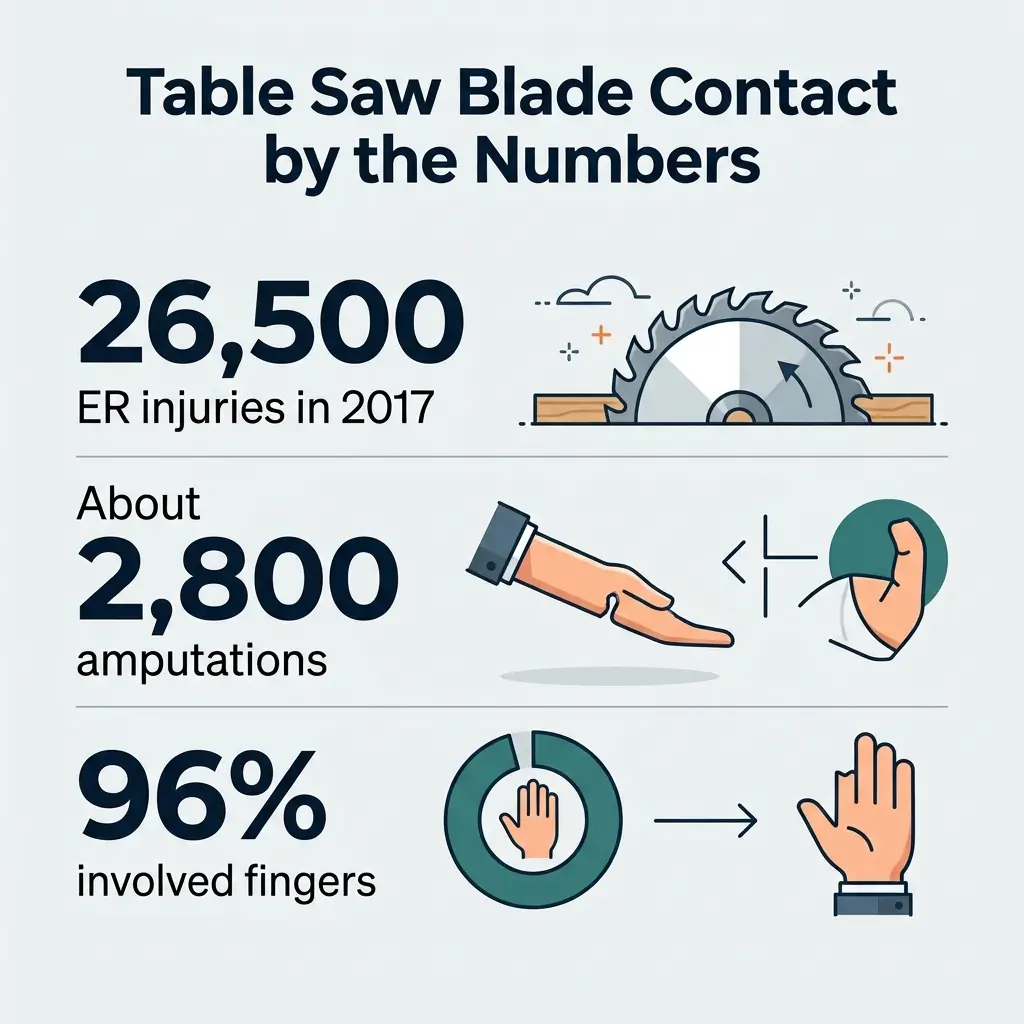
- Around 2,800 amputations a year come from table-saw blade contact in the US alone, out of roughly 26,500 emergency-room injuries in 2017 there were an estimated 26,500 table saw blade-contact injuries treated in emergency departments, including about 2,800 amputations (US CPSC, 2023). Federal Register
- A blade guard was fitted in only about 31% of studied table-saw injuries — guards come off and stay off a blade guard was attached to the saw prior to or at the time of injury in 30.9 percent of the cases (US CPSC survey, 2007–2008). CPSC
- Stock kicked back in about 36% of those same injuries, making ejection as common a mechanism as simple contact the stock kicked back or jumped in 35.6 percent of the cases (US CPSC survey, 2007–2008). CPSC
- Wood dust is an IARC Group 1 carcinogen, tied to nasal and sinus cancer — the machine hazard that surfaces decades later the International Agency for Research on Cancer classifies wood dust as a Group 1 carcinogen, confirmed to cause cancer in humans (WHO/IARC). Envigilance
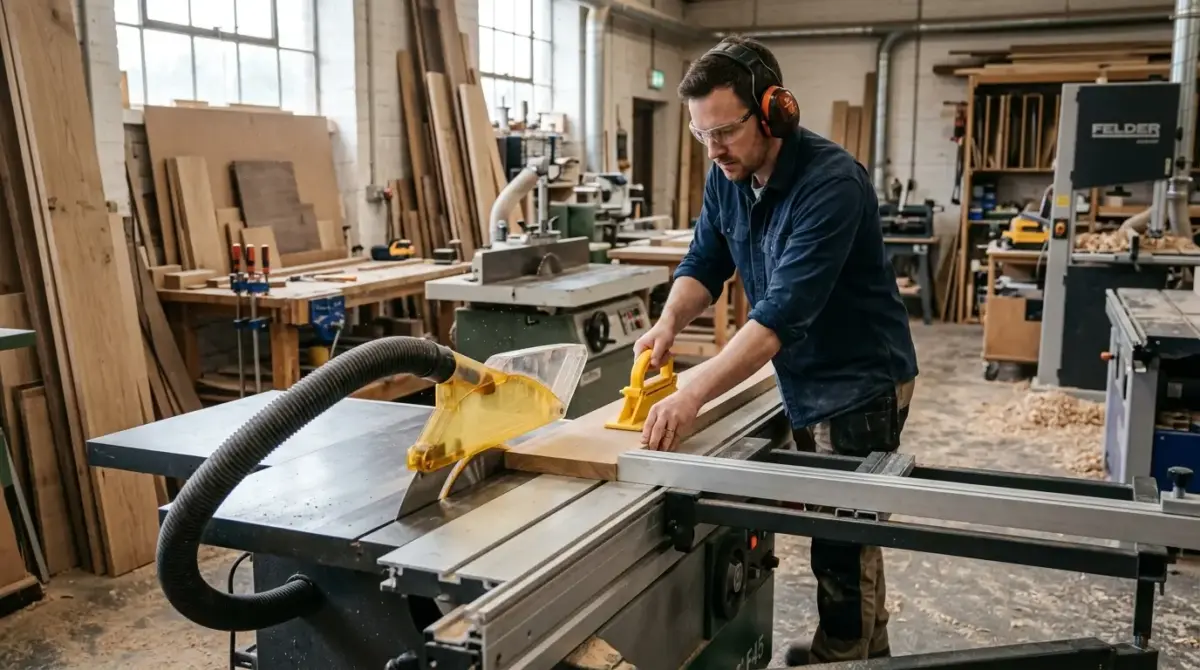
Woodworking machinery safety rests on controlling four mechanical hazards — point-of-operation contact, kickback, entanglement, and flying debris — alongside wood dust and noise. The core controls are fixed guards, riving knives and anti-kickback devices, push sticks, local exhaust ventilation, and trained operators working to OSHA, PUWER, or EN ISO 19085 requirements.
In 2017, table saws alone sent an estimated 26,500 people in the United States to emergency rooms with blade-contact injuries, and about 2,800 of those wounds were amputations (US CPSC, 2023). Fingers accounted for the overwhelming majority — a permanent price for a fraction of a second against a spinning blade.
Woodworking machines concentrate enormous cutting energy a few centimetres from an operator’s hands, and they do it hundreds of times a shift. This guide walks through the machinery hazards behind those injuries and the controls that hold them back — how each hazard works, what the guarding rules in the US, UK, and EU actually demand, and where dust and noise fit into the picture.
The Four Ways Woodworking Machines Cause Harm
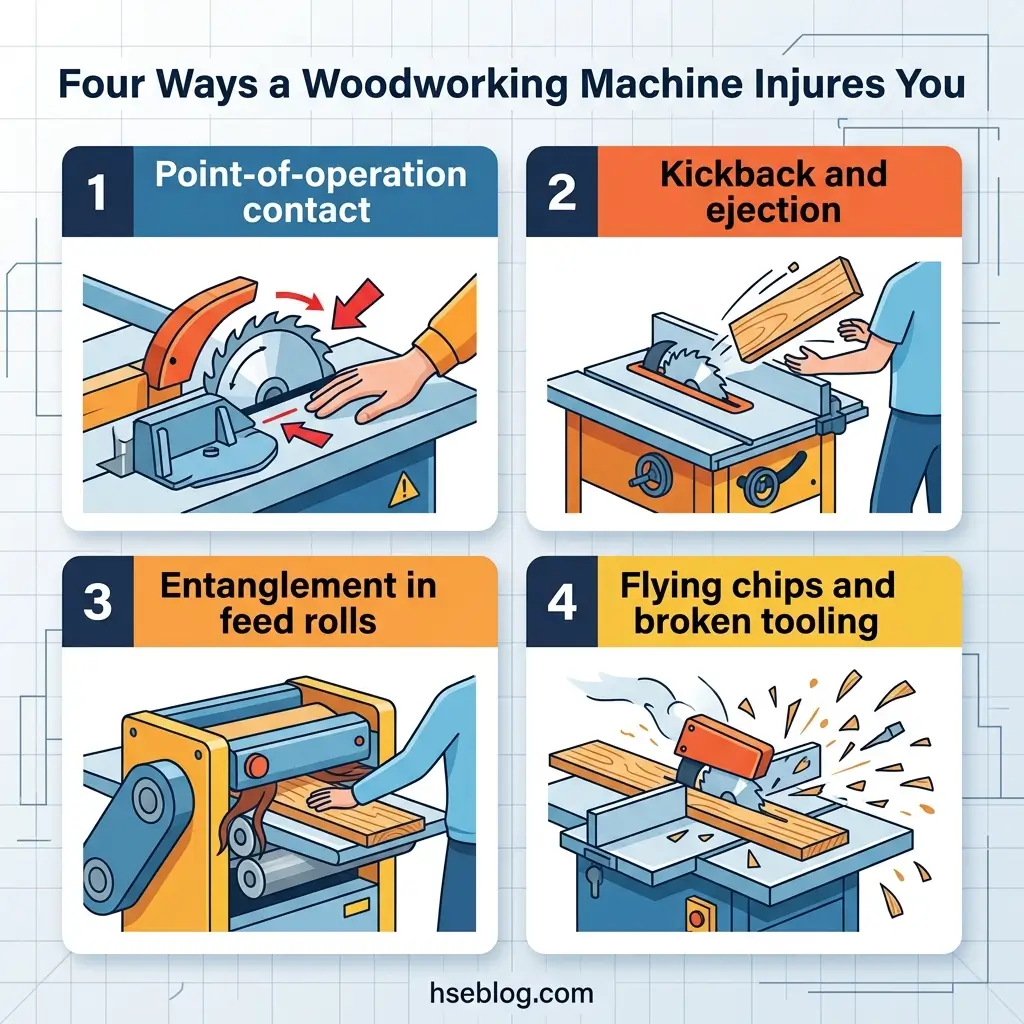
The published injury record for woodworking machines keeps returning to the same short list of mechanisms. Almost every serious machine injury traces to one of four physical events, and naming them makes the right control obvious.
| Hazard | How it happens | Where it shows up |
|---|---|---|
| Point-of-operation contact | A hand reaches the blade or cutter at the cut | Table saw, planer, spindle moulder, band saw |
| Kickback / ejection | Stock binds and is thrown back at speed | Table saw, spindle moulder |
| Entanglement / in-running nip | Clothing, gloves, or hair pulled into feed rolls or cutters | Planer-moulder feed rolls, turning lathes |
| Flying debris | Chips, knots, or broken tooling ejected from the cut | Any cutting machine |
Behind these mechanical hazards sit two slower ones — wood dust and noise — which cause harm over years rather than in an instant. Both are covered further down.
This article provides general HSE knowledge. High-consequence machine work — setting up, adjusting, or running cutting machines that can amputate — must be planned and supervised by a competent person with relevant training, jurisdiction-specific authorization, and a site-specific risk assessment. The information here does not replace that.
Point-of-Operation Contact: The Amputation Risk
Most life-changing woodworking injuries come down to a single event: a hand reaches the blade. Small workpieces force the hand close to the tool, and a slip or a piece that suddenly grabs does the rest.
OSHA’s woodworking eTool on point-of-operation hazards is blunt about the mechanism — stock can jam in a blade and pull the operator’s hands straight in. The controls all work by keeping flesh and tooling apart:
- Fixed and adjustable guards. Cover the cutting tool so a hand cannot reach it during normal operation; under US rules a hand-fed ripsaw needs a hood over the blade plus a spreader and anti-kickback fingers (OSHA 29 CFR 1910.213, US).
- Push sticks and push blocks. Move the last few centimetres of stock past the blade with a tool, not fingers — the single cheapest amputation control there is.
- Featherboards and hold-downs. Keep stock pinned to the table and fence so it cannot lift or wander into the operator’s grip.
- Active injury mitigation (AIM). Flesh-sensing saws drop a spinning blade in milliseconds on skin contact, turning an amputation into a scratch.
- No gloves near rotating tooling. A glove that catches drags the hand in; woodworking guidance treats gloves near running machines as a hazard, not protection.
That last point on AIM comes with a regulatory footnote worth knowing. In August 2025 the US Consumer Product Safety Commission withdrew its proposed rule that would have required flesh-sensing technology on new consumer table saws, so no federal mandate exists as of 2026 — and the agency’s remit never covered industrial saws anyway the U.S. Consumer Product Safety Commission dropped a proposed rule addressing blade-contact injuries on table saws (US CPSC, 2025). Workplace machines stay under OSHA guarding rules regardless; the CPSC’s rulemaking record had estimated the withdrawn rule could have prevented or reduced roughly 49,000 injuries a year. Woodworking Network
Kickback: How Stock Becomes a Projectile
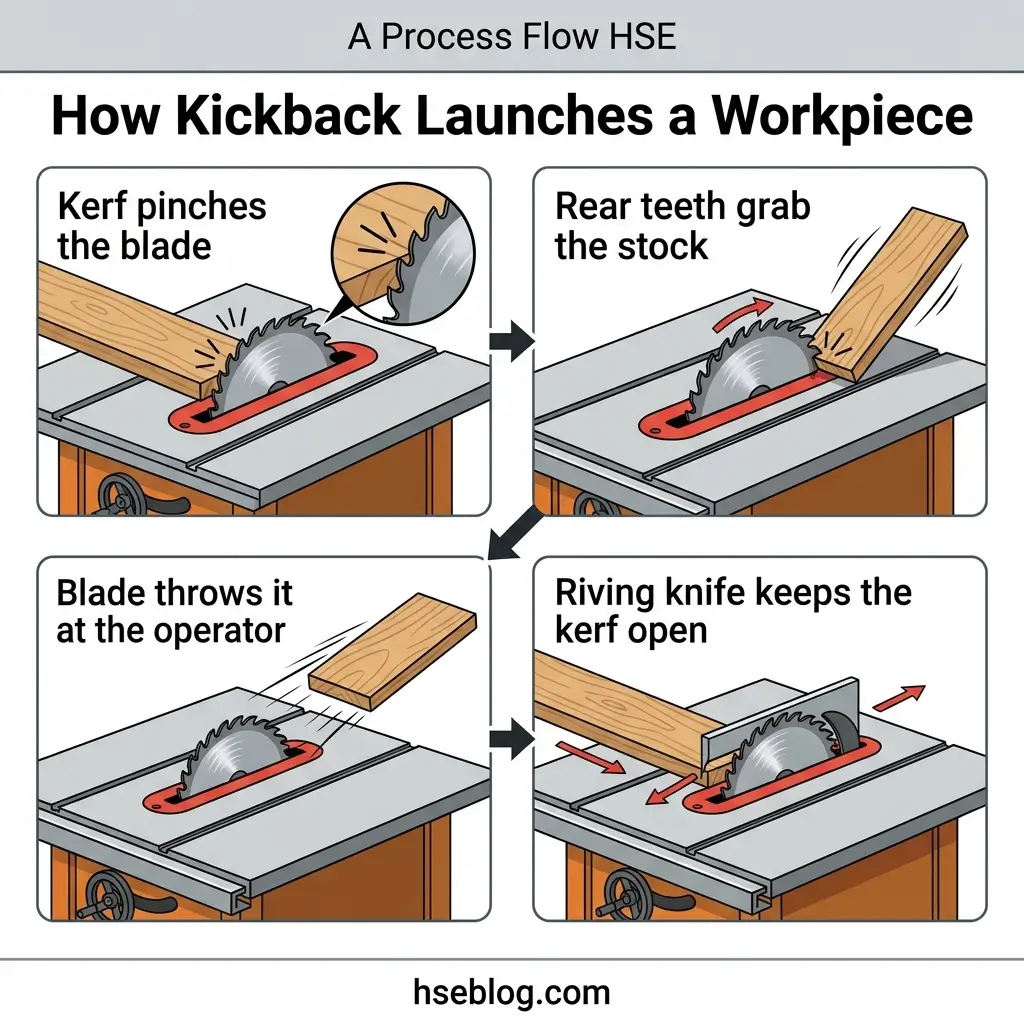
Kickback catches experienced operators as often as beginners, because it happens faster than a person can react. It follows a predictable sequence:
- The workpiece pinches the blade. Wood closes on the saw kerf, twists against the fence, or lifts off the table.
- The rising rear teeth grab the trapped stock. At the back of the blade the teeth are climbing, so they bite upward and backward.
- The blade hurls it toward the operator. Ejected stock can leave the machine faster than the blade’s own rim speed, striking the abdomen or dragging the hand across the blade.
The controls attack each step. A riving knife or spreader holds the kerf open so it cannot close on the blade. Anti-kickback pawls dig into stock that starts moving the wrong way. Correct fence alignment stops the workpiece binding, and a disciplined stance — standing out of the direct line behind the blade — means a piece that does launch misses the person. Given that stock kicked back in more than a third of studied table-saw injuries (US CPSC survey, 2007–2008), a well-set riving knife earns its keep on every rip cut.
What Machine Guarding Rules Require Across Jurisdictions
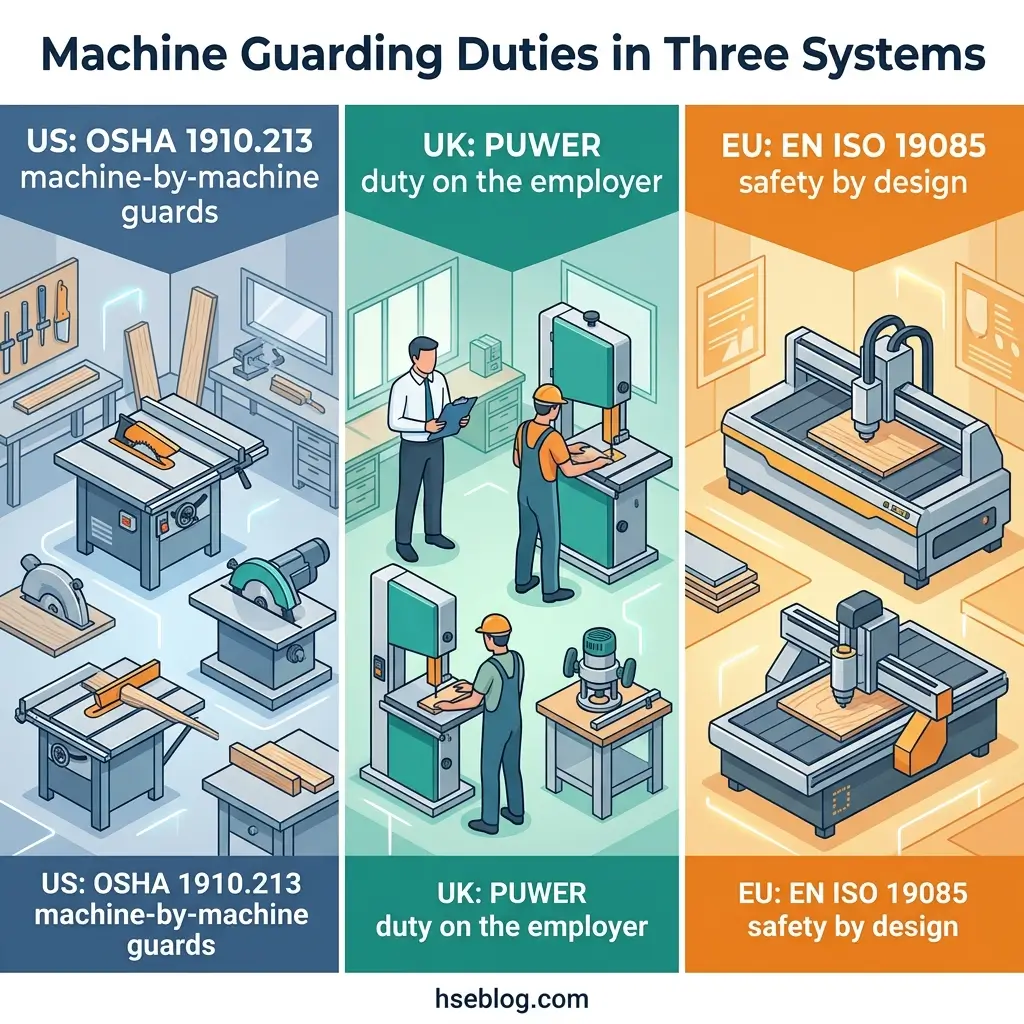
Three regulatory systems govern woodworking machine guarding, and they reach the same goal by different routes. One prescribes guards machine by machine, one places a duty on the employer to make equipment safe, and one builds safety into the machine before it is ever sold.
| Jurisdiction | Primary instrument | Core guarding duty |
|---|---|---|
| United States | OSHA 29 CFR 1910.213 | Specific guards by machine type; hand-fed ripsaws require a hood guard, spreader, and anti-kickback fingers |
| United Kingdom | PUWER 1998 + ACOP L114 | Suitable guarding, effective braking, and trained, competent operators, risk-assessed per machine |
| EU / International | EN ISO 19085 series | Safeguards, interlocks, and braking designed into the machine at manufacture |
The UK route has a sharp edge worth noting. The HSE’s Approved Code of Practice, Safe use of woodworking machinery (L114), carries special legal status — if an employer is prosecuted and did not follow it, they must show they met the law some other way. The international design standards keep moving too: ISO 19085-5, covering dimension saws, was updated in 2024 ISO 19085-5:2024 specifies the safety requirements and measures for dimension saws (ISO, 2024). Where two systems set different requirements, the more protective one is the safer baseline for any organisation operating across borders. ISO
Wood Dust and Noise: The Hazards You Don’t Feel Immediately
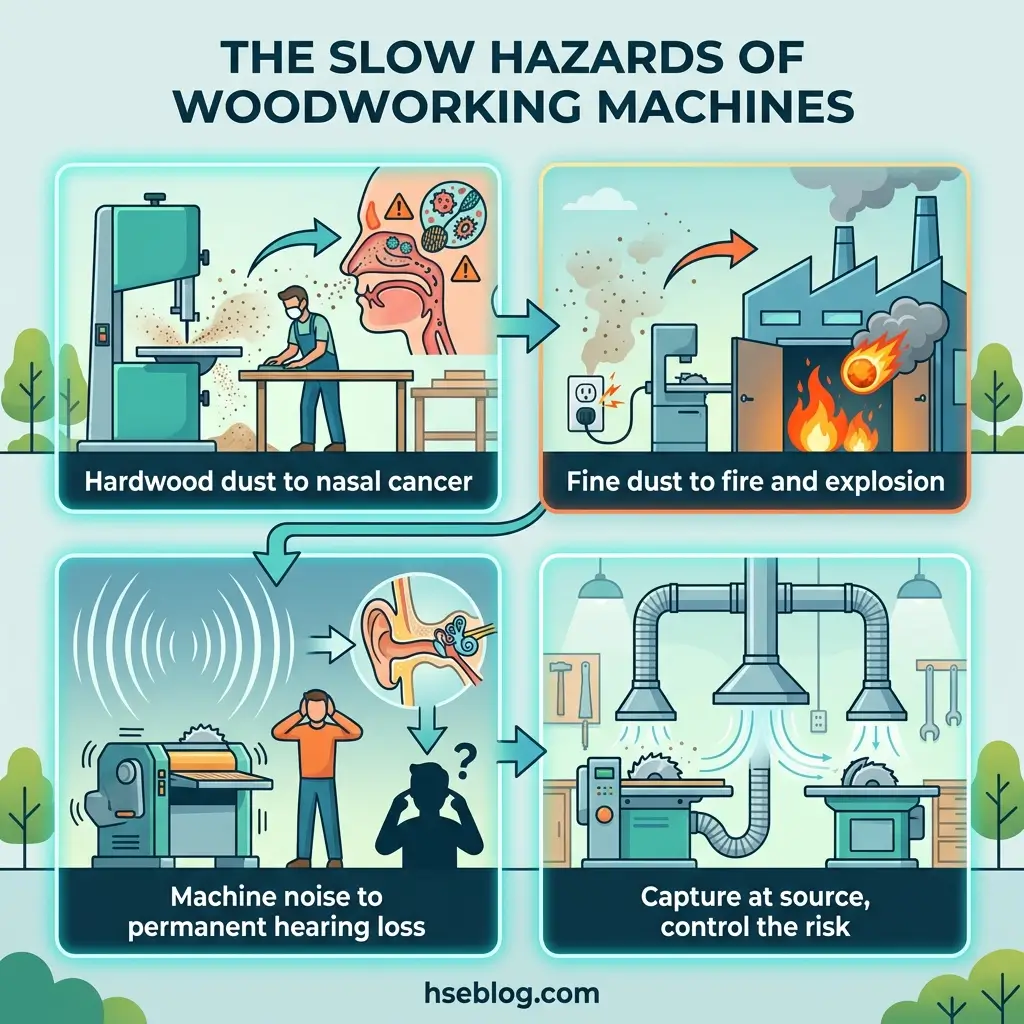
Two machine hazards do their damage slowly, which is exactly why they get neglected. Neither draws blood on the day of exposure, so the controls compete against the temptation to skip them.
Wood dust as a carcinogen
Wood dust is a confirmed human carcinogen, linked most strongly to adenocarcinoma of the nasal cavity and sinuses among long-exposed woodworkers (WHO/IARC). Hardwoods such as oak, beech, and walnut carry the clearest cancer signal, though the health risk is not limited to them.
The primary control is capture at source. Fit local exhaust ventilation (LEV) at each machine so dust never reaches the operator’s breathing zone, and read the HSE’s guidance on controlling wood dust for how to check it is working. In Great Britain, that LEV must be thoroughly examined by a competent person at least every 14 months under COSHH it is a legal requirement to have the extraction system examined by a competent person at least every 14 months (HSE). Never sweep or use compressed air, which throws settled dust back into the air. HSE
Exposure limits differ sharply by country. In the EU, the binding hardwood-dust limit dropped to 2 mg/m³ in 2023 under the Carcinogens and Mutagens Directive; the UK retains 3 mg/m³ for hardwood and 5 mg/m³ for softwood (HSE); and US OSHA still regulates most wood dust as a nuisance dust at 15 mg/m³ total OSHA’s permissible exposure limit for wood dust is 15 mg/m3 for total dust and 5 mg/m3 for the respirable fraction (OSHA). NIOSH and ACGIH both recommend 1 mg/m³ as the health-protective target, so the lowest figure — not the local legal ceiling — is the sound engineering goal. Envigilance
Content covering wood-dust exposure and health surveillance is for HSE practitioner reference. It is not medical advice. Workers with respiratory symptoms, persistent nasal problems, or exposure concerns should consult an occupational physician or qualified medical professional.
Wood dust as fire and explosion fuel
Fine wood dust is not just a health hazard — it burns and detonates. A dust cloud reaches its minimum explosible concentration for wood flour at around 60 g/m³, dense enough to resemble a thick fog the minimum explosible concentration for wood flour is 60g/m3 and a dust cloud at this concentration would resemble a very dense fog (HSE). Many woodworking fires start inside the extraction system itself, so ductwork should be designed to keep out ignition sources, and accumulated dust on beams, ledges, and motors must be removed before it can be lofted into a cloud. HSE
Noise
Planers, spindle moulders, and band resaws routinely push operators past safe noise levels, and the hearing loss they cause is permanent and painless as it develops. Controls run from quieter tooling and machine mounting through to enclosure and, last, hearing protection. Because noise-induced loss builds silently, exposure has to be assessed and managed rather than judged by ear.
Building a Machine Safety System That Holds
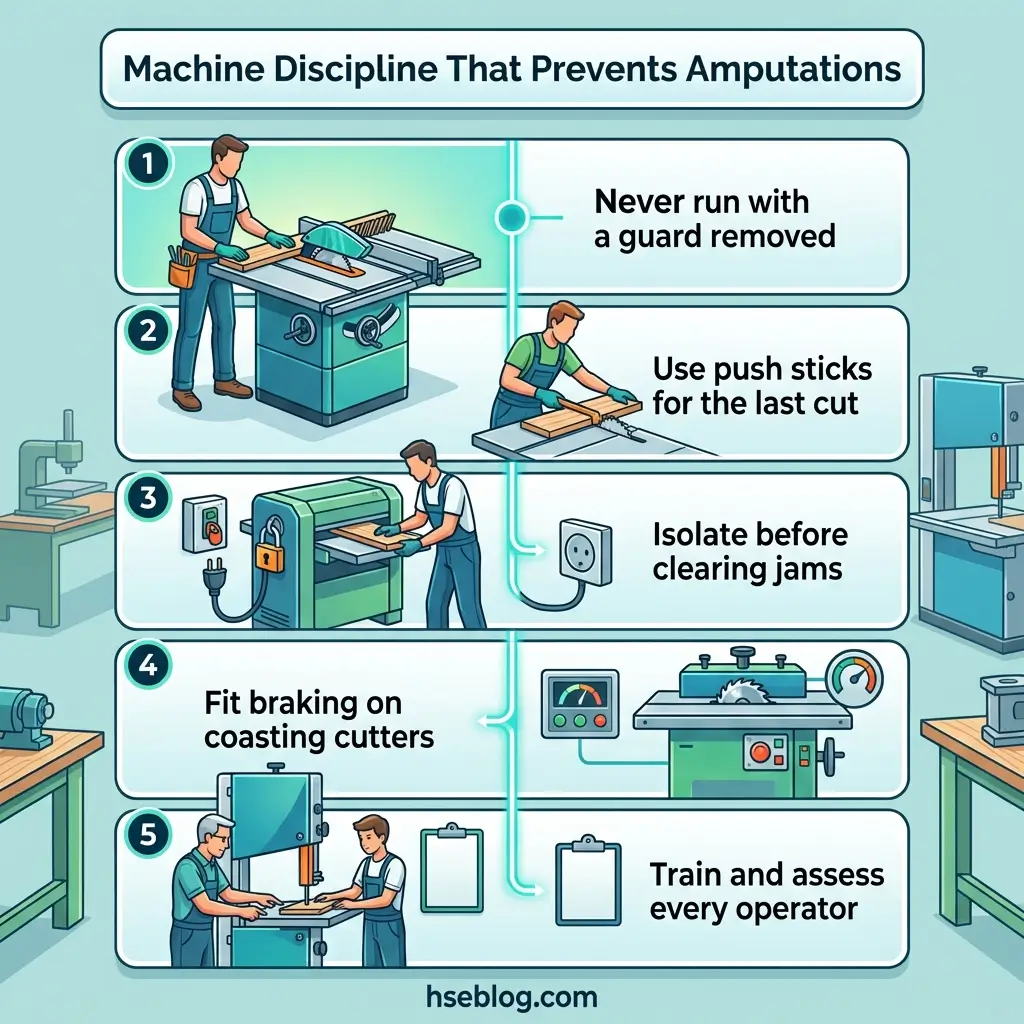
Where machine injuries stay low, the difference is rarely one clever device — it is discipline applied consistently to a handful of controls. A workable system runs on five habits:
- Guard discipline. No machine runs with a guard removed, bypassed, or “temporarily” propped aside. Given that guards were absent in most studied injuries, this single rule prevents more harm than any other.
- A safe operating procedure per machine. Each machine gets its own method — feed direction, push-tool use, and what the operator must never do — not a generic shop rule.
- Isolation for maintenance. Lock off and prove zero energy before clearing a jam, changing tooling, or reaching past a guard. Most cutter-contact-during-maintenance injuries trace to a machine that was still live.
- Effective braking. Cutters that coast for seconds after shut-off invite contact; braking that brings tooling to rest quickly closes that window.
- Competence, not just familiarity. Operators are trained and assessed against a recognised route — NEBOSH or IOSH courses, OSHA outreach training, the HSE’s ACOP guidance, or a regional equivalent — with evidence they can run the specific machine safely.
Frequently Asked Questions
The Habit That Actually Prevents These Injuries
The recurring lesson across the injury record is not exotic. Guards come off for a tricky cut and never go back, and hands travel near the tool because the setup left no other option. The highest-impact change in woodworking machinery safety is refusing to run a machine with its safeguards removed or bypassed, and arranging the work so fingers never need to approach the cutting tool in the first place.
No regulator is about to hand operators a safer machine by mandate — the US closed that route in 2025 — so the responsibility sits squarely with the people who set up and run the equipment. A push stick, a properly set riving knife, working extraction, and a trained operator cost almost nothing against the price of an amputation. A saw that has taken a finger was, in nearly every case, running exactly as designed, with the guard sitting somewhere on a shelf.