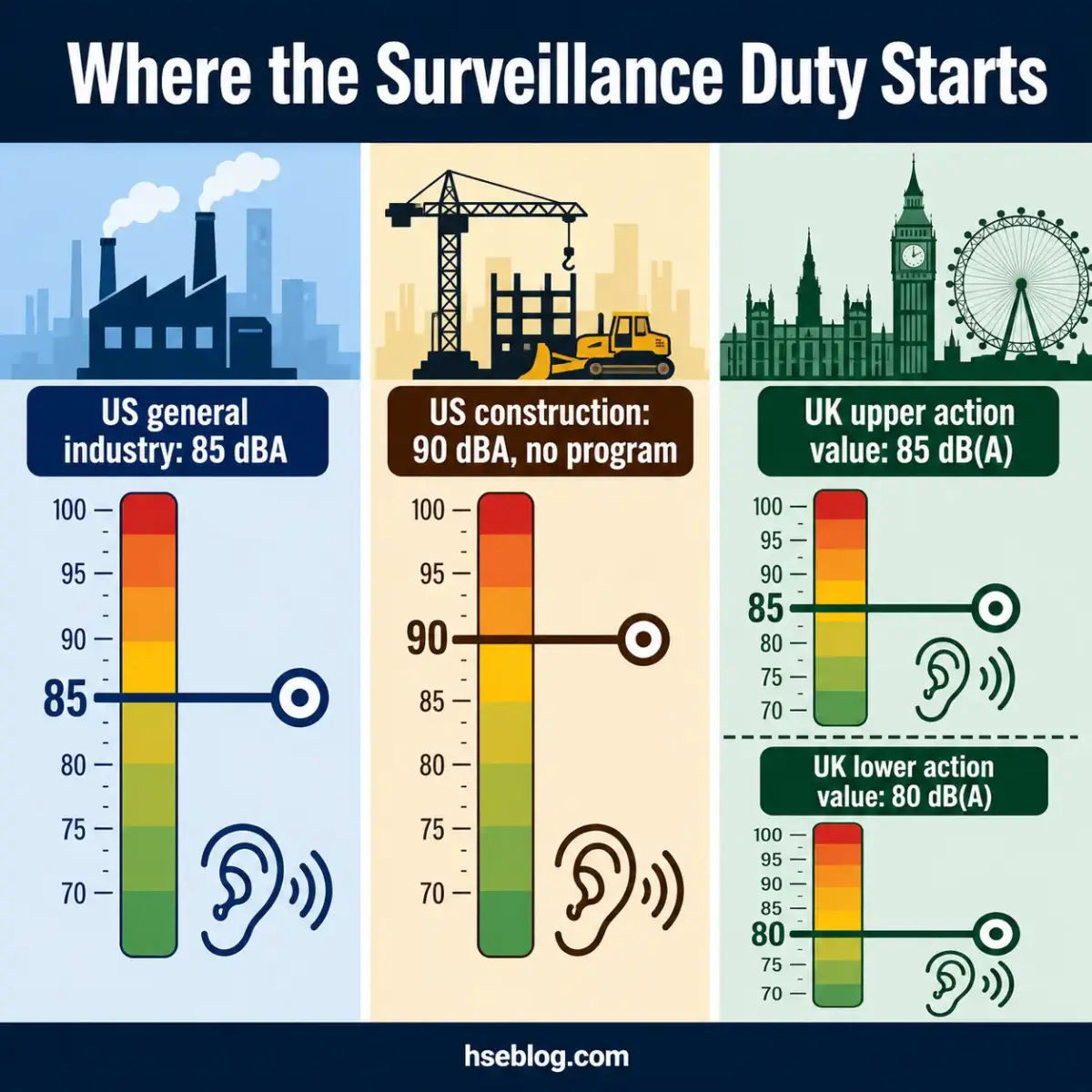
An audiometry program becomes a legal requirement once noise exposure reaches the action level — an 8-hour average of 85 dBA under OSHA's 1910.95 in the US, or 85 dB(A) under the UK's 2005 Noise Regulations. Setup requires a defined exposed cohort, a qualified professional supervisor, calibrated equipment, baseline and periodic audiograms, threshold-shift monitoring, and long-term record retention.
Medical-overlap caveat: Content on health surveillance, audiometry, otoscopy and threshold-shift interpretation is for HSE practitioner reference. It is not medical advice. Audiometry and shift interpretation require clinical judgment; workers with symptoms or exposure concerns should consult an occupational physician or qualified medical professional.
Legal-overlap caveat: Regulatory content here reflects general HSE professional understanding of US and UK requirements as of [year]. It is not legal advice. Specific compliance, enforcement or prosecution questions should go to qualified legal counsel in the applicable jurisdiction.
Competent-person caveat: Audiometric testing and threshold-shift determination must be planned and supervised by a competent occupational-health professional with relevant training and jurisdiction-specific authorization. The information here supports program design — it does not replace that supervision.
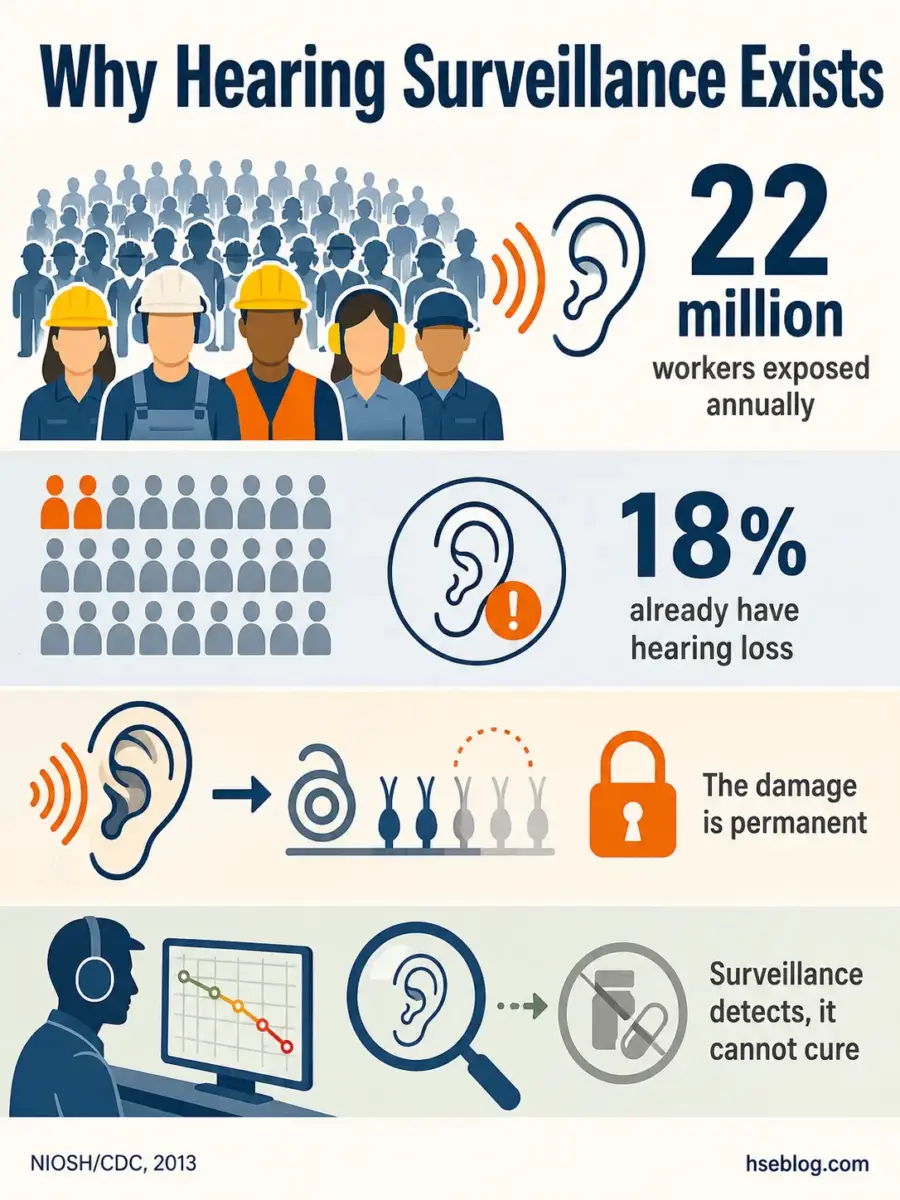
About 22 million US workers are exposed to hazardous noise every year, and roughly 18% of those exposed already carry measurable hearing loss (NIOSH/CDC, 2013). In Great Britain, an average of around 15,000 people a year live with hearing problems caused or made worse by work, on a three-year average (HSE, 2025).
Those figures describe damage that is permanent, and a program built late or built loosely cannot recover it. This guide walks audiometry program setup as a single blueprint that runs OSHA and HSE/EU requirements in parallel — from the trigger threshold through baseline, standard threshold shift, calibration and retention — and flags the points where programs quietly fail audit.
What Is Noise Health Surveillance, and When Does an Audiometry Program Become a Legal Requirement?
Health surveillance for hearing is ongoing, systematic audiometric monitoring of noise-exposed workers — not a single screening test. It sits on top of noise control to detect early damage; it never replaces controlling the noise at source.
The trigger is the action level, and it differs by jurisdiction:
| Jurisdiction | Trigger value | Duty triggered |
|---|---|---|
| US — general industry (29 CFR 1910.95) | 85 dBA, 8-hr TWA (action level) | Audiometric testing program: baseline + annual audiograms, STS monitoring, records |
| US — construction (29 CFR 1926.52) | 90 dBA | Noise controls and hearing protection only — no mandated audiometric program |
| UK (Control of Noise at Work Regs 2005) | 85 dB(A) upper action value / 135 dB(C) peak | Hearing protection and health surveillance |
| UK — lower action value | 80 dB(A) | Information, instruction and training |
| EU (Directive 2003/10/EC) | Parent framework | Health surveillance where there is a risk to health |
A point competitors blur: US general industry starts surveillance at 85 dBA, but US construction under 1926.52 sits at 90 dBA and carries no audiometric-program duty. Multinational and UK readers should not import the construction number into a general-industry setting.
The recurring compliance error I see across the published enforcement record is treating "ear defenders are available" as the whole duty. The HSE position, set out in its guidance on health surveillance for hearing, is that compliance is evidenced by control and detection — surveillance is how you prove the protection is actually working, not a box you tick by issuing plugs. There is also a newer wrinkle: combined exposure to noise and ototoxic chemicals can warrant surveillance considerations below noise-only thresholds, a dimension reinforced by 2025 occupational-health research (NIOSH/CDC, 2026 page update; peer-reviewed study, 2025).
Step-by-Step: How to Set Up an Audiometric Testing Program (Pre-Launch Foundations)
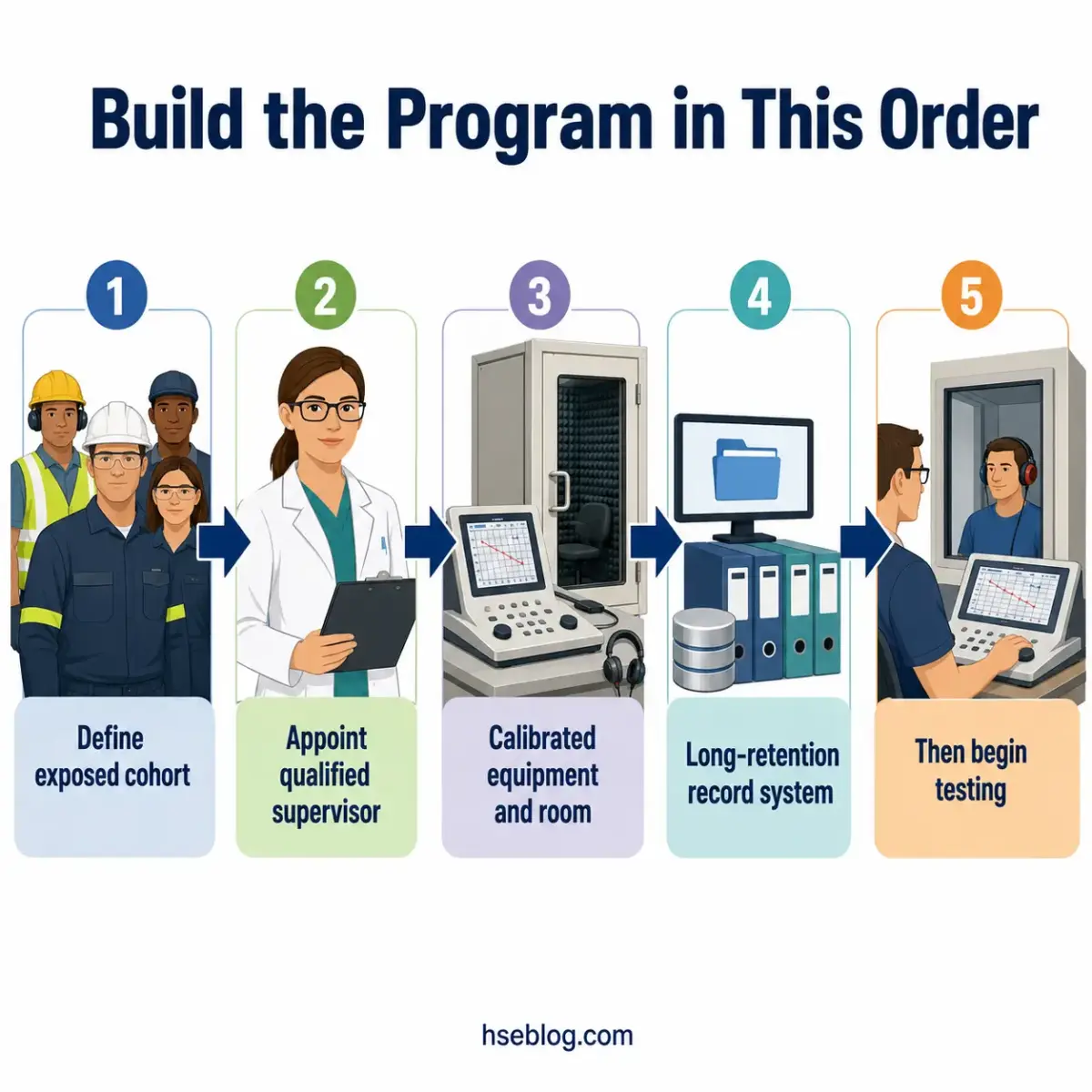
In real operations, the program that survives audit is the one whose foundations were laid before the first worker put on headphones. Four things must exist first; testing ahead of them produces data you cannot defend.
- Define the exposed cohort from a noise risk assessment. What good looks like: dosimetry identifies who exceeds the action level, at which tasks and for how long — the test list flows from measured exposure, not job titles.
- Appoint the clinically responsible professional. What good looks like: a named licensed/certified audiologist, otolaryngologist or physician supervises (US); the whole programme is under occupational-health-professional control (UK), with tests administered by appropriately trained staff.
- Establish equipment and environment standards. What good looks like: a calibrated, standard-compliant audiometer and a documented test environment — detailed in the calibration section below.
- Stand up the record system before day one. What good looks like: a system already sized for decades-long retention, capturing calibration dates and room ambient levels, not just thresholds.
A consistent setup failure in the published record: an employer hires a technician to run the tests but appoints no qualified professional to review shifts and make referral calls. The program then runs for years generating audiograms that nobody clinically interprets — until a claim forces someone to read them.
Choosing the Delivery Model: In-House vs. Mobile Van vs. Clinic
The delivery model changes your baseline deadline and how easily you can prove the quiet period — so choose it before you book testing.
| Model | Baseline deadline (US) | Quiet-period control | Best-fit employer |
|---|---|---|---|
| In-house room | 6 months | Easiest to verify and document per worker | Large single sites, steady headcount |
| Mobile test van | Extends to 12 months, but HPDs must be worn for the whole extension | Harder to evidence per worker in a once-a-year visit | Dispersed/multi-site operations |
| External clinic | 6 months | Controlled, but scheduling and travel add friction | Smaller employers, no on-site capacity |
The van extension carries a jurisdiction-within-jurisdiction trap: some state plans (for example, Oregon OSHA) did not adopt it and still require the baseline within 6 months. The judgment call is between logistical convenience and a tighter, more verifiable quiet period — and the convenience evaporates the moment a state plan refuses the extension.
The Baseline Audiogram: Getting the Reference Right
The problem this section solves is invisible at the time it occurs: a contaminated baseline silently corrupts every standard threshold shift you will ever calculate for that worker. Get the reference wrong and the program looks compliant for years while measuring against a false zero.
Timing differs by jurisdiction:
- US: baseline within 6 months of first exposure at or above the action level (12 months if using a mobile van, with hearing protection worn during the extension).
- UK: best practice is to baseline new starters before exposure; follow-up is typically annual for the first two years, then every three years — more often if a problem is detected or risk is high.
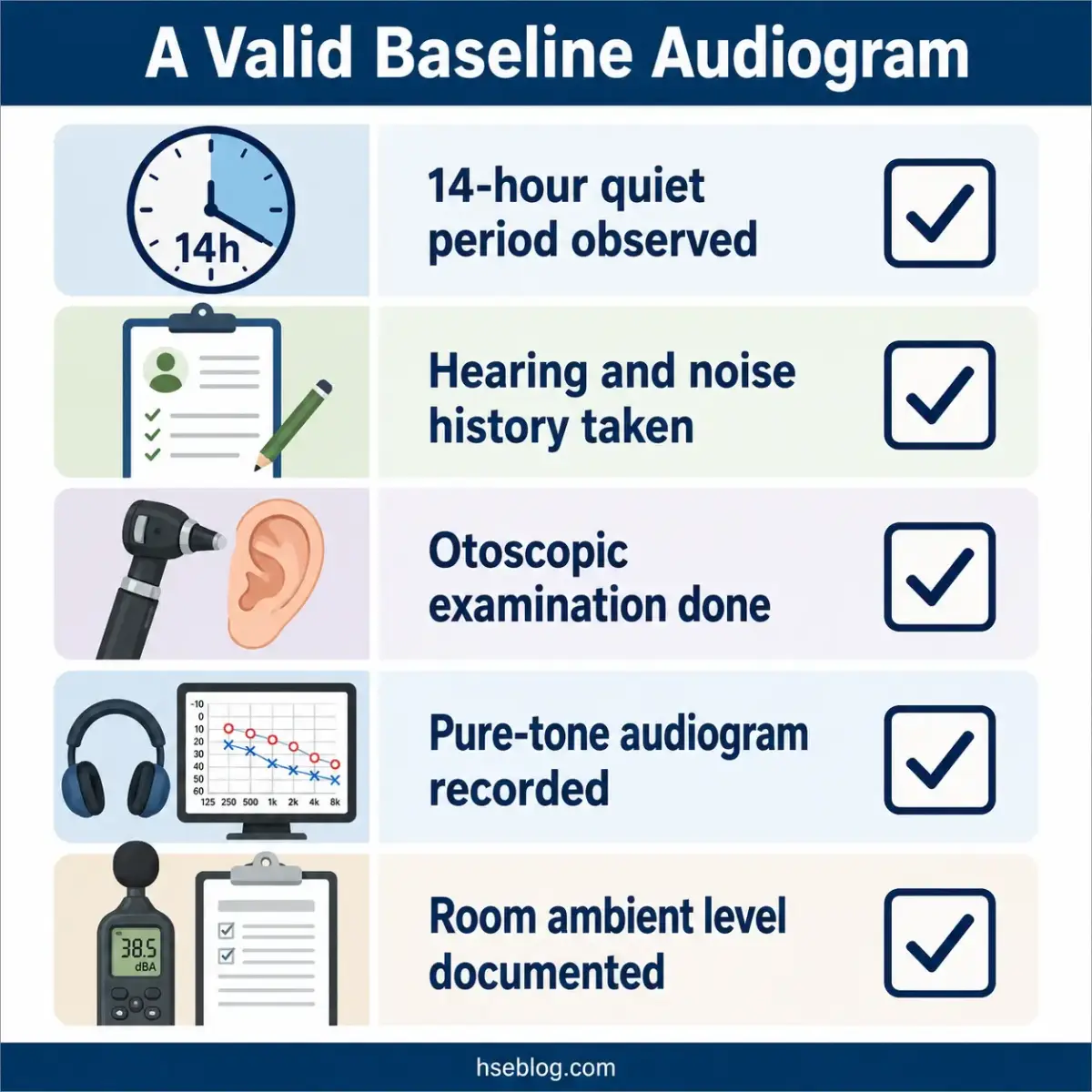
What makes a baseline valid:
- 14-hour quiet period first. At least 14 hours without workplace noise at or above the action level precedes the test, so temporary threshold shift does not contaminate the reference. Hearing protectors may substitute for the noise-free interval.
- Hearing and noise history questionnaire. Captures non-work noise exposure, ear conditions and ototoxic medications.
- Otoscopic examination. Checks the ear canal before the audiogram (a standard component of UK baseline surveillance).
- The pure-tone audiogram itself. Across the required frequencies in each ear.
What makes a baseline invalid: testing inside the quiet period, no documented room ambient level, or no history/otoscopy to explain non-occupational findings later.
A revised baseline is established where a persistent shift or a significant, sustained improvement occurs — but that decision belongs to the supervising professional, not the technician. The detail this deserves is disproportionate, because the baseline is the one test every future result is judged against.
Standard Threshold Shift (STS): Detection and the Required Response Chain
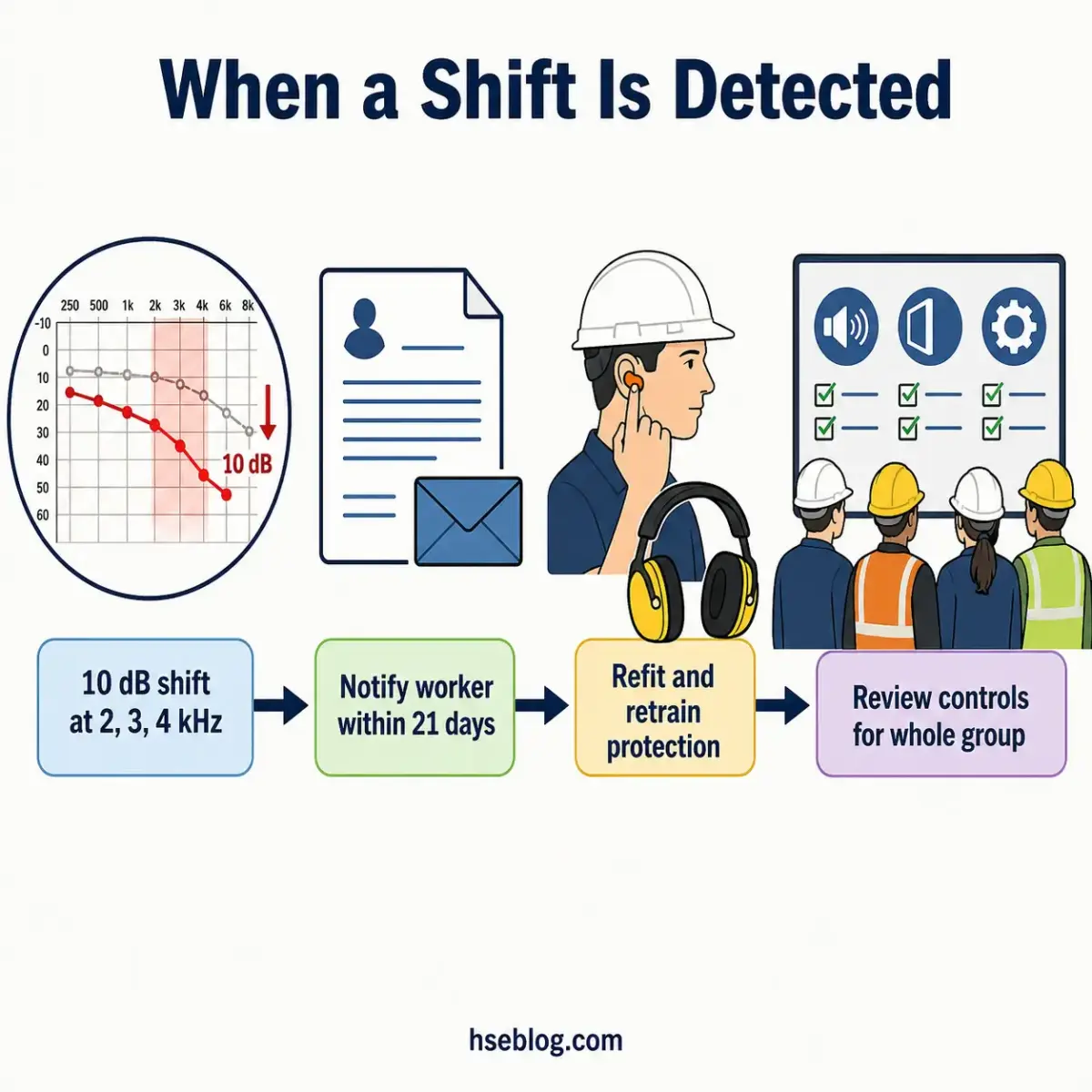
Under OSHA's occupational noise standard, 29 CFR 1910.95, a standard threshold shift is an average change of 10 dB or more at 2,000, 3,000 and 4,000 Hz in either ear, relative to the baseline. That definition is the operational heart of the program — everything downstream hangs on calculating it correctly.
Before concluding an STS has occurred, an allowance for age-related hearing loss (presbycusis) may be applied per Appendix F of the standard. Age correction is permitted, not mandatory — and it is a clinical judgment, not a clerical one.
The required US response chain, once a confirmed STS stands:
- Notify the employee in writing within 21 days of the determination.
- Refit and retrain the worker on hearing protection — fit, selection and use.
- Apply the protective steps unless a physician or audiologist determines the shift is not work-related.
- Assess recordability under 29 CFR 1904.10 where the criteria are met.
In the UK, the parallel is to act on the occupational-health professional's advice, remove the worker from exposure where necessary, and review the risk assessment for the wider workforce.
The frequent breakdown is treating an STS as a paperwork event — send the letter, file the form, move on. A shift is a control-failure signal. One confirmed STS in an exposure group often means the engineering controls or protection scheme are failing for the whole cohort, and the right response re-examines controls for everyone exposed, not just the individual whose ears flagged first.
Equipment, Calibration, and Test-Environment Standards
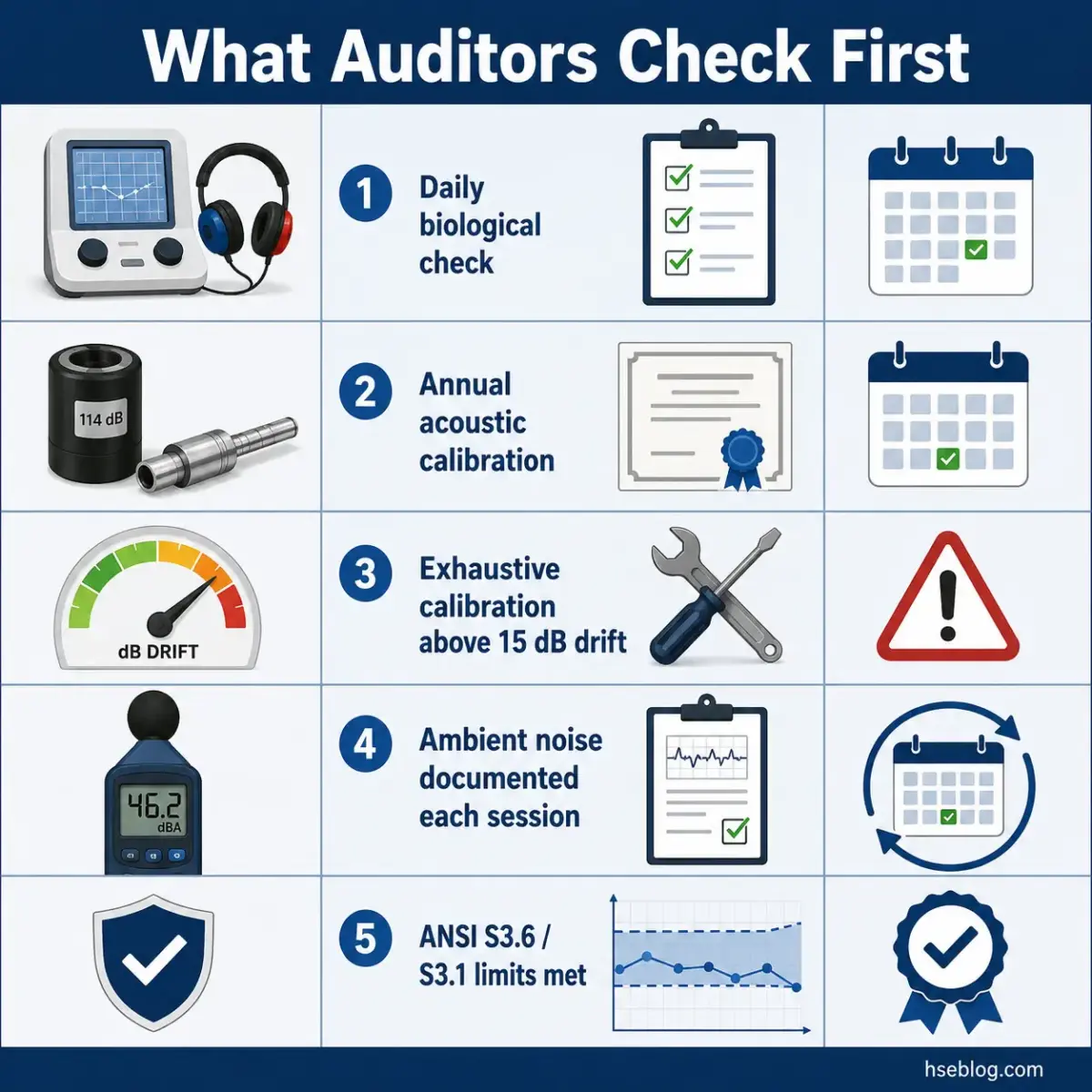
What consistently goes wrong here is not the audiometer — it is the room. The most commonly cited technical deficiency in this area is undocumented test-room ambient noise; many van and informal setups never log it, which can invalidate every audiogram taken there even when the tester was perfectly competent.
The compliance backbone auditors check first:
| Item | Standard / requirement | Frequency | Who verifies |
|---|---|---|---|
| Test frequencies | 500, 1,000, 2,000, 3,000, 4,000, 6,000 Hz each ear (some add 8,000 Hz) | Every test | Technician |
| Audiometer | ANSI S3.6-compliant, currently calibrated | Continuous compliance | Supervising professional |
| Biological (functional) check | Listening/known-subject check | Daily before use | Technician |
| Acoustic calibration | Instrument calibration to standard | Annual | Calibration provider |
| Exhaustive calibration | Triggered when deviations exceed 15 dB | As triggered | Calibration provider |
| Room ambient noise | Max permissible levels (OSHA Appendix D / ANSI S3.1) | Every session, documented | Technician/professional |
A point worth stressing: a soundproof booth is not strictly mandated. The duty is to meet the ambient limits and document them. The UK's definitive practical-compliance document, L108: Controlling Noise at Work, frames competence and procedure the same way — the test must be defensible, with the conditions recorded, not merely performed in an impressive-looking enclosure.
Recordkeeping, Retention, and Audit-Readiness
Records are the program's evidentiary memory, and hearing-loss claims surface decades after the exposure that caused them. A record missing the calibration date or the ambient-noise log is functionally worthless at exactly the moment it is needed most.
US retention rules:
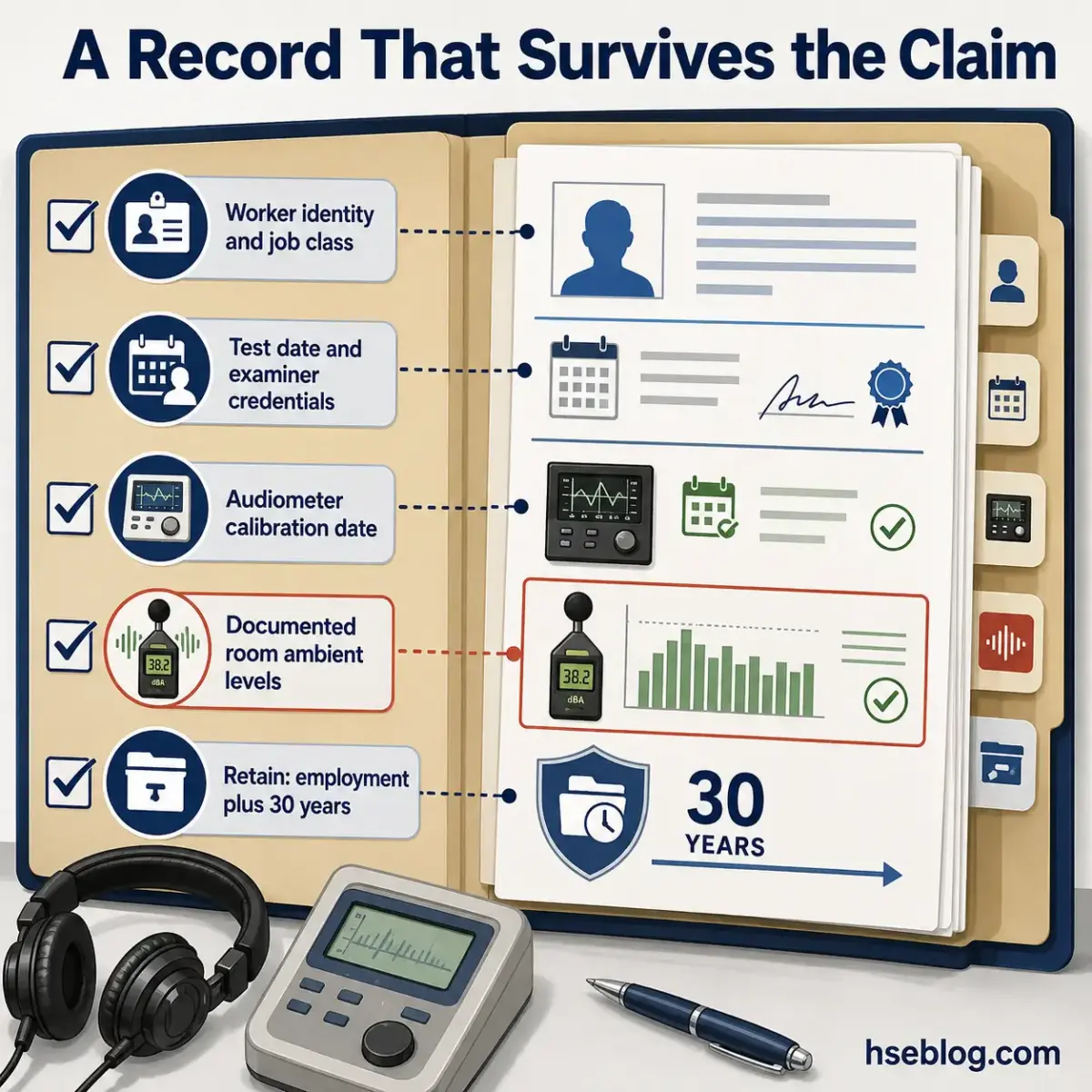
- Audiometric records: retained for the duration of employment plus 30 years.
- Noise-exposure measurement records: retained as part of the program file.
- Calibration records: retained to prove instrument validity at the time of each test.
A complete, defensible record contains:
- Worker identity and job classification — tied to the exposure assessment.
- Test date and examiner name and credentials — who tested, and were they competent.
- Audiometer calibration date — proving the instrument was valid that day.
- Exposure assessment — linking the worker to a measured exposure level.
- Documented test-room ambient levels — the field most often missing, and the one that invalidates the rest.
In the UK, the duties are framed slightly differently: keep individual health records, provide workers access to their own data, and keep the records confidential. The underlying logic is identical across jurisdictions — the record must still stand up long after the people who created it have moved on.
Conflicting Standards: OSHA Minimum vs. NIOSH Best Practice vs. UK/EU Values
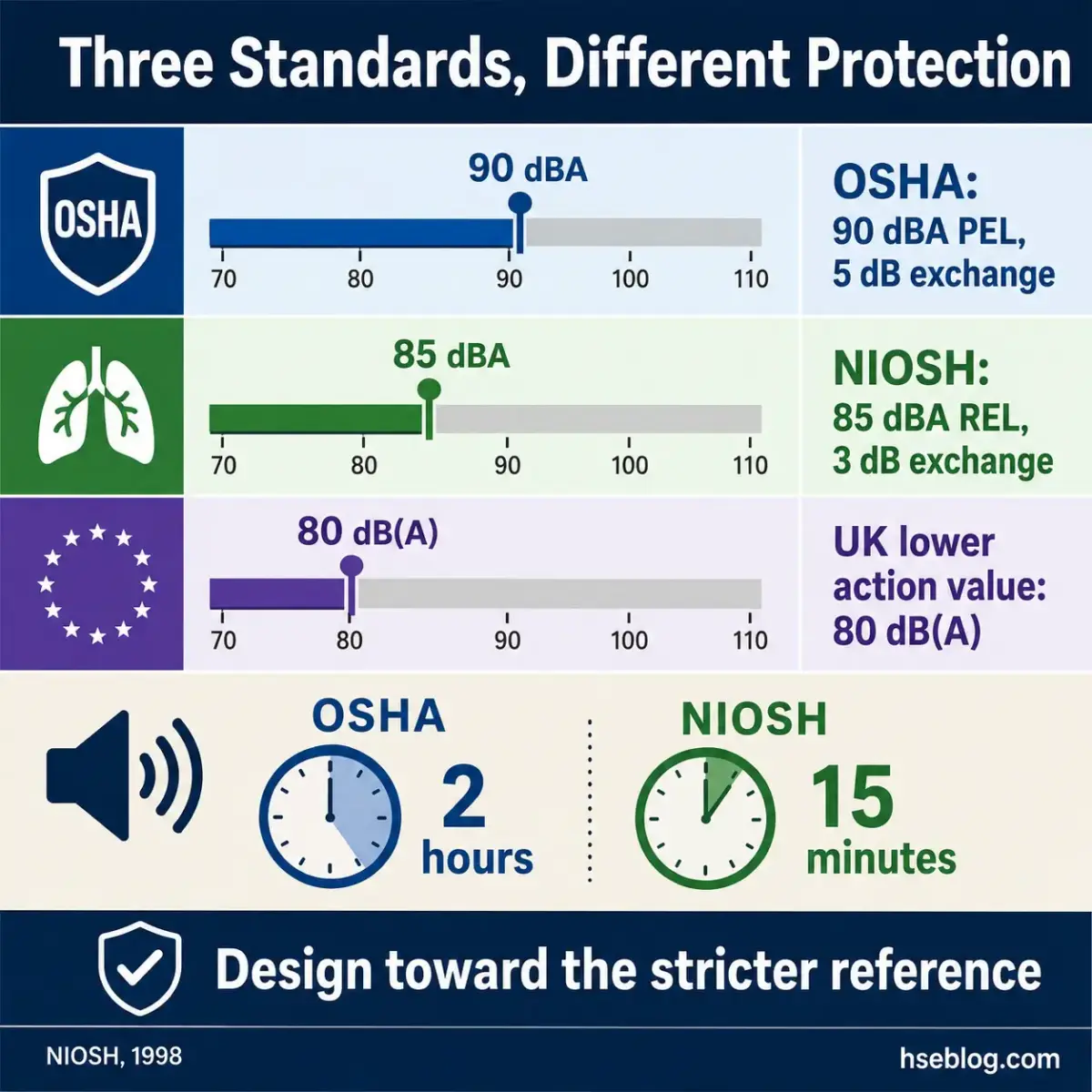
The numbers you design toward decide how much hearing your program actually protects — and the three frameworks disagree, sometimes dramatically. OSHA's PEL sits at 90 dBA with a 5 dB exchange rate; NIOSH recommends an 85 dBA REL with a 3 dB exchange rate, more protective but advisory; the UK lower action value reaches down to 80 dB(A).
| Reference | Action / limit | Exchange rate | Status |
|---|---|---|---|
| OSHA (US) | 90 dBA PEL / 85 dBA action level | 5 dB | Enforceable |
| NIOSH (US) ✔ stricter | 85 dBA REL | 3 dB | Advisory |
| UK lower action value ✔ stricter | 80 dB(A) | — | Enforceable (UK) |
| UK upper / limit | 85 dB(A) / 87 dB(A) | — | Enforceable (UK) |
| EU Directive 2003/10/EC | 80 / 85 / 87 dB(A) | — | Parent framework |
The divergence is sharpest at high levels: at 100 dBA, OSHA permits roughly 2 hours of exposure where NIOSH advises 15 minutes. The protective gap is quantified too — NIOSH estimates an 8% excess risk of noise-induced hearing loss at the 85 dBA REL over a 40-year working life, against 25% at the 90 dBA PEL (NIOSH, 1998). The rationale behind those advisory numbers is laid out in the NIOSH occupational hearing-loss overview.
My recommendation for program design is plain: state clearly which standard legally governs your jurisdiction, then design toward the stricter reference — NIOSH's 3 dB exchange and 85 dBA REL, and the UK 80 dB(A) lower action value — because compliance is the floor, not the goal. Freshness reinforces this: 2025 NIOSH construction data found 37% of US construction workers exposed to hazardous noise and 52% of those exposed reporting they do not wear hearing protection (NIOSH/CDC, 2026; Masterson & Themann, 2025) — a protection-use gap that a minimum-compliance program will never close.
Frequently Asked Questions
Who can legally carry out and interpret audiometric tests?
Two roles, not one. A CAOHC-certified technician may administer the test, but interpretation and referral decisions belong to a licensed professional — an audiologist, otolaryngologist or physician under OSHA, who reviews threshold shifts and makes the referral call. In the UK, the whole programme must be under the control of an occupational-health professional, with hearing checks done by someone appropriately trained.
Does audiometric testing require a soundproof booth?
No. The legal requirement is to meet the maximum permissible ambient noise levels (OSHA Appendix D / ANSI S3.1) and to document them, not to own a booth. A boothless setup can fully comply if the ambient levels are met and logged for each session. The undocumented room, not the missing booth, is what fails audit.
Why is a 14-hour quiet period required before the baseline?
Because temporary threshold shift (TTS) from recent noise can mimic permanent loss and contaminate the reference. At least 14 hours without workplace noise at or above the action level lets hearing recover before the baseline is captured. Hearing protectors may substitute for the noise-free interval — the goal is an uncontaminated zero, not a specific way of achieving it.
Is noise-induced hearing loss reversible, and what can surveillance actually achieve?
It is permanent and irreversible — surveillance cannot cure it. What an audiometry program does is detect early shifts so controls can be changed before more damage accrues. Treat the purpose honestly: the program protects the hearing a worker still has, by turning a measured shift into a control decision, not by restoring what is already lost.
Do ototoxic chemicals change who needs hearing surveillance?
They can. Combined exposure to noise and ototoxic substances raises hearing-loss risk, and emerging guidance suggests chemical exposure may warrant surveillance considerations below noise-only thresholds — a dimension reinforced by 2025 occupational-health research (NIOSH/CDC, 2026). This is HSE reference, not medical or legal advice; assess combined exposures with an occupational-health professional in your jurisdiction.
What's the difference between a hearing conservation program and health surveillance?
Health surveillance — the audiometry layer — is one element inside the wider hearing conservation program. The full program also includes noise monitoring, engineering and administrative controls, hearing-protection selection and fit, worker training, and records. Audiometry is the detection mechanism; the program is the whole control system it sits inside.
Conclusion
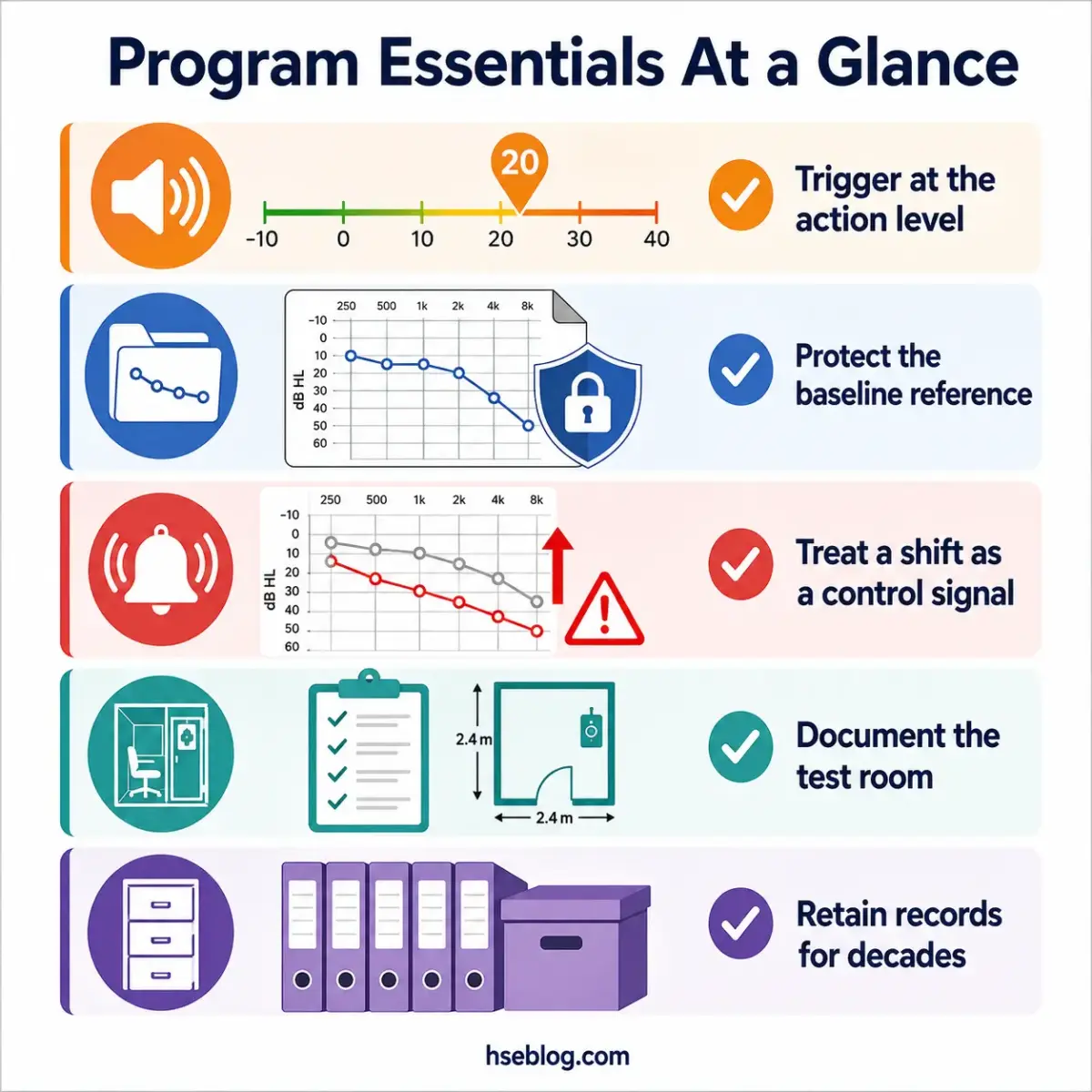
Strong audiometry program setup comes down to a handful of decisions made in the right order. Define the exposed cohort from real exposure data before testing anyone. Appoint a qualified professional to supervise and interpret — not just a technician to administer. Protect the baseline as the program's foundation, document the test-room ambient noise every session, and build a record system sized for decades from day one.
The single change that separates a compliant program from a protective one is how it treats a standard threshold shift. Read as paperwork, it generates a letter and a filed form. Read as a control-failure signal, it sends you back to the engineering controls for the whole exposure group — which is the only thing that actually stops the next worker's hearing from following the first.
Design toward the stricter reference your jurisdiction allows, state clearly which standard governs you, and keep the medical interpretation in qualified hands. Hearing loss does not reverse, and an audiometry program earns its place only by catching the shift early enough to change something. Build it that way, and the program protects hearing instead of merely documenting its decline.