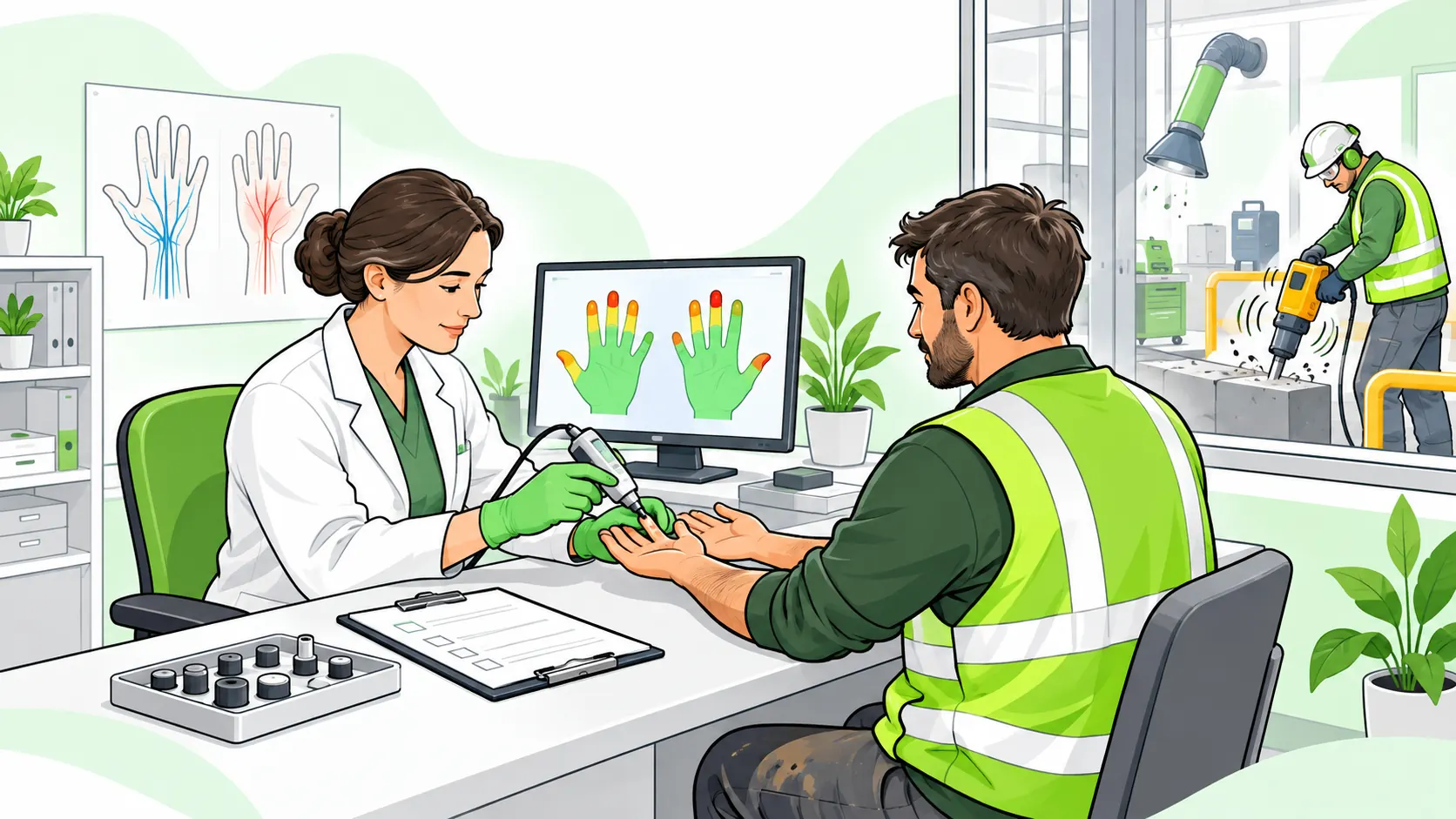
HAVS health surveillance uses a five-tier system recommended by the UK HSE: Tier 1, a baseline questionnaire; Tier 2, annual screening; Tier 3, a clinical assessment by a qualified occupational health professional; Tier 4, formal diagnosis by an occupational physician; and Tier 5, optional specialist testing. Tiers escalate when symptoms appear, and a diagnosis triggers RIDDOR reporting.
Scope and limits. This is HSE practitioner reference, not medical advice — workers with symptoms or exposure concerns should consult an occupational physician. It reflects a general understanding of UK regulatory requirements as of 2025 and is not legal advice; specific compliance or enforcement questions belong with qualified counsel in the applicable jurisdiction.
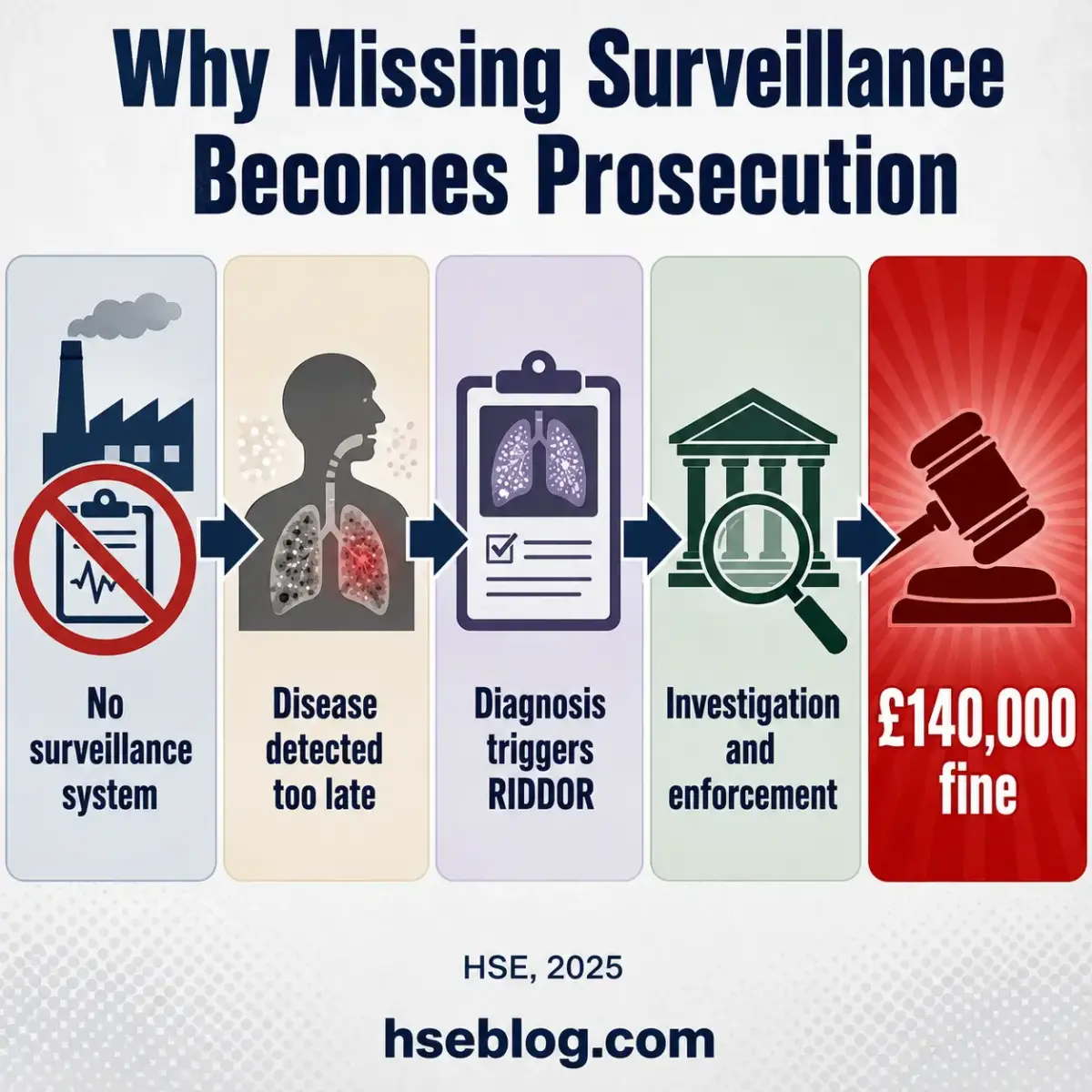
In April 2025, social housing provider Stonewater Limited was fined £140,000 after two of its employees were diagnosed with hand-arm vibration syndrome (HSE, 2025). The investigation found no risk assessment, no training, and no suitable system of health surveillance.
That last failing carries more weight than most employers expect. Missing surveillance is not a paperwork gap — it is the breach that turns a hidden health problem into a prosecution. This guide maps the five HAVS health surveillance tiers, who is competent to deliver each, how escalation actually works, and what a diagnosis legally obligates an employer to do.
What Is Tiered HAVS Health Surveillance?
Tiered HAVS health surveillance is the UK HSE's five-level system for catching hand-arm vibration syndrome early and tracking it over time. It is built to run as a pipeline, not a single appointment.
The tier model comes from HSE guidance L140 and operates under UK law. Readers outside Great Britain should note that the 1–5 labels are UK-specific, even where a surveillance duty exists in their own framework.
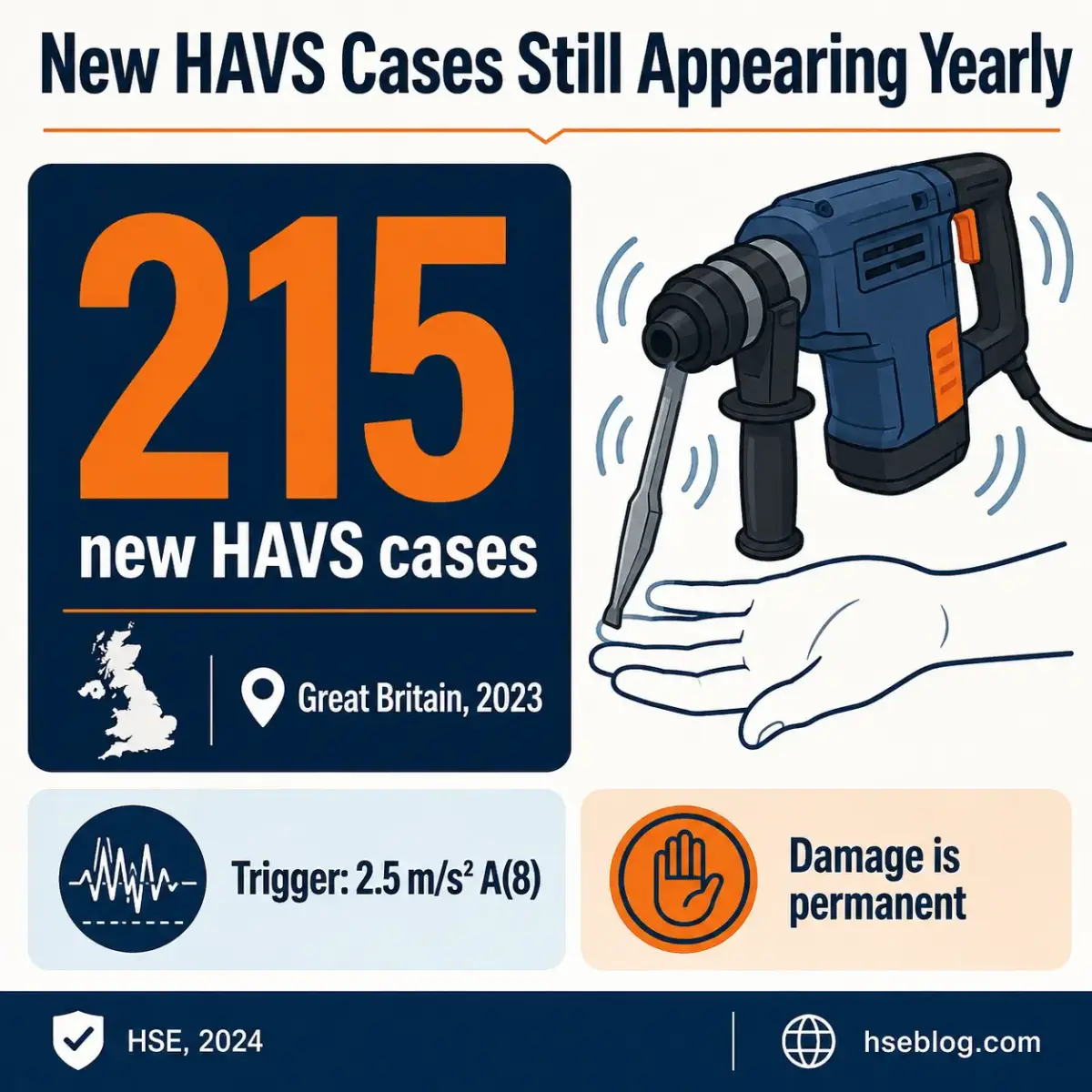
The reason there are five tiers is simple: HAVS is incurable. Once the vascular and nerve damage becomes permanent, nothing reverses it — so the system exists to detect reversible early symptoms before they progress.
The exposed population is large. HSE's long-standing prevalence estimate puts UK sufferers at around 300,000, with over 2 million people exposed to risk (HSE/MRC survey, 1997–98) — a figure worth treating as a dated baseline rather than a current count, since it traces to a survey from the late 1990s. Current case-tracking is better read through the live HSE hand-arm vibration statistics.
Surveillance under this system serves three statutory purposes:
- Identify those at particular risk — including workers with pre-existing susceptibility, such as Raynaud's phenomenon, that vibration can worsen.
- Detect disease early — before symptoms progress into disabling vascular or sensorineural stages.
- Check that controls work — surveillance data shows whether vibration-reduction measures are actually lowering exposure on the ground.
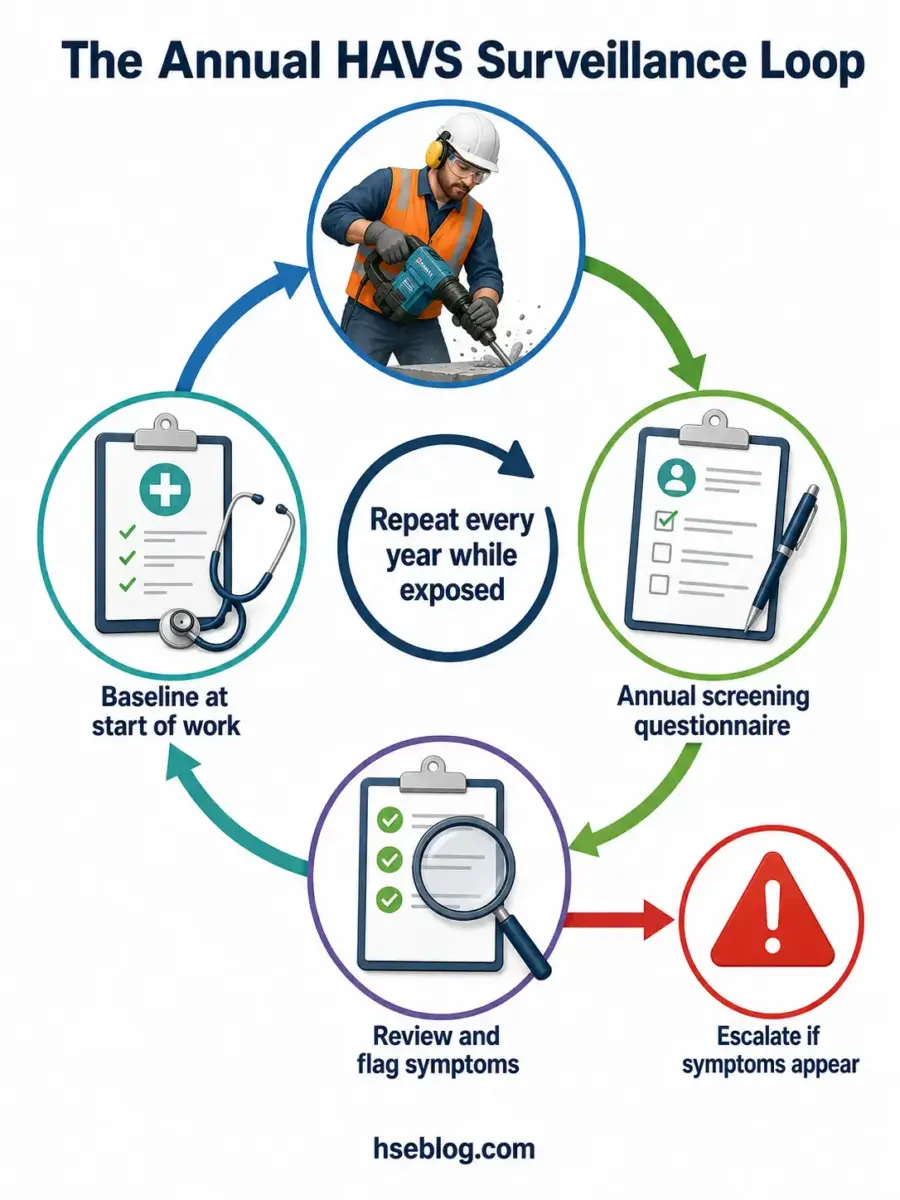
A recurring failure across the published enforcement record is employers treating surveillance as a one-off "tick-box medical." The tiers only protect anyone when they run as a continuous loop, and the annual Tier 2 screen is the part most often quietly dropped.
When Is HAVS Health Surveillance Legally Required?
Surveillance becomes a legal duty under Regulation 7 of the Control of Vibration at Work Regulations 2005 (UK) once a worker is likely to be regularly exposed above the exposure action value — not the higher limit value. The duty bites at the lower threshold.
Three conditions trigger the obligation:
- Regular exposure above the EAV — workers likely to be regularly exposed above 2.5 m/s² A(8), equivalent to 100 HSE exposure points.
- Occasional exposure with identified risk — workers occasionally exposed above the EAV where the risk assessment identifies a risk to health.
- Already diagnosed — anyone already diagnosed with HAVS stays under surveillance even if their current exposure has fallen below the EAV.
The exposure values are easy to confuse, and getting them the wrong way round is exactly where scoping fails. The full statutory detail sits in the Control of Vibration at Work Regulations 2005.
| Value | Threshold (UK) | What it governs |
|---|---|---|
| Exposure action value (EAV) | 2.5 m/s² A(8) — 100 points | Triggers the surveillance duty and the requirement to control exposure |
| Exposure limit value (ELV) | 5 m/s² A(8) — 400 points | Absolute ceiling that must not be exceeded; about prohibition, not surveillance scope |
A common scoping error is assuming surveillance only applies once exposure crosses the 5 m/s² limit value. Because the duty actually bites at the action value, programmes built around the ELV routinely under-cover the workforce that should be in the system.
The Five Tiers of HAVS Health Surveillance Explained
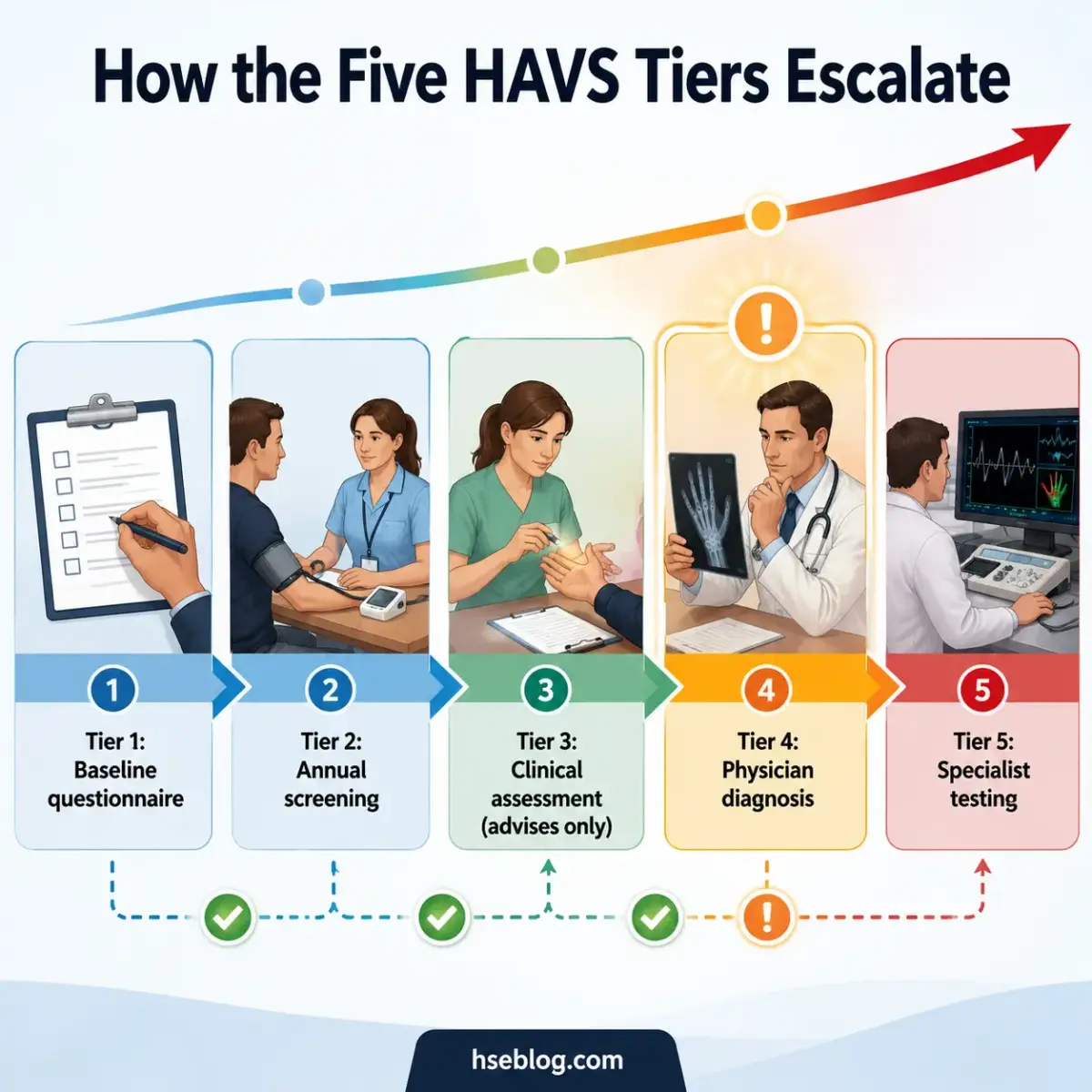
The five tiers escalate from a self-completed questionnaire to formal medical diagnosis, with each level handing off to the next only when symptoms are flagged. The structure is defined in HSE guidance L140 (UK).
This section explains how the tier system works. Clinical assessment and diagnosis at Tiers 3–5 must be delivered by a competent person with the relevant Faculty of Occupational Medicine training and authorisation, working from a site-specific risk assessment. The descriptions here do not replace that.
Tier 1 – Baseline Screening Questionnaire
A pre-placement or initial questionnaire establishing a worker's baseline health status before, or at the start of, vibration work. It can be self-completed and sent confidentially to an occupational health professional.
- Who delivers it: responsible person / OH administration.
- When: before or at the start of vibration exposure.
- Escalation trigger: existing symptoms or susceptibility (e.g. Raynaud's) flagged for clinical review.
Tier 2 – Annual Screening Questionnaire
A yearly questionnaire for exposed workers, used to flag anyone who needs onward referral. This is the recurring engine of the whole system.
- Who delivers it: responsible person managing the programme.
- When: every 12 months while exposure continues.
- Escalation trigger: any positive response indicating possible HAVS symptoms — refer to Tier 3.
Tier 3 – HAVS Health Assessment by a Qualified Person
A clinical assessment by a suitably trained OH professional, typically an OH nurse holding the approved Faculty of Occupational Medicine HAVS qualification. The crucial limit: Tier 3 advises the employer but cannot make a formal diagnosis.
- Who delivers it: trained OH nurse / professional with the FOM HAVS certificate.
- When: on referral from Tier 2, or on symptom report.
- Escalation trigger: findings suggesting HAVS — refer to Tier 4.
Tier 4 – Formal Diagnosis by an Occupational Physician
A formal diagnosis by an appropriately qualified occupational physician. It produces a written diagnosis, Stockholm Workshop Scale staging, fitness-for-work advice, and triggers the employer's RIDDOR duty.
- Who delivers it: occupational physician with HAVS training.
- When: on referral from Tier 3.
- Escalation trigger: complex or contested cases — consider Tier 5.
Tier 5 – Optional Specialised Diagnostic Testing
Optional standardised tests — such as thermal aesthesiometry, vibrotactile thresholds, or cold-provocation testing — used to support diagnosis and fitness decisions in difficult cases. This is the exception, not the routine.
| Tier | What it is | Frequency / timing | Escalation trigger |
|---|---|---|---|
| 1 | Baseline questionnaire | Start of vibration work | Pre-existing symptoms flagged |
| 2 | Annual screening questionnaire | Every 12 months | Positive symptom response |
| 3 | Clinical assessment | On referral | Findings suggesting HAVS |
| 4 | Formal diagnosis | On referral | Complex/contested case |
| 5 | Specialist testing | Exception only | N/A — supports Tier 4 |
The judgment call most programmes get wrong sits at the Tier 3 / Tier 4 boundary. A nurse-led Tier 3 assessment cannot "diagnose HAVS," yet employers regularly act on a Tier 3 outcome as though it were a diagnosis — creating both a clinical error and a RIDDOR-reporting error in one move.
Who Is Competent to Deliver Each Tier?
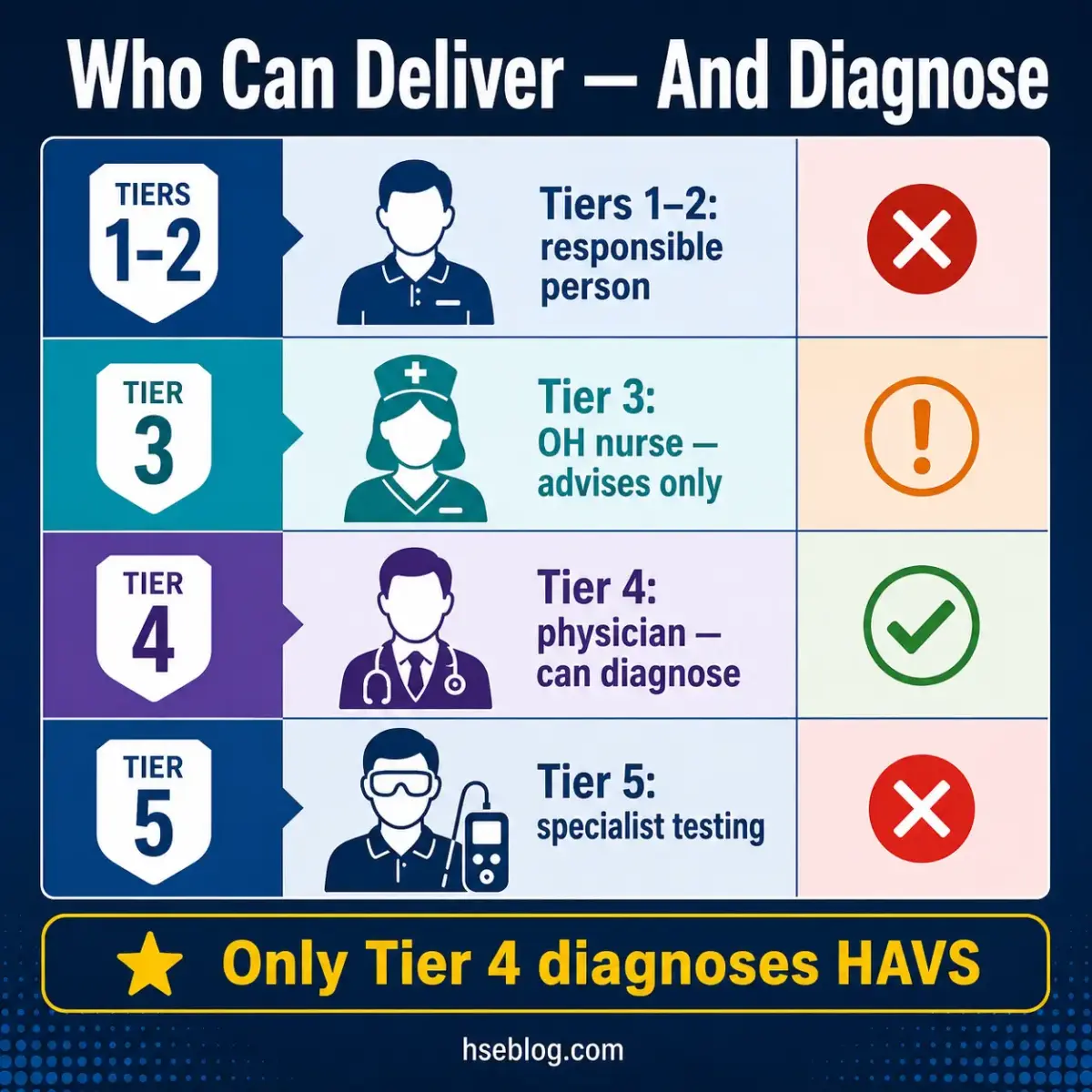
Competence rises with each tier, and that progression is where most ranking content goes silent. Tiers 1–2 sit with a trained responsible person, Tier 3 requires an OH professional holding the Faculty of Occupational Medicine HAVS certificate, and Tier 4 requires an occupational physician.
| Tier | Delivered by | Qualification expected | Can diagnose HAVS? |
|---|---|---|---|
| 1 | Responsible person / OH admin | Trained in the programme | No |
| 2 | Responsible person | Trained in the programme | No |
| 3 | OH nurse / professional | FOM HAVS certificate | No — advises only |
| 4 | Occupational physician | HAVS-trained physician (often FOM-affiliated) | Yes |
| 5 | Specialist tester | Standardised test competence | Supports Tier 4 |
Two practical points sit behind that table:
- SEQOHS accreditation is a useful quality marker when commissioning an external OH provider — it signals the service meets recognised occupational health standards.
- Competence is itself a legal exposure. An inadequate surveillance system is an enforcement and prosecution trigger in its own right, not merely a quality concern.
A repeated procurement pattern is employers buying "HAVS medicals" without checking whether the provider can actually deliver a Tier 4 diagnosis. They end up holding Tier 3 escalations they cannot close, with no route to the diagnosis that the law eventually demands. For the people running these programmes, the relevant training pathways are NEBOSH or IOSH on the health-and-safety side and FOM-accredited routes for the clinical tiers.
What Happens After a HAVS Diagnosis: RIDDOR, Fitness, and Controls
A written Tier 4 diagnosis sets off a defined chain of employer duties — it does not close the case, it opens a new set of obligations. This is the part competitors almost universally omit.
Work through the sequence in order:
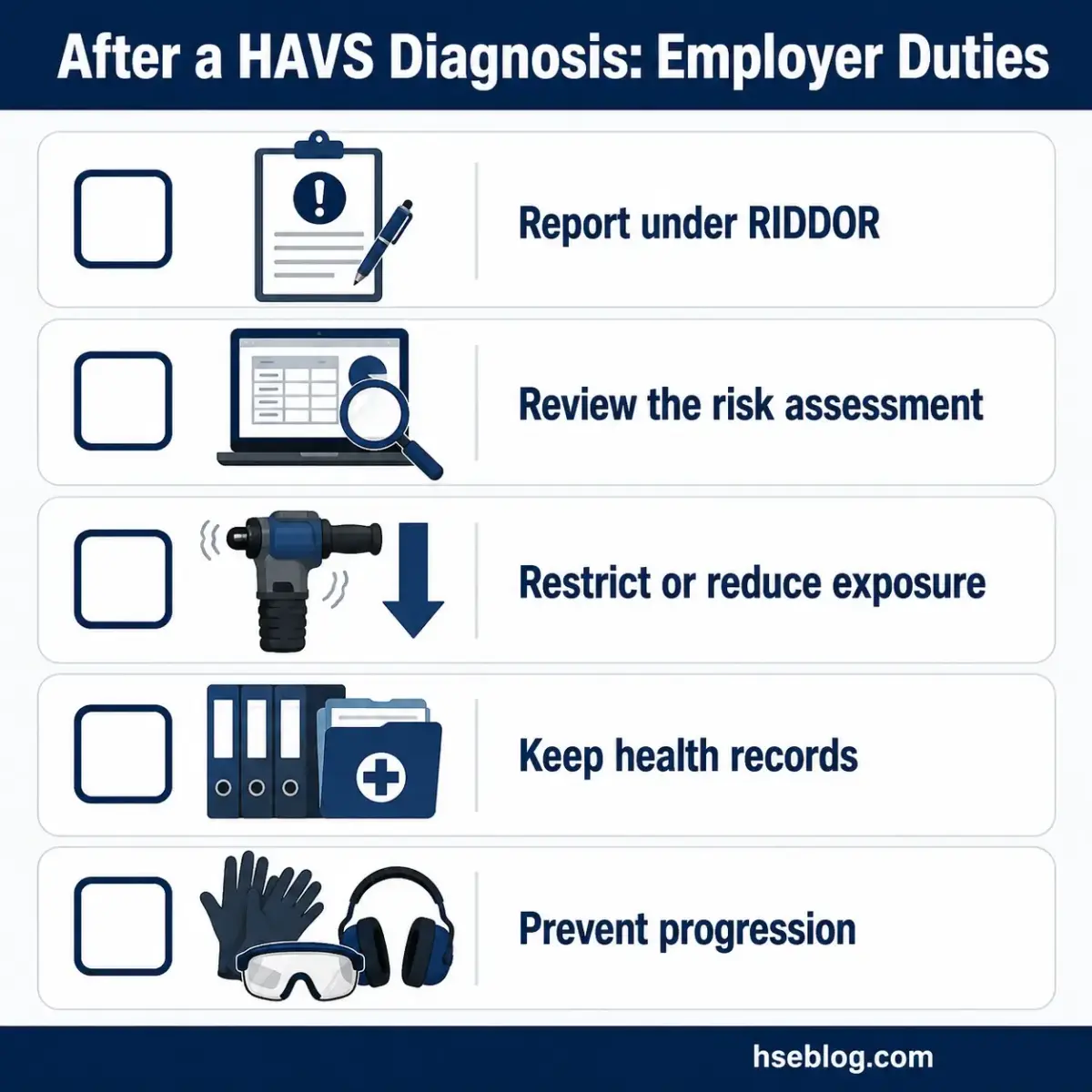
- Report under RIDDOR. Once a doctor provides written confirmation that the HAVS (or vibration-related carpal tunnel syndrome) is likely occupational in origin, the employer must report it under RIDDOR 2013 (UK). Use the official route to report a diagnosed case under RIDDOR.
- Review the risk assessment. A confirmed case is direct evidence that existing controls may not be working; the assessment must be revisited rather than assumed adequate.
- Adjust or restrict exposure. Reduce the affected worker's vibration exposure, and reassess the wider crew exposed to the same tools and tasks.
- Keep the records. Maintain individual health records and provide grouped, anonymised data to demonstrate whether controls are reducing exposure across the workforce.
- Prevent progression. The clinical goal is to stop advancement toward the later Stockholm Workshop Scale stages, where damage becomes disabling.
The legal risk usually crystallises after diagnosis, not before. A consistent pattern in the published prosecution record is that the case starts from a RIDDOR-reported diagnosis, which then exposes the surveillance and control failures retrospectively.
That is reinforced by HSE's revised Hand-Arm Vibration Inspection and Enforcement Guidance, OG-00119 (UK, current revision, analysed 2024), which sets the inspector benchmark and prosecution threshold — for example, a single HAVS case staged at Stockholm Stage 2 (late) or Stage 3. The Stonewater prosecution noted at the top of this article fits the pattern exactly: a diagnosis surfaced first, and the absent surveillance system became the central failing.
How HAVS Surveillance Differs Outside the UK
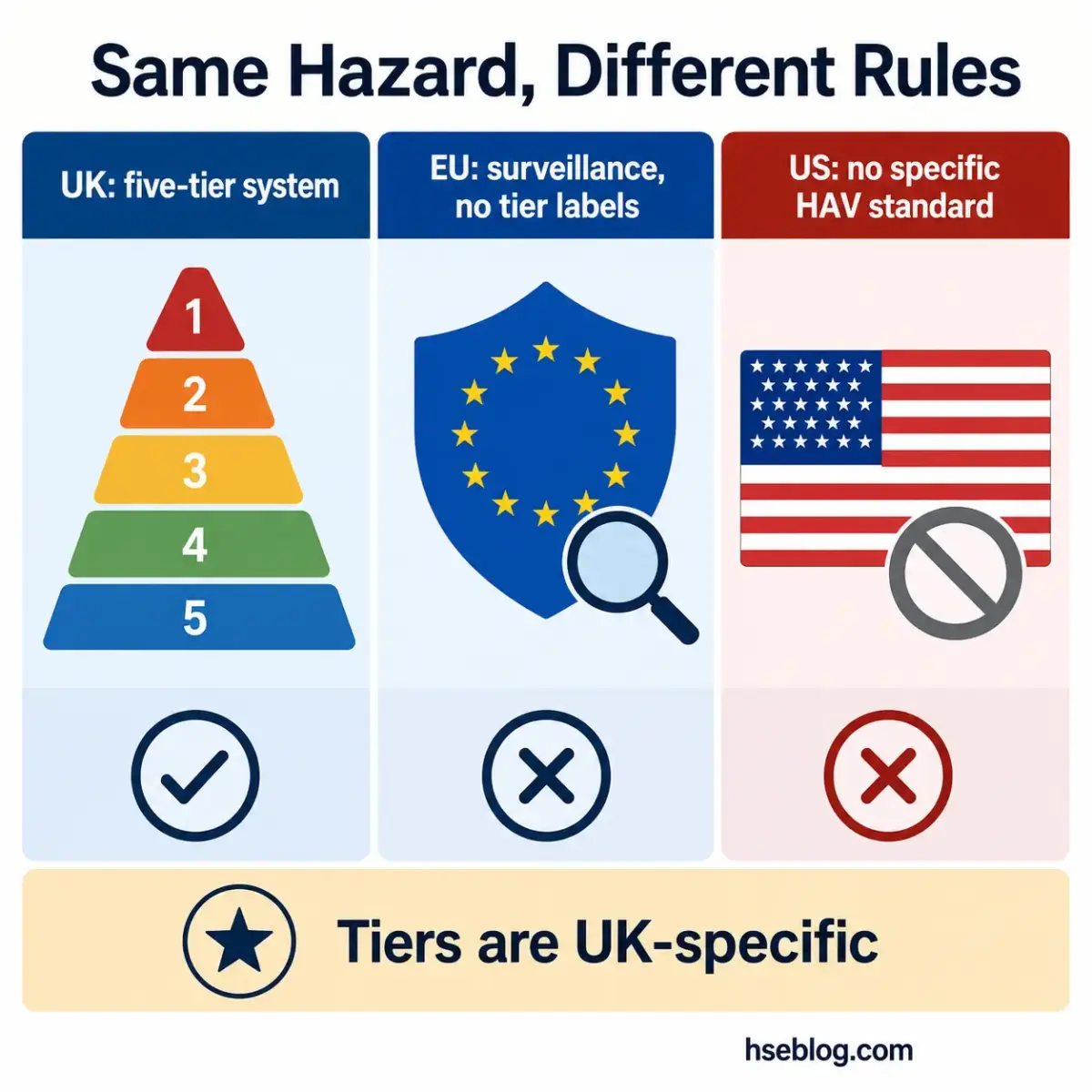
The tier labels are UK-only. The underlying surveillance duty exists in the EU, is far weaker in the US, and the international standards cover measurement rather than surveillance itself.
This matters because the "tier" language travels badly. A reader copying a UK tier template into another jurisdiction can easily misattribute legal force to a structure that has no statutory equivalent there.
| Jurisdiction | What governs vibration surveillance | Tier model? |
|---|---|---|
| UK (GB) | Control of Vibration at Work Regulations 2005, Reg 7; HSE L140 | Yes — the 1–5 tiers |
| EU | Directive 2002/44/EC — mandates surveillance and notification on positive diagnosis | No tier labels |
| US | No specific HAV standard; covered under the OSHA General Duty Clause | No — not a US term |
| International | ISO 5349 governs vibration measurement, an input to surveillance | Not a surveillance system |
The practical reading: the tiers are a delivery method, while the legal duty varies by country. In Great Britain the tier framework is the reference to follow; elsewhere, identify the duty that applies locally and treat the UK tiers, at most, as an organising structure rather than a legal requirement.
Frequently Asked Questions
How often is HAVS health surveillance required?
Surveillance is ongoing, not a one-off. A baseline questionnaire is completed at the start of vibration work, and a Tier 2 screening questionnaire then runs every 12 months for as long as the worker remains exposed. Anyone flagged at the annual screen escalates to a Tier 3 clinical assessment; the yearly cadence is what keeps the system functioning.
Can an occupational health nurse diagnose HAVS?
No. A Tier 3 assessment by a trained OH nurse can advise the employer and recommend referral, but it cannot produce a formal diagnosis. Under the UK tier model, diagnosis sits only with a Tier 4 occupational physician, who also provides Stockholm Workshop Scale staging and fitness-for-work advice. Acting on a Tier 3 outcome as if it were a diagnosis is a common and serious error.
Is HAVS reportable under RIDDOR?
Yes, once it is formally diagnosed in writing. Under RIDDOR 2013 (UK), the employer must report a HAVS case after a doctor confirms it is likely occupational in origin. The same applies to vibration-related carpal tunnel syndrome. The reporting duty is the employer's, and it is usually the point at which any underlying surveillance failure becomes visible to the regulator.
What's the difference between the exposure action value and exposure limit value?
The exposure action value (EAV) is 2.5 m/s² A(8), and the exposure limit value (ELV) is 5 m/s² A(8). The EAV is the trigger — it brings in the duty to provide health surveillance and control exposure. The ELV is the absolute ceiling that must not be exceeded. Surveillance scope is set by the lower action value, not the limit value.
Can HAVS health surveillance be done remotely?
Partly. Current Faculty and Society of Occupational Medicine (FOM/SOM) guidance supports remote delivery of Tier 1–3 elements with clear clinical caveats — for example, confirming reported colour change in the fingers and using a hand symptom diagram. Some clinical judgements still need in-person examination, so remote delivery is a supplement to the tier system, not a wholesale replacement for it.
Do I still need surveillance for someone already diagnosed with HAVS but now below the action value?
Yes. The "already diagnosed" rule keeps a worker in surveillance regardless of current exposure, even if it has dropped below the EAV. The logic is clinical: HAVS is progressive, so monitoring continues to track whether the condition is stable or worsening and to inform fitness-for-work decisions. Lowering exposure does not end the surveillance obligation.
Conclusion
Pull up your own programme and answer three uncomfortable questions. First: does your provider hold the FOM HAVS certificate at Tier 3 and have an occupational physician available at Tier 4 — or have you bought "medicals" that can raise an escalation but never close it with a diagnosis?
Second: is your Tier 2 annual screen actually running this year, for everyone exposed above 2.5 m/s² A(8), including those occasionally over it where a risk was identified? The annual loop is the part that silently lapses, and a lapsed loop is the gap inspectors and prosecutors work backwards from.
Third: if a Tier 4 diagnosis landed on your desk tomorrow, do you know your RIDDOR clock, your risk-assessment review, and your exposure-restriction route — before the regulator asks? The Stonewater outcome is a reminder that with HAVS health surveillance tiers, the prosecution rarely starts with exposure data; it starts with a diagnosis that exposes the system you never properly built.